Gospel Wednesday | Matthew 5:13-30

bibleLast week we looked at the introduction to Jesus’ sermon on the mount, the portion generally known as the Beatitudes. This week we will start digging into the meat of this sermon. The Sermon on the mount is rich with theology and clarity of the Law. Jesus is preaching repentance here, and He is preaching the Law to convict those present (and us) of our sins. That is the purpose of the Law. Jesus IS the Gospel, He is the Messiah, the Lamb of God sent to take away the sins of the world. Jesus preaches the Law and presents Himself as the remedy, for He will lay His life down to bear the wrath of God in our place, so that by His Blood we might be saved. This sermon is going to take a few weeks for us to work through.

Matthew 5:13-30 (ESV)

Matthew 5:13 (ESV) | Salt

13 “You are the salt of the earth, but if salt has lost its taste, how shall its saltiness be restored? It is no longer good for anything except to be thrown out and trampled under people’s feet.

Matthew 5:14-16 (ESV) | Light

14 “You are the light of the world. A city set on a hill cannot be hidden. 15 Nor do people light a lamp and put it under a basket, but on a stand, and it gives light to all in the house. 16 In the same way, let your light shine before others, so that they may see your good works and give glory to your Father who is in heaven.

In our culture, we generally hear “experts” telling us that we consume too much salt and how it’s not good for you. That is because we are an over-indulgent society. We would be remiss to view this passage from our secular perspective on salt. Salt is vital for our survival. Check out the intro to this website discussing the History of Salt:

As far back as 6050 BC, salt has been an important and integral part of the world’s history, as it has been interwoven into the daily lives of countless historic civilizations. Used as a part of Egyptian religious offerings and valuable trade between the Phoenicians and their Mediterranean empire, salt and history have been inextricably intertwined for millennia, with great importance placed on salt by many different races and cultures of people. Even today, the history of salt touches our daily lives. The word “salary” was derived from the word “salt.” Salt was highly valued and its production was legally restricted in ancient times, so it was historically used as a method of trade and currency. The word “salad” also originated from “salt,” and began with the early Romans salting their leafy greens and vegetables. Undeniably, the history of salt is both broad ranging and unique, leaving its indelible mark in cultures across the globe.

There is no mistaking salt. Saltiness is one of the 5 flavors or tastes (salt, sweet, sour, bitter, and umami) our tongues were designed to identify. The value of Salt isn’t in its taste; rather, it is in its preservative and medicinal qualities. Salt that has lost its taste isn’t salt… it’s remaining impurities. If you went out to a salt bed (like the Dead Sea) and scooped up a bunch of it in a bucket and filled it with water to overflowing… the salt would dissolve and run out and whatever was left behind wouldn’t be salt. It would be whatever else you scooped up with the salt. It would have no purpose other than being thrown out and trampled under foot. What is it that makes us Salt of the Earth? Faith. For the Jews hearing this sermon, it would have been Faith in the Word of God (Hebrews 11), in His Promise. Israel… Jerusalem… had lost its saltiness. Jesus, we’ll see throughout the Gospel Accounts, holds the Religious leaders, the Chief Priests, Scribes, and Lawyers accountable for their poor stewardship over God’s Chosen Ones, Israel. Now they have a problem… Jesus asked the question, “how shall its saltiness be restored”? There is nothing that the salt can do to regain its own saltiness. There is nothing man can do to make himself right with God. Praise be to Our Lord and Savior that Jesus came to do just that on our behalf… make a way, the only way, for us to be made right with God.

Matthew 5:14-16 (ESV) | Light

14 “You are the light of the world. A city set on a hill cannot be hidden. 15 Nor do people light a lamp and put it under a basket, but on a stand, and it gives light to all in the house. 16 In the same way, let your light shine before others, so that they may see your good works and give glory to your Father who is in heaven.

Here, Jesus is declaring that His audience is the light of the world. As such, they cannot be hidden. The world will see them. Jesus is charging them to shine before others that they might see their good works and in so seeing give glory to God (Soli Deo Gloria). Two things I’d like to highlight here… the first being that good works are to point others to God, not us. Our good works are not of us or by us nor for us; rather, they are by Him, working in us, for His Glory. The second is that similar to the salt analogy, a lamp doesn’t light itself. It required oil and a flame. God provides both. We don’t do anything to make ourselves valuable salt, nor do we light our lamps. To God be the Glory.

Matthew 5:17-20 (ESV) | Christ Came to Fulfill the Law

17 “Do not think that I have come to abolish the Law or the Prophets; I have not come to abolish them but to fulfill them. 18 For truly, I say to you, until heaven and earth pass away, not an iota, not a dot, will pass from the Law until all is accomplished. 19 Therefore whoever relaxes one of the least of these commandments and teaches others to do the same will be called least in the kingdom of heaven, but whoever does them and teaches them will be called great in the kingdom of heaven. 20 For I tell you, unless your righteousness exceeds that of the scribes and Pharisees, you will never enter the kingdom of heaven.

Just when the people listening might have expected Jesus to drop the good news (Gospel, Evangel) of why He came, He derails that thought here in verse 17. Jesus didn’t come to abolish the Law. Prophecy pointed to a son of David who would usher in a New Kingdom and a New Covenant. Jesus did all of that, but He didn’t do it by abolishing the Law or the Prophets. He fulfilled them… all of them. So great, God fulfilled God’s law, how is that good news? He laid down His life to bear the full wrath of God as punishment for our sin. He doesn’t get there yet, but that’s where He is headed… it is what the Law requires and what the Prophets recorded of Him. Praise God. Don’t let verse 20 trip you up. Jesus is not indicating that the Pharisees were righteous. They weren’t. They were dead in their sin and trespasses… and they were completely unaware of how desperately they were in need of a Savior. I think it is important to jump ahead a bit to Matthew 23:1-3 (ESV) for some clarity here:

Matthew 23 (ESV) | Seven Woes to the Scribes and Pharisees
1 Then Jesus said to the crowds and to his disciples, 2 “The scribes and the Pharisees sit on Moses’ seat, 3 so do and observe whatever they tell you, but not the works they do. For they preach, but do not practice…

Here, in Matthew 5, Jesus sets up His teaching of the Law by absolutely destroying what had become a false measure of righteousness. The Pharisees, the scribes, the chief priests, they had all set themselves up as the epitome, the standard of what it means to keep the Law of Moses. They expected the Messiah to arrive and congratulate them for their righteousness… they didn’t expect the rebuke, nor did they humble themselves to repent of their sin… for they did not recognize their sin. Jesus is about to preach the Law in a way that had once been preached long ago… but had not been taught for some time. I’m referring to Deuteronomy 6, the chapter following the reiteration of the 10 Commandments of the Law, where God makes perfectly clear what it the Greatest commandment.

Deuteronomy 6:4-9 (ESV) 4 “Hear, O Israel: The Lord our God, the Lord is one. 5 You shall love the Lord your God with all your heart and with all your soul and with all your might. 6 And these words that I command you today shall be on your heart. 7 You shall teach them diligently to your children, and shall talk of them when you sit in your house, and when you walk by the way, and when you lie down, and when you rise. 8 You shall bind them as a sign on your hand, and they shall be as frontlets between your eyes. 9 You shall write them on the doorposts of your house and on your gates.

From the time Israel was given the Law, it was to be written on their hearts. It wasn’t only to be physically obeyed/observed, but Israel was to love the Lord with all of their heart, soul, and might. The Pharisees had lost sight of this, and under their blinded guidance had led Israel astray. Sure they had large phylacteries a literally bound the law on their foreheads and hands… but inside they were dead, as were we all before the Grace of God stirred our hearts to saving Faith in Christ Jesus. Jesus wasn’t calling His hearers to greater outward works than the Pharisees… He was calling them to a righteousness they couldn’t do on their own, a righteousness that will only come by His blood. Let us look at how this plays out in the first 2 Laws Jesus preaches.

Matthew 5:21-26 (ESV) | Anger

21 “You have heard that it was said to those of old, ‘You shall not murder; and whoever murders will be liable to judgment.’ 22 But I say to you that everyone who is angry with his brother will be liable to judgment; whoever insults his brother will be liable to the council; and whoever says, ‘You fool!’ will be liable to the hell of fire. 23 So if you are offering your gift at the altar and there remember that your brother has something against you, 24 leave your gift there before the altar and go. First be reconciled to your brother, and then come and offer your gift. 25 Come to terms quickly with your accuser while you are going with him to court, lest your accuser hand you over to the judge, and the judge to the guard, and you be put in prison. 26 Truly, I say to you, you will never get out until you have paid the last penny.

Jesus first tackles anger and the commandment, “You shall not murder”. Clearly, the act of murder is a crime (liable to judgement), but Jesus takes it further to indicate that anger with a brother is also liable to judgement. Our society tries to make some murders even more odious by labeling it a “hate crime”. Interestingly enough, what Jesus is doing here is making Anger a Murderous crime… the sin is in the heart of man, not just in his actions. Jesus also makes it a point for us to make things right with our brothers before presenting ourselves before God. This last portion causes my mind to leap forward to the Lord’s Prayer (forgive us our debts as we forgive our debtors) but it also ties back to the Salt and Light introduction we read previously, as well as the beatitude of “Blessed are the peacemakers, for they shall be called sons of God. (Matt 5:9)“.

Matthew 5:27-30 (ESV) | Lust

27 “You have heard that it was said, ‘You shall not commit adultery.’ 28 But I say to you that everyone who looks at a woman with lustful intent has already committed adultery with her in his heart. 29 If your right eye causes you to sin, tear it out and throw it away. For it is better that you lose one of your members than that your whole body be thrown into hell. 30 And if your right hand causes you to sin, cut it off and throw it away. For it is better that you lose one of your members than that your whole body go into hell.

There is harm in looking, for lust is the sin of adultery in the heart. Idolatry (idol worship) is also the sin of adultery. Following through with the physical sin was punishable by death… just as murders was, and Jesus here is saying that those who look upon a woman with lustful intent has already committed adultery, is equally guilty of the sin by reason of the heart. Quite the blow to those hearing this teaching. Take every sin of sexual immorality listed in Deuteronomy 22:13-30 and apply what Jesus is teaching to them. The sin of lustful intent in the mere looking carries the same weight as the act. Who then is righteous? None but Christ. The Law is hard, and its purpose is to reveal our sinfulness and unrighteousness… how unworthy we are of God.

2 Corinthians 5:20-21 (ESV)
20 Therefore, we are ambassadors for Christ, God making his appeal through us. We implore you on behalf of Christ, be reconciled to God. 21 For our sake he made him to be sin who knew no sin, so that in him we might become the righteousness of God.

Why did Jesus begin with these 2? Jesus will work through all of the major areas of the Law so the “why” of which ones are recorded first here in the Gospel According to Matthew may not be a major issue. However, I do find it interesting that the first account of sin after the Fall is that of Cain murdering Abel, Genesis 4. Notice also, that in the account, Cain’s anger is highlighted and God addresses Cain regarding his anger, “Why are you angry, and why has your face fallen?  If you do well, will you not be accepted? And if you do not do well, sin is crouching at the door. Its desire is for you, but you must rule over it. (Gen 4:6-7 ESV)” Cain goes on to murder his brother, Abel. The “doing well” wasn’t in “not committing murder”, it was in offering an acceptable sacrifice to God.

After this account we get a list of the generations from Adam to Noah in Chapter 5, and in Chapter 6 notice how we are introduced to the wickedness of man.

Genesis 6:1-5 (ESV) | Increasing Corruption on Earth
1 When man began to multiply on the face of the land and daughters were born to them, 2 the sons of God saw that the daughters of man were attractive. And they took as their wives any they chose. 3 Then the Lord said, “My Spirit shall not abide in man forever, for he is flesh: his days shall be 120 years.” 4 The Nephilim were on the earth in those days, and also afterward, when the sons of God came in to the daughters of man and they bore children to them. These were the mighty men who were of old, the men of renown. 5 The Lord saw that the wickedness of man was great in the earth, and that every intention of the thoughts of his heart was only evil continually.

There was lust and lawlessness, and every intention of the thoughts of his heart was only evil continually. The heart of sinful, fallen man is wicked and it is from there that we sin. This is a very hard teaching… the Law kills. That’s its purpose. It is to break us, our will, our self-righteousness so that we might humble ourselves and repent from sin and turn to Christ’s finished work on the cross for our forgiveness, so that His righteousness will be extended toward us in Jesus’ Name.

Until next week…

We will pick up in verse 31 and work through Jesus’ expansion of the social laws. Having decimated our picture of man’s righteousness, Jesus is going to work through how God intends for us to conduct our lives in accordance with the Law, knowing full well that apart from God’s Grace we’d all be liable to judgement and destruction.

Romans 15:5-6 (ESV) 5 May the God of endurance and encouragement grant you to live in such harmony with one another, in accord with Christ Jesus, 6 that together you may with one voice glorify the God and Father of our Lord Jesus Christ.

In Christ Jesus,
Jorge
Gospel Wednesday | Matthew 5:1-12

bibleLast week we looked at the start of Jesus’ ministry in the Gospel according to Matthew, Chapter 4. This week, we will start looking at the first recorded sermon preached by Jesus, often referred to as the Sermon on the Mount. This isn’t His first sermon, merely the first one recorded in detail by Matthew. We’ve already seen how Jesus traveled throughout the region preaching, “Repent, for the Kingdom of Heaven is at hand”.

The Sermon on the mount is rich with theology and clarity of the Law. Jesus is preaching repentance here, and He is preaching the Law to convict those present (and us) of our sins. That is the purpose of the Law. Jesus IS the Gospel, He is the Messiah, the Lamb of God sent to take away the sins of the world. Jesus preaches the Law and presents Himself as the remedy, for He will lay His life down to bear the wrath of God in our place, so that by His Blood we might be saved. This sermon is going to take a few weeks for us to work through.

Matthew 5:1-12 (ESV)

The Sermon on the Mount

Seeing the crowds, he went up on the mountain, and when he sat down, his disciples came to him.

The Beatitudes

And he opened his mouth and taught them, saying:
“Blessed are the poor in spirit, for theirs is the kingdom of heaven.
“Blessed are those who mourn, for they shall be comforted.
“Blessed are the meek, for they shall inherit the earth.
“Blessed are those who hunger and thirst for righteousness, for they shall be satisfied.
“Blessed are the merciful, for they shall receive mercy.
“Blessed are the pure in heart, for they shall see God.
“Blessed are the peacemakers, for they shall be called sons of God.
10 “Blessed are those who are persecuted for righteousness’ sake, for theirs is the kingdom of heaven.
11 “Blessed are you when others revile you and persecute you and utter all kinds of evil against you falsely on my account. 12 Rejoice and be glad, for your reward is great in heaven, for so they persecuted the prophets who were before you.

Is Jesus preaching something “new” here? Are these completely new and unheard of declarations? No. Remember that everything in the Old Testament points forward to Jesus, in as much as everything in the New Testament points back to the cross and testifies of Jesus who is returning. Let’s pause for a moment and look at each of the Beatitudes and see where these are found in the Law and the Prophets.

Blessed are the poor in spirit, for theirs is the kingdom of heaven

Isaiah 66:1-2 (ESV) | The Humble and Contrite in Spirit
1 Thus says the Lord:
“Heaven is my throne,
and the earth is my footstool;
what is the house that you would build for me,
and what is the place of my rest?
2 All these things my hand has made,
and so all these things came to be,
declares the Lord.
But this is the one to whom I will look:
    he who is humble and contrite in spirit
    and trembles at my word.

Blessed are those who mourn, for they shall be comforted

Isaiah 61:1-4 (ESV) | The Year of the Lord’s Favor
61 The Spirit of the Lord God is upon me,
because the Lord has anointed me
to bring good news to the poor;
he has sent me to bind up the brokenhearted,
to proclaim liberty to the captives,
and the opening of the prison to those who are bound;
2 to proclaim the year of the Lord’s favor,
and the day of vengeance of our God;
to comfort all who mourn;
3 to grant to those who mourn in Zion
 to give them a beautiful headdress instead of ashes,
the oil of gladness instead of mourning,
    the garment of praise instead of a faint spirit;
that they may be called oaks of righteousness,
    the planting of the Lord, that he may be glorified.
4 They shall build up the ancient ruins;
they shall raise up the former devastations;
they shall repair the ruined cities,
the devastations of many generations.

It’s important to note that in Luke 4, we see Jesus opening up the scroll of Isaiah 61, reading to those present in the synagogue and proclaiming, “Today this Scripture has been fulfilled in your hearing” [Luke 4:16-21 (ESV)]. Yes, Jesus is the Word made flesh, and He is preaching from God’s Word already revealed to Israel. Moses and the Prophets wrote about Jesus, and now Jesus is teaching about Himself from the Law and the Prophets.

Blessed are the meek, for they shall inherit the earth

Psalm 37:5-11 (ESV)
Commit your way to the Lord;
    trust in him, and he will act.
6 He will bring forth your righteousness as the light,
    and your justice as the noonday.
7 Be still before the Lord and wait patiently for him;
fret not yourself over the one who prospers in his way,
over the man who carries out evil devices!
8 Refrain from anger, and forsake wrath!
Fret not yourself; it tends only to evil.
9 For the evildoers shall be cut off,
   but those who wait for the Lord shall inherit the land.
10 In just a little while, the wicked will be no more;
though you look carefully at his place, he will not be there.
11 But the meek shall inherit the land
    and delight themselves in abundant peace.

The crowd gathered, because Israel longed for the Salvation of the Lord. Jesus is preaching to them that the kingdom of heaven is at hand. He is now preaching of who He is, and that the meek shall inherit the land, the earth.

Blessed are those who hunger and thirst for righteousness, for they shall be satisfied

Isaiah 55:1-2 (ESV) | The Compassion of the Lord
55 “Come, everyone who thirsts,
come to the waters;
and he who has no money,
come, buy and eat!
Come, buy wine and milk
without money and without price.
Why do you spend your money for that which is not bread,
    and your labor for that which does not satisfy?
Listen diligently to me, and eat what is good,
and delight yourselves in rich food.

Blessed are the merciful, for they shall receive mercy

Proverbs 19:17 (ESV)
17 Whoever is generous to the poor lends to the Lord,
and he will repay him for his deed.

This is a theme Jesus will expand upon greatly in his harsh rebuke of the Pharisees for their lack of mercy and compassion upon those whom they were supposed to shepherd (the Children of Israel). We see it included into the Lord’s Prayer when He taught the Disciples to pray, “and forgive us our debts as we also have forgiven our debtors (Matt 6:12)”.

Blessed are the pure in heart, for they shall see God

Psalm 24:1-6 (ESV) | The King of Glory
A Psalm of David.
1 The earth is the Lord’s and the fullness thereof,
the world and those who dwell therein,
2 for he has founded it upon the seas
and established it upon the rivers.
3 Who shall ascend the hill of the Lord?
And who shall stand in his holy place?
He who has clean hands and a pure heart,
    who does not lift up his soul to what is false
    and does not swear deceitfully.
He will receive blessing from the Lord
    and righteousness from the God of his salvation.
6 Such is the generation of those who seek him,
 who seek the face of the God of Jacob. Selah

Blessed are the peacemakers, for they shall be called sons of God

Exodus 23:4-5 (ESV)
4 “If you meet your enemy’s ox or his donkey going astray, you shall bring it back to him. 5 If you see the donkey of one who hates you lying down under its burden, you shall refrain from leaving him with it; you shall rescue it with him.

This section finds itself in an interesting spot. Most of the laws are bout not cheating someone, not breaking any of the laws and statutes of the Lord, but here, God specifically points out how we are to treat our enemy and one who hates us. Interesting. I find this to be an excellent example of being a peacemaker under the Law. Most commentaries I’ve read on this passage interpret this passage spiritually, that repentance and faith in Jesus grants us peace with God and we are adopted into the Kingdom of light and we become the sons of God, heirs and joint-heirs with Christ. I agree, as far as looking forward in the Gospel goes. I just wanted to demonstrate how this is anchored in the Law.

Blessed are those who are persecuted for righteousness’ sake, for theirs is the kingdom of heaven. Blessed are you when others revile you and persecute you and utter all kinds of evil against you falsely on my account.

The remaining beatitudes are more of a summary and conclusion of this portion. Notice Jesus aligns those who are persecuted on Jesus’ account with the prophets who were martyred before Christ. True to form, we see the Law being preached and its conclusion is the Gospel of Jesus Christ. In this case, He is pointing to Himself… He’s right there teaching His disciples and the crowds that had surrounded them.

Until next week…

We will pick up in verse 13 and work through Jesus’ expansion of the Law from that which man can perform outwardly down to the root of sin that lies within the very heart of man, in the flesh. Jesus preached the Law… and part of the reason He sent God the Holy Spirit is to convict the world of their sin.  We do the Church a disservice when when we stop preaching the Gospel to believers, and we do a disservice to the Gospel of Jesus Christ and to the World when we skip or gloss over the Law when preaching the Gospel to unbelievers. Until then, spend time in the Word of God, pray for understanding, repent and be forgiven in the Name of Jesus.

Romans 15:5-6 (ESV) 5 May the God of endurance and encouragement grant you to live in such harmony with one another, in accord with Christ Jesus, 6 that together you may with one voice glorify the God and Father of our Lord Jesus Christ.

In Christ Jesus,
Jorge

Gospel Wednesday | Matthew 4:12-25

bibleLast time, we looked at the Temptation of Jesus in the wilderness. Jesus overcame every temptation using the Word of God to refute and resist the Devil. Afterward, we saw Jesus being ministered to by the angels.

Remember that upon being baptized by John the Baptist, God the Father testified of His Son before the people in an audible voice and God the Holy Spirit descended upon Jesus in the form of a dove. We know that the Holy Spirit then sent Jesus out into the wilderness to be tempted… and that temptation picks up in the texts after 40 days. Today, we pick up the Gospel According to Matthew in verse 12. The ESV marks this portion of Matthew’s account as the beginning of His ministry.

Matthew 4:12-25 (ESV) | Jesus Begins His Ministry

12 Now when he heard that John had been arrested, he withdrew into Galilee.13 And leaving Nazareth he went and lived in Capernaum by the sea, in the territory of Zebulun and Naphtali, 14 so that what was spoken by the prophet Isaiah might be fulfilled:

15 “The land of Zebulun and the land of Naphtali,
    the way of the sea, beyond the Jordan, Galilee of the Gentiles—
16 the people dwelling in darkness
    have seen a great light,
and for those dwelling in the region and shadow of death,
    on them a light has dawned.”

17 From that time Jesus began to preach, saying, “Repent, for the kingdom of heaven is at hand.”

Matthew is still focused on demonstrating to his Jewish audience how completely Jesus fulfilled the Law and the Prophets. We, Gentiles, tend to focus on the prophecies that point to Christ’s death and resurrection (as we should) for the forgiveness of our sins and our adoption into the Kingdom of God. The Jews, however, were God’s chosen ones. Matthew (under the influence of the Holy Spirit) isn’t waiting for those prophetic references, he is  presenting the very life of Jesus in light of Prophecy, particularly here from the Prophet Isaiah. Let us pause Matthew for a moment and read from Isaiah 9, beginning in the first verse.

Isaiah 9:1-7 (ESV) | For to Us a Child Is Born
1  But there will be no gloom for her who was in anguish. In the former time he brought into contempt the land of Zebulun and the land of Naphtali, but in the latter time he has made glorious the way of the sea, the land beyond the Jordan, Galilee of the nations.

2 The people who walked in darkness
have seen a great light;
those who dwelt in a land of deep darkness,
on them has light shone.
3 You have multiplied the nation;
you have increased its joy;
they rejoice before you
as with joy at the harvest,
as they are glad when they divide the spoil.
4 For the yoke of his burden,
and the staff for his shoulder,
the rod of his oppressor,
you have broken as on the day of Midian.
5 For every boot of the tramping warrior in battle tumult
and every garment rolled in blood
will be burned as fuel for the fire.
6 For to us a child is born,
    to us a son is given;
and the government shall be upon his shoulder,
    and his name shall be called
Wonderful Counselor, Mighty God,
    Everlasting Father, Prince of Peace.
7 Of the increase of his government and of peace
    there will be no end,
on the throne of David and over his kingdom,
    to establish it and to uphold it
with justice and with righteousness
    from this time forth and forevermore.
The zeal of the Lord of hosts will do this.

This is such a beautiful passage of Scripture. The Jews of Jesus’s day longed for this prophecy to come to pass. They had come out of the Exile but the throne of David had not yet been reestablished. They were an occupied people. They longed for the Messiah… only they still wanted a king like the other nations, only they wanted their king to rule as David did. They weren’t ready for Jesus. The next portion of this prophecy speaks of judgment upon Israel. This was initially a prophecy of the coming judgement upon Israel, the northern kingdom. I’ll leave it to you to read on and see if Matthew isn’t also pointing ahead toward the judgement against the religious leaders of Jesus’s Day also. Jesus was coming to fulfill the Law and the Prophets and very soon the Temple would be replaced by Christ’s body. Isaiah has historical context that cannot be subverted, but in its historicity, we see a foreshadowing of what Jesus, the Messiah, was coming to accomplish. Great stuff. Okay, let’s get back to Matthew.

Matthew 4:18-22 ESV | Jesus Calls the First Disciples

18 While walking by the Sea of Galilee, he saw two brothers, Simon (who is called Peter) and Andrew his brother, casting a net into the sea, for they were fishermen. 19 And he said to them, “Follow me, and I will make you fishers of men.” 20 Immediately they left their nets and followed him. 21 And going on from there he saw two other brothers, James the son of Zebedee and John his brother, in the boat with Zebedee their father, mending their nets, and he called them. 22 Immediately they left the boat and their father and followed him.

Jesus saw them, called them, and they followed Him. Maybe it happens to you, but I didn’t grow up in a fishing community, so often when I read through this passage I picture Jesus walking along the side of a lake at a KOA campground with a few weekend families out on a fishing trip. I have to remind myself that this isn’t their recreation, this is their profession. This isn’t some isolated lake, but it is an integral part of the local economy. The seashore was likely full of fishermen. I don’t like pulling in extra-biblical material, but since I needed an external reference to better picture this scene, let’s look at how historians describe this area around the time of Jesus.

When Herod Antipas took over Galilee in Jesus’ time, it was a rural region on Judea’s margins. Larger towns such as Bethsaida, a fishing center on the Sea of Galilee, could hold as many as 2,000 to 3,000 people. However, most people lived in small villages such as Nazareth, the home of Jesus’ foster father Joseph and his mother Mary, and Capernaum, the village where Jesus’ ministry was centered. The populations of these hamlets rarely rose above 400 people, according to archaeologist Jonathan L. Reed in his book, The Harper Collins Visual Guide to the New Testament.
(ref: About.com)

Another website claiming to quote Josephus (I’ve not yet chased down it’s veracity) assesses that each village in the area of Galilee held populations in excess of 15,000 each. Suffice it to say that my mental image based on how I grew up is far too small. This draws extra significance to the fact that Jesus saw these men and called them. It would be like walking into the food court area of the popular local mall and spotting 4 individuals to call upon… not at random… not by asking for volunteers, but seeing them and calling them. Matthew didn’t need to tell his audience what a busy scene Jesus would have been walking into… they knew. I hope that at least in some way, now you do, too.  Let us continue.

Matthew 4:23-25 ESV | Jesus Ministers to Great Crowds

23 And he went throughout all Galilee, teaching in their synagogues and proclaiming the gospel of the kingdom and healing every disease and every affliction among the people. 24 So his fame spread throughout all Syria, and they brought him all the sick, those afflicted with various diseases and pains, those oppressed by demons, epileptics, and paralytics, and he healed them.25 And great crowds followed him from Galilee and the Decapolis, and from Jerusalem and Judea, and from beyond the Jordan.

What was the focus of Jesus’ Ministry? Teaching and proclaiming the Gospel. Did He also heal the sick and cast out demons? Yes. Was this a “healing and deliverance crusade”? No. Jesus went throughout Galilee teaching in the synagogues and proclaiming the Gospel. What was he preaching? While we don’t have specifics in this passage, Matthew’s reference point coming into this portion is “Now when he heard that John had been arrested…” What was John’s Gospel?

Matthew 3:1-2 (ESV) 1 In those days John the Baptist came preaching in the wilderness of Judea,2 “Repent, for the kingdom of heaven is at hand.”

Matthew 3:11-12 (ESV) 11 “I baptize you with water for repentance, but he who is coming after me is mightier than I, whose sandals I am not worthy to carry. He will baptize you with the Holy Spirit and fire. 12 His winnowing fork is in his hand, and he will clear his threshing floor and gather his wheat into the barn, but the chaff he will burn with unquenchable fire.”

Jesus was most likely teaching, “Repent, for the kingdom of heaven is at hand”, only He wasn’t a herald for one who would come after, He is the One, the Only Begotten Son of God, who came to take away the sins of the world. John’s preaching brought many out of Jerusalem to be baptized… Jesus’ preaching brought out many more, from the entire region. Next week, we’ll be diving into the Sermon on the Mount.

Romans 11:33-36 (ESV)
33 Oh, the depth of the riches and wisdom and knowledge of God! How unsearchable are his judgments and how inscrutable his ways!

34 “For who has known the mind of the Lord,
or who has been his counselor?”
35 “Or who has given a gift to him
that he might be repaid?”

36 For from him and through him and to him are all things. To him be glory forever. Amen.

Amen, indeed. May the Lord bless you and keep you in Him until that great day.

In Christ Jesus,
Jorge

OT | The Lord is My Banner (Exodus 17)

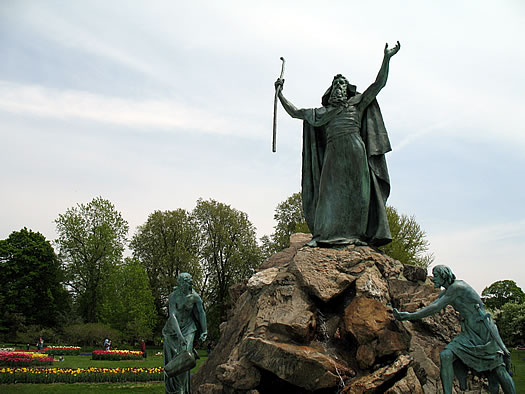
Moses fountain in Washington Park, Albany, NY.

Moses fountain in Washington Park, Albany, NY.

In our last Old Testament Study, we looked at how after God had provided the Children of Israel with mana in the wilderness (Jesus is the Bread from Heaven) He also provided them with water (Jesus called Himself the fountain of living water in the wilderness). Today’s post will be extra short so that (hopefully) you can take some time to review the OT studies leading up to Exodus 17.

Let’s jump into the text.

Exodus 17:8-16 (ESV)

Israel Defeats Amalek

Then Amalek came and fought with Israel at Rephidim. So Moses said to Joshua, “Choose for us men, and go out and fight with Amalek. Tomorrow I will stand on the top of the hill with the staff of God in my hand.” 10 So Joshua did as Moses told him, and fought with Amalek, while Moses, Aaron, and Hur went up to the top of the hill. 11 Whenever Moses held up his hand, Israel prevailed, and whenever he lowered his hand, Amalek prevailed. 12 But Moses’ hands grew weary, so they took a stone and put it under him, and he sat on it, while Aaron and Hur held up his hands, one on one side, and the other on the other side. So his hands were steady until the going down of the sun. 13 And Joshua overwhelmed Amalek and his people with the sword.

14 Then the Lord said to Moses, “Write this as a memorial in a book and recite it in the ears of Joshua, that I will utterly blot out the memory of Amalek from under heaven.” 15 And Moses built an altar and called the name of it, The Lord Is My Banner, 16 saying, “A hand upon the throne of the Lord! The Lord will have war with Amalek from generation to generation.”

Several interesting things here. The first thing I’d like to mention is that we shouldn’t read this portion as an isolated event, separated from all previous events. Such is the current, post-modern paradigm of viewing everything that happens as “new” and completely disconnected from everything that has happened before.

Who is Amalek?

They are descended of Esau (Genesis 36). Though himself a son of Isaac, God rejected him in favor of Jacob, whom he would rename Israel. Esau took wives from the daughters of Heth (Canaan) further separating himself from the Promise to Abraham. Now, after so many generations, Amalek is waging war with the People of God, the Children of Promise.

Whose Victory of Battle?

Moses sends Joshua to choose men for battle, but to whom is the victory attributed? The Lord. Moses goes up on a hill and holds, not his staff, but the Staff of God. While in some cases it might be referred to as Moses’s staff, in this case Moses is clear to Joshua what is going to take place. The very staff that God instructed Moses and Aaron to use for each the plagues against Pharaoh, the staff with which God parted the Red Sea and the same staff God commanded Moses to strike the rock with at Horeb. Moses wasn’t saying “I’ll make sure you win”, he was saying “the Lord God is your Banner in battle”.

Banner?

While researching this passage, there was an entry in the Reformation Study Bible I thought was very informative, demonstrating something that might be lost in translation for us.

17:15 The Lord is my banner. The Hebrew word translated “banner” underlies “staff” in v. 9 and is used for the “pole” on which the bronze serpent was later placed (Num. 21:8). Since “banner” suggests cloth to us, this connection is lost. A spear could serve as a standard in battle, with or without bits of cloth tied to it. Later, a staff might have a device on it to mark the rallying point for troops. In the ancient world, these were sometimes images or signs of the gods. Moses’ staff is the ensign to which Joshua’s army could look and that symbolized God’s saving power. Moses declares that God Himself is the Standard, the Ensign of His people.

Very cool. Once again, what we are seeing here is not the greatness of Joshua’s leadership, but the Mighty Hand of God at work, showing His favor upon Israel, Moses, and Joshua. Remember the Song of Moses as recorded in Exodus 15.

Exodus 15 (ESV)

The Song of Moses

15 Then Moses and the people of Israel sang this song to the Lord, saying,

“I will sing to the Lord, for he has triumphed gloriously;
    the horse and his rider he has thrown into the sea.
The Lord is my strength and my song,
    and he has become my salvation;
this is my God, and I will praise him,
    my father’s God, and I will exalt him.
The Lord is a man of war;
    the Lord is his name.

“Pharaoh’s chariots and his host he cast into the sea,
    and his chosen officers were sunk in the Red Sea.
The floods covered them;
    they went down into the depths like a stone.
Your right hand, O Lord, glorious in power,
    your right hand, O Lord, shatters the enemy.
In the greatness of your majesty you overthrow your adversaries;
    you send out your fury; it consumes them like stubble.
At the blast of your nostrils the waters piled up;
    the floods stood up in a heap;
    the deeps congealed in the heart of the sea.
The enemy said, ‘I will pursue, I will overtake,
    I will divide the spoil, my desire shall have its fill of them.
    I will draw my sword; my hand shall destroy them.’
10 You blew with your wind; the sea covered them;
    they sank like lead in the mighty waters.

11 “Who is like you, O Lord, among the gods?
    Who is like you, majestic in holiness,
    awesome in glorious deeds, doing wonders?
12 You stretched out your right hand;
    the earth swallowed them.

13 “You have led in your steadfast love the people whom you have redeemed;
    you have guided them by your strength to your holy abode.
14 The peoples have heard; they tremble;
    pangs have seized the inhabitants of Philistia.
15 Now are the chiefs of Edom dismayed;
    trembling seizes the leaders of Moab;
    all the inhabitants of Canaan have melted away.
16 Terror and dread fall upon them;
    because of the greatness of your arm, they are still as a stone,
till your people, O Lord, pass by,
    till the people pass by whom you have purchased.
17 You will bring them in and plant them on your own mountain,
    the place, O Lord, which you have made for your abode,
    the sanctuary, O Lord, which your hands have established.
18 The Lord will reign forever and ever.”

In Hebrews 11, we are taught that all of the mighty deeds accomplished in Scripture were by faith. Faith in whom? In the Only Living God of Abraham, Isaac, and Jacob, the Creator of all things. The Lord is my Banner… while there was a physical symbol of the favor of the Lord, neither Joshua, Aaron, Moses, nor Hur were under any misgivings that there was something in the staff itself, nor in the efforts of Moses. This was God’s work and God’s victory over Amalek.

Hebrews 13:20-21 (ESV)

Benediction

20 Now may the God of peace who brought again from the dead our Lord Jesus,the great shepherd of the sheep, by the blood of the eternal covenant, 21 equip you with everything good that you may do his will, working in us that which is pleasing in his sight, through Jesus Christ, to whom be glory forever and ever. Amen.

May the Grace of God be with you today and forever,
In Christ Jesus,
Jorge

OT | Bread from Heaven (Exodus 16)

Bible card Illustration published 1907  by Providence Lithograph Company

Bible card Illustration published 1907
by Providence Lithograph Company

Last week, in our Old Testament Study, we looked at the Song of Moses and how it served as a model for true worship and thanksgiving to our Heavenly Father.

As a quick review, the nation of Israel has been led out of Egypt. By the Mighty Hand of God Pharoah was utterly defeated and put to open shame before the nations as his army was utterly destroyed by God who parted the Red Sea for His people and then closed upon the Egyptian Army. In the aftermath of that destruction, the nation of Israel praised God and they sang the Song of Moses, praising God for His might work of Salvation. A song that we, too, will sing standing along the shores of the great sea of glass mingled with fire (Revelation 15), praising God for His work of Salvation.

The Provision of God

Now, Israel is truly free from the slavery of Egypt. They are separated from the house of slavery by the waters that God had used to crush the Egyptian army. Though they have been delivered out of the hands of Pharaoh and are now clearly under the protection of the One True God (who could deny His Mighty Works?) under the supervision of Moses. While we might be tempted to simply read on through as though reading a novel, stop and think about all that has happened. If this were a movie, the ending credits would have been rolling during the Song of Moses and the film would fade to black. But this isn’t a movie, these are real events in history. The biggest question probably in many minds is, “Now what?” As long as Israel is looking at the waters and the floating debris they are thinking about how awesomely God worked to rescue them from that army, but as soon as they turn around, they realize they are not in the Promised Land, they are in-fact in the wilderness. That would be daunting enough a thought if you were standing with your family, extended family, maybe even your church congregation. Do you remember how many people had left Egypt? Let’s turn back to chapter 12 for just a moment:

Exodus 12:37-39 (ESV) 37 And the people of Israel journeyed from Rameses to Succoth, about six hundred thousand men on foot, besides women and children. 38 A mixed multitude also went up with them, and very much livestock, both flocks and herds.39 And they baked unleavened cakes of the dough that they had brought out of Egypt, for it was not leavened, because they were thrust out of Egypt and could not wait, nor had they prepared any provisions for themselves.

Woah! 600,000 men plus women, children, and a mixed multitude and livestock. Remember that livestock was what the sons of Israel noted as their profession when they were given the land of Goshen by Pharaoh in the time of Joseph. Before they were slaves, they were herdsmen.

Genesis 47:1-3 (ESV) | Jacob’s Family Settles in Goshen
47 So Joseph went in and told Pharaoh, “My father and my brothers, with their flocks and herds and all that they possess, have come from the land of Canaan. They are now inthe land of Goshen.” 2 And from among his brothers he took five men and presented them to Pharaoh. 3 Pharaoh said to his brothers, “What is your occupation?” And they said to Pharaoh, “Your servants are shepherds, as our fathers were.

Now they were all on the other side of the Red Sea, in the wilderness, without provisions. They had unleavened bread, but for a people who knew no such luxuries as grocery stores, convenience stores, nor fast-food restaurants, the idea of making provisions for a long journey extend well beyond having some unleavened bread. How do the children of Israel respond? Let us turn now to Exodus 16.

Exodus 16 (ESV) | Bread from Heaven

They set out from Elim, and all the congregation of the people of Israel came to the wilderness of Sin, which is between Elim and Sinai, on the fifteenth day of the second month after they had departed from the land of Egypt. And the whole congregation of the people of Israel grumbled against Moses and Aaron in the wilderness, and the people of Israel said to them, “Would that we had died by the hand of the Lord in the land of Egypt, when we sat by the meat pots and ate bread to the full, for you have brought us out into this wilderness to kill this whole assembly with hunger.”

I’m actually fairly impressed that so many people walking in the wilderness went that long (2.5 months?) on the scant provisions they had left Egypt with. Nevertheless, they burn through what little they had from Egypt and by now the Mighty Hand of God was sooo 2 months ago. Do people evolve? No, no we don’t. Our technology might, but we don’t. The whole congregation grumbled against Moses and Aaron. And what are they saying? Would that we had died by the hand of the Lord in the land of Egypt, when we sat by the meat pots and ate bread to the full… our fallen flesh is so weak and completely turned in on itself. They would rather die in slavery with full stomachs than be free, following Moses toward the Land of Promise on an empty stomach. Not only that, but they accuse Moses and Aaron of malice, having brought all of these people into the wilderness to die of hunger. They’ve lost sight of the Promise, and long for what used to be considered comfort… in the house of slavery. In the Parable of the Sower, the children of Israel here are demonstrating the rocky soil, Matthew 13:21 (ESV)21 yet he has no root in himself, but endures for a while, and when tribulation or persecution arises on account of the word, immediately he falls away.” We mentioned it before when Israel thought they were going to get slaughtered by Pharaoh’s army, but now their hunger is what has them falling away, losing their faith in the Promise.

Then the Lord said to Moses, “Behold, I am about to rain bread from heaven for you, and the people shall go out and gather a day’s portion every day, that I may test them, whether they will walk in my law or not. On the sixth day, when they prepare what they bring in, it will be twice as much as they gather daily.” So Moses and Aaron said to all the people of Israel, “At evening you shall know that it was the Lord who brought you out of the land of Egypt, and in the morning you shall see the glory of the Lord, because he has heard your grumbling against the Lord. For what are we, that you grumble against us?” And Moses said, “When the Lord gives you in the evening meat to eat and in the morning bread to the full, because the Lord has heard your grumbling that you grumble against him—what are we? Your grumbling is not against us but against the Lord.”

So, hold on just a second… the Law has not yet been officially given. I’m not saying God hasn’t revealed His laws, or statutes, but when we currently talk about the Law, we look back to when God gives Moses the Law on the tablets of the Testimony on Mount Sinai. But in this story we have not yet reached Mount Sinai. God has issued commands and in this new command God specifies that He is testing His people, the ones He has already pulled out of Egypt, whether they will walk in His Law or not. God already knows the hearts of every person, He’s not testing for His sake, but for ours. What is the purpose of the Law? To expose sin. No one will walk in His Law until Jesus Christ comes to fulfill the Law for us. Here we see the first Law regarding the Sabbath, and it comes in reference to the provision of the Lord God. God will rain down bread from heaven, to meet their needs for the day, until the 6th day, where they will receive a double portion.

Then Moses said to Aaron, “Say to the whole congregation of the people of Israel, ‘Come near before the Lord, for he has heard your grumbling.’” 10 And as soon as Aaron spoke to the whole congregation of the people of Israel, they looked toward the wilderness, and behold, the glory of the Lord appeared in the cloud. 11 And the Lord said to Moses, 12 “I have heard the grumbling of the people of Israel. Say to them, ‘At twilight you shall eat meat, and in the morning you shall be filled with bread. Then you shall know that I am the Lord your God.’

13 In the evening quail came up and covered the camp, and in the morning dew lay around the camp. 14 And when the dew had gone up, there was on the face of the wilderness a fine, flake-like thing, fine as frost on the ground. 15 When the people of Israel saw it, they said to one another, “What is it?” For they did not know what it was. And Moses said to them, “It is the bread that the Lord has given you to eat. 16 This is what the Lord has commanded: ‘Gather of it, each one of you, as much as he can eat. You shall each take an omer, according to the number of the persons that each of you has in his tent.’” 17 And the people of Israel did so. They gathered, some more, some less. 18 But when they measured it with an omer, whoever gathered much had nothing left over, and whoever gathered little had no lack. Each of them gathered as much as he could eat.19 And Moses said to them, “Let no one leave any of it over till the morning.” 20 But they did not listen to Moses. Some left part of it till the morning, and it bred worms and stank. And Moses was angry with them. 21 Morning by morning they gathered it, each as much as he could eat; but when the sun grew hot, it melted.

22 On the sixth day they gathered twice as much bread, two omers each. And when all the leaders of the congregation came and told Moses, 23 he said to them, “This is what the Lord has commanded: ‘Tomorrow is a day of solemn rest, a holy Sabbath to the Lord; bake what you will bake and boil what you will boil, and all that is left over lay aside to be kept till the morning.’” 24 So they laid it aside till the morning, as Moses commanded them, and it did not stink, and there were no worms in it. 25 Moses said, “Eat it today, fortoday is a Sabbath to the Lord; today you will not find it in the field. 26 Six days you shall gather it, but on the seventh day, which is a Sabbath, there will be none.”

The Lord will provide for His people, so that they will know that He is the Lord their God. They needed to let go of Egypt. They were free from the house of slavery, by a Mighty Hand of God, but their hearts still turned toward Egypt whenever they grumbled against the Lord. God now demonstrates His superior greatness by raining bread from heaven to meet all of their needs. Those who gathered much did not have excess and those who gathered little lacked nothing. How were they performing in their test? Not well. A stark reminder that our sinful state isn’t just a matter of a lack of effort or knowledge, it is a failure in our being, our flesh is cursed by sin, and we have fallen away from the perfection of God.

27 On the seventh day some of the people went out to gather, but they found none. 28 And the Lord said to Moses, “How long will you refuse to keep my commandments and my laws? 29 See! The Lord has given you the Sabbath; therefore on the sixth day he gives you bread for two days. Remain each of you in his place; let no one go out of his place on the seventh day.” 30 So the people rested on the seventh day.

Notice the wording God used in his rebuke directed at the people in verse 29, “the Lord has given you the Sabbath”. Let’s jump ahead at how Jesus responded to the Pharisees who accused Jesus and His disciples of breaking the Sabbath according to their tradition.

Mark 2:27-28 (ESV) 27 And he said to them, “The Sabbath was made for man, not man for the Sabbath. 28 So the Son of Man is lord even of the Sabbath.”

The failure of Israel to obey is foreshadowing the reality that despite the Grace and Mercy of God the Father throughout the history of Israel, man will refuse to keep His commandments and laws. With this question fresh in our minds, let’s take a peek at what Jesus said in Matthew 5:

Matthew 5:17-18 (ESV)| Christ Came to Fulfill the Law
17 “Do not think that I have come to abolish the Law or the Prophets; I have not come to abolish them but to fulfill them. 18 For truly, I say to you, until heaven and earth pass away, not an iota, not a dot, will pass from the Law until all is accomplished.

The Law continues to do what it was intended to do, convict us of sin while testifying of God’s Greatness and Perfection. But Christ came to fulfill the Law and the Prophets, and when He returns all will be accomplished. The keeping the Law is not the means of Salvation; it points out how lost we are. Salvation is by faith in the Promise of God. The Apostle Paul lays this out very well in Romans (particularly the first 8 chapters), but let us look at just a portion for now.

Romans 3:19-31 (ESV) | The Righteousness of God Through Faith
19 Now we know that whatever the law says it speaks to those who are under the law, so that every mouth may be stopped, and the whole world may be held accountable to God.20 For by works of the law no human being will be justified in his sight, since through the law comes knowledge of sin.

21 But now the righteousness of God has been manifested apart from the law, although the Law and the Prophets bear witness to it— 22 the righteousness of God through faith in Jesus Christ for all who believe. For there is no distinction: 23 for all have sinned and fall short of the glory of God, 24 and are justified by his grace as a gift, through the redemption that is in Christ Jesus, 25 whom God put forward as a propitiation by his blood, to be received by faith. This was to show God’s righteousness, because in his divine forbearance he had passed over former sins. 26 It was to show his righteousness at the present time, so that he might be just and the justifier of the one who has faith in Jesus.

27 Then what becomes of our boasting? It is excluded. By what kind of law? By a law of works? No, but by the law of faith. 28 For we hold that one is justified by faith apart from works of the law. 29 Or is God the God of Jews only? Is he not the God of Gentiles also? Yes, of Gentiles also, 30 since God is one—who will justify the circumcised by faith and the uncircumcised through faith. 31 Do we then overthrow the law by this faith? By no means! On the contrary, we uphold the law.

We will jump more heavily into Hebrews and in Romans once we reach the Law given at Horeb (Mt Sinai), but for now, let us close out Exodus chapter 16.

Exodus 16:31-36 (ESV)

31 Now the house of Israel called its name manna. It was like coriander seed, white, and the taste of it was like wafers made with honey. 32 Moses said, “This is what the Lord has commanded: ‘Let an omer of it be kept throughout your generations, so that they may see the bread with which I fed you in the wilderness, when I brought you out of the land of Egypt.’” 33 And Moses said to Aaron, “Take a jar, and put an omer of manna in it, and place it before the Lord to be kept throughout your generations.” 34 As the Lord commanded Moses, so Aaron placed it before the testimony to be kept. 35 The people of Israel ate the manna forty years, till they came to a habitable land. They ate the manna till they came to the border of the land of Canaan. 36 (An omer is the tenth part of an ephah.)

I love how this reminder of what God had done for Israel, this miraculous provision doesn’t point backward to Egypt, rather, it points forward to Christ. So often we get this wrong picture in our minds that sharing a testimony involves highlighting the sin in our lives “before we were Saved”, but that only glorifies Egypt, the house of slavery. The testimony that matters, is the one that points to Christ. In closing, let us turn now to John 6, where Jesus taught us how to rightly understand what God was doing here in Exodus 16.

John 6:26-71 (ESV)26 Jesus answered them, “Truly, truly, I say to you, you are seeking me, not because you saw signs, but because you ate your fill of the loaves. 27 Do not work for the food that perishes, but for the food that endures to eternal life, which the Son of Man will give to you. For on him God the Father has set his seal.” 28 Then they said to him, “What must we do, to be doing the works of God?” 29 Jesus answered them, “This is the work of God, that you believe in him whom he has sent.” 30 So they said to him, “Then what sign do you do, that we may see and believe you? What work do you perform? 31 Our fathers ate the manna in the wilderness; as it is written, ‘He gave them bread from heaven to eat.’”32 Jesus then said to them, “Truly, truly, I say to you, it was not Moses who gave you the bread from heaven, but my Father gives you the true bread from heaven. 33 For the bread of God is he who comes down from heaven and gives life to the world.” 34 They said to him, “Sir, give us this bread always.”

35 Jesus said to them, “I am the bread of life; whoever comes to me shall not hunger, and whoever believes in me shall never thirst. 36 But I said to you that you have seen me and yet do not believe. 37 All that the Father gives me will come to me, and whoever comes to me I will never cast out. 38 For I have come down from heaven, not to do my own will but the will of him who sent me. 39 And this is the will of him who sent me, that I should lose nothing of all that he has given me, but raise it up on the last day. 40 For this is the will of my Father, that everyone who looks on the Son and believes in him should have eternal life, and I will raise him up on the last day.”

41 So the Jews grumbled about him, because he said, “I am the bread that came down from heaven.” 42 They said, “Is not this Jesus, the son of Joseph, whose father and mother we know? How does he now say, ‘I have come down from heaven’?” 43 Jesus answered them, “Do not grumble among yourselves. 44 No one can come to me unless the Father who sent me draws him. And I will raise him up on the last day. 45 It is written in the Prophets, ‘And they will all be taught by God.’ Everyone who has heard and learned from the Father comes to me— 46 not that anyone has seen the Father except he who is from God; he has seen the Father. 47 Truly, truly, I say to you, whoever believes has eternal life. 48 I am the bread of life. 49 Your fathers ate the manna in the wilderness, and they died. 50 This is the bread that comes down from heaven, so that one may eat of it and not die. 51 I am the living bread that came down from heaven. If anyone eats of this bread, he will live forever. And the bread that I will give for the life of the world is my flesh.

52 The Jews then disputed among themselves, saying, “How can this man give us his flesh to eat?” 53 So Jesus said to them, “Truly, truly, I say to you, unless you eat the flesh of the Son of Man and drink his blood, you have no life in you. 54 Whoever feeds on my flesh and drinks my blood has eternal life, and I will raise him up on the last day. 55 For my flesh is true food, and my blood is true drink. 56 Whoever feeds on my flesh and drinks my blood abides in me, and I in him. 57 As the living Father sent me, and I live because of the Father, so whoever feeds on me, he also will live because of me. 58 This is the bread that came down from heaven, not like the bread the fathers ate, and died. Whoever feeds on this bread will live forever.” 59 Jesus said these things in the synagogue, as he taught at Capernaum.

60 When many of his disciples heard it, they said, “This is a hard saying; who can listen to it?” 61 But Jesus, knowing in himself that his disciples were grumbling about this, said to them, “Do you take offense at this? 62 Then what if you were to see the Son of Man ascending to where he was before? 63 It is the Spirit who gives life; the flesh is no help at all. The words that I have spoken to you are spirit and life. 64 But there are some of you who do not believe.” (For Jesus knew from the beginning who those were who did not believe, and who it was who would betray him.) 65 And he said, “This is why I told you that no one can come to me unless it is granted him by the Father.”

66 After this many of his disciples turned back and no longer walked with him. 67 So Jesus said to the Twelve, “Do you want to go away as well?” 68 Simon Peter answered him, “Lord, to whom shall we go? You have the words of eternal life, 69 and we have believed, and have come to know, that you are the Holy One of God.” 70 Jesus answered them, “Did I not choose you, the Twelve? And yet one of you is a devil.” 71 He spoke of Judas the son of Simon Iscariot, for he, one of the Twelve, was going to betray him.

I know we took this well beyond our target word limit, but I firmly believe this was well worth it. What we feast on here is the Word of God, the Words of Life, the Testimony and the Gospel of Jesus Christ, Son of the Living God, our Savior and Our Lord. He is the mana from Heaven, who ascended back into Heaven and who is returning to take His people to the Promised Land, where we will be with Him forever, Amen.

1 Thessalonians 4:13-18 (ESV)| The Coming of the Lord
13 But we do not want you to be uninformed, brothers, about those who are asleep, that you may not grieve as others do who have no hope. 14 For since we believe that Jesus died and rose again, even so, through Jesus, God will bring with him those who have fallen asleep. 15 For this we declare to you by a word from the Lord, that we who are alive, who are left until the coming of the Lord, will not precede those who have fallen asleep. 16 For the Lord himself will descend from heaven with a cry of command, with the voice of an archangel, and with the sound of the trumpet of God. And the dead in Christ will rise first. 17 Then we who are alive, who are left, will be caught up together with them in the clouds to meet the Lord in the air, and so we will always be with the Lord. 18 Therefore encourage one another with these words.

May the Grace of God be with you today and forever,
In Christ Jesus,
Jorge