OT | The Lord is My Banner (Exodus 17)

Moses fountain in Washington Park, Albany, NY.

Moses fountain in Washington Park, Albany, NY.

In our last Old Testament Study, we looked at how after God had provided the Children of Israel with mana in the wilderness (Jesus is the Bread from Heaven) He also provided them with water (Jesus called Himself the fountain of living water in the wilderness). Today’s post will be extra short so that (hopefully) you can take some time to review the OT studies leading up to Exodus 17.

Let’s jump into the text.

Exodus 17:8-16 (ESV)

Israel Defeats Amalek

Then Amalek came and fought with Israel at Rephidim. So Moses said to Joshua, “Choose for us men, and go out and fight with Amalek. Tomorrow I will stand on the top of the hill with the staff of God in my hand.” 10 So Joshua did as Moses told him, and fought with Amalek, while Moses, Aaron, and Hur went up to the top of the hill. 11 Whenever Moses held up his hand, Israel prevailed, and whenever he lowered his hand, Amalek prevailed. 12 But Moses’ hands grew weary, so they took a stone and put it under him, and he sat on it, while Aaron and Hur held up his hands, one on one side, and the other on the other side. So his hands were steady until the going down of the sun. 13 And Joshua overwhelmed Amalek and his people with the sword.

14 Then the Lord said to Moses, “Write this as a memorial in a book and recite it in the ears of Joshua, that I will utterly blot out the memory of Amalek from under heaven.” 15 And Moses built an altar and called the name of it, The Lord Is My Banner, 16 saying, “A hand upon the throne of the Lord! The Lord will have war with Amalek from generation to generation.”

Several interesting things here. The first thing I’d like to mention is that we shouldn’t read this portion as an isolated event, separated from all previous events. Such is the current, post-modern paradigm of viewing everything that happens as “new” and completely disconnected from everything that has happened before.

Who is Amalek?

They are descended of Esau (Genesis 36). Though himself a son of Isaac, God rejected him in favor of Jacob, whom he would rename Israel. Esau took wives from the daughters of Heth (Canaan) further separating himself from the Promise to Abraham. Now, after so many generations, Amalek is waging war with the People of God, the Children of Promise.

Whose Victory of Battle?

Moses sends Joshua to choose men for battle, but to whom is the victory attributed? The Lord. Moses goes up on a hill and holds, not his staff, but the Staff of God. While in some cases it might be referred to as Moses’s staff, in this case Moses is clear to Joshua what is going to take place. The very staff that God instructed Moses and Aaron to use for each the plagues against Pharaoh, the staff with which God parted the Red Sea and the same staff God commanded Moses to strike the rock with at Horeb. Moses wasn’t saying “I’ll make sure you win”, he was saying “the Lord God is your Banner in battle”.

Banner?

While researching this passage, there was an entry in the Reformation Study Bible I thought was very informative, demonstrating something that might be lost in translation for us.

17:15 The Lord is my banner. The Hebrew word translated “banner” underlies “staff” in v. 9 and is used for the “pole” on which the bronze serpent was later placed (Num. 21:8). Since “banner” suggests cloth to us, this connection is lost. A spear could serve as a standard in battle, with or without bits of cloth tied to it. Later, a staff might have a device on it to mark the rallying point for troops. In the ancient world, these were sometimes images or signs of the gods. Moses’ staff is the ensign to which Joshua’s army could look and that symbolized God’s saving power. Moses declares that God Himself is the Standard, the Ensign of His people.

Very cool. Once again, what we are seeing here is not the greatness of Joshua’s leadership, but the Mighty Hand of God at work, showing His favor upon Israel, Moses, and Joshua. Remember the Song of Moses as recorded in Exodus 15.

Exodus 15 (ESV)

The Song of Moses

15 Then Moses and the people of Israel sang this song to the Lord, saying,

“I will sing to the Lord, for he has triumphed gloriously;
    the horse and his rider he has thrown into the sea.
The Lord is my strength and my song,
    and he has become my salvation;
this is my God, and I will praise him,
    my father’s God, and I will exalt him.
The Lord is a man of war;
    the Lord is his name.

“Pharaoh’s chariots and his host he cast into the sea,
    and his chosen officers were sunk in the Red Sea.
The floods covered them;
    they went down into the depths like a stone.
Your right hand, O Lord, glorious in power,
    your right hand, O Lord, shatters the enemy.
In the greatness of your majesty you overthrow your adversaries;
    you send out your fury; it consumes them like stubble.
At the blast of your nostrils the waters piled up;
    the floods stood up in a heap;
    the deeps congealed in the heart of the sea.
The enemy said, ‘I will pursue, I will overtake,
    I will divide the spoil, my desire shall have its fill of them.
    I will draw my sword; my hand shall destroy them.’
10 You blew with your wind; the sea covered them;
    they sank like lead in the mighty waters.

11 “Who is like you, O Lord, among the gods?
    Who is like you, majestic in holiness,
    awesome in glorious deeds, doing wonders?
12 You stretched out your right hand;
    the earth swallowed them.

13 “You have led in your steadfast love the people whom you have redeemed;
    you have guided them by your strength to your holy abode.
14 The peoples have heard; they tremble;
    pangs have seized the inhabitants of Philistia.
15 Now are the chiefs of Edom dismayed;
    trembling seizes the leaders of Moab;
    all the inhabitants of Canaan have melted away.
16 Terror and dread fall upon them;
    because of the greatness of your arm, they are still as a stone,
till your people, O Lord, pass by,
    till the people pass by whom you have purchased.
17 You will bring them in and plant them on your own mountain,
    the place, O Lord, which you have made for your abode,
    the sanctuary, O Lord, which your hands have established.
18 The Lord will reign forever and ever.”

In Hebrews 11, we are taught that all of the mighty deeds accomplished in Scripture were by faith. Faith in whom? In the Only Living God of Abraham, Isaac, and Jacob, the Creator of all things. The Lord is my Banner… while there was a physical symbol of the favor of the Lord, neither Joshua, Aaron, Moses, nor Hur were under any misgivings that there was something in the staff itself, nor in the efforts of Moses. This was God’s work and God’s victory over Amalek.

Hebrews 13:20-21 (ESV)

Benediction

20 Now may the God of peace who brought again from the dead our Lord Jesus,the great shepherd of the sheep, by the blood of the eternal covenant, 21 equip you with everything good that you may do his will, working in us that which is pleasing in his sight, through Jesus Christ, to whom be glory forever and ever. Amen.

May the Grace of God be with you today and forever,
In Christ Jesus,
Jorge

Christmas | Gospel According to Matthew

bible

As we move into another Christmas season, we plan on working our way through the Book of Matthew for our Gospel Wednesday study.

On a personal note, I dislike referring to this book (and the other three) as “the Gospel of Matthew”. there is only one Gospel, and that is of Jesus Christ, not Matthew, Mark, Luke, or John. Thankfully, I’m not alone in this and when researching the Encyclopedia of the Bible, I found the following discourse on the title of this book:

2. The title. The title of this gospel in most modern Bibles reads, “The Gospel According to St. Matthew.” This wording is an exact tr. of the title in many Gr. MSS which reads Εὐαγγέλιον Κατα Μαθαῖον, “The Gospel According To Matthew.” But the oldest Gr. copies of the gospel have the shortened form, “According to Matthew” (Κατα Μαθαῖον). Most scholars believe the original text had no title at all. When the early Christians wished to distinguish one gospel from another, they called the first gospel not the “Gospel of Matthew,” as we often say, but “The Gospel According to Matthew,” to distinguish it from the other VSS of Mark, Luke and John. There is only one Gospel, but four VSS or accounts of it. The term “Gospel According to Matthew” is, therefore, not the “Good News of Matthew,” but Matthew’s VS of the “Good News from God.” The Gospel is “God’s Story” of salvation and life, the best news story the world has ever heard. The earliest Church Fathers, for example, Irenaeus (a.d. 180), spoke of the fourfold Gospel canon in this manner; that is, that there is only one Gospel according to four different authors (Against Heresies III. 11, 8).

I will be referring to these from now on as The Gospel According to Matthew. Let us turn to the first chapter of Matthew. It is critically important that we remember that Matthew 1 isn’t the beginning of the story of God’s relationship with His Creation, it is in-fact the start of the final chapter, the last days. God is bringing about the fulfillment of His promise to crush the head of the serpent back in Genesis 3. Let that sink in… while it might be said that for the Gentile everything begins at the Gospel of Jesus Christ and then we have to learn the Law to grow in our faith in God; for Israel, God’s chosen ones, they are awaiting the promised Messiah.

Matthew 1 (ESV)

The Genealogy of Jesus Christ

The book of the genealogy of Jesus Christ, the son of David, the son of Abraham.

Abraham was the father of Isaac, and Isaac the father of Jacob, and Jacob the father of Judah and his brothers, and Judah the father of Perez and Zerah by Tamar, and Perez the father of Hezron, and Hezron the father of Ram, and Ram the father of Amminadab, and Amminadab the father of Nahshon, and Nahshon the father of Salmon, and Salmon the father of Boaz by Rahab, and Boaz the father of Obed by Ruth, and Obed the father of Jesse, and Jesse the father of David the king.

And David was the father of Solomon by the wife of Uriah, and Solomon the father of Rehoboam, and Rehoboam the father of Abijah, and Abijah the father of Asaph, and Asaph the father of Jehoshaphat, and Jehoshaphat the father of Joram, and Joram the father of Uzziah, and Uzziah the father of Jotham, and Jotham the father of Ahaz, and Ahaz the father of Hezekiah, 10 and Hezekiah the father of Manasseh, and Manasseh the father of Amos, and Amos the father of Josiah, 11 and Josiah the father of Jechoniah and his brothers, at the time of the deportation to Babylon.

12 And after the deportation to Babylon: Jechoniah was the father of Shealtiel,and Shealtiel the father of Zerubbabel, 13 and Zerubbabel the father of Abiud, and Abiud the father of Eliakim, and Eliakim the father of Azor, 14 and Azor the father of Zadok, and Zadok the father of Achim, and Achim the father of Eliud,15 and Eliud the father of Eleazar, and Eleazar the father of Matthan, and Matthan the father of Jacob, 16 and Jacob the father of Joseph the husband of Mary, of whom Jesus was born, who is called Christ.

17 So all the generations from Abraham to David were fourteen generations, and from David to the deportation to Babylon fourteen generations, and from the deportation to Babylon to the Christ fourteen generations.

I don’t want to get into the weeds in this geneology, but this was recorded for a purpose, for God the Holy Spirit’s purpose. For now, I want to highlight that Matthew was being very intentional here to point out how perfectly Christ completes God’s Promise to Abraham. He points out the following:

Abraham –  King David – Babylonian Exile – Christ

 God promised Abraham the land of Canaan, and King David ruled over it, but Israel fell away after David, and were sent into Exile. God promised Israel that He would send an Anointed One (Messiah / Christ) to sit on the Throne of David again… and He sent His One and Only Son, Jesus. I feel this is significant for understanding the framework of Matthew’s narrative, considering that the Gospel According to John began “in the Beginning was the Word…”, focusing on the Deity of Christ from before Creation.

Matthew 1 | The Birth of Jesus Christ

18 Now the birth of Jesus Christ took place in this way. When his mother Mary had been betrothed to Joseph, before they came together she was found to be with child from the Holy Spirit. 19 And her husband Joseph, being a just man and unwilling to put her to shame, resolved to divorce her quietly. 20 But as he considered these things, behold, an angel of the Lord appeared to him in a dream, saying, “Joseph, son of David, do not fear to take Mary as your wife, for that which is conceived in her is from the Holy Spirit. 21 She will bear a son, and you shall call his name Jesus, for he will save his people from their sins.” 22 All this took place to fulfill what the Lord had spoken by the prophet:

23 “Behold, the virgin shall conceive and bear a son,
    and they shall call his name Immanuel”

(which means, God with us). 24 When Joseph woke from sleep, he did as the angel of the Lord commanded him: he took his wife, 25 but knew her not until she had given birth to a son. And he called his name Jesus.

The Gospel according to Luke spent a great deal of time on Mary and the immaculate conception, but here Matthew jumps straight to Joseph. Here, we see Joseph desiring to show mercy to Mary by not putting her to shame. Apart from the intervention of God the Holy Spirit, there was no way for Mary to be pregnant without having had unlawful sex. Joseph is a popular name in this culture, but have you thought about why? Let’s look back in Genesis at one of the patriarchs whose name was Joseph, the son of Jacob/Israel.

Genesis 37:1-3 (ESV) 1 Jacob lived in the land of his father’s sojournings, in the land of Canaan. 2 These are the generations of Jacob. Joseph, being seventeen years old, was pasturing the flock with his brothers. He was a boy with the sons of Bilhah and Zilpah, his father’s wives. And Joseph brought a bad report of them to their father. 3 Now Israel loved Joseph more than any other of his sons, because he was the son of his old age. And he made him a robe of many colors.

Jacob, whose name God changed to Israel, loved Joseph more than any other of his sons. He was a favored son, and he made him a robe of many colors. Fast-forward to Matthew, and we have Joseph, favored of God to serve as an earthly guardian of Mary and Jesus. And the angel of the Lord appeared to Joesph in a dream. No doubt the Jewish readers/hearers of this Gospel account would already be thinking on Joseph. Where did the dreams given to Joseph, son of Jacob, lead him? To Egypt. Eventually God would preserve Israel in the land of Egypt during the 7 year famine. Let’s continue in Matthew where we will see this connection revisited.

Matthew 2 (ESV)

The Visit of the Wise Men

Now after Jesus was born in Bethlehem of Judea in the days of Herod the king, behold, wise men from the east came to Jerusalem, saying, “Where is he who has been born king of the Jews? For we saw his star when it rose and have come to worship him.” 3 When Herod the king heard this, he was troubled, and all Jerusalem with him; and assembling all the chief priests and scribes of the people, he inquired of them where the Christ was to be born. They told him, “In Bethlehem of Judea, for so it is written by the prophet:

“‘And you, O Bethlehem, in the land of Judah,
    are by no means least among the rulers of Judah;
for from you shall come a ruler
    who will shepherd my people Israel.’”

Then Herod summoned the wise men secretly and ascertained from them what time the star had appeared. And he sent them to Bethlehem, saying, “Go and search diligently for the child, and when you have found him, bring me word, that I too may come and worship him.” After listening to the king, they went on their way. And behold, the star that they had seen when it rose went before them until it came to rest over the place where the child was. 10 When they saw the star, they rejoiced exceedingly with great joy. 11 And going into the house they saw the child with Mary his mother, and they fell down and worshiped him. Then, opening their treasures, they offered him gifts, gold and frankincense and myrrh. 12 And being warned in a dream not to return to Herod, they departed to their own country by another way.

So we have the Wise Men from the east coming because they recognized the sign in the heavens, a star, marking the birth of the king of the Jews. Where were they from? Most likely from Babylon, from where Israel spent so much time in Exile (remember how Matthew set apart this event as significant). These wise men were not quoting prophecy as we tend to think of quoting, they were giving their understanding of the meaning of two different prophetic passages (Micah 5:2 and Ezekiel 34:23). Quoting the prophets directly wasn’t necessary given their audience was all of the chief priests and scribes, they needed to convey the interpretation that was undoubtedly revealed to them by God of the fulfillment of these 2 prophetic passages. Reflecting on the life of Joseph, son of Israel, notice that this news troubled Herod and all Jerusalem with him. This is analogous to the response of Joseph’s brothers. Let’s look at some of the their thoughts toward Joseph recorded in Genesis 37 (ESV):

4 But when his brothers saw that their father loved him more than all his brothers, they hated him and could not speak peacefully to him. Now Joseph had a dream, and when he told it to his brothers they hated him even more. He said to them, “Hear this dream that I have dreamed: Behold, we were binding sheaves in the field, and behold, my sheaf arose and stood upright. And behold, your sheaves gathered around it and bowed down to my sheaf.” His brothers said to him, “Are you indeed to reign over us? Or are you indeed to rule over us?” So they hated him even more for his dreams and for his words

18 They saw him from afar, and before he came near to them they conspired against him to kill him. 19 They said to one another, “Here comes this dreamer.20 Come now, let us kill him and throw him into one of the pits. Then we will say that a fierce animal has devoured him, and we will see what will become of his dreams.”

They hated their brother. Herod and all of Jerusalem were troubled by the news of the birth of the king of the Jews. Now, these parallels aren’t provided to suggest that “they should have seen it coming”; rather, they are being examined to point to God and His Sovereignty. Let’s continue in Matthew 2.

Matthew 2 | The Flight to Egypt

13 Now when they had departed, behold, an angel of the Lord appeared to Joseph in a dream and said, “Rise, take the child and his mother, and flee to Egypt, and remain there until I tell you, for Herod is about to search for the child, to destroy him.14 And he rose and took the child and his mother by night and departed to Egypt 15 and remained there until the death of Herod. This was to fulfill what the Lord had spoken by the prophet, “Out of Egypt I called my son.”

Herod Kills the Children

16 Then Herod, when he saw that he had been tricked by the wise men, became furious, and he sent and killed all the male children in Bethlehem and in all that region who were two years old or under, according to the time that he had ascertained from the wise men. 17 Then was fulfilled what was spoken by the prophet Jeremiah:

18 “A voice was heard in Ramah,
    weeping and loud lamentation,
Rachel weeping for her children;
    she refused to be comforted, because they are no more.”

Herod was indeed evil. God warned Joseph in a dream (again) of Herod’s plot to kill Jesus, so Joseph took Mary and Jesus and fled to Egypt until Herod’s death. What I find fascinating here is that Matthew (via the Holy Spirit) points to Jesus as a picture of Israel when he quotes Hosea 11:1 (ESV), When Israel was a child, I loved him, and out of Egypt I called my son”. This is right in line with how we’ve been reading the Exodus account and how it points to Jesus. This is how the Book of Hebrews approaches the message of the Gospel. Hosea was prophetically looking backward to the shadow of Christ in the Nation of Israel, as well as pointing forward to Jesus the Messiah. Praise God. 

Matthew 2 | The Return to Nazareth

19 But when Herod died, behold, an angel of the Lord appeared in a dream to Joseph in Egypt, 20 saying, “Rise, take the child and his mother and go to the land of Israel, for those who sought the child’s life are dead.” 21 And he rose and took the child and his mother and went to the land of Israel. 22 But when he heard that Archelaus was reigning over Judea in place of his father Herod, he was afraid to go there, and being warned in a dream he withdrew to the district of Galilee. 23 And he went and lived in a city called Nazareth, so that what was spoken by the prophets might be fulfilled, that he would be called a Nazarene.

With another dream, Joseph brings his wife and Jesus out of Egypt and settled down in Nazareth. Now, there is no direct quote that I could find pointing to His being called a Nazarene. Again, Matthew seems to be conveying understanding of prophecy (revealed by the Holy Spirit) more than actually quoting it. Being called a Nazarene bore with it some disdain, because there was nothing special about Nazareth, and that was part of God’s point. Let’s look at a few verses that suggest this could be a way of rightly understanding this point.

John 7:40-52 (ESV) | Division Among the People
40 When they heard these words, some of the people said, “This really is the Prophet.” 41 Others said, “This is the Christ.” But some said, “Is the Christ to come from Galilee? 42 Has not the Scripture said that the Christ comes from the offspring of David, and comes from Bethlehem, the village where David was?” 43 So there was a division among the people over him. 44 Some of them wanted to arrest him, but no one laid hands on him. 45 The officers then came to the chief priests and Pharisees, who said to them, “Why did you not bring him?” 46 The officers answered, “No one ever spoke like this man!” 47 The Pharisees answered them, “Have you also been deceived? 48 Have any of the authorities or the Pharisees believed in him? 49 But this crowd that does not know the law is accursed.” 50 Nicodemus, who had gone to him before, and who was one of them, said to them, 51 “Does our law judge a man without first giving him a hearing and learning what he does?” 52 They replied, “Are you from Galilee too? Search and see that no prophet arises from Galilee.”

Had Jesus begun his ministry having grown up in Bethlehem, he would have had instant buy-in. Instead, God chose a different route. Indeed, Jesus was born in Bethlehem, the City of David, but by the time of His ministry He was known as a Galilean, a Nazarene.

John 1:43-51 (ESV) | Jesus Calls Philip and Nathanael
43 The next day Jesus decided to go to Galilee. He found Philip and said to him,“Follow me.” 44 Now Philip was from Bethsaida, the city of Andrew and Peter.45 Philip found Nathanael and said to him, “We have found him of whom Moses in the Law and also the prophets wrote, Jesus of Nazareth, the son of Joseph.” 46 Nathanael said to him, “Can anything good come out of Nazareth?” Philip said to him, “Come and see.” 47 Jesus saw Nathanael coming toward him and said of him, “Behold, an Israelite indeed, in whom there is no deceit!” 48 Nathanael said to him, “How do you know me?” Jesus answered him, “Before Philip called you, when you were under the fig tree, I saw you.” 49 Nathanael answered him,“Rabbi, you are the Son of God! You are the King of Israel!” 50 Jesus answered him, “Because I said to you, ‘I saw you under the fig tree,’ do you believe? You will see greater things than these.” 51 And he said to him, “Truly, truly, I say to you, you will see heaven opened, and the angels of God ascending and descending on the Son of Man.”

Nazareth had a reputation. Even Nathanael, of whom Jesus said, “Behold, an Israelite indeed, in whom there is no deceit!” held an unfavorable view of Nazareth. How does all of this point to what the Prophet said of Jesus? Let’s look to Isaiah 53.

Isaiah 53:3 (ESV) 3 He was despised and rejected by men;
a man of sorrows, and acquainted with grief;
and as one from whom men hide their faces
he was despised, and we esteemed him not.

This was by design, according to His purpose. Jesus humbled Himself in order to redeem mankind. He created all things in the beginning, yet He came to save wicked sinners like you and me. Let us close on this thought, wonderfully conveyed by the Apostle Paul in his letter to the Philippians.

Philippians 2:1-13 (ESV)

Christ’s Example of Humility

So if there is any encouragement in Christ, any comfort from love, any participation in the Spirit, any affection and sympathy, complete my joy by being of the same mind, having the same love, being in full accord and of one mind. Do nothing from selfish ambition or conceit, but in humility count others more significant than yourselves. Let each of you look not only to his own interests, but also to the interests of others. Have this mind among yourselves, which is yours in Christ Jesus, who, though he was in the form of God, did not count equality with God a thing to be grasped, but emptied himself, by taking the form of a servant, being born in the likeness of men.And being found in human form, he humbled himself by becoming obedient to the point of death, even death on a cross. Therefore God has highly exalted him and bestowed on him the name that is above every name, 10 so that at the name of Jesus every knee should bow, in heaven and on earth and under the earth, 11 and every tongue confess that Jesus Christ is Lord, to the glory of God the Father. 12 Therefore, my beloved, as you have always obeyed, so now, not only as in my presence but much more in my absence, work out your own salvation with fear and trembling, 13 for it is God who works in you, both to will and to work for his good pleasure.

Amen.
In Christ Jesus,
Jorge

OT | Bread from Heaven (Exodus 16)

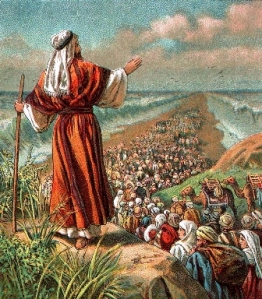
Bible card Illustration published 1907  by Providence Lithograph Company

Bible card Illustration published 1907
by Providence Lithograph Company

Last week, in our Old Testament Study, we looked at the Song of Moses and how it served as a model for true worship and thanksgiving to our Heavenly Father.

As a quick review, the nation of Israel has been led out of Egypt. By the Mighty Hand of God Pharoah was utterly defeated and put to open shame before the nations as his army was utterly destroyed by God who parted the Red Sea for His people and then closed upon the Egyptian Army. In the aftermath of that destruction, the nation of Israel praised God and they sang the Song of Moses, praising God for His might work of Salvation. A song that we, too, will sing standing along the shores of the great sea of glass mingled with fire (Revelation 15), praising God for His work of Salvation.

The Provision of God

Now, Israel is truly free from the slavery of Egypt. They are separated from the house of slavery by the waters that God had used to crush the Egyptian army. Though they have been delivered out of the hands of Pharaoh and are now clearly under the protection of the One True God (who could deny His Mighty Works?) under the supervision of Moses. While we might be tempted to simply read on through as though reading a novel, stop and think about all that has happened. If this were a movie, the ending credits would have been rolling during the Song of Moses and the film would fade to black. But this isn’t a movie, these are real events in history. The biggest question probably in many minds is, “Now what?” As long as Israel is looking at the waters and the floating debris they are thinking about how awesomely God worked to rescue them from that army, but as soon as they turn around, they realize they are not in the Promised Land, they are in-fact in the wilderness. That would be daunting enough a thought if you were standing with your family, extended family, maybe even your church congregation. Do you remember how many people had left Egypt? Let’s turn back to chapter 12 for just a moment:

Exodus 12:37-39 (ESV) 37 And the people of Israel journeyed from Rameses to Succoth, about six hundred thousand men on foot, besides women and children. 38 A mixed multitude also went up with them, and very much livestock, both flocks and herds.39 And they baked unleavened cakes of the dough that they had brought out of Egypt, for it was not leavened, because they were thrust out of Egypt and could not wait, nor had they prepared any provisions for themselves.

Woah! 600,000 men plus women, children, and a mixed multitude and livestock. Remember that livestock was what the sons of Israel noted as their profession when they were given the land of Goshen by Pharaoh in the time of Joseph. Before they were slaves, they were herdsmen.

Genesis 47:1-3 (ESV) | Jacob’s Family Settles in Goshen
47 So Joseph went in and told Pharaoh, “My father and my brothers, with their flocks and herds and all that they possess, have come from the land of Canaan. They are now inthe land of Goshen.” 2 And from among his brothers he took five men and presented them to Pharaoh. 3 Pharaoh said to his brothers, “What is your occupation?” And they said to Pharaoh, “Your servants are shepherds, as our fathers were.

Now they were all on the other side of the Red Sea, in the wilderness, without provisions. They had unleavened bread, but for a people who knew no such luxuries as grocery stores, convenience stores, nor fast-food restaurants, the idea of making provisions for a long journey extend well beyond having some unleavened bread. How do the children of Israel respond? Let us turn now to Exodus 16.

Exodus 16 (ESV) | Bread from Heaven

They set out from Elim, and all the congregation of the people of Israel came to the wilderness of Sin, which is between Elim and Sinai, on the fifteenth day of the second month after they had departed from the land of Egypt. And the whole congregation of the people of Israel grumbled against Moses and Aaron in the wilderness, and the people of Israel said to them, “Would that we had died by the hand of the Lord in the land of Egypt, when we sat by the meat pots and ate bread to the full, for you have brought us out into this wilderness to kill this whole assembly with hunger.”

I’m actually fairly impressed that so many people walking in the wilderness went that long (2.5 months?) on the scant provisions they had left Egypt with. Nevertheless, they burn through what little they had from Egypt and by now the Mighty Hand of God was sooo 2 months ago. Do people evolve? No, no we don’t. Our technology might, but we don’t. The whole congregation grumbled against Moses and Aaron. And what are they saying? Would that we had died by the hand of the Lord in the land of Egypt, when we sat by the meat pots and ate bread to the full… our fallen flesh is so weak and completely turned in on itself. They would rather die in slavery with full stomachs than be free, following Moses toward the Land of Promise on an empty stomach. Not only that, but they accuse Moses and Aaron of malice, having brought all of these people into the wilderness to die of hunger. They’ve lost sight of the Promise, and long for what used to be considered comfort… in the house of slavery. In the Parable of the Sower, the children of Israel here are demonstrating the rocky soil, Matthew 13:21 (ESV)21 yet he has no root in himself, but endures for a while, and when tribulation or persecution arises on account of the word, immediately he falls away.” We mentioned it before when Israel thought they were going to get slaughtered by Pharaoh’s army, but now their hunger is what has them falling away, losing their faith in the Promise.

Then the Lord said to Moses, “Behold, I am about to rain bread from heaven for you, and the people shall go out and gather a day’s portion every day, that I may test them, whether they will walk in my law or not. On the sixth day, when they prepare what they bring in, it will be twice as much as they gather daily.” So Moses and Aaron said to all the people of Israel, “At evening you shall know that it was the Lord who brought you out of the land of Egypt, and in the morning you shall see the glory of the Lord, because he has heard your grumbling against the Lord. For what are we, that you grumble against us?” And Moses said, “When the Lord gives you in the evening meat to eat and in the morning bread to the full, because the Lord has heard your grumbling that you grumble against him—what are we? Your grumbling is not against us but against the Lord.”

So, hold on just a second… the Law has not yet been officially given. I’m not saying God hasn’t revealed His laws, or statutes, but when we currently talk about the Law, we look back to when God gives Moses the Law on the tablets of the Testimony on Mount Sinai. But in this story we have not yet reached Mount Sinai. God has issued commands and in this new command God specifies that He is testing His people, the ones He has already pulled out of Egypt, whether they will walk in His Law or not. God already knows the hearts of every person, He’s not testing for His sake, but for ours. What is the purpose of the Law? To expose sin. No one will walk in His Law until Jesus Christ comes to fulfill the Law for us. Here we see the first Law regarding the Sabbath, and it comes in reference to the provision of the Lord God. God will rain down bread from heaven, to meet their needs for the day, until the 6th day, where they will receive a double portion.

Then Moses said to Aaron, “Say to the whole congregation of the people of Israel, ‘Come near before the Lord, for he has heard your grumbling.’” 10 And as soon as Aaron spoke to the whole congregation of the people of Israel, they looked toward the wilderness, and behold, the glory of the Lord appeared in the cloud. 11 And the Lord said to Moses, 12 “I have heard the grumbling of the people of Israel. Say to them, ‘At twilight you shall eat meat, and in the morning you shall be filled with bread. Then you shall know that I am the Lord your God.’

13 In the evening quail came up and covered the camp, and in the morning dew lay around the camp. 14 And when the dew had gone up, there was on the face of the wilderness a fine, flake-like thing, fine as frost on the ground. 15 When the people of Israel saw it, they said to one another, “What is it?” For they did not know what it was. And Moses said to them, “It is the bread that the Lord has given you to eat. 16 This is what the Lord has commanded: ‘Gather of it, each one of you, as much as he can eat. You shall each take an omer, according to the number of the persons that each of you has in his tent.’” 17 And the people of Israel did so. They gathered, some more, some less. 18 But when they measured it with an omer, whoever gathered much had nothing left over, and whoever gathered little had no lack. Each of them gathered as much as he could eat.19 And Moses said to them, “Let no one leave any of it over till the morning.” 20 But they did not listen to Moses. Some left part of it till the morning, and it bred worms and stank. And Moses was angry with them. 21 Morning by morning they gathered it, each as much as he could eat; but when the sun grew hot, it melted.

22 On the sixth day they gathered twice as much bread, two omers each. And when all the leaders of the congregation came and told Moses, 23 he said to them, “This is what the Lord has commanded: ‘Tomorrow is a day of solemn rest, a holy Sabbath to the Lord; bake what you will bake and boil what you will boil, and all that is left over lay aside to be kept till the morning.’” 24 So they laid it aside till the morning, as Moses commanded them, and it did not stink, and there were no worms in it. 25 Moses said, “Eat it today, fortoday is a Sabbath to the Lord; today you will not find it in the field. 26 Six days you shall gather it, but on the seventh day, which is a Sabbath, there will be none.”

The Lord will provide for His people, so that they will know that He is the Lord their God. They needed to let go of Egypt. They were free from the house of slavery, by a Mighty Hand of God, but their hearts still turned toward Egypt whenever they grumbled against the Lord. God now demonstrates His superior greatness by raining bread from heaven to meet all of their needs. Those who gathered much did not have excess and those who gathered little lacked nothing. How were they performing in their test? Not well. A stark reminder that our sinful state isn’t just a matter of a lack of effort or knowledge, it is a failure in our being, our flesh is cursed by sin, and we have fallen away from the perfection of God.

27 On the seventh day some of the people went out to gather, but they found none. 28 And the Lord said to Moses, “How long will you refuse to keep my commandments and my laws? 29 See! The Lord has given you the Sabbath; therefore on the sixth day he gives you bread for two days. Remain each of you in his place; let no one go out of his place on the seventh day.” 30 So the people rested on the seventh day.

Notice the wording God used in his rebuke directed at the people in verse 29, “the Lord has given you the Sabbath”. Let’s jump ahead at how Jesus responded to the Pharisees who accused Jesus and His disciples of breaking the Sabbath according to their tradition.

Mark 2:27-28 (ESV) 27 And he said to them, “The Sabbath was made for man, not man for the Sabbath. 28 So the Son of Man is lord even of the Sabbath.”

The failure of Israel to obey is foreshadowing the reality that despite the Grace and Mercy of God the Father throughout the history of Israel, man will refuse to keep His commandments and laws. With this question fresh in our minds, let’s take a peek at what Jesus said in Matthew 5:

Matthew 5:17-18 (ESV)| Christ Came to Fulfill the Law
17 “Do not think that I have come to abolish the Law or the Prophets; I have not come to abolish them but to fulfill them. 18 For truly, I say to you, until heaven and earth pass away, not an iota, not a dot, will pass from the Law until all is accomplished.

The Law continues to do what it was intended to do, convict us of sin while testifying of God’s Greatness and Perfection. But Christ came to fulfill the Law and the Prophets, and when He returns all will be accomplished. The keeping the Law is not the means of Salvation; it points out how lost we are. Salvation is by faith in the Promise of God. The Apostle Paul lays this out very well in Romans (particularly the first 8 chapters), but let us look at just a portion for now.

Romans 3:19-31 (ESV) | The Righteousness of God Through Faith
19 Now we know that whatever the law says it speaks to those who are under the law, so that every mouth may be stopped, and the whole world may be held accountable to God.20 For by works of the law no human being will be justified in his sight, since through the law comes knowledge of sin.

21 But now the righteousness of God has been manifested apart from the law, although the Law and the Prophets bear witness to it— 22 the righteousness of God through faith in Jesus Christ for all who believe. For there is no distinction: 23 for all have sinned and fall short of the glory of God, 24 and are justified by his grace as a gift, through the redemption that is in Christ Jesus, 25 whom God put forward as a propitiation by his blood, to be received by faith. This was to show God’s righteousness, because in his divine forbearance he had passed over former sins. 26 It was to show his righteousness at the present time, so that he might be just and the justifier of the one who has faith in Jesus.

27 Then what becomes of our boasting? It is excluded. By what kind of law? By a law of works? No, but by the law of faith. 28 For we hold that one is justified by faith apart from works of the law. 29 Or is God the God of Jews only? Is he not the God of Gentiles also? Yes, of Gentiles also, 30 since God is one—who will justify the circumcised by faith and the uncircumcised through faith. 31 Do we then overthrow the law by this faith? By no means! On the contrary, we uphold the law.

We will jump more heavily into Hebrews and in Romans once we reach the Law given at Horeb (Mt Sinai), but for now, let us close out Exodus chapter 16.

Exodus 16:31-36 (ESV)

31 Now the house of Israel called its name manna. It was like coriander seed, white, and the taste of it was like wafers made with honey. 32 Moses said, “This is what the Lord has commanded: ‘Let an omer of it be kept throughout your generations, so that they may see the bread with which I fed you in the wilderness, when I brought you out of the land of Egypt.’” 33 And Moses said to Aaron, “Take a jar, and put an omer of manna in it, and place it before the Lord to be kept throughout your generations.” 34 As the Lord commanded Moses, so Aaron placed it before the testimony to be kept. 35 The people of Israel ate the manna forty years, till they came to a habitable land. They ate the manna till they came to the border of the land of Canaan. 36 (An omer is the tenth part of an ephah.)

I love how this reminder of what God had done for Israel, this miraculous provision doesn’t point backward to Egypt, rather, it points forward to Christ. So often we get this wrong picture in our minds that sharing a testimony involves highlighting the sin in our lives “before we were Saved”, but that only glorifies Egypt, the house of slavery. The testimony that matters, is the one that points to Christ. In closing, let us turn now to John 6, where Jesus taught us how to rightly understand what God was doing here in Exodus 16.

John 6:26-71 (ESV)26 Jesus answered them, “Truly, truly, I say to you, you are seeking me, not because you saw signs, but because you ate your fill of the loaves. 27 Do not work for the food that perishes, but for the food that endures to eternal life, which the Son of Man will give to you. For on him God the Father has set his seal.” 28 Then they said to him, “What must we do, to be doing the works of God?” 29 Jesus answered them, “This is the work of God, that you believe in him whom he has sent.” 30 So they said to him, “Then what sign do you do, that we may see and believe you? What work do you perform? 31 Our fathers ate the manna in the wilderness; as it is written, ‘He gave them bread from heaven to eat.’”32 Jesus then said to them, “Truly, truly, I say to you, it was not Moses who gave you the bread from heaven, but my Father gives you the true bread from heaven. 33 For the bread of God is he who comes down from heaven and gives life to the world.” 34 They said to him, “Sir, give us this bread always.”

35 Jesus said to them, “I am the bread of life; whoever comes to me shall not hunger, and whoever believes in me shall never thirst. 36 But I said to you that you have seen me and yet do not believe. 37 All that the Father gives me will come to me, and whoever comes to me I will never cast out. 38 For I have come down from heaven, not to do my own will but the will of him who sent me. 39 And this is the will of him who sent me, that I should lose nothing of all that he has given me, but raise it up on the last day. 40 For this is the will of my Father, that everyone who looks on the Son and believes in him should have eternal life, and I will raise him up on the last day.”

41 So the Jews grumbled about him, because he said, “I am the bread that came down from heaven.” 42 They said, “Is not this Jesus, the son of Joseph, whose father and mother we know? How does he now say, ‘I have come down from heaven’?” 43 Jesus answered them, “Do not grumble among yourselves. 44 No one can come to me unless the Father who sent me draws him. And I will raise him up on the last day. 45 It is written in the Prophets, ‘And they will all be taught by God.’ Everyone who has heard and learned from the Father comes to me— 46 not that anyone has seen the Father except he who is from God; he has seen the Father. 47 Truly, truly, I say to you, whoever believes has eternal life. 48 I am the bread of life. 49 Your fathers ate the manna in the wilderness, and they died. 50 This is the bread that comes down from heaven, so that one may eat of it and not die. 51 I am the living bread that came down from heaven. If anyone eats of this bread, he will live forever. And the bread that I will give for the life of the world is my flesh.

52 The Jews then disputed among themselves, saying, “How can this man give us his flesh to eat?” 53 So Jesus said to them, “Truly, truly, I say to you, unless you eat the flesh of the Son of Man and drink his blood, you have no life in you. 54 Whoever feeds on my flesh and drinks my blood has eternal life, and I will raise him up on the last day. 55 For my flesh is true food, and my blood is true drink. 56 Whoever feeds on my flesh and drinks my blood abides in me, and I in him. 57 As the living Father sent me, and I live because of the Father, so whoever feeds on me, he also will live because of me. 58 This is the bread that came down from heaven, not like the bread the fathers ate, and died. Whoever feeds on this bread will live forever.” 59 Jesus said these things in the synagogue, as he taught at Capernaum.

60 When many of his disciples heard it, they said, “This is a hard saying; who can listen to it?” 61 But Jesus, knowing in himself that his disciples were grumbling about this, said to them, “Do you take offense at this? 62 Then what if you were to see the Son of Man ascending to where he was before? 63 It is the Spirit who gives life; the flesh is no help at all. The words that I have spoken to you are spirit and life. 64 But there are some of you who do not believe.” (For Jesus knew from the beginning who those were who did not believe, and who it was who would betray him.) 65 And he said, “This is why I told you that no one can come to me unless it is granted him by the Father.”

66 After this many of his disciples turned back and no longer walked with him. 67 So Jesus said to the Twelve, “Do you want to go away as well?” 68 Simon Peter answered him, “Lord, to whom shall we go? You have the words of eternal life, 69 and we have believed, and have come to know, that you are the Holy One of God.” 70 Jesus answered them, “Did I not choose you, the Twelve? And yet one of you is a devil.” 71 He spoke of Judas the son of Simon Iscariot, for he, one of the Twelve, was going to betray him.

I know we took this well beyond our target word limit, but I firmly believe this was well worth it. What we feast on here is the Word of God, the Words of Life, the Testimony and the Gospel of Jesus Christ, Son of the Living God, our Savior and Our Lord. He is the mana from Heaven, who ascended back into Heaven and who is returning to take His people to the Promised Land, where we will be with Him forever, Amen.

1 Thessalonians 4:13-18 (ESV)| The Coming of the Lord
13 But we do not want you to be uninformed, brothers, about those who are asleep, that you may not grieve as others do who have no hope. 14 For since we believe that Jesus died and rose again, even so, through Jesus, God will bring with him those who have fallen asleep. 15 For this we declare to you by a word from the Lord, that we who are alive, who are left until the coming of the Lord, will not precede those who have fallen asleep. 16 For the Lord himself will descend from heaven with a cry of command, with the voice of an archangel, and with the sound of the trumpet of God. And the dead in Christ will rise first. 17 Then we who are alive, who are left, will be caught up together with them in the clouds to meet the Lord in the air, and so we will always be with the Lord. 18 Therefore encourage one another with these words.

May the Grace of God be with you today and forever,
In Christ Jesus,
Jorge
OT | The Song of Moses

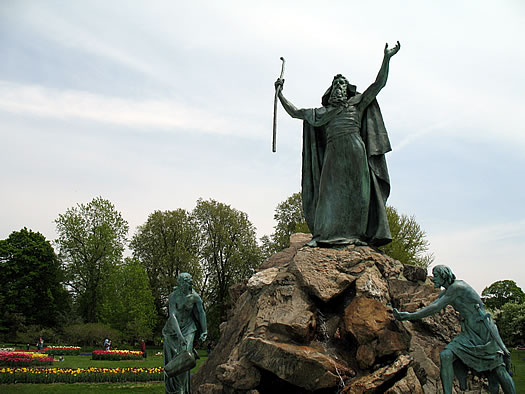
Illustration from a Bible card published 1907  by the Providence Lithograph Company

Illustration from a Bible card published 1907
by the Providence Lithograph Company

Last week, in our Old Testament Study, we looked at the Crossing of the Red Sea. As we’ve explored many times before, this is a picture of our salvation out of the kingdom of darkness, and of the baptism into the death and resurrection of Jesus Christ. In this foreshadowing, we see how the kingdom of darkness was put to open shame at the cross of Jesus, in the same way that Egypt was put to shame when the waters came crashing down onto the Egyptian army and they were utterly destroyed. This week we will pick up in the next chapter for a look at what true worship looks like.

Thus the Lord Saved Israel

Let us start off with a reminder of the salvation of Israel by the Mighty Hand of God.

Exodus 14:26-31 (ESV) 26 Then the Lord said to Moses, “Stretch out your hand over the sea, that the water may come back upon the Egyptians, upon their chariots, and upon their horsemen.” 27 So Moses stretched out his hand over the sea, and the sea returned to its normal course when the morning appeared. And as the Egyptians fled into it, the Lord threw the Egyptians into the midst of the sea. 28 The waters returned and covered the chariots and the horsemen; of all the host of Pharaoh that had followed them into the sea, not one of them remained. 29 But the people of Israel walked on dry ground through the sea, the waters being a wall to them on their right hand and on their left. 30 Thus the Lord saved Israel that day from the hand of the Egyptians, and Israel saw the Egyptians dead on the seashore. 31 Israel saw the great power that the Lord used against the Egyptians, so the people feared the Lord, and they believed in the Lord and in his servant Moses.

This closing statement is a powerful foreshadowing of the Gospel of Jesus Christ. Where Moses foreshadows Jesus, the servant of the Lord, who is the Son of the Living God. Moses is not equal with Jesus, he merely foreshadows what Jesus will do, Once and For All.

Israel Worshiped the Lord God

Exodus 15:1-21 (ESV) | The Song of Moses

15 Then Moses and the people of Israel sang this song to the Lord, saying,

“I will sing to the Lord, for he has triumphed gloriously;
    the horse and his rider he has thrown into the sea.
The Lord is my strength and my song,
    and he has become my salvation;
this is my God, and I will praise him,
    my father’s God, and I will exalt him.
The Lord is a man of war;
    the Lord is his name.

“Pharaoh’s chariots and his host he cast into the sea,
    and his chosen officers were sunk in the Red Sea.
The floods covered them;
    they went down into the depths like a stone.
Your right hand, O Lord, glorious in power,
    your right hand, O Lord, shatters the enemy.
In the greatness of your majesty you overthrow your adversaries;
    you send out your fury; it consumes them like stubble.
At the blast of your nostrils the waters piled up;
    the floods stood up in a heap;
    the deeps congealed in the heart of the sea.
The enemy said, ‘I will pursue, I will overtake,
    I will divide the spoil, my desire shall have its fill of them.
    I will draw my sword; my hand shall destroy them.’
10 You blew with your wind; the sea covered them;
    they sank like lead in the mighty waters.

11 “Who is like you, O Lord, among the gods?
    Who is like you, majestic in holiness,
    awesome in glorious deeds, doing wonders?
12 You stretched out your right hand;
    the earth swallowed them.

13 You have led in your steadfast love the people whom you have redeemed;
    you have guided them by your strength to your holy abode.
14 The peoples have heard; they tremble;
    pangs have seized the inhabitants of Philistia.
15 Now are the chiefs of Edom dismayed;
    trembling seizes the leaders of Moab;
    all the inhabitants of Canaan have melted away.
16 Terror and dread fall upon them;
    because of the greatness of your arm, they are still as a stone,
till your people, O Lord, pass by,
    till the people pass by whom you have purchased.
17 You will bring them in and plant them on your own mountain,
    the place, O Lord, which you have made for your abode,
    the sanctuary, O Lord, which your hands have established.
18 The Lord will reign forever and ever.

19 For when the horses of Pharaoh with his chariots and his horsemen went into the sea, the Lord brought back the waters of the sea upon them, but the people of Israel walked on dry ground in the midst of the sea. 20 Then Miriam the prophetess, the sister of Aaron, took a tambourine in her hand, and all the women went out after her with tambourines and dancing. 21 And Miriam sang to them:

Sing to the Lord, for he has triumphed gloriously;
the horse and his rider he has thrown into the sea.”

Let’s talk about worship. There has been worship throughout time since the Creation, but here we see man singing a song of praise and worship to the Lord for who He is and what He has done. Take a moment to scan back through the song to see if in any place the children of Israel were singing about what they will do, can do, are about to do, or any victory they’ve secured as a result of their being the chosen ones of God. What are the “I” portions? I will sing to, I will praise, and I will exalt Him. This is the model for the praise and worship that flows from knowing you are redeemed, that you have been brought through the waters into the kingdom of Heaven by the Hand of God and His servant, Jesus Christ. When the song declares the Lord to be their strength notice they don’t complete that thought by declaring their strength; rather, they praise God for what He did by His might, by His strength. The itemized praise here is specific to the wondrous deeds of the Lord, and we should do likewise. Actually, we will do likewise. Let’s turn for a moment to the Book of Revelation.

Revelation 15 (ESV) | The Seven Angels with Seven Plagues

15 Then I saw another sign in heaven, great and amazing, seven angels with seven plagues, which are the last, for with them the wrath of God is finished.

And I saw what appeared to be a sea of glass mingled with fire—and also those who had conquered the beast and its image and the number of its name, standing beside the sea of glass with harps of God in their hands. And they sing the song of Moses, the servant of God, and the song of the Lamb, saying,

“Great and amazing are your deeds,
    O Lord God the Almighty!
Just and true are your ways,
    O King of the nations!
Who will not fear, O Lord,
    and glorify your name?
For you alone are holy.
    All nations will come
    and worship you,
for your righteous acts have been revealed.”

After this I looked, and the sanctuary of the tent of witness in heaven was opened, and out of the sanctuary came the seven angels with the seven plagues, clothed in pure, bright linen, with golden sashes around their chests. And one of the four living creatures gave to the seven angels seven golden bowls full of the wrath of God who lives forever and ever, and the sanctuary was filled with smoke from the glory of God and from his power, and no one could enter the sanctuary until the seven plagues of the seven angels were finished.

The Word of God is absolutely wonderful. Notice the setting of the vision, in verse 2 we see that the singing multitude is standing beside the sea of glass. In the Exodus account, they were on the shores of the Red Sea, witnesses to the victory secured by God. Here, in Revelation 15, these standing here are those who had conquered the beast and its image and the number of its name. And they sing the song of Moses, the servant of God. Notice this song is also the song of the Lamb, Jesus, our Passover Lamb, sacrificed for our redemption. This song is condensed, but remains the same song, the song of Salvation. A song sung to the Lord God by His children.

Now, this passage in Revelation moves on immediately to the seven angels with the seven plagues coming out of the sanctuary of the tent of witness. We have yet to see the earthly copy of this sanctuary, but notice that no one could enter the sanctuary until the seven plagues of the seven angels were finished. These plagues are judgment about to be poured out onto the earth, onto those who have received the mark of the beast, and when they fall on the people, the people will curse God and will not repent of their sin (Revelation 16). Let’s go back to Exodus 15 to see how it closes out.

I Am the Lord Your Healer

Exodus 15:22-27 (ESV) | Bitter Water Made Sweet

22 Then Moses made Israel set out from the Red Sea, and they went into the wilderness of Shur. They went three days in the wilderness and found no water. 23 When they came to Marah, they could not drink the water of Marah because it was bitter; therefore it was named Marah. 24 And the people grumbled against Moses, saying, “What shall we drink?” 25 And he cried to the Lord, and the Lord showed him a log, and he threw it into the water, and the water became sweet.

There the Lord made for them a statute and a rule, and there he tested them, 26 saying, “If you will diligently listen to the voice of the Lord your God, and do that which is right in his eyes, and give ear to his commandments and keep all his statutes, I will put none of the diseases on you that I put on the Egyptians, for I am the Lord, your healer.”

27 Then they came to Elim, where there were twelve springs of water and seventy palm trees, and they encamped there by the water.

Without delving too heavily into man-made eschatological doctrines, I think the close parallel between Revelation 15 and Exodus 15 is significant, and serves as an encouragement to Believers. The plagues being poured out on the earth, whether the saints have already been wiped out (by persecution) or whether they remain on the earth, will not suffer from these plagues, for the Lord is our Healer. If your eye keeps fixating on the “if you diligently listen…” remember that by faith we put away our old selves and rest in the Righteousness of Christ. He fulfilled the Law and bore the full wrath of God at the cross in our place. Therefore, this serves as a promise, a hope, sealed by God the Holy Spirit for all who believe in Christ. With this thought firmly in our minds, let us close out this topic with a visit to the Book of Deuteronomy. Here, Moses had recorded the Law given to him by God, and Joshua has been designated to succeed Moses and lead Israel into the Promised Land (in this way, Joshua foreshadows Jesus, too).

Deuteronomy 31:30 (ESV) | The Song of Moses

30 Then Moses spoke the words of this song until they were finished, in the ears of all the assembly of Israel:

Deuteronomy 32 (ESV)
32 “Give ear, O heavens, and I will speak,
and let the earth hear the words of my mouth.
2 May my teaching drop as the rain,
my speech distill as the dew,
like gentle rain upon the tender grass,
and like showers upon the herb.
For I will proclaim the name of the Lord;
    ascribe greatness to our God!
4 “The Rock, his work is perfect,
    for all his ways are justice.
A God of faithfulness and without iniquity,
    just and upright is he.
5 They have dealt corruptly with him;
they are no longer his children because they are blemished;
they are a crooked and twisted generation.
6 Do you thus repay the Lord,
you foolish and senseless people?
Is not he your father, who created you,
    who made you and established you?
7 Remember the days of old;
consider the years of many generations;
ask your father, and he will show you,
your elders, and they will tell you.
8 When the Most High gave to the nations their inheritance,
    when he divided mankind,
he fixed the borders of the peoples
    according to the number of the sons of God.
9 But the Lord’s portion is his people,
Jacob his allotted heritage.
10 “He found him in a desert land,
and in the howling waste of the wilderness;
he encircled him, he cared for him,
he kept him as the apple of his eye.
11 Like an eagle that stirs up its nest,
that flutters over its young,
spreading out its wings, catching them,
bearing them on its pinions,
12 the Lord alone guided him,
no foreign god was with him.
13 He made him ride on the high places of the land,
and he ate the produce of the field,
and he suckled him with honey out of the rock,
and oil out of the flinty rock.
14 Curds from the herd, and milk from the flock,
with fat of lambs,
rams of Bashan and goats,
with the very finest of the wheat—
and you drank foaming wine made from the blood of the grape.
15 “But Jeshurun grew fat, and kicked;
you grew fat, stout, and sleek;
then he forsook God who made him
and scoffed at the Rock of his salvation.
16 They stirred him to jealousy with strange gods;
with abominations they provoked him to anger.
17 They sacrificed to demons that were no gods,
to gods they had never known,
to new gods that had come recently,
whom your fathers had never dreaded.
18 You were unmindful of the Rock that bore you,
    and you forgot the God who gave you birth.
19 “The Lord saw it and spurned them,
because of the provocation of his sons and his daughters.
20 And he said, ‘I will hide my face from them;
I will see what their end will be,
for they are a perverse generation,
children in whom is no faithfulness.
21 They have made me jealous with what is no god;
they have provoked me to anger with their idols.
So I will make them jealous with those who are no people;
I will provoke them to anger with a foolish nation.
22 For a fire is kindled by my anger,
and it burns to the depths of Sheol,
devours the earth and its increase,
and sets on fire the foundations of the mountains.
23 “‘And I will heap disasters upon them;
I will spend my arrows on them;
24 they shall be wasted with hunger,
and devoured by plague
and poisonous pestilence;
I will send the teeth of beasts against them,
with the venom of things that crawl in the dust.
25 Outdoors the sword shall bereave,
and indoors terror,
for young man and woman alike,
the nursing child with the man of gray hairs.
26 I would have said, “I will cut them to pieces;
I will wipe them from human memory,”
27 had I not feared provocation by the enemy,
lest their adversaries should misunderstand,
lest they should say, “Our hand is triumphant,
    it was not the Lord who did all this.”’
28 “For they are a nation void of counsel,
and there is no understanding in them.
29 If they were wise, they would understand this;
they would discern their latter end!
30 How could one have chased a thousand,
and two have put ten thousand to flight,
unless their Rock had sold them,
and the Lord had given them up?
31 For their rock is not as our Rock;
our enemies are by themselves.
32 For their vine comes from the vine of Sodom
and from the fields of Gomorrah;
their grapes are grapes of poison;
their clusters are bitter;
33 their wine is the poison of serpents
and the cruel venom of asps.
34 “‘Is not this laid up in store with me,
sealed up in my treasuries?
35 Vengeance is mine, and recompense,
    for the time when their foot shall slip;
for the day of their calamity is at hand,
    and their doom comes swiftly.’
36 For the Lord will vindicate his people
    and have compassion on his servants,
when he sees that their power is gone
    and there is none remaining, bond or free.
37 Then he will say, ‘Where are their gods,
the rock in which they took refuge,
38 who ate the fat of their sacrifices
and drank the wine of their drink offering?
Let them rise up and help you;
let them be your protection!
39 “‘See now that I, even I, am he,
    and there is no god beside me;
I kill and I make alive;
    I wound and I heal;
    and there is none that can deliver out of my hand.
40 For I lift up my hand to heaven
    and swear, As I live forever,
41 if I sharpen my flashing sword
    and my hand takes hold on judgment,
I will take vengeance on my adversaries
    and will repay those who hate me.
42 I will make my arrows drunk with blood,
    and my sword shall devour flesh—
with the blood of the slain and the captives,
    from the long-haired heads of the enemy.’
43 “Rejoice with him, O heavens;
    bow down to him, all gods,
for he avenges the blood of his children
    and takes vengeance on his adversaries.
He repays those who hate him
    and cleanses his people’s land.”
44 Moses came and recited all the words of this song in the hearing of the people, he and Joshua the son of Nun. 45 And when Moses had finished speaking all these words to all Israel, 46 he said to them, “Take to heart all the words by which I am warning you today, that you may command them to your children, that they may be careful to do all the words of this law. 47 For it is no empty word for you, but your very life, and by this word you shall live long in the land that you are going over the Jordan to possess.”

When we read these words through the lens of the New Testament, we see all the more the Greatness of our God and the beauty of the Gospel of Jesus Christ. Though Israel may have understood that Moses was speaking of the contrast of the children of Israel and those who inhabited the land of Canaan, but we know that this speaks to something greater, it speaks of those in the kingdom of darkness and we who are born-again, into the Kingdom of Heaven. We may revisit this again soon, because there is so much going in here, but for now, may I recommend reading through Romans 1, how Paul describes the sin of the world, and how Moses speaks here in verses 5 and 6. I also found it interesting how verses 26 and 27 give a different perspective on the “why” God didn’t just eradicate man for his sin… so that His enemies will not falsely claim their own victory over God’s children. Soli Deo Gloria also applies to God’s Grace in that even when He is righteous and just to exterminate all of Creation for sin, His grace serves His glory greater. All praise be the God the Father, Creator of Heaven and Earth, and to His Son, in whom we have redemption, the forgiveness of sins.

Jude 1:24-25 (ESV) | Doxology

24 Now to him who is able to keep you from stumbling and to present you blameless before the presence of his glory with great joy, 25 to the only God, our Savior, through Jesus Christ our Lord, be glory, majesty, dominion, and authority, before all time and now and forever. Amen.

May the Grace of God be with you today and always,
In Christ Jesus,
Jorge

OT | Crossing the Red Sea

Illustration from a Bible card published 1907  by the Providence Lithograph Company

Illustration from a Bible card published 1907
by the Providence Lithograph Company

Last week, in our Old Testament Study, we looked at Consecration and Redemption of the Firstborn in Exodus 13 and how it points to Christ as explained in the New Testament. This week, we will continue in Exodus 13 as we examine Israel’s crossing of the Red Sea and how that points ahead to our salvation and baptism.

Reminder of the Strong Hand of God

Let us start off with a reminder of the explanation God gave for the statue of consecrating and redeeming the firstborn.

Exodus 13:13-16 (ESV)

13 Every firstborn of a donkey you shall redeem with a lamb, or if you will not redeem it you shall break its neck. Every firstborn of man among your sons you shall redeem.14 And when in time to come your son asks you, ‘What does this mean?’ you shall say to him, ‘By a strong hand the Lord brought us out of Egypt, from the house of slavery. 15 For when Pharaoh stubbornly refused to let us go, the Lord killed all the firstborn in the land of Egypt, both the firstborn of man and the firstborn of animals. Therefore I sacrifice to the Lord all the males that first open the womb, but all the firstborn of my sons I redeem.’16 It shall be as a mark on your hand or frontlets between your eyes, for by a strong hand the Lord brought us out of Egypt.”

This isn’t the first time we see this declaration. The same was provided as an explanation for the feast of unleavened bread and the Passover. What follows next is a return to the historical narrative from the legal prescriptions of remembrance of the exodus. All of Israel has left the service of Pharoah, with Egypt’s plunder and a hope of being taken to the lands promised to Abraham, the Land of the Canaanites, the Land flowing with milk and honey. Let us take a moment to remind ourselves of this covenant made between God and Abram.

Genesis 17:1-10 (ESV) | Abraham and the Covenant of Circumcision

When Abram was ninety-nine years old the Lord appeared to Abram and said to him, “I am God Almighty; walk before me, and be blameless, that I may make my covenant between me and you, and may multiply you greatly. Then Abram fell on his face. And God said to him, “Behold, my covenant is with you, and you shall be the father of a multitude of nations. No longer shall your name be called Abram, but your name shall be Abraham, for I have made you the father of a multitude of nations. I will make you exceedingly fruitful, and I will make you into nations, and kings shall come from you.And I will establish my covenant between me and you and your offspring after you throughout their generations for an everlasting covenant, to be God to you and to your offspring after you. And I will give to you and to your offspring after you the land of your sojournings, all the land of Canaan, for an everlasting possession, and I will be their God.” And God said to Abraham, “As for you, you shall keep my covenant, you and your offspring after you throughout their generations. 10 This is my covenant, which you shall keep, between me and you and your offspring after you: Every male among you shall be circumcised.

This is the covenant of Abraham, of the circumcision. God promised the land of Canaan as an everlasting possession. The children of Israel feared Pharoah, and to say they were reticent to have Moses promise them that God had sent him to them to lead them to the Promised Land would be a huge under statement. Slavery is all these people knew. No doubt that is why God has made it plain to them that the Passover, the unleavened bread, and the consecration of the firstborn are a testimony to what the Lord God has done for Israel, bringing them out of the House of Slavery (Egypt).  What we will see here, though, that their soil is indeed rocky (Parable of the Sower). Let’s continue in the historical narrative of Exodus 13.

Exodus 13:17-22 (ESV) | Pillars of Cloud and Fire

17 When Pharaoh let the people go, God did not lead them by way of the land of the Philistines, although that was near. For God said, “Lest the people change their minds when they see war and return to Egypt.” 18 But God led the people around by the way of the wilderness toward the Red Sea. And the people of Israel went up out of the land of Egypt equipped for battle. 19 Moses took the bones of Joseph with him, for Joseph had made the sons of Israel solemnly swear, saying, “God will surely visit you, and you shall carry up my bones with you from here.” 20 And they moved on from Succoth and encamped at Etham, on the edge of the wilderness. 21 And the Lord went before them by day in a pillar of cloud to lead them along the way, and by night in a pillar of fire to give them light, that they might travel by day and by night. 22 The pillar of cloud by day and the pillar of fire by night did not depart from before the people.

God knows our hearts. He sees the quality of the soil and knows that they are not yet ready to endure the sight of the Philistines. So the Lord leads them by a pillar of cloud by day and a pillar of fire by night into the wilderness. While He is leading the people miraculously, and mightily, their faith is yet very weak. Let’s continue reading into the next chapter.

Exodus 14:1-9 (ESV) | Crossing the Red Sea

14 Then the Lord said to Moses, “Tell the people of Israel to turn back and encamp in front of Pi-hahiroth, between Migdol and the sea, in front of Baal-zephon; you shall encamp facing it, by the sea. For Pharaoh will say of the people of Israel, ‘They are wandering in the land; the wilderness has shut them in.’ And I will harden Pharaoh’s heart, and he will pursue them, and I will get glory over Pharaoh and all his host, and the Egyptians shall know that I am the Lord.” And they did so.

When the king of Egypt was told that the people had fled, the mind of Pharaoh and his servants was changed toward the people, and they said, “What is this we have done, that we have let Israel go from serving us?” 6 So he made ready his chariot and took his army with him, and took six hundred chosen chariots and all the other chariots of Egypt with officers over all of them. And the Lord hardened the heart of Pharaoh king of Egypt, and he pursued the people of Israel while the people of Israel were going out defiantly. The Egyptians pursued them, all Pharaoh’s horses and chariots and his horsemen and his army, and overtook them encamped at the sea, by Pi-hahiroth, in front of Baal-zephon.

Where these places point on the modern map I cannot say with certainty. It is interesting here that the Lord chooses the location for Israel’s encounter with Pharaoh’s men. God chose a location facing Baal Zephon, undoubtedly a significant Egyptian site to one of their gods. Notice the Lord tells Moses what Pharaoh will say and that he will interpret Israel’s movement as chaotic and aimless, that the wilderness will shut them in. Ancient Egyptians idenfitified deities over various lands, so Pharaoh may have thought that while the God of Israel had defeated all of the primary gods of Egypt, that their god (or demon) of the wilderness had ensnared Israel. However it might have played out in Pharaoh’s unbelieving heart/mind, the Lord God indeed hardened the heart of Pharaoh, and he sought out the destruction of Israel. I often wonder how much time must have passed between the death of all of the firstborn of Egypt to the time when Pharaoh took to the chase. The Bible does not say. It was long enough to amass quite a chariot army and give chase.

Exodus 14:10-14 (ESV)

10 When Pharaoh drew near, the people of Israel lifted up their eyes, and behold, the Egyptians were marching after them, and they feared greatly. And the people of Israel cried out to the Lord. 11 They said to Moses, “Is it because there are no graves in Egypt that you have taken us away to die in the wilderness? What have you done to us in bringing us out of Egypt? 12 Is not this what we said to you in Egypt: ‘Leave us alone that we may serve the Egyptians’? For it would have been better for us to serve the Egyptians than to die in the wilderness.”13 And Moses said to the people, “Fear not, stand firm, and see the salvation of the Lord, which he will work for you today. For the Egyptians whom you see today, you shall never see again. 14 The Lord will fight for you, and you have only to be silent.”

Rocky soil, weak faith. They cry out to the Lord and they turn on Moses, even pull out a “we told you to leave us alone”. Had God broken His promise? No. Despite all that the Lord had done for them, and let’s not forget that the pillar of fire and smoke is still present, when they saw the army of the Pharaoh, they are overcome with fear and are shaken in their faith in God.

Exodus 14:15-25 (ESV)

15 The Lord said to Moses, “Why do you cry to me? Tell the people of Israel to go forward.16 Lift up your staff, and stretch out your hand over the sea and divide it, that the people of Israel may go through the sea on dry ground. 17 And I will harden the hearts of the Egyptians so that they shall go in after them, and I will get glory over Pharaoh and all his host, his chariots, and his horsemen. 18 And the Egyptians shall know that I am the Lord, when I have gotten glory over Pharaoh, his chariots, and his horsemen.

19 Then the angel of God who was going before the host of Israel moved and went behind them, and the pillar of cloud moved from before them and stood behind them, 20 coming between the host of Egypt and the host of Israel. And there was the cloud and the darkness. And it lit up the night without one coming near the other all night.

21 Then Moses stretched out his hand over the sea, and the Lord drove the sea back by a strong east wind all night and made the sea dry land, and the waters were divided. 22 Andthe people of Israel went into the midst of the sea on dry ground, the waters being a wall to them on their right hand and on their left. 23 The Egyptians pursued and went in after them into the midst of the sea, all Pharaoh’s horses, his chariots, and his horsemen.24 And in the morning watch the Lord in the pillar of fire and of cloud looked down on the Egyptian forces and threw the Egyptian forces into a panic, 25 clogging their chariot wheels so that they drove heavily. And the Egyptians said, “Let us flee from before Israel, for the Lord fights for them against the Egyptians.

Wow. I’d like to draw your attention to something, in verse 18, and the Egyptians shall know… I found it interesting here that it doesn’t read “and all of Israel shall know”. I mean, it is Israel, who is has suddenly lost their faith. Interesting. Also backing up a bit to verse 17 where we see that God hardens the hearts of the Egyptians so that they will chase Israel through the Red Sea so that God will get glory over Pharaoh. This mighty hand of God moves for His glory, Soli Deo Gloria. The parting of the waters will both make a way of escape for Israel AND serve to bring Glory to God so that Egypt will know that the God of Israel is the Lord. Let’s continue before jumping to the New Testament.

Exodus 14:26-31 (ESV)

26 Then the Lord said to Moses, “Stretch out your hand over the sea, that the water may come back upon the Egyptians, upon their chariots, and upon their horsemen.” 27 So Moses stretched out his hand over the sea, and the sea returned to its normal course when the morning appeared. And as the Egyptians fled into it, the Lord threw the Egyptians into the midst of the sea. 28 The waters returned and covered the chariots and the horsemen; of all the host of Pharaoh that had followed them into the sea, not one of them remained. 29 But the people of Israel walked on dry ground through the sea, the waters being a wall to them on their right hand and on their left.

30 Thus the Lord saved Israel that day from the hand of the Egyptians, and Israel saw the Egyptians dead on the seashore. 31 Israel saw the great power that the Lord used against the Egyptians, so the people feared the Lord, and they believed in the Lord and in his servant Moses.

The victory belongs to the Lord. He utterly destroyed the Egyptian army that had gone after Israel. With a mighty Hand, the Lord brought Israel out of Egypt, the house of slavery.

Alive and Free in Christ

The Passover points to Christ who presented Himself as our Passover Lamb, slain to redeem all of mankind to God, out of the kingdom of darkness, the house of slavery to sin. The crossing of the Red Sea points to our Baptism into the death and resurrection of Jesus Christ. Let’s take a look at a portion of Paul’s letter to the Colossians.

Colossians 2:1-15 (ESV) | Alive in Christ

For I want you to know how great a struggle I have for you and for those at Laodicea and for all who have not seen me face to face, that their hearts may be encouraged, being knit together in love, to reach all the riches of full assurance of understanding and the knowledge of God’s mystery, which is Christ, in whom are hidden all the treasures of wisdom and knowledge. I say this in order that no one may delude you with plausible arguments. For though I am absent in body, yet I am with you in spirit, rejoicing to see your good order and the firmness of your faith in Christ.

Therefore, as you received Christ Jesus the Lord, so walk in him, rooted and built up in him and established in the faith, just as you were taught, abounding in thanksgiving. See to it that no one takes you captive by philosophy and empty deceit, according to human tradition, according to the elemental spirits of the world, and not according to Christ. For in him the whole fullness of deity dwells bodily, 10 and you have been filled in him, who is the head of all rule and authority.11 In him also you were circumcised with a circumcision made without hands, by putting off the body of the flesh, by the circumcision of Christ, 12 having been buried with him in baptism, in which you were also raised with him through faith in the powerful working of God, who raised him from the dead.13 And you, who were dead in your trespasses and the uncircumcision of your flesh, God made alive together with him, having forgiven us all our trespasses, 14 by canceling the record of debt that stood against us with its legal demands. This he set aside, nailing it to the cross. 15 He disarmed the rulers and authorities and put them to open shame, by triumphing over them in him.

Amen. Notice some of the familiar wording used, we have the reference to the circumcision (the sign of God’s covenant with Abraham), only this is a better circumcision. Having been buried in Him in baptism. As Israel crossed through the Red Sea, Egypt chased after, and God slowed the wheels of the chariots as they pursued. God nailed the record of debt, of slavery to sin, to the cross. Much like how God brought the waters crashing down upon the armies of Egypt so that they would not follow Israel out of the sea. Also notice how Paul closes this thought… that God disarmed the rulers and authorities and put them to open shame by triumphing over them in Christ. The open shame experienced by Egypt was only a shadow of the open shame of the Kingdom of darkness in the triumph of Christ at the cross. This is the Gospel of Jesus Christ, that by a strong hand the Lord brought us out of the Kingdom of Darkness, from the house of slavery to sin. The next time you take communion, remember what God has done for you, and know that He alone is the Lord.

We will continue studying the Exodus and how it points to the redemptive work of Jesus Christ. I do hope you will join us again next week. if you have any questions or comments, please feel free to share.

Romans 16:25-27 (ESV) 25 Now to him who is able to strengthen you according to my gospel and the preaching of Jesus Christ, according to the revelation of the mystery that was kept secret for long ages 26 but has now been disclosed and through the prophetic writings has been made known to all nations, according to the command of the eternal God, to bring about the obedience of faith— 27 to the only wise God be glory forevermore through Jesus Christ! Amen.

May the Grace of God be with you today and always,
In Christ Jesus,
Jorge