CTT | Discernment or Critical Spirit?

A recent radio segment by Beth Moore called “A Word with Beth Moore” was entirely dedicated to an ad hominem attack on discernment ministries. She began with a caveat of, “now spiritual discernment is important but…” and then she launched into her diatribe that people cloak their critical and judgmental spirits behind discernment and that it just makes her sick to her stomach. She didn’t differentiate between the sin of being mean and the practice of discernment. She ended her segment demanding that everyone should be loving leaving the trailing implication that discernment (broad stroke) is the opposite of love.

More recently, I was accused of being “too critical” and “judgmental” myself for bringing up questionable memes taken as memes in a Facebook forum I created specifically to practice discussing matters Biblically. It is interesting to me how long and hard some will fight to defend an unbiblical statement/meme/concept as “maybe having some value to someone” without ever opening up the Scriptures to see what God has to say in His Word. That’s the result of our post-modern society influencing the church, being conformed to this world’s rationale and philosophy. So let’s talk about this “critical spirit” thing, shall we?

Critical Spirit?

There is no “critical spirit” in the sense of a particular demon whose job it is to make people mean and overly critical. What makes us mean and overly critical is sin. Don’t look to blame demons for sin, we do that all on our own. Demons practice deception, false teaching, temptation, and pose as angels of light. We sin when we follow our own fleshly desires. Sometimes the enemy tempts us, but if we’re honest with ourselves, we sin plenty on our own.

Galatians 5:16-26 (ESV) | Keep in Step with the Spirit

16 But I say, walk by the Spirit, and you will not gratify the desires of the flesh.17 For the desires of the flesh are against the Spirit, and the desires of the Spirit are against the flesh, for these are opposed to each other, to keep you from doing the things you want to do. 18 But if you are led by the Spirit, you are not under the law. 19 Now the works of the flesh are evident: sexual immorality, impurity, sensuality, 20 idolatry, sorcery, enmity, strife, jealousy, fits of anger, rivalries, dissensions, divisions, 21 envy, drunkenness, orgies, and things like these. I warn you, as I warned you before, that those who do such things will not inherit the kingdom of God. 22 But the fruit of the Spirit is love, joy, peace, patience, kindness, goodness, faithfulness, 23 gentleness, self-control; against such things there is no law. 24 And those who belong to Christ Jesus have crucified the flesh with its passions and desires. 25 If we live by the Spirit, let us also keep in step with the Spirit. 26 Let us not become conceited, provoking one another, envying one another.

Discernment and Sin

The major problem with Moore’s ad hominem is the conflation of discernment with sin. Discernment is differentiating between Truth and error. It can (and should) be done in love. Is it possible to sin while practicing discernment? Yes. We are all sinful creatures in need of a Savior. Does that mean that we should avoid practicing discernment? That’s ridiculous. It simply means we need to be humble in our approach and ready to confess and repent from sin. We repent from the sin, not the Truth of the discernment. For example, the Apostle Paul issued the following command to exercise discernment in love without compromising the truth:

Galatians 1:6-9 (ESV) | No Other Gospel

I am astonished that you are so quickly deserting him who called you in the grace of Christ and are turning to a different gospel— not that there is another one, but there are some who trouble you and want to distort the gospel of Christ. But even if we or an angel from heaven should preach to you a gospel contrary to the one we preached to you, let him be accursed. As we have said before, so now I say again: If anyone is preaching to you a gospel contrary to the one you received, let him be accursed.

Those are strong, direct, and harsh words… and they are spoken in love, and there is no sin in this. Paul did not have to repent of these words. The church would be out of line to rebuke Paul for disguising a “critical spirit” behind discernment. Later in the same letter, Paul also makes the following statement:

Galatians 5:7-12 (ESV)

You were running well. Who hindered you from obeying the truth? This persuasion is not from him who calls you. A little leaven leavens the whole lump. 10 I have confidence in the Lord that you will take no other view, and the one who is troubling you will bear the penalty, whoever he is. 11 But if I, brothers, still preach circumcision, why am I still being persecuted? In that case the offense of the cross has been removed. 12 I wish those who unsettle you would emasculate themselves!

The context of Galatians is that they were being told that in order to be a true Christian, Gentiles had to become Jews (circumcision). Therefore, Paul is saying that in this case he wishes the individual who is forcing them to be circumcised would just go ahead and remove his own member. Very harsh words… because the error is so great. The error here hindered the Galatians from obeying the Truth of the Gospel of Jesus Christ. This is loving, and the rebuke was warranted and ordained by God the Holy Spirit. Ms Moore may not like it, but discernment isn’t just avoiding pitfalls, but calling out the charlatans.

Now, having established that discernment can be simultaneously harsh and loving (hence discipline), where men are involved there is always room for sin. We’ll be looking at the Sermon on the Mount later this week, but let’s look at how Jesus taught on Anger (since it can burn both the one practicing discernment and the one being rebuked).

Matthew 5:21-26 (ESV) | Anger

21 “You have heard that it was said to those of old, ‘You shall not murder; and whoever murders will be liable to judgment.’ 22 But I say to you that everyone who is angry with his brother will be liable to judgment; whoever insults his brother will be liable to the council; and whoever says, ‘You fool!’ will be liable to the hell of fire. 23 So if you are offering your gift at the altar and there remember that your brother has something against you, 24 leave your gift there before the altar and go. First be reconciled to your brother, and then come and offer your gift. 25 Come to terms quickly with your accuser while you are going with him to court, lest your accuser hand you over to the judge, and the judge to the guard, and you be put in prison. 26 Truly, I say to you, you will never get out until you have paid the last penny.

So, you see, if the motive is wrong in the one pointing out error, there is sin in his heart. That sin is separate from whether or not the error is in-fact an error. If what he is speaking is Truth, the sin in his heart has no bearing on the Truthfulness of God’s Word. He needs to repent and be reconciled to his brother, but the Truth remains the Truth. Similarly, if in being offended one chooses to reject the Truth of God’s word and refuses to repent from wrong doing or false teaching, their guilt remains on their heads. It’s not like you get a bye on your false teaching simply because you found the other person “offensive”. Ms Moore twists scripture and has been joining with many a popular false teacher of late, as she enjoys much notoriety, fame, and honor of women in the public square. While it remains our duty to speak in the Truth in love at all times, it is also incumbent upon ourselves to remain humble and receive rebuke and correction as noble Bereans.

Stop Straining at Gnats and Focus on Essentials

This is one of those times when I really want to open up the scripture and point out how someone is misusing a passage. The average evangelical would probably not know where to find this reference, and would most likely assert that the problem of the Pharisees is that they were too busy fussing about unimportant things… just like some Discernment bloggers myopically focus on the unimportant things in order to disparage their favorite “anointed” ones. This comes from Jesus’s 7 Woes to the Pharisees, recorded in Matthew 23. I’ll make a quick list and then point out what this passage is really about.

  1. But woe to you, scribes and Pharisees, hypocrites! For you shut the kingdom of heaven in people’s faces. For you neither enter yourselves nor allow those who would enter to go in.
  2. Woe to you, scribes and Pharisees, hypocrites! For you travel across sea and land to make a single proselyte, and when he becomes a proselyte, you make him twice as much a child of hell as yourselves.
  3. Woe to you, blind guides, who say, ‘If anyone swears by the temple, it is nothing, but if anyone swears by the gold of the temple, he is bound by his oath.’ 17 You blind fools! For which is greater, the gold or the temple that has made the gold sacred? 18 And you say, ‘If anyone swears by the altar, it is nothing, but if anyone swears by the gift that is on the altar, he is bound by his oath.’ 19 You blind men! For which is greater, the gift or the altar that makes the gift sacred? 20 So whoever swears by the altar swears by it and by everything on it. 21 And whoever swears by the temple swears by it and by him who dwells in it. 22 And whoever swears by heaven swears by the throne of God and by him who sits upon it.
  4. Woe to you, scribes and Pharisees, hypocrites! For you tithe mint and dill and cumin, and have neglected the weightier matters of the law: justice and mercy and faithfulness. These you ought to have done, without neglecting the others. 24 You blind guides, straining out a gnat and swallowing a camel!
  5. Woe to you, scribes and Pharisees, hypocrites! For you clean the outside of the cup and the plate, but inside they are full of greed and self-indulgence.26 You blind Pharisee! First clean the inside of the cup and the plate, that the outside also may be clean.
  6. Woe to you, scribes and Pharisees, hypocrites! For you are like whitewashed tombs, which outwardly appear beautiful, but within are full of dead people’s bones and all uncleanness. 28 So you also outwardly appear righteous to others, but within you are full of hypocrisy and lawlessness.
  7. Woe to you, scribes and Pharisees, hypocrites! For you build the tombs of the prophets and decorate the monuments of the righteous, 30 saying, ‘If we had lived in the days of our fathers, we would not have taken part with them in shedding the blood of the prophets.’ 31 Thus you witness against yourselves that you are sons of those who murdered the prophets.

So, is this passage about fussing over inconsequential matters? No. It’s about hypocrisy. Notice in the 23rd verse the clause, without neglecting the others. All of the Law is important, and the sin of the Pharisee was his hypocrisy and rejection of Jesus Christ.

Discernment in the Little Things

In closing, I’d like to address the notion that there is such a thing as discernment wasted on “the little things”. The idea that one should wait until something is important to speak up and exercise Biblical discernment. Rather than spell out my objection to this thought, let’s look to one of Jesus’ teachings as He closes out one of the tougher parables and expounds upon it to call out the Pharisees.

Luke 16:10-17 (ESV)

10 One who is faithful in a very little is also faithful in much, and one who is dishonest in a very little is also dishonest in much. 11 If then you have not been faithful in the unrighteous wealth, who will entrust to you the true riches?12 And if you have not been faithful in that which is another’s, who will give you that which is your own? 13 No servant can serve two masters, for either he will hate the one and love the other, or he will be devoted to the one and despise the other. You cannot serve God and money.”

14 The Pharisees, who were lovers of money, heard all these things, and they ridiculed him. 15 And he said to them, “You are those who justify yourselves before men, but God knows your hearts. For what is exalted among men is an abomination in the sight of God.

16 “The Law and the Prophets were until John; since then the good news of the kingdom of God is preached, and everyone forces his way into it. 17 But it is easier for heaven and earth to pass away than for one dot of the Law to become void.

Is this only about money? I don’t think it is limited to money.

Jude 1:24-25 (ESV)

24 Now to him who is able to keep you from stumbling and to present youblameless before the presence of his glory with great joy, 25 to the only God, our Savior, through Jesus Christ our Lord, be glory, majesty, dominion, and authority, before all time and now and forever. Amen.

May the Lord bless and keep you,
In Him,
Jorge
OT | Jethro’s Advice (Exodus 18)

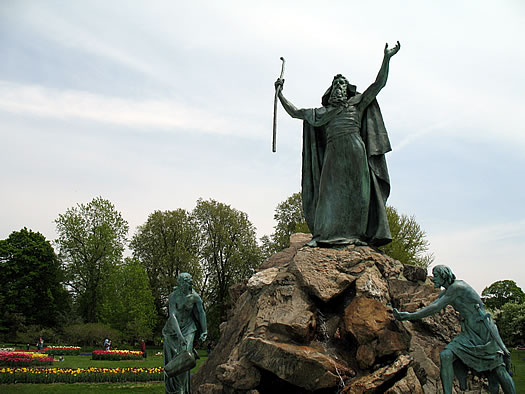
Moses fountain in Washington Park, Albany, NY.

Moses fountain in Washington Park, Albany, NY.

In our last Old Testament Study, we took a quick look at the closing of Exodus 17, and we left room for folks to catch up to where we are in the text. Today, we are going to take a look at Jethro’s Advice recorded in Exodus 18. We are going to see 2 major themes here, first we are going to take a look at the proper (Biblical) sharing of a testimony and worshiping God. Then we will look at Jethro’s advice to Moses and we will examine how churches today get this part wrong.

So let us dive right into the text beginning in the first verse of Exodus 18.

Exodus 18 (ESV) | Jethro’s Advice

Jethro, the priest of Midian, Moses’ father-in-law, heard of all that God had done for Moses and for Israel his people, how the Lord had brought Israel out of Egypt. Now Jethro, Moses’ father-in-law, had taken Zipporah, Moses’ wife, after he had sent her home, along with her two sons. The name of the one was Gershom (for he said, “I have been a sojourner in a foreign land”), and the name of the other, Eliezer (for he said, “The God of my father was my help, and delivered me from the sword of Pharaoh”). Jethro, Moses’ father-in-law, came with his sons and his wife to Moses in the wilderness where he was encamped at the mountain of God. And when he sent word to Moses, “I, your father-in-law Jethro, am coming to you with your wife and her two sons with her,” Moses went out to meet his father-in-law and bowed down and kissed him. And they asked each other of their welfare and went into the tent. Then Moses told his father-in-law all that the Lord had done to Pharaoh and to the Egyptians for Israel’s sake, all the hardship that had come upon them in the way, and how the Lord had delivered them. And Jethro rejoiced for all the good that the Lord had done to Israel, in that he had delivered them out of the hand of the Egyptians.

Testimony… we give testimony not of ourselves and how awesome we’ve become or how wonderful our life has become now that we made a decision or said a prayer. Our testimony is of what the Lord has done on our behalf. Notice the section that follows that Jethro doesn’t lavish praise upon Moses; rather, he offers praise and worship to the Lord God.

10 Jethro said, “Blessed be the Lord, who has delivered you out of the hand of the Egyptians and out of the hand of Pharaoh and has delivered the people from under the hand of the Egyptians. 11 Now I know that the Lord is greater than all gods, because in this affair they dealt arrogantly with the people.”12 And Jethro, Moses’ father-in-law, brought a burnt offering and sacrifices to God; and Aaron came with all the elders of Israel to eat bread with Moses’ father-in-law before God.

All praise and glory and honor be to God. They worshiped God (blessed His Name, confessed Him as God, offered burnt offering and sacrifices) and then they broke bread together. Now this act of worship takes a great deal of time, and led to the breaking of bread at the end of the day. The following day, we see Moses fulfilling his role as the Prophet of God to the Children of Israel, in the day-to-day affairs of leading such a large group through the wilderness. Until now, we’ve seen when the people murmur and complain to Moses, who then cries out to God and He acts, granting manna from heaven, quail from the wilderness, and water from a rock.

13 The next day Moses sat to judge the people, and the people stood around Moses from morning till evening. 14 When Moses’ father-in-law saw all that he was doing for the people, he said, “What is this that you are doing for the people? Why do you sit alone, and all the people stand around you from morning till evening?” 15 And Moses said to his father-in-law, “Because the people come to me to inquire of God; 16 when they have a dispute, they come to me and I decide between one person and another, and I make them know the statutes of God and his laws. 17 Moses’ father-in-law said to him, “What you are doing is not good. 18 You and the people with you will certainly wear yourselves out, for the thing is too heavy for you. You are not able to do it alone. 19 Now obey my voice; I will give you advice, and God be with you! You shall represent the people before God and bring their cases to God, 20 and you shall warn them about the statutes and the laws, and make them know the way in which they must walk and what they must do. 21 Moreover, look for able men from all the people, men who fear God, who are trustworthy and hate a bribe, and place such men over the people as chiefs of thousands, of hundreds, of fifties, and of tens. 22 And let them judge the people at all times. Every great matter they shall bring to you, but any small matter they shall decide themselves. So it will be easier for you, and they will bear the burden with you.23 If you do this, God will direct you, you will be able to endure, and all this people also will go to their place in peace.”

24 So Moses listened to the voice of his father-in-law and did all that he had said. 25 Moses chose able men out of all Israel and made them heads over the people, chiefs of thousands, of hundreds, of fifties, and of tens. 26 And they judged the people at all times. Any hard case they brought to Moses, but any small matter they decided themselves. 27 Then Moses let his father-in-law depart, and he went away to his own country.

Now, we have not yet been given the 10 Commandments. Moses was God’s servant and he heard God’s voice and God listened to Moses. Jethro knew that Moses alone could not be the only judge over all of the people. Moses needed to appoint men and delegate authority to them to sit as judges over tens, fifties, hundreds, and thousands. Delegated authority, not surrendered authority. Moses was still is held accountable to God for the people… he still represents the people before God. However, the smaller cases that have already been made clear can now be heard by able, God-fearing, trustworthy men who hate a bribe.

So how does the present-day church get this wrong? Modern-day pastors read themselves into the position of Moses when they should be reading themselves into the “able, God-fearing, trustworthy men who hate a bribe”. Jesus Christ is the head of His Church. Jesus Christ is our advocate with the Father in Heaven… the role of Moses is a shadow of Jesus Christ our Lord and Savior. Jesus, the Word made flesh, is the Head of His Church, not your senior pastor. Your elders/pastors are the ones to whom have been delegated authority in Christ Jesus to watch over, tend, teach, and feed His sheep. Some are placed over thousands, some hundreds, some fifties, and some tens. The children of Israel were divided up into tribes, clans, houses… but all were God’s Chosen People. The Church today is even more diverse and equally unified through the Gospel of Jesus Christ as written in His Word. Beware the false teacher, the false prophet, and the falsely anointed one (false christs). In closing, let us visit Paul’s exhortation to the elders of the church in Ephesus:

Acts 20:28-32 (ESV)

28 Pay careful attention to yourselves and to all the flock, in which the Holy Spirit has made you overseers, to care for the church of God, which he obtained with his own blood. 29 I know that after my departure fierce wolves will come in among you, not sparing the flock; 30 and from among your own selves will arise men speaking twisted things, to draw away the disciples after them. 31 Therefore be alert, remembering that for three years I did not cease night or day to admonish every one with tears. 32 And now I commend you to God and to the word of his grace, which is able to build you up and to give you the inheritance among all those who are sanctified.

In Christ Jesus,
Jorge

OT | The Lord is My Banner (Exodus 17)

Moses fountain in Washington Park, Albany, NY.

Moses fountain in Washington Park, Albany, NY.

In our last Old Testament Study, we looked at how after God had provided the Children of Israel with mana in the wilderness (Jesus is the Bread from Heaven) He also provided them with water (Jesus called Himself the fountain of living water in the wilderness). Today’s post will be extra short so that (hopefully) you can take some time to review the OT studies leading up to Exodus 17.

Let’s jump into the text.

Exodus 17:8-16 (ESV)

Israel Defeats Amalek

Then Amalek came and fought with Israel at Rephidim. So Moses said to Joshua, “Choose for us men, and go out and fight with Amalek. Tomorrow I will stand on the top of the hill with the staff of God in my hand.” 10 So Joshua did as Moses told him, and fought with Amalek, while Moses, Aaron, and Hur went up to the top of the hill. 11 Whenever Moses held up his hand, Israel prevailed, and whenever he lowered his hand, Amalek prevailed. 12 But Moses’ hands grew weary, so they took a stone and put it under him, and he sat on it, while Aaron and Hur held up his hands, one on one side, and the other on the other side. So his hands were steady until the going down of the sun. 13 And Joshua overwhelmed Amalek and his people with the sword.

14 Then the Lord said to Moses, “Write this as a memorial in a book and recite it in the ears of Joshua, that I will utterly blot out the memory of Amalek from under heaven.” 15 And Moses built an altar and called the name of it, The Lord Is My Banner, 16 saying, “A hand upon the throne of the Lord! The Lord will have war with Amalek from generation to generation.”

Several interesting things here. The first thing I’d like to mention is that we shouldn’t read this portion as an isolated event, separated from all previous events. Such is the current, post-modern paradigm of viewing everything that happens as “new” and completely disconnected from everything that has happened before.

Who is Amalek?

They are descended of Esau (Genesis 36). Though himself a son of Isaac, God rejected him in favor of Jacob, whom he would rename Israel. Esau took wives from the daughters of Heth (Canaan) further separating himself from the Promise to Abraham. Now, after so many generations, Amalek is waging war with the People of God, the Children of Promise.

Whose Victory of Battle?

Moses sends Joshua to choose men for battle, but to whom is the victory attributed? The Lord. Moses goes up on a hill and holds, not his staff, but the Staff of God. While in some cases it might be referred to as Moses’s staff, in this case Moses is clear to Joshua what is going to take place. The very staff that God instructed Moses and Aaron to use for each the plagues against Pharaoh, the staff with which God parted the Red Sea and the same staff God commanded Moses to strike the rock with at Horeb. Moses wasn’t saying “I’ll make sure you win”, he was saying “the Lord God is your Banner in battle”.

Banner?

While researching this passage, there was an entry in the Reformation Study Bible I thought was very informative, demonstrating something that might be lost in translation for us.

17:15 The Lord is my banner. The Hebrew word translated “banner” underlies “staff” in v. 9 and is used for the “pole” on which the bronze serpent was later placed (Num. 21:8). Since “banner” suggests cloth to us, this connection is lost. A spear could serve as a standard in battle, with or without bits of cloth tied to it. Later, a staff might have a device on it to mark the rallying point for troops. In the ancient world, these were sometimes images or signs of the gods. Moses’ staff is the ensign to which Joshua’s army could look and that symbolized God’s saving power. Moses declares that God Himself is the Standard, the Ensign of His people.

Very cool. Once again, what we are seeing here is not the greatness of Joshua’s leadership, but the Mighty Hand of God at work, showing His favor upon Israel, Moses, and Joshua. Remember the Song of Moses as recorded in Exodus 15.

Exodus 15 (ESV)

The Song of Moses

15 Then Moses and the people of Israel sang this song to the Lord, saying,

“I will sing to the Lord, for he has triumphed gloriously;
    the horse and his rider he has thrown into the sea.
The Lord is my strength and my song,
    and he has become my salvation;
this is my God, and I will praise him,
    my father’s God, and I will exalt him.
The Lord is a man of war;
    the Lord is his name.

“Pharaoh’s chariots and his host he cast into the sea,
    and his chosen officers were sunk in the Red Sea.
The floods covered them;
    they went down into the depths like a stone.
Your right hand, O Lord, glorious in power,
    your right hand, O Lord, shatters the enemy.
In the greatness of your majesty you overthrow your adversaries;
    you send out your fury; it consumes them like stubble.
At the blast of your nostrils the waters piled up;
    the floods stood up in a heap;
    the deeps congealed in the heart of the sea.
The enemy said, ‘I will pursue, I will overtake,
    I will divide the spoil, my desire shall have its fill of them.
    I will draw my sword; my hand shall destroy them.’
10 You blew with your wind; the sea covered them;
    they sank like lead in the mighty waters.

11 “Who is like you, O Lord, among the gods?
    Who is like you, majestic in holiness,
    awesome in glorious deeds, doing wonders?
12 You stretched out your right hand;
    the earth swallowed them.

13 “You have led in your steadfast love the people whom you have redeemed;
    you have guided them by your strength to your holy abode.
14 The peoples have heard; they tremble;
    pangs have seized the inhabitants of Philistia.
15 Now are the chiefs of Edom dismayed;
    trembling seizes the leaders of Moab;
    all the inhabitants of Canaan have melted away.
16 Terror and dread fall upon them;
    because of the greatness of your arm, they are still as a stone,
till your people, O Lord, pass by,
    till the people pass by whom you have purchased.
17 You will bring them in and plant them on your own mountain,
    the place, O Lord, which you have made for your abode,
    the sanctuary, O Lord, which your hands have established.
18 The Lord will reign forever and ever.”

In Hebrews 11, we are taught that all of the mighty deeds accomplished in Scripture were by faith. Faith in whom? In the Only Living God of Abraham, Isaac, and Jacob, the Creator of all things. The Lord is my Banner… while there was a physical symbol of the favor of the Lord, neither Joshua, Aaron, Moses, nor Hur were under any misgivings that there was something in the staff itself, nor in the efforts of Moses. This was God’s work and God’s victory over Amalek.

Hebrews 13:20-21 (ESV)

Benediction

20 Now may the God of peace who brought again from the dead our Lord Jesus,the great shepherd of the sheep, by the blood of the eternal covenant, 21 equip you with everything good that you may do his will, working in us that which is pleasing in his sight, through Jesus Christ, to whom be glory forever and ever. Amen.

May the Grace of God be with you today and forever,
In Christ Jesus,
Jorge

Christmas Gospel | What Mary Knew

Truthinator's Blog: Humor, Satire, and Opinion of a Theological Nature

Truthinator’s Blog: Humor, Satire, and Opinion of a Theological Nature

We’ll continue our study of the Gospel According to Matthew in a few weeks. For now, we feel it is important to remain fixed on the topic of Advent, when the Word became flesh, Jesus the Son of God. One very popular Christmas song explores the question of “Mary, did you know” who Jesus would become and what He would do? Recently the Truthinator’s Blog Facebook page shared this graphic, which solidified my desire to explore what it was that Mary knew, by faith.

What Gabriel Told Mary

Luke 1:26-38 (ESV)

Birth of Jesus Foretold

26 In the sixth month the angel Gabriel was sent from God to a city of Galilee named Nazareth, 27 to a virgin betrothed to a man whose name was Joseph, of the house of David. And the virgin’s name was Mary. 28 And he came to her and said, “Greetings, O favored one, the Lord is with you!” 29 But she was greatly troubled at the saying, and tried to discern what sort of greeting this might be.30 And the angel said to her, “Do not be afraid, Mary, for you have found favor with God. 31 And behold, you will conceive in your womb and bear a son, and you shall call his name Jesus. 32 He will be great and will be called the Son of the Most High. And the Lord God will give to him the throne of his father David,33 and he will reign over the house of Jacob forever, and of his kingdom there will be no end.”

34 And Mary said to the angel, “How will this be, since I am a virgin?”

35 And the angel answered her, “The Holy Spirit will come upon you, and the power of the Most High will overshadow you; therefore the child to be born will be called holy—the Son of God. 36 And behold, your relative Elizabeth in her old age has also conceived a son, and this is the sixth month with her who was called barren. 37 For nothing will be impossible with God.”38 And Mary said, “Behold, I am the servant of the Lord; let it be to me according to your word.” And the angel departed from her.

Wow. She was told a lot. Mary knew that Jesus was the Son of God. She knew that He would be given David’s throne, and that He would be great, and His reign would be eternal. Only God can have such a reign. By faith, Mary knew that the child would be the Son of the Most High God. Now, after the angel departed from her, Mary went to visit Elizabeth. Let’s continue in the text.

Luke 1:39-80 (ESV)

Mary Visits Elizabeth

39 In those days Mary arose and went with haste into the hill country, to a town in Judah, 40 and she entered the house of Zechariah and greeted Elizabeth.41 And when Elizabeth heard the greeting of Mary, the baby leaped in her womb. And Elizabeth was filled with the Holy Spirit, 42 and she exclaimed with a loud cry, “Blessed are you among women, and blessed is the fruit of your womb! 43 And why is this granted to me that the mother of my Lord should come to me? 44 For behold, when the sound of your greeting came to my ears, the baby in my womb leaped for joy. 45 And blessed is she who believed that there would be a fulfillment of what was spoken to her from the Lord.”

I get emotional every time I read this passage. No doubt Mary was still concerned by her encounter with the angel Gabriel and what his message meant. God is so good that the moment Mary greeted her, the Holy Spirit prophetically confirmed for Mary all that the angel had told her regarding her pregnancy. Let us continue.

Luke 1 | Mary’s Song of Praise: The Magnificat

46 And Mary said,

My soul magnifies the Lord,
47     and my spirit rejoices in God my Savior,
48 for he has looked on the humble estate of his servant.
    For behold, from now on all generations will call me blessed;
49 for he who is mighty has done great things for me,
    and holy is his name.
50 And his mercy is for those who fear him
    from generation to generation.
51 He has shown strength with his arm;
    he has scattered the proud in the thoughts of their hearts;
52 he has brought down the mighty from their thrones
    and exalted those of humble estate;
53 he has filled the hungry with good things,
    and the rich he has sent away empty.
54 He has helped his servant Israel,
    in remembrance of his mercy,
55 as he spoke to our fathers,
    to Abraham and to his offspring forever.”

56 And Mary remained with her about three months and returned to her home.

Mary rightly understood her place, a humble servant, and knew that all generations would caller her blessed. Not by her merit, simply by what God had done for her, to the Glory of His Name. Mary knew a great deal of who Jesus was and His significance for all of mankind. However, there is more… let’s continue reading.

Luke 1 | The Birth of John the Baptist

57 Now the time came for Elizabeth to give birth, and she bore a son. 58 And her neighbors and relatives heard that the Lord had shown great mercy to her, and they rejoiced with her. 59 And on the eighth day they came to circumcise the child. And they would have called him Zechariah after his father, 60 but his mother answered, “No; he shall be called John.” 61 And they said to her, “None of your relatives is called by this name.” 62 And they made signs to his father, inquiring what he wanted him to be called. 63 And he asked for a writing tablet and wrote, “His name is John.” And they all wondered. 64 And immediately his mouth was opened and his tongue loosed, and he spoke, blessing God. 65 Andfear came on all their neighbors. And all these things were talked about through all the hill country of Judea, 66 and all who heard them laid them up in their hearts, saying, “What then will this child be?” For the hand of the Lord was with him.

Zechariah’s Prophecy

67 And his father Zechariah was filled with the Holy Spirit and prophesied, saying,

68 “Blessed be the Lord God of Israel,
    for he has visited and redeemed his people
69 and has raised up a horn of salvation for us
    in the house of his servant David,
70 as he spoke by the mouth of his holy prophets from of old,
71 that we should be saved from our enemies
    and from the hand of all who hate us;
72 to show the mercy promised to our fathers
    and to remember his holy covenant,
73 the oath that he swore to our father Abraham, to grant us
74     that we, being delivered from the hand of our enemies,
might serve him without fear,
75     in holiness and righteousness before him all our days.
76 And you, child, will be called the prophet of the Most High;
    for you will go before the Lord to prepare his ways,
77 to give knowledge of salvation to his people
    in the forgiveness of their sins,
78 because of the tender mercy of our God,
    whereby the sunrise shall visit us from on high
79 to give light to those who sit in darkness and in the shadow of death,
    to guide our feet into the way of peace.”

80 And the child grew and became strong in spirit, and he was in the wilderness until the day of his public appearance to Israel.

Mary likely heard these stories, and this prophecy, and knew that John would prepare the way for Jesus. Shortly after His birth, the shepherds came to worship him as they were told by the Angels, the Heavenly Host. Let’s turn to Luke chapter 2.

Luke 2:8-20 (ESV) | The Shepherds and the Angels

And in the same region there were shepherds out in the field, keeping watch over their flock by night. And an angel of the Lord appeared to them, and the glory of the Lord shone around them, and they were filled with great fear.10 And the angel said to them, “Fear not, for behold, I bring you good news of great joy that will be for all the people. 11 For unto you is born this day in the city of David a Savior, who is Christ the Lord. 12 And this will be a sign for you: you will find a baby wrapped in swaddling cloths and lying in a manger.” 13 And suddenly there was with the angel a multitude of the heavenly host praising God and saying,

14 “Glory to God in the highest,
    and on earth peace among those with whom he is pleased!”

15 When the angels went away from them into heaven, the shepherds said to one another, “Let us go over to Bethlehem and see this thing that has happened, which the Lord has made known to us.” 16 And they went with haste and found Mary and Joseph, and the baby lying in a manger. 17 And when they saw it, they made known the saying that had been told them concerning this child. 18 And all who heard it wondered at what the shepherds told them.19 But Mary treasured up all these things, pondering them in her heart.20 And the shepherds returned, glorifying and praising God for all they had heard and seen, as it had been told them.

Now the shepherds relayed what they had been told by the angel of the Lord, that Jesus is the Savior, who is Christ the Lord. And Mary treasured up all these things, pondering them in her heart. She knew who Jesus was. Where there things she didn’t know? Sure… she and the disciples never quite understood that Jesus had to die for the sin of all mankind, despite how often He taught them and told them it would be. She and Joseph did receive a prophetic message concerning this… but it didn’t become clear until the events transpired. Let’s continue in the text.

Luke 2:22-38 (ESV) | Jesus Presented at the Temple

22 And when the time came for their purification according to the Law of Moses, they brought him up to Jerusalem to present him to the Lord 23 (as it is written in the Law of the Lord, “Every male who first opens the womb shall be called holy to the Lord”) 24 and to offer a sacrifice according to what is said in the Law of the Lord, “a pair of turtledoves, or two young pigeons.” 25 Now there was a man in Jerusalem, whose name was Simeon, and this man was righteous and devout, waiting for the consolation of Israel, and the Holy Spirit was upon him.26 And it had been revealed to him by the Holy Spirit that he would not see death before he had seen the Lord’s Christ. 27 And he came in the Spirit into the temple, and when the parents brought in the child Jesus, to do for him according to the custom of the Law, 28 he took him up in his arms and blessed God and said,

29 “Lord, now you are letting your servant depart in peace,
    according to your word;
30 for my eyes have seen your salvation
31     that you have prepared in the presence of all peoples,
32 a light for revelation to the Gentiles,
    and for glory to your people Israel.”

33 And his father and his mother marveled at what was said about him. 34 And Simeon blessed them and said to Mary his mother, “Behold, this child is appointed for the fall and rising of many in Israel, and for a sign that is opposed 35 (and a sword will pierce through your own soul also), so that thoughts from many hearts may be revealed.”

36 And there was a prophetess, Anna, the daughter of Phanuel, of the tribe of Asher. She was advanced in years, having lived with her husband seven years from when she was a virgin, 37 and then as a widow until she was eighty-four. She did not depart from the temple, worshiping with fasting and prayer night and day. 38 And coming up at that very hour she began to give thanks to God and to speak of him to all who were waiting for the redemption of Jerusalem.

As we learn in the Gospel according to Matthew, some time after this Herod sought to kill Jesus, and the Holy Spirit warned Joseph in a dream and they fled to Egypt (Matthew 2).

Did Mary anticipate each individual miracle He performed? Probably not, but Mary knew who Jesus was. She and the disciples didn’t understand how dying on the cross could be part of God’s plan, but in His Grace and Mercy He spent time teaching them what it all meant. In closing, I’d like to share my favorite rendition of this Christmas song, “Mary did you know”. I think it is fitting that my favorite version is sung by one who is probably not a Christian… though he might consider himself from “Gospel roots”. Please pray for Cee Lo Green, that he may come to know the Truth of the Gospel of Jesus Christ.

[youtube http://youtu.be/D1ptNwE7K8o]

Whenever you hear this song this season, know that Mary would likely answer “yes” to most of the lines in this song. The truly important question, is do you know who Jesus is? Do you know that He is returning?

Jude 1:24-25 (ESV) | Doxology

24 Now to him who is able to keep you from stumbling and to present you blameless before the presence of his glory with great joy, 25 to the only God, our Savior, through Jesus Christ our Lord, be glory, majesty, dominion, and authority, before all time and now and forever. Amen.

Amen.
In Christ Jesus,
Jorge