But Empty Calories Taste Gooood

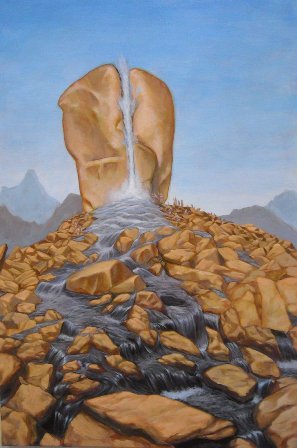
Rock of Horeb by Mariano David Otero ©2010-2014 MarianoDavidOtero

Rock of Horeb by Mariano David Otero ©2010-2014 MarianoDavidOtero

Today has been a different sort of day for me, so today’s post is more of me sharing in a blog what has been rolling around in my head for the past week or so.

Drink water

Are you and avid water drinker? If you aren’t part of the “get fit” crowd, chances are you go through your day without so much as a single glass of water. We have lots of sports drinks, sodas, milk, tea, coffee, fruit juices and even very tasty vegetable juices, not to mention beer and liquor. Our bodies need water for their functions.  If I may, I thought I’d grab a quick list from a fun site (though we could turn to medical journals for a more scholarly approach)

source: http://www.dummies.com/how-to/content/why-your-body-needs-water.html

Your body is mostly (50 to 70 percent) water. Exactly how much water depends on how old you are and how much muscle and fat you have. Muscle tissue has more water than fat tissue. Because the average male body has proportionately more muscle than the average female body, it also has more water. For the same reason — more muscle — a young body has more water than an older one.

You definitely won’t enjoy the experience, but if you have to, you can live without food for weeks at a time, getting subsistence levels of nutrients by digesting your own muscle and fat. But water is different. Without it, you’ll die in a matter of days — more quickly in a place warm enough to make you perspire and lose water more quickly.

You need water to

  • Digest food, dissolving nutrients so that they can pass through the intestinal cell walls into your bloodstream, and move food along through your intestinal tract.
    Carry waste products out of your body.
  • Provide a medium in which biochemical reactions such as metabolism (digesting food, producing energy, and building tissue) occur.
  • Send electrical messages between cells so that your muscles can move, your eyes can see, your brain can think, and so on.
  • Regulate body temperature — cooling your body with moisture (perspiration) that evaporates on your skin.
  • Lubricate your moving parts.

As much as three-quarters of the water in your body is in intracellular fluid, the liquid inside body cells. The rest is in extracellular fluid, which is all the other body liquids, such as

  • Interstitial fluid (the fluid between cells)
  • Blood plasma (the clear liquid in blood)
  • Lymph (a clear, slightly yellow fluid collected from body tissues that flows through your lymph nodes and eventually into your blood vessels)
  • Bodily secretions such as sweat, seminal fluid, and vaginal fluids
  • Urine

Personal confession: while growing up, I did not enjoy drinking water directly unless it was during a break in Wrestling or Football practice. After serving in the Army, I learned the value of good drinking water, even from a plastic canteen that has been sitting in the 90ºF sun for several hours. However, whenever I am comfortably in my home enjoying time with friends and family and not breaking a sweat… I don’t turn to water, I go for some of those empty calorie drinks. Why? Because they taste goooood. Sure, in every consumable liquid there is some measure of water; however, the body has to work a lot harder to use what little water is available and some of it has to be then used to cleanse the system of impurities (pointing mainly at the sugary sodas, coffee, tea, and alcoholic drinks). When a doctor prescribes “more fluids”, we should understand “water” (you should get your electrolytes from eating good foods, it doesn’t have to be in drink form).

Drink Water

John 4:1-15 (ESV) | Jesus and the Woman of Samaria
1 Now when Jesus learned that the Pharisees had heard that Jesus was making and baptizing more disciples than John 2 (although Jesus himself did not baptize, but only his disciples), 3 he left Judea and departed again for Galilee. 4 And he had to pass through Samaria. 5 So he came to a town of Samaria called Sychar, near the field that Jacob had given to his son Joseph. 6 Jacob’s well was there; so Jesus, wearied as he was from his journey, was sitting beside the well. It was about the sixth hour.

7 A woman from Samaria came to draw water. Jesus said to her, “Give me a drink.” 8 (For his disciples had gone away into the city to buy food.) 9 The Samaritan woman said to him, “How is it that you, a Jew, ask for a drink from me, a woman of Samaria?” (For Jews have no dealings with Samaritans.)10 Jesus answered her, “If you knew the gift of God, and who it is that is saying to you, ‘Give me a drink,’ you would have asked him, and he would have given you living water.” 11 The woman said to him, “Sir, you have nothing to draw water with, and the well is deep. Where do you get that living water? 12 Are you greater than our father Jacob? He gave us the well and drank from it himself, as did his sons and his livestock.” 13 Jesus said to her, “Everyone who drinks of this water will be thirsty again, 14 but whoever drinks of the water that I will give him will never be thirsty again. The water that I will give him will become in him a spring of water welling up to eternal life.” 15 The woman said to him, “Sir, give me this water, so that I will not be thirsty or have to come here to draw water.”

This passage is often heavily spiritualized (particularly within the continuationist view) pointing to God the Holy Spirit. This passage isn’t just about God the Holy Spirit, but about the Word of God, the Word made Flesh in Jesus Christ and in the Written Word that was Breathed Out by God. Without the Holy Spirit we cannot hope to see God in the Scriptures; however, we who have received faith by hearing the Word of God and have accepted the Law and Gospel of Jesus and been baptized have been sealed in Christ by the Holy Spirit, who teaches us as we read the Written Word of God.

During any given week, I read through some 20 or so discernment articles or blogs, and listen to a good 15 hours of exegetical teaching, discernment ministries, commentaries, and (regrettably) some really bad sermons. The answer I jump to in almost all cases is “read your Bibles”. Last week, while I was listening to one of the bad sermons, I heard the false teacher implore the listeners to “read their Bibles”.  That’s when it struck me… they don’t know how to read their Bibles, and the false-teacher knows it. The false teacher presents himself (or herself) as the keeper of the well. They are the only ones who know how to draw the water, because the well is so deep. So they’ll say in one breath “read your Bibles” and with the next they’ll twist a passage completely out of context to woo the crowd and impress them with their sugary drink theology. The question that is left in the mind of the listener is, “why is it when I draw my own water (Read the Bible) it never comes out tasting so sweetly?” There is no way to read the Bible yourself and come up with the wild allegories and “life applications” that these false teachers peddle, and they know it. But they are counting on you to defer to their teaching for your next “sugar rush” more than they are on you clearing your palate.

A child who has grown up on a steady diet of fruit juices and milk will find water unpleasant to drink. It tastes bland without all of that sugar. There aren’t any bubbles. There’s no buzz.  Even as an adult, have you ever tried to eliminate extra sugar from your diet? It makes everything taste… well… blah. The truth is, you’ve grown accustomed to high-fructose sugary everything. Your palate has been overloaded for so long, you have no idea just how much sugar you ingest without noticing (incidentally, we also tend to do this with salt). Most people can’t handle going from a normal-high sugar diet to a balanced diet and hold steadily. I find that I need to reset my palate first by eliminating as many sources of added sugar as possible, so that I can once-again detect when my food/drink has been sweetened.

Learn to Read Your Bible and Drink Pure Water

What we try to focus on here is pointing out to our readers what it takes to read the Bible for what it says, without additives. Please, take a break from all of the NY Times Best Sellers advertised in your Christian bookstore, and learn to read your Bible. I recommend getting a good coach. I’ve learned a lot from listening to Chris Rosebrough at Fighting for the Faith, Jonathan Fisk at Worldview Everlasting, Alistair Begg on Truth for Life, and Todd Friel at WretchedRadio. For those keeping track of denominations, that’s 2 Lutheran, 1 Nondenominational, and 1 Reformed. From time to time, if we get side-tracked and you feel we’ve not made clear where we draw our connections in the text, please challenge us here. Let us know when we’ve skipped a step or erred entirely. Hold us accountable, so that we might be Faithful Stewards of God’s Word.

Colossians 3:16-17 (ESV) 16 Let the word of Christ dwell in you richly, teaching and admonishing one another in all wisdom, singing psalms and hymns and spiritual songs, with thankfulness in your hearts to God. 17 And whatever you do, in word or deed, do everything in the name of the Lord Jesus, giving thanks to God the Father through him.

Amen.
In Christ Jesus,
Jorge
OT | Jethro’s Advice (Exodus 18)

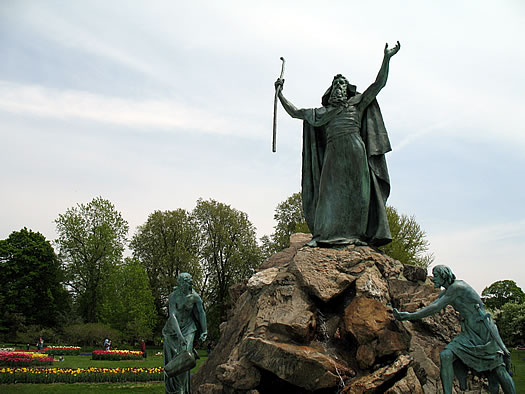
Moses fountain in Washington Park, Albany, NY.

Moses fountain in Washington Park, Albany, NY.

In our last Old Testament Study, we took a quick look at the closing of Exodus 17, and we left room for folks to catch up to where we are in the text. Today, we are going to take a look at Jethro’s Advice recorded in Exodus 18. We are going to see 2 major themes here, first we are going to take a look at the proper (Biblical) sharing of a testimony and worshiping God. Then we will look at Jethro’s advice to Moses and we will examine how churches today get this part wrong.

So let us dive right into the text beginning in the first verse of Exodus 18.

Exodus 18 (ESV) | Jethro’s Advice

Jethro, the priest of Midian, Moses’ father-in-law, heard of all that God had done for Moses and for Israel his people, how the Lord had brought Israel out of Egypt. Now Jethro, Moses’ father-in-law, had taken Zipporah, Moses’ wife, after he had sent her home, along with her two sons. The name of the one was Gershom (for he said, “I have been a sojourner in a foreign land”), and the name of the other, Eliezer (for he said, “The God of my father was my help, and delivered me from the sword of Pharaoh”). Jethro, Moses’ father-in-law, came with his sons and his wife to Moses in the wilderness where he was encamped at the mountain of God. And when he sent word to Moses, “I, your father-in-law Jethro, am coming to you with your wife and her two sons with her,” Moses went out to meet his father-in-law and bowed down and kissed him. And they asked each other of their welfare and went into the tent. Then Moses told his father-in-law all that the Lord had done to Pharaoh and to the Egyptians for Israel’s sake, all the hardship that had come upon them in the way, and how the Lord had delivered them. And Jethro rejoiced for all the good that the Lord had done to Israel, in that he had delivered them out of the hand of the Egyptians.

Testimony… we give testimony not of ourselves and how awesome we’ve become or how wonderful our life has become now that we made a decision or said a prayer. Our testimony is of what the Lord has done on our behalf. Notice the section that follows that Jethro doesn’t lavish praise upon Moses; rather, he offers praise and worship to the Lord God.

10 Jethro said, “Blessed be the Lord, who has delivered you out of the hand of the Egyptians and out of the hand of Pharaoh and has delivered the people from under the hand of the Egyptians. 11 Now I know that the Lord is greater than all gods, because in this affair they dealt arrogantly with the people.”12 And Jethro, Moses’ father-in-law, brought a burnt offering and sacrifices to God; and Aaron came with all the elders of Israel to eat bread with Moses’ father-in-law before God.

All praise and glory and honor be to God. They worshiped God (blessed His Name, confessed Him as God, offered burnt offering and sacrifices) and then they broke bread together. Now this act of worship takes a great deal of time, and led to the breaking of bread at the end of the day. The following day, we see Moses fulfilling his role as the Prophet of God to the Children of Israel, in the day-to-day affairs of leading such a large group through the wilderness. Until now, we’ve seen when the people murmur and complain to Moses, who then cries out to God and He acts, granting manna from heaven, quail from the wilderness, and water from a rock.

13 The next day Moses sat to judge the people, and the people stood around Moses from morning till evening. 14 When Moses’ father-in-law saw all that he was doing for the people, he said, “What is this that you are doing for the people? Why do you sit alone, and all the people stand around you from morning till evening?” 15 And Moses said to his father-in-law, “Because the people come to me to inquire of God; 16 when they have a dispute, they come to me and I decide between one person and another, and I make them know the statutes of God and his laws. 17 Moses’ father-in-law said to him, “What you are doing is not good. 18 You and the people with you will certainly wear yourselves out, for the thing is too heavy for you. You are not able to do it alone. 19 Now obey my voice; I will give you advice, and God be with you! You shall represent the people before God and bring their cases to God, 20 and you shall warn them about the statutes and the laws, and make them know the way in which they must walk and what they must do. 21 Moreover, look for able men from all the people, men who fear God, who are trustworthy and hate a bribe, and place such men over the people as chiefs of thousands, of hundreds, of fifties, and of tens. 22 And let them judge the people at all times. Every great matter they shall bring to you, but any small matter they shall decide themselves. So it will be easier for you, and they will bear the burden with you.23 If you do this, God will direct you, you will be able to endure, and all this people also will go to their place in peace.”

24 So Moses listened to the voice of his father-in-law and did all that he had said. 25 Moses chose able men out of all Israel and made them heads over the people, chiefs of thousands, of hundreds, of fifties, and of tens. 26 And they judged the people at all times. Any hard case they brought to Moses, but any small matter they decided themselves. 27 Then Moses let his father-in-law depart, and he went away to his own country.

Now, we have not yet been given the 10 Commandments. Moses was God’s servant and he heard God’s voice and God listened to Moses. Jethro knew that Moses alone could not be the only judge over all of the people. Moses needed to appoint men and delegate authority to them to sit as judges over tens, fifties, hundreds, and thousands. Delegated authority, not surrendered authority. Moses was still is held accountable to God for the people… he still represents the people before God. However, the smaller cases that have already been made clear can now be heard by able, God-fearing, trustworthy men who hate a bribe.

So how does the present-day church get this wrong? Modern-day pastors read themselves into the position of Moses when they should be reading themselves into the “able, God-fearing, trustworthy men who hate a bribe”. Jesus Christ is the head of His Church. Jesus Christ is our advocate with the Father in Heaven… the role of Moses is a shadow of Jesus Christ our Lord and Savior. Jesus, the Word made flesh, is the Head of His Church, not your senior pastor. Your elders/pastors are the ones to whom have been delegated authority in Christ Jesus to watch over, tend, teach, and feed His sheep. Some are placed over thousands, some hundreds, some fifties, and some tens. The children of Israel were divided up into tribes, clans, houses… but all were God’s Chosen People. The Church today is even more diverse and equally unified through the Gospel of Jesus Christ as written in His Word. Beware the false teacher, the false prophet, and the falsely anointed one (false christs). In closing, let us visit Paul’s exhortation to the elders of the church in Ephesus:

Acts 20:28-32 (ESV)

28 Pay careful attention to yourselves and to all the flock, in which the Holy Spirit has made you overseers, to care for the church of God, which he obtained with his own blood. 29 I know that after my departure fierce wolves will come in among you, not sparing the flock; 30 and from among your own selves will arise men speaking twisted things, to draw away the disciples after them. 31 Therefore be alert, remembering that for three years I did not cease night or day to admonish every one with tears. 32 And now I commend you to God and to the word of his grace, which is able to build you up and to give you the inheritance among all those who are sanctified.

In Christ Jesus,
Jorge

OT | The Lord is My Banner (Exodus 17)

Moses fountain in Washington Park, Albany, NY.

Moses fountain in Washington Park, Albany, NY.

In our last Old Testament Study, we looked at how after God had provided the Children of Israel with mana in the wilderness (Jesus is the Bread from Heaven) He also provided them with water (Jesus called Himself the fountain of living water in the wilderness). Today’s post will be extra short so that (hopefully) you can take some time to review the OT studies leading up to Exodus 17.

Let’s jump into the text.

Exodus 17:8-16 (ESV)

Israel Defeats Amalek

Then Amalek came and fought with Israel at Rephidim. So Moses said to Joshua, “Choose for us men, and go out and fight with Amalek. Tomorrow I will stand on the top of the hill with the staff of God in my hand.” 10 So Joshua did as Moses told him, and fought with Amalek, while Moses, Aaron, and Hur went up to the top of the hill. 11 Whenever Moses held up his hand, Israel prevailed, and whenever he lowered his hand, Amalek prevailed. 12 But Moses’ hands grew weary, so they took a stone and put it under him, and he sat on it, while Aaron and Hur held up his hands, one on one side, and the other on the other side. So his hands were steady until the going down of the sun. 13 And Joshua overwhelmed Amalek and his people with the sword.

14 Then the Lord said to Moses, “Write this as a memorial in a book and recite it in the ears of Joshua, that I will utterly blot out the memory of Amalek from under heaven.” 15 And Moses built an altar and called the name of it, The Lord Is My Banner, 16 saying, “A hand upon the throne of the Lord! The Lord will have war with Amalek from generation to generation.”

Several interesting things here. The first thing I’d like to mention is that we shouldn’t read this portion as an isolated event, separated from all previous events. Such is the current, post-modern paradigm of viewing everything that happens as “new” and completely disconnected from everything that has happened before.

Who is Amalek?

They are descended of Esau (Genesis 36). Though himself a son of Isaac, God rejected him in favor of Jacob, whom he would rename Israel. Esau took wives from the daughters of Heth (Canaan) further separating himself from the Promise to Abraham. Now, after so many generations, Amalek is waging war with the People of God, the Children of Promise.

Whose Victory of Battle?

Moses sends Joshua to choose men for battle, but to whom is the victory attributed? The Lord. Moses goes up on a hill and holds, not his staff, but the Staff of God. While in some cases it might be referred to as Moses’s staff, in this case Moses is clear to Joshua what is going to take place. The very staff that God instructed Moses and Aaron to use for each the plagues against Pharaoh, the staff with which God parted the Red Sea and the same staff God commanded Moses to strike the rock with at Horeb. Moses wasn’t saying “I’ll make sure you win”, he was saying “the Lord God is your Banner in battle”.

Banner?

While researching this passage, there was an entry in the Reformation Study Bible I thought was very informative, demonstrating something that might be lost in translation for us.

17:15 The Lord is my banner. The Hebrew word translated “banner” underlies “staff” in v. 9 and is used for the “pole” on which the bronze serpent was later placed (Num. 21:8). Since “banner” suggests cloth to us, this connection is lost. A spear could serve as a standard in battle, with or without bits of cloth tied to it. Later, a staff might have a device on it to mark the rallying point for troops. In the ancient world, these were sometimes images or signs of the gods. Moses’ staff is the ensign to which Joshua’s army could look and that symbolized God’s saving power. Moses declares that God Himself is the Standard, the Ensign of His people.

Very cool. Once again, what we are seeing here is not the greatness of Joshua’s leadership, but the Mighty Hand of God at work, showing His favor upon Israel, Moses, and Joshua. Remember the Song of Moses as recorded in Exodus 15.

Exodus 15 (ESV)

The Song of Moses

15 Then Moses and the people of Israel sang this song to the Lord, saying,

“I will sing to the Lord, for he has triumphed gloriously;
    the horse and his rider he has thrown into the sea.
The Lord is my strength and my song,
    and he has become my salvation;
this is my God, and I will praise him,
    my father’s God, and I will exalt him.
The Lord is a man of war;
    the Lord is his name.

“Pharaoh’s chariots and his host he cast into the sea,
    and his chosen officers were sunk in the Red Sea.
The floods covered them;
    they went down into the depths like a stone.
Your right hand, O Lord, glorious in power,
    your right hand, O Lord, shatters the enemy.
In the greatness of your majesty you overthrow your adversaries;
    you send out your fury; it consumes them like stubble.
At the blast of your nostrils the waters piled up;
    the floods stood up in a heap;
    the deeps congealed in the heart of the sea.
The enemy said, ‘I will pursue, I will overtake,
    I will divide the spoil, my desire shall have its fill of them.
    I will draw my sword; my hand shall destroy them.’
10 You blew with your wind; the sea covered them;
    they sank like lead in the mighty waters.

11 “Who is like you, O Lord, among the gods?
    Who is like you, majestic in holiness,
    awesome in glorious deeds, doing wonders?
12 You stretched out your right hand;
    the earth swallowed them.

13 “You have led in your steadfast love the people whom you have redeemed;
    you have guided them by your strength to your holy abode.
14 The peoples have heard; they tremble;
    pangs have seized the inhabitants of Philistia.
15 Now are the chiefs of Edom dismayed;
    trembling seizes the leaders of Moab;
    all the inhabitants of Canaan have melted away.
16 Terror and dread fall upon them;
    because of the greatness of your arm, they are still as a stone,
till your people, O Lord, pass by,
    till the people pass by whom you have purchased.
17 You will bring them in and plant them on your own mountain,
    the place, O Lord, which you have made for your abode,
    the sanctuary, O Lord, which your hands have established.
18 The Lord will reign forever and ever.”

In Hebrews 11, we are taught that all of the mighty deeds accomplished in Scripture were by faith. Faith in whom? In the Only Living God of Abraham, Isaac, and Jacob, the Creator of all things. The Lord is my Banner… while there was a physical symbol of the favor of the Lord, neither Joshua, Aaron, Moses, nor Hur were under any misgivings that there was something in the staff itself, nor in the efforts of Moses. This was God’s work and God’s victory over Amalek.

Hebrews 13:20-21 (ESV)

Benediction

20 Now may the God of peace who brought again from the dead our Lord Jesus,the great shepherd of the sheep, by the blood of the eternal covenant, 21 equip you with everything good that you may do his will, working in us that which is pleasing in his sight, through Jesus Christ, to whom be glory forever and ever. Amen.

May the Grace of God be with you today and forever,
In Christ Jesus,
Jorge

Friday Sermon | Alistair Begg – Elizabeth and Zechariah (Luke 1:5-23)

2011-alistair-beggToday, we’ll visit TruthforLife.org for a sermon by Alistair Begg.

Elizabeth and Zechariah

After years of prophetic silence, God announced the birth of John the Baptist to one faithful couple. As Alistair Begg explains, the announcement illustrates the mystery of God’s work throughout history. The events surrounding the birth of Jesus remind us that the providence of God can be seen at work in ordinary events, both good and bad.

Luke 1:5-23 (ESV) | Birth of John the Baptist Foretold

In the days of Herod, king of Judea, there was a priest named Zechariah, of the division of Abijah. And he had a wife from the daughters of Aaron, and her name was Elizabeth. And they were both righteous before God, walking blamelessly in all the commandments and statutes of the Lord. But they had no child, because Elizabeth was barren, and both were advanced in years.

Now while he was serving as priest before God when his division was on duty,according to the custom of the priesthood, he was chosen by lot to enter the temple of the Lord and burn incense. 10 And the whole multitude of the people were praying outside at the hour of incense. 11 And there appeared to him an angel of the Lord standing on the right side of the altar of incense. 12 And Zechariah was troubled when he saw him, and fear fell upon him. 13 But the angel said to him, “Do not be afraid, Zechariah, for your prayer has been heard, and your wife Elizabeth will bear you a son, and you shall call his name John. 14 And you will have joy and gladness, and many will rejoice at his birth,15 for he will be great before the Lord. And he must not drink wine or strong drink, and he will be filled with the Holy Spirit, even from his mother’s womb.16 And he will turn many of the children of Israel to the Lord their God, 17 and he will go before him in the spirit and power of Elijah, to turn the hearts of the fathers to the children, and the disobedient to the wisdom of the just, to make ready for the Lord a people prepared.”

18 And Zechariah said to the angel, “How shall I know this? For I am an old man, and my wife is advanced in years.” 19 And the angel answered him, “I amGabriel. I stand in the presence of God, and I was sent to speak to you and to bring you this good news. 20 And behold, you will be silent and unable to speak until the day that these things take place, because you did not believe my words, which will be fulfilled in their time.” 21 And the people were waiting for Zechariah, and they were wondering at his delay in the temple. 22 And when he came out, he was unable to speak to them, and they realized that he had seen a vision in the temple. And he kept making signs to them and remained mute.23 And when his time of service was ended, he went to his home.

May God bless you and keep you until the Day of Christ’s Return,
In Him,
Jorge

Friday Sermon | Reformation Montana 2014 (Voddie Baucham )

refmt-logoLast week we watched session 3 of the Reformation Montana 2014 Conference held this past June 19th. We listened to Sye Ten Bruggencate give his talk on presuppositional apologetics, making a reasoned defense of our faith.

This week we’ll skip over Chris Rosebrough’s second talk for session 5 and jump to Voddie Baucham’s sermon regarding the proper reading of Genesis and the Joseph account. Given the fact that we already looked at how the Gospel According to Matthew points back to Genesis, this sermon comes at a time where we can really solidify how we read Genesis in light of the Gospel of Jesus Christ.

[youtube http://youtu.be/1yXpBbTf_Lk]

If you’d rather have an audio-only version, you can access them from the Reformation Montana 2014 website.

If you have any questions, concerns, or feedback please feel free to share.

May God bless you and keep you until the Day of Christ’s Return,
In Him,
Jorge