Friday Sermon | The Allure and the Agony of Adultery by Bert Daniel

BereaToday, I’d like to share the sermon my pastor, Bert Daniel, preached this past Sunday (8/9/15). We’ve been working through the book of Proverbs, and this sermon was on Proverbs Chapter 7. This sermon is a good example of how expository preaching, working through God’s word and examining what it says, is always relevant… because despite all of our trappings, mankind has not changed. We are still sinners, bent in on ourselves as wretches, in desperate need of a Savior, Our Lord Jesus Christ. Who by God’s Grace, was born of a virgin, lived the perfect life of righteousness we couldn’t live, and laid down His own Life as the perfect, spotless sacrifice to atone for our sins. He who knew no sin, became sin in our place to pay the price we couldn’t pay… so that in Him, we might become the righteousness of God, by faith and that not of ourselves, it is the gift of God.

Bert has served as Berea’s pastor since 2002. He and his wife Nikki have two sons (Noah and Isaiah) and one daughter (Tatom). Bert has a bachelor’s degree from Columbia International University and a Master of Divinity from The Southern Baptist Theological Seminary. He enjoys spending time with his family, reading, working out, and watching Georgia Tech football.

Sermon Text

Proverbs 7 (ESV) | Warning Against the Adulteress

My son, keep my words
    and treasure up my commandments with you;
keep my commandments and live;
    keep my teaching as the apple of your eye;
bind them on your fingers;
    write them on the tablet of your heart.
Say to wisdom, “You are my sister,”
    and call insight your intimate friend,
to keep you from the forbidden woman,
    from the adulteress with her smooth words.

For at the window of my house
    I have looked out through my lattice,
and I have seen among the simple,
    I have perceived among the youths,
    a young man lacking sense,
passing along the street near her corner,
    taking the road to her house
in the twilight, in the evening,
    at the time of night and darkness.

10 And behold, the woman meets him,
    dressed as a prostitute, wily of heart.
11 She is loud and wayward;
    her feet do not stay at home;
12 now in the street, now in the market,
    and at every corner she lies in wait.
13 She seizes him and kisses him,
    and with bold face she says to him,
14 “I had to offer sacrifices,
    and today I have paid my vows;
15 so now I have come out to meet you,
    to seek you eagerly, and I have found you.
16 I have spread my couch with coverings,
    colored linens from Egyptian linen;
17 I have perfumed my bed with myrrh,
    aloes, and cinnamon.
18 Come, let us take our fill of love till morning;
    let us delight ourselves with love.
19 For my husband is not at home;
    he has gone on a long journey;
20 he took a bag of money with him;
    at full moon he will come home.”

21 With much seductive speech she persuades him;
    with her smooth talk she compels him.
22 All at once he follows her,
    as an ox goes to the slaughter,
or as a stag is caught fast
23     till an arrow pierces its liver;
as a bird rushes into a snare;
    he does not know that it will cost him his life.

24 And now, O sons, listen to me,
    and be attentive to the words of my mouth.
25 Let not your heart turn aside to her ways;
    do not stray into her paths,
26 for many a victim has she laid low,
    and all her slain are a mighty throng.
27 Her house is the way to Sheol,
    going down to the chambers of death.

Sermon Audio

One final thought… as you ponder the call of Proverbs 7 to seek Wisdom and abstain from sexual immorality, know that it is by faith that we serve a Gracious and Merciful God, who knows our weakness. When you fall, when you struggle, confess, repent, and be forgiven in Jesus’ Name.

1 Timothy 1:12-17 (ESV) | Christ Jesus Came to Save Sinners

12 I thank him who has given me strength, Christ Jesus our Lord, because he judged me faithful, appointing me to his service, 13 though formerly I was a blasphemer, persecutor, and insolent opponent. But I received mercy because I had acted ignorantly in unbelief, 14 and the grace of our Lord overflowed for me with the faith and love that are in Christ Jesus.15 The saying is trustworthy and deserving of full acceptance, that Christ Jesus came into the world to save sinners, of whom I am the foremost.16 But I received mercy for this reason, that in me, as the foremost, Jesus Christ might display his perfect patience as an example to those who were to believe in him for eternal life. 17 To the King of the ages, immortal, invisible, the only God, be honor and glory forever and ever. Amen.

Amen, Indeed.
In Christ Jesus,
Jorge

CTT | Will Man Rob God?

Today’s post is a continuation of sorts from Monday’s CTT post, “Sow a Seed?”

It is time to deal with the issue of the Tithe. This will not be a short post. The issue of “tithing” is one of great abuse in modern-day churches. Let us begin with the most abused proof-text found in Malachi.

Malachi 3:8-10 (ESV)

Will man rob God? Yet you are robbing me. But you say, ‘How have we robbed you?’ In your tithes and contributions. You are cursed with a curse, for you are robbing me, the whole nation of you.10 Bring the full tithe into the storehouse, that there may be food in my house. And thereby put me to the test, says the Lord of hosts, if I will not open the windows of heaven for you and pour down for you a blessing until there is no more need.

Sometimes, even this proof text is reduced only to verse 10 in order to present a quid-pro-quo promise of prosperity. Is this valid? No. Let’s work through the context of this passage.

The Context of Malachi

This book is one (of many) of Prophecy. Though an exact time-frame isn’t possible to nail down for Malachi, this book was written after the Exile from Babylon and after the temple was rebuilt and worship resumed. This book of prophecy is intended for a specific people for a specific purpose. Let’s look at the first chapter to see how it plays out.

Malachi 1:1-5 (ESV) | The Lord’s Love for Israel
1 The oracle of the word of the Lord to Israel by Malachi. 2 “I have loved you,” says the Lord. But you say, “How have you loved us?” “Is not Esau Jacob’s brother?” declares the Lord. “Yet I have loved Jacob 3 but Esau I have hated. I have laid waste his hill country and left his heritage to jackals of the desert.” 4 If Edom says, “We are shattered but we will rebuild the ruins,” the Lord of hosts says, “They may build, but I will tear down, and they will be called ‘the wicked country,’ and ‘the people with whom the Lord is angry forever.’” 5 Your own eyes shall see this, and you shall say, “Great is the Lord beyond the border of Israel!”

The very first section is addressed to Israel. God declares “I have loved you” to Israel, and then God repeats Israel’s complaint of “How have you loved us?”. Israel is suffering and blaming God for it. They question God’s love for them. God’s answer to them is interesting. He points to Jacob (whose name God changed to Israel) and Esau. God’s Covenant with Abraham didn’t extend to Esau, but to Jacob. Indeed, Israel is suffering, but not like Edom. God declares that once Israel sees Edom remain in ruin while they receive His promise, they’ll Praise God for His Greatness. Now the next section.

Malachi 1:6-14 (ESV) | The Priests’ Polluted Offerings
6 “A son honors his father, and a servant his master. If then I am a father, where is my honor? And if I am a master, where is my fear? says the Lord of hosts to you, O priests, who despise my name. But you say, ‘How have we despised your name?’ 7 By offering polluted food upon my altar. But you say, ‘How have we polluted you?’ By saying that the Lord’s table may be despised. 8 When you offer blind animals in sacrifice, is that not evil? And when you offer those that are lame or sick, is that not evil? Present that to your governor; will he accept you or show you favor? says the Lord of hosts. 9 And now entreat the favor of God, that he may be gracious to us. With such a gift from your hand, will he show favor to any of you? says the Lord of hosts. 10 Oh that there were one among you who would shut the doors, that you might not kindle fire on my altar in vain! I have no pleasure in you, says the Lord of hosts, and I will not accept an offering from your hand. 11 For from the rising of the sun to its setting my name will be great among the nations, and in every place incense will be offered to my name, and a pure offering. For my name will be great among the nations, says the Lord of hosts. 12 But you profane it when you say that the Lord’s table is polluted, and its fruit, that is, its food may be despised. 13 But you say, ‘What a weariness this is,’ and you snort at it, says the Lord of hosts. You bring what has been taken by violence or is lame or sick, and this you bring as your offering! Shall I accept that from your hand? says the Lord. 14 Cursed be the cheat who has a male in his flock, and vows it, and yet sacrifices to the Lord what is blemished. For I am a great King, says the Lord of hosts, and my name will be feared among the nations.

After addressing Israel as a nation, the Lord specifically calls out the sin of the priests. This is no small matter. We’ll see just how serious in the next chapter.

Malachi 2  (ESV) | The Lord Rebukes the Priests
1 “And now, O priests, this command is for you. 2 If you will not listen, if you will not take it to heart to give honor to my name, says the Lord of hosts, then I will send the curse upon you and I will curse your blessings. Indeed, I have already cursed them, because you do not lay it to heart. 3 Behold, I will rebuke your offspring, and spread dung on your faces, the dung of your offerings, and you shall be taken away with it. 4 So shall you know that I have sent this command to you, that my covenant with Levi may stand, says the Lord of hosts. 5 My covenant with him was one of life and peace, and I gave them to him. It was a covenant of fear, and he feared me. He stood in awe of my name.6 True instruction was in his mouth, and no wrong was found on his lips. He walked with me in peace and uprightness, and he turned many from iniquity.7 For the lips of a priest should guard knowledge, and people should seek instruction from his mouth, for he is the messenger of the Lord of hosts. 8 But you have turned aside from the way. You have caused many to stumble by your instruction. You have corrupted the covenant of Levi, says the Lord of hosts, 9 and so I make you despised and abased before all the people, inasmuch as you do not keep my ways but show partiality in your instruction.

God is invoking His covenant with Levi. The priests had forgotten their place. They had profaned the Covenant of Levi.

Malachi 2:10-16 (ESV) | Judah Profaned the Covenant
10 Have we not all one Father? Has not one God created us? Why then are we faithless to one another, profaning the covenant of our fathers? 11 Judah has been faithless, and abomination has been committed in Israel and in Jerusalem. For Judah has profaned the sanctuary of the Lord, which he loves, and has married the daughter of a foreign god. 12 May the Lord cut off from the tents of Jacob any descendant of the man who does this, who brings an offering to the Lord of hosts! 13 And this second thing you do. You cover the Lord’s altar with tears, with weeping and groaning because he no longer regards the offering or accepts it with favor from your hand. 14 But you say, “Why does he not?” Because the Lord was witness between you and the wife of your youth, to whom you have been faithless, though she is your companion and your wife by covenant. 15 Did he not make them one, with a portion of the Spirit in their union? And what was the one God seeking? Godly offspring. So guard yourselves in your spirit, and let none of you be faithless to the wife of your youth. 16 “For the man who does not love his wife but divorces her, says the Lord, the God of Israel, covers his garment with violence, says the Lord of hosts. So guard yourselves in your spirit, and do not be faithless.

Malachi narrows the language a bit in the next portion to that of Judah, which brings God’s current reproach into the present-day of Malachi, for only Judah, the Southern Kingdom remains after the Assyrian and Babylonian Exiles. God preserved Judah by covenant, for the Messiah is to be the Lion of Judah. Jerusalem and the Temple are within Judah, so God has not moved away from the Priests just yet, God is calling out the sin of Judah that have been blessed off on by the Priests. Malachi is confessing the sin of Judah before God and before the Priests by way of accusation. This confession should be coming from them, but Malachi is offering them while prophesying the consequences should they refuse to repent. He closes out this section with a Word from the Lord. This is another one of those places in Scripture where Adultery and Idolatry are held in equality. Both demonstrate faithlessness.

Malachi 2:17 (ESV) | The Messenger of the Lord
17 You have wearied the Lord with your words. But you say, “How have we wearied him?” By saying, “Everyone who does evil is good in the sight of the Lord, and he delights in them.” Or by asking, “Where is the God of justice?”

Not only has Israel doubted, the priests profaned the covenant of Levi, and Judah been faithless… they have declared evil doers “good in the sight of the Lord” and even claimed that He delights in evil doers. Remember what the Apostle Paul closes out Romans 1 (ESV)

Though they know God’s righteous decree that those who practice such things deserve to die, they not only do them but give approval to those who practice them.

Now, we’ve caught up to Chapter 3. Let’s see how it flows into our proof-text.

Malachi 3  (ESV)
1 “Behold, I send my messenger, and he will prepare the way before me. And the Lord whom you seek will suddenly come to his temple; and the messenger of the covenant in whom you delight, behold, he is coming, says the Lord of hosts. 2 But who can endure the day of his coming, and who can stand when he appears? For he is like a refiner’s fire and like fullers’ soap. 3 He will sit as a refiner and purifier of silver, and he will purify the sons of Levi and refine them like gold and silver, and they will bring offerings in righteousness to the Lord. 4 Then the offering of Judah and Jerusalem will be pleasing to the Lord as in the days of old and as in former years. 5 “Then I will draw near to you for judgment. I will be a swift witness against the sorcerers, against the adulterers, against those who swear falsely, against those who oppress the hired worker in his wages, the widow and the fatherless, against those who thrust aside the sojourner, and do not fear me, says the Lord of hosts.

Here we have a Messianic prophecy. If you’ve ever been puzzled by Jesus’s harshness toward the Chief Priests, the scribes, and the Pharisees, think back to Malachi.

Malachi 3:6-15 (ESV) | Robbing God
6 “For I the Lord do not change; therefore you, O children of Jacob, are not consumed. 7 From the days of your fathers you have turned aside from my statutes and have not kept them. Return to me, and I will return to you, says the Lord of hosts. But you say, ‘How shall we return?’ 8 Will man rob God? Yet you are robbing me. But you say, ‘How have we robbed you?’ In your tithes and contributions. 9 You are cursed with a curse, for you are robbing me, the whole nation of you. 10 Bring the full tithe into the storehouse, that there may be food in my house. And thereby put me to the test, says the Lord of hosts, if I will not open the windows of heaven for you and pour down for you a blessing until there is no more need. 11 I will rebuke the devourer for you, so that it will not destroy the fruits of your soil, and your vine in the field shall not fail to bear, says the Lord of hosts. 12 Then all nations will call you blessed, for you will be a land of delight, says the Lord of hosts. 13 “Your words have been hard against me, says the Lord. But you say, ‘How have we spoken against you?’ 14 You have said, ‘It is vain to serve God. What is the profit of our keeping his charge or of walking as in mourning before the Lord of hosts? 15 And now we call the arrogant blessed. Evildoers not only prosper but they put God to the test and they escape.’”

So, here we are. It really didn’t take very long, 3 short chapters. Is this some generic proclamation of “principles” such as Proverbs? No. This is a specific rebuke to the children of Jacob, regarding the covenant with Moses and Levi. God points out that they had turned aside from His covenants and statutes from the days of their fathers. That would be the covenants and statues handed to them via Moses. They were indeed under a curse, the Mosaic Curse. You don’t need to guess or divine what curses were being invoked, they come from the Law. Deuteronomy 28:15-68 (ESV). Here are a few relevant examples:

  • Deu 28:23 And the heavens over your head shall be bronze, and the earth under you shall be iron. 24 The Lord will make the rain of your land powder. From heaven dust shall come down on you until you are destroyed.
  • Deu 28:32 Your sons and your daughters shall be given to another people, while your eyes look on and fail with longing for them all day long, but you shall be helpless.
  • Deu 28:33 A nation that you have not known shall eat up the fruit of your ground and of all your labors, and you shall be only oppressed and crushed continually, 34 so that you are driven mad by the sights that your eyes see.

So you see, Malachi isn’t saying that failure to give 10% (tithe) is the root of the curse, nor is he saying that simply tithing unlocks divine financial blessing. God is calling Israel to repent and return to Him under the Mosaic Covenant.

Bro, Do You Even Tithe?

The obligation of the Tithe can only be found in the Mosaic Covenant. Before the Covenant, it was freely given as an act of worship and thanksgiving to God by Abraham. So, if we are talking about the “cursed portion”, “robbing God”, “bringing the full tithe to the storehouse” we must be talking about the Mosaic Covenant. Let’s give it a look.

Deuteronomy 14:22-29 (ESV) | Tithes
22 “You shall tithe all the yield of your seed that comes from the field year by year. 23 And before the Lord your God, in the place that he will choose, to make his name dwell there, you shall eat the tithe of your grain, of your wine, and of your oil, and the firstborn of your herd and flock, that you may learn to fear the Lord your God always. 24 And if the way is too long for you, so that you are not able to carry the tithe, when the Lord your God blesses you, because the place is too far from you, which the Lord your God chooses, to set his name there, 25 then you shall turn it into money and bind up the money in your hand and go to the place that the Lord your God chooses 26 and spend the money for whatever you desire—oxen or sheep or wine or strong drink, whatever your appetite craves. And you shall eat there before the Lord your God and rejoice, you and your household. 27 And you shall not neglect the Levite who is within your towns, for he has no portion or inheritance with you.

28 “At the end of every three years you shall bring out all the tithe of your produce in the same year and lay it up within your towns. 29 And the Levite, because he has no portion or inheritance with you, and the sojourner, the fatherless, and the widow, who are within your towns, shall come and eat and be filled, that the Lord your God may bless you in all the work of your hands that you do.

What does it mean that the Levite has no portion or inheritance? Well, let’s look to their portion as recorded in the book of Numbers.

Numbers 18:21-32 (ESV)
21 “To the Levites I have given every tithe in Israel for an inheritance, in return for their service that they do, their service in the tent of meeting, 22 so that the people of Israel do not come near the tent of meeting, lest they bear sin and die. 23 But the Levites shall do the service of the tent of meeting, and they shall bear their iniquity. It shall be a perpetual statute throughout your generations, and among the people of Israel they shall have no inheritance.24 For the tithe of the people of Israel, which they present as a contribution to the Lord, I have given to the Levites for an inheritance.Therefore I have said of them that they shall have no inheritance among the people of Israel.

So, are they then expected to offer a Tithe? Yes.

Numbers 18 (ESV) cont…
25 And the Lord spoke to Moses, saying, 26 “Moreover, you shall speak and say to the Levites, ‘When you take from the people of Israel the tithe that I have given you from them for your inheritance, then you shall present a contribution from it to the Lord, a tithe of the tithe. 27 And your contribution shall be counted to you as though it were the grain of the threshing floor, and as the fullness of the winepress. 28 So you shall also present a contribution to the Lord from all your tithes, which you receive from the people of Israel. And from it you shall give the Lord’s contribution to Aaron the priest. 29 Out of all the gifts to you, you shall present every contribution due to the Lord; from each its best part is to be dedicated.’ 30 Therefore you shall say to them, ‘When you have offered from it the best of it, then the rest shall be counted to the Levites as produce of the threshing floor, and as produce of the winepress. 31 And you may eat it in any place, you and your households, for it is your reward in return for your service in the tent of meeting. 32 And you shall bear no sin by reason of it, when you have contributed the best of it. But you shall not profane the holy things of the people of Israel, lest you die.’”

Finally, we’ll look in Leviticus at a key conclusion statement after the instructions on Vows and the Tithe:

Leviticus 27:30-34 (ESV)
30 “Every tithe of the land, whether of the seed of the land or of the fruit of the trees, is the Lord’s; it is holy to the Lord. 31 If a man wishes to redeem some of his tithe, he shall add a fifth to it. 32 And every tithe of herds and flocks, every tenth animal of all that pass under the herdsman’s staff, shall be holy to the Lord. 33 One shall not differentiate between good or bad, neither shall he make a substitute for it; and if he does substitute for it, then both it and the substitute shall be holy; it shall not be redeemed.”

34 These are the commandments that the Lord commanded Moses for the people of Israel on Mount Sinai.

The Mosaic covenant cannot be kept anymore. There is no Earthly Temple where God chooses to Make His Name Dwell. You don’t Tithe, not in accordance with the Law of Moses. Therefore, you do not incur the curses or the blessings of the Law as found in Deuteronomy 28. You simply don’t. We are not grafted into the Mosaic Covenant. We are partakers in a better covenant.

Jesus, High Priest of a Better Covenant

Hebrews 8 (ESV) 
8 Now the point in what we are saying is this: we have such a high priest, one who is seated at the right hand of the throne of the Majesty in heaven, 2 a minister in the holy places, in the true tent that the Lord set up, not man. 3 For every high priest is appointed to offer gifts and sacrifices; thus it is necessary for this priest also to have something to offer. 4 Now if he were on earth, he would not be a priest at all, since there are priests who offer gifts according to the law. 5 They serve a copy and shadow of the heavenly things. For when Moses was about to erect the tent, he was instructed by God, saying, “See that you make everything according to the pattern that was shown you on the mountain.” 6 But as it is, Christ has obtained a ministry that is as much more excellent than the old as the covenant he mediates is better, since it is enacted on better promises. 7 For if that first covenant had been faultless, there would have been no occasion to look for a second.

8 For he finds fault with them when he says:

“Behold, the days are coming, declares the Lord,
when I will establish a new covenant with the house of Israel
and with the house of Judah,
9 not like the covenant that I made with their fathers
on the day when I took them by the hand to bring them out of the land of Egypt.
For they did not continue in my covenant,
and so I showed no concern for them, declares the Lord.
10 For this is the covenant that I will make with the house of Israel
after those days, declares the Lord:
I will put my laws into their minds,
and write them on their hearts,
and I will be their God,
and they shall be my people.
11 And they shall not teach, each one his neighbor
and each one his brother, saying, ‘Know the Lord,’
for they shall all know me,
from the least of them to the greatest.
12 For I will be merciful toward their iniquities,
    and I will remember their sins no more.

13 In speaking of a new covenant, he makes the first one obsolete. And what is becoming obsolete and growing old is ready to vanish away.

Closing Thoughts

Is it a sin to give a tithe, as in 10% of your income? No. Not at all. Is it a sin to encourage brothers and sisters to shoot for 10%? No. But be very careful in your “encouragement”. Do not offer them promises that are not for them, and do not place a yoke on their necks that you are unable to bear. We cannot keep the Law of Moses by our own doing. Jesus kept the Law and His righteousness is imputed to us by Faith, not by works of the Law. God loves a cheerful giver, indeed. God blesses those who give freely and not under compulsion. He also punishes those who would abuse His children and cause even the littlest one to stumble. Fear the Lord, and know that we are part of the New Covenant, secured by the Blood of Jesus, our Great High Priest.

Hebrews 9:23-28 (ESV)23 Thus it was necessary for the copies of the heavenly things to be purified with these rites, but the heavenly things themselves with better sacrifices than these. 24 For Christ has entered, not into holy places made with hands, which are copies of the true things, but into heaven itself, now to appear in the presence of God on our behalf. 25 Nor was it to offer himself repeatedly, as the high priest enters the holy places every year with blood not his own, 26 for then he would have had to suffer repeatedly since the foundation of the world. But as it is, he has appeared once for all at the end of the ages to put away sin by the sacrifice of himself. 27 And just as it is appointed for man to die once, and after that comes judgment, 28 so Christ, having been offered once to bear the sins of many, will appear a second time, not to deal with sin but to save those who are eagerly waiting for him.

Amen. We look forward to the Great Day of His Return.
In Christ Jesus,
Jorge

CTT | Discernment or Critical Spirit?

A recent radio segment by Beth Moore called “A Word with Beth Moore” was entirely dedicated to an ad hominem attack on discernment ministries. She began with a caveat of, “now spiritual discernment is important but…” and then she launched into her diatribe that people cloak their critical and judgmental spirits behind discernment and that it just makes her sick to her stomach. She didn’t differentiate between the sin of being mean and the practice of discernment. She ended her segment demanding that everyone should be loving leaving the trailing implication that discernment (broad stroke) is the opposite of love.

More recently, I was accused of being “too critical” and “judgmental” myself for bringing up questionable memes taken as memes in a Facebook forum I created specifically to practice discussing matters Biblically. It is interesting to me how long and hard some will fight to defend an unbiblical statement/meme/concept as “maybe having some value to someone” without ever opening up the Scriptures to see what God has to say in His Word. That’s the result of our post-modern society influencing the church, being conformed to this world’s rationale and philosophy. So let’s talk about this “critical spirit” thing, shall we?

Critical Spirit?

There is no “critical spirit” in the sense of a particular demon whose job it is to make people mean and overly critical. What makes us mean and overly critical is sin. Don’t look to blame demons for sin, we do that all on our own. Demons practice deception, false teaching, temptation, and pose as angels of light. We sin when we follow our own fleshly desires. Sometimes the enemy tempts us, but if we’re honest with ourselves, we sin plenty on our own.

Galatians 5:16-26 (ESV) | Keep in Step with the Spirit

16 But I say, walk by the Spirit, and you will not gratify the desires of the flesh.17 For the desires of the flesh are against the Spirit, and the desires of the Spirit are against the flesh, for these are opposed to each other, to keep you from doing the things you want to do. 18 But if you are led by the Spirit, you are not under the law. 19 Now the works of the flesh are evident: sexual immorality, impurity, sensuality, 20 idolatry, sorcery, enmity, strife, jealousy, fits of anger, rivalries, dissensions, divisions, 21 envy, drunkenness, orgies, and things like these. I warn you, as I warned you before, that those who do such things will not inherit the kingdom of God. 22 But the fruit of the Spirit is love, joy, peace, patience, kindness, goodness, faithfulness, 23 gentleness, self-control; against such things there is no law. 24 And those who belong to Christ Jesus have crucified the flesh with its passions and desires. 25 If we live by the Spirit, let us also keep in step with the Spirit. 26 Let us not become conceited, provoking one another, envying one another.

Discernment and Sin

The major problem with Moore’s ad hominem is the conflation of discernment with sin. Discernment is differentiating between Truth and error. It can (and should) be done in love. Is it possible to sin while practicing discernment? Yes. We are all sinful creatures in need of a Savior. Does that mean that we should avoid practicing discernment? That’s ridiculous. It simply means we need to be humble in our approach and ready to confess and repent from sin. We repent from the sin, not the Truth of the discernment. For example, the Apostle Paul issued the following command to exercise discernment in love without compromising the truth:

Galatians 1:6-9 (ESV) | No Other Gospel

I am astonished that you are so quickly deserting him who called you in the grace of Christ and are turning to a different gospel— not that there is another one, but there are some who trouble you and want to distort the gospel of Christ. But even if we or an angel from heaven should preach to you a gospel contrary to the one we preached to you, let him be accursed. As we have said before, so now I say again: If anyone is preaching to you a gospel contrary to the one you received, let him be accursed.

Those are strong, direct, and harsh words… and they are spoken in love, and there is no sin in this. Paul did not have to repent of these words. The church would be out of line to rebuke Paul for disguising a “critical spirit” behind discernment. Later in the same letter, Paul also makes the following statement:

Galatians 5:7-12 (ESV)

You were running well. Who hindered you from obeying the truth? This persuasion is not from him who calls you. A little leaven leavens the whole lump. 10 I have confidence in the Lord that you will take no other view, and the one who is troubling you will bear the penalty, whoever he is. 11 But if I, brothers, still preach circumcision, why am I still being persecuted? In that case the offense of the cross has been removed. 12 I wish those who unsettle you would emasculate themselves!

The context of Galatians is that they were being told that in order to be a true Christian, Gentiles had to become Jews (circumcision). Therefore, Paul is saying that in this case he wishes the individual who is forcing them to be circumcised would just go ahead and remove his own member. Very harsh words… because the error is so great. The error here hindered the Galatians from obeying the Truth of the Gospel of Jesus Christ. This is loving, and the rebuke was warranted and ordained by God the Holy Spirit. Ms Moore may not like it, but discernment isn’t just avoiding pitfalls, but calling out the charlatans.

Now, having established that discernment can be simultaneously harsh and loving (hence discipline), where men are involved there is always room for sin. We’ll be looking at the Sermon on the Mount later this week, but let’s look at how Jesus taught on Anger (since it can burn both the one practicing discernment and the one being rebuked).

Matthew 5:21-26 (ESV) | Anger

21 “You have heard that it was said to those of old, ‘You shall not murder; and whoever murders will be liable to judgment.’ 22 But I say to you that everyone who is angry with his brother will be liable to judgment; whoever insults his brother will be liable to the council; and whoever says, ‘You fool!’ will be liable to the hell of fire. 23 So if you are offering your gift at the altar and there remember that your brother has something against you, 24 leave your gift there before the altar and go. First be reconciled to your brother, and then come and offer your gift. 25 Come to terms quickly with your accuser while you are going with him to court, lest your accuser hand you over to the judge, and the judge to the guard, and you be put in prison. 26 Truly, I say to you, you will never get out until you have paid the last penny.

So, you see, if the motive is wrong in the one pointing out error, there is sin in his heart. That sin is separate from whether or not the error is in-fact an error. If what he is speaking is Truth, the sin in his heart has no bearing on the Truthfulness of God’s Word. He needs to repent and be reconciled to his brother, but the Truth remains the Truth. Similarly, if in being offended one chooses to reject the Truth of God’s word and refuses to repent from wrong doing or false teaching, their guilt remains on their heads. It’s not like you get a bye on your false teaching simply because you found the other person “offensive”. Ms Moore twists scripture and has been joining with many a popular false teacher of late, as she enjoys much notoriety, fame, and honor of women in the public square. While it remains our duty to speak in the Truth in love at all times, it is also incumbent upon ourselves to remain humble and receive rebuke and correction as noble Bereans.

Stop Straining at Gnats and Focus on Essentials

This is one of those times when I really want to open up the scripture and point out how someone is misusing a passage. The average evangelical would probably not know where to find this reference, and would most likely assert that the problem of the Pharisees is that they were too busy fussing about unimportant things… just like some Discernment bloggers myopically focus on the unimportant things in order to disparage their favorite “anointed” ones. This comes from Jesus’s 7 Woes to the Pharisees, recorded in Matthew 23. I’ll make a quick list and then point out what this passage is really about.

  1. But woe to you, scribes and Pharisees, hypocrites! For you shut the kingdom of heaven in people’s faces. For you neither enter yourselves nor allow those who would enter to go in.
  2. Woe to you, scribes and Pharisees, hypocrites! For you travel across sea and land to make a single proselyte, and when he becomes a proselyte, you make him twice as much a child of hell as yourselves.
  3. Woe to you, blind guides, who say, ‘If anyone swears by the temple, it is nothing, but if anyone swears by the gold of the temple, he is bound by his oath.’ 17 You blind fools! For which is greater, the gold or the temple that has made the gold sacred? 18 And you say, ‘If anyone swears by the altar, it is nothing, but if anyone swears by the gift that is on the altar, he is bound by his oath.’ 19 You blind men! For which is greater, the gift or the altar that makes the gift sacred? 20 So whoever swears by the altar swears by it and by everything on it. 21 And whoever swears by the temple swears by it and by him who dwells in it. 22 And whoever swears by heaven swears by the throne of God and by him who sits upon it.
  4. Woe to you, scribes and Pharisees, hypocrites! For you tithe mint and dill and cumin, and have neglected the weightier matters of the law: justice and mercy and faithfulness. These you ought to have done, without neglecting the others. 24 You blind guides, straining out a gnat and swallowing a camel!
  5. Woe to you, scribes and Pharisees, hypocrites! For you clean the outside of the cup and the plate, but inside they are full of greed and self-indulgence.26 You blind Pharisee! First clean the inside of the cup and the plate, that the outside also may be clean.
  6. Woe to you, scribes and Pharisees, hypocrites! For you are like whitewashed tombs, which outwardly appear beautiful, but within are full of dead people’s bones and all uncleanness. 28 So you also outwardly appear righteous to others, but within you are full of hypocrisy and lawlessness.
  7. Woe to you, scribes and Pharisees, hypocrites! For you build the tombs of the prophets and decorate the monuments of the righteous, 30 saying, ‘If we had lived in the days of our fathers, we would not have taken part with them in shedding the blood of the prophets.’ 31 Thus you witness against yourselves that you are sons of those who murdered the prophets.

So, is this passage about fussing over inconsequential matters? No. It’s about hypocrisy. Notice in the 23rd verse the clause, without neglecting the others. All of the Law is important, and the sin of the Pharisee was his hypocrisy and rejection of Jesus Christ.

Discernment in the Little Things

In closing, I’d like to address the notion that there is such a thing as discernment wasted on “the little things”. The idea that one should wait until something is important to speak up and exercise Biblical discernment. Rather than spell out my objection to this thought, let’s look to one of Jesus’ teachings as He closes out one of the tougher parables and expounds upon it to call out the Pharisees.

Luke 16:10-17 (ESV)

10 One who is faithful in a very little is also faithful in much, and one who is dishonest in a very little is also dishonest in much. 11 If then you have not been faithful in the unrighteous wealth, who will entrust to you the true riches?12 And if you have not been faithful in that which is another’s, who will give you that which is your own? 13 No servant can serve two masters, for either he will hate the one and love the other, or he will be devoted to the one and despise the other. You cannot serve God and money.”

14 The Pharisees, who were lovers of money, heard all these things, and they ridiculed him. 15 And he said to them, “You are those who justify yourselves before men, but God knows your hearts. For what is exalted among men is an abomination in the sight of God.

16 “The Law and the Prophets were until John; since then the good news of the kingdom of God is preached, and everyone forces his way into it. 17 But it is easier for heaven and earth to pass away than for one dot of the Law to become void.

Is this only about money? I don’t think it is limited to money.

Jude 1:24-25 (ESV)

24 Now to him who is able to keep you from stumbling and to present youblameless before the presence of his glory with great joy, 25 to the only God, our Savior, through Jesus Christ our Lord, be glory, majesty, dominion, and authority, before all time and now and forever. Amen.

May the Lord bless and keep you,
In Him,
Jorge

OT | Jethro’s Advice (Exodus 18)

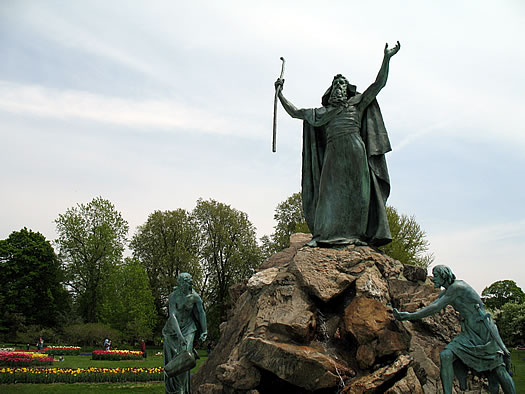
Moses fountain in Washington Park, Albany, NY.

Moses fountain in Washington Park, Albany, NY.

In our last Old Testament Study, we took a quick look at the closing of Exodus 17, and we left room for folks to catch up to where we are in the text. Today, we are going to take a look at Jethro’s Advice recorded in Exodus 18. We are going to see 2 major themes here, first we are going to take a look at the proper (Biblical) sharing of a testimony and worshiping God. Then we will look at Jethro’s advice to Moses and we will examine how churches today get this part wrong.

So let us dive right into the text beginning in the first verse of Exodus 18.

Exodus 18 (ESV) | Jethro’s Advice

Jethro, the priest of Midian, Moses’ father-in-law, heard of all that God had done for Moses and for Israel his people, how the Lord had brought Israel out of Egypt. Now Jethro, Moses’ father-in-law, had taken Zipporah, Moses’ wife, after he had sent her home, along with her two sons. The name of the one was Gershom (for he said, “I have been a sojourner in a foreign land”), and the name of the other, Eliezer (for he said, “The God of my father was my help, and delivered me from the sword of Pharaoh”). Jethro, Moses’ father-in-law, came with his sons and his wife to Moses in the wilderness where he was encamped at the mountain of God. And when he sent word to Moses, “I, your father-in-law Jethro, am coming to you with your wife and her two sons with her,” Moses went out to meet his father-in-law and bowed down and kissed him. And they asked each other of their welfare and went into the tent. Then Moses told his father-in-law all that the Lord had done to Pharaoh and to the Egyptians for Israel’s sake, all the hardship that had come upon them in the way, and how the Lord had delivered them. And Jethro rejoiced for all the good that the Lord had done to Israel, in that he had delivered them out of the hand of the Egyptians.

Testimony… we give testimony not of ourselves and how awesome we’ve become or how wonderful our life has become now that we made a decision or said a prayer. Our testimony is of what the Lord has done on our behalf. Notice the section that follows that Jethro doesn’t lavish praise upon Moses; rather, he offers praise and worship to the Lord God.

10 Jethro said, “Blessed be the Lord, who has delivered you out of the hand of the Egyptians and out of the hand of Pharaoh and has delivered the people from under the hand of the Egyptians. 11 Now I know that the Lord is greater than all gods, because in this affair they dealt arrogantly with the people.”12 And Jethro, Moses’ father-in-law, brought a burnt offering and sacrifices to God; and Aaron came with all the elders of Israel to eat bread with Moses’ father-in-law before God.

All praise and glory and honor be to God. They worshiped God (blessed His Name, confessed Him as God, offered burnt offering and sacrifices) and then they broke bread together. Now this act of worship takes a great deal of time, and led to the breaking of bread at the end of the day. The following day, we see Moses fulfilling his role as the Prophet of God to the Children of Israel, in the day-to-day affairs of leading such a large group through the wilderness. Until now, we’ve seen when the people murmur and complain to Moses, who then cries out to God and He acts, granting manna from heaven, quail from the wilderness, and water from a rock.

13 The next day Moses sat to judge the people, and the people stood around Moses from morning till evening. 14 When Moses’ father-in-law saw all that he was doing for the people, he said, “What is this that you are doing for the people? Why do you sit alone, and all the people stand around you from morning till evening?” 15 And Moses said to his father-in-law, “Because the people come to me to inquire of God; 16 when they have a dispute, they come to me and I decide between one person and another, and I make them know the statutes of God and his laws. 17 Moses’ father-in-law said to him, “What you are doing is not good. 18 You and the people with you will certainly wear yourselves out, for the thing is too heavy for you. You are not able to do it alone. 19 Now obey my voice; I will give you advice, and God be with you! You shall represent the people before God and bring their cases to God, 20 and you shall warn them about the statutes and the laws, and make them know the way in which they must walk and what they must do. 21 Moreover, look for able men from all the people, men who fear God, who are trustworthy and hate a bribe, and place such men over the people as chiefs of thousands, of hundreds, of fifties, and of tens. 22 And let them judge the people at all times. Every great matter they shall bring to you, but any small matter they shall decide themselves. So it will be easier for you, and they will bear the burden with you.23 If you do this, God will direct you, you will be able to endure, and all this people also will go to their place in peace.”

24 So Moses listened to the voice of his father-in-law and did all that he had said. 25 Moses chose able men out of all Israel and made them heads over the people, chiefs of thousands, of hundreds, of fifties, and of tens. 26 And they judged the people at all times. Any hard case they brought to Moses, but any small matter they decided themselves. 27 Then Moses let his father-in-law depart, and he went away to his own country.

Now, we have not yet been given the 10 Commandments. Moses was God’s servant and he heard God’s voice and God listened to Moses. Jethro knew that Moses alone could not be the only judge over all of the people. Moses needed to appoint men and delegate authority to them to sit as judges over tens, fifties, hundreds, and thousands. Delegated authority, not surrendered authority. Moses was still is held accountable to God for the people… he still represents the people before God. However, the smaller cases that have already been made clear can now be heard by able, God-fearing, trustworthy men who hate a bribe.

So how does the present-day church get this wrong? Modern-day pastors read themselves into the position of Moses when they should be reading themselves into the “able, God-fearing, trustworthy men who hate a bribe”. Jesus Christ is the head of His Church. Jesus Christ is our advocate with the Father in Heaven… the role of Moses is a shadow of Jesus Christ our Lord and Savior. Jesus, the Word made flesh, is the Head of His Church, not your senior pastor. Your elders/pastors are the ones to whom have been delegated authority in Christ Jesus to watch over, tend, teach, and feed His sheep. Some are placed over thousands, some hundreds, some fifties, and some tens. The children of Israel were divided up into tribes, clans, houses… but all were God’s Chosen People. The Church today is even more diverse and equally unified through the Gospel of Jesus Christ as written in His Word. Beware the false teacher, the false prophet, and the falsely anointed one (false christs). In closing, let us visit Paul’s exhortation to the elders of the church in Ephesus:

Acts 20:28-32 (ESV)

28 Pay careful attention to yourselves and to all the flock, in which the Holy Spirit has made you overseers, to care for the church of God, which he obtained with his own blood. 29 I know that after my departure fierce wolves will come in among you, not sparing the flock; 30 and from among your own selves will arise men speaking twisted things, to draw away the disciples after them. 31 Therefore be alert, remembering that for three years I did not cease night or day to admonish every one with tears. 32 And now I commend you to God and to the word of his grace, which is able to build you up and to give you the inheritance among all those who are sanctified.

In Christ Jesus,
Jorge

OT | The Lord is My Banner (Exodus 17)

Moses fountain in Washington Park, Albany, NY.

Moses fountain in Washington Park, Albany, NY.

In our last Old Testament Study, we looked at how after God had provided the Children of Israel with mana in the wilderness (Jesus is the Bread from Heaven) He also provided them with water (Jesus called Himself the fountain of living water in the wilderness). Today’s post will be extra short so that (hopefully) you can take some time to review the OT studies leading up to Exodus 17.

Let’s jump into the text.

Exodus 17:8-16 (ESV)

Israel Defeats Amalek

Then Amalek came and fought with Israel at Rephidim. So Moses said to Joshua, “Choose for us men, and go out and fight with Amalek. Tomorrow I will stand on the top of the hill with the staff of God in my hand.” 10 So Joshua did as Moses told him, and fought with Amalek, while Moses, Aaron, and Hur went up to the top of the hill. 11 Whenever Moses held up his hand, Israel prevailed, and whenever he lowered his hand, Amalek prevailed. 12 But Moses’ hands grew weary, so they took a stone and put it under him, and he sat on it, while Aaron and Hur held up his hands, one on one side, and the other on the other side. So his hands were steady until the going down of the sun. 13 And Joshua overwhelmed Amalek and his people with the sword.

14 Then the Lord said to Moses, “Write this as a memorial in a book and recite it in the ears of Joshua, that I will utterly blot out the memory of Amalek from under heaven.” 15 And Moses built an altar and called the name of it, The Lord Is My Banner, 16 saying, “A hand upon the throne of the Lord! The Lord will have war with Amalek from generation to generation.”

Several interesting things here. The first thing I’d like to mention is that we shouldn’t read this portion as an isolated event, separated from all previous events. Such is the current, post-modern paradigm of viewing everything that happens as “new” and completely disconnected from everything that has happened before.

Who is Amalek?

They are descended of Esau (Genesis 36). Though himself a son of Isaac, God rejected him in favor of Jacob, whom he would rename Israel. Esau took wives from the daughters of Heth (Canaan) further separating himself from the Promise to Abraham. Now, after so many generations, Amalek is waging war with the People of God, the Children of Promise.

Whose Victory of Battle?

Moses sends Joshua to choose men for battle, but to whom is the victory attributed? The Lord. Moses goes up on a hill and holds, not his staff, but the Staff of God. While in some cases it might be referred to as Moses’s staff, in this case Moses is clear to Joshua what is going to take place. The very staff that God instructed Moses and Aaron to use for each the plagues against Pharaoh, the staff with which God parted the Red Sea and the same staff God commanded Moses to strike the rock with at Horeb. Moses wasn’t saying “I’ll make sure you win”, he was saying “the Lord God is your Banner in battle”.

Banner?

While researching this passage, there was an entry in the Reformation Study Bible I thought was very informative, demonstrating something that might be lost in translation for us.

17:15 The Lord is my banner. The Hebrew word translated “banner” underlies “staff” in v. 9 and is used for the “pole” on which the bronze serpent was later placed (Num. 21:8). Since “banner” suggests cloth to us, this connection is lost. A spear could serve as a standard in battle, with or without bits of cloth tied to it. Later, a staff might have a device on it to mark the rallying point for troops. In the ancient world, these were sometimes images or signs of the gods. Moses’ staff is the ensign to which Joshua’s army could look and that symbolized God’s saving power. Moses declares that God Himself is the Standard, the Ensign of His people.

Very cool. Once again, what we are seeing here is not the greatness of Joshua’s leadership, but the Mighty Hand of God at work, showing His favor upon Israel, Moses, and Joshua. Remember the Song of Moses as recorded in Exodus 15.

Exodus 15 (ESV)

The Song of Moses

15 Then Moses and the people of Israel sang this song to the Lord, saying,

“I will sing to the Lord, for he has triumphed gloriously;
    the horse and his rider he has thrown into the sea.
The Lord is my strength and my song,
    and he has become my salvation;
this is my God, and I will praise him,
    my father’s God, and I will exalt him.
The Lord is a man of war;
    the Lord is his name.

“Pharaoh’s chariots and his host he cast into the sea,
    and his chosen officers were sunk in the Red Sea.
The floods covered them;
    they went down into the depths like a stone.
Your right hand, O Lord, glorious in power,
    your right hand, O Lord, shatters the enemy.
In the greatness of your majesty you overthrow your adversaries;
    you send out your fury; it consumes them like stubble.
At the blast of your nostrils the waters piled up;
    the floods stood up in a heap;
    the deeps congealed in the heart of the sea.
The enemy said, ‘I will pursue, I will overtake,
    I will divide the spoil, my desire shall have its fill of them.
    I will draw my sword; my hand shall destroy them.’
10 You blew with your wind; the sea covered them;
    they sank like lead in the mighty waters.

11 “Who is like you, O Lord, among the gods?
    Who is like you, majestic in holiness,
    awesome in glorious deeds, doing wonders?
12 You stretched out your right hand;
    the earth swallowed them.

13 “You have led in your steadfast love the people whom you have redeemed;
    you have guided them by your strength to your holy abode.
14 The peoples have heard; they tremble;
    pangs have seized the inhabitants of Philistia.
15 Now are the chiefs of Edom dismayed;
    trembling seizes the leaders of Moab;
    all the inhabitants of Canaan have melted away.
16 Terror and dread fall upon them;
    because of the greatness of your arm, they are still as a stone,
till your people, O Lord, pass by,
    till the people pass by whom you have purchased.
17 You will bring them in and plant them on your own mountain,
    the place, O Lord, which you have made for your abode,
    the sanctuary, O Lord, which your hands have established.
18 The Lord will reign forever and ever.”

In Hebrews 11, we are taught that all of the mighty deeds accomplished in Scripture were by faith. Faith in whom? In the Only Living God of Abraham, Isaac, and Jacob, the Creator of all things. The Lord is my Banner… while there was a physical symbol of the favor of the Lord, neither Joshua, Aaron, Moses, nor Hur were under any misgivings that there was something in the staff itself, nor in the efforts of Moses. This was God’s work and God’s victory over Amalek.

Hebrews 13:20-21 (ESV)

Benediction

20 Now may the God of peace who brought again from the dead our Lord Jesus,the great shepherd of the sheep, by the blood of the eternal covenant, 21 equip you with everything good that you may do his will, working in us that which is pleasing in his sight, through Jesus Christ, to whom be glory forever and ever. Amen.

May the Grace of God be with you today and forever,
In Christ Jesus,
Jorge