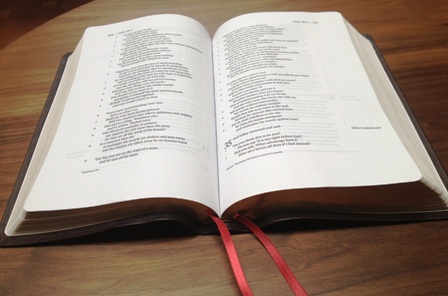
Gospel Wednesday | Matthew 13:1-51

bibleLast week, we took a look at the last portion of Matthew 12. It was such a wonderful story we ended up jumping over to the Gospel of Mark to really explore what was taking place at this time. To get back into the timeline in Matthew’s Account, let’s review it once more before jumping into Chapter 13.

Jesus’ Mother and Brothers

Matthew 12:46-50 (ESV) | Jesus’ Mother and Brothers

46 While he was still speaking to the people, behold, his mother and his brothers stood outside, asking to speak to him. 48 But he replied to the man who told him, “Who is my mother, and who are my brothers?” 49 And stretching out his hand toward his disciples, he said, “Here are my mother and my brothers! 50 For whoever does the will of my Father in heaven is my brother and sister and mother.”

The Parables

Matthew 13:1-51 (ESV)

The Parable of the Sower

That same day Jesus went out of the house and sat beside the sea. And great crowds gathered about him, so that he got into a boat and sat down. And the whole crowd stood on the beach. And he told them many things in parables, saying: “A sower went out to sow. And as he sowed, some seeds fell along the path, and the birds came and devoured them. Other seeds fell on rocky ground, where they did not have much soil, and immediately they sprang up, since they had no depth of soil, but when the sun rose they were scorched. And since they had no root, they withered away. Other seeds fell among thorns, and the thorns grew up and choked them. Other seeds fell on good soil and produced grain, some a hundredfold, some sixty, some thirty.He who has ears, let him hear.”

The Purpose of the Parables

10 Then the disciples came and said to him, “Why do you speak to them in parables?” 11 And he answered them, To you it has been given to know the secrets of the kingdom of heaven, but to them it has not been given. 12 For to the one who has, more will be given, and he will have an abundance, but from the one who has not, even what he has will be taken away. 13 This is why I speak to them in parables, because seeing they do not see, and hearing they do not hear, nor do they understand. 14 Indeed, in their case the prophecy of Isaiah is fulfilled that says:

“‘“You will indeed hear but never understand,
    and you will indeed see but never perceive.”
15 For this people’s heart has grown dull,
    and with their ears they can barely hear,
    and their eyes they have closed,
lest they should see with their eyes
    and hear with their ears
and understand with their heart
    and turn, and I would heal them.’

16 But blessed are your eyes, for they see, and your ears, for they hear.17 For truly, I say to you, many prophets and righteous people longed to see what you see, and did not see it, and to hear what you hear, and did not hear it.

The Parable of the Sower Explained

18 “Hear then the parable of the sower: 19 When anyone hears the word of the kingdom and does not understand it, the evil one comes and snatches away what has been sown in his heart. This is what was sown along the path. 20 As for what was sown on rocky ground, this is the one who hears the word and immediately receives it with joy, 21 yet he has no root in himself, but endures for a while, and when tribulation or persecution arises on account of the word, immediately he falls away. 22 As for what was sown among thorns, this is the one who hears the word, but the cares of the world and the deceitfulness of riches choke the word, and it proves unfruitful. 23 As for what was sown on good soil, this is the one who hears the word and understands it. He indeed bears fruit and yields, in one case a hundredfold, in another sixty, and in another thirty.”

What Jesus teaches here is wonderful. This is Jesus teaching about what takes place when 4 different types of people hear the word of the Kingdom being preached. So much conjecture in the church (and some fear mongering) about “false conversions” and stuff… Jesus explained clearly here what happens. The real focus in the church should be fixed on whether or not the seed is indeed the Gospel of Jesus Christ or the gospel of men.

The Parable of the Weeds

24 He put another parable before them, saying, “The kingdom of heaven may be compared to a man who sowed good seed in his field, 25 but while his men were sleeping, his enemy came and sowed weeds among the wheat and went away.26 So when the plants came up and bore grain, then the weeds appeared also.27 And the servants of the master of the house came and said to him, ‘Master, did you not sow good seed in your field? How then does it have weeds?’ 28 He said to them, ‘An enemy has done this.’ So the servants said to him, ‘Then do you want us to go and gather them?’ 29 But he said, ‘No, lest in gathering the weeds you root up the wheat along with them. 30 Let both grow together until the harvest, and at harvest time I will tell the reapers, Gather the weeds first and bind them in bundles to be burned, but gather the wheat into my barn.’”

The Mustard Seed and the Leaven

31 He put another parable before them, saying, “The kingdom of heaven is like a grain of mustard seed that a man took and sowed in his field. 32 It is the smallest of all seeds, but when it has grown it is larger than all the garden plants and becomes a tree, so that the birds of the air come and make nests in its branches.”

33 He told them another parable. “The kingdom of heaven is like leaven that a woman took and hid in three measures of flour, till it was all leavened.”

Prophecy and Parables

34 All these things Jesus said to the crowds in parables; indeed, he said nothing to them without a parable. 35 This was to fulfill what was spoken by the prophet:

“I will open my mouth in parables;
    I will utter what has been hidden since the foundation of the world.”

With the parables of the mustard seed and the leaven, we see depictions of evangelism. Like the parable of the sower, the man who plants the mustard seed and the woman who hides the leaven in flour do nothing more than wait for the appointed time. In the parable of the sower, the sower sows the seed (the word of the Kingdom) and then does nothing more. Our role in evangelism is to preach the Words of Christ, sow the seed. God does the work through His Word. Jesus Christ builds His church… our part is clearly defined: preach the Word. Now, the parable of the weeds is a little different, and Jesus explains that one to us next.

The Parable of the Weeds Explained

36 Then he left the crowds and went into the house. And his disciples came to him, saying, “Explain to us the parable of the weeds of the field.” 37 He answered, “The one who sows the good seed is the Son of Man. 38 The field is the world, and the good seed is the sons of the kingdom. The weeds are the sons of the evil one, 39 and the enemy who sowed them is the devil. The harvest is the end of the age, and the reapers are angels. 40 Just as the weeds are gathered and burned with fire, so will it be at the end of the age. 41 The Son of Man will send his angels, and they will gather out of his kingdom all causes of sin and all law-breakers, 42 and throw them into the fiery furnace. In that place there will be weeping and gnashing of teeth. 43 Then the righteous will shine like the sun in the kingdom of their Father. He who has ears, let him hear.

The Parable of the Hidden Treasure

44 “The kingdom of heaven is like treasure hidden in a field, which a man found and covered up. Then in his joy he goes and sells all that he has and buys that field.

The Parable of the Pearl of Great Value

45 “Again, the kingdom of heaven is like a merchant in search of fine pearls,46 who, on finding one pearl of great value, went and sold all that he had and bought it.

This is no speculative venture. This isn’t reckless. It is assured by faith in Jesus Christ. There is also no safety net, no 30-day guarantee, no trial period, no test drive. One does not “give Jesus a chance”, that is not the Gospel. Reciting “the sinner’s prayer” doesn’t lock you in, either. This isn’t about what you say with your mouth only. The moment a person hears the Gospel of Jesus Christ, the word of the Kingdom, and understands it and believes in the Son, that person has been given faith. That is a work of the Holy Spirit, opening up the ears of the hearer to hear. He who has ears, let him hear.

The Parable of the Net

47 “Again, the kingdom of heaven is like a net that was thrown into the sea and gathered fish of every kind. 48 When it was full, men drew it ashore and sat down and sorted the good into containers but threw away the bad. 49 So it will be at the end of the age. The angels will come out and separate the evil from the righteous 50 and throw them into the fiery furnace. In that place there will be weeping and gnashing of teeth.

This parable is a return to the theme of the parable of the weeds, with a focus on the Day of Christ’s return. This is one another of Christ’s teaching that leads me away from any notion of a secret rapture. Jesus didn’t teach it, nor did He include it in His direct teaching/prophecy of the last days.

New and Old Treasures

51 “Have you understood all these things?” They said to him, “Yes.” 52 And he said to them, “Therefore every scribe who has been trained for the kingdom of heaven is like a master of a house, who brings out of his treasure what is new and what is old.” 

We have been blessed with the writings/teachings of the old testament and that of the Apostles of Jesus Christ, those who laid the foundation of His church, with Christ as its cornerstone. Let us strive to understand all that has been written and given to us, so that we might be trained for the kingdom of Heaven, being faithful stewards of the House of God, the Church.

Until Next Week…

Next week, Matthew’s account will take a shift from the parables back to His public ministry. He will continue teaching, and Matthew makes it a point to testify of His mighty public works. Jesus’ ministry was no secret, hidden thing, God made Himself known to the people. Some exciting stuff ahead, I hope to see you here next week.

Jude 1:24-25 (ESV) 24 Now to him who is able to keep you from stumbling and to present you blameless before the presence of his glory with great joy, 25 to the only God, our Savior, through Jesus Christ our Lord, be glory, majesty, dominion, and authority, before all time and now and forever. Amen.

In Christ Jesus,
Jorge

DiM | “Flawless” by MercyMe

Presentation1Today is “Discernment in Music” (DiM) day here at Faithful Stewardship (2 Corinthians 10:4-6 (ESV)).

June 09, 2015. Today we’ll be taking a look at “Flawless” by MercyMe which currently sits at #19 at 20theCountdownMagazine.

We’ll continue using this top 20 song list until I find a better list. Your feedback in this would be greatly appreciated.

When I first heard this song on the radio, I was driving and didn’t catch most of the first verse, but I was really excited to hear a song talking about God’s Grace and how there is nothing we can do to earn that Grace, not before salvation or retroactively. However, now that I’ve listened to it several times and read the lyrics (part of my writing process), I’m less excited about the song. In seeking to assuage one fear (works-based righteousness before God), it conveys several poor notions. We’ll discuss those below.

VEVO Music Video

Lyrcs (via KLove)

Flawless by MercyMe

There’s got to be more
Than going back and forth
From doing right to doing wrong
‘Cause we were taught that’s who we are
Come on get in line right behind me
You along with everybody
Thinking there’s worth in what you do

Then like a hero who takes the stage when
We’re on the edge of our seats saying it’s too late
Well let me introduce you to amazing grace

No matter the bumps
No matter the bruises
No matter the scars
Still the truth is
The cross has made
The cross has made you flawless
No matter the hurt
Or how deep the wound is
No matter the pain
Still the truth is
The cross has made
The cross has made you flawless

Could it possibly be
That we simply can’t believe
That this unconditional
Kind of love would be enough
To take a filthy wretch like this
And wrap him up in righteousness
But that’s exactly what He did

Take a breath smile and say
Right here right now I’m ok because
The cross was enough

Then like a hero who takes the stage when
We’re on the edge of our seats saying it’s too late
Well let me introduce you to grace grace
God’s grace

No matter what they say
Or what you think you are
The day you called His name
He made you flawless

Publishing: MercyMe Music (ASCAP) (admin. by Music Services); Wet As A Fish Music (ASCAP) (admin. by Music Services); Soul Glow Activator Music (BMI) (admin. by Music Services); D Soul Music / Universal Music Brentwood Benson Publishing (ASCAP) (admin. by capitolcmgpublishing.com); 9t One Songs / Ariose Music (ASCAP) (admin. by capitolcmgpublishing.com). All rights reserved.
Writer(s): Bart Millard, Mike Scheuchzer, Nathan Cochran, Robby Shaffer; Barry Graul; Solomon Olds; David Garcia; Ben Glover

Discussion

Overall Intent

I believe the intent behind this song is a good one. I’m inferring intent based on the direction of the errors and the current theme in the Christian music industry. The intent is to reassure the listener that faith in Christ’s life, death, & resurrection is sufficient for salvation. That the one who believes in the Son has eternal life assured, and that nothing he does in this life can improve upon that assurance. Our rightstanding with God is by faith alone in Christ alone to the Glory of God alone. Both boasting (in our good works) and condemnation (for not measuring up to the good works of others) are excluded.

Ephesians 2:8-10 (ESV) 8 For by grace you have been saved through faith. And this is not your own doing; it is the gift of God, 9 not a result of works, so that no one may boast. 10 For we are his workmanship, created in Christ Jesus for good works, which God prepared beforehand, that we should walk in them.

Romans 8:1-11 (ESV) | Life in the Spirit
1 There is therefore now no condemnation for those who are in Christ Jesus. 2 For the law of the Spirit of life has set you free in Christ Jesus from the law of sin and death. 3 For God has done what the law, weakened by the flesh, could not do. By sending his own Son in the likeness of sinful flesh and for sin, he condemned sin in the flesh, 4 in order that the righteous requirement of the law might be fulfilled in us, who walk not according to the flesh but according to the Spirit. 5 For those who live according to the flesh set their minds on the things of the flesh, but those who live according to the Spirit set their minds on the things of the Spirit. 6 For to set the mind on the flesh is death, but to set the mind on the Spirit is life and peace. 7 For the mind that is set on the flesh is hostile to God, for it does not submit to God’s law; indeed, it cannot. 8 Those who are in the flesh cannot please God. 9 You, however, are not in the flesh but in the Spirit, if in fact the Spirit of God dwells in you. Anyone who does not have the Spirit of Christ does not belong to him. 10 But if Christ is in you, although the body is dead because of sin, the Spirit is life because of righteousness. 11 If the Spirit of him who raised Jesus from the dead dwells in you, he who raised Christ Jesus from the dead will also give life to your mortal bodies through his Spirit who dwells in you.

Hopefully, in reading through the passage in Romans, we see where MercyMe was intending to go but toward the end of that passage we see where the song gets a bit off track. Does the cross make us flawless in the here and now? Not in the flesh. This flesh is corrupted, dead, because of sin. We walk in sinful bodies, but we who are in Christ do not submit ourselves to the flesh; rather, we walk in the Spirit, meaning by faith we hold onto the promise of the Resurrection, a Promise sealed in us by the indwelling of the Holy Spirit as a Gift for those who have believed in the Gospel of Jesus Christ.

1 Peter 1:3-9 (ESV) | Born Again to a Living Hope
1 Blessed be the God and Father of our Lord Jesus Christ! According to his great mercy, he has caused us to be born again to a living hope through the resurrection of Jesus Christ from the dead, 4 to an inheritance that is imperishable, undefiled, and unfading, kept in heaven for you, 5 who by God’s power are being guarded through faith for a salvation ready to be revealed in the last time. 6 In this you rejoice, though now for a little while, if necessary, you have been grieved by various trials, 7 so that the tested genuineness of your faith—more precious than gold that perishes though it is tested by fire—may be found to result in praise and glory and honor at the revelation of Jesus Christ. 8 Though you have not seen him, you love him. Though you do not now see him, you believe in him and rejoice with joy that is inexpressible and filled with glory, 9 obtaining the outcome of your faith, the salvation of your souls.

Peter makes it clear that our Salvation and Hope are assured, though our reception of the fullness of the Promise is not yet. How can that be? Faith.

Romans 8:23-25 (ESV) 23 And not only the creation, but we ourselves, who have the firstfruits of the Spirit, groan inwardly as we wait eagerly for adoption as sons, the redemption of our bodies. 24 For in this hope we were saved. Now hope that is seen is not hope. For who hopes for what he sees? 25 But if we hope for what we do not see, we wait for it with patience.

No one hopes for what he sees. We hope (with assurance by faith) for what we do not yet see, our adoption as sons, the redemption of our bodies, the resurrection in Christ Jesus.

The cross has made you flawless in the hope that is to come, the Return of Jesus Christ. This song stays focused on hurts and sins of the past. Our bodies still bear the scars of sin… we all will die a physical death.

Problems

While I believe the overall intent of the song to have come from a good place, there are some big problems in the lyrics that bear mentioning.

Verse 1. There’s got to be more Than going back and forth From doing right to doing wrong ‘Cause we were taught that’s who we are… What is really being countered here? I mean, the truth is that this is who we are, we are simultaneously justified by faith and sinners in the flesh. If we stop teaching this as the truth of our existence, does that change the existence? No. What is the alternative? That Christians no longer sin or that sin is no longer sin for Christians? Absolutely not! So, this whole verse gets a “fail” from me. The last line of this verse, if held tightly within the context of what we’d explored as the “intent” of the song, kind of fits. But the truth is that what we do (or don’t do) has worth, it has value, within the Body of Christ. Not in our right-standing with God, but in our love for our neighbors. When (not “if”) we sin against our neighbor, we need to repent and seek forgiveness. That act has worth.

Pre-Chorus. I like the imagery of the pre-chorus. At first, I was concerned that it was making the listener the one taking the stage, but I don’t think that’s it. I think it’s the Grace of God being introduced on the stage that is being conveyed here, and I really like that. Kudos to whoever wrote this pre-chorus.

Chorus. bumps, bruises, scars… and then the cross made us flawless? I think we got a bit lost in the imagery. The power of the Gospel of Jesus Christ is that by His blood we are forgiven of our sin. Sin is far more than bumps, bruises, and scars… sin is death. Bumps and bruises, in light of the Gospel, are trials and tribulations of this life. They pale in comparison to the Gospel of Grace. Our flesh is scarred by sin (ours and of others). Sometimes our scars lead us to sin (habitual sins, learned sinful behavior, vengeance etc.) and only the Grace of God can heal those wounds. This chorus can be encouraging, in that thanks to the Cross of Jesus Christ, we no longer are slaves to sin or the kingdom of darkness… but the authors confused the two forms of righteousness and don’t seem to rightly understand the idea of simul justes et peccator. We are completely forgiven in Jesus’ name, and we continue to sin and repent of those sins as the Holy Spirit convicts us. Forgiveness is assured, He is Faithful and Just to forgive us our sins when we confess and repent.

Verse 2. Okay, this verse is an improvement, but it fails in the same area that the majority of popular Christian songs fail… there is no mention of repentance and forgiveness. What is available here and now is forgiveness, based on Christ’s atonement for our sin. It is a beautiful and glorious exchange, our repentance by faith exchanges our filthy rags for a robe of righteousness in Jesus’ Name.

Conclusion

We need to get back to understanding the Truth of what the Apostle Paul taught regarding our existence as simultaneously Justified and sinner. By faith we are joined with Jesus Christ in His death and resurrection for the forgiveness of our sins. Yet, we remain walking this earth as exiles, no longer belonging to this world but not yet rid of this sinful flesh to put on fully redeemed bodies.

Philippians 3:8-16 (ESV) 8 Indeed, I count everything as loss because of the surpassing worth of knowing Christ Jesus my Lord. For his sake I have suffered the loss of all things and count them as rubbish, in order that I may gain Christ 9 and be found in him, not having a righteousness of my own that comes from the law, but that which comes through faith in Christ, the righteousness from God that depends on faith— 10 that I may know him and the power of his resurrection, and may share his sufferings, becoming like him in his death, 11 that by any means possible I may attain the resurrection from the dead. 12 Not that I have already obtained this or am already perfect, but I press on to make it my own, because Christ Jesus has made me his own. 13 Brothers, I do not consider that I have made it my own. But one thing I do: forgetting what lies behind and straining forward to what lies ahead, 14 I press on toward the goal for the prize of the upward call of God in Christ Jesus. 15 Let those of us who are mature think this way, and if in anything you think otherwise, God will reveal that also to you. 16 Only let us hold true to what we have attained.

As surely as the patriarchs longed for the Promised Messiah, we long for His return, for the upward call of God in Christ Jesus, when at last we will be completely healed of every remnant of sin in our mortal bodies, for we will be given new bodies in Christ Jesus. The Promise is True, He will return for His Church.

Revelation 22:20-21 (ESV) 20 He who testifies to these things says, “Surely I am coming soon.” Amen.Come, Lord Jesus! 21 The grace of the Lord Jesus be with all. Amen.

Amen.
In Christ Jesus,
Jorge

CTT | Do you do well to be Angry?

Jonah 4:1-4 (ESV) | Jonah’s Anger and the Lord‘s Compassion

But it displeased Jonah exceedingly, and he was angry. And he prayed to the Lord and said, “O Lord, is not this what I said when I was yet in my country? That is why I made haste to flee to Tarshish; for I knew that you are a gracious God and merciful, slow to anger and abounding in steadfast love, and relenting from disaster. Therefore now, O Lord, please take my life from me, for it is better for me to die than to live.” And the Lord said, “Do you do well to be angry?”

It’s such a simple question.   God is addressing His sulking prophet, Jonah, and rhetorically asking him, “Do you do well to be angry?” Why was Jonah angry? Let’s look at what happens in chapter 3, to see if we can grasp what it was that had Jonah angry enough to forfeit his very life.

Jonah 3 (ESV)Jonah Goes to Nineveh

Then the word of the Lord came to Jonah the second time, saying, “Arise, go to Nineveh, that great city, and call out against it the message that I tell you.” So Jonah arose and went to Nineveh, according to the word of the Lord. Now Nineveh was an exceedingly great city, three days’ journey in breadth.Jonah began to go into the city, going a day’s journey. And he called out, “Yet forty days, and Nineveh shall be overthrown!” And the people of Nineveh believed God. They called for a fast and put on sackcloth, from the greatest of them to the least of them.

Notice the wording here… it doesn’t say they believed Jonah… the people of Nineveh believed God. Jonah was preaching the Word of the Lord.

Jonah 3 | The People of Nineveh Repent

The word reached the king of Nineveh, and he arose from his throne, removed his robe, covered himself with sackcloth, and sat in ashes. And he issued a proclamation and published through Nineveh, “By the decree of the king and his nobles: Let neither man nor beast, herd nor flock, taste anything. Let them not feed or drink water, but let man and beast be covered with sackcloth, and let them call out mightily to God. Let everyone turn from his evil way and from the violence that is in his hands. Who knows? God may turn and relent and turn from his fierce anger, so that we may not perish.”

10 When God saw what they did, how they turned from their evil way, God relented of the disaster that he had said he would do to them, and he did not do it.

God relented… He did not bring about disaster upon them because of their repentance by faith. Why do I say faith? Because they believed the Word of God spoken through the prophet Jonah. The people of Nineveh believed God, by faith, and turned from (repented) their evil way, and God forgave them and relented. And that is what displeased Jonah exceedingly, and made him angry.

Do you do well to be angry?

Jonah strongly reminds God, of why he ran in the first place. Jonah wasn’t afraid of Nineveh, and he had no doubt of God’s ability to destroy Nineveh. Jonah knew full-well it was God who caused the storm to attack the boat and he knew that God was responsible for the fish… but he also knew of God’s Mercy and Grace. He knew that if Nineveh believed the Word of God and repented, that God would show mercy. He knew it… and He didn’t want Nineveh spared. Nineveh was guilty… her walls were painted with graphic murals of her king’s torturous treatment of captives. Justice demanded Nineveh’s destruction. Jonah demanded justice. He was so angry that God relented, that Jonah decided he’d rather die than live with the knowledge that Nineveh had repented at his preaching and been forgiven.

Jonah 4:5-11 (ESV)

Jonah went out of the city and sat to the east of the city and made a booth for himself there. He sat under it in the shade, till he should see what would become of the city. Now the Lord God appointed a plant and made it come up over Jonah, that it might be a shade over his head, to save him from his discomfort. So Jonah was exceedingly glad because of the plant. But when dawn came up the next day, God appointed a worm that attacked the plant, so that it withered. When the sun rose, God appointed a scorching east wind,and the sun beat down on the head of Jonah so that he was faint. And he asked that he might die and said, “It is better for me to die than to live.” But God said to Jonah, “Do you do well to be angry for the plant?” And he said, “Yes, I do well to be angry, angry enough to die.” 10 And the Lord said, “You pity the plant, for which you did not labor, nor did you make it grow, which came into being in a night and perished in a night. 11 And should not I pity Nineveh, that great city, in which there are more than 120,000 persons who do not know their right hand from their left, and also much cattle?”

What right does Jonah have to be angry at God for sparing a repentant Nineveh? None. Jonah doesn’t have the right. He is in no way entitled to this anger. He is angry at God for His mercy and grace to the people of Nineveh. And that same God shows him mercy and grace in this rebuke. Nineveh’s faith wanes and she is later destroyed by God (Book of Nahum)… but for now, God extends grace and delays justice.

Matthew 12:38-42 (ESV) | The Sign of Jonah

38 Then some of the scribes and Pharisees answered him, saying, “Teacher, we wish to see a sign from you.” 39 But he answered them, An evil and adulterous generation seeks for a sign, but no sign will be given to it except the sign of the prophet Jonah. 40 For just as Jonah was three days and three nights in the belly of the great fish, so will the Son of Man be three days and three nights in the heart of the earth. 41 The men of Nineveh will rise up at the judgment with this generation and condemn it, for they repented at the preaching of Jonah, and behold, something greater than Jonah is here. 42 The queen of the South will rise up at the judgment with this generation and condemn it, for she came from the ends of the earth to hear the wisdom of Solomon, and behold, something greater than Solomon is here.

God is still extending Grace and Mercy… this time coming to perform an act of mercy far greater than was witnessed by Jonah. Jesus came to bear the full brunt of God’s wrath on the cross… in our place. The Pharisees lacked faith, and Jesus told them they would be condemned by the men of Nineveh who repented.

We, too, struggle with forgiveness, don’t we? We insist on earning our forgiveness… paying penance, “making things right”. Is it not because we fail to understand the gravity of our sin, of our wrong, of our guilt? Surely this is the case, because we who long for forgiveness for ourselves seem awfully keen to withhold forgiveness from others. Sure, we’ll forgive, but Justice must be served! We are entitled to closure… to satisfaction that justice has been served and that the wrongs have been made right… right?

Matthew 18:21-35 (ESV) | The Parable of the Unforgiving Servant

21 Then Peter came up and said to him, “Lord, how often will my brother sin against me, and I forgive him? As many as seven times?” 22 Jesus said to him,“I do not say to you seven times, but seventy-seven times.

23 “Therefore the kingdom of heaven may be compared to a king who wished to settle accounts with his servants. 24 When he began to settle, one was brought to him who owed him ten thousand talents. 25 And since he could not pay, his master ordered him to be sold, with his wife and children and all that he had, and payment to be made. 26 So the servant fell on his knees, imploring him, ‘Have patience with me, and I will pay you everything.’ 27 And out of pity for him, the master of that servant released him and forgave him the debt. 28 But when that same servant went out, he found one of his fellow servants who owed him a hundred denarii, and seizing him, he began to choke him, saying, ‘Pay what you owe.’ 29 So his fellow servant fell down and pleaded with him, ‘Have patience with me, and I will pay you.’ 30 He refused and went and put him in prison until he should pay the debt. 31 When his fellow servants saw what had taken place, they were greatly distressed, and they went and reported to their master all that had taken place. 32 Then his master summoned him and said to him, ‘You wicked servant! I forgave you all that debt because you pleaded with me. 33 And should not you have had mercy on your fellow servant, as I had mercy on you?’34 And in anger his master delivered him to the jailers, until he should pay all his debt.35 So also my heavenly Father will do to every one of you, if you do not forgive your brother from your heart.”

For a laborer, a talent was about a year’s wages. 10,000 year’s wages was forgiven him. A denarius was about a day’s wage… He couldn’t see fit to forgive the debt of 100 day’s wages in light of having been forgiven 10,000 years worth of debt.

Dear Christian… do you do well to be angry? Is there any sin your brother, sister, or neighbor can commit against you that compares to eternity? Do you think you have the right to insist on justice over forgiveness on behalf of another?

Matthew 6:7-15 (ESV)

“And when you pray, do not heap up empty phrases as the Gentiles do, for they think that they will be heard for their many words. Do not be like them,for your Father knows what you need before you ask him. Pray then like this:

“Our Father in heaven,
hallowed be your name.
10 Your kingdom come,
your will be done,
    on earth as it is in heaven.
11 Give us this day our daily bread,
12 and forgive us our debts,
    as we also have forgiven our debtors.
13 And lead us not into temptation,
    but deliver us from evil.

14 For if you forgive others their trespasses, your heavenly Father will also forgive you, 15 but if you do not forgive others their trespasses, neither will your Father forgive your trespasses.

The world speaks with confidence of things it doesn’t understand. The world demands Justice while it rejects the God of creation. We who are called in Jesus’ Name, out of the darkness and into the Light of the Gospel of Jesus Christ, we know better than to demand Justice over Mercy and Grace. At least, we should. You see, Justice comes from the One who also extends Mercy. Jonah wasn’t seeking really seeking Justice to be poured out on Nineveh… he wanted vengeance.

Do you do well to be angry?

In Christ Jesus,
Jorge

Friday Sermon | Genesis 12 via Romans 3 and 4 by Pastor Chris Rosebrough

churchToday’s sermon comes from the Adult Sunday School taught at Kongsvinger Lutheran Church. I think more Churches should return to the concept of an adult Bible Study for exegetical study of scripture. Particularly those Churches stuck in the “topical study” mindset for Sunday Service. Pastor Chris Rosebrough is working through the Old Testament following what he refers to as the crimson thread (the Lineage) of the Promised Messiah, Jesus Christ. Today’s lesson will serve to demonstrate how we allow the New Testament to bring clarity and understanding for the Old Testament.

Lesson Audio

Lesson Text

Romans 3 (ESV)

God’s Righteousness Upheld

Then what advantage has the Jew? Or what is the value of circumcision?Much in every way. To begin with, the Jews were entrusted with the oracles of God. What if some were unfaithful? Does their faithlessness nullify the faithfulness of God? By no means! Let God be true though every one were a liar, as it is written,

“That you may be justified in your words,
    and prevail when you are judged.”

But if our unrighteousness serves to show the righteousness of God, what shall we say? That God is unrighteous to inflict wrath on us? (I speak in a human way.) By no means! For then how could God judge the world? But if through my lie God’s truth abounds to his glory, why am I still being condemned as a sinner? And why not do evil that good may come?—as some people slanderously charge us with saying. Their condemnation is just.

No One Is Righteous

What then? Are we Jews any better off? No, not at all. For we have already charged that all, both Jews and Greeks, are under sin, 10 as it is written:

“None is righteous, no, not one;
11     no one understands;
    no one seeks for God.
12 All have turned aside; together they have become worthless;
    no one does good,
    not even one.”
13 “Their throat is an open grave;
    they use their tongues to deceive.”
“The venom of asps is under their lips.”
14     “Their mouth is full of curses and bitterness.”
15 “Their feet are swift to shed blood;
16     in their paths are ruin and misery,
17 and the way of peace they have not known.”
18     “There is no fear of God before their eyes.”

19 Now we know that whatever the law says it speaks to those who are under the law, so that every mouth may be stopped, and the whole world may be held accountable to God. 20 For by works of the law no human being will be justified in his sight, since through the law comes knowledge of sin.

The Righteousness of God Through Faith

21 But now the righteousness of God has been manifested apart from the law, although the Law and the Prophets bear witness to it— 22 the righteousness of God through faith in Jesus Christ for all who believe. For there is no distinction:23 for all have sinned and fall short of the glory of God, 24 and are justified by his grace as a gift, through the redemption that is in Christ Jesus, 25 whom God put forward as a propitiation by his blood, to be received by faith. This was to show God’s righteousness, because in his divine forbearance he had passed over former sins. 26 It was to show his righteousness at the present time, so that he might be just and the justifier of the one who has faith in Jesus.

27 Then what becomes of our boasting? It is excluded. By what kind of law? By a law of works? No, but by the law of faith. 28 For we hold that one is justified by faith apart from works of the law. 29 Or is God the God of Jews only? Is he not the God of Gentiles also? Yes, of Gentiles also, 30 since God is one—who will justify the circumcised by faith and the uncircumcised through faith. 31 Do we then overthrow the law by this faith? By no means! On the contrary, we uphold the law.

Romans 4 (ESV)

Abraham Justified by Faith

What then shall we say was gained by Abraham, our forefather according to the flesh? For if Abraham was justified by works, he has something to boast about, but not before God. For what does the Scripture say? “Abraham believed God, and it was counted to him as righteousness.” Now to the one who works, his wages are not counted as a gift but as his due. And to the one who does not work but believes in him who justifies the ungodly, his faith is counted as righteousness, just as David also speaks of the blessing of the one to whom God counts righteousness apart from works:

“Blessed are those whose lawless deeds are forgiven,
    and whose sins are covered;
blessed is the man against whom the Lord will not count his sin.”

Is this blessing then only for the circumcised, or also for the uncircumcised?For we say that faith was counted to Abraham as righteousness. 10 How then was it counted to him? Was it before or after he had been circumcised? It was not after, but before he was circumcised. 11 He received the sign of circumcision as a seal of the righteousness that he had by faith while he was still uncircumcised. The purpose was to make him the father of all who believe without being circumcised, so that righteousness would be counted to them as well, 12 and to make him the father of the circumcised who are not merely circumcised but who also walk in the footsteps of the faith that our father Abraham had before he was circumcised.

The Promise Realized Through Faith

13 For the promise to Abraham and his offspring that he would be heir of the world did not come through the law but through the righteousness of faith.14 For if it is the adherents of the law who are to be the heirs, faith is null and the promise is void. 15 For the law brings wrath, but where there is no law there is no transgression.

16 That is why it depends on faith, in order that the promise may rest on grace and be guaranteed to all his offspring—not only to the adherent of the law but also to the one who shares the faith of Abraham, who is the father of us all,17 as it is written, “I have made you the father of many nations”—in the presence of the God in whom he believed, who gives life to the dead and calls into existence the things that do not exist. 18 In hope he believed against hope, that he should become the father of many nations, as he had been told, “So shall your offspring be.” 19 He did not weaken in faith when he considered his own body, which was as good as dead (since he was about a hundred years old), or when he considered the barrenness of Sarah’s womb. 20 No unbelief made him waver concerning the promise of God, but he grew strong in his faith as he gave glory to God, 21 fully convinced that God was able to do what he had promised. 22 That is why his faith was “counted to him as righteousness.” 23 Butthe words “it was counted to him” were not written for his sake alone, 24 but for ours also. It will be counted to us who believe in him who raised from the dead Jesus our Lord, 25 who was delivered up for our trespasses and raised for our justification.

Genesis 12 (ESV)

The Call of Abram

12 Now the Lord said to Abram, “Go from your country and your kindred and your father’s house to the land that I will show you. And I will make of you a great nation, and I will bless you and make your name great, so that you will be a blessing. I will bless those who bless you, and him who dishonors you I will curse, and in you all the families of the earth shall be blessed.”

So Abram went, as the Lord had told him, and Lot went with him. Abram was seventy-five years old when he departed from Haran. And Abram took Sarai his wife, and Lot his brother’s son, and all their possessions that they had gathered, and the people that they had acquired in Haran, and they set out to go to the land of Canaan. When they came to the land of Canaan, Abrampassed through the land to the place at Shechem, to the oak of Moreh. At that time the Canaanites were in the land. Then the Lord appeared to Abram and said, “To your offspring I will give this land.” So he built there an altar to theLord, who had appeared to him. From there he moved to the hill country on the east of Bethel and pitched his tent, with Bethel on the west and Ai on the east. And there he built an altar to the Lord and called upon the name of theLord. And Abram journeyed on, still going toward the Negeb.

Abram and Sarai in Egypt

10 Now there was a famine in the land. So Abram went down to Egypt to sojourn there, for the famine was severe in the land. 11 When he was about to enter Egypt, he said to Sarai his wife, “I know that you are a woman beautiful in appearance, 12 and when the Egyptians see you, they will say, ‘This is his wife.’ Then they will kill me, but they will let you live. 13 Say you are my sister, that it may go well with me because of you, and that my life may be spared for your sake.” 14 When Abram entered Egypt, the Egyptians saw that the woman was very beautiful. 15 And when the princes of Pharaoh saw her, they praised her to Pharaoh. And the woman was taken into Pharaoh’s house. 16 And for her sake he dealt well with Abram; and he had sheep, oxen, male donkeys, male servants, female servants, female donkeys, and camels.

17 But the Lord afflicted Pharaoh and his house with great plagues because of Sarai, Abram’s wife. 18 So Pharaoh called Abram and said, “What is this you have done to me? Why did you not tell me that she was your wife? 19 Why did you say, ‘She is my sister,’ so that I took her for my wife? Now then, here is your wife; take her, and go.” 20 And Pharaoh gave men orders concerning him, and they sent him away with his wife and all that he had.

Gospel Wednesday | Matthew 12:46-50

bibleLast week, we took a look at the second portion of Matthew 12. I couldn’t quite fit in the last segment of chapter 12, and had intended to simply pick up that section today as we then move on into chapter 13. This transition away from Jesus’ declaration of who He is and His warning against the false teaching of the Pharisees toward His teaching of the masses in Parables is important.

Jesus’ Mother and Brothers

Matthew 12:46-50 (ESV) | Jesus’ Mother and Brothers

46 While he was still speaking to the people, behold, his mother and his brothers stood outside, asking to speak to him. 48 But he replied to the man who told him, “Who is my mother, and who are my brothers?” 49 And stretching out his hand toward his disciples, he said, “Here are my mother and my brothers! 50 For whoever does the will of my Father in heaven is my brother and sister and mother.”

Now, where Matthew shares this account as a transition point in the focus of His preaching (remember, Matthew is making the case of Jesus fulfilling the Messianic Prophecies). He was preaching of Who He is, and now He will be preaching to the people in Parables (in fulfillment of scripture) while also giving clear lessons for His Apostles. Mark’s account follows a different arch, a different focus in the presentation of the Gospel of Jesus Christ. There are enough clues in Mark Chapter 3 to indicate this is the same event, but Mark skips over some things and includes some others. The Gospel according to Mark focuses less on making the case for Jesus being the Promised Messiah, and more on demonstrating His Authority as the Son of God. The Gospel of Mark is an action-packed Gospel of power and compassion of God the Son. With that in mind, let us look to Mark chapter 3 where we see the cross-reference to our Matthew text.

Mark 3:13-35 (ESV) | The Twelve Apostles

13 And he went up on the mountain and called to him those whom he desired, and they came to him. 14 And he appointed twelve (whom he also named apostles) so that they might be with him and he might send them out to preach15 and have authority to cast out demons. 16 He appointed the twelve: Simon (to whom he gave the name Peter); 17 James the son of Zebedee and John the brother of James (to whom he gave the name Boanerges, that is, Sons of Thunder); 18 Andrew, and Philip, and Bartholomew, and Matthew, and Thomas, and James the son of Alphaeus, and Thaddaeus, and Simon the Zealot, 19 and Judas Iscariot, who betrayed him.

20 Then he went home, and the crowd gathered again, so that they could not even eat.21 And when his family heard it, they went out to seize him, for they were saying, “He is out of his mind.”

Blasphemy Against the Holy Spirit

22 And the scribes who came down from Jerusalem were saying, “He is possessed by Beelzebul,” and “by the prince of demons he casts out the demons.” 23 And he called them to him and said to them in parables, “How can Satan cast out Satan? 24 If a kingdom is divided against itself, that kingdom cannot stand. 25 And if a house is divided against itself, that house will not be able to stand. 26 And if Satan has risen up against himself and is divided, he cannot stand, but is coming to an end. 27 But no one can enter a strong man’s house and plunder his goods, unless he first binds the strong man. Then indeed he may plunder his house.

28 “Truly, I say to you, all sins will be forgiven the children of man, and whatever blasphemies they utter, 29 but whoever blasphemes against the Holy Spirit never has forgiveness, but is guilty of an eternal sin” 30 for they were saying, “He has an unclean spirit.”

Jesus’ Mother and Brothers

31 And his mother and his brothers came, and standing outside they sent to him and called him. 32 And a crowd was sitting around him, and they said to him, “Your mother and your brothers are outside, seeking you.” 33 And he answered them, “Who are my mother and my brothers?” 34 And looking about at those who sat around him, he said, “Here are my mother and my brothers! 35 For whoever does the will of God, he is my brother and sister and mother.”

I think it would have been easy for us to come to a skewed and dismissive view of Jesus’ comments regarding his mother and brothers if we only had the account in Matthew. Jesus’ mother and brothers had come to Jesus out of concern for Him, sure, but they sought to bring counsel, even possibly a rebuke, for what He was preaching. Jesus was not out of His mind, He was doing exactly what He was supposed to be doing. Jesus was doing the Will of the Father. Though their earthly concern for Jesus was understandable, and arguably well-intentioned, it was misguided and sinful due to a lack of faith. Jesus would not be counselled against doing the Will of God, nor would He permit being interrupted.

Alistair Begg taught on this passage in Mark a while back (2009) at it has been made available for listening on Truthforlife.org.

https://www.truthforlife.org/resources/sermon/jesus-true-family/

He ends this sermon with such a beautiful picture of the Gospel of Jesus Christ, that by His death and Resurrection the Way was made for us to become heirs and joint heirs with Christ Jesus, to be His brothers and sisters by God’s Grace through faith.

Until Next Week…

Next week, we will start looking at some of Jesus’ parables in Chapter 13. Until then, spend time in the Word and in prayer. The summer is upon us, so enjoy this time with your family, and find ways of maintaining a routine of seeking the Word of God on a regular basis. I will do my best to provide supplemental material on this blog site.

Jude 1:24-25 (ESV) 24 Now to him who is able to keep you from stumbling and to present you blameless before the presence of his glory with great joy, 25 to the only God, our Savior, through Jesus Christ our Lord, be glory, majesty, dominion, and authority, before all time and now and forever. Amen.

In Christ Jesus,
Jorge