In our last Old Testament Study, we took a quick look at the closing of Exodus 17, and we left room for folks to catch up to where we are in the text. Today, we are going to take a look at Jethro’s Advice recorded in Exodus 18. We are going to see 2 major themes here, first we are going to take a look at the proper (Biblical) sharing of a testimony and worshiping God. Then we will look at Jethro’s advice to Moses and we will examine how churches today get this part wrong.
So let us dive right into the text beginning in the first verse of Exodus 18.
1 Jethro, the priest of Midian, Moses’ father-in-law, heard of all that God had done for Moses and for Israel his people, how the Lord had brought Israel out of Egypt.2 Now Jethro, Moses’ father-in-law, had taken Zipporah, Moses’ wife, after he had sent her home,3 along with her two sons. The name of the one was Gershom (for he said, “I have been a sojourner in a foreign land”),4 and the name of the other, Eliezer (for he said, “The God of my father was my help, and delivered me from the sword of Pharaoh”).5 Jethro, Moses’ father-in-law, came with his sons and his wife to Moses in the wilderness where he was encamped at the mountain of God.6 And when he sent word to Moses, “I, your father-in-law Jethro, am coming to you with your wife and her two sons with her,”7 Moses went out to meet his father-in-law and bowed down and kissed him. And they asked each other of their welfare and went into the tent.8 Then Moses told his father-in-law all that the Lord had done to Pharaoh and to the Egyptians for Israel’s sake, all the hardship that had come upon them in the way, and how the Lord had delivered them.9 And Jethro rejoiced for all the good that the Lord had done to Israel, in that he had delivered them out of the hand of the Egyptians.
Testimony… we give testimony not of ourselves and how awesome we’ve become or how wonderful our life has become now that wemade a decision or said a prayer. Our testimony is of what the Lord has done on our behalf. Notice the section that follows that Jethro doesn’t lavish praise upon Moses; rather, he offers praise and worship to the Lord God.
10 Jethro said, “Blessed be the Lord, who has delivered you out of the hand of the Egyptians and out of the hand of Pharaoh and has delivered the people from under the hand of the Egyptians.11 Now I know that the Lord is greater than all gods, because in this affair they dealt arrogantly with the people.”12 And Jethro, Moses’ father-in-law, brought a burnt offering and sacrifices to God; and Aaron came with all the elders of Israel to eat bread with Moses’ father-in-law before God.
All praise and glory and honor be to God. They worshiped God (blessed His Name, confessed Him as God, offered burnt offering and sacrifices) and then they broke bread together. Now this act of worship takes a great deal of time, and led to the breaking of bread at the end of the day. The following day, we see Moses fulfilling his role as the Prophet of God to the Children of Israel, in the day-to-day affairs of leading such a large group through the wilderness. Until now, we’ve seen when the people murmur and complain to Moses, who then cries out to God and He acts, granting manna from heaven, quail from the wilderness, and water from a rock.
13 The next day Moses sat to judge the people, and the people stood around Moses from morning till evening.14 When Moses’ father-in-law saw all that he was doing for the people, he said, “What is this that you are doing for the people? Why do you sit alone, and all the people stand around you from morning till evening?”15 And Moses said to his father-in-law, “Because the people come to me to inquire of God;16 when they have a dispute, they come to me and I decide between one person and another, and I make them know the statutes of God and his laws.”17 Moses’ father-in-law said to him, “What you are doing is not good.18 You and the people with you will certainly wear yourselves out, for the thing is too heavy for you. You are not able to do it alone.19 Now obey my voice; I will give you advice, and God be with you! You shall represent the people before God and bring their cases to God,20 and you shall warn them about the statutes and the laws, and make them know the way in which they must walk and what they must do.21 Moreover, look for able men from all the people, men who fear God, who are trustworthy and hate a bribe, and place such men over the people as chiefs of thousands, of hundreds, of fifties, and of tens.22 And let them judge the people at all times. Every great matter they shall bring to you, but any small matter they shall decide themselves. So it will be easier for you, and they will bear the burden with you.23 If you do this, God will direct you, you will be able to endure, and all this people also will go to their place in peace.”
24 So Moses listened to the voice of his father-in-law and did all that he had said.25 Moses chose able men out of all Israel and made them heads over the people, chiefs of thousands, of hundreds, of fifties, and of tens.26 And they judged the people at all times. Any hard case they brought to Moses, but any small matter they decided themselves.27 Then Moses let his father-in-law depart, and he went away to his own country.
Now, we have not yet been given the 10 Commandments. Moses was God’s servant and he heard God’s voice and God listened to Moses. Jethro knew that Moses alone could not be the only judge over all of the people. Moses needed to appoint men and delegate authority to them to sit as judges over tens, fifties, hundreds, and thousands. Delegated authority, not surrendered authority. Moses was still is held accountable to God for the people… he still represents the people before God. However, the smaller cases that have already been made clear can now be heard by able, God-fearing, trustworthy men who hate a bribe.
So how does the present-day church get this wrong? Modern-day pastors read themselves into the position of Moses when they should be reading themselves into the “able, God-fearing, trustworthy men who hate a bribe”. Jesus Christ is the head of His Church. Jesus Christ is our advocate with the Father in Heaven… the role of Moses is a shadow of Jesus Christ our Lord and Savior. Jesus, the Word made flesh, is the Head of His Church, not your senior pastor. Your elders/pastors are the ones to whom have been delegated authority in Christ Jesus to watch over, tend, teach, and feed His sheep. Some are placed over thousands, some hundreds, some fifties, and some tens. The children of Israel were divided up into tribes, clans, houses… but all were God’s Chosen People. The Church today is even more diverse and equally unified through the Gospel of Jesus Christ as written in His Word. Beware the false teacher, the false prophet, and the falsely anointed one (false christs). In closing, let us visit Paul’s exhortation to the elders of the church in Ephesus:
28 Pay careful attention to yourselves and to all the flock, in which the Holy Spirit has made you overseers, to care for the church of God, which he obtained with his own blood.29 I know that after my departure fierce wolves will come in among you, not sparing the flock;30and from among your own selves will arise men speaking twisted things, to draw away the disciples after them.31 Therefore be alert, remembering that for three years I did not cease night or day to admonish every one with tears.32 And now I commend you to God and to the word of his grace, which is able to build you up and to give you the inheritance among all those who are sanctified.
Last week, we picked up our Gospel Wednesday posts continuing in the Gospel According to Matthew, Chapter 3. After some feedback from my extended family and close friends, we’ve cut back on the amount of Scripture we aim to cover in a single post. While these posts are primarily the result of our family Bible studies, we’d love your feedback to see if we might better present our studies and make them available to you, the reader.
In our last post, we looked John the Baptist and how he fulfilled prophecy as the precursor to the arrival of the Messiah. Today, we will look at the Messiah entering the Account of Matthew continuing to fulfill all righteousness.
13 Then Jesus came from Galilee to the Jordan to John, to be baptized by him.14 John would have prevented him, saying, “I need to be baptized by you, and do you come to me?”15 But Jesus answered him, “Let it be so now, for thus it is fitting for us to fulfill all righteousness.” Then he consented.16 And when Jesus was baptized, immediately he went up from the water, and behold, the heavens were opened to him, and he saw the Spirit of God descending like a dove and coming to rest on him;17 and behold, a voice from heaven said, “This is my beloved Son, with whom I am well pleased.”
This point has always perplexed me a bit. Why did Jesus need to be baptized? Much false christology has been birthed from bad rationalization of this portion of scripture. Firstly, let’s look at Jesus’s response, “Let it be so now, for thus it is fitting for us to fulfill all righteousness”. If we look for a ceremony of Baptism in the Old Testament that matches what John the Baptist was doing, we won’t find an exact copy. There are ceremonial cleansing laws for going outside the camp, bathing, and washing of garments worn at the time of having become unclean, but these on their own don’t fully define what John was doing. All of Jerusalem were coming out to John the Baptist confessing sins and being baptized for the forgiveness of sins, they weren’t going out there because they had touched a dead body or an unclean animal per se. The baptism for the forgiveness of sins what the ceremonial cleansing laws were pointing forward to, not the other way around. When John was baptizing by water, he also pointed forward to the one who would come after him to baptize by the Holy Spirit and with fire. Now that He has arrived on the scene, He is asking John to baptize Him for the sake of fulfilling all righteousness. At this command, John concedes. Jesus had no sins to confess or need for repentance, He was blameless.
One way to look at this comes from our having been blessed with the complete written Word of God so we can draw from Paul’s second letter to the church in Corinth:
2 Corinthians 5:16-21 (ESV) 16 From now on, therefore, we regard no one according to the flesh. Even though we once regarded Christ according to the flesh, we regard him thus no longer. 17 Therefore, if anyone is in Christ, he is a new creation. The old has passed away; behold, the new has come. 18 All this is from God, who through Christ reconciled us to himself and gave us the ministry of reconciliation; 19 that is, in Christ God was reconciling the world to himself, not counting their trespasses against them, and entrusting to us the message of reconciliation.20 Therefore, we are ambassadors for Christ, God making his appeal through us. We implore you on behalf of Christ, be reconciled to God. 21 For our sake he made him to be sin who knew no sin, so that in him we might become the righteousness of God.
Christ shed his blood on that cross as the ultimate payment for our sins, and now we join with Christ via Baptism. The Apostle Peter taught of water baptism in this way. Another way of looking at this which comes from a typological view of Scripture is to see that Jesus is Israel in the flesh. We know that Jesus is the very fulfillment of the Law and the Prophets. In Him, was the whole of the Scriptures fulfilled. We understand this from the clear teaching in the book of Hebrews. With this view in mind, let us turn to Ezekiel, chapter 36.
Ezekiel 36:22-32 (ESV) | I Will Put My Spirit Within You
22 “Therefore say to the house of Israel, Thus says the Lord God: It is not for your sake, O house of Israel, that I am about to act, but for the sake of my holy name, which you have profaned among the nations to which you came. 23 And I will vindicate the holiness of my great name, which has been profaned among the nations, and which you have profaned among them. And the nations will know that I am the Lord, declares the Lord God, when through you I vindicate my holiness before their eyes. 24 I will take you from the nations and gather you from all the countries and bring you into your own land. 25 I will sprinkle clean water on you, and you shall be clean from all your uncleannesses, and from all your idols I will cleanse you. 26 And I will give you a new heart, and a new spirit I will put within you. And I will remove the heart of stone from your flesh and give you a heart of flesh. 27 And I will put my Spirit within you, and cause you to walk in my statutes and be careful to obey my rules. 28 You shall dwell in the land that I gave to your fathers, and you shall be my people, and I will be your God. 29 And I will deliver you from all your uncleannesses. And I will summon the grain and make it abundant and lay no famine upon you. 30 I will make the fruit of the tree and the increase of the field abundant, that you may never again suffer the disgrace of famine among the nations. 31 Then you will remember your evil ways, and your deeds that were not good, and you will loathe yourselves for your iniquities and your abominations. 32 It is not for your sake that I will act, declares the Lord God; let that be known to you. Be ashamed and confounded for your ways, O house of Israel.
Now this prophecy pointed both to God’s bringing Israel out of the Exile into Babylon, but also points to the greater promise of the Messiah, a promise initially made in the Garden, when God said that the seed of woman would crush the head of the serpent. Jesus bore no uncleaness in His person, for He is the Word, God the Son; however, the Word became flesh to stand in our place. He fulfilled the Law and the Prophets on behalf of Israel, the Children of God. Wonderful stuff. Before we move on, I’d like to point out how Jesus brought up this baptism to the Pharisees when they questioned His authority.
Matthew 21:23-27 (ESV) | The Authority of Jesus Challenged
23 And when he entered the temple, the chief priests and the elders of the people came up to him as he was teaching, and said, “By what authority are you doing these things, and who gave you this authority?” 24 Jesus answered them, “I also will ask you one question, and if you tell me the answer, then I also will tell you by what authority I do these things. 25 The baptism of John, from where did it come? From heaven or from man?” And they discussed it among themselves, saying, “If we say, ‘From heaven,’ he will say to us, ‘Why then did you not believe him?’ 26 But if we say, ‘From man,’ we are afraid of the crowd, for they all hold that John was a prophet.” 27 So they answered Jesus, “We do not know.” And he said to them, “Neither will I tell you by what authority I do these things.
Jesus is clearly placing the Baptism of John as a Divinely inspired act. God is the author of the Baptism, not John. This is why I can say that the cleansing laws pointed forward to this Baptism and not the other way around.
As we continue in the Matthew 3 text, notice that the Spirit of God descends upon Jesus immediately following His baptism. This is why we went to the prophecy in Ezekiel, though we could find other references. God’s promise to send His spirit upon the righteous is being fulfilled here in Matthew 3. This promise is made available to all who believe in Him and are baptized in His name, just as Peter told his audience in Acts 2:36-41. Not only did the witnesses see the Heavens opened up to Jesus, and the Spirit of God descending upon Him, God the Father gave an audible testimony of Jesus as the Christ, “This is my beloved Son, with whom I am well pleased.”
Next week, we will take a look at the battle fought out in the wilderness where the Holy Spirit of God led Jesus.
Colossians 3:16-17 (ESV) 16 Let the word of Christ dwell in you richly, teaching and admonishing one another in all wisdom, singing psalms and hymns and spiritual songs, with thankfulness in your hearts to God. 17 And whatever you do, in word or deed, do everything in the name of the Lord Jesus, giving thanks to God the Father through him.
It is good to be back on this DiM Tuesday, the first of 2015. Not a lot of new music in the 20theCountdownMagazine chart, so today we’ll be taking a look at the #8 slot, “He Knows” by Jeremy Camp. Today will be the first we time we take a look at a Jeremy Camp song.
This is a good song of encouragement for sinners that God isn’t ignorant to our sins, nor our struggles, hurts, pains, or fears. By sinners, I’m including Christians. We often hear of God’s omniscience as something to fear as in “God is not mocked”, but it is also a point of comfort for the believer. He Knows, so your confession isn’t to surprise and disappoint Him, it’s to seek His forgiveness, as promised by the Blood of Christ.
All the bitter weary ways
endless striving day by day
you barely have the strength to pray
in the valley low
how hard your fight has been
how deep the pain within
wounds that no one else has seen
hurts too much to show
all the doubt you’re standing in between
And all the weight that brings you to your knees
HE KNOWS, HE KNOWS
EVERY HURT AND EVERY STING
HE HAS WALKED THE SUFFERING
HE KNOWS, HE KNOWS
LET YOUR BURDENS COME UNDONE
LIFT YOUR EYES UP TO THE ONE
WHO KNOWS
HE KNOWS
we may faint and we may sink
feel the pain and near the brink
but the dark begins to shrink
when you find the one who knows
the chains of doubt that held you in between
one by one are starting to break free
every time that you feel forsaken
every time that you feel alone
He is near to the broken hearted
every tear
He knows…
As mentioned in the introduction to this post, this is a wonderful reminder of the comfort we have in the omniscience of God. He knows. Too often we hear the law-heavy exhortation plucked out of its context:
Galatians 6:7 Do not be deceived: God is not mocked, for whatever one sows, that will he also reap.
Now let’s look at this verse in its context:
Galatians 6:1-10 (ESV) | Bear One Another’s Burdens
6 Brothers, if anyone is caught in any transgression, you who are spiritual should restore him in a spirit of gentleness. Keep watch on yourself, lest you too be tempted. 2 Bear one another’s burdens, and so fulfill the law of Christ. 3 For if anyone thinks he is something, when he is nothing, he deceives himself. 4 But let each one test his own work, and then his reason to boast will be in himself alone and not in his neighbor. 5 For each will have to bear his own load.
6 Let the one who is taught the word share all good things with the one who teaches. 7 Do not be deceived: God is not mocked, for whatever one sows, that will he also reap. 8 For the one who sows to his own flesh will from the flesh reap corruption, but the one who sows to the Spirit will from the Spirit reap eternal life. 9 And let us not grow weary of doing good, for in due season we will reap, if we do not give up. 10 So then, as we have opportunity, let us do good to everyone, and especially to those who are of the household of faith.
Okay, so now that is out of the way, let’s move on with this song. Jeremy provides a good foundation for the purpose/intent behind the song in the interview above. Let’s look to the Word to expand on the ideas he presented.
John 11:28-37 (ESV)28 When she had said this, she went and called her sister Mary, saying in private, “The Teacher is here and is calling for you.” 29 And when she heard it, she rose quickly and went to him. 30 Now Jesus had not yet come into the village, but was still in the place where Martha had met him. 31 When the Jewswho were with her in the house, consoling her, saw Mary rise quickly and go out, they followed her, supposing that she was going to the tomb to weep there. 32 Now when Mary came to where Jesus was and saw him, she fell at his feet, saying to him, “Lord, if you had been here, my brother would not have died.” 33 When Jesus saw her weeping, and the Jews who had come with her also weeping, he was deeply moved in his spirit and greatly troubled. 34 And he said, “Where have you laid him?” They said to him, “Lord, come and see.” 35 Jesus wept. 36 So the Jews said, “See how he loved him!” 37 But some of them said, “Could not he who opened the eyes of the blind man also have kept this man from dying?”
I encourage you to read the full chapter, because Jesus knew that everything was being done for God’s glory. He told His disciples that they were going to raise Lazarus from the dead. This was going to be a demonstration/confirmation that Jesus is indeed the Resurrection and the Life. Still, He was moved in His spirit, and He wept. There was much pain and confusion surrounding the death of Lazarus, and the Children of God were hurting from the loss as well as confused as to how God would allow such a death. Jesus did raise Lazarus for a season (Lazarus would die later, as all men do), and not too far in the future His disciples would have to endure the death of Jesus Christ on a cross. He knows. Moving forward a bit in time, let us look at Jesus in the Garden of Gethsemane.
Matthew 26:36-46 (ESV) 36 Then Jesus went with them to a place called Gethsemane, and he said to his disciples, “Sit here, while I go over there and pray.” 37 And taking with him Peter and the two sons of Zebedee, he began to be sorrowful and troubled. 38 Then he said to them, “My soul is very sorrowful, even to death; remain here, and watch with me.” 39 And going a little farther he fell on his face and prayed, saying, “My Father, if it be possible, let this cup pass from me; nevertheless, not as I will, but as you will.” 40 And he came to the disciples and found them sleeping. And he said to Peter, “So, could you not watch with me one hour? 41 Watch and pray that you may not enter into temptation. The spirit indeed is willing, but the flesh is weak.” 42 Again, for the second time, he went away and prayed, “My Father, if this cannot pass unless I drink it, your will be done.” 43 And again he came and found them sleeping, for their eyes were heavy. 44 So, leaving them again, he went away and prayed for the third time, saying the same words again. 45 Then he came to the disciples and said to them, “Sleep and take your rest later on. See, the hour is at hand, and the Son of Man is betrayed into the hands of sinners. 46 Rise, let us be going; see, my betrayer is at hand.”
Without sinning, Jesus met sorrow, even to death. He knows first-hand the weakness of the flesh, without ever succumbing to sin. He knows… even more than any of us can know in this life. By His Blood, my brothers and sisters in Christ will never taste the full brunt of the wrath of God poured out on us for our sin. He bore that price on our behalf, He drank of that cup, He laid down His life on our behalf. Looking at that underlined statement Jesus made, “sleep and take your rest later on”, notice how He is separating sleep and rest. What does this mean? For this answer, let us look to the second passage Jeremy Camp referenced, Hebrews 4. Only to better understand the rest of which Jesus referred, let us begin in chapter 3.
Hebrews 3 (ESV) | Jesus Greater Than Moses
1 Therefore, holy brothers, you who share in a heavenly calling, consider Jesus, the apostle and high priest of our confession, 2 who was faithful to him who appointed him, just as Moses also was faithful in all God’s house. 3 For Jesus has been counted worthy of more glory than Moses—as much more glory as the builder of a house has more honor than the house itself. 4 (For every house is built by someone, but the builder of all things is God.) 5 Now Moses was faithful in all God’s house as a servant, to testify to the things that were to be spoken later, 6 but Christ is faithful over God’s house as a son. And we are his house if indeed we hold fast our confidence and our boasting in our hope.
7 Therefore, as the Holy Spirit says,
“Today, if you hear his voice,
8 do not harden your hearts as in the rebellion,
on the day of testing in the wilderness,
9 where your fathers put me to the test
and saw my works for forty years.
10 Therefore I was provoked with that generation,
and said, ‘They always go astray in their heart;
they have not known my ways.’
11 As I swore in my wrath, ‘They shall not enter my rest.’”
12 Take care, brothers, lest there be in any of you an evil, unbelieving heart, leading you to fall away from the living God. 13 But exhort one another every day, as long as it is called “today,” that none of you may be hardened by the deceitfulness of sin. 14 For we have come to share in Christ, if indeed we hold our original confidence firm to the end. 15 As it is said,
“Today, if you hear his voice, do not harden your hearts as in the rebellion.”
16 For who were those who heard and yet rebelled? Was it not all those who left Egypt led by Moses? 17 And with whom was he provoked for forty years? Was it not with those who sinned, whose bodies fell in the wilderness? 18 And to whom did he swear that they would not enter his rest, but to those who were disobedient? 19 So we see that they were unable to enter because of unbelief.
Hebrews 4 (ESV)
1 Therefore, while the promise of entering his rest still stands, let us fear lest any of you should seem to have failed to reach it. 2 For good news came to us just as to them, but the message they heard did not benefit them, because they were not united by faith with those who listened. 3 For we who have believed enter that rest, as he has said,
“As I swore in my wrath,
‘They shall not enter my rest,’”
although his works were finished from the foundation of the world. 4 For he has somewhere spoken of the seventh day in this way: “And God rested on the seventh day from all his works.” 5 And again in this passage he said,
“They shall not enter my rest.”
6 Since therefore it remains for some to enter it, and those who formerly received the good news failed to enter because of disobedience, 7 again he appoints a certain day, “Today,” saying through David so long afterward, in the words already quoted,
“Today, if you hear his voice,
do not harden your hearts.”
8 For if Joshua had given them rest, God would not have spoken of another day later on. 9 So then, there remains a Sabbath rest for the people of God, 10 for whoever has entered God’s rest has also rested from his works as God did from his.
11 Let us therefore strive to enter that rest, so that no one may fall by the same sort of disobedience. 12 For the word of God is living and active, sharper than any two-edged sword, piercing to the division of soul and of spirit, of joints and of marrow, and discerning the thoughts and intentions of the heart. 13 And no creature is hidden from his sight, but all are naked and exposed to the eyes of him to whom we must give account.
14 Since then we have a great high priest who has passed through the heavens, Jesus, the Son of God, let us hold fast our confession. 15 For we do not have a high priest who is unable to sympathize with our weaknesses, but one who in every respect has been tempted as we are, yet without sin. 16 Let us then with confidence draw near to the throne of grace, that we may receive mercy and find grace to help in time of need.
Amen. He knows. Your confession of sin isn’t about revealing to God a disappointment He didn’t know about already, it’s about agreeing with Him about your sin, your temptation, your weakness and placing your faith in His Word, in His Son, for the forgiveness of sin. “Please forgive me, Lord, for I am a sinner”.
Luke 18:9-14 (ESV) | The Pharisee and the Tax Collector
9 He also told this parable to some who trusted in themselves that they were righteous, and treated others with contempt: 10 “Two men went up into the temple to pray, one a Pharisee and the other a tax collector. 11 The Pharisee,standing by himself, prayed thus: ‘God, I thank you that I am not like other men, extortioners, unjust, adulterers, or even like this tax collector. 12 I fast twice a week; I give tithes of all that I get.’ 13 But the tax collector, standing far off, would not even lift up his eyes to heaven, but beat his breast, saying, ‘God, be merciful to me, a sinner!’ 14 I tell you, this man went down to his house justified, rather than the other. For everyone who exalts himself will be humbled, but the one who humbles himself will be exalted.”
He knows… and our humble confession and repentance is true worship.
Concerns
The one concern in this song is that it doesn’t complete the thought. “Lift your eyes up to the One who knows” isn’t clear enough to indicate confession and repentance to anyone except a Christian who is well established in the Faith.
Luke 24:44-49 (ESV) 44 Then he said to them, “These are my words that I spoke to you while I was still with you, that everything written about me in the Law of Moses and the Prophets and the Psalms must be fulfilled.” 45 Then he opened their minds to understand the Scriptures, 46 and said to them, “Thus it is written, that the Christ should suffer and on the third day rise from the dead, 47 and that repentance and forgiveness of sins should be proclaimed in his name to all nations, beginning from Jerusalem. 48 You are witnesses of these things. 49 And behold, I am sending the promise of my Father upon you. But stay in the city until you are clothed with power from on high.”
This song also carries with it the typical burden of antinomianism, meaning the accusation that those who preach “free grace” are often accused of being “soft on sin”. This is a false-accusation, but one that rears its ugly head often, especially from those who hold to a works-based salvation (such as Roman Catholicism according to the Council of Trent). We preach Law and Gospel together, not holding one above the other, understanding that Christ is the fulfillment of the Law and His blood atones for our failure to uphold the law since Adam, and this entire message is the Gospel of Jesus Christ.
Conclusion
I am a fan of this song, it is a welcomed comfort for all who struggle with sin (every Christian). He knows, so confess your sins to Him and be forgiven by Grace, through faith, which you received from God when you heard the Word of the Gospel of Jesus Christ.
1 Thessalonians 5:12-24 (ESV) | Final Instructions and Benediction
12 We ask you, brothers, to respect those who labor among you and are over you in the Lord and admonish you, 13 and to esteem them very highly in love because of their work. Be at peace among yourselves. 14 And we urge you, brothers, admonish the idle, encourage the fainthearted, help the weak, be patient with them all. 15 See that no one repays anyone evil for evil, but always seek to do good to one another and to everyone. 16 Rejoice always, 17 pray without ceasing, 18 give thanks in all circumstances; for this is the will of God in Christ Jesus for you. 19 Do not quench the Spirit. 20 Do not despise prophecies, 21 but test everything; hold fast what is good. 22 Abstain from every form of evil.
23 Now may the God of peace himself sanctify you completely, and may your whole spirit and soul and body be kept blameless at the coming of our Lord Jesus Christ. 24 He who calls you is faithful; he will surely do it.
Today’s “Friday Sermon” is not so much a sermon per se; rather, it is an introduction or overview of Mormonism geared at exposing how vastly different it is from Christianity despite its use of Christian terminology. This clip is a short (21 min) overview of Mormon theology. I’ll be linking to a longer class he taught on this subject at the end of the post. In a recent shared post on my personal Facebook page, I had an acquaintance jump into a discussion on my timeline who is a member of LDS assert that he considered himself Christian. While I have read through a large portion of the LDS.org website, I’ve avoided making stark distinctions before opting instead to simply focus on what the Gospel of Jesus Christ is without calling out other false gospels specifically. Thankfully, I’ve been introduced to the Ministry of Dr. James White via his response to the Newsweek article hit-piece on the Bible. With the popularity/prevalence of Glenn Beck (theBlaze) and the rumors of Mitt Romney possibly taking another run at Presidency, the false notion that Mormonism is a Christian denomination may come up again.
Dr. James White is the director of Alpha and Omega Ministries, a Christian apologetics organization based in Phoenix, Arizona. He is the author of more than twenty books, a professor, an accomplished debater, and an elder of the Phoenix Reformed Baptist Church.
[youtube http://youtu.be/a1BLR4rufYA]
For an extended (2 hours 18min) seminar on witnessing to Mormons by Dr James White, click here.
11 May you be strengthened with all power, according to his glorious might, forall endurance and patience with joy,12 giving thanks to the Father, who has qualified you to share in the inheritance of the saints in light.13 He has delivered us from the domain of darkness and transferred us to the kingdom of his beloved Son,14 in whom we have redemption, the forgiveness of sins.
15 He is the image of the invisible God, the firstborn of all creation.16 For by him all things were created, in heaven and on earth, visible and invisible, whether thrones or dominions or rulers or authorities—all things were created through him and for him.17 And he is before all things, and in him all things hold together.18 And he is the head of the body, the church. He is the beginning,the firstborn from the dead, that in everything he might be preeminent.19 For in him all the fullness of God was pleased to dwell,20 and through him to reconcile to himself all things, whether on earth or in heaven, making peace by the blood of his cross.
21 And you, who once were alienated and hostile in mind, doing evil deeds,22 he has now reconciled in his body of flesh by his death, in order to present you holy and blameless and above reproach before him,23 if indeed you continue in the faith, stable and steadfast, not shifting from the hope of the gospel that you heard, which has been proclaimed in all creation under heaven, and of which I, Paul, became a minister.
1 And you were dead in the trespasses and sins2 in which you once walked, following the course of this world, following the prince of the power of the air, the spirit that is now at work in the sons of disobedience—3 among whom we all once lived in the passions of our flesh, carrying out the desires of the body and the mind, and were by nature children of wrath, like the rest of mankind.4 But God, being rich in mercy, because of the great love with which he loved us,5 even when we were dead in our trespasses, made us alive together with Christ—by grace you have been saved—6 and raised us up with him and seated us with him in the heavenly places in Christ Jesus,7 so that in the coming ages he might show the immeasurable riches of his grace in kindness toward us in Christ Jesus.8 For by grace you have been saved through faith. And this is not your own doing; it is the gift of God,9 not a result of works, so that no one may boast.10 For we are his workmanship, created in Christ Jesus for good works,which God prepared beforehand, that we should walk in them.
In our last Old Testament Study, we looked at how after God had provided the Children of Israel with mana in the wilderness (Jesus is the Bread from Heaven) He also provided them with water (Jesus called Himself the fountain of living water in the wilderness). Today’s post will be extra short so that (hopefully) you can take some time to review the OT studies leading up to Exodus 17.
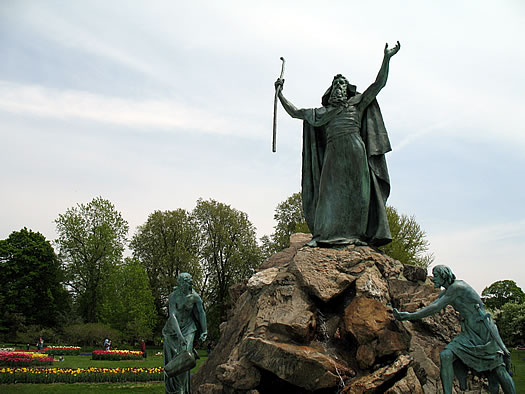
8 Then Amalek came and fought with Israel at Rephidim.9 So Moses said to Joshua, “Choose for us men, and go out and fight with Amalek. Tomorrow I will stand on the top of the hill with the staff of God in my hand.”10 So Joshua did as Moses told him, and fought with Amalek, while Moses, Aaron, and Hur went up to the top of the hill.11 Whenever Moses held up his hand, Israel prevailed, and whenever he lowered his hand, Amalek prevailed.12 But Moses’ hands grew weary, so they took a stone and put it under him, and he sat on it, while Aaron and Hur held up his hands, one on one side, and the other on the other side. So his hands were steady until the going down of the sun.13 And Joshua overwhelmed Amalek and his people with the sword.
14 Then the Lord said to Moses, “Write this as a memorial in a book and recite it in the ears of Joshua, that I will utterly blot out the memory of Amalek from under heaven.”15 And Moses built an altar and called the name of it, The Lord Is My Banner,16 saying, “A hand upon the throne of the Lord! The Lord will have war with Amalek from generation to generation.”
Several interesting things here. The first thing I’d like to mention is that we shouldn’t read this portion as an isolated event, separated from all previous events. Such is the current, post-modern paradigm of viewing everything that happens as “new” and completely disconnected from everything that has happened before.
Who is Amalek?
They are descended of Esau (Genesis 36). Though himself a son of Isaac, God rejected him in favor of Jacob, whom he would rename Israel. Esau took wives from the daughters of Heth (Canaan) further separating himself from the Promise to Abraham. Now, after so many generations, Amalek is waging war with the People of God, the Children of Promise.
Whose Victory of Battle?
Moses sends Joshua to choose men for battle, but to whom is the victory attributed? The Lord. Moses goes up on a hill and holds, not his staff, but the Staff of God. While in some cases it might be referred to as Moses’s staff, in this case Moses is clear to Joshua what is going to take place. The very staff that God instructed Moses and Aaron to use for each the plagues against Pharaoh, the staff with which God parted the Red Sea and the same staff God commanded Moses to strike the rock with at Horeb. Moses wasn’t saying “I’ll make sure you win”, he was saying “the Lord God is your Banner in battle”.
Banner?
While researching this passage, there was an entry in the Reformation Study Bible I thought was very informative, demonstrating something that might be lost in translation for us.
17:15The Lord is my banner. The Hebrew word translated “banner” underlies “staff” in v. 9 and is used for the “pole” on which the bronze serpent was later placed (Num. 21:8). Since “banner” suggests cloth to us, this connection is lost. A spear could serve as a standard in battle, with or without bits of cloth tied to it. Later, a staff might have a device on it to mark the rallying point for troops. In the ancient world, these were sometimes images or signs of the gods. Moses’ staff is the ensign to which Joshua’s army could look and that symbolized God’s saving power. Moses declares that God Himself is the Standard, the Ensign of His people.
Very cool. Once again, what we are seeing here is not the greatness of Joshua’s leadership, but the Mighty Hand of God at work, showing His favor upon Israel, Moses, and Joshua. Remember the Song of Moses as recorded in Exodus 15.
15 Then Moses and the people of Israel sang this song to the Lord, saying,
“I will sing to the Lord, for he has triumphed gloriously; the horse and his rider he has thrown into the sea. 2 The Lord is my strength and my song, and he has become my salvation; this is my God, and I will praise him, my father’s God, and I will exalt him. 3 The Lord is a man of war; the Lord is his name.
4 “Pharaoh’s chariots and his host he cast into the sea, and his chosen officers were sunk in the Red Sea. 5 The floods covered them; they went down into the depths like a stone. 6 Your right hand, O Lord, glorious in power, your right hand, O Lord, shatters the enemy. 7 In the greatness of your majesty you overthrow your adversaries; you send out your fury; it consumes them like stubble. 8 At the blast of your nostrils the waters piled up; the floods stood up in a heap; the deeps congealed in the heart of the sea. 9 The enemy said, ‘I will pursue, I will overtake, I will divide the spoil, my desire shall have its fill of them. I will draw my sword; my hand shall destroy them.’ 10 You blew with your wind; the sea covered them; they sank like lead in the mighty waters.
11 “Who is like you, O Lord, among the gods? Who is like you, majestic in holiness, awesome in glorious deeds, doing wonders? 12 You stretched out your right hand; the earth swallowed them.
13 “You have led in your steadfast love the people whom you have redeemed; you have guided them by your strength to your holy abode. 14 The peoples have heard; they tremble; pangs have seized the inhabitants of Philistia. 15 Now are the chiefs of Edom dismayed; trembling seizes the leaders of Moab; all the inhabitants of Canaan have melted away. 16 Terror and dread fall upon them; because of the greatness of your arm, they are still as a stone, till your people, O Lord, pass by, till the people pass by whom you have purchased. 17 You will bring them in and plant them on your own mountain, the place, O Lord, which you have made for your abode, the sanctuary, O Lord, which your hands have established. 18 The Lord will reign forever and ever.”
In Hebrews 11, we are taught that all of the mighty deeds accomplished in Scripture were by faith. Faith in whom? In the Only Living God of Abraham, Isaac, and Jacob, the Creator of all things. The Lord is my Banner… while there was a physical symbol of the favor of the Lord, neither Joshua, Aaron, Moses, nor Hur were under any misgivings that there was something in the staff itself, nor in the efforts of Moses. This was God’s work and God’s victory over Amalek.
Hebrews 13:20-21 (ESV)
Benediction
20 Now may the God of peace who brought again from the dead our Lord Jesus,the great shepherd of the sheep, by the blood of the eternal covenant,21 equip you with everything good that you may do his will, working in us that which is pleasing in his sight, through Jesus Christ, to whom be glory forever and ever. Amen.
May the Grace of God be with you today and forever,
In Christ Jesus,
Jorge


 Faithful Stewardship
You must be logged in to post a comment.