Abraham and Isaac | Pointing to the Cross

??????????Today, I wanted to share a wonderful look at Genesis 22, where God tests Abraham. Those of you who attend a foundational, bible-teaching, church should already have been presented with this view of the story. However, as society and the evangelical community drifts further and further away from bible teaching, I think we should take some time to check it out now.

Genesis 22 (ESV)

1 After these things God tested Abraham and said to him, “Abraham!” And he said, “Here I am.” 2 He said, “Take your son, your only son Isaac, whom you love, and go to the land of Moriah, and offer him there as a burnt offering on one of the mountains of which I shall tell you.”

His only son Isaac? Why is God ignoring the fact that Abram had already fathered Ishmael by Hagar? Abram was 86 years old when Ishmael was born. God changed Abram’s name to Abraham, and Sarai’s name to Sarah 13 years later. God’s covenant with Abraham (circumcision) was established when he was 99 years old. At the time of their circumcision, Ishmael is referred to as Abraham’s son. So is this a contradiction? Absolutely not. Let’s look at what God said of Ishmael specifically regarding God’s covenant with Abraham for all of mankind, His Promise of the Messiah.

Genesis 17:15-21 (ESV) 15 And God said to Abraham, “As for Sarai your wife, you shall not call her name Sarai, but Sarah shall be her name. 16 I will bless her, and moreover, I will give you a son by her. I will bless her, and she shall become nations; kings of peoples shall come from her.” 17 Then Abraham fell on his face and laughed and said to himself, “Shall a child be born to a man who is a hundred years old? Shall Sarah, who is ninety years old, bear a child?” 18 And Abraham said to God, “Oh that Ishmael might live before you!” 19 God said, “No, but Sarah your wife shall bear you a son, and you shall call his name Isaac. I will establish my covenant with him as an everlasting covenant for his offspring after him. 20 As for Ishmael, I have heard you; behold, I have blessed him and will make him fruitful and multiply him greatly. He shall father twelve princes, and I will make him into a great nation. 21 But I will establish my covenant with Isaac, whom Sarah shall bear to you at this time next year.”

God was very clear about Isaac being the son of Promise, the son with whom God will keep His covenant with Abraham. Yes, He heard Abraham’s request for Ishmael to be blessed, and Ishmael was blessed (while still being a wild donkey of a man…). But Sarah was upset when she witnessed Ishmael laughing at Isaac, and implored Abraham to send Hagar and Ishmael away.

Genesis 21:10-13 (ESV) 10 So she said to Abraham, “Cast out this slave woman with her son, for the son of this slave woman shall not be heir with my son Isaac.” 11 And the thing was very displeasing to Abraham on account of his son. 12 But God said to Abraham, “Be not displeased because of the boy and because of your slave woman. Whatever Sarah says to you, do as she tells you, for through Isaac shall your offspring be named. 13 And I will make a nation of the son of the slave woman also, because he is your offspring.”

God does make a nation of Ishmael. However, God’s promise to Abraham, for his namesake, for the lineage of the Messiah, is through Isaac, not Ishmael. Therefore, with respect to God’s promise to Abraham, God’s covenant with Abraham, there is only one son, Isaac. There is no “back-up”… plan B was rejected before plan A was even implemented. No turning back. Therefore, when God told Abraham to sacrifice “his only son”, He wasn’t miss counting offspring, He was letting Abraham know that He was fully aware that Isaac was the sole bearer of Abraham’s namesake, the only son by which God declared His promise to Abraham. This is significant, because what follows next points directly at the cross.

John 3:16-18 (ESV) 16 “For God so loved the world, that he gave his only Son, that whoever believes in him should not perish but have eternal life. 17 For God did not send his Son into the world to condemn the world, but in order that the world might be saved through him. 18 Whoever believes in him is not condemned, but whoever does not believe is condemned already, because he has not believed in the name of the only Son of God.

Praise the Lord. Next, let’s take a look at where God send Abraham for the sacrifice, to the land of Moriah, to a mountain He will show Abraham. Now, this is long before the captivity in Egypt, the Exodus, and the Law of Moses. Before Israel is lead into the Promised Land. Before King David and King Solomon. But notice the location of where King Solomon built the Temple of the Lord:

2 Chronicles 3:1 (ESV) 1 Then Solomon began to build the house of the Lord in Jerusalem on Mount Moriah, where the Lord had appeared to David his father, at the place that David had appointed, on the threshing floor of Ornan the Jebusite.

How cool is that? Even more interesting, is that if you’ll remember your history, when the Second Temple was built (after the Babylonian exile), the Temple remained in the same place, and maintained its same dimensions, but Herod wanted to make it more grand in nature, so he widened the temple mount… essentially creating a plateau of the hills around Mount Moriah, so that the Temple Mount was extended around the Temple. Jesus was crucified outside the city, on a hill of Moriah… where Abraham was lead to sacrifice “his only son” as a burnt offering to the Lord God. Let us continue on with the story.

Genesis 22:33 So Abraham rose early in the morning, saddled his donkey, and took two of his young men with him, and his son Isaac. And he cut the wood for the burnt offering and arose and went to the place of which God had told him. 4 On the third day Abraham lifted up his eyes and saw the place from afar. 5 Then Abraham said to his young men, “Stay here with the donkey; I and the boy will go over there and worship and come again to you.” 6 And Abraham took the wood of the burnt offering and laid it on Isaac his son. And he took in his hand the fire and the knife. So they went both of them together. 7 And Isaac said to his father Abraham, “My father!” And he said, “Here I am, my son.” He said, “Behold, the fire and the wood, but where is the lamb for a burnt offering?” 8 Abraham said, “God will provide for himself the lamb for a burnt offering, my son.” So they went both of them together.

Isaac carried the wood for the burnt offering, the sacrifice. We read in  John 19:16b-17 (ESV) “So he delivered him over to them to be crucified. So they took Jesus, 17 and he went out, bearing his own cross, to the place called The Place of a Skull, which in Aramaic is called Golgotha.” Praise the Lord.

Genesis 22:9 When they came to the place of which God had told him, Abraham built the altar there and laid the wood in order and bound Isaac his son and laid him on the altar, on top of the wood. 10 Then Abraham reached out his hand and took the knife to slaughter his son. 11 But the angel of the Lord called to him from heaven and said, “Abraham, Abraham!” And he said, “Here I am.” 12 He said, “Do not lay your hand on the boy or do anything to him, for now I know that you fear God, seeing you have not withheld your son, your only son, from me.” 13 And Abraham lifted up his eyes and looked, and behold, behind him was a ram, caught in a thicket by his horns. And Abraham went and took the ram and offered it up as a burnt offering instead of his son. 14 So Abraham called the name of that place, “The Lord will provide”; as it is said to this day, “On the mount of the Lord it shall be provided.”

Now here, we have the provision of God. God provides the sacrifice. Yes, Jesus was born of a virgin, and was fully man, the offspring of Abraham provided by God. God intervened so that mankind might by saved, spared from the judgement. Have you ever wondered about the crown of thorns they placed on Jesus head? Notice the ram provided by God as a substitutionary sacrifice on man’s behalf, is caught in a thicket by his horns.

15 And the angel of the Lord called to Abraham a second time from heaven 16 and said, “By myself I have sworn, declares the Lord, because you have done this and have not withheld your son, your only son, 17 I will surely bless you, and I will surely multiply your offspring as the stars of heaven and as the sand that is on the seashore. And your offspring shall possess the gate of his enemies, 18 and in your offspring shall all the nations of the earth be blessed, because you have obeyed my voice.”

We see here that God is again letting Abraham know that the Messiah is coming from his offspring because he obeyed the voice of the Lord God. Praise be to our Lord and Savior. In closing, I’d like to borrow from the Apostle Paul’s closing of his letter to the Romans:

Romans 16:25-27 (ESV) 16 Now to him who is able to strengthen you according to my gospel and the preaching of Jesus Christ, according to the revelation of the mystery that was kept secret for long ages 26 but has now been disclosed and through the prophetic writings has been made known to all nations, according to the command of the eternal God, to bring about the obedience of faith— 27 to the only wise God be glory forevermore through Jesus Christ! Amen.

May the Lord bless you and keep you,
In Him,

Jorge
Confessions of the Christ | What Israel was waiting for

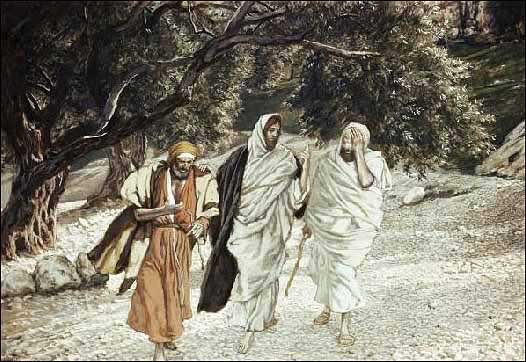
Road to Emmaus  by James J. Tissot

Road to Emmaus
by James J. Tissot

I shared a couple of weeks ago that I was working on this topic. I realized that I had gotten sucked into the trap of researching nuggets when in-fact the entirety of the Bible points to Jesus as the Messiah, the Christ, the Anointed One. So, this won’t be a singular post type of topic; rather, this is the central issue, the basis of our entire faith. I think the distraction was amplified by a desire to really make an impactful post in time for Easter, but thankfully, everything went wrong on many fronts. Thankfully? Yes. Sometimes things have to go wrong, for us to realize we’ve become too wrapped up in our own devices/plans/schemes/agendas. So, let’s get back to the basics of sharing Bible Studies as often as I can find the time, without worrying so much about “making something” of this blog. Forgive me for losing sight so quickly.

Confessions of the Christ

Our first stop will be the Gospel written by John. Please take a moment now to read John Chapter 1 in its entirety. Remember when we talked about the Sin of the Pharisee, we noted that John the Baptist knew what the Pharisees were getting at when they asked him who he was.

John 1:19-20 (ESV) 19 And this is the testimony of John, when the Jews sent priests and Levites from Jerusalem to ask him, “Who are you?” 20 He confessed, and did not deny, but confessed, “I am not the Christ.”

So without hesitation, he makes it clear to them that he is not the Christ. Now, when Jesus does step forward, John introduces Jesus to the people in a way that doesn’t fit with what they were looking for in the Christ:

John 1:29 (ESV) The next day he saw Jesus coming toward him, and said, “Behold, the Lamb of God, who takes away the sin of the world!…

At this time, sacrifices are a regular occurrence at the Temple. How did they miss this introduction as what is clearly a declaration of Jesus being the atoning sacrifice? They didn’t catch it, because they weren’t looking for it. Let us see what they were looking for:

John 1:30-34 (ESV) 30 This is he of whom I said, ‘After me comes a man who ranks before me, because he was before me.’ 31 I myself did not know him, but for this purpose I came baptizing with water, that he might be revealed to Israel.” 32 And John bore witness: “I saw the Spirit descend from heaven like a dove, and it remained on him. 33 I myself did not know him, but he who sent me to baptize with water said to me, ‘He on whom you see the Spirit descend and remain, this is he who baptizes with the Holy Spirit.’ 34 And I have seen and have borne witness that this is the Son of God.

Okay, so here we have a flat-out declaration of Jesus not only being named “The Christ” but now He is plainly declared to be the Son of God. Now, let’s look at the reactions of the early disciples to Him.

John 1:35-51 (ESV) 35 The next day again John was standing with two of his disciples, 36 and he looked at Jesus as he walked by and said, “Behold, the Lamb of God!” 37 The two disciples heard him say this, and they followed Jesus. 38 Jesus turned and saw them following and said to them, “What are you seeking?” And they said to him, “Rabbi” (which means Teacher), “where are you staying?” 39 He said to them, “Come and you will see.” So they came and saw where he was staying, and they stayed with him that day, for it was about the tenth hour. 40 One of the two who heard John speak and followed Jesus was Andrew, Simon Peter’s brother. 41 He first found his own brother Simon and said to him, “We have found the Messiah” (which means Christ). 42 He brought him to Jesus. Jesus looked at him and said, “You are Simon the son of John. You shall be called Cephas” (which means Peter).43 The next day Jesus decided to go to Galilee. He found Philip and said to him, “Follow me.” 44 Now Philip was from Bethsaida, the city of Andrew and Peter. 45 Philip found Nathanael and said to him, “We have found him of whom Moses in the Law and also the prophets wrote, Jesus of Nazareth, the son of Joseph.” 46 Nathanael said to him, “Can anything good come out of Nazareth?” Philip said to him, “Come and see.” 47 Jesus saw Nathanael coming toward him and said of him, “Behold, an Israelite indeed, in whom there is no deceit!” 48 Nathanael said to him, “How do you know me?” Jesus answered him, “Before Philip called you, when you were under the fig tree, I saw you.” 49 Nathanael answered him, “Rabbi, you are the Son of God! You are the King of Israel!” 50 Jesus answered him, “Because I said to you, ‘I saw you under the fig tree,’ do you believe? You will see greater things than these.” 51 And he said to him, “Truly, truly, I say to you, you will see heaven opened, and the angels of God ascending and descending on the Son of Man.”

Now, when these two disciples of John the Baptist hear Jesus identified as the “Lamb of God”, they understand that He is the One for whom John the Baptist was preparing them. So they follow Jesus. Here, we have the author explaining that the Hebrew word for “Messiah” is synonymous with the Greek word “Christ”. Neither word is actually translated into English, we’ve simply changed the way they are pronounced. They both translate to “Anointed”, and in the specific case of Jesus, “the Anointed One”. For those who might be new to the faith, or for those who simply have never asked, “Christ” isn’t part of Jesus name, it is a title. We notice also that Nathanael’s response to the news of Jesus was regarding Nazareth. Nazareth is never mentioned in the Law or the Prophets.  They were expecting the Messiah to come from the Bethlehem, the City of David (where Jesus was born). The Jewsish leaders of the day were looking for a descendant of David. Present-day Judaism still holds to these prophesies as indicators of the “end of days”, having missed their fulfillment in Jesus:

Jeremiah 23:5-6 (ESV)  5 “Behold, the days are coming, declares the Lord, when I will raise up for David a righteous Branch, and he shall reign as king and deal wisely, and shall execute justice and righteousness in the land. 6 In his days Judah will be saved, and Israel will dwell securely. And this is the name by which he will be called: ‘The Lord is our righteousness.’

Jeremiah 33:14-16 (ESV) 14 “Behold, the days are coming, declares the Lord, when I will fulfill the promise I made to the house of Israel and the house of Judah. 15 In those days and at that time I will cause a righteous Branch to spring up for David, and he shall execute justice and righteousness in the land. 16 In those days Judah will be saved, and Jerusalem will dwell securely. And this is the name by which it will be called: ‘The Lord is our righteousness.’ 17 “For thus says the Lord: David shall never lack a man to sit on the throne of the house of Israel, 18 and the Levitical priests shall never lack a man in my presence to offer burnt offerings, to burn grain offerings, and to make sacrifices forever.”

The prophet Isaiah also prophesied regarding Him in a similar phrasing (naturally, since these are the Words of God, not of men):

Isaiah 11:1-5 (ESV) 1 There shall come forth a shoot from the stump of Jesse, and a branch from his roots shall bear fruit.
2 And the Spirit of the Lord shall rest upon him,
the Spirit of wisdom and understanding,
the Spirit of counsel and might,
the Spirit of knowledge and the fear of the Lord.
3 And his delight shall be in the fear of the Lord.
He shall not judge by what his eyes see,
or decide disputes by what his ears hear,
4 but with righteousness he shall judge the poor,
and decide with equity for the meek of the earth;
and he shall strike the earth with the rod of his mouth,
and with the breath of his lips he shall kill the wicked.
5 Righteousness shall be the belt of his waist,
and faithfulness the belt of his loins.

So we see clearly between the confessions of John the Baptist, and the Prophecies of Jeremiah and Isaiah, that Jesus came as the atoning sacrifice, the Lamb of God, the Messiah, the Christ, the Branch of David, who will be called “the Lord is our Righteousness”… this is the Gospel of Jesus, the Christ, the Son of God. God’s Word is so awesome.

It was not only the Pharisees and the disciples of John the Baptist who were looking for the Christ. As we see in John 4, even the lowly Samaritans where aware of the prophesied Messaiah:

John 4:16-26 (ESV) 16 Jesus said to her, “Go, call your husband, and come here.” 17 The woman answered him, “I have no husband.” Jesus said to her, “You are right in saying, ‘I have no husband’; 18 for you have had five husbands, and the one you now have is not your husband. What you have said is true.” 19 The woman said to him, “Sir, I perceive that you are a prophet. 20 Our fathers worshiped on this mountain, but you say that in Jerusalem is the place where people ought to worship.” 21 Jesus said to her, “Woman, believe me, the hour is coming when neither on this mountain nor in Jerusalem will you worship the Father. 22 You worship what you do not know; we worship what we know, for salvation is from the Jews. 23 But the hour is coming, and is now here, when the true worshipers will worship the Father in spirit and truth, for the Father is seeking such people to worship him. 24 God is spirit, and those who worship him must worship in spirit and truth.” 25 The woman said to him, “I know that Messiah is coming (he who is called Christ). When he comes, he will tell us all things.” 26 Jesus said to her, “I who speak to you am he.”

So awesome. Jesus tells her at the Samaritans (corporate “you”) worship what they do not know. To demonstrate what she does know, she shows us that they, too, were waiting for the Messiah to tell them all things. Samaritans were outsiders. They were of mixed blood and mixed faith, but they looked for the Messiah to come. Praise the Lord God for His faithfulness.

Now then, that we have seen some of what it was the Jews and even the Samaritans were looking for, lets look at Peter’s confession of Jesus.

Matthew 16:13-20 (ESV) 13 Now when Jesus came into the district of Caesarea Philippi, he asked his disciples, “Who do people say that the Son of Man is?” 14 And they said, “Some say John the Baptist, others say Elijah, and others Jeremiah or one of the prophets.” 15 He said to them, “But who do you say that I am?” 16 Simon Peter replied, “You are the Christ, the Son of the living God.” 17 And Jesus answered him, “Blessed are you, Simon Bar-Jonah! For flesh and blood has not revealed this to you, but my Father who is in heaven. 18 And I tell you, you are Peter, and on this rock I will build my church, and the gates of hell shall not prevail against it. 19 I will give you the keys of the kingdom of heaven, and whatever you bind on earth shall be bound in heaven, and whatever you loose on earth shall be loosed in heaven.” 20 Then he strictly charged the disciples to tell no one that he was the Christ.

This confession is huge. One into which Peter would yet need to grow, but he does by the Grace of God. Notice, that this confession/revelation is not by flesh and blood, but given as a gift from God the Father who is in heaven. This statement bears a strong resemblance to what Paul wrote in Ephesians 2:8 (ESV) “For by grace you have been saved through faith. And this is not your own doing; it is the gift of God…”

Peter was not alone in having to grow into the understanding of just what it meant to confess Jesus as the Christ, Son of the Living God. Martha had a very hard time of it, too when her brother, Lazarus, died.

John 11:17-27 (ESV) 17 Now when Jesus came, he found that Lazarus had already been in the tomb four days. 18 Bethany was near Jerusalem, about two miles off, 19 and many of the Jews had come to Martha and Mary to console them concerning their brother. 20 So when Martha heard that Jesus was coming, she went and met him, but Mary remained seated in the house. 21 Martha said to Jesus, “Lord, if you had been here, my brother would not have died. 22 But even now I know that whatever you ask from God, God will give you.” 23 Jesus said to her, “Your brother will rise again.” 24 Martha said to him, “I know that he will rise again in the resurrection on the last day.” 25 Jesus said to her, “I am the resurrection and the life. Whoever believes in me, though he die, yet shall he live, 26 and everyone who lives and believes in me shall never die. Do you believe this?” 27 She said to him, “Yes, Lord; I believe that you are the Christ, the Son of God, who is coming into the world.”

It is on this note, that I’d like to pause for a moment. We all, must come to faith in Jesus as the Christ, Son of the Living God. The Lamb of God who laid down His life as the perfect atonement for the sin of mankind, for our sins included. This faith comes as a Gift from God, that we might die to sin ourselves, so that in Him we might have everlasting life.

Ephesians 4:1-16 (ESV) 1 I therefore, a prisoner for the Lord, urge you to walk in a manner worthy of the calling to which you have been called, 2 with all humility and gentleness, with patience, bearing with one another in love, 3 eager to maintain the unity of the Spirit in the bond of peace. 4 There is one body and one Spirit—just as you were called to the one hope that belongs to your call— 5 one Lord, one faith, one baptism, 6 one God and Father of all, who is over all and through all and in all. 7 But grace was given to each one of us according to the measure of Christ’s gift. 8 Therefore it says,

“When he ascended on high he led a host of captives,and he gave gifts to men.”[Ps 68:18]

9 (In saying, “He ascended,” what does it mean but that he had also descended into the lower regions, the earth? 10 He who descended is the one who also ascended far above all the heavens, that he might fill all things.) 11 And he gave the apostles, the prophets, the evangelists, the shepherds and teachers, 12 to equip the saints for the work of ministry, for building up the body of Christ, 13 until we all attain to the unity of the faith and of the knowledge of the Son of God, to mature manhood, to the measure of the stature of the fullness of Christ, 14 so that we may no longer be children, tossed to and fro by the waves and carried about by every wind of doctrine, by human cunning, by craftiness in deceitful schemes. 15 Rather, speaking the truth in love, we are to grow up in every way into him who is the head, into Christ, 16 from whom the whole body, joined and held together by every joint with which it is equipped, when each part is working properly, makes the body grow so that it builds itself up in love.

In Jesus, the Christ, the Son of the Living God, through the working of God the Holy Spirit, we are being woven together, fitted together, into one body. I thank God for each of you who do the hard work of discernment in all things, and in sharing the Gospel of Jesus Christ, the Lamb of God, who has is called “the Lord is our righteousness”. We who are in Christ long for the day of His return, to reign forever as King of kings and Lord of lords. Until that day, let do the work the Lord predestined for us to do in Him, so that when the Master returns, He will find His servants hard at work. Study the Scriptures, Preach the Word, and Love your neighbors as yourselves. Amen.

In Him,
Jorge

Plagiarism and the Pulpit

CTTRecently in the news and across the Christian blogosphere, we’ve seen a great deal of fallout regarding Mark Driscoll and his publishing scandals (plagiarism and manipulation of the NY Best Sellers list). That’s easy to discern since the books were sold for profit and the integrity issues are plain as day. But what about plagiarism from the pulpit? Is it only a problem if done without permission from the original author? If a preacher has gone to great lengths to build a sermon series but then offers it as free material to be used in any way imaginable by anyone… does that absolve others of any wrong doing for using that material without acknowledging that the work was not their own? If you are an artist, you probably say, “yes, everyone is free and clear to use images that have been made public domain by its author without requiring citation”. But is that the standard?

Paul exhorted Timothy many times in his letters to preach the Word of God. Titus, too, was warned to preach sound doctrine. Paul told Timothy that all Scripture is God-Breathed (2 Tim 3:10-17) and Peter pointed out that no prophetic word of Scripture comes from man’s own interpretation (2 Peter 1:16-21). One of the major promises Jesus made to the Apostles regarding the Holy Spirit was that He would remind them of all Jesus had told them. His Word. That is why the Apostles point to the Scriptures and instruct so strongly against false teaching. The Written Word of God is sufficient for all things in this life and the life that is to come for those who believe in Jesus Christ.

Throughout school, we are warned, scrutinized, and punished for plagiarism. The tagline for Plagiarism in school usually takes the form of “plagiarism = stealing“. But what about the cases where the plagiarism isn’t stealing? Does that absolve the wrong of plagiarism? No. Because the rebuke of plagiarism in school isn’t only based on the idea of theft, but on falsely representing one’s own understanding of the material being presented. Why is that a problem in school? Because the very purpose of attending school (in the classical sense, not this new age progressive sense) is to demonstrate a working knowledge of academic material. Therefore, plagiarism isn’t only stealing, it’s also cheating. You are hoping to gain credit for someone else’s work by presenting it as your own. Proper citation demonstrates both the level of research taken and the integrity to distinguish your own work from the work done by others.

Plagiarism in the professional world (outside of academia) generally revolves around the concept of stolen property. Again, that is an easy one to spot. How about in the area of Christian Ministry? Rather than jump straight to plagiarism, lets first take a look at the role of citation of sources in Christian Ministry. What if an individual at the pulpit taught a sermon about how to pray without citing a single verse of scripture, or specifying which God to whom we should pray? Is the problem that he might have stolen the material? No. The problem here is that he’s speaking on his own authority and we have no means of testing the spirit behind his teaching, and we can’t even be sure if what he teaches is sound doctrine, because he has not properly cited the Word of God. In academia, the “cheating” element of plagiarism seeks to take credit for the work of another; however, when it comes to teaching/preaching, a lack of proper citation is often used to present the speakers ideas as though they were coming from God. When we preach the Word of God, we cite the Word of God because of the Authority of Scriptures (2 Tim 3:16) and to make it clear that we are not speaking on our own authority. Therefore, the role of teacher/preacher has a higher standard than a student in English Literature 101. Because the preacher isn’t supposed to preaching the myths or schemes of men, but the Word of God. The preacher must properly, contextually, dutifully, humbly cite the Word of God in an authoritative fashion for the building/edification of the Body of Christ. He must make clear when he’s sharing his interpretation, his understanding of the scriptures, so that the faithful Berean listener might search out the Scriptures for themselves to see what holds True to Sound Doctrine.

Preaching another man’s sermon from the pulpit, without citation is not a problem of stealing intellectual property. Doing so “with permission” doesn’t solve the problem of presenting as your own understanding what you did not extract from Scriptures. Furthermore, within today’s emergent, evangelical circles, pastors claim to be speaking divinely inspired messages that are custom-tailored to the needs of their congregation, and as such moved more to quoting portions of scripture rather than teaching passages of Scripture. This trend when combined with the trend of preaching pre-built sermons creates another integrity problem. If a sermon being preached to a small church in West Virginia is in-fact taken wholesale from a Beverly Hills, CA Mega-church… properly citing that sermon runs the risk of offending those who are under the impression that their pastor is teaching what God has for their church; however, NOT citing the Mega-Church sermon runs the risk of presenting someone else’s research, outline, anecdotes, application, promises, assurances, and errors as their own.

That last comment, is in-fact my biggest concern regarding pulpit plagiarism. A pastor/overseer/elder/deacon is worthy of a double portion provided he remains firmly rooted and grounded in sound doctrine, in the Word of God. The danger of this position is when he allows himself to drift from the Word of God and chase after myths, genealogies, and doctrines of demons, dishonest gain… because he does so not only at his own peril, but he risks being held accountable for all that he causes to stumble or leads astray. If the person preaching the sermon of another verbatim doesn’t catch the false doctrine or false teaching of his source material, then he is equally guilty of false teaching. Saying, “but I just preached what so-and-so preached” will not spare anyone. So then, it is clear to me that being absolved of theft (by an author making the sermon freely usable) does not fully remedy the problem, nor does properly citing the author but copying wholesale. Proper citation is the first step to solving the problem, but ultimately the problem stems from preaching other sermons as opposed to preaching the Word of God. The role of pastor/preacher/teacher isn’t just to give a good lecture, it is to preach the Word of God and that which accords with sound Doctrine.

2 Timothy 4:1-4 (ESV) 1 I charge you in the presence of God and of Christ Jesus, who is to judge the living and the dead, and by his appearing and his kingdom: 2 preach the word; be ready in season and out of season; reprove, rebuke, and exhort, with complete patience and teaching. 3 For the time is coming when people will not endure sound teaching, but having itching ears they will accumulate for themselves teachers to suit their own passions, 4 and will turn away from listening to the truth and wander off into myths.

The Gospel Coalition was looking at this issue back in 2010. Take a moment to read the initial post presented as a question to the coalition, and the responses from pastors in the coalition at the bottom (hyperlinks).

In closing, as some of the pastors in the TGC responses mentioned, there are varying degrees of error here. When a pastor follows a script and incorporates even the jokes and anecdotal stories… there is a clear problem. How does one properly cite a sermon that is quoted verbatim without saying, “today I will be preaching so-and-so’s sermon with little deviation”? I’m sure that would be okay once in a while… but if it happened often people might start wondering why they attend and give money to this church if they can stay home and watch the original sermons on WebTV. Is copying graphics, series titles, and general outline problematic? All I can say is that it could be, so pray about it. I leave you with one thought. If “borrowing” such material as a starting point is such a minor point… then why not take the extra couple of hours to start from scratch? We don’t want people coming for our graphic design skills, we want them coming to hear the Word of God.

If you discover that your pastor is regularly preaching material pulled from another pastor and doesn’t cite the source, I recommend talking to him about it privately. If there are errors in scripture or doctrine that isn’t sound, it definitely needs to be addressed in a meeting. However, if the pastor refuses to acknowledge this as a problem then pray for him and consider taking the matter to the elders. The responsibility and authority to teach sound doctrine rests with the elders, not with the congregants. If you approach them in love with a valid concern and are ignored, I recommend shaking off the dust and finding a church whose leadership takes their responsibilities to teaching the Word of God more seriously.  Those who notice you’ve gone and care will ask questions, answer truthfully. As the body of Christ, our unity must be based on the Word of God, not the branding of a church organization. I think that in most cases, a simple citation of borrowed material is all that is needed to both alert the congregation and elders of the source material and to encourage the preacher to search the scriptures himself, otherwise he’ll be citing entire sermons.

May the Lord Bless you and keep you,
In Him,
Jorge

The Story Behind The Hymn – I Know Whom I Have Believed

Okay, so as excited as I have been about the series on God the Holy Spirit… I’m delaying part 3 of that post. In listening to a sermon this morning on 2 Timothy 1, the speaker mentioned the Hymn I Know Whom I Have Believed, and the story of its author, Major Daniel Webster Whittle. Not being much of a hymnal guy, it was the first I had heard of Mr Whittle. I chose to look this story up, and with a tear in my eye, I decided this was well worth sharing today.  I pray you find some blessing in this story, too.

The Story Behind The Song – I Know Whom I Have Believed

This beloved hymn written by Major Daniel Webster Whittle, the exact date of his composition is not known, but it was originally published in 1883 in Gospel Hymns No. 4. It is one of about two hundred hymns composed by Major Whittle as he was known. It is one of his most well-known hymns, one other popular hymn that he wrote is “There Shall Be Showers of Blessings” If you look at these two hymns for the authorship you may be a bit confused, you will see the name El Nathan on the left hand side indicating that El Nathan wrote the Lyrics, and you will see James McGranahan on the right hand side, indicating that he wrote the music. El Nathan is a pseudonym – a fictitious name used by a person or sometimes a group, which Daniel Webster Whittle used. He also used the pseudonyms Elias Nathan and W.W.D.

Daniel Webster Whittle was born in Chicopee Falls, Massachusetts on November 22, 1840. He was named after the great American politician Daniel Webster who was greatly admired by Whittle’s father. Little is known of his childhood. His father had heard Daniel Webster, the great statesman, make a stirring speech. Daniel Webster in this speech said “It is my living sentiment, and by the blessing of God it shall be my dying sentiment — independence now and independence forever!”

This would later inspire his parents to name him after Daniel Webster in hopes that he would become a great leader in the fight for freedom as well. His mother is said to have been a godly woman who instilled in him and his three brothers strong Christian principles.

Daniel Whittle worked as a cashier for Wells Fargo bank as a teenager and into his early twenties. He was not a wicked man at first, on the contrary, he was quiet religious. He surrendered his life to the Lord one night while acting as a night watchman at the Wells Fargo Bank. He went into the vault, got down on his knees and gave his surrendered his life for the Heavenly Father to use as he would. He even became the Sunday School Superintendent at the great Tabernacle in Chicago where he would meet his wife, Miss Abbie Hanson. He would join the army in 1861 and be commissioned as a 2nd Lieutenant. In the summer of 1862, August as the Civil War began to intensify his unit was called to go South. August 22, 1862, the night before his departure, he and Abbie were married. It would be a year before they would be reunited. In his own words he tells of his departure, “My dear mother was a devout Christian, and parted from me with many a tear, and followed me with many a prayer. She had placed a New Testament in a pocket of the haversack that she’d arranged for me”

This little New Testament would pay a vital part in his rededication. Whittle rose to the rank of Major and while leading a charge, actually filling in, and he was wounded in his sword arm which led to the amputation of his arm and a stay in a prisoner of war camp. It was while he was in this POW camp that out of boredom he began to search for something to read. He found in his personal effects the little New Testament that his Mother had placed there. He read through the New Testament in a matter of days and started through it again. One night the nurse woke him up and told him that one of his men was dying and had been begging for someone to pray for him. The nurse told Major Whittle that he (the nurse) was a wicked man and could not pray. Major Whittle confessed that he too was wicked man with many sins in his own life and could not pray either. The nurse said that he thought Major Whittle was a Christian because he had observed him constantly reading the Scripture and the Major Whittle did not cuss as the other men. The nurse begged Major Whittle to at least accompany him to see the boy as he did not want to return alone. Moved with compassion, Major Whittle reluctantly agreed. Here, in Major Whittle’s own words, is what took place that night: “I dropped on my knees and held the boy’s hand in mine. In a few broken words I confessed my sins and asked Christ to forgive me. I believed right there that He did forgive me. I then prayed earnestly for the boy. He became quiet and pressed my hand as I prayed and pleaded God’s promises. When I arose from my knees, he was dead. A look of peace had come over his troubled face, and I cannot but believe that God who used him to bring me to the Savior, used me to lead him to trust Christ’s precious blood and find pardon. I hope to meet him in heaven.”

Ten years later at the encouragement of his close friend D.L. Moody he would enter into evangelism. Some of his first songs were set to music by Phillip Bliss. Whittle attended and participated in the memorial service for Phillip Bliss. Later he would work closely with the man who would set to music many of his later songs, and who set the music to this song, “I Know Whom I Have Believed”, James McGranahan. Major Whittle died March 4, 1901 after having written over 200 hymns.

The refrain of the hymn is a direct quotation from the King James Bible in II Timothy 1:12 “…for I know whom I have believed, and am persuaded that he is able to keep that which I have committed unto him against that day.”

The rest of the article is interesting, but I wanted to stop here and reflect a bit about the message of Salvation, the Gospel of Jesus Christ. In closing, let us return to the words of the Apostle Paul in his second letter to Timothy:

2 Timothy 1 (ESV)
1 Paul, an apostle of Christ Jesus by the will of God according to the promise of the life that is in Christ Jesus,
2 To Timothy, my beloved child:
Grace, mercy, and peace from God the Father and Christ Jesus our Lord.

3 I thank God whom I serve, as did my ancestors, with a clear conscience, as I remember you constantly in my prayers night and day. 4 As I remember your tears, I long to see you, that I may be filled with joy. 5 I am reminded of your sincere faith, a faith that dwelt first in your grandmother Lois and your mother Eunice and now, I am sure, dwells in you as well. 6 For this reason I remind you to fan into flame the gift of God, which is in you through the laying on of my hands, 7 for God gave us a spirit not of fear but of power and love and self-control.

8 Therefore do not be ashamed of the testimony about our Lord, nor of me his prisoner, but share in suffering for the gospel by the power of God, 9 who saved us and called us to a holy calling, not because of our works but because of his own purpose and grace, which he gave us in Christ Jesus before the ages began, 10 and which now has been manifested through the appearing of our Savior Christ Jesus, who abolished death and brought life and immortality to light through the gospel, 11 for which I was appointed a preacher and apostle and teacher, 12 which is why I suffer as I do. But I am not ashamed, for I know whom I have believed, and I am convinced that he is able to guard until that Day what has been entrusted to me. 13 Follow the pattern of the sound words that you have heard from me, in the faith and love that are in Christ Jesus. 14 By the Holy Spirit who dwells within us, guard the good deposit entrusted to you.

May the Lord bless and keep you, and may the Holy Spirit who dwells within us grow us into the full knowledge of Him who Saved us,
In Him,
Jorge

Discernment is an Imperative

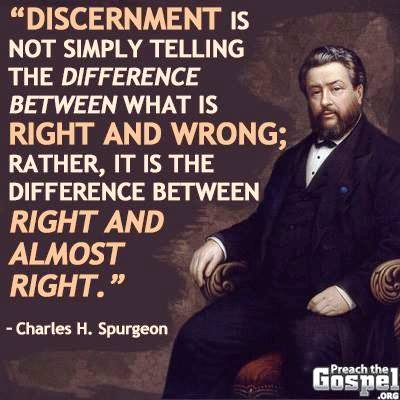
I’m not a big fan of the majority of internet memes (or info-graphics) that get shared all over the blog-o-sphere and Facebook. Occasionally, one gets shared that I think… “awesome”… and they stick with me for a while. I have a confession to make: I have only recently become familiar with Charles H. Spurgeon and some of the other influential church leaders in the past. Okay, moving along, this one meme in particular was a quote from Charles H. Spurgeon regarding Discernment. It is easy to practice Biblical discernment when you disagree with what is being said, or dislike the person saying it. Especially if what you are countering is clearly wrong according to scriptures. But it is an altogether different experience to discern between “right” and “almost right”… especially if you are trying to establish the “rightness” of a statement you already agree with, or one being made by a person you look up to (or, dare I say it, idolize) or someone a dear friend looks up to.

discernmentIs Discernment Really an Imperative?

Yes. Let’s look at what the Word of God says:

Matthew 7:15-23 (ESV) 15 “Beware of false prophets, who come to you in sheep’s clothing but inwardly are ravenous wolves. 16 You will recognize them by their fruits. Are grapes gathered from thornbushes, or figs from thistles? 17 So, every healthy tree bears good fruit, but the diseased tree bears bad fruit. 18 A healthy tree cannot bear bad fruit, nor can a diseased tree bear good fruit. 19 Every tree that does not bear good fruit is cut down and thrown into the fire. 20 Thus you will recognize them by their fruits. 21 “Not everyone who says to me, ‘Lord, Lord,’ will enter the kingdom of heaven, but the one who does the will of my Father who is in heaven. 22 On that day many will say to me, ‘Lord, Lord, did we not prophesy in your name, and cast out demons in your name, and do many mighty works in your name?’ 23 And then will I declare to them, ‘I never knew you; depart from me, you workers of lawlessness.’

1 John 4:1 (ESV) 4 Beloved, do not believe every spirit, but test the spirits to see whether they are from God, for many false prophets have gone out into the world.

Galatians 1:6-7 (ESV) 6 I am astonished that you are so quickly deserting Him who called you in the grace of Christ and are turning to a different gospel— 7 not that there is another one, but there are some who trouble you and want to distort the gospel of Christ.

There may be more references worth including here, but here I’ve listed the Authoritative warning by Jesus, and the reminder from 2 witnesses John and Paul. As I’ve said before, the entire book of Galatians focuses on this point… on the point of discerning between Gospel (“right”) and  Law (which cannot be considered wrong, but if you’ll read Galatians, you’ll see that it’s an “almost right”).  Before you start explaining away these passages as being about paganism, Satanism, or Mormonism… stop. Jesus said they’d be in sheep’s clothing… meaning they’d look like you and me. In 1 John, he goes to explain that some of these men had gone out from them… from the church in Jerusalem… and they were false. And Paul, in his letter to the Galatians, is talking about men from Jerusalem who were of the circumcision party of believers. We aren’t talking only about the obviously wrong teaching, or the in-your-face blasphemies… we are talking about a distortion of the Gospel of Christ.

Well, You are Entitled to your Opinion…

Yes, you are. But that has absolutely nothing to do with Biblical Discernment. In fact, if your opposition to (or defense of) a message, a prophecy, a sermon, or a theology begins and ends with “I feel like” or “what this passage means to me” you are engaging in opinion-sharing. While everyone has an opinion, it doesn’t mean there are no right, almost right, and wrong opinions. Furthermore, Biblical Discernment is not about opinion, it’s about understanding what the Word of God says, according to the Word of God. I submit to you that very little… if anything… is open to personal opinion when it comes to the God-breathed Scriptures. Don’t let anyone discourage you from comparing what is being said in the Name of God to what we find written in the Word of God. And if there is still a hesitation in your mind… well, let’s see what Paul thought.

Galatians 1:8-12 (ESV) 8 But even if we or an angel from heaven should preach to you a gospel contrary to the one we preached to you, let him be accursed. 9 As we have said before, so now I say again: If anyone is preaching to you a gospel contrary to the one you received, let him be accursed. 10 For am I now seeking the approval of man, or of God? Or am I trying to please man? If I were still trying to please man, I would not be a servant of Christ. 11 For I would have you know, brothers, that the gospel that was preached by me is not man’s gospel. 12 For I did not receive it from any man, nor was I taught it, but I received it through a revelation of Jesus Christ.

Galatians 5:7-12 (ESV) 7 You were running well. Who hindered you from obeying the truth? 8 This persuasion is not from him who calls you. 9 A little leaven leavens the whole lump. 10 I have confidence in the Lord that you will take no other view, and the one who is troubling you will bear the penalty, whoever he is. 11 But if I, brothers, still preach circumcision, why am I still being persecuted? In that case the offense of the cross has been removed. 12 I wish those who unsettle you would emasculate themselves!

And we also have this warning from Peter:

2 Peter 2:1-3 (ESV) 2 But false prophets also arose among the people, just as there will be false teachers among you, who will secretly bring in destructive heresies, even denying the Master who bought them, bringing upon themselves swift destruction. 2 And many will follow their sensuality, and because of them the way of truth will be blasphemed. 3 And in their greed they will exploit you with false words. Their condemnation from long ago is not idle, and their destruction is not asleep.

So, this is what is at stake. Any deviation from the Gospel of Christ is to be rebuked. But this isn’t just about calling out falsehood! Discernment is also about establishing what is true in light of the Word of God. Going back to 1 John 4:1, we weren’t told to test to see if they were false, but to test to see if the spirit is of God. When you grade a test, you don’t compare it to what is wrong, you compare it to what is Right, what is Truth!

Acts 17:10-12 (ESV) 10 The brothers immediately sent Paul and Silas away by night to Berea, and when they arrived they went into the Jewish synagogue. 11 Now these Jews were more noble than those in Thessalonica; they received the word with all eagerness, examining the Scriptures daily to see if these things were so. 12 Many of them therefore believed, with not a few Greek women of high standing as well as men.

These were Jews, described as being more noble than those in Thessalonica (because those in Thessalonica were jealous of the following that Paul and Silas gained, and stirred up the crowds to persecute Paul and Silas) and they examined the Scriptures daily. Paul and Silas were bringing them the Gospel of Jesus Christ, and these men were weighing what they were hearing by what they already knew was the Word of God! And it proved to be Right, and True according to God’s Word (the Law and the Prophets, our Old Testament) and so they were already obeying 1 John 4:1 before it was even written! And because God’s Word is True, they believed the Gospel as preached by Paul and Silas in the Grace given them by Our Lord and Savior Jesus Christ.

I don’t want to grieve the Holy Spirit…

Nor do I. Take great care in how you characterize the message and the messenger as you go about searching the Scriptures as the men in Berea did. But the solution to this concern is not to shy away from obeying what is clearly a Biblical Imperative. Based on Jesus teaching in Matthew 22:37-40, “And [Jesus] said to him, “You shall love the Lord your God with all your heart and with all your soul and with all your mind.  This is the great and first commandment.  And a second is like it: You shall love your neighbor as yourself.  On these two commandments depend all the Law and the Prophets.” Let us look to 1 Corinthians 13 to see how Love is defined in Scripture:

1 Corinthians 13:1-6 (ESV)1 If I speak in the tongues of men and of angels, but have not love, I am a noisy gong or a clanging cymbal. 2 And if I have prophetic powers, and understand all mysteries and all knowledge, and if I have all faith, so as to remove mountains, but have not love, I am nothing. 3 If I give away all I have, and if I deliver up my body to be burned, but have not love, I gain nothing. 4 Love is patient and kind; love does not envy or boast; it is not arrogant 5 or rude. It does not insist on its own way; it is not irritable or resentful; 6 it does not rejoice at wrongdoing, but rejoices with the truth.

When you choose to speak up (which you should) do so in Love. I also strongly recommend that you do so in private, first. Why? Matthew 18:15 “If your brother sins against you, go and tell him his fault, between you and him alone. If he listens to you, you have gained your brother…” so yes… do so in private, and in Love. Will it be welcomed? No. Will you always gain your brother? No. Will you always be right? only so far as you rightly use the Word of God, and don’t fall to your own sin of misinterpretation of the Word of God.

Again, it is not easy confronting false teaching that comes from a friend, or even a mentor. However, if you are not engaging in the opinions of men, and you’ve searched out the Scriptures, and proceed in love, it is a good thing to do. There is no prescription or mandate, to tolerate false-teaching. In fact, we are told not to fear the false teachers, nor to listen to them.

Titus 1:5-11 (ESV) 5 This is why I left you in Crete, so that you might put what remained into order, and appoint elders in every town as I directed you— 6 if anyone is above reproach, the husband of one wife, and his children are believers and not open to the charge of debauchery or insubordination. 7 For an overseer, as God’s steward, must be above reproach. He must not be arrogant or quick-tempered or a drunkard or violent or greedy for gain, 8 but hospitable, a lover of good, self-controlled, upright, holy, and disciplined. 9 He must hold firm to the trustworthy word as taught, so that he may be able to give instruction in sound doctrine and also to rebuke those who contradict it. 10 For there are many who are insubordinate, empty talkers and deceivers, especially those of the circumcision party. 11 They must be silenced, since they are upsetting whole families by teaching for shameful gain what they ought not to teach.

listentomenPaul is not instructing Titus to do something Paul had not already done. In fact, Titus was there when it happened. Let’s return to Galatians:

Galatians 2:1-11 (ESV) 1 Then after fourteen years I went up again to Jerusalem with Barnabas, taking Titus along with me. 2 I went up because of a revelation and set before them (though privately before those who seemed influential) the gospel that I proclaim among the Gentiles, in order to make sure I was not running or had not run in vain. 3 But even Titus, who was with me, was not forced to be circumcised, though he was a Greek. 4 Yet because of false brothers secretly brought in—who slipped in to spy out our freedom that we have in Christ Jesus, so that they might bring us into slavery— 5 to them we did not yield in submission even for a moment, so that the truth of the gospel might be preserved for you. 6 And from those who seemed to be influential (what they were makes no difference to me; God shows no partiality)—those, I say, who seemed influential added nothing to me. 7 On the contrary, when they saw that I had been entrusted with the gospel to the uncircumcised, just as Peter had been entrusted with the gospel to the circumcised 8 (for he who worked through Peter for his apostolic ministry to the circumcised worked also through me for mine to the Gentiles), 9 and when James and Cephas and John, who seemed to be pillars, perceived the grace that was given to me, they gave the right hand of fellowship to Barnabas and me, that we should go to the Gentiles and they to the circumcised. 10 Only, they asked us to remember the poor, the very thing I was eager to do. 11 But when Cephas came to Antioch, I opposed him to his face, because he stood condemned.

Titus witnessed was taught the value of conferring with Elders, submitting to Biblical Discernment (or Paul wanted to know that he had not run in vain) and in the necessity of rebuking hypocrisy and false doctrine (though it was the behavior of Cephas that was silently bearing testimony to the false teaching of the Judaizers). Cephas, was one who seemed to be influential, to be a pillar. The final thought for this post is this, that we dare not take the word of a leader over the Word of God.

I pray this has been of some encouragement to you. God’s Word isn’t open to individual interpretations and opinions… because it is Truth, Objective and Absolute Truth. We do not define Scripture by our emotion or by our opinions, but by the Word of God. The Elders of your assembly bear a great deal of responsibility. You, too, having all of the Word of God made readily available to you in this present age, learn to love God’s Word and search it out. No issue is too small, nor trial too great for answers to be found in the written Word of God.

May the Lord Bless and Keep you,
In Him,
Jorge