Discipleship: Calling, Apprenticeship, & Ministry III

Apprentice

Repro. of painting by Emile Adan, copyrighted by Braun & Co., N.Y.

To switch things up a bit in this series, I’d like to take a look at one of the Apostles. Today, Let’s take a look at the Calling, Apprenticeship, & Ministry of the Apostle Paul.You might be thinking, “woah, that’s a huge jump from Gideon to Paul”. It is, but I believe that once we’ve finished going through this study, you’ll realize that ultimately, it doesn’t matter whose life we study, what we see is God at work in and through these men of faith. I’m so excited to get into this, because the Apostle Paul went to great lengths to provide us with what we need to know about God’s redemptive work first in Paul and then through him, but all of the work was done by Him.

Paul (formerly Saul)

Our first introduction to Saul comes in Acts 7. But I don’t want to dive right in without some context first. In the first 5 chapters of the Acts of the Apostles, we see the Apostles launch in the Ministry of the Gospel, the Great Commission. We will study this time in the near future, but for now let me just say that these sermons are powerful. The Spirit of God works mightily in His Church. The Church grew so large that the Apostles could no longer see to every detail of the needs of the brethren while also devoting sufficient time to prayer and preaching the Gospel of Jesus Christ. Therefore, in Acts 6, the Apostles promote seven men of good reputation, full of the Spirit and of wisdom, to be promoted as deacons, so that the Apostles could devote themselves to prayer and the ministry of the Word. We will also take a closer look at the New Testament model for Church structure. So many projects in the queue, Praise the Lord! But I digress, one of the chosen men was Stephen. Men of various synagogues tried to trip Stephen up but couldn’t, due to the work of the Holy Spirit, so they got false witnesses to testify against him in front of the Sanhedrin. When it is finally Stephen’s turn to respond to the accusations against him… he launches into an astounding sermon beginning in Acts 7:2. How he ends the speech, and what happens next always brings a tear to my eye…

Acts 7:51-60 (ESV) 51 “You stiff-necked people, uncircumcised in heart and ears, you always resist the Holy Spirit. As your fathers did, so do you. 52 Which of the prophets did your fathers not persecute? And they killed those who announced beforehand the coming of the Righteous One, whom you have now betrayed and murdered, 53 you who received the law as delivered by angels and did not keep it.” 54 Now when they heard these things they were enraged, and they ground their teeth at him. 55 But he, full of the Holy Spirit, gazed into heaven and saw the glory of God, and Jesus standing at the right hand of God. 56 And he said, “Behold, I see the heavens opened, and the Son of Man standing at the right hand of God.” 57 But they cried out with a loud voice and stopped their ears and rushed together at him. 58 Then they cast him out of the city and stoned him. And the witnesses laid down their garments at the feet of a young man named Saul. 59 And as they were stoning Stephen, he called out, “Lord Jesus, receive my spirit.” 60 And falling to his knees he cried out with a loud voice, “Lord, do not hold this sin against them.” And when he had said this, he fell asleep.

Acts 8:1-3 (ESV) 1 And Saul approved of his execution. And there arose on that day a great persecution against the church in Jerusalem, and they were all scattered throughout the regions of Judea and Samaria, except the apostles. 2 Devout men buried Stephen and made great lamentation over him. 3 But Saul was ravaging the church, and entering house after house, he dragged off men and women and committed them to prison.

Now take a second look at what is happening to the church in Jerusalem. Had the church done something wrong? No. Is this punishment from God? No. This punishment is from men. The church scattered, the apostles remained. Emotionally, this is a devastating blow to go from the victory, boldness, and blessing that seemed to be the norm in the first 6 chapters of Acts. For they made great lamentations over him [Stephen]. Make no mistake, God is still in control. We would do well to remember these times in Jerusalem when our ears are being tickled with prosperity doctrine that ignores the reality of the Gospel, or when we are encouraged to anchor our faith to our emotions. Our faith needs but One Anchor, and that is the Gospel of Jesus Christ. Let us continue…

Acts 9:1-9 (ESV) 1 But Saul, still breathing threats and murder against the disciples of the Lord, went to the high priest 2 and asked him for letters to the synagogues at Damascus, so that if he found any belonging to the Way, men or women, he might bring them bound to Jerusalem. 3 Now as he went on his way, he approached Damascus, and suddenly a light from heaven shone around him. 4 And falling to the ground he heard a voice saying to him, “Saul, Saul, why are you persecuting me?” 5 And he said, “Who are you, Lord?” And he said, “I am Jesus, whom you are persecuting. 6 But rise and enter the city, and you will be told what you are to do.” 7 The men who were traveling with him stood speechless, hearing the voice but seeing no one. 8 Saul rose from the ground, and although his eyes were opened, he saw nothing. So they led him by the hand and brought him into Damascus. 9 And for three days he was without sight, and neither ate nor drank.

We are pausing here, to note that as yet we do not have the Call of God upon Saul’s life. Only that Jesus saw fit to stop Saul from sinning against Him. Jesus stepped in. Jesus intervened. He made Himself known to Saul, in a powerful, and divine way. Saul needed to repent, as do all who are born in sin. I think it is worth noting that Saul’s response realizing he was woefully in the wrong and persecuting the Son of God. He neither ate nor drank for 3 days (and I think he’d have gone longer had God not sent someone to him). Let’s continue reading…

Acts 9:10-20 (ESV) 10 Now there was a disciple at Damascus named Ananias. The Lord said to him in a vision, “Ananias.” And he said, “Here I am, Lord.” 11 And the Lord said to him, “Rise and go to the street called Straight, and at the house of Judas look for a man of Tarsus named Saul, for behold, he is praying, 12 and he has seen in a vision a man named Ananias come in and lay his hands on him so that he might regain his sight.” 13 But Ananias answered, “Lord, I have heard from many about this man, how much evil he has done to your saints at Jerusalem. 14 And here he has authority from the chief priests to bind all who call on your name.” 15 But the Lord said to him, “Go, for he is a chosen instrument of mine to carry my name before the Gentiles and kings and the children of Israel. 16 For I will show him how much he must suffer for the sake of my name. 17 So Ananias departed and entered the house. And laying his hands on him he said, “Brother Saul, the Lord Jesus who appeared to you on the road by which you came has sent me so that you may regain your sight and be filled with the Holy Spirit.” 18 And immediately something like scales fell from his eyes, and he regained his sight. Then he rose and was baptized; 19 and taking food, he was strengthened. For some days he was with the disciples at Damascus. 20 And immediately he proclaimed Jesus in the synagogues, saying, “He is the Son of God.”

So many things going on in this passage.  Very clearly, we see the Calling that God has placed on Saul in v15… and just as quickly we see that this would be an extremely heavy burden to bear, where it not for the fact that God is the one who completes the works He has started. Now, remember at the start of this series that I said that these “phases” I’m using to break down the Call, Apprenticeship, and Ministry might not always be distinct phases. Paul wasn’t without training. It’s not like he was all zeal and no substance. His zeal was anchored in his understanding of the scriptures. He was dead wrong because he was dead in sin. Let’s look at how he describes himself later:

Philippians 3:3-6 (ESV) 3 For we are the circumcision, who worship by the Spirit of God and glory in Christ Jesus and put no confidence in the flesh— 4 though I myself have reason for confidence in the flesh also. If anyone else thinks he has reason for confidence in the flesh, I have more: 5 circumcised on the eighth day, of the people of Israel, of the tribe of Benjamin, a Hebrew of Hebrews; as to the law, a Pharisee; 6 as to zeal, a persecutor of the church; as to righteousness under the law, blameless.

Galatians 1:11-24 (ESV) 11 For I would have you know, brothers, that the gospel that was preached by me is not man’s gospel. 12 For I did not receive it from any man, nor was I taught it, but I received it through a revelation of Jesus Christ. 13 For you have heard of my former life in Judaism, how I persecuted the church of God violently and tried to destroy it. 14 And I was advancing in Judaism beyond many of my own age among my people, so extremely zealous was I for the traditions of my fathers. 15 But when He who had set me apart before I was born, and who called me by His Grace, 16 was pleased to reveal His Son to me, in order that I might preach him among the Gentiles, I did not immediately consult with anyone; 17 nor did I go up to Jerusalem to those who were apostles before me, but I went away into Arabia, and returned again to Damascus. 18 Then after three years I went up to Jerusalem to visit Cephas and remained with him fifteen days. 19 But I saw none of the other apostles except James the Lord’s brother. 20 (In what I am writing to you, before God, I do not lie!) 21 Then I went into the regions of Syria and Cilicia. 22 And I was still unknown in person to the churches of Judea that are in Christ. 23 They only were hearing it said, “He who used to persecute us is now preaching the faith he once tried to destroy.” 24 And they glorified God because of me.

Paul makes it abundantly clear, time and time again, that he was dead in his sin and it was but by the Grace of God that He chose to reveal His Son Jesus to Paul. Paul needed no further teaching because he had already studied and memorized the Law and the Prophets (as to the Law, a Pharisee) and everything he was doing while dead in his sin he did in accordance with the Law (as to righteousness under the law, blameless) to punish the blasphemy. For you see, there is no middle ground with respect to the person of Jesus of Nazareth. Either He is the Son of God, being equal to God, and having been with God since the beginning, or He is a liar and a blasphemer. There is NO OTHER OPTION. What Paul (then Saul) lacked, was the revelation that Jesus was not a man making empty claims of deity, Jesus is in-fact the Son of God. Once that revelation was given to him by the Grace of God, Paul was then able to accept who Jesus really is. As Jesus spoke identifying Himself as the Bread of Life there is a comment He makes that I feel is reflected in the story of Paul’s conversion, John 6:43-44 (ESV) Jesus answered them, “Do not grumble among yourselves. No one can come to me unless the Father who sent me draws him…”

Paul was immediately ready to preach the Gospel of Jesus Christ. And all who heard of Paul’s conversion, glorified God. God uses Paul mightily as His Apostle to the Gentiles. God inspires Paul to write 15 epistles to the churches, two of which contain such marvelous examples of seeing the Gospel of Jesus Christ throughout the Old Testament (Hebrews and Romans). He was not alone in this, for when we look at Stephen’s final sermon, and look at Peter’s sermons, we’ll see that truly all of the Apostles had their understanding of the Gospel of Jesus Christ grounded in the Law and the Prophets. In closing, I’d like to share a wonderful quote from Graeme Goldsworthy… that I put into a graphic for a different purpose, but I think it works well here, too.

fbbanner

May the Lord bless and keep you always,
In Him,
Jorge
Discipleship: Calling, Apprenticeship, & Ministry II

Apprentice

Repro. of painting by Emile Adan, copyrighted by Braun & Co., N.Y.

When I felt the push to explore this theme of Discipleship throughout the Old Testament, I had initially purposed to move through the Old Testament chronologically. However, I think that as long as I do a good job of identifying the Calling of each individual, I can skip to the more popularized figures of the Old Testament so that we aren’t always introducing readers to new characters; rather, we can begin with individuals whose stories most Christians feel they know well. In today’s post, I’d like to take a look at Gideon.

Gideon

So, I’d like to move forward a bit into the era of the Judges. The Lord God has led Israel into the promised land under Joshua’s leadership. To this point, however, Israel has failed to fully eradicate the inhabitants of the Promised Land. So after Joshua’s death, Israel sins, God raises up a judge to deliver Israel, and then Israel sins again. Most recently, God delivers Israel from the hand of Jabin, king of Canaan and the land goes undisturbed for 40 years. Now, we pick up our story in Judges Chapter 6.

Judges 6:1-6 (ESV) 6 The people of Israel did what was evil in the sight of the Lord, and the Lord gave them into the hand of Midian seven years. 2 And the hand of Midian overpowered Israel, and because of Midian the people of Israel made for themselves the dens that are in the mountains and the caves and the strongholds. 3 For whenever the Israelites planted crops, the Midianites and the Amalekites and the people of the East would come up against them. 4 They would encamp against them and devour the produce of the land, as far as Gaza, and leave no sustenance in Israel and no sheep or ox or donkey. 5 For they would come up with their livestock and their tents; they would come like locusts in number—both they and their camels could not be counted—so that they laid waste the land as they came in. 6 And Israel was brought very low because of Midian. And the people of Israel cried out for help to the Lord.

Oh my… another period of sin. The Lord God gives them over to Midian for 7 years. Discipline often requires punishment. The Midianites and the Amalekites are a ruthless, ungodly people about whom Israel was instructed to completely eradicate. The Lord God waits for His people to cry out for help. The answer He first sends comes in a formal rebuke (Discipline always involves rebuke of wrong-doing).

Judges 6:7-10 (ESV) 7 When the people of Israel cried out to the Lord on account of the Midianites, 8 the Lord sent a prophet to the people of Israel. And he said to them, “Thus says the Lord, the God of Israel: I led you up from Egypt and brought you out of the house of slavery. 9 And I delivered you from the hand of the Egyptians and from the hand of all who oppressed you, and drove them out before you and gave you their land. 10 And I said to you, ‘I am the Lord your God; you shall not fear the gods of the Amorites in whose land you dwell.’ But you have not obeyed my voice.”

Ouch. The Lord God heard the cry of Israel, and He was going to send help, but they needed to understand that their predicament was not “bad luck” or “neglect”; rather, it was punishment. The Lord God making it absolutely clear to them of His Sovereignty, His mighty hand, and His promise. Now, once again, the Lord God will call from among His people a Judge.

Judges 6:11-16 (ESV) 11 Now the angel of the Lord came and sat under the terebinth at Ophrah, which belonged to Joash the Abiezrite, while his son Gideon was beating out wheat in the winepress to hide it from the Midianites. 12 And the angel of the Lord appeared to him and said to him, “The Lord is with you, O mighty man of valor.” 13 And Gideon said to him, “Please, sir, if the Lord is with us, why then has all this happened to us? And where are all his wonderful deeds that our fathers recounted to us, saying, ‘Did not the Lord bring us up from Egypt?’ But now the Lord has forsaken us and given us into the hand of Midian.” 14 And the Lord turned to him and said, “Go in this might of yours and save Israel from the hand of Midian; do not I send you?” 15 And he said to him, “Please, Lord, how can I save Israel? Behold, my clan is the weakest in Manasseh, and I am the least in my father’s house.” 16 And the Lord said to him, “But I will be with you, and you shall strike the Midianites as one man.”

The Lord is with you, O mighty man of valor… When men “call” on someone, we are limited in what we know of them, or in what we hope may be in them. The Lord God knows no such limitation. When the Lord God calls Gideon a mighty man of valor, He is not necessarily referring to that which stands before Him (or as some would call “seeing something undiscovered within him”)… threshing wheat in a wine-press rather than on a threshing floor… He is speaking it into existence, for He is with Gideon to make it so. I love how Gideon’s first response isn’t even about the irony in being called a mighty man of valor in his present circumstance, but he struggles to accept the first part of the statement, “The Lord is with you“. He knows full well the history of what the Lord God has done for Israel in the past (perhaps he even heard the rebuke that came from the prophet sent by God?) and he has fully accepted that Israel’s present condition is punishment for disobeying the Lord God. Additionally, notice how Gideon clearly makes the case that he had done nothing… nothing… worthy of the Call of the Lord God on his life. The youngest in his household, the weakest clan of the tribe of Manasseh.  We’ll find out later that his father, Joash, had built an altar to Baal and complete with the Asherah. Evil in the sight of the Lord. God demonstrates a great deal of patience with Gideon, as his response to the Call of the Lord God involves a lot of hesitation and requests for confirmation by signs. Definitely not a prescription for how one should respond to the Call of God… except… that Gideon answered the call and submitted to the calling of the Lord God.

As with any apprenticeship, the Master instructs, tests, admonishes, and rewards the apprentice in his growth. As you’ll read on (please, I urge you to read the rest of chapter 6 and chapter 7 on your own, so that I need not include it within the text of this post), you’ll see that the Lord gives Gideon step-by-step instructions and encouragement so that he will learn to trust in the Lord God and in the Calling God had placed upon him. The Lord delivers the camp of Midian into the hand of Gideon. Now let’s go to chapter 8:

Judges 8:1-3 (ESV) 8 Then the men of Ephraim said to him, “What is this that you have done to us, not to call us when you went to fight against Midian?” And they accused him fiercely. 2 And he said to them, “What have I done now in comparison with you? Is not the gleaning of the grapes of Ephraim better than the grape harvest of Abiezer? 3 God has given into your hands the princes of Midian, Oreb and Zeeb. What have I been able to do in comparison with you?” Then their anger against him subsided when he said this.

With this encounter, Gideon has graduated his apprenticeship and is now walking in his calling (his ministry) as a mighty man of valor. When the men of Ephraim accuse him of basically seeking to deprive others of their share of the glory, Gideon remembers the Word of the Lord, and that it must be known that to God be the glory for this victory. God fulfills His promise to Gideon, and to Israel and saves them from the hand of Midian. At the end of Gideon’s ministry, he again credits everything to the Lord God

Judges 8:22-23 (ESV) 22 Then the men of Israel said to Gideon, “Rule over us, you and your son and your grandson also, for you have saved us from the hand of Midian.” 23 Gideon said to them, “I will not rule over you, and my son will not rule over you; the Lord will rule over you.

Sadly, the nation of Israel does not remain faithful, and even Gideon falters. For you see, what Gideon did right, was to believe in the Lord God. Everything else, was accomplished by God, and through God, to preserve the Promise of God to one day bless all the nations of the earth through the offspring of Abraham, that is, Jesus Christ. And with that thought, I’d like to leave you with this thought from the Apostle Paul:

Philippians 1:1-11 (ESV) 1 Paul and Timothy, servants of Christ Jesus, To all the saints in Christ Jesus who are at Philippi, with the overseers and deacons:
2 Grace to you and peace from God our Father and the Lord Jesus Christ.

3 I thank my God in all my remembrance of you, 4 always in every prayer of mine for you all making my prayer with joy, 5 because of your partnership in the gospel from the first day until now. 6 And I am sure of this, that he who began a good work in you will bring it to completion at the day of Jesus Christ. 7 It is right for me to feel this way about you all, because I hold you in my heart, for you are all partakers with me of grace, both in my imprisonment and in the defense and confirmation of the gospel. 8 For God is my witness, how I yearn for you all with the affection of Christ Jesus. 9 And it is my prayer that your love may abound more and more, with knowledge and all discernment, 10 so that you may approve what is excellent, and so be pure and blameless for the day of Christ, 11 filled with the fruit of righteousness that comes through Jesus Christ, to the glory and praise of God.

Amen. I pray you have a wonderful weekend, and may the Lord bless and keep you always,
In Him,
Jorge

All Scripture is God-breathed…

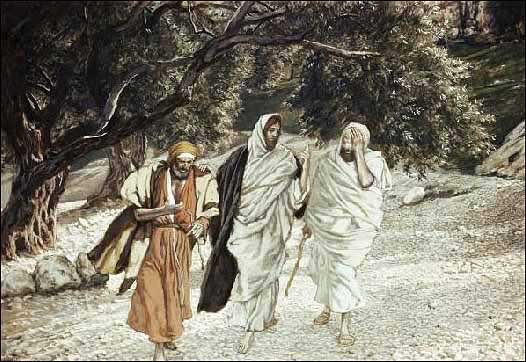
Road to Emmaus  by James J. Tissot

Road to Emmaus
by James J. Tissot

I had hoped to have written today’s post a bit sooner; nevertheless, I am grateful that God has granted me the grace and mercy to share another post on this fine Monday morning. As I have been spending a great deal of time in prayer regarding His plans for my life and my involvement within the local church (each year, twice a year, our local church engages in 21 days of prayer and fasting seeking God’s Will for our fellowship, our families, and our individual walks), this blog has come to mind repeatedly. I am reminded that I am not to take this blog lightly, that I cannot simply post what I like and rely on the first amendment to shield me from these writings. Rather, that as I commit myself to the study of God’s Word, and share here what I learn in the Scriptures, by the Grace of God by His Holy Spirit, that I do so prayerfully and humbly.

In the last post, we started to look at the subject of Biblical submission, that is, submitting to God and His Word in righteousness. Before continuing, I do think it important that we spend time again looking at the authority of the Scriptures. So, consider this a companion to the last post, because one cannot effectively discuss submission, without clearly and completely discussing authority.

Let us begin with the Apostle Paul’s instruction to Timothy, in which he declares:

2 Timothy 3:16 (NASB, emphasis mine) 16 All Scripture is [a]inspired by God and profitable for teaching, for reproof, for correction, for training in righteousness;
Footnote: [a] 2 Timothy 3:16 Lit God-breathed

I don’t normally include the footnotes in these posts; however, I couldn’t find a translation of the this passage that included the literal meaning of the Greek in the text. Every translation I searched included the literal meaning of the Greek as a footnote, and I believe it is important for us to recognize. Now, there is nothing wrong with the word “inspired” here, but I want to examine the literal “God-breathed” for a few moments.

Psalm 33:6 (NASB, emphasis mine) 6 By the word of the Lord the heavens were made, And by the breath of His mouth all their host.

Genesis 2:7 (NASB emphasis mine) 7 Then the Lord God formed man of dust from the ground, and breathed into his nostrils the breath of life; and man became a living being.

So, you see, the connection of all of Scripture to the Breath of God is an important one to maintain. As Paul wrote in Acts 17:28a (KJV), “For in him we live, and move, and have our being;” {oh yeah… I went old-school on that one 😉 }.

I mention this because in the past couple of decades we’ve seen a surge in the number of non-denominational Churches both here and abroad. There is a breaking away from the major hierarchies and set doctrines of these Churches that can be traced back to the reformation of the Roman Catholic Church. No doubt breaking away from false teaching, false doctrine, and corrupt leadership is necessary, but to do so without reconnecting to the authority of Scripture only leaves you floating aimlessly in a sea of organizations of men. Without a firm grasp on the authority of Scriptures, we cannot hope to remain submitted to God in keeping with His word, thus our attempts at reformation degrade into mere rebellion.  I’ve spoken to so many Christians who have left the church because they were hurt, mistreated, or lied to… only to reject all authority and to purpose within their hearts never to submit to “anyone but the Holy Spirit”. But to do so without acknowledging fully the authority of Scriptures is both reckless and rebellious and is a popular snare of the devil in our present culture and age.  It is to this generation that I hope to reach and reaffirm the authority of whole of Scriptures and the Gospel of Jesus Christ. It is why I’m focusing primarily in the New Testament affirmations of the Divine authority of scriptures. Let us continue on then…

I’d like to take a moment to look at one of the coolest accounts of Jesus after His resurrection found in Luke 24. I urge you strongly, to read the whole chapter… and then re-read it. It happens that as the women returned from finding the tomb of Jesus empty, and having been spoken to by Angels of the Lord, and shared their testimony with the disciples, that most did not believe. They were in mourning. Imagine for a moment, that only 3 days ago you saw your mentor, beloved teacher, Savior tortured and killed… you would undoubtedly have clouded judgement as well, would you not? But Peter took off running to see for himself. I love Peter… but that’s not where we are going right now, just setting up the backdrop for begins in verse 13:

Luke 24:13-17 (NASB, emphasis mine) 13 And behold, two of them were going that very day to a village named Emmaus, which was about seven miles from Jerusalem. 14 And they were talking with each other about all these things which had taken place. 15 While they were talking and discussing, Jesus Himself approached and began traveling with them. 16 But their eyes were prevented from recognizing Him. 17 And He said to them, “What are these words that you are exchanging with one another as you are walking?” And they stood still, looking sad.

The “them” in v13 refers to those disciples who heard the testimony of the women who had seen the empty tomb. But why did Jesus not just appear in full glory like, “here I am, BAM”? let’s read on, because the answer to this question is absolutely beautiful…

Luke 24:18-27 (NASB, emphasis mine) 18 One of them, named Cleopas, answered and said to Him, “Are You the only one visiting Jerusalem and unaware of the things which have happened here in these days?” 19 And He said to them, “What things?” And they said to Him, “The things about Jesus the Nazarene, who was a prophet mighty in deed and word in the sight of God and all the people, 20 and how the chief priests and our rulers delivered Him to the sentence of death, and crucified Him. 21 But we were hoping that it was He who was going to redeem Israel. Indeed, besides all this, it is the third day since these things happened. 22 But also some women among us amazed us. When they were at the tomb early in the morning, 23 and did not find His body, they came, saying that they had also seen a vision of angels who said that He was alive. 24 Some of those who were with us went to the tomb and found it just exactly as the women also had said; but Him they did not see.” 25 And He said to them, “O foolish men and slow of heart to believe in all that the prophets have spoken! 26 Was it not necessary for the Christ to suffer these things and to enter into His glory?” 27 Then beginning with Moses and with all the prophets, He explained to them the things concerning Himself in all the Scriptures.

Wow. You see… Jesus wanted His disciples to understand who He was and what had just happened in context of the Scriptures. He later reveals Himself to His disciples… but first, He chose to explain to them what they needed to know about Him… beginning with Moses and with all the prophets… Praise the Lord! While Jesus, being the Son of God, and already the first-born from the grave (resurrected) already bears all Authority in Heaven and Earth, He still chose to demonstrate His authority to His disciples by walking them through the scriptures. If Jesus chose to reveal Himself to His disciples in this manner, then we, too should likewise turn to the whole of Scripture to understand, proclaim, and reveal Jesus, the King of kings, and Lord of lords.

One more example before we close today. Let us return to the Apostle Paul for an example of how we are to share the Gospel as stewards of His word. Lets look at his letter to the Thessalonians. In the opening chapters of this letter, Paul is giving thanks for the faithfulness of the believers. One of the things for which Paul expresses thankfulness is particularly striking:

1 Thessalonians 2:13 (NASB) 13 For this reason we also constantly thank God that when you received the word of God which you heard from us, you accepted it not as the word of men, but for what it really is, the word of God, which also performs its work in you who believe.

So we have here that the Apostle is thankful that the believers accepted their words as the Word of God. But how is it, then, that such Authority could have been given to Paul by these believers? That they would not only accept their words as being of God, but that they “became imitators of the churches of God in Christ Jesus that are in Judea, for you also endured the same sufferings at the hands of your own countrymen…(v14)”. Thankfully, we have the account in Acts to bring us up-to-speed on what took place.

Acts 17:1-4(NASB) Paul at Thessalonica
17 Now when they had traveled through Amphipolis and Apollonia, they came to Thessalonica, where there was a synagogue of the Jews. 2 And according to Paul’s custom, he went to them, and for three Sabbaths reasoned with them from the Scriptures, 3 explaining and giving evidence that the Christ had to suffer and rise again from the dead, and saying, “This Jesus whom I am proclaiming to you is the Christ.” 4 And some of them were persuaded and joined Paul and Silas, along with a large number of the God-fearing Greeks and a number of the leading women.

This Jesus…is the Christ.” Paul reasoned with them from the Scriptures. That is where he derived his authority to preach, proclaiming the Jesus who had stopped him on the road to Damascus was in-fact the Christ. The authority isn’t in the vision, it’s in the Scriptures. Paul’s eyes needed to be opened, just as the eyes of the disciples that were walking on the road to Emmaus needed their eyes to be open.

It is my sincere prayer, that these posts spark a desire in your heart to read these scriptures for yourselves, and to get the full context of each passage. As I read/hear these passages I get a sense of what the disciples shared with one another after Jesus revealed Himself to them.

Luke 24:31-32 (NASB) 31 Then their eyes were opened and they recognized Him; and He vanished from their sight. 32 They said to one another, “Were not our hearts burning within us while He was speaking to us on the road, while He was explaining the Scriptures to us?”

May the Holy Spirit do likewise in your hearts as you search the Scriptures, and submit to the authority of God and His Word.

In Him,
FS

The Righteousness of Biblical Submission

Christ in Gethsemane by Heinrich Hofmann

Christ in Gethsemane by Heinrich Hofmann

We live in a society that absolutely rejects the notion of submission. For most Americans, submission is a sign of weakness, inferiority, and failure. What’s worse, there is a disturbing upward trend in deviant fetishism that seeks to add a very sick and twisted meaning to submission, due in large part to a recent publication of filth I don’t care to mention. To put it bluntly, submission is a dirty word in our society. There is a very good reason the enemy works so diligently to pervert, distort, and redefine “submission” and what it means to submit. As we will see in the Scriptures, the reason is that submission to God and the authority of His Word is our only hope for salvation. While that may seem like a “given”, I urge you to bear with me and see if we might dig a bit deeper into what it means to submit to God and His Word.

In the first chapter of the Gospel of John, we have the following introduction of Jesus Christ:

John 1:1-5 (NASB) The Deity of Jesus Christ
1 In the beginning was the Word, and the Word was with God, and the Word was God. 2 He was in the beginning with God. 3 All things came into being through Him, and apart from Him nothing came into being that has come into being. 4 In Him was life, and the life was the Light of men. 5 The Light shines in the darkness, and the darkness did not comprehend it.

John 1:14-18 (NASB) The Word Made Flesh
14 And the Word became flesh, and dwelt among us, and we saw His glory, glory as of the only begotten from the Father, full of grace and truth. 15 John *testified about Him and cried out, saying, “This was He of whom I said, ‘He who comes after me has a higher rank than I, for He existed before me.’” 16 For of His fullness we have all received, and grace upon grace. 17 For the Law was given through Moses; grace and truth were realized through Jesus Christ. 18 No one has seen God at any time; the only begotten God who is in the bosom of the Father, He has explained Him.

I like to start in the book of John, because I find that his intro does a wonderful job of introducing the Christ in such a manner that unifies the whole Bible. Right off the bat it is clear that in order to fully understand what it means to know Jesus involves studying all of God’s Word from Genesis through Revelation. If you’ll remember the wording of the prophecy in Isaiah 9:6 regarding the Messiah, “For a child will be born to us, a son will be given to us”, you see here that John was pointing out that while His flesh was born that day, Jesus was given to us… ,”And the Word became flesh”.

Now, as Christians, we are to take Jesus as our example. What did Jesus have to say about the Law and the Prophets?

Matthew 5:17-19 (NASB)
17 “Do not think that I came to abolish the Law or the Prophets; I did not come to abolish but to fulfill. 18 For truly I say to you, until heaven and earth pass away, not the smallest letter or stroke shall pass from the Law until all is accomplished. 19 Whoever then annuls one of the least of these commandments, and teaches others to do the same, shall be called least in the kingdom of heaven; but whoever keeps and teaches them, he shall be called great in the kingdom of heaven.

Jesus had every right, being God, to simply speak truth from His own authority. Why did He choose to return to scriptures time and time again? A common quick-answer given today is simply that He did so to demonstrate to us how we might live our lives. While there is truth in that, I believe that answer to be incomplete, and it leaves too much room for the enemy to inject into our minds doubts and false doctrines regarding the person of Jesus and the role of  biblical submission to Divine Authority. Jesus wasn’t just demonstrating submission to the scriptures and to God the Father, He submitted to the Father’s Will.  When He fasted for 40 days (Matt 4), He submitted to the Spirit, was led into the wilderness to be tempted, and He was hungry. Not an act just for demonstration’s sake, it was real. He resisted the temptation of the devil by referring to the Scriptures. That alone would make the point I’m trying to make, but look at His response to the second temptation.

Matthew 4:7 Jesus said to him, “On the other hand, it is written, ‘You shall not put the Lord your God to the test.’”

Jesus isn’t directing the quote at Satan, He presents the quote as a standard by which He must resist the temptation to put the Lord God to the test. Jesus is saying that He will not do what Satan suggested He do, because Scriptures clearly stay that we are not to test the Lord our God. Submission. Likewise in the response to the third and final temptation, Jesus isn’t commanding Satan ‘You shall worship the Lord your God, and serve Him only.’ He is saying that He is to worship the Lord God and serve Him only; therefore, He will resist the final temptation. Submission. Satan had to flee… and after he had run away, the angels came to minister to Jesus. I think that it is from this example that James writes

James 4:7-10 (NASB)
7 Submit therefore to God. Resist the devil and he will flee from you. 8 Draw near to God and He will draw near to you. Cleanse your hands, you sinners; and purify your hearts, you double-minded. 9 Be miserable and mourn and weep; let your laughter be turned into mourning and your joy to gloom. 10 Humble yourselves in the presence of the Lord, and He will exalt you.

I look forward to returning to James 4 at a later date, but for now, I just wanted to point out that the Apostles understood submission because they saw it in the life of Jesus. In your own private reading time, examine for yourselves all of the times Jesus deferred to His Father in Heaven. In the book of John, He made it very clear to the Pharisees that He was the Son of God, and that He was sent by Him, and that His authority over sin, sickness, even the Sabbath was from God; however, He also deferred to God’s Will and Authority. Let’s go to another truly desperate and painful times when Jesus submitted to God the Father

Mark 14:36 (NASB) (Luke 22:39-46; Matthew 26:36-46; Mark 14:32-42)
36 And He was saying, “Abba! Father! All things are possible for You; remove this cup from Me; yet not what I will, but what You will.”

Luke 23:34 (NASB) (On the Cross)
34 But Jesus was saying, “Father, forgive them; for they do not know what they are doing.” And they cast lots, dividing up His garments among themselves.

Luke 23:46 (NASB) 46 And Jesus, crying out with a loud voice, said, “Father, into Your hands I commit My spirit.” Having said this, He breathed His last.

Amen. Yes, Jesus demonstrated complete and total submission to God the Father… by being fully and completely submitted to God the Father. It is this point, this point exactly, that lead me to share this message today. If Jesus, being the Son of God, the Word of God, equal to God was righteous in His submission to God and the Word of God… where is it that we get this false notion that submission denotes inferiority? We submit to God not only because He is superior to us (because we are, in-fact, inferior to God) but because it is Right that we do so. If submission were based solely on inferiority of being then Jesus could not have submitted to God the Father, for He is in no way an inferior being. He submitted to the Authority of God the Father, because that is the design of God’s creation.

Pray about this, and settle it in your spirits. Biblical submission is righteousness in the sight of God. Submit therefore to God. There is much more to discuss concerning the righteousness of biblical submission. Know that the basis for subsequent discussion has been presented here, in that we must first submit to God, His Word, His Son, His Spirit, and His Will. We will take a prayerful look at what the scriptures have to say about submission, particularly in how we are to live our lives as Christians in society, family, and within the Church.

Until next time, May the Lord bless and keep you in His Will,

In Him,
FS

Related articles