CTT | Churching the unchurched?

day-of-pentecost-acts-2-38A theme or apologetic used by the seeker-sensitive and emergent (post-modern progressive christians) for taking it upon themselves to redefine the Church, Praise and Worship, and the role of the Pastor is their claim to be “churching the unchruched”. Is that valid? What does that even mean? Let’s discuss.

There’s a book?

So, there is a book entitled, “Church for the Unchurched” that I do not recommend anyone read. But I want to share an endorsement from the Amazon.com page:

“This is a groundbreaking book. What sets it apart from all the others is that it is based on hard data and real life examples…If you want to know what is really happening in the so-called Seeker churches, this book is a must read.” –Rick Warren, Senior Pastor, Saddleback Community Church, Mission Viejo, California

What sets this book apart is… being based on hard data and real life examples? Okay… should a book about Church and Evangelism be based on Scripture? Yes, actually, it should be.

Ephesians 2:19-21 (ESV) 19 So then you are no longer strangers and aliens, but you are fellow citizens with the saints and members of the household of God, 20 built on the foundation of the apostles and prophets, Christ Jesus himself being the cornerstone, 21 in whom the whole structure, being joined together, grows into a holy temple in the Lord.

Purpose of the Church for the Unchurched?

What is the purpose of the Church? The gathering of the assembly? The seeker-mergent belief (and teaching) is that the assembly of the saints is supposed to be where unbelievers are supposed to hear the Gospel and become believers. But what prevents an unbeliever from attending church in the first place? These seeker-mergent teachers would have you believe that how traditional churches present the Gospel (you know, preaching Law (sin) and Gospel (repentance) and the forgiveness of sins) that has been “failing”. So, they inevitably get caught up in dialing down the preaching of the Law (sins become “mistakes”) and over-emphasizing God’s Love (by avoiding His Holiness,  Justice, Righteousness) trying to compel unbelievers to first agree to attend this non-church style of Church and then later “make a decision for Christ” based on how “loving, warm, engaging, inviting, and welcoming” the congregation is. They are led in a prayer, told they are saved, and then they are fed a diet of self-help legalism that Christians must abide by to establish their Christian-ness. But that legalism isn’t based on Law-preaching, because now that they are “saved” the purpose of their church is no longer them, but the other “unchurched”. So they are expected to read the Bible on their own, while from the pulpit they hear life tips from the latest Christian self-help book, or simply from the pastor’s life experiences.

What does the Bible say about the purpose of Pastors and the Church?

I want to look at a couple of passages that help put together a picture of what it means first to be a pastor and also the role of the Church. Let’s begin in Matthew:

Matthew 16:5-20 (ESV) | The Leaven of the Pharisees and Sadducees
5 When the disciples reached the other side, they had forgotten to bring any bread. 6 Jesus said to them, “Watch and beware of the leaven of the Pharisees and Sadducees.” 7 And they began discussing it among themselves, saying, “We brought no bread.” 8 But Jesus, aware of this, said, “O you of little faith, why are you discussing among yourselves the fact that you have no bread? 9 Do you not yet perceive? Do you not remember the five loaves for the five thousand, and how many baskets you gathered? 10 Or the seven loaves for the four thousand, and how many baskets you gathered? 11 How is it that you fail to understand that I did not speak about bread? Beware of the leaven of the Pharisees and Sadducees.” 12 Then they understood that he did not tell them to beware of the leaven of bread, but of the teaching of the Pharisees and Sadducees.

13 Now when Jesus came into the district of Caesarea Philippi, he asked his disciples, “Who do people say that the Son of Man is?” 14 And they said, “Some say John the Baptist, others say Elijah, and others Jeremiah or one of the prophets.” 15 He said to them, “But who do you say that I am?” 16 Simon Peter replied, “You are the Christ, the Son of the living God.” 17 And Jesus answered him, “Blessed are you, Simon Bar-Jonah! For flesh and blood has not revealed this to you, but my Father who is in heaven. 18 And I tell you, you are Peter, and on this rock I will build my church, and the gates of hell shall not prevail against it. 19 I will give you the keys of the kingdom of heaven, and whatever you bind on earth shall be bound in heaven, and whatever you loose on earth shall be loosed in heaven.” 20 Then he strictly charged the disciples to tell no one that he was the Christ.

John 21:1-19 (ESV) | Jesus Appears to Seven Disciples
21 After this Jesus revealed himself again to the disciples by the Sea of Tiberias, and he revealed himself in this way. 2 Simon Peter, Thomas (called the Twin), Nathanael of Cana in Galilee, the sons of Zebedee, and two others of his disciples were together. 3 Simon Peter said to them, “I am going fishing.” They said to him, “We will go with you.” They went out and got into the boat, but that night they caught nothing. 4 Just as day was breaking, Jesus stood on the shore; yet the disciples did not know that it was Jesus. 5 Jesus said to them, “Children, do you have any fish?” They answered him, “No.” 6 He said to them, “Cast the net on the right side of the boat, and you will find some.” So they cast it, and now they were not able to haul it in, because of the quantity of fish. 7 That disciple whom Jesus loved therefore said to Peter, “It is the Lord!” When Simon Peter heard that it was the Lord, he put on his outer garment, for he was stripped for work, and threw himself into the sea. 8 The other disciples came in the boat, dragging the net full of fish, for they were not far from the land, but about a hundred yards off. 9 When they got out on land, they saw a charcoal fire in place, with fish laid out on it, and bread. 10 Jesus said to them, “Bring some of the fish that you have just caught.” 11 So Simon Peter went aboard and hauled the net ashore, full of large fish, 153 of them. And although there were so many, the net was not torn. 12 Jesus said to them, “Come and have breakfast.” Now none of the disciples dared ask him, “Who are you?” They knew it was the Lord. 13 Jesus came and took the bread and gave it to them, and so with the fish. 14 This was now the third time that Jesus was revealed to the disciples after he was raised from the dead. 15 When they had finished breakfast, Jesus said to Simon Peter, “Simon, son of John, do you love me more than these?” He said to him, “Yes, Lord; you know that I love you.” He said to him, “Feed my lambs.” 16 He said to him a second time, “Simon, son of John, do you love me?” He said to him, “Yes, Lord; you know that I love you.” He said to him,“Tend my sheep.” 17 He said to him the third time, “Simon, son of John, do you love me?”Peter was grieved because he said to him the third time, “Do you love me?” and he said to him, “Lord, you know everything; you know that I love you.” Jesus said to him, “Feed my sheep. 18 Truly, truly, I say to you, when you were young, you used to dress yourself and walk wherever you wanted, but when you are old, you will stretch out your hands, and another will dress you and carry you where you do not want to go.” 19 (This he said to show by what kind of death he was to glorify God.) And after saying this he said to him,“Follow me.”

So we have here a picture of teaching and preaching being presented in terms of food. I believe that when Jesus appeared on the shoreline, the disciples remembered what Jesus taught at Peter’s confession. We also see that the disciples understood the teaching of the leaven of the Pharisees and Sadducees was in their teaching, not in actual food. The religious leaders of that day taught themselves, their doctrines, and their righteousness. Jesus rebuked them repeatedly, pointing out to them that if they had indeed believed Moses and his teaching, they would believe in Jesus (John 5:45-47). They added to the Law and the Prophets with their oral tradition and interpretations of the Law and Prophets, they introduced their own leaven to the Bread of Life (Jesus, the Word made flesh).

At breakfast, Jesus addresses Peter specifically, and asks three times “do you love Me”. What goes on the Greek is fascinating, but for now, let us focus on Jesus’ response, “feed my lambs; tend my sheep, feed my sheep”. Is Jesus just talking about food here? No. Is he saying that Peter is supposed to find his own way to feed the sheep? Absolutely not. Looking back at Peter’s confession of Christ, notice that Jesus specifies that the revelation was from God; therefore, Peter’s confession is the rock upon which Jesus will build His Church, not Peter’s flesh (the Greek makes it very clear) though Peter’s name is changed. When we look back at Jesus’s rebuke of His disciples for worrying about not bringing bread, Jesus points out that He had already demonstrated that He will provide for our earthly needs, that clearly He is focused on more important things for the church. God provides the physical bread and fish, and He also provides the Spiritual bread, the Gospel of Jesus Christ, by which Peter is to feed and tend the flock of Christ (the Church).

The Early Church Evangelized the Synagogue

Yes, the early Church first evangelized the Temple (in Jerusalem) and the synagogues. Does that mean that the purpose of Church is to get unbelievers to attend so that they can become believers? No. Please don’t freak out on me just yet, let’s first discuss what was going on in the early church. After Christ’s ascension into Heaven, we see the first assembly of the Church.

Acts 1:12-19 (ESV) 12 Then they returned to Jerusalem from the mount called Olivet, which is near Jerusalem, a Sabbath day’s journey away. 13 And when they had entered, they went up to the upper room, where they were staying, Peter and John and James and Andrew, Philip and Thomas, Bartholomew and Matthew, James the son of Alphaeus and Simon the Zealot and Judas the son of James. 14 All these with one accord were devoting themselves to prayer, together with the women and Mary the mother of Jesus, and his brothers. 15 In those days Peter stood up among the brothers (the company of persons was in all about 120) and said, 16 “Brothers, the Scripture had to be fulfilled, which the Holy Spirit spoke beforehand by the mouth of David concerning Judas, who became a guide to those who arrested Jesus. 17 For he was numbered among us and was allotted his share in this ministry.” 18 (Now this man acquired a field with the reward of his wickedness, and falling headlong he burst open in the middle and all his bowels gushed out. 19 And it became known to all the inhabitants of Jerusalem, so that the field was called in their own language Akeldama, that is, Field of Blood.)

When the Day of Pentecost arrives, God pours out His Spirit upon His Church, all who were assembled in the upper room, and the sound of their worship of God in many languages (by a miracle of the Holy Spirit) drew a crowd and Peter preached Law and Gospel to them, and many were added to the Church on that day. After Peter’s sermon in chapter 2, let’s look at how the Church assembled:

Acts 2:42-47 (ESV) | The Fellowship of the Believers
42 And they devoted themselves to the apostles’ teaching and the fellowship, to the breaking of bread and the prayers. 43 And awe came upon every soul, and many wonders and signs were being done through the apostles. 44 And all who believed were together and had all things in common. 45 And they were selling their possessions and belongings and distributing the proceeds to all, as any had need. 46 And day by day, attending the temple together and breaking bread in their homes, they received their food with glad and generous hearts, 47 praising God and having favor with all the people. And the Lord added to their number day by day those who were being saved.

Does this look like a church whose focus is on attracting the “unchurched”? No. Who added to their number? The Lord did. Who was being added? Those who were being saved. The Church, God’s Church is for the Christians, those who have believed in the Gospel of Jesus Christ. Any attempt to tailor a Church for those who are unbelievers is an exercise in futility. Let’s see how Paul addressed this idea in his letter to the Romans. At the close of chapter 9, Paul is trying to fix some misconceptions some Gentiles had regarding the Jews. Let’s begin there and move into chapter 10.

Romans 9:30-33 (ESV) | Israel’s Unbelief
30 What shall we say, then? That Gentiles who did not pursue righteousness have attained it, that is, a righteousness that is by faith; 31 but that Israel who pursued a law that would lead to righteousness did not succeed in reaching that law. 32 Why? Because they did not pursue it by faith, but as if it were based on works. They have stumbled over the stumbling stone, 33 as it is written,

“Behold, I am laying in Zion a stone of stumbling, and a rock of offense;
and whoever believes in him will not be put to shame.”

Romans 10 (ESV) | The Message of Salvation to All
1 Brothers, my heart’s desire and prayer to God for them is that they may be saved. 2 For I bear them witness that they have a zeal for God, but not according to knowledge. 3 For, being ignorant of the righteousness of God, and seeking to establish their own, they did not submit to God’s righteousness. 4 For Christ is the end of the law for righteousness to everyone who believes.

5 For Moses writes about the righteousness that is based on the law, that the person who does the commandments shall live by them. 6 But the righteousness based on faith says,“Do not say in your heart, ‘Who will ascend into heaven?’” (that is, to bring Christ down) 7 “or ‘Who will descend into the abyss?’” (that is, to bring Christ up from the dead). 8 But what does it say? “The word is near you, in your mouth and in your heart” (that is, the word of faith that we proclaim); 9 because, if you confess with your mouth that Jesus is Lord and believe in your heart that God raised him from the dead, you will be saved. 10 For with the heart one believes and is justified, and with the mouth one confesses and is saved. 11 For the Scripture says, “Everyone who believes in him will not be put to shame.” 12 For there is no distinction between Jew and Greek; for the same Lord is Lord of all, bestowing his riches on all who call on him. 13 For “everyone who calls on the name of the Lord will be saved.”
14 How then will they call on him in whom they have not believed? And how are they to believe in him of whom they have never heard? And how are they to hear without someone preaching? 15 And how are they to preach unless they are sent? As it is written,“How beautiful are the feet of those who preach the good news!” 16 But they have not all obeyed the gospel. For Isaiah says, “Lord, who has believed what he has heard from us?” 17 So faith comes from hearing, and hearing through the word of Christ.
18 But I ask, have they not heard? Indeed they have, for
“Their voice has gone out to all the earth,
and their words to the ends of the world.”
19 But I ask, did Israel not understand? First Moses says,
“I will make you jealous of those who are not a nation;
with a foolish nation I will make you angry.”
20 Then Isaiah is so bold as to say,
“I have been found by those who did not seek me;
I have shown myself to those who did not ask for me.”
21 But of Israel he says, “All day long I have held out my hands to a disobedient and contrary people.”

We are not born with faith. We are in-fact born in unbelief, dead in sins and trespasses. Faith is a gift from God, one that comes only by hearing the word of Christ, the Bread of Life. The leaven of the Pharisees is to be avoided and has no part in Christ. It doesn’t matter how awesome/entertaining/welcoming your church service is to the unbeliever, unless they hear unleavened preaching, they will not obtain faith necessary for salvation. Your “testimony” of Christ’s forgiveness isn’t enough, neither is your band’s rendition of “Awesome God”. For it is by hearing the Word of Christ that faith comes.

Conclusion

The Church is the body of Christ, and there is no way to have a church that “churches” unbelievers. Unbelievers who come to the church should undeniably be presented Law and Gospel so that they might become believers (faith comes by hearing the Word of God), but the responsibility for bringing them in rests with the Christians, not the Church. Jesus told Peter to feed and tend His flock. Again, the Church is the body of Christ, Christ is the head of His body. We are to share the gospel with the unbelievers, and invite them to the Church of Jesus Christ, we don’t decide to change the focus of Christ’s Church so that it is more palatable for unbelievers.

1 Corinthians 1:18-25 (ESV) | Christ the Wisdom and Power of God
18 For the word of the cross is folly to those who are perishing, but to us who are being saved it is the power of God. 19 For it is written,
“I will destroy the wisdom of the wise,
and the discernment of the discerning I will thwart.”
20 Where is the one who is wise? Where is the scribe? Where is the debater of this age?Has not God made foolish the wisdom of the world? 21 For since, in the wisdom of God, the world did not know God through wisdom, it pleased God through the folly of what we preach to save those who believe. 22 For Jews demand signs and Greeks seek wisdom,23 but we preach Christ crucified, a stumbling block to Jews and folly to Gentiles, 24 but to those who are called, both Jews and Greeks, Christ the power of God and the wisdom of God. 25 For the foolishness of God is wiser than men, and the weakness of God is stronger than men.

There is only one way to the Father, and that is through Christ. Getting someone to join in an attendance ritual on Sunday morning isn’t going to grant faith, unless they are hearing the unleavened Word of God. Changing what is heard on Sunday morning so that unbelievers will “sign up” doesn’t bring them closer to repentance. Unless we preach Christ and Him crucified for our sin, we’ve simply invited lost sinners to a social club built around “positive messaging”.

Our Father in Heaven, Holy is Your Name. Your Kingdom come, Your Will be done on Earth as it is in Heaven. Give us this day our daily bread, and forgive us our sin as we forgive those who sin against us. Lead us not into temptation, but deliver us from evil. We thank you, Father, that there is now no condemnation for those who are in Christ Jesus. For the law of the Spirit of life has set us free in Christ Jesus from the law of sin and death. For You have done what the law, weakened by our flesh, could not do. By sending Your Own Son in the likeness of sinful flesh and for sin, You condemned sin in the flesh, in order that the righteous requirement of the law might be fulfilled in us. May we walk not according to the flesh but according to the Spirit, by Your Grace in Christ Jesus, Amen. (Matt 6, Romans 8)

In Christ Jesus,
Jorge

Video | “Cheap Grace for the Peorple” by Worldview Everlasting

WorldviewEverlastingCropw245I had intended to write something light and short today, but after watching today’s episode of Worldview Everlasting, I decided to share it. This is a short video (18 min) by Worldview Everlasting, a YouTube Channel hosted by Lutheran Reverend Jonathan Fisk. In this video he tackles the poor label of “cheap Grace” used to disparage those who insist on preaching the Law with the Gospel even to Believers (as opposed to preaching only Law to those who “are already saved” so that they can be better Christians by striving to following the Law).

Rev. Fisk also does a great job of describing at a World View is and wonderfully lays out the Atheistic worldview.

[youtube http://youtu.be/fHs28nnpXxI]

If you have any questions or comments for us regarding this video, please feel free to comment or contact us directly. Remember there is still that rather long video from last week (Church of Tares) that is well worth watching if discernment in these last days is a concern of yours.

Jude 1:24-25 (ESV) Now to him who is able to keep you from stumbling and to present you blameless before the presence of his glory with great joy, to the only God, our Savior, through Jesus Christ our Lord, be glory, majesty, dominion, and authority, before all time and now and forever. Amen.

Your servant in Christ Jesus,
Jorge

CTT | Jesus Friend of Sinners?

jesus_eats_with_publicans_and_sinners_bidaDid Jesus walk this earth to befriend sinners? Does this partial quote justify hanging out with sinners without preaching Law and Gospel? Does this justify abandoning the purpose of the church found in Scripture (maturing the saints) in favor of creating a cool place for “unchurched” people to hang out, be entertained, and be encouraged regardless of whether or not they believe in the Son of God and what He did as a payment for what their sin deserves? Let’s look at the text.

Jesus, Friend of Sinners

The partial quote “Jesus friend of sinners” is found in the tail end of the account where disciples of John the Baptist come to Jesus on John’s behalf to ask if He was in-fact the Messiah. John had been thrown in jail shortly after Jesus’s ministry began, and he wanted encouragement. This account is recorded nearly verbatim in Matthew 11 and in Luke 7. Luke records a reaction from the crowd that I think is important for understanding the message, so we will begin in Luke.

Luke 7:18-35 (ESV) | Messengers from John the Baptist
18 The disciples of John reported all these things to him. And John, 19 calling two of his disciples to him, sent them to the Lord, saying, “Are you the one who is to come, or shall we look for another?” 20 And when the men had come to him, they said, “John the Baptist has sent us to you, saying, ‘Are you the one who is to come, or shall we look for another?’” 21 In that hour he healed many people of diseases and plagues and evil spirits, and on many who were blind he bestowed sight. 22 And he answered them, “Go and tell John what you have seen and heard: the blind receive their sight, the lame walk, lepers are cleansed, and the deaf hear, the dead are raised up, the poor have good news preached to them. 23 And blessed is the one who is not offended by me.” 24 When John’s messengers had gone, Jesus began to speak to the crowds concerning John: “What did you go out into the wilderness to see? A reed shaken by the wind? 25 What then did you go out to see? A man dressed in soft clothing? Behold, those who are dressed in splendid clothing and live in luxury are in kings’ courts. 26 What then did you go out to see? A prophet? Yes, I tell you, and more than a prophet. 27 This is he of whom it is written,

“‘Behold, I send my messenger before your face,
who will prepare your way before you.’

28 I tell you, among those born of women none is greater than John. Yet the one who is least in the kingdom of God is greater than he.” 29 (When all the people heard this, and the tax collectors too, they declared God just, having been baptized with the baptism of John, 30 but the Pharisees and the lawyers rejected the purpose of God for themselves, not having been baptized by him.)

31 “To what then shall I compare the people of this generation, and what are they like?32 They are like children sitting in the marketplace and calling to one another,

“‘We played the flute for you, and you did not dance;
    we sang a dirge, and you did not weep.’

33 For John the Baptist has come eating no bread and drinking no wine, and you say, ‘He has a demon.’ 34 The Son of Man has come eating and drinking, and you say, ‘Look at him! A glutton and a drunkard, a friend of tax collectors and sinners!’ 35 Yet wisdom is justified by all her children.”

Interesting. After such a powerful testimony of John the Baptist, Jesus then declares that the one who is least in the kingdom of God is greater than he. Why would the tax collectors resonate with this statement? In that day, the top rung of the social ladder was the chief priests and elders, and the lowest were the prostitutes and tax collectors. The tax collectors were equated with prostitutes in that they, being Jews, took money from Jews to pay tribute to Rome. Remember when we discussed in an earlier post, we saw that John’s baptism was one of Repentance. Let’s revisit how Jesus ended one of His parables to the chief priests and elders of the Temple.

Matthew 21:28-32 (ESV) | The Parable of the Two Sons
28 “What do you think? A man had two sons. And he went to the first and said, ‘Son, go and work in the vineyard today.’ 29 And he answered, ‘I will not,’ but afterward he changed his mind and went. 30 And he went to the other son and said the same. And he answered, ‘I go, sir,’ but did not go. 31 Which of the two did the will of his father?” They said, “The first.” Jesus said to them, “Truly, I say to you, the tax collectors and the prostitutes go into the kingdom of God before you. 32 For John came to you in the way of righteousness, and you did not believe him, but the tax collectors and the prostitutes believed him. And even when you saw it, you did not afterward change your minds and believe him.

John the Baptist Preached Repentance

Luke records the reaction of the people, specifying that tax collectors were present, demonstrates that Jesus wasn’t talking about John the Baptist to those who were completely ignorant of who he was. These people whom Jesus addressed had gone out to John the Baptist, and Jesus was reminding them of who they saw. Jesus was also explaining John’s significance. The least in the kingdom of Israel had gone out to John the Baptist, confessing their sins and repenting. The religious leaders, the Pharisees and Sadducees rejected the purpose of God for themselves… they did not believe in John’s baptism. John the Baptist was greater than all mankind (except Jesus because He is the Son of God), but the least in the Kingdom of God was greater than John. How? Because their entry into the Kingdom of God is by the Blood of Jesus, not by their own.

The People of This Generation

Getting back to our text, in Luke 7:32 Jesus transitions to describing the people of this generation. Notice how He chose to describe them, as children sitting in the marketplace calling to one another. Are the children encouraging each other? Are they celebrating each other? No… they are frustrated with each other for when they played the flute no one danced, so when they sang a dirge no one wept (a dirge being a mournful song, piece of music, or poem).  Jesus is setting up the next point He is going to make about the religious leaders and their whining excuses for rejecting the Kingdom of God.

Luke 7:33-35 (ESV) 33 For John the Baptist has come eating no bread and drinking no wine, and you say, ‘He has a demon.’ 34 The Son of Man has come eating and drinking, and you say, ‘Look at him! A glutton and a drunkard, a friend of tax collectors and sinners!’ 35 Yet wisdom is justified by all her children.”

John the Baptist came as a Nazirite from birth, eating no bread (locusts and honey) and drinking no wine or strong drink, and the religious leaders rejected him and his prophecy and told the people he had a demon (sang a dirge) . Now that Jesus, the Son of Man, had come eating and drinking, the religious leaders continue to reject Him and His Testimony while telling the people, “Look at him! A glutton and a drunkard, a friend of tax collectors and sinners!” (played the flute).

Immediate Context of the Quote

So, normally, I like to start with the immediate context of a CTT quote, but this time I really felt it necessary to begin with the full context. The immediate context is highly questionable… this “Jesus friend of sinners” is a quote of what the unbelieving Pharisees are saying about Jesus, but it doesn’t stand alone. The Pharisees are lining it up with declaring Jesus a glutton and a drunkard! This is levied as an insult to Jesus. They aren’t complimenting Him, nor is Jesus declaring this accusation to be true, because He also quoted their accusation of John the Baptist having a demon. The immediate context of this quote completely destroys the emergent, seeker-sensitive twist of this passage as somehow proclaim traditional Church to be Pharisaical and contrary to the ministry of Jesus. The greater context also draws that out, when we see that those in attendance knew and acknowledged the message of John the Baptist, who definitely hadn’t “befriended”, ate, and drank with them; rather, he called them to repent for the Kingdom of Heaven is at hand.

To Seek and to Save the Lost

To call Jesus a “friend of sinners” is to misunderstand either who the “sinners” are or to confuse why Jesus walked the earth. Unless you are acknowledging that we are all sinners, equally dead in our trespasses and sins, you are missing the point of who it was that Jesus befriended. Everyone Jesus spoke to, ate with, walked with, and met was a sinner. Everyone. The Pharisees didn’t get it, they didn’t understand that the call to repent was to them in equal measure as it was to the prostitutes and the tax collectors. Though pointing this out to a seeker-mergent ministry will get an emphatic “amen” it actually destroys their argument that Church needed to be re-envisioned for holding the attention of unbelievers because we are all sinners. We all need to repent and be forgiven every day we live on this Earth. So this partial quote cannot be “properly clarified” and still support the notion that Church that seeks to mature the saints are Pharisaical.

The more dangerous road this can take, is to minimize the work and ministry of Jesus Christ by suggesting that we should seek out sinful living and become a part of it as a form of befriending the sinner. That isn’t what Jesus did, that is what the Pharisees accused Him of doing (gluttony, drunkard, befriending, etc.). Jesus came to fulfill the Law and the Prophets on our behalf (for no one else could do it perfectly) and then lay down His life to suffer the wrath of God that we deserve so that the payment for our sin was made (substitutionary atonement) on our behalf. Let’s look at what Jesus did when He visited the home of Zacchaeus, the tax collector.

Luke 19:1-10 (ESV) | Jesus and Zacchaeus
1 He entered Jericho and was passing through. 2 And behold, there was a man named Zacchaeus. He was a chief tax collector and was rich. 3 And he was seeking to see who Jesus was, but on account of the crowd he could not, because he was small in stature. 4 So he ran on ahead and climbed up into a sycamore tree to see him, for he was about to pass that way. 5 And when Jesus came to the place, he looked up and said to him,“Zacchaeus, hurry and come down, for I must stay at your house today.” 6 So he hurried and came down and received him joyfully. 7 And when they saw it, they all grumbled, “He has gone in to be the guest of a man who is a sinner.” 8 And Zacchaeus stood and said to the Lord, “Behold, Lord, the half of my goods I give to the poor. And if I have defrauded anyone of anything, I restore it fourfold.” 9 And Jesus said to him, “Today salvation has come to this house, since he also is a son of Abraham. 10 For the Son of Man came to seek and to save the lost.”

What did Zacchaeus do when Jesus came to his home? Confessed and repented of his sin. Jesus responded by forgiving him and then declaring that salvation had come to Zacchaeus’s home. You see, brothers and sisters, it is a false dichotomy to assert that we need to act out the Gospel before or even instead of preaching it. By God’s Grace we should endeavor to live in step with the Holy Spirit, but we are all sinners in need of Grace.  The Gospel of Jesus Christ is the only power to save, not our own examples or interpretations. Zacchaeus knew who Jesus was, and wanted to see Him. We do need to go and preach Law and Gospel to the lost in this world, but that doesn’t require abandoning the feeding of God’s sheep for the maturing of the saints.

Who Did Jesus call His Friends?

We know that Jesus came, the first time, not to judge the world but to save it. The Son of Man came to seek and to save the lost, from every nation, both Jew and Gentile. He will return again and when He does it will be to Judge both the Living and the Dead. Jesus left us with our marching orders, and gave the Church the Holy Spirit and the Apostles to build her up on the foundation of the Gospel of Jesus Christ, with Christ as its corner-stone.

John 15:12-17 (ESV) 12 “This is my commandment, that you love one another as I have loved you. 13 Greater love has no one than this, that someone lay down his life for his friends. 14 You are my friends if you do what I command you. 15 No longer do I call you servants, for the servant does not know what his master is doing; but I have called you friends, for all that I have heard from my Father I have made known to you. 16 You did not choose me, but I chose you and appointed you that you should go and bear fruit and that your fruit should abide, so that whatever you ask the Father in my name, he may give it to you. 17 These things I command you, so that you will love one another.

Jesus didn’t call the sinner living in sin a friend. Make no mistake in what I am saying here, I am not saying Jesus didn’t die for the sinners (all of us) or that He didn’t minister to them or seek out the lost. I’m saying that when Jesus speaks of friendship, it is an upgrade from servant. For those who live in sin are enemies of God, that is what sin did to us in the Fall.

James 4:1-5 (ESV) | Warning Against Worldliness
1 What causes quarrels and what causes fights among you? Is it not this, that your passions are at war within you? 2 You desire and do not have, so you murder. You covet and cannot obtain, so you fight and quarrel. You do not have, because you do not ask. 3 You ask and do not receive, because you ask wrongly, to spend it on your passions. 4 You adulterous people! Do you not know that friendship with the world is enmity with God?Therefore whoever wishes to be a friend of the world makes himself an enemy of God. 5 Or do you suppose it is to no purpose that the Scripture says, “He yearns jealously over the spirit that he has made to dwell in us”?

Jesus Christ came to save the world, to redeem Mankind from sin… not to befriend the world. The most loving thing you can do is to love your brothers and sisters in Christ, and preach the Gospel. The Gospel is the only means of salvation for those who are perishing in their sin. What does it profit a man to gain the whole world yet lose his own soul? You can pour out good works on your neighbor, giving him everything he ever thought he could ever need, but if he does not hear the Word of God, he cannot gain faith, and without faith he cannot be saved. If you are going err, err on the side of preaching, so that the Word of God might work on the hearts of the lost and might grant them faith.

Galatians 6:1-10 (ESV) | Bear One Another’s Burdens
1 Brothers, if anyone is caught in any transgression, you who are spiritual should restore him in a spirit of gentleness. Keep watch on yourself, lest you too be tempted. 2 Bear one another’s burdens, and so fulfill the law of Christ. 3 For if anyone thinks he is something, when he is nothing, he deceives himself. 4 But let each one test his own work, and then his reason to boast will be in himself alone and not in his neighbor. 5 For each will have to bear his own load. 6 Let the one who is taught the word share all good things with the one who teaches. 7 Do not be deceived: God is not mocked, for whatever one sows, that will he also reap. 8 For the one who sows to his own flesh will from the flesh reap corruption, but the one who sows to the Spirit will from the Spirit reap eternal life. 9 And let us not grow weary of doing good, for in due season we will reap, if we do not give up. 10 So then, as we have opportunity, let us do good to everyone, and especially to those who are of the household of faith.

May the Grace of God be with you always,
In Christ Jesus,
Jorge

CTT | What is the Biblical Stance on Racism?

CTTThe Bible has many references to people groups, nations, and lineage, but does that make it racist? Not in the way we generally think of racism. In our modern-day we tend to focus on visible distinctions (skin color, hair type, or language) and we use those distinctions to malign people. The color of a person’s skin is used to determine if a statement or decision was racist, wrongfully exempting some and falsely accusing others of racism. When the world rejects Truth and defines all “right and wrong” based on self we shouldn’t really find double-standards all that surprising. We live in a day where sinful judgement takes place all of the time and is often smoke-screened with ad hominem attacks and straw-man racism. Rather than discuss the issues at hand, many who struggle with racism who are caught without a valid argument are the first to play the “racist” card. The world is lost because it has rejected the Truth of God’s Word.

Romans 1:18-20 (ESV)18 For the wrath of God is revealed from heaven against all ungodliness and unrighteousness of men, who by their unrighteousness suppress the truth. 19 For what can be known about God is plain to them, because God has shown it to them. 20 For his invisible attributes, namely, his eternal power and divine nature, have been clearly perceived, ever since the creation of the world, in the things that have been made. So they are without excuse.

So enough about how wrong and sinful the world is today. Let us turn to the Truth of God’s Word to explore this notion of racism and see what the Bible has to say on the matter.

God Created Mankind as One Kind, a single race.

Let us begin on the sixth day of Creation Week.

Genesis 1:24-31 (ESV) 24 And God said, “Let the earth bring forth living creatures according to their kinds—livestock and creeping things and beasts of the earth according to their kinds.” And it was so. 25 And God made the beasts of the earth according to their kinds and the livestock according to their kinds, and everything that creeps on the ground according to its kind. And God saw that it was good.

26 Then God said, “Let us make man in our image, after our likeness. And let them have dominion over the fish of the sea and over the birds of the heavens and over the livestock and over all the earth and over every creeping thing that creeps on the earth.”

27 So God created man in his own image,
    in the image of God he created him;
    male and female he created them.

28 And God blessed them. And God said to them, “Be fruitful and multiply and fill the earth and subdue it, and have dominion over the fish of the sea and over the birds of the heavens and over every living thing that moves on the earth.” 29 And God said, “Behold, I have given you every plant yielding seed that is on the face of all the earth, and every tree with seed in its fruit. You shall have them for food. 30 And to every beast of the earth and to every bird of the heavens and to everything that creeps on the earth, everything that has the breath of life, I have given every green plant for food.” And it was so. 31 And God saw everything that he had made, and behold, it was very good. And there was evening and there was morning, the sixth day.

Every living creature is created according to its kind. When God created plant life (day 3), He instituted the concept of bearing seed after it own kind. Each kind of plant will only bear seed of its own kind, and it will not bear the seed of a different kind. A banana kind will not suddenly bear seeds for stone fruit (like peaches). When the Bible refers to procreation of man, it uses the same rules of seed bearing after its own kind. The Hebrew word (אָדָם) is translated Adam, man, and mankind. All of mankind are a single race. That any man can join with any woman and produce children after their own kind demonstrates this truth. The creation account in Chapter 2 further illustrates this truth.

Genesis 2:18-20 (ESV) 18 Then the Lord God said, “It is not good that the man should be alone; I will make him a helper fit for him.” 19 Now out of the ground the Lord God had formed every beast of the field and every bird of the heavens and brought them to the man to see what he would call them. And whatever the man called every living creature, that was its name. 20 The man gave names to all livestock and to the birds of the heavens and to every beast of the field. But for Adam there was not found a helper fit for him.

In all of creation, there was no helper suitable for Adam. Therefore God created woman out of man and joined them together. One race, one kind, and it was all very good. Now, God designed within Creation a wide array of variety, for we have classified many variations within kinds (different cats, dogs, fruit, vegetables) of the lower creatures and within mankind (heights, weights, skin tones, hair types, eye colors, etc). Before the fall, there was only Adam and his wife, but the genetic material was all there. With sin came the curse, and degradation of all of creation. Divisions of mankind happened, but they did not become different kinds.

The Reset in the Time of Noah

We know that there was great variety in mankind after the fall as they multiplied on the earth. There were men of great renown (Nephilim or giants) in those days and after the flood (Sons of Anak; Numbers 13 (ESV)).  In Genesis 6, we see God is grieved by the wickedness of mankind on the earth and brought judgement upon it, saving Noah and his family. Now all people groups, all of the race of mankind is preserved in the 8 who were aboard the Ark. After the flood, the face of the whole Earth was changed, as well as its climate, and the need to survive in multivarious environments had to have been designed into the mankind by God, and it was. All of mankind spoke one language, and were one people.

Now sin persists in mankind and soon after the flood and the first harvest of the vine, Ham, sinned against his father, Noah. Noah curses Canaan, the son of Ham, as punishment for the wrong committed him by Ham. This becomes our first major separation of people groups, the sons of Canaan become subjects to Japheth and Shem who did what was right by Noah. This is a prophetic judgement on the house of Canaan, one God revisits in the time of Abraham.

Genesis 17:7-9 (ESV) 7 And I will establish my covenant between me and you and your offspring after you throughout their generations for an everlasting covenant, to be God to you and to your offspring after you. 8 And I will give to you and to your offspring after you the land of your sojournings, all the land of Canaan, for an everlasting possession, and I will be their God.” 9 And God said to Abraham, “As for you, you shall keep my covenant, you and your offspring after you throughout their generations.

Abraham was a descendant of Shem. But how did the groups become so foreign to one another in the time that passed between Shem and Abraham, such that Abraham was a sojourner in the land of Canaan?

The Tower of Babel

Let’s look turn to the beginning of Genesis 11.

Genesis 11:1-9 (ESV) | The Tower of Babel
1 Now the whole earth had one language and the same words. 2 And as people migrated from the east, they found a plain in the land of Shinar and settled there. 3 And they said to one another, “Come, let us make bricks, and burn them thoroughly.” And they had brick for stone, and bitumen for mortar. 4 Then they said, “Come, let us build ourselves a city and a tower with its top in the heavens, and let us make a name for ourselves, lest we be dispersed over the face of the whole earth.” 5 And the Lord came down to see the city and the tower, which the children of man had built. 6 And the Lord said, “Behold, they are one people, and they have all one language, and this is only the beginning of what they will do. And nothing that they propose to do will now be impossible for them. 7 Come, let us go down and there confuse their language, so that they may not understand one another’s speech.” 8 So the Lord dispersed them from there over the face of all the earth, and they left off building the city. 9 Therefore its name was called Babel, because there the Lord confused the language of all the earth. And from there the Lord dispersed them over the face of all the earth.

So, we see the first separation of people groups after the flood comes as a direct result of sin committed against Noah. A prophetic declaration of separation from the sons of Shem and Japheth and the sons of Ham. After some time, we have a second, major separation when God confused the languages of the people. Remember that everything here was written by Moses as he recorded God’s eye-witness account. We have some clue as to how the languages divided the people by looking at the genealogies recorded in chapter 10, particularly in how the accounts of the descendants of Japheth, Ham, and Shem are concluded. Let’s look at the descendants of Ham.

Genesis 10:6-20 (ESV) 6 The sons of Ham: Cush, Egypt, Put, and Canaan.

7 The sons of Cush: Seba, Havilah, Sabtah, Raamah, and Sabteca.

The sons of Raamah: Sheba and Dedan.

Cush fathered Nimrod; he was the first on earth to be a mighty man.He was a mighty hunter before the Lord. Therefore it is said, “Like Nimrod a mighty hunter before the Lord.” 10 The beginning of his kingdom was Babel, Erech, Accad, and Calneh, in the land of Shinar. 11 From that land he went into Assyria and built Nineveh, Rehoboth-Ir, Calah, and 12 Resen between Nineveh and Calah; that is the great city. 13 Egypt fathered Ludim, Anamim, Lehabim, Naphtuhim, 14 Pathrusim, Casluhim (from whom the Philistines came), and Caphtorim.

15 Canaan fathered Sidon his firstborn and Heth, 16 and the Jebusites, the Amorites, the Girgashites, 17 the Hivites, the Arkites, the Sinites, 18 the Arvadites, the Zemarites, and the Hamathites. Afterward the clans of the Canaanites dispersed. 19 And the territory of the Canaanites extended from Sidon in the direction of Gerar as far as Gaza, and in the direction of Sodom, Gomorrah, Admah, and Zeboiim, as far as Lasha. 20 These are the sons of Ham, by their clans, their languages, their lands, and their nations.

I’ve highlighted several of the people groups that would become enemies of Israel, worshipers of false gods, wicked men of old. I am confident that most of the highlighted ones are easily recognized while a couple (Heth and Cush) might not be so. We looked at the significance of the descendants of Heth in the story of Jacob and Esau. We will take a look at Cush, but for now I’d like to draw your attention to the significance of Nimrod, the first on earth to be a mighty man. Now, we know that there were Nephilim or giants before the flood, so here the connotation is that Nimrod is perhaps the first earthly king. The beginning of his kingdom was Babel, Erech, Accad, and Calneh. This is significant in understanding what went wrong in the building of the Tower of Babel. After having established his kingdom, he sought to build a tower into Heaven, to be like God, and he had the support of the people. We see that when he left the land of Shinar, he built Nineveh.

After God confused the languages of the people, they dispersed in clans, languages, and nations over the Earth. When their languages split, so did their gene pools and their cultures. Very few remembered God their creator… as we see in chapter 12, God calls Abram to leave the land of his family (Ur of the Chaldeans) into a land that God would give him. We see God calling Abram out of the dispersion of people who had at one time committed to build a monument to themselves, a tower to Heaven. Much like today, when the Gospel of Jesus Christ is to call out of the world a people for Himself. The key separation here is a people who follow and worship the One True God, the descendants of Abraham.

What about skin color?

Skin color has already varied because our genetic makeup has already been set; however, it has not been mentioned as a determining factor in dividing people groups. Now that we have clans and languages split, and the post-flood world, it stands to reason that skin color may become more and more significant in the natural selection process based on climate and language. Answers in Genesis did a good job of explaining how skin type plays a role in natural selection with regards to climates.

Fast-forwarding to Moses as he records the Law, he is God’s chosen prophet to the children of Israel. God used Moses to deliver Israel from their slavery in Egypt, and to lead the people of Israel through the wilderness while God made Himself known to Israel first, and the rest of mankind later. He promised Abraham that the nations would be blessed by his offspring, that is Jesus Christ, through whom all mankind might be saved from the wrath earned by their sin. In Numbers, chapter 12, we see events transpire that would easily qualify as racism in today’s vernacular.

Numbers 12  (ESV) | Miriam and Aaron Oppose Moses
12 Miriam and Aaron spoke against Moses because of the Cushite woman whom he had married, for he had married a Cushite woman. 2 And they said, “Has the Lord indeed spoken only through Moses? Has he not spoken through us also?” And the Lord heard it. 3 Now the man Moses was very meek, more than all people who were on the face of the earth. 4 And suddenly the Lord said to Moses and to Aaron and Miriam, “Come out, you three, to the tent of meeting.” And the three of them came out. 5 And the Lord came down in a pillar of cloud and stood at the entrance of the tent and called Aaron and Miriam, and they both came forward. 6 And he said, “Hear my words: If there is a prophet among you, I the Lord make myself known to him in a vision; I speak with him in a dream. 7 Not so with my servant Moses. He is faithful in all my house. 8 With him I speak mouth to mouth, clearly, and not in riddles, and he beholds the form of the Lord. Why then were you not afraid to speak against my servant Moses?” 9 And the anger of the Lord was kindled against them, and he departed. 10 When the cloud removed from over the tent, behold, Miriam was leprous, like snow. And Aaron turned toward Miriam, and behold, she was leprous. 11 And Aaron said to Moses, “Oh, my lord, do not punish us because we have done foolishly and have sinned. 12 Let her not be as one dead, whose flesh is half eaten away when he comes out of his mother’s womb.” 13 And Moses cried to the Lord, “O God, please heal her—please.” 14 But the Lord said to Moses, “If her father had but spit in her face, should she not be shamed seven days? Let her be shut outside the camp seven days, and after that she may be brought in again.” 15 So Miriam was shut outside the camp seven days, and the people did not set out on the march till Miriam was brought in again. 16 After that the people set out from Hazeroth, and camped in the wilderness of Paran.

Ah, here we have a reference to Cush, the son of Ham. The Hebrew word here translated “Cushite” is elsewhere translated “Ethiopian”. The root of this word is the Hebrew word for the Cush which also means “black”. Cush was probably given his name because he was born darker than his siblings. The land of Cush is the land in the southern regions of the Nile, south of Egypt. Moses had taken a black woman for a wife, Miriam and Aaron oppose Moses for it, and God’s anger is kindled. The people have the Law and the statutes of the Lord. If they had any just objection to Moses marrying this woman, they would have presented their case. They didn’t, Miriam and Aaron objected to the marriage and even slightly invoked their status as having prophesied before the Lord before as somehow supporting their issue against Moses. God was furious. He addresses even the fact that the prophets don’t even speak to God in the same manner that God speaks to Moses. As punishment, God strikes Miriam with leprosy. Even when Moses makes his plea with God to heal her, God insists they abide by the Law, and so Miriam must observe the Law and wait 7 days outside the camp before being allowed back in. Is false judgement according to the color of skin condoned in the Bible? Absolutely not. Miriam was cut off from her people (for 7 days) for it.

Conclusion

What we superficially throw around as racism is in no way condoned in the Bible. God created one race, one kind, that is mankind. There are divisions of people, first and foremost whether or not we know the One True God and worship Him as God. There are differences within mankind, differences that I believe God enjoys, for He is the one who Created our variety, our languages, our appearance, our skills, our laughter. He created us in His likeness, in His image… we are a dim reflection of His Greatness. We all are sinners, we’ve all fallen in the sin of Adam and are born dead in sins and trespasses. But just as in Adam all men have sinned and died, through Jesus a way of salvation was provided for all of mankind.

John 3:16-21 (ESV) | For God So Loved the World
16 “For God so loved the world, that he gave his only Son, that whoever believes in him should not perish but have eternal life. 17 For God did not send his Son into the world to condemn the world, but in order that the world might be saved through him. 18 Whoever believes in him is not condemned, but whoever does not believe is condemned already, because he has not believed in the name of the only Son of God. 19 And this is the judgment: the light has come into the world, and people loved the darkness rather than the light because their works were evil. 20 For everyone who does wicked things hates the light and does not come to the light, lest his works should be exposed. 21 But whoever does what is true comes to the light, so that it may be clearly seen that his works have been carried out in God.”

John 6:28-29 (ESV) 28 Then they said to him, “What must we do, to be doing the works of God?” 29 Jesus answered them, “This is the work of God, that you believe in him whom he has sent.”

Do the work of God, believe in Jesus Christ, whom the Lord God sent out of His love for us, so that we might not perish. Bear fruit in keeping with repentance. May the Lord bless you and keep you in His Word.

In Christ Jesus,
Jorge

CTT | The Barren Fig Tree

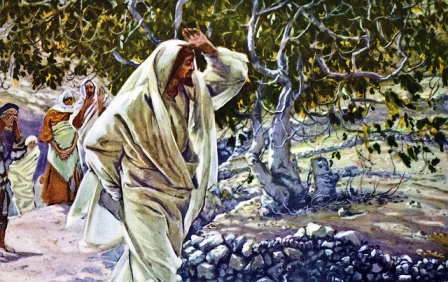
Artist: J JAMES TISSOT

Artist: J JAMES TISSOT

Today, let’s take a look at the parable of the Barren Fig Tree and see if we can’t bring some context to some of the accounts that have perplexed me over the years. We will be looking through a few of the Gospel texts, but for starters, let’s turn to Luke 13.

Luke 13:1-9 (ESV)  1 There were some present at that very time who told him about the Galileans whose blood Pilate had mingled with their sacrifices. 2 And he answered them, “Do you think that these Galileans were worse sinners than all the other Galileans, because they suffered in this way? 3 No, I tell you; but unless you repent, you will all likewise perish. 4 Or those eighteen on whom the tower in Siloam fell and killed them: do you think that they were worse offenders than all the others who lived in Jerusalem? 5 No, I tell you; but unless you repent, you will all likewise perish.” 6 And he told this parable: “A man had a fig tree planted in his vineyard, and he came seeking fruit on it and found none. 7 And he said to the vinedresser, ‘Look, for three years now I have come seeking fruit on this fig tree, and I find none. Cut it down. Why should it use up the ground?’ 8 And he answered him, ‘Sir, let it alone this year also, until I dig around it and put on manure. 9 Then if it should bear fruit next year, well and good; but if not, you can cut it down.’”

Now, the ESV separates these into two different paragraphs, but for the purpose of this study I believe the two concepts go together. Jesus sets up this parable of the fig tree with a reminder of the call to repentance and the judgement that awaits all who refuse to repent. He clearly teaches that everyone is guilty of sin, not just those who seem to have received punishment while others lived. Jesus exposes the myth that those who die suddenly were being judged by God as special cases of sinfulness or offense, and those who lived where more righteous. The parable that follows this begins with a fig tree that was planted in the master’s vineyard, and for three years it bore no fruit. Judgement is coming to the barren fig tree, for the master is ready to cut it down. However, the vinedresser appeals to the master for grace, allow the tree one more year while special care is taken for the tree, fertilizer will be added. If after the year the tree still bears no fruit, then it shall be cut down. By Grace the fig tree was planted in the garden, and by the master’s Grace that tree was allowed to continue fruitlessness for three years, and by Grace it will be given another year with special attention. Judgement is coming, but by God’s Grace there is time for repentance.

In the Matthew 21, we see the account of the triumphal entry into Jerusalem. We are going to pick up in an awkward spot, so if you are unfamiliar with this passage, please read Matthew 21 in full. Here let us look at what happens when Jesus enters Jerusalem.

Matthew 21:10-32 (ESV)10 And when he entered Jerusalem, the whole city was stirred up, saying, “Who is this?” 11 And the crowds said, “This is the prophet Jesus, from Nazareth of Galilee.” 12 And Jesus entered the temple and drove out all who sold and bought in the temple, and he overturned the tables of the money-changers and the seats of those who sold pigeons. 13 He said to them, “It is written, ‘My house shall be called a house of prayer,’ but you make it a den of robbers.” 

14 And the blind and the lame came to him in the temple, and he healed them. 15 But when the chief priests and the scribes saw the wonderful things that he did, and the children crying out in the temple, “Hosanna to the Son of David!” they were indignant, 16 and they said to him, “Do you hear what these are saying?” And Jesus said to them,“Yes; have you never read,

“‘Out of the mouth of infants and nursing babies
you have prepared praise’?”

17 And leaving them, he went out of the city to Bethany and lodged there.

18 In the morning, as he was returning to the city, he became hungry. 19 And seeing a fig tree by the wayside, he went to it and found nothing on it but only leaves. And he said to it, “May no fruit ever come from you again!” And the fig tree withered at once. 20 When the disciples saw it, they marveled, saying, “How did the fig tree wither at once?” 21 And Jesus answered them, “Truly, I say to you, if you have faith and do not doubt, you will not only do what has been done to the fig tree, but even if you say to this mountain,‘Be taken up and thrown into the sea,’ it will happen. 22 And whatever you ask in prayer, you will receive, if you have faith.”

23 And when he entered the temple, the chief priests and the elders of the people came up to him as he was teaching, and said, “By what authority are you doing these things, and who gave you this authority?” 24 Jesus answered them, “I also will ask you one question, and if you tell me the answer, then I also will tell you by what authority I do these things. 25 The baptism of John, from where did it come? From heaven or from man?” And they discussed it among themselves, saying, “If we say, ‘From heaven,’ he will say to us, ‘Why then did you not believe him?’ 26 But if we say, ‘From man,’ we are afraid of the crowd, for they all hold that John was a prophet.” 27 So they answered Jesus, “We do not know.” And he said to them, “Neither will I tell you by what authority I do these things.

28 “What do you think? A man had two sons. And he went to the first and said, ‘Son, go and work in the vineyard today.’ 29 And he answered, ‘I will not,’ but afterward hechanged his mind and went. 30 And he went to the other son and said the same. And he answered, ‘I go, sir,’ but did not go. 31 Which of the two did the will of his father?” They said, “The first.” Jesus said to them, “Truly, I say to you, the tax collectors and the prostitutes go into the kingdom of God before you. 32 For John came to you in the way of righteousness, and you did not believe him, but the tax collectors and the prostitutes believed him. And even when you saw it, you did not afterward change your minds and believe him.

Now, this is a wonderful passage, filled with some extremely tense imagery. Jesus enters Jerusalem and clears out the temple of the money changers and the merchants. He rebukes them for what they have done to the House of the Lord God (for such was the Temple) and ministered to the lame and the blind, performing many wonderful works. The children sang a song of praise Hosanna to the Son of David and the Pharisees were indignant. Fig trees, planted in the Master’s vineyard as teachers and overseers of God’s people, bearing no fruit for a great many years. Jesus leaves Jerusalem and stays the night in Bethany.

When He returns to Jerusalem, He sees the barren fig tree and curses it, and it withers. Often when this passage is taught, the emphasis moves immediately to verses 20-22 to teach the power of prayer and faith and to look at “our potential” as Christians. Let’s not do that today, our focus is on the fig tree. Given our initial parable of the barren fig tree, and the events of the day prior to this morning, we are starting to see that this fig tree is a sign of unbelief. It will not be allowed to live on in selfish unrighteousness, refusing to bear fruit, forever.

Jesus enters the Temple and begins teaching. The chief priests and elders interrupt His teaching to demand that Jesus provide His credentials, by what authority and from whom did He receive said authority to do these things. These men didn’t make these demands the day prior when all where praising God, confessing Jesus as the Messiah (Son of David), or healing the lame and the blind, and they didn’t stop Him from clearing out the merchants and the money changers. No, they were indignant on that day… and then waited for the next day, when Jesus came to teach. Now, notice how Jesus responds. Is He playing coy? Absolutely not. Jesus has never denied that He was the Son of God, the promised Messiah, and He called the Lord God to be His Father. He did so the day prior, and the works He performed were a testimony of His authority to “do these things”. No, Jesus wasn’t playing coy… He was calling out the chief priests and elders, time to inspect the fruit of these trees.

Matthew 7:15-20 (ESV) | A Tree and Its Fruit
15 “Beware of false prophets, who come to you in sheep’s clothing but inwardly are ravenous wolves. 16 You will recognize them by their fruits. Are grapes gathered from thorn bushes, or figs from thistles? 17 So, every healthy tree bears good fruit, but the diseased tree bears bad fruit. 18 A healthy tree cannot bear bad fruit, nor can a diseased tree bear good fruit. 19 Every tree that does not bear good fruit is cut down and thrown into the fire. 20 Thus you will recognize them by their fruits.

You see, the chief priests and elders conferred among themselves and reasoned rightly that their answer would put them at odds with either the Messiah or with the People. For they realized that if they answered that John’s baptism was not of God, the people would revolt against them; however, if they declared John’s baptism was from God, they’d have to answer for their unbelief. They missed 2 major concepts, the first is that the problem was they needed to confess and repent of their unbelief, and the second was that in refusing to answer, they were not safe because any tree that does not bear good fruit is cut down and thrown into the fire. However, because these leaders were self-seeking, they were trees planted in the vineyard to display their own greatness in their leaves, but providing no fruit. Time and time again, God has granted to them grace and opportunity to repent. Luke records for us in the book of Acts, chapter 19, that Paul answered this question of John’s baptism to the disciples in Ephesus

Acts 19:1-7 (ESV) | Paul in Ephesus
19 And it happened that while Apollos was at Corinth, Paul passed through the inland country and came to Ephesus. There he found some disciples. 2 And he said to them, “Did you receive the Holy Spirit when you believed?” And they said, “No, we have not even heard that there is a Holy Spirit.” 3 And he said, “Into what then were you baptized?” They said, “Into John’s baptism.” 4 And Paul said, “John baptized with the baptism of repentance, telling the people to believe in the one who was to come after him, that is, Jesus.” 5 On hearing this, they were baptized in the name of the Lord Jesus. 6 And when Paul had laid his hands on them, the Holy Spirit came on them, and they began speaking in tongues and prophesying. 7 There were about twelve men in all.

John baptized with the baptism of repentance. Let us look to John’s baptism, of which Jesus tested the chief priests and elders at the Temple.

Matthew 3:1-12 (ESV) | John the Baptist Prepares the Way
1 In those days John the Baptist came preaching in the wilderness of Judea, 2 “Repent, for the kingdom of heaven is at hand.” 3 For this is he who was spoken of by the prophet Isaiah when he said,

“The voice of one crying in the wilderness:
‘Prepare the way of the Lord;
make his paths straight.’”

4 Now John wore a garment of camel’s hair and a leather belt around his waist, and his food was locusts and wild honey. 5 Then Jerusalem and all Judea and all the region about the Jordan were going out to him, 6 and they were baptized by him in the river Jordan, confessing their sins. 7 But when he saw many of the Pharisees and Sadducees coming to his baptism, he said to them, “You brood of vipers! Who warned you to flee from the wrath to come? 8 Bear fruit in keeping with repentance. 9 And do not presume to say to yourselves, ‘We have Abraham as our father,’ for I tell you, God is able from these stones to raise up children for Abraham. 10 Even now the axe is laid to the root of the trees. Every tree therefore that does not bear good fruit is cut down and thrown into the fire.

11 “I baptize you with water for repentance, but he who is coming after me is mightier than I, whose sandals I am not worthy to carry. He will baptize you with the Holy Spirit and fire. 12 His winnowing fork is in his hand, and he will clear his threshing floor and gather his wheat into the barn, but the chaff he will burn with unquenchable fire.”

Praise God. Repent, for the Kingdom of God is here. Bear fruit in keeping with repentance. Don’t presume that you are safe simply because God planted you in His vineyard (tying this thought in with our parable), for if you do not bear fruit in keeping with repentance, you will be cut down and thrown into the fire. Amen.

As Christians, we must bear the fruit of repentance. This is what taking our crosses daily and denying ourselves looks, when we remember (in active form) that we are sinful beings in need of a Savior. Repent, for the Kingdom of God is near. There is no “moving beyond the Gospel”, it is an ever present place of rest. It is also our mission, to preach the Gospel to all of creation, so that those who hear the Word of God might obtain Faith, confess their sin, and repent from their sinful ways and trust in Christ Jesus, the Way, the Truth, and the Life.

John 6:27-29 (ESV)27 Do not work for the food that perishes, but for the food that endures to eternal life, which the Son of Man will give to you. For on him God the Father has set his seal.” 28 Then they said to him, “What must we do, to be doing the works of God?” 29 Jesus answered them, “This is the work of God, that you believe in him whom he has sent.

1 John 5:9-11 (ESV)9 If we receive the testimony of men, the testimony of God is greater, for this is the testimony of God that he has borne concerning his Son. 10 Whoever believes in the Son of God has the testimony in himself. Whoever does not believe God has made him a liar, because he has not believed in the testimony that God has borne concerning his Son. 11 And this is the testimony, that God gave us eternal life, and this life is in his Son.

Amen. Bear the fruit of repentance, and believe in and confess the Son of God before mankind. Remain in Him, and trust that the Holy Spirit will bear fruit in you as you grow in Him, and you will never be cut away nor cast into the fire. The chief priests, the elders, the Sadducees and Pharisees did not repent, nor did they believe in the Son, and they were cut off.

In the last parable of the 2 sons, we see clearly that all who were lost and came to repentance are like the first son who defied their father, but later obeyed. The second son was the one who professed with his mouth to obey the father, but rejected his authority and commandments and did what was wrong in the end. He represents those chosen by God to be overseers and spiritual leaders who rejected the Law (instead honoring commandments of men that were self-serving) and the Gospel of Jesus Christ.

Matthew 21:31-32 (ESV) 31 Which of the two did the will of his father?” They said, “The first.” Jesus said to them,“ Truly, I say to you, the tax collectors and the prostitutes go into the kingdom of God before you. 32 For John came to you in the way of righteousness, and you did not believe him, but the tax collectors and the prostitutes believed him. And even when you saw it, you did not afterward change your minds and believe him.

The tax collectors and the prostitutes were among those who confessed their sins and repented in John’s baptism, thereby entering the kingdom of God before the Pharisees. And even after seeing the Gospel reach the lowly sinner, they still did not later change their minds and believe.

May the God the Holy Spirit minister to your hearts today and bring His Word to life and grant you understanding and wisdom and increase your faith. In the Name of Our Lord Jesus Christ, Amen.

In Christ Jesus,
Jorge