Delegation of Authority: Adam

We’ve been spending a great deal of time looking into the Authority of God and His Word, particularly at the Authority of Bible. The Bible declares God as the Sovereign ruler and creator of everything… by His Word. We’ve established that Jesus is the Word of God made flesh, and that He was with God in the beginning, and apart from Him nothing that has come into being has come into being (John 1, NASB), I love that wording! So, in the beginning there was God, His Word, and His Spirit… and all things were created by Him. As Creator, He is undoubtedly Sovereign in His dominion.
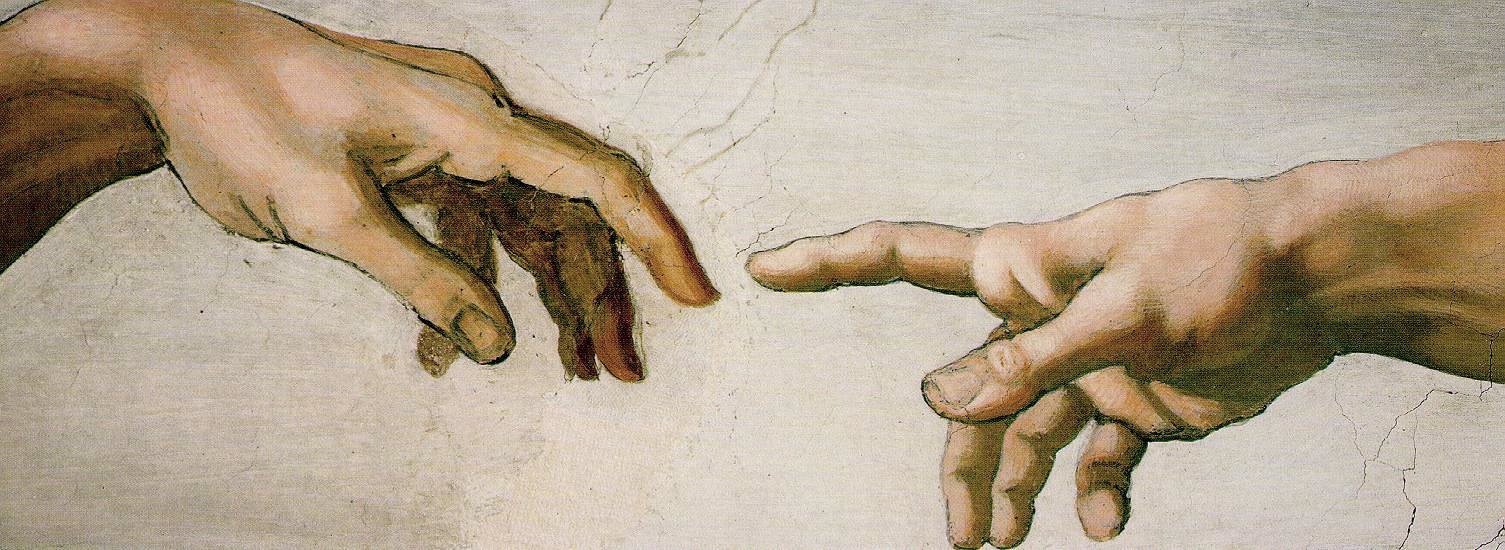
the Hands by Michelangelo

the Hands by Michelangelo

Genesis 1:26-31 (NASB) 26 Then God said, “Let Us make man in Our image, according to Our likeness; and let them rule over the fish of the sea and over the birds of the sky and over the cattle and over all the earth, and over every creeping thing that creeps on the earth.” 27 God created man in His own image, in the image of God He created him; male and female He created them. 28 God blessed them; and God said to them, “Be fruitful and multiply, and fill the earth, and subdue it; and rule over the fish of the sea and over the birds of the sky and over every living thing that moves on the earth.” 29 Then God said, “Behold, I have given you every plant yielding seed that is on the surface of all the earth, and every tree which has fruit yielding seed; it shall be food for you; 30 and to every beast of the earth and to every bird of the sky and to every thing that moves on the earth which has life, I have given every green plant for food”; and it was so. 31 God saw all that He had made, and behold, it was very good. And there was evening and there was morning, the sixth day.

Here we have the first instance of delegated authority. Man, having been formed from the very dust of the Earth, was now delegated authority over the Earth. Man is set to “rule over” everything on earth and in the sky above the earth and in the sea. In the next chapter, we get some specifics on that authority and how that played out for mankind.

Genesis 2:15-17 (NASB) 15 Then the Lord God took the man and put him into the garden of Eden to cultivate it and keep it. 16 The Lord God commanded the man, saying, “From any tree of the garden you may eat freely; 17 but from the tree of the knowledge of good and evil you shall not eat, for in the day that you eat from it you will surely die.”

I have always been fascinated with the garden of Eden. Particularly with the way it is introduced and how the Adam gets placed into it after he is created… and then booted out of it later on as a result of the fall of man. But for now, let us look at the authority and responsibility (the two concepts are inextricably linked, by the way) given to Adam. He was placed into the garden of Eden to cultivate it and keep it. Adam was given a task, and the authority to perform the task was delegated to him. How interesting to see that in the very next verse, we have the first instance of something in all of creation being “not good”. Continue on with me

Genesis 2:18-24(NASB) 18 Then the Lord God said, “It is not good for the man to be alone; I will make him a helper suitable for him.” 19 Out of the ground the Lord God formed every beast of the field and every bird of the sky, and brought them to the man to see what he would call them; and whatever the man called a living creature, that was its name. 20 The man gave names to all the cattle, and to the birds of the sky, and to every beast of the field, but for Adam there was not found a helper suitable for him. 21 So the Lord God caused a deep sleep to fall upon the man, and he slept; then He took one of his ribs and closed up the flesh at that place. 22 The Lord God fashioned into a woman the rib which He had taken from the man, and brought her to the man. 23 The man said,

 “This is now bone of my bones,
And flesh of my flesh;
She shall be called Woman,
Because she was taken out of Man.”

24 For this reason a man shall leave his father and his mother, and be joined to his wife; and they shall become one flesh.

It was not good for the man to be alone. He needed a helper. However, nothing that was formed from the ground was a suitable helper for Adam (sorry, guys… the notion of “man’s best friend” being a dog…simply isn’t biblical 😉 ).  All joking aside, there are some key points I believe being made here.

The first one being that man was already created, and delegated authority and rule over all created things AND he’s been put to work while he was still alone. In his solitude, God saw that it was not good for him to be alone, so He decided man needed a helper. God had a plan the entire time, so the trotting out of all of the created beings before Adam was NOT an exercise of trial-and-error for God. It was for Adam’s benefit that God wanted to demonstrate to him that none of the other created beings were worthy of serving as helper to man. Why is that? Because man was of a different kind from the rest of creation, and man was to be set as ruler over all created beings in the sea, on the earth, and in the sky. For man to fulfill his charge, and execute his authority in ruling over the earth and filling the earth, he needed a helper of his own kind. Therefore, The Lord God fashioned into a woman the rib which He had taken from the man, and brought her to the man. Adam recognized the significance of what the Lord God had done here, which is why God saw fit that we maintain the quote from Adam. Now Adam was no longer alone, and in being joined with his wife, they shall become one flesh, and now they were given the ability to be fruitful and multiply and fill the earth, after their own kind (mankind).

The second point I’d like to make, is that there is no realignment of authority once the woman is created. Adam was already placed in charge, and given the task and its singular parameter (not to eat of the fruit of the tree of knowledge of good an evil, v17) to obey. The authority and responsibility to keep the law was placed upon Adam, before woman was created. Once Adam was given his helper, his wife, the order is not re-given to them. Adam is responsible and it will be Adam who will ultimately be held responsible. That is the nature of authority. So, mankind was created equal, male and female both equal because no other alternative was suitable for Adam. However, within that equality, there is still authority. Woman was created as a helper for man, enabling him to fulfill God’s commandment to man. Woman is equal to man, having been pulled out of his rib and formed to be joined with him. But it is Adam that was given authority.

Even was tempted by the serpent (Gen 3), and was apparently not properly instructed (v3) in the commandment of the Lord God, given to Adam (which was Adam’s responsibility) and she ate the fruit. She then handed it to Adam, and he joined her in her sin. So now what? Who’s in charge now? Remember that we serve an all-powerful, all-knowing, and ever-present God. So God knows exactly what happened, and who was at fault for each act. So, again, the investigation that takes place after the sin is not for God’s sake, but ours. God questions the Adam first, because it was to Adam that He gave the instruction, authority, and responsibility. Having failed to do what is right in the sight of God, Adam sought to escape judgement by assigning blame, interestingly he goes about it cleverly (though foolishly) in trying to get the Lord God to accept blame for having given the woman to Adam. Following the example set before her, she blames the serpent. Notice, none of them lied about what happened, but they both tried to avoid blame. This doesn’t go their way, and we have judgement issued from the bottom up, first the serpent, then the woman, and finally Adam.

Genesis 3:14-15 (NASB) 14 The Lord God said to the serpent,
“Because you have done this,
Cursed are you more than all cattle,
And more than every beast of the field;
On your belly you will go,
And dust you will eat All the days of your life;
15 And I will put enmity Between you and the woman,
And between your seed and her seed;
He shall bruise you on the head,
And you shall bruise him on the heel.”

The Lord God has a plan. God was not caught off-guard, nor was He caught unaware. He knows everything, and here, we see the Lord God declaring that the seed of woman would bruise (or crush) satan’s head, though satan will bruise him on the heel. Why her seed? because it has to be a human, but cannot come from Adam’s seed because it is now dead to sin. This is why the virgin birth is absolutely essential to the Gospel. The broken authority of mankind rests in man, not woman. It was by Adam’s sin that all of mankind fell into darkness, why we are born dead in sin (Romans 5:12-14) in need of a Savior,  Jesus Christ.

Genesis 3:16-18 (NASB) 16 To the woman He said,
“I will greatly multiply Your pain in childbirth,
In pain you will bring forth children;
Yet your desire will be for your husband, And he will rule over you.”

I do not wish to spend a great deal of time on this point, but here we have God’s judgment on woman for her sin. My wife and I are strong believers in natural childbirth, and we believe that God has a plan for every aspect of our lives, including childbirth. Throughout the scriptures, God uses birth pains as an illustration of what is taking place on Earth. We’ve been blessed with 2 beautiful children by natural means. God is good, and He provides,  Hallelujah! Notice the last portion… God is reiterating the roles of authority. Adam and Eve are still equal and when they are joined they are one flesh. But it is the husband who has authority over her. This is important to understanding much of the Gospel of Jesus Christ and the fullness of what He came to redeem, and for what He said He will return.

Genesis 3:17-19 (NASB) 17 Then to Adam He said, “Because you have listened to the voice of your wife, and have eaten from the tree about which I commanded you, saying, ‘You shall not eat from it’;
Cursed is the ground because of you;
In toil you will eat of it
All the days of your life.
18 “Both thorns and thistles it shall grow for you;
And you will eat the plants of the field;
19 By the sweat of your face
You will eat bread,
Till you return to the ground,
Because from it you were taken;
For you are dust,
And to dust you shall return.”

As Paul wrote in Romans 5, and really as the entirety of the Scriptures points out, the state of man is now complete separation from God. But our God is merciful and continually works to redeem His people and to gather all nations unto Him. But you see here that the very ground was cursed by Adam’s sin. What was Adam’s task in the Garden? To cultivate the garden and keep it. Now that very task is marred.  This leads to another issue, that when you are given authority and responsibility over something, you are held accountable for it… and your failures/successes don’t just affect you, but to that over which you are responsible.

God will redeem His creation, but He cannot do it through Adam’s seed, it must be through the seed of the woman, where the Word of God will be made flesh, so that He can redeem His people.  Jesus came to fulfill the Law and the Prophets. Jesus, having lived, died on the cross, and resurrected…has secured all authority in Heaven and Earth. Having paid the ultimate penalty for the sin of mankind, bearing within Himself the death that was required by Adam’s sin, He now is the authority over Heaven and Earth, at the Right Hand of God the Father. Jesus has perfected the relationship between man and Creator and through Him is made the only Way to God.

A common error in modern-day Christianity is to forget that Jesus is still fully man in addition to being fully God. He didn’t lose his perfected body when ascended into Heaven, He still has his perfected body… and He will return for His bride, the Church. I make this point to set up the next: Paul makes it very clear that Jesus Christ maintains absolute authority over the His people. The declaration takes various forms in the New Testament, so let’s look at some of them:

Colossians 1:18 (NASB) 18 [Jesus Christ] is also head of the body, the church; and He is the beginning, the firstborn from the dead, so that He Himself will come to have first place in everything.

1 Corinthians 11:3 (NASB) 3 But I want you to understand that Christ is the head of every man, and the man is the head of a woman, and God is the head of Christ.

Hebrews 4:14-16 (NASB) 14 Therefore, since we have a great high priest who has passed through the heavens, Jesus the Son of God, let us hold fast our confession. 15 For we do not have a high priest who cannot sympathize with our weaknesses, but One who has been tempted in all things as we are, yet without sin. 16 Therefore let us draw near with confidence to the throne of grace, so that we may receive mercy and find grace to help in time of need.

Revelation 19:11-16 (NASB) 11 And I saw heaven opened, and behold, a white horse, and He who sat on it is called Faithful and True, and in righteousness He judges and wages war. 12 His eyes are a flame of fire, and on His head are many diadems; and He has a name written on Him which no one knows except Himself. 13 He is clothed with a robe dipped in blood, and His name is called The Word of God. 14 And the armies which are in heaven, clothed in fine linen, white and clean, were following Him on white horses. 15 From His mouth comes a sharp sword, so that with it He may strike down the nations, and He will rule them with a rod of iron; and He treads the wine-press of the fierce wrath of God, the Almighty. 16 And on His robe and on His thigh He has a name written, “KING OF KINGS, AND LORD OF LORDS.”

I urge you, not to get caught so up modern feminism or misogyny that you miss out on the great picture of Jesus Christ, and the profound depth of God’s love and perfect planning in making for us a way of escape from our own sin. Jesus now fulfills every role of authority that man has messed up: man (second Adam), husband (to His bride, the church), judge, priest, and King. All authority. The Gospel of Jesus Christ is about so much more than just granting you a “get out of hell free” card… It’s about the Greatness of our Lord God. Praise be to God and His son, Jesus.

In Him,
FS

The Righteousness of Biblical Submission

Christ in Gethsemane by Heinrich Hofmann

Christ in Gethsemane by Heinrich Hofmann

We live in a society that absolutely rejects the notion of submission. For most Americans, submission is a sign of weakness, inferiority, and failure. What’s worse, there is a disturbing upward trend in deviant fetishism that seeks to add a very sick and twisted meaning to submission, due in large part to a recent publication of filth I don’t care to mention. To put it bluntly, submission is a dirty word in our society. There is a very good reason the enemy works so diligently to pervert, distort, and redefine “submission” and what it means to submit. As we will see in the Scriptures, the reason is that submission to God and the authority of His Word is our only hope for salvation. While that may seem like a “given”, I urge you to bear with me and see if we might dig a bit deeper into what it means to submit to God and His Word.

In the first chapter of the Gospel of John, we have the following introduction of Jesus Christ:

John 1:1-5 (NASB) The Deity of Jesus Christ
1 In the beginning was the Word, and the Word was with God, and the Word was God. 2 He was in the beginning with God. 3 All things came into being through Him, and apart from Him nothing came into being that has come into being. 4 In Him was life, and the life was the Light of men. 5 The Light shines in the darkness, and the darkness did not comprehend it.

John 1:14-18 (NASB) The Word Made Flesh
14 And the Word became flesh, and dwelt among us, and we saw His glory, glory as of the only begotten from the Father, full of grace and truth. 15 John *testified about Him and cried out, saying, “This was He of whom I said, ‘He who comes after me has a higher rank than I, for He existed before me.’” 16 For of His fullness we have all received, and grace upon grace. 17 For the Law was given through Moses; grace and truth were realized through Jesus Christ. 18 No one has seen God at any time; the only begotten God who is in the bosom of the Father, He has explained Him.

I like to start in the book of John, because I find that his intro does a wonderful job of introducing the Christ in such a manner that unifies the whole Bible. Right off the bat it is clear that in order to fully understand what it means to know Jesus involves studying all of God’s Word from Genesis through Revelation. If you’ll remember the wording of the prophecy in Isaiah 9:6 regarding the Messiah, “For a child will be born to us, a son will be given to us”, you see here that John was pointing out that while His flesh was born that day, Jesus was given to us… ,”And the Word became flesh”.

Now, as Christians, we are to take Jesus as our example. What did Jesus have to say about the Law and the Prophets?

Matthew 5:17-19 (NASB)
17 “Do not think that I came to abolish the Law or the Prophets; I did not come to abolish but to fulfill. 18 For truly I say to you, until heaven and earth pass away, not the smallest letter or stroke shall pass from the Law until all is accomplished. 19 Whoever then annuls one of the least of these commandments, and teaches others to do the same, shall be called least in the kingdom of heaven; but whoever keeps and teaches them, he shall be called great in the kingdom of heaven.

Jesus had every right, being God, to simply speak truth from His own authority. Why did He choose to return to scriptures time and time again? A common quick-answer given today is simply that He did so to demonstrate to us how we might live our lives. While there is truth in that, I believe that answer to be incomplete, and it leaves too much room for the enemy to inject into our minds doubts and false doctrines regarding the person of Jesus and the role of  biblical submission to Divine Authority. Jesus wasn’t just demonstrating submission to the scriptures and to God the Father, He submitted to the Father’s Will.  When He fasted for 40 days (Matt 4), He submitted to the Spirit, was led into the wilderness to be tempted, and He was hungry. Not an act just for demonstration’s sake, it was real. He resisted the temptation of the devil by referring to the Scriptures. That alone would make the point I’m trying to make, but look at His response to the second temptation.

Matthew 4:7 Jesus said to him, “On the other hand, it is written, ‘You shall not put the Lord your God to the test.’”

Jesus isn’t directing the quote at Satan, He presents the quote as a standard by which He must resist the temptation to put the Lord God to the test. Jesus is saying that He will not do what Satan suggested He do, because Scriptures clearly stay that we are not to test the Lord our God. Submission. Likewise in the response to the third and final temptation, Jesus isn’t commanding Satan ‘You shall worship the Lord your God, and serve Him only.’ He is saying that He is to worship the Lord God and serve Him only; therefore, He will resist the final temptation. Submission. Satan had to flee… and after he had run away, the angels came to minister to Jesus. I think that it is from this example that James writes

James 4:7-10 (NASB)
7 Submit therefore to God. Resist the devil and he will flee from you. 8 Draw near to God and He will draw near to you. Cleanse your hands, you sinners; and purify your hearts, you double-minded. 9 Be miserable and mourn and weep; let your laughter be turned into mourning and your joy to gloom. 10 Humble yourselves in the presence of the Lord, and He will exalt you.

I look forward to returning to James 4 at a later date, but for now, I just wanted to point out that the Apostles understood submission because they saw it in the life of Jesus. In your own private reading time, examine for yourselves all of the times Jesus deferred to His Father in Heaven. In the book of John, He made it very clear to the Pharisees that He was the Son of God, and that He was sent by Him, and that His authority over sin, sickness, even the Sabbath was from God; however, He also deferred to God’s Will and Authority. Let’s go to another truly desperate and painful times when Jesus submitted to God the Father

Mark 14:36 (NASB) (Luke 22:39-46; Matthew 26:36-46; Mark 14:32-42)
36 And He was saying, “Abba! Father! All things are possible for You; remove this cup from Me; yet not what I will, but what You will.”

Luke 23:34 (NASB) (On the Cross)
34 But Jesus was saying, “Father, forgive them; for they do not know what they are doing.” And they cast lots, dividing up His garments among themselves.

Luke 23:46 (NASB) 46 And Jesus, crying out with a loud voice, said, “Father, into Your hands I commit My spirit.” Having said this, He breathed His last.

Amen. Yes, Jesus demonstrated complete and total submission to God the Father… by being fully and completely submitted to God the Father. It is this point, this point exactly, that lead me to share this message today. If Jesus, being the Son of God, the Word of God, equal to God was righteous in His submission to God and the Word of God… where is it that we get this false notion that submission denotes inferiority? We submit to God not only because He is superior to us (because we are, in-fact, inferior to God) but because it is Right that we do so. If submission were based solely on inferiority of being then Jesus could not have submitted to God the Father, for He is in no way an inferior being. He submitted to the Authority of God the Father, because that is the design of God’s creation.

Pray about this, and settle it in your spirits. Biblical submission is righteousness in the sight of God. Submit therefore to God. There is much more to discuss concerning the righteousness of biblical submission. Know that the basis for subsequent discussion has been presented here, in that we must first submit to God, His Word, His Son, His Spirit, and His Will. We will take a prayerful look at what the scriptures have to say about submission, particularly in how we are to live our lives as Christians in society, family, and within the Church.

Until next time, May the Lord bless and keep you in His Will,

In Him,
FS

Related articles

I can do all things…

Praise the Lord for His traveling mercies this past Thanksgiving weekend. I will have to learn to make time to update this blog while I’m on vacation, but all in due time.

Today, I’d like to share some quick thoughts on an often quoted verse, Philippians 4:13 “I can do all things through Him who strengthens me” (NASB). Whenever I see or hear a verse of scripture presented or quoted in an encouragement, rebuke, or as basis for an opinion I become excited that someone is turning to God’s Word for Truth. If it is a verse I have not memorized or am unfamiliar with, I search the word for it, to see what else I have missed, and to be sure that the quoted verse is indeed a verse (“cleanliness is next to Godliness” isn’t in the Scriptures).

That is not to say that there aren’t some strong warning signs that flash. A surefire way to furrow my brow is to present a quoted scripture in written form without its reference. In the Internet age, there simply is no excuse to not include at least the reference for the scripture. None. Google allows you to start typing out the quote and usually within the first few results it becomes clear if the phrase is an idiom or a Scripture verse, and normally you can see the reference of the verse without following a single link. Additionally, if the quoted text is a single phrase or partial sentence, I hesitate. Why? Because I worry about the verse being used out of context. If the context is solid, and the audience is well versed, then a simple line or a partial quote is more than enough to bring the passage of scripture into the remembrance of audience and everyone walks away blessed. However, in a mixed audience, there can be room for error.

Now, getting back to Phil 4:13, it is a commonly quoted verse of scripture that has provided me with comfort and encouragement over the years. Even now, in my present-day struggles, I lean on this verse. Let us look at the verse in context:

Philippians 4:4-14 (NASB)
Rejoice in the Lord always; again I will say, rejoice! Let your gentle spirit be known to all men. The Lord is near. Be anxious for nothing, but in everything by prayer and supplication with thanksgiving let your requests be made known to God. And the peace of God, which surpasses all comprehension, will guard your hearts and your minds in Christ Jesus. Finally, brethren, whatever is true, whatever is honorable, whatever is right, whatever is pure, whatever is lovely, whatever is of good repute, if there is any excellence and if anything worthy of praise, dwell on these things. The things you have learned and received and heard and seen in me, practice these things, and the God of peace will be with you.
10 But I rejoiced in the Lord greatly, that now at last you have revived your concern for me; indeed, you were concerned before, but you lacked opportunity. 11 Not that I speak from want, for I have learned to be content in whatever circumstances I am. 12 I know how to get along with humble means, and I also know how to live in prosperity; in any and every circumstance I have learned the secret of being filled and going hungry, both of having abundance and suffering need.13 I can do all things through Him who strengthens me. 14 Nevertheless, you have done well to share with me in my affliction.

Paul is saying a lot in this chapter. We are commanded to Rejoice in the Lord always. We are given guidelines for what we should be focused on and meditated on.  I probably provided more than was needed, but I really wanted to show the slight topic shift. After presenting the commandment for us to rejoice in the Lord, Paul now moves to his rejoicing in being remembered in his affliction. Verse 11 is when it really gets heavy… Paul has already learned how to accept God’s provision regardless of circumstance. Here he simply explained that he has learned to get along “with humble means” or “poverty” and how to live in prosperity. The secret of being filled and going hungry… in abundance and in suffering need. That secret is in knowing that I can do all things through Him who strengthens me. What a blessing to be given such profound wisdom and encouragement!

Unfortunately, this verse is often misquoted. A key phrase within the verse is “through Him”. I’ve heard this verse used in a way that conveys more of a “I can do all things because Christ strengthens me to do everything”. Do you see what is missing? There is a limitation to the “all things” that can be done… they must be done “through Him” or “in Him”. We cannot simply go through life being our own bosses and expect Jesus to serve as our hired muscle. That isn’t how the scriptures read and it is not the example Paul led for us. Even Jesus deferred to the Will of God the Father, and Jesus is God. But He demonstrated how we are to live our lives in Him and through Him. More subtly, the verse is sometimes used (or received) as a pep talk implying that Jesus will fix our circumstances. Such an interpretation generally stems from ignorance of the verses immediately preceding v13.

So, what sorts of circumstances can we count on the strength of God to provide for us as we remain in Him? Lets look at a quick list Paul provided in his rebuke to the Corinthians regarding boasting. The greater context of chapter 11 is in regards to boasting and in the defense of his apostleship, but we are looking specifically for a list of the types of circumstances Paul had to endure in Christ:

2 Corinthians 11:23-33 (NASB)
23 Are they servants of Christ?—I speak as if insane—I more so; in far more labors, in far more imprisonments, beaten times without number, often in danger of death. 24 Five times I received from the Jews thirty-nine lashes. 25 Three times I was beaten with rods, once I was stoned, three times I was shipwrecked, a night and a day I have spent in the deep. 26 I have been on frequent journeys, in dangers from rivers, dangers from robbers, dangers from my countrymen, dangers from the Gentiles, dangers in the city, dangers in the wilderness, dangers on the sea, dangers among false brethren; 27 I have been in labor and hardship, through many sleepless nights, in hunger and thirst, often without food, in cold and exposure. 28 Apart from suchexternal things, there is the daily pressure on me of concern for all the churches. 29 Who is weak without my being weak? Who is led into sin without my intense concern?
30 If I have to boast, I will boast of what pertains to my weakness. 31 The God and Father of the Lord Jesus, He who is blessed forever, knows that I am not lying. 32 In Damascus the ethnarch under Aretas the king was guarding the city of the Damascenes in order to seize me, 33 and I was let down in a basket through a window in the wall, and so escaped his hands.

Wow. My circumstances are quite comfortable by comparison. Yet, the Grace of God and of His provision is as accessible to me as it was to Paul. My appreciation and maturity pales in comparison, and I submit that it is greatly due to my comparative lack of trials. I Praise God that He has blessed me and kept me from such harm thus far. This isn’t shared that we might compare ourselves to Paul; rather, it was to highlight just how awesome our God is, and what He can do with an obedient servant.

So, whenever we think wrestle with trials and struggles, anxiety and doubt… we should return to Philippians 4. Rejoicing in the Lord always, getting our minds right (“think on these things…”) and then trusting on God to strengthen us regardless of our circumstances. I pray you find this encouraging. The next time you hear/see Phil4:13 taken out of context, I pray you will share the rest of the chapter in love and humility.

In Him,
FS