
Eschatology: No Secret Rapture

sunriseIt has taken me quite a while to return to this subject. Toward the end of our previous discussion of Eschatology, I confessed that I saw no basis for any pre-Tribulation or even mid-Tribulation rapture of the Saints. I grew up in the “Left Behind” generation. I spent several years of my childhood fearful that Christ might have secretly raptured all of my friends and family, leaving me behind because of some unrepentant sin, or that I accidentally might have committed the unpardonable sin. Rough times for me, but eventually I learned to just ignore those fears. But why did I have those fears in the first place? Because I was taught that there would be some pre-tribulation rapture and that teaching was reinforced by the “Left Behind” movie. But is this concept taught in Scripture? Sure people pull together a lot of proof texts, but is the concept plainly taught in Scripture? In our last blog, we took a look at what Jesus had to say when His disciples asked Him about the end times. In that discourse, He made no mention of any rapture; rather, He made it clear that , “he who endures to the end would be saved”. He also says plainly that His return would happen “immediately after the tribulation” (Matt 24:31).  No one leaves early except those who die in Christ.

I believe there are a couple of definition problems at play in various eschatologies with regard to proof-texting efforts. The first is “tribulation”. To make the case for pre/mid-tribulation rapture, often times the definition of “tribulation” becomes carelessly intertwined with the definition of “judgement” or the “Wrath of God”. The Judgement of Jesus Christ comes after the tribulation. We who are in Christ will not be recipients of His judgement, for Christ has already paid the price for our sin. Those who remain will be those who have rejected the Gospel of Jesus Christ and persecuted the church. Another problem is the definition of “rapture”. It is not a Biblical term, it is one we have invented after the canon was closed, but most point to 1 Thessalonians 4:13-18 for its definition. Let’s look at that chapter of the Bible.

1 Thessalonians 4:13-18 (ESV) 13 But we do not want you to be uninformed, brothers, about those who are asleep, that you may not grieve as others do who have no hope. 14 For since we believe that Jesus died and rose again, even so, through Jesus, God will bring with him those who have fallen asleep. 15 For this we declare to you by a word from the Lord, that we who are alive, who are left until the coming of the Lord, will not precede those who have fallen asleep. 16 For the Lord himself will descend from heaven with a cry of command, with the voice of an archangel, and with the sound of the trumpet of God. And the dead in Christ will rise first. 17 Then we who are alive, who are left, will be caught up together with them in the clouds to meet the Lord in the air, and so we will always be with the Lord. 18 Therefore encourage one another with these words.

Praise the Lord. So this event, the resurrection of the dead in Christ and then those of us who remain until the coming of the Lord will be caught up together with our Lord in the air. This will happen once. Paul doesn’t leave room for this happening in stages. His encouragement to the Thessalonians continues in the next chapter (remember, Paul didn’t write in chapters and verses… he just wrote a letter)

1 Thessalonians 5:1-11 (ESV) 1 Now concerning the times and the seasons, brothers, you have no need to have anything written to you. 2 For you yourselves are fully aware that the day of the Lord will come like a thief in the night. 3 While people are saying, “There is peace and security,” then sudden destruction will come upon them as labor pains come upon a pregnant woman, and they will not escape. 4 But you are not in darkness, brothers, for that day to surprise you like a thief. 5 For you are all children of light, children of the day. We are not of the night or of the darkness. 6 So then let us not sleep, as others do, but let us keep awake and be sober. 7 For those who sleep, sleep at night, and those who get drunk, are drunk at night. 8 But since we belong to the day, let us be sober, having put on the breastplate of faith and love, and for a helmet the hope of salvation. 9 For God has not destined us for wrath, but to obtain salvation through our Lord Jesus Christ, 10 who died for us so that whether we are awake or asleep we might live with him. 11 Therefore encourage one another and build one another up, just as you are doing.

It is tempting to stop reading at verse 3 with an Aha, so it will be a secret event! However, in verse 4, Paul makes it clear that we (brothers and sisters in Christ) should not be surprised by the day (though, clearly, we don’t know what day or hour when it will come). Jesus explained the day of the Son of Man in much the same way in Luke.

Luke 17:22-37 (ESV) 22 And he said to the disciples, “The days are coming when you will desire to see one of the days of the Son of Man, and you will not see it. 23 And they will say to you, ‘Look, there!’ or ‘Look, here!’ Do not go out or follow them. 24 For as the lightning flashes and lights up the sky from one side to the other, so will the Son of Man be in his day. 25 But first he must suffer many things and be rejected by this generation. 26 Just as it was in the days of Noah, so will it be in the days of the Son of Man. 27 They were eating and drinking and marrying and being given in marriage, until the day when Noah entered the ark, and the flood came and destroyed them all. 28 Likewise, just as it was in the days of Lot—they were eating and drinking, buying and selling, planting and building, 29 but on the day when Lot went out from Sodom, fire and sulfur rained from heaven and destroyed them all— 30 so will it be on the day when the Son of Man is revealed. 31 On that day, let the one who is on the housetop, with his goods in the house, not come down to take them away, and likewise let the one who is in the field not turn back. 32 Remember Lot’s wife. 33 Whoever seeks to preserve his life will lose it, but whoever loses his life will keep it. 34 I tell you, in that night there will be two in one bed. One will be taken and the other left. 35 There will be two women grinding together. One will be taken and the other left.” 37 And they said to him, “Where, Lord?” He said to them, “Where the corpse is, there the vultures will gather.”

Again, the flood was not a surprise to Noah, who likely spent 60-70 years building the ark. Similarly, the Angels of the Lord made it clear to Abram and Lot that God was going to bring judgment upon Sodom and Gomorrah and that they must leave. It was only to the wicked, the lost, those living in darkness that the judgment of God came as a surprise. Another thing I’d like to point out here is that in verse 24, Jesus makes it clear that though the world will be caught completely unaware, it will not be a secret event. He warns his disciples not to be deceived, that His coming will be as unmistakable as lightning flashes and lights up the sky. It will be obvious to everyone, on the day when the Son of Man is revealed.

Let’s take a look at how Paul instructed and encouraged the Corinthians regarding the return of Christ.

1 Corinthians 15:42-58 (ESV) 42 So is it with the resurrection of the dead. What is sown is perishable; what is raised is imperishable. 43 It is sown in dishonor; it is raised in glory. It is sown in weakness; it is raised in power. 44 It is sown a natural body; it is raised a spiritual body. If there is a natural body, there is also a spiritual body. 45 Thus it is written, “The first man Adam became a living being”; the last Adam became a life-giving spirit. 46 But it is not the spiritual that is first but the natural, and then the spiritual. 47 The first man was from the earth, a man of dust; the second man is from heaven. 48 As was the man of dust, so also are those who are of the dust, and as is the man of heaven, so also are those who are of heaven. 49 Just as we have borne the image of the man of dust, we shall also bear the image of the man of heaven. 50 I tell you this, brothers: flesh and blood cannot inherit the kingdom of God, nor does the perishable inherit the imperishable. 51 Behold! I tell you a mystery. We shall not all sleep, but we shall all be changed, 52 in a moment, in the twinkling of an eye, at the last trumpet. For the trumpet will sound, and the dead will be raised imperishable, and we shall be changed. 53 For this perishable body must put on the imperishable, and this mortal body must put on immortality. 54 When the perishable puts on the imperishable, and the mortal puts on immortality, then shall come to pass the saying that is written:

“Death is swallowed up in victory.”
55 “O death, where is your victory?
O death, where is your sting?”

56 The sting of death is sin, and the power of sin is the law. 57 But thanks be to God, who gives us the victory through our Lord Jesus Christ. 58 Therefore, my beloved brothers, be steadfast, immovable, always abounding in the work of the Lord, knowing that in the Lord your labor is not in vain.

So here, Paul is instructing the Church of Corinth on the Resurrection. I recommend reading the whole chapter to see how he’s building up the concept of resurrection, culminating in an explanation of what we can expect when Jesus returns. Those who have not “fallen asleep” (euphemism for death used often in Scripture) will still have to be changed on the Day of Christ’s return. That change will happen in a “twinkling of an eye, at the last trumpet”.  When the trumpet of God sounds… all will hear it.

Whenever Paul points toward our goal, our end-state, he points to the Return of Jesus Christ and to the Resurrection. In the Book of Revelation, there are 2 resurrections mentioned.

Revelation 20:1-6 (ESV) | The Thousand Years
1 Then I saw an angel coming down from heaven, holding in his hand the key to the bottomless pit[a] and a great chain. 2 And he seized the dragon, that ancient serpent, who is the devil and Satan, and bound him for a thousand years, 3 and threw him into the pit, and shut it and sealed it over him, so that he might not deceive the nations any longer, until the thousand years were ended. After that he must be released for a little while.

4 Then I saw thrones, and seated on them were those to whom the authority to judge was committed. Also I saw the souls of those who had been beheaded for the testimony of Jesus and for the word of God, and those who had not worshiped the beast or its image and had not received its mark on their foreheads or their hands. They came to life and reigned with Christ for a thousand years. 5 The rest of the dead did not come to life until the thousand years were ended. This is the first resurrection. 6 Blessed and holy is the one who shares in the first resurrection! Over such the second death has no power, but they will be priests of God and of Christ, and they will reign with him for a thousand years.

The second resurrection will be for judgement before the White Throne (v11-15). I don’t know how to explain the details provided in v7-11, but notice that there are still saints mentioned, and a deception. Satan will at-last be permanently destroyed and then the final judgement will take place. I encourage each of you to read through the Book of Revelation. Just read it through. There is no “pre tribulation rapture” event described. It is a prophetic book, and as such there is a great deal that simply cannot be understood in advance. We should not add to it, nor take away from it no matter how noble we consider our motives to be.

Revelation 22:18-19 (ESV) 18 I warn everyone who hears the words of the prophecy of this book: if anyone adds to them, God will add to him the plagues described in this book, 19 and if anyone takes away from the words of the book of this prophecy, God will take away his share in the tree of life and in the holy city, which are described in this book.

I am not going to try to explain all of Revelation at this time, but I would like to point out some key phrases that point me away from any notion that simply being a Christian means that I should expect to be secretly spirited away from the Earth before the tribulation. Again, the driving force behind my rejection of pre-tribulation is how Jesus described the tribulation and His return and how Paul described it. If you’ve never read through Revelation in one sitting, please do so, even if only to try to prove me wrong here. Revelation opens up with letters to the churches, and the first prophetic visions described are of the throne room in Heaven and of a scroll with seven seals. As each seal is opened, events are foretold to take place. Notice this declaration between the fifth and sixth seals:

Revelation 6:9-11 (ESV) 9 When he opened the fifth seal, I saw under the altar the souls of those who had been slain for the word of God and for the witness they had borne. 10 They cried out with a loud voice, “O Sovereign Lord, holy and true, how long before you will judge and avenge our blood on those who dwell on the earth?” 11 Then they were each given a white robe and told to rest a little longer, until the number of their fellow servants and their brothers should be complete, who were to be killed as they themselves had been.

Here we have the souls of those who had been slain for the Word of God and for the witness they had borne under the altar. They long for God to judge and avenge their blood. They are told to rest a little longer… until the number of their fellow servants and their brothers should be complete… killed as they had been. There are still saints on the Earth at this time, still being persecuted, and martyred for the Word of God and for bearing witness to the Gospel of Jesus Christ.

Revelation 13:5-10 (ESV) 5 And the beast was given a mouth uttering haughty and blasphemous words, and it was allowed to exercise authority for forty-two months. 6 It opened its mouth to utter blasphemies against God, blaspheming his name and his dwelling, that is, those who dwell in heaven. 7 Also it was allowed to make war on the saints and to conquer them. And authority was given it over every tribe and people and language and nation, 8 and all who dwell on earth will worship it, everyone whose name has not been written before the foundation of the world in the book of life of the Lamb who was slain. 9 If anyone has an ear, let him hear:

10 If anyone is to be taken captive, to captivity he goes;
if anyone is to be slain with the sword, with the sword must he be slain.

Here is a call for the endurance and faith of the saints.

Revelation 14:9-13 (ESV) 9 And another angel, a third, followed them, saying with a loud voice, “If anyone worships the beast and its image and receives a mark on his forehead or on his hand, 10 he also will drink the wine of God’s wrath, poured full strength into the cup of his anger, and he will be tormented with fire and sulfur in the presence of the holy angels and in the presence of the Lamb. 11 And the smoke of their torment goes up forever and ever, and they have no rest, day or night, these worshipers of the beast and its image, and whoever receives the mark of its name.”

12 Here is a call for the endurance of the saints, those who keep the commandments of God and their faith in Jesus. 13 And I heard a voice from heaven saying, “Write this: Blessed are the dead who die in the Lord from now on.” “Blessed indeed,” says the Spirit, “that they may rest from their labors, for their deeds follow them!”

This takes place in the vision that follows after the 7 seals and the 7 trumpets. Even here, in the second half of the book (theologians divide Revelation into two major sections) we see the saints remaining on the Earth while these events take place. In the closing imagery of Revelation, we see God’s judgment against the Babylon, mother of prostitutes and of earth’s abominations (Rev 17:5). Early in His judgment, we see the following command to the saints:

Revelation 18:4 (ESV)4 Then I heard another voice from heaven saying, “Come out of her, my people, lest you take part in her sins, lest you share in her plagues;…

The Book of Revelation closes with a final exhortation:

Revelation 22:6-15 (ESV) | Jesus Is Coming

6 And he said to me, “These words are trustworthy and true. And the Lord, the God of the spirits of the prophets, has sent his angel to show his servants what must soon take place.”

7 “And behold, I am coming soon. Blessed is the one who keeps the words of the prophecy of this book.”

8 I, John, am the one who heard and saw these things. And when I heard and saw them, I fell down to worship at the feet of the angel who showed them to me, 9 but he said to me, “You must not do that! I am a fellow servant with you and your brothers the prophets, and with those who keep the words of this book. Worship God.”

10 And he said to me, “Do not seal up the words of the prophecy of this book, for the time is near. 11 Let the evildoer still do evil, and the filthy still be filthy, and the righteous still do right, and the holy still be holy.

12 “Behold, I am coming soon, bringing my recompense with me, to repay each one for what he has done. 13 I am the Alpha and the Omega, the first and the last, the beginning and the end.”

14 Blessed are those who wash their robes, so that they may have the right to the tree of life and that they may enter the city by the gates. 15 Outside are the dogs and sorcerers and the sexually immoral and murderers and idolaters, and everyone who loves and practices falsehood.

At the end of Revelation, is the Gospel of Jesus Christ, who paid the price for our sins, so that by His blood, we might wash our robes and gain access to the city by the gates. In closing, I wonder why it is that we’ve held on so tightly to a false hope that our faith in Jesus will allow us to escape tribulation or persecution? That certainly didn’t hold true for the Apostles, the Prophets, nor a great many of the early church, nor of the present day church in nations that are currently openly hostile to the Gospel of Jesus Christ (China, Sudan, Egypt, Syria, etc). We are called to bear witness to the Gospel of Jesus Christ… until the end. Until the final Judgement, where Jesus in His Justice and Righteousness will judge the Living and the dead and God’s Wrath will finally be poured out on all who have rejected Christ’s atoning work on the cross. Jesus will also reward us for our deeds, our testimony, and our faithfulness to endure until the end. As Paul and James put it, those of us who have been blessed to share in the persecution and afflictions of Christ.

I’d like to close again, by returning to Jude:

Jude 1:17-25 (ESV) 17 But you must remember, beloved, the predictions of the apostles of our Lord Jesus Christ. 18 They said to you, “In the last time there will be scoffers, following their own ungodly passions.” 19 It is these who cause divisions, worldly people, devoid of the Spirit. 20 But you, beloved, building yourselves up in your most holy faith and praying in the Holy Spirit, 21 keep yourselves in the love of God, waiting for the mercy of our Lord Jesus Christ that leads to eternal life. 22 And have mercy on those who doubt; 23 save others by snatching them out of the fire; to others show mercy with fear, hating even the garment stained by the flesh. 24 Now to him who is able to keep you from stumbling and to present you blameless before the presence of his glory with great joy, 25 to the only God, our Savior, through Jesus Christ our Lord, be glory, majesty, dominion, and authority, before all time and now and forever. Amen.

May the Lord Bless you and keep you, May He grant you peace and strength to endure until the end, firmly rooted and grounded in Christ Jesus.
Jorge
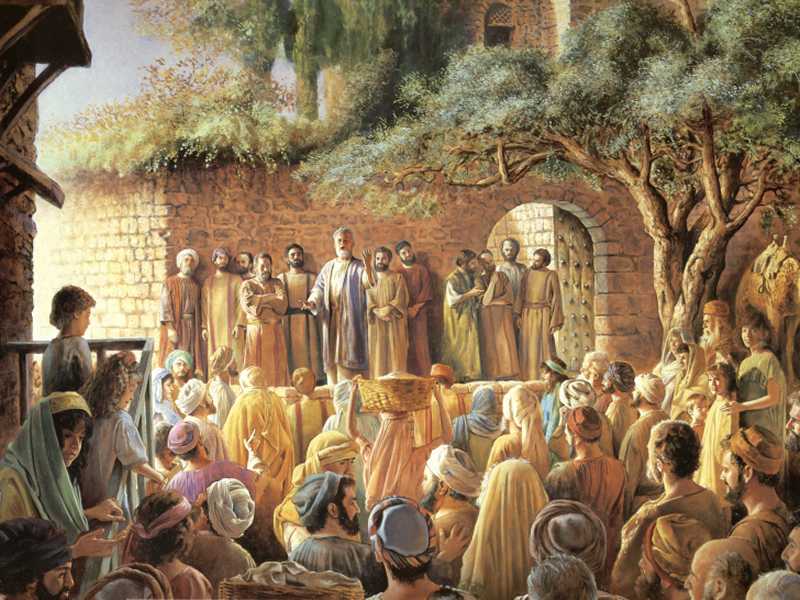
Peter’s first sermon

day-of-pentecost-acts-2-38

I tried to find the original of this image for proper citation, if you know the artist or title of this work please inform me.

I’ve made references to Peter’s first sermon a few times in prior posts, and today I thought it would be awesome to take a look at this first sermon preached by Peter. Our text will be Acts 2. If you’ve been following our bible studies here, you should remember that Acts 2 begins with the promise of God the Holy Spirit being poured out on the day of Pentecost. The Day of Pentecost is not a “new testament” thing, it is in-fact a Jewish celebration of the Feast of Weeks (Leviticus 23:15-22). Pentecost is the Greek word (the fiftieth day) referring to this Hebrew Festival. This festival is particularly important, because it was listed as one of the 3 festivals that all Jewish men were required to appear before the Lord God of Israel (Exodus 34:22-23), which by the time Jesus arrived on the earth, the Lord God had already declared His presence to be made at the Temple in Jerusalem. Therefore, all Jewish men had to make pilgrimage to Jerusalem 3 times a year, one of these times is for the Feast of Weeks, or Pentecost (in Greek). Jews from around the world were in Jerusalem to appear before the Lord God of Israel for Pentecost. It is on this day, that the Promise of God the Holy Spirit as spoken by Jesus Christ, was delivered. The first Gift of God the Holy Spirit manifested is the gift of different tongues/languages so that the men from all over the world would hear the Glory of God proclaimed in their native tongues, not just in Galilean Aramaic. So, Peter’s first sermon was not to Gentiles, it was to Jews. Devout, learned Jews who were observing the Feast of Weeks in keeping with the Law of Moses. These were not strangers to the Law or of the Prophets, they were familiar with the Holy Scriptures. However, in their knowledge, the did not recognize Jesus of Nazareth as the Christ, the Messiah. So, Peter’s first audience was a tough one. Thank God for His Holy Spirit. Now that we’ve set the stage, let us take a look at his sermon:

Acts 2:14-41 (ESV)

14 But Peter, standing with the eleven, lifted up his voice and addressed them: “Men of Judea and all who dwell in Jerusalem, let this be known to you, and give ear to my words. 15 For these people are not drunk, as you suppose, since it is only the third hour of the day. 16 But this is what was uttered through the prophet Joel:

17 “‘And in the last days it shall be, God declares,
that I will pour out my Spirit on all flesh,
and your sons and your daughters shall prophesy,
and your young men shall see visions,
and your old men shall dream dreams;
18 even on my male servants and female servants
in those days I will pour out my Spirit, and they shall prophesy.
19 And I will show wonders in the heavens above
and signs on the earth below,
blood, and fire, and vapor of smoke;
20 the sun shall be turned to darkness
and the moon to blood,
before the day of the Lord comes, the great and magnificent day.
21 And it shall come to pass that everyone who calls upon the name of the Lord shall be saved.’

I just wanted to take a moment to highlight that Peter is quoting from Joel 2:28-32. This prophecy starts in Joel 1:1 and runs throughout the book of Joel. It is all one prophecy. Peter is quoting the portion that rests between the Lord taking pity on His people, and sitting in Judgment over the nations. These are the last days in which we find ourselves, for the Lord had taken pity upon His creation and gave to us the ultimate sacrifice for the remission of sin, the Gospel of Jesus Christ, the Gift of God. We also await the day of His Glorious return, when He will redeem all who have called upon the Name of the Lord and He will sit in Judgment over creation. Why did Peter go to Joel first? Well, clearly the God the Holy Spirit was giving Peter the words to speak in that very hour (as Jesus told the disciples would happen), but notice the entrance into this sermon comes as a response to the accusations against the manifestation of the Gift of the Holy Spirit as mere drunkenness.  The first visit to Scripture is a clear statement of the outpouring of the Holy Spirit as foretold by Joel (who prophesied by the Spirit of God). Peter was also clearly marking the present age, the need for repentance and acceptance of the gift of God and the need to do so before the coming judgement. The book of Joel is not long, and I encourage you to take some time to read through it. However, let us continue for now in Peter’s sermon.

22 “Men of Israel, hear these words: Jesus of Nazareth, a man attested to you by God with mighty works and wonders and signs that God did through him in your midst, as you yourselves know— 23 this Jesus, delivered up according to the definite plan and foreknowledge of God, you crucified and killed by the hands of lawless men. 24 God raised him up, loosing the pangs of death, because it was not possible for him to be held by it. 25 For David says concerning him,

“‘I saw the Lord always before me,
for he is at my right hand that I may not be shaken;
26 therefore my heart was glad, and my tongue rejoiced;
my flesh also will dwell in hope.
27 For you will not abandon my soul to Hades,
or let your Holy One see corruption.
28 You have made known to me the paths of life;
you will make me full of gladness with your presence.’

29 “Brothers, I may say to you with confidence about the patriarch David that he both died and was buried, and his tomb is with us to this day. 30 Being therefore a prophet, and knowing that God had sworn with an oath to him that he would set one of his descendants on his throne, 31 he foresaw and spoke about the resurrection of the Christ, that he was not abandoned to Hades, nor did his flesh see corruption. 32 This Jesus God raised up, and of that we all are witnesses. 33 Being therefore exalted at the right hand of God, and having received from the Father the promise of the Holy Spirit, he has poured out this that you yourselves are seeing and hearing. 34 For David did not ascend into the heavens, but he himself says,

“‘The Lord said to my Lord,
“Sit at my right hand,
35 until I make your enemies your footstool.”’

36 Let all the house of Israel therefore know for certain that God has made him both Lord and Christ, this Jesus whom you crucified.”

37 Now when they heard this they were cut to the heart, and said to Peter and the rest of the apostles, “Brothers, what shall we do?” 38 And Peter said to them, “Repent and be baptized every one of you in the name of Jesus Christ for the forgiveness of your sins, and you will receive the gift of the Holy Spirit. 39 For the promise is for you and for your children and for all who are far off, everyone whom the Lord our God calls to himself.” 40 And with many other words he bore witness and continued to exhort them, saying, “Save yourselves from this crooked generation.” 41 So those who received his word were baptized, and there were added that day about three thousand souls.

Amen. Peter points out that the Jews were guilty of putting Jesus to death, by the hands of lawless men (Romans). Once Peter explained in Scriptures that the Jews were witness to the outpouring of the Holy Spirit, he then moved to identifying Jesus as the Christ. When he quotes from the Psalms of David, he first goes to Psalm 16. I have to be honest, had I read this Psalm without knowing Peter’s interpretation of the Psalm, I wouldn’t have read it as a prophetic Psalm about Jesus. However, Peter makes it clear that since David’s body did see corruption (his body rotted in the grave), it wasn’t about himself that he was speaking; rather, David was referring to the death and resurrection of Jesus Christ. So awesome. The new testament provides us with clear insight into how we should read the old testament to see Jesus (not ourselves, because the bible is not about us).

The next Psalm Peter visits is Psalms 110. Here, however, Peter quotes the introduction to the Psalm. Read the rest of the Psalm, because David is again prophesying of Jesus but he is doing so regarding the Day of Judgement, the Day of Christ’s Return. So, again, we have Peter explaining from scriptures that we find ourselves in the last days, between the salvation of the Lord and His Judgement. Notice, in verse 37, that all who heard these words understood the gravity of what was being taught and their guilt was before them, something they dare not proceed into judgement with, “Brothers, what shall we do?” Peter’s response is great direct and powerful. He also returns to the initial point of the sermon, the outpouring of the Holy Spirit. They don’t have to wait, because they (as are we all) are in the last days when the Spirit of God is poured out.

Peter preaches the Gospel of Jesus Christ from the Scriptures, clearly identifies their sin and need of a Savior (these being folks who follow the Law and the Prophets, not a Godless group of people, but one still perishing nonetheless for they have not yet believed in Jesus as the Christ) and then offers them the Way of escape. He also is quick to relay the promise of God the Holy Spirit. The disciples had just received the very gift that Jesus instructed them to wait for and they knew immediately that this Gift was promised to all who believe and are baptized in the Name of the Lord Jesus Christ.

That same Holy Spirit that gave Peter the words to speak, lives within each of us who call upon the Name of the Lord and have our names written in the Lamb’s book of life. We may not move as powerfully in the Holy Spirit, but I think that is due to a lack of knowledge of the Scriptures, and poor discipleship. Peter walked with the Son of God for years. That’s powerful discipleship. We have a great deal of it, but we don’t have all of what Jesus did (John 21:25), so we don’t have the fullness by which the 12 Apostles were taught. Remember in John 14:26 that the Holy Spirit is promised to both teach and remind them of all that Jesus had said to them. That is critical for us to have the New Testament written, but also as a promise to us that He will remind us of His Word that we have buried in our hearts (Psalms 119:9-16).

Brothers and sisters, please become life-long students of the Word of God. Pray in the Spirit, always, AND edify your mind by drinking in the written Word of God.  If you look around the web, you’ll see that gallop estimates that 40% of Americans attend church daily. However, a Hartford Institute of Religion study indicates that only half of those are telling the truth. But that is only the tip of the iceberg, so to speak. If 20% attend church weekly, how much of each service is actually devoted to studying and exegeting properly the Word of God? If the typical Sunday morning service runs from 10:30am to Noon, with the first 45 minutes of a concert, 10 minutes of announcements, intro videos, skits, collecting of tithe/offerings, that leaves roughly 30 minutes for a sermon. Now, what if the sermon is geared more toward sloganeering of a self-help book, or casting the vision of the pastor rather than teaching the text of the Bible? It can become all to easy to lose sight of the Word of God even while conducting the business of church. I pray your church experience is nothing like what I’ve detailed above. Still, even if that 1.5 hrs of Sunday Morning church were devoted to biblical study, it wouldn’t be enough. That is why I am so eager to share what I am studying throughout the week, and am so excited that you are reading here today. Even if you disagree with everything I write, at least you are reading the Word of God that is copy-and-pasted into these posts and hopefully following the external links to bible references. 😉

In closing, I’d like to echo Paul’s benediction from 2 Thessalonians 3:16 (ESV) “Now may the Lord of peace himself give you peace at all times in every way. The Lord be with you all.”

In Him,
Jorge

The Story Behind The Hymn – I Know Whom I Have Believed

Okay, so as excited as I have been about the series on God the Holy Spirit… I’m delaying part 3 of that post. In listening to a sermon this morning on 2 Timothy 1, the speaker mentioned the Hymn I Know Whom I Have Believed, and the story of its author, Major Daniel Webster Whittle. Not being much of a hymnal guy, it was the first I had heard of Mr Whittle. I chose to look this story up, and with a tear in my eye, I decided this was well worth sharing today.  I pray you find some blessing in this story, too.

The Story Behind The Song – I Know Whom I Have Believed

This beloved hymn written by Major Daniel Webster Whittle, the exact date of his composition is not known, but it was originally published in 1883 in Gospel Hymns No. 4. It is one of about two hundred hymns composed by Major Whittle as he was known. It is one of his most well-known hymns, one other popular hymn that he wrote is “There Shall Be Showers of Blessings” If you look at these two hymns for the authorship you may be a bit confused, you will see the name El Nathan on the left hand side indicating that El Nathan wrote the Lyrics, and you will see James McGranahan on the right hand side, indicating that he wrote the music. El Nathan is a pseudonym – a fictitious name used by a person or sometimes a group, which Daniel Webster Whittle used. He also used the pseudonyms Elias Nathan and W.W.D.

Daniel Webster Whittle was born in Chicopee Falls, Massachusetts on November 22, 1840. He was named after the great American politician Daniel Webster who was greatly admired by Whittle’s father. Little is known of his childhood. His father had heard Daniel Webster, the great statesman, make a stirring speech. Daniel Webster in this speech said “It is my living sentiment, and by the blessing of God it shall be my dying sentiment — independence now and independence forever!”

This would later inspire his parents to name him after Daniel Webster in hopes that he would become a great leader in the fight for freedom as well. His mother is said to have been a godly woman who instilled in him and his three brothers strong Christian principles.

Daniel Whittle worked as a cashier for Wells Fargo bank as a teenager and into his early twenties. He was not a wicked man at first, on the contrary, he was quiet religious. He surrendered his life to the Lord one night while acting as a night watchman at the Wells Fargo Bank. He went into the vault, got down on his knees and gave his surrendered his life for the Heavenly Father to use as he would. He even became the Sunday School Superintendent at the great Tabernacle in Chicago where he would meet his wife, Miss Abbie Hanson. He would join the army in 1861 and be commissioned as a 2nd Lieutenant. In the summer of 1862, August as the Civil War began to intensify his unit was called to go South. August 22, 1862, the night before his departure, he and Abbie were married. It would be a year before they would be reunited. In his own words he tells of his departure, “My dear mother was a devout Christian, and parted from me with many a tear, and followed me with many a prayer. She had placed a New Testament in a pocket of the haversack that she’d arranged for me”

This little New Testament would pay a vital part in his rededication. Whittle rose to the rank of Major and while leading a charge, actually filling in, and he was wounded in his sword arm which led to the amputation of his arm and a stay in a prisoner of war camp. It was while he was in this POW camp that out of boredom he began to search for something to read. He found in his personal effects the little New Testament that his Mother had placed there. He read through the New Testament in a matter of days and started through it again. One night the nurse woke him up and told him that one of his men was dying and had been begging for someone to pray for him. The nurse told Major Whittle that he (the nurse) was a wicked man and could not pray. Major Whittle confessed that he too was wicked man with many sins in his own life and could not pray either. The nurse said that he thought Major Whittle was a Christian because he had observed him constantly reading the Scripture and the Major Whittle did not cuss as the other men. The nurse begged Major Whittle to at least accompany him to see the boy as he did not want to return alone. Moved with compassion, Major Whittle reluctantly agreed. Here, in Major Whittle’s own words, is what took place that night: “I dropped on my knees and held the boy’s hand in mine. In a few broken words I confessed my sins and asked Christ to forgive me. I believed right there that He did forgive me. I then prayed earnestly for the boy. He became quiet and pressed my hand as I prayed and pleaded God’s promises. When I arose from my knees, he was dead. A look of peace had come over his troubled face, and I cannot but believe that God who used him to bring me to the Savior, used me to lead him to trust Christ’s precious blood and find pardon. I hope to meet him in heaven.”

Ten years later at the encouragement of his close friend D.L. Moody he would enter into evangelism. Some of his first songs were set to music by Phillip Bliss. Whittle attended and participated in the memorial service for Phillip Bliss. Later he would work closely with the man who would set to music many of his later songs, and who set the music to this song, “I Know Whom I Have Believed”, James McGranahan. Major Whittle died March 4, 1901 after having written over 200 hymns.

The refrain of the hymn is a direct quotation from the King James Bible in II Timothy 1:12 “…for I know whom I have believed, and am persuaded that he is able to keep that which I have committed unto him against that day.”

The rest of the article is interesting, but I wanted to stop here and reflect a bit about the message of Salvation, the Gospel of Jesus Christ. In closing, let us return to the words of the Apostle Paul in his second letter to Timothy:

2 Timothy 1 (ESV)
1 Paul, an apostle of Christ Jesus by the will of God according to the promise of the life that is in Christ Jesus,
2 To Timothy, my beloved child:
Grace, mercy, and peace from God the Father and Christ Jesus our Lord.

3 I thank God whom I serve, as did my ancestors, with a clear conscience, as I remember you constantly in my prayers night and day. 4 As I remember your tears, I long to see you, that I may be filled with joy. 5 I am reminded of your sincere faith, a faith that dwelt first in your grandmother Lois and your mother Eunice and now, I am sure, dwells in you as well. 6 For this reason I remind you to fan into flame the gift of God, which is in you through the laying on of my hands, 7 for God gave us a spirit not of fear but of power and love and self-control.

8 Therefore do not be ashamed of the testimony about our Lord, nor of me his prisoner, but share in suffering for the gospel by the power of God, 9 who saved us and called us to a holy calling, not because of our works but because of his own purpose and grace, which he gave us in Christ Jesus before the ages began, 10 and which now has been manifested through the appearing of our Savior Christ Jesus, who abolished death and brought life and immortality to light through the gospel, 11 for which I was appointed a preacher and apostle and teacher, 12 which is why I suffer as I do. But I am not ashamed, for I know whom I have believed, and I am convinced that he is able to guard until that Day what has been entrusted to me. 13 Follow the pattern of the sound words that you have heard from me, in the faith and love that are in Christ Jesus. 14 By the Holy Spirit who dwells within us, guard the good deposit entrusted to you.

May the Lord bless and keep you, and may the Holy Spirit who dwells within us grow us into the full knowledge of Him who Saved us,
In Him,
Jorge

Delegation of Authority: The Holy Spirit

dove

…the Holy Spirit descended upon Him in bodily form like a dove…
(Luke Chapter 3)

When we last spoke about how Authority had been delegated to Adam, and that God did not take it back immediately when Adam sinned, I couldn’t leave it alone without pointing out that one of the many awesome truths of the purpose that Jesus came to fulfill was in taking the Authority that man forfeited. We looked at how Jesus had to be born a man, but not from man’s seed (to inherit sin), so the virgin birth was required so that Jesus (the Word Made Flesh) could come and lay down His life:

John 10:11-18 (ESV) 11 I am the good shepherd. The good shepherd lays down his life for the sheep. 12 He who is a hired hand and not a shepherd, who does not own the sheep, sees the wolf coming and leaves the sheep and flees, and the wolf snatches them and scatters them. 13 He flees because he is a hired hand and cares nothing for the sheep. 14 I am the good shepherd. I know my own and my own know me, 15 just as the Father knows me and I know the Father; and I lay down my life for the sheep. 16 And I have other sheep that are not of this fold. I must bring them also, and they will listen to my voice. So there will be one flock, one shepherd. 17 For this reason the Father loves me, because I lay down my life that I may take it up again. 18 No one takes it from me, but I lay it down of my own accord. I have authority to lay it down, and I have authority to take it up again. This charge I have received from my Father.”

Praise the Lord! Notice here, that Jesus clearly states His purpose, His Authority, and that He received it from God the Father. Now, remember that our charge is given to us in the Great Commission, but let’s look at it again in Matthew:

Matthew 28:16-20 (ESV) 16 Now the eleven disciples went to Galilee, to the mountain to which Jesus had directed them. 17 And when they saw him they worshiped him, but some doubted. 18 And Jesus came and said to them, “All authority in heaven and on earth has been given to me. 19 Go therefore and make disciples of all nations, baptizing them in the name of the Father and of the Son and of the Holy Spirit, 20 teaching them to observe all that I have commanded you. And behold, I am with you always, to the end of the age.”

Notice the “therefore”. A cute little saying I heard growing up in Sunday School regarding taking the time to understand the context of scriptures was, What’s the ‘therefore’ there for? Here, it is telling us that our charge to Go and make disciples of all nations… is based in the fact that All authority in heaven and on earth has been given to Jesus… who is then giving us the charge to Go…

Now, let’s talk about the Holy Spirit. In the book of John, we see Jesus making several attempts at preparing the disciples for what was about to take place (crucifixion, resurrection, & ascension). In hindsight, we can see that Jesus was speaking quite plainly. But He knew (and said as much) that they just wouldn’t understand what He was telling them. Let’s take a look at the promise of Jesus to send a Helper:

John 15:18-27 (ESV) 18 “If the world hates you, know that it has hated me before it hated you. 19 If you were of the world, the world would love you as its own; but because you are not of the world, but I chose you out of the world, therefore the world hates you. 20 Remember the word that I said to you: ‘A servant is not greater than his master.’ If they persecuted me, they will also persecute you. If they kept my word, they will also keep yours. 21 But all these things they will do to you on account of my name, because they do not know him who sent me. 22 If I had not come and spoken to them, they would not have been guilty of sin, but now they have no excuse for their sin. 23 Whoever hates me hates my Father also. 24 If I had not done among them the works that no one else did, they would not be guilty of sin, but now they have seen and hated both me and my Father. 25 But the word that is written in their Law must be fulfilled: ‘They hated me without a cause.’ 26 “But when the Helper comes, whom I will send to you from the Father, the Spirit of truth, who proceeds from the Father, He will bear witness about Me. 27 And you also will bear witness, because you have been with me from the beginning.

John 16:1-15(ESV) 1 “I have said all these things to you to keep you from falling away. 2 They will put you out of the synagogues. Indeed, the hour is coming when whoever kills you will think he is offering service to God. 3 And they will do these things because they have not known the Father, nor me. 4 But I have said these things to you, that when their hour comes you may remember that I told them to you. “I did not say these things to you from the beginning, because I was with you. 5 But now I am going to him who sent me, and none of you asks me, ‘Where are you going?’ 6 But because I have said these things to you, sorrow has filled your heart. 7 Nevertheless, I tell you the truth: it is to your advantage that I go away, for if I do not go away, the Helper will not come to you. But if I go, I will send him to you. 8 And when he comes, he will convict the world concerning sin and righteousness and judgment: 9 concerning sin, because they do not believe in me; 10 concerning righteousness, because I go to the Father, and you will see me no longer; 11 concerning judgment, because the ruler of this world is judged. 12 “I still have many things to say to you, but you cannot bear them now. 13 When the Spirit of truth comes, he will guide you into all the truth, for he will not speak on his own authority, but whatever he hears he will speak, and he will declare to you the things that are to come. 14 He will glorify me, for he will take what is mine and declare it to you. 15 All that the Father has is mine; therefore I said that he will take what is mine and declare it to you.

The Holy Spirit is called our Helper, (the Greek word here is Paracletos, one called alongside to help; or Comforter, Advocate, Intercessor) and the Spirit of Truth. But Jesus doesn’t just identify Whom He will send, but for what purpose, to bear witness about Jesus. But here is something very cool (at least, I thought so)… this was already the role of the Holy Spirit. Only before, He took His marching orders from God the Father.

Luke 3:21-22 (ESV) 21 Now when all the people were baptized, and when Jesus also had been baptized and was praying, the heavens were opened, 22 and the Holy Spirit descended on him in bodily form, like a dove; and a voice came from heaven, “You are my beloved Son; with you I am well pleased.”

Praise the Lord. What is different now, is that before Christ, God sent His Spirit to speak the Word of the Lord through Prophets, Priests, and Judges over Israel. The Spirit of God was only available to whom God had called for His purpose. Now Jesus is sending the Holy Spirit to all who hear and place their faith in the Gospel of Jesus Christ, being baptized in the Name of the Father, of the Son, and of the Holy Spirit!

Remember, that God keeps His promises. In Acts 2, the promise of Jesus Christ to send the Holy Spirit takes place on the day of Pentecost. It is a momentous event. Peter’s first sermon is amazing, and I strongly recommend studying it closely. But for this blog, we are going to key in on how the crowd responds to the conclusion of the sermon, and Peter’s response to the question:

Acts 2:36-41 (ESV) 36 Let all the house of Israel therefore know for certain that God has made him both Lord and Christ, this Jesus whom you crucified.” 37 Now when they heard this they were cut to the heart, and said to Peter and the rest of the apostles, “Brothers, what shall we do?” 38 And Peter said to them, “Repent and be baptized every one of you in the name of Jesus Christ for the forgiveness of your sins, and you will receive the gift of the Holy Spirit. 39 For the promise is for you and for your children and for all who are far off, everyone whom the Lord our God calls to himself.” 40 And with many other words he bore witness and continued to exhort them, saying, “Save yourselves from this crooked generation.” 41 So those who received his word were baptized, and there were added that day about three thousand souls.

Praise the Lord! This promise is for us, we who are far off, those of us whom the Lord Our God has called to Himself through His Word! I want to turn quickly to one more passage of scripture before we close this out. Now, remember that role for which Jesus said He was going to send the Holy Spirit. Bearing that in mind, let us look to 1 John 4:

1 John 4:1-6 (ESV) 4 Beloved, do not believe every spirit, but test the spirits to see whether they are from God, for many false prophets have gone out into the world. 2 By this you know the Spirit of God: every spirit that confesses that Jesus Christ has come in the flesh is from God, 3 and every spirit that does not confess Jesus is not from God. This is the spirit of the antichrist, which you heard was coming and now is in the world already. 4 Little children, you are from God and have overcome them, for he who is in you is greater than he who is in the world. 5 They are from the world; therefore they speak from the world, and the world listens to them. 6 We are from God. Whoever knows God listens to us; whoever is not from God does not listen to us. By this we know the Spirit of truth and the spirit of error.

It is not a sign of doubt, unbelief, or insubordination to test the spirits to see whether they are from God. We are told to do so. Don’t let anyone silence you out of fear of being labeled a “critical person” or worse, for having a “spirit of criticism” simply because you aren’t yielding to the move of every spirit. For the role of the Holy Spirit is not to bring glory to Himself… but to Jesus Christ. Do we rely on our emotions? No. Remember that Jesus is the Word made flesh (John 1:14), so knowing the Word of God is critical to identifying rightly the Spirit of Truth from the many spirits of error. I hope to dive into 1 Corinthians 12-14 sometime, but I will say that spiritual discernment is one of the gifts of the Holy Spirit given to the body of believers (the Church), but knowledge of the Word of God is still necessary to properly operate in the Gifts of the Spirit.

I pray you have a wonderful weekend, and that you’ve found some blessing in these bible studies. May the Lord bless you and keep you in His Will,
In Him,
Jorge

An imperfect picture of the Perfect Love of the Father

I’ve been spending a great deal of time reading the Scriptures and praying for understanding of the whole of scriptures in relationship to the Gospel of Jesus Christ. There has been a great deal of growth, and yet I feel like I’m only scratching the surface. I hope you can relate to that feeling. Lately, I’ve been trying carefully to re-evaluate every aspect of my doctrine to make sure that what I believe is in line with the Scriptures. I’ll admit, it’s not fun. We usually like to start with those beliefs we didn’t trust, or that we suspected were unBiblical, but when it comes to challenging our own… *sigh*… it can be rough. My personal growth has been what I would call a Renaissance of the Preeminence of the Gospel of Jesus Christ in all of Scriptures.  I’m learning that a common pitfall in Evangelical circles, is to allow ourselves to somehow graduate from the Gospel and move on toward living a Holy life. The problem is in the false-notion that we can (or should) graduate from the Gospel. There is nothing beyond the Gospel, because the Gospel is everything. Outside of the Gospel, there is no hope of living a Holy life. So, instead of graduating, what happens is we allow our focus to fall from the grace of the Gospel, back under the Law.

Galatians 5:1-6 (ESV)
5 For freedom Christ has set us free; stand firm therefore, and do not submit again to a yoke of slavery.
2 Look: I, Paul, say to you that if you accept circumcision, Christ will be of no advantage to you. 3 I testify again to every man who accepts circumcision that he is obligated to keep the whole law. 4 You are severed from Christ, you who would be justified by the law; you have fallen away from grace. 5 For through the Spirit, by faith, we ourselves eagerly wait for the hope of righteousness. 6 For in Christ Jesus neither circumcision nor uncircumcision counts for anything, but only faith working through love.

The Apostle Paul is not encouraging any sense of Lawlessness. I have no desire to encourage or condone lawlessness. So where’s the balance? I can cite several places where Paul is rebuking those who fall from grace and back into Law… and also where James is rebuking lawlessness. I know (intellectually, theologically, scripturally) the answer is, “in Jesus Christ”.  I’d like to share an object lesson I believe the Holy Spirit gave me over the weekend.

Photo of my beautiful daughter

“Daddy… you mad?”

I am the father of a wonderful 4-year-old son, and a beautiful 2-year-old daughter. Lately, my daughter has been pushing the limits of her authority and testing the patience of her parents. She’s always been strong-willed, and quite the ham, but lately she has become very aware of her desires and quite capable to communicate those desires. She has been testing the waters in matching her will against ours. If you have toddlers now, or can remember when your kids were at this age, you know that this is simply a part of growing up. It isn’t rebellion, but it is a resistance to submission of will. Naturally, it is my duty to rebuke, reprimand, and even admonish such willful acts of disobedience, so I must, though it breaks my heart to do so. My son generally just needs a strong word. He may not understand (or even want to) why he was “in trouble” but he acknowledges he was reprimanded and then we have to build him back up. My daughter… will fight. Over the weekend, she disobeyed direct commands (stop that, don’t play with that, come here, pick that up) to varying degrees of defiance. In a few cases, this lead to punishment, tears, and a few instances of “telling on daddy” to mommy. A funny thing also kept coming up… once all was said and done, she apologized, we hugged, and reaffirmed our love for each other… she’d ask me later, “Daddy… you mad?”. I’d tell her, “no, honey, I’m not mad. It makes Daddy mad when you don’t do what I tell you to do, but I’m not mad now, and I still love you very, very much”. She’d smile at me and continue playing, sometimes hamming it up with an overwhelming tackle of a hug. As we were putting the kids to bed this past Saturday evening, and I started thinking about how I relate to our Heavenly Father.

Luke 11:11-13 (ESV) 11 What father among you, if his son asks for a fish, will instead of a fish give him a serpent; 12 or if he asks for an egg, will give him a scorpion? 13 If you then, who are evil, know how to give good gifts to your children, how much more will the heavenly Father give the Holy Spirit to those who ask him!”

As a father, I am an imperfect picture of the Perfect Love of Our Heavenly Father. Yes, my daughter is learning what it means to please and displease me, her earthly father. But those lessons are being taught and reinforced within the context of my love for her as my daughter. At no time… ever… is there any question that I love my daughter. None. And in my flesh, I am evil. How much more… is a powerful statement. One of the most dangerous lies of the devil, is when he accuses God of malice in His correction/punishment of our disobedience. Do not allow the enemy to twist the consequences of disobedience or the fleshly failings/stumblings that are going to happen, into doubt of your standing with God. Just as my daughter doesn’t stop being my daughter just because I had to correct her wrong doing, we don’t stop being Children of God simply because we failed to be Holy. Our performance was not what saved us in the first place!

Ephesians 2 (ESV)
2 And you were dead in the trespasses and sins 2 in which you once walked, following the course of this world, following the prince of the power of the air, the spirit that is now at work in the sons of disobedience— 3 among whom we all once lived in the passions of our flesh, carrying out the desires of the body and the mind, and were by nature children of wrath, like the rest of mankind. 4 But God, being rich in mercy, because of the great love with which he loved us, 5 even when we were dead in our trespasses, made us alive together with Christ—by grace you have been saved— 6 and raised us up with him and seated us with him in the heavenly places in Christ Jesus, 7 so that in the coming ages he might show the immeasurable riches of his grace in kindness toward us in Christ Jesus. 8 For by grace you have been saved through faith. And this is not your own doing; it is the gift of God, 9 not a result of works, so that no one may boast. 10 For we are his workmanship, created in Christ Jesus for good works, which God prepared beforehand, that we should walk in them. One in Christ 11 Therefore remember that at one time you Gentiles in the flesh, called “the uncircumcision” by what is called the circumcision, which is made in the flesh by hands— 12 remember that you were at that time separated from Christ, alienated from the commonwealth of Israel and strangers to the covenants of promise, having no hope and without God in the world. 13 But now in Christ Jesus you who once were far off have been brought near by the blood of Christ. 14 For he himself is our peace, who has made us both one and has broken down in his flesh the dividing wall of hostility 15 by abolishing the law of commandments expressed in ordinances, that he might create in himself one new man in place of the two, so making peace, 16 and might reconcile us both to God in one body through the cross, thereby killing the hostility. 17 And he came and preached peace to you who were far off and peace to those who were near. 18 For through him we both have access in one Spirit to the Father. 19 So then you are no longer strangers and aliens, but you are fellow citizens with the saints and members of the household of God, 20 built on the foundation of the apostles and prophets, Christ Jesus himself being the cornerstone, 21 in whom the whole structure, being joined together, grows into a holy temple in the Lord. 22 In him you also are being built together into a dwelling place for God by the Spirit.

The Christian life, is a life lived in Christ. We are being built together, joined together, grown into a holy temple in the Lord… but Jesus Christ is the cornerstone. You cannot make (or keep) a wall straight, if you take your eyes off of the cornerstone. When we fall out of alignment (and it will happen while we walk in the flesh), the Holy Spirit will work us back into alignment. Do not mistake the rebuke and correction of the Holy Spirit for malice. There is no room to question God’s love, for Scripture makes it clear that He loved us while we were dead in our sins. We don’t reject the Law and the Prophets, we don’t ignore them one bit, not a single iota, because in doing so we would lose sight of depth and width of that for which Jesus gave Himself as the final sacrifice.

2 Timothy 3:16-17 (ESV) 16 All Scripture is breathed out by God and profitable for teaching, for reproof, for correction, and for training in righteousness, 17 that the man of God may be complete, equipped for every good work.

The problem is not the Law and the Prophets, it’s in allowing your focus to move off of what Christ did for us and onto an obligation to fulfill the whole law ourselves, something we are incapable of doing apart from Christ! How does that pan out?

  • theology that declares that God hates you because you sinned
  • theology that limits the forgiveness paid by Christ to only those sins you committed before you were “saved” (leaving you to seek penance through the Law to make up for sins committed after you “received Christ”)
  • theology that declares you “owe it to God” to fulfill the Law
  • theology that tells you that you need to prove to God how much you love Him by performing works of the Law

So, in closing, we should expect to get corrected, rebuked, and punished for wrong doing… as Children of God in Christ Jesus, for the maturing of the Church. We will mess up and He will correct us. But we remain, forever, His children. Bless the Lord for His Love, His Kindness, His Mercy, and His Grace. Amen.

May the Lord bless you and keep you,
In Him,
Jorge