Video | “Cheap Grace for the Peorple” by Worldview Everlasting

WorldviewEverlastingCropw245I had intended to write something light and short today, but after watching today’s episode of Worldview Everlasting, I decided to share it. This is a short video (18 min) by Worldview Everlasting, a YouTube Channel hosted by Lutheran Reverend Jonathan Fisk. In this video he tackles the poor label of “cheap Grace” used to disparage those who insist on preaching the Law with the Gospel even to Believers (as opposed to preaching only Law to those who “are already saved” so that they can be better Christians by striving to following the Law).

Rev. Fisk also does a great job of describing at a World View is and wonderfully lays out the Atheistic worldview.

[youtube http://youtu.be/fHs28nnpXxI]

If you have any questions or comments for us regarding this video, please feel free to comment or contact us directly. Remember there is still that rather long video from last week (Church of Tares) that is well worth watching if discernment in these last days is a concern of yours.

Jude 1:24-25 (ESV) Now to him who is able to keep you from stumbling and to present you blameless before the presence of his glory with great joy, to the only God, our Savior, through Jesus Christ our Lord, be glory, majesty, dominion, and authority, before all time and now and forever. Amen.

Your servant in Christ Jesus,
Jorge

CTT | Jesus Friend of Sinners?

jesus_eats_with_publicans_and_sinners_bidaDid Jesus walk this earth to befriend sinners? Does this partial quote justify hanging out with sinners without preaching Law and Gospel? Does this justify abandoning the purpose of the church found in Scripture (maturing the saints) in favor of creating a cool place for “unchurched” people to hang out, be entertained, and be encouraged regardless of whether or not they believe in the Son of God and what He did as a payment for what their sin deserves? Let’s look at the text.

Jesus, Friend of Sinners

The partial quote “Jesus friend of sinners” is found in the tail end of the account where disciples of John the Baptist come to Jesus on John’s behalf to ask if He was in-fact the Messiah. John had been thrown in jail shortly after Jesus’s ministry began, and he wanted encouragement. This account is recorded nearly verbatim in Matthew 11 and in Luke 7. Luke records a reaction from the crowd that I think is important for understanding the message, so we will begin in Luke.

Luke 7:18-35 (ESV) | Messengers from John the Baptist
18 The disciples of John reported all these things to him. And John, 19 calling two of his disciples to him, sent them to the Lord, saying, “Are you the one who is to come, or shall we look for another?” 20 And when the men had come to him, they said, “John the Baptist has sent us to you, saying, ‘Are you the one who is to come, or shall we look for another?’” 21 In that hour he healed many people of diseases and plagues and evil spirits, and on many who were blind he bestowed sight. 22 And he answered them, “Go and tell John what you have seen and heard: the blind receive their sight, the lame walk, lepers are cleansed, and the deaf hear, the dead are raised up, the poor have good news preached to them. 23 And blessed is the one who is not offended by me.” 24 When John’s messengers had gone, Jesus began to speak to the crowds concerning John: “What did you go out into the wilderness to see? A reed shaken by the wind? 25 What then did you go out to see? A man dressed in soft clothing? Behold, those who are dressed in splendid clothing and live in luxury are in kings’ courts. 26 What then did you go out to see? A prophet? Yes, I tell you, and more than a prophet. 27 This is he of whom it is written,

“‘Behold, I send my messenger before your face,
who will prepare your way before you.’

28 I tell you, among those born of women none is greater than John. Yet the one who is least in the kingdom of God is greater than he.” 29 (When all the people heard this, and the tax collectors too, they declared God just, having been baptized with the baptism of John, 30 but the Pharisees and the lawyers rejected the purpose of God for themselves, not having been baptized by him.)

31 “To what then shall I compare the people of this generation, and what are they like?32 They are like children sitting in the marketplace and calling to one another,

“‘We played the flute for you, and you did not dance;
    we sang a dirge, and you did not weep.’

33 For John the Baptist has come eating no bread and drinking no wine, and you say, ‘He has a demon.’ 34 The Son of Man has come eating and drinking, and you say, ‘Look at him! A glutton and a drunkard, a friend of tax collectors and sinners!’ 35 Yet wisdom is justified by all her children.”

Interesting. After such a powerful testimony of John the Baptist, Jesus then declares that the one who is least in the kingdom of God is greater than he. Why would the tax collectors resonate with this statement? In that day, the top rung of the social ladder was the chief priests and elders, and the lowest were the prostitutes and tax collectors. The tax collectors were equated with prostitutes in that they, being Jews, took money from Jews to pay tribute to Rome. Remember when we discussed in an earlier post, we saw that John’s baptism was one of Repentance. Let’s revisit how Jesus ended one of His parables to the chief priests and elders of the Temple.

Matthew 21:28-32 (ESV) | The Parable of the Two Sons
28 “What do you think? A man had two sons. And he went to the first and said, ‘Son, go and work in the vineyard today.’ 29 And he answered, ‘I will not,’ but afterward he changed his mind and went. 30 And he went to the other son and said the same. And he answered, ‘I go, sir,’ but did not go. 31 Which of the two did the will of his father?” They said, “The first.” Jesus said to them, “Truly, I say to you, the tax collectors and the prostitutes go into the kingdom of God before you. 32 For John came to you in the way of righteousness, and you did not believe him, but the tax collectors and the prostitutes believed him. And even when you saw it, you did not afterward change your minds and believe him.

John the Baptist Preached Repentance

Luke records the reaction of the people, specifying that tax collectors were present, demonstrates that Jesus wasn’t talking about John the Baptist to those who were completely ignorant of who he was. These people whom Jesus addressed had gone out to John the Baptist, and Jesus was reminding them of who they saw. Jesus was also explaining John’s significance. The least in the kingdom of Israel had gone out to John the Baptist, confessing their sins and repenting. The religious leaders, the Pharisees and Sadducees rejected the purpose of God for themselves… they did not believe in John’s baptism. John the Baptist was greater than all mankind (except Jesus because He is the Son of God), but the least in the Kingdom of God was greater than John. How? Because their entry into the Kingdom of God is by the Blood of Jesus, not by their own.

The People of This Generation

Getting back to our text, in Luke 7:32 Jesus transitions to describing the people of this generation. Notice how He chose to describe them, as children sitting in the marketplace calling to one another. Are the children encouraging each other? Are they celebrating each other? No… they are frustrated with each other for when they played the flute no one danced, so when they sang a dirge no one wept (a dirge being a mournful song, piece of music, or poem).  Jesus is setting up the next point He is going to make about the religious leaders and their whining excuses for rejecting the Kingdom of God.

Luke 7:33-35 (ESV) 33 For John the Baptist has come eating no bread and drinking no wine, and you say, ‘He has a demon.’ 34 The Son of Man has come eating and drinking, and you say, ‘Look at him! A glutton and a drunkard, a friend of tax collectors and sinners!’ 35 Yet wisdom is justified by all her children.”

John the Baptist came as a Nazirite from birth, eating no bread (locusts and honey) and drinking no wine or strong drink, and the religious leaders rejected him and his prophecy and told the people he had a demon (sang a dirge) . Now that Jesus, the Son of Man, had come eating and drinking, the religious leaders continue to reject Him and His Testimony while telling the people, “Look at him! A glutton and a drunkard, a friend of tax collectors and sinners!” (played the flute).

Immediate Context of the Quote

So, normally, I like to start with the immediate context of a CTT quote, but this time I really felt it necessary to begin with the full context. The immediate context is highly questionable… this “Jesus friend of sinners” is a quote of what the unbelieving Pharisees are saying about Jesus, but it doesn’t stand alone. The Pharisees are lining it up with declaring Jesus a glutton and a drunkard! This is levied as an insult to Jesus. They aren’t complimenting Him, nor is Jesus declaring this accusation to be true, because He also quoted their accusation of John the Baptist having a demon. The immediate context of this quote completely destroys the emergent, seeker-sensitive twist of this passage as somehow proclaim traditional Church to be Pharisaical and contrary to the ministry of Jesus. The greater context also draws that out, when we see that those in attendance knew and acknowledged the message of John the Baptist, who definitely hadn’t “befriended”, ate, and drank with them; rather, he called them to repent for the Kingdom of Heaven is at hand.

To Seek and to Save the Lost

To call Jesus a “friend of sinners” is to misunderstand either who the “sinners” are or to confuse why Jesus walked the earth. Unless you are acknowledging that we are all sinners, equally dead in our trespasses and sins, you are missing the point of who it was that Jesus befriended. Everyone Jesus spoke to, ate with, walked with, and met was a sinner. Everyone. The Pharisees didn’t get it, they didn’t understand that the call to repent was to them in equal measure as it was to the prostitutes and the tax collectors. Though pointing this out to a seeker-mergent ministry will get an emphatic “amen” it actually destroys their argument that Church needed to be re-envisioned for holding the attention of unbelievers because we are all sinners. We all need to repent and be forgiven every day we live on this Earth. So this partial quote cannot be “properly clarified” and still support the notion that Church that seeks to mature the saints are Pharisaical.

The more dangerous road this can take, is to minimize the work and ministry of Jesus Christ by suggesting that we should seek out sinful living and become a part of it as a form of befriending the sinner. That isn’t what Jesus did, that is what the Pharisees accused Him of doing (gluttony, drunkard, befriending, etc.). Jesus came to fulfill the Law and the Prophets on our behalf (for no one else could do it perfectly) and then lay down His life to suffer the wrath of God that we deserve so that the payment for our sin was made (substitutionary atonement) on our behalf. Let’s look at what Jesus did when He visited the home of Zacchaeus, the tax collector.

Luke 19:1-10 (ESV) | Jesus and Zacchaeus
1 He entered Jericho and was passing through. 2 And behold, there was a man named Zacchaeus. He was a chief tax collector and was rich. 3 And he was seeking to see who Jesus was, but on account of the crowd he could not, because he was small in stature. 4 So he ran on ahead and climbed up into a sycamore tree to see him, for he was about to pass that way. 5 And when Jesus came to the place, he looked up and said to him,“Zacchaeus, hurry and come down, for I must stay at your house today.” 6 So he hurried and came down and received him joyfully. 7 And when they saw it, they all grumbled, “He has gone in to be the guest of a man who is a sinner.” 8 And Zacchaeus stood and said to the Lord, “Behold, Lord, the half of my goods I give to the poor. And if I have defrauded anyone of anything, I restore it fourfold.” 9 And Jesus said to him, “Today salvation has come to this house, since he also is a son of Abraham. 10 For the Son of Man came to seek and to save the lost.”

What did Zacchaeus do when Jesus came to his home? Confessed and repented of his sin. Jesus responded by forgiving him and then declaring that salvation had come to Zacchaeus’s home. You see, brothers and sisters, it is a false dichotomy to assert that we need to act out the Gospel before or even instead of preaching it. By God’s Grace we should endeavor to live in step with the Holy Spirit, but we are all sinners in need of Grace.  The Gospel of Jesus Christ is the only power to save, not our own examples or interpretations. Zacchaeus knew who Jesus was, and wanted to see Him. We do need to go and preach Law and Gospel to the lost in this world, but that doesn’t require abandoning the feeding of God’s sheep for the maturing of the saints.

Who Did Jesus call His Friends?

We know that Jesus came, the first time, not to judge the world but to save it. The Son of Man came to seek and to save the lost, from every nation, both Jew and Gentile. He will return again and when He does it will be to Judge both the Living and the Dead. Jesus left us with our marching orders, and gave the Church the Holy Spirit and the Apostles to build her up on the foundation of the Gospel of Jesus Christ, with Christ as its corner-stone.

John 15:12-17 (ESV) 12 “This is my commandment, that you love one another as I have loved you. 13 Greater love has no one than this, that someone lay down his life for his friends. 14 You are my friends if you do what I command you. 15 No longer do I call you servants, for the servant does not know what his master is doing; but I have called you friends, for all that I have heard from my Father I have made known to you. 16 You did not choose me, but I chose you and appointed you that you should go and bear fruit and that your fruit should abide, so that whatever you ask the Father in my name, he may give it to you. 17 These things I command you, so that you will love one another.

Jesus didn’t call the sinner living in sin a friend. Make no mistake in what I am saying here, I am not saying Jesus didn’t die for the sinners (all of us) or that He didn’t minister to them or seek out the lost. I’m saying that when Jesus speaks of friendship, it is an upgrade from servant. For those who live in sin are enemies of God, that is what sin did to us in the Fall.

James 4:1-5 (ESV) | Warning Against Worldliness
1 What causes quarrels and what causes fights among you? Is it not this, that your passions are at war within you? 2 You desire and do not have, so you murder. You covet and cannot obtain, so you fight and quarrel. You do not have, because you do not ask. 3 You ask and do not receive, because you ask wrongly, to spend it on your passions. 4 You adulterous people! Do you not know that friendship with the world is enmity with God?Therefore whoever wishes to be a friend of the world makes himself an enemy of God. 5 Or do you suppose it is to no purpose that the Scripture says, “He yearns jealously over the spirit that he has made to dwell in us”?

Jesus Christ came to save the world, to redeem Mankind from sin… not to befriend the world. The most loving thing you can do is to love your brothers and sisters in Christ, and preach the Gospel. The Gospel is the only means of salvation for those who are perishing in their sin. What does it profit a man to gain the whole world yet lose his own soul? You can pour out good works on your neighbor, giving him everything he ever thought he could ever need, but if he does not hear the Word of God, he cannot gain faith, and without faith he cannot be saved. If you are going err, err on the side of preaching, so that the Word of God might work on the hearts of the lost and might grant them faith.

Galatians 6:1-10 (ESV) | Bear One Another’s Burdens
1 Brothers, if anyone is caught in any transgression, you who are spiritual should restore him in a spirit of gentleness. Keep watch on yourself, lest you too be tempted. 2 Bear one another’s burdens, and so fulfill the law of Christ. 3 For if anyone thinks he is something, when he is nothing, he deceives himself. 4 But let each one test his own work, and then his reason to boast will be in himself alone and not in his neighbor. 5 For each will have to bear his own load. 6 Let the one who is taught the word share all good things with the one who teaches. 7 Do not be deceived: God is not mocked, for whatever one sows, that will he also reap. 8 For the one who sows to his own flesh will from the flesh reap corruption, but the one who sows to the Spirit will from the Spirit reap eternal life. 9 And let us not grow weary of doing good, for in due season we will reap, if we do not give up. 10 So then, as we have opportunity, let us do good to everyone, and especially to those who are of the household of faith.

May the Grace of God be with you always,
In Christ Jesus,
Jorge

CTT | The Barren Fig Tree

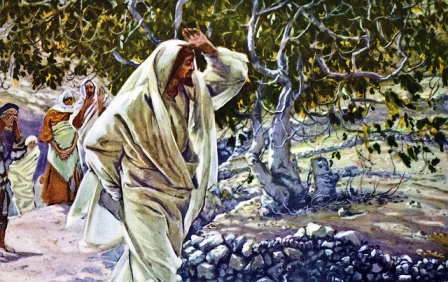
Artist: J JAMES TISSOT

Artist: J JAMES TISSOT

Today, let’s take a look at the parable of the Barren Fig Tree and see if we can’t bring some context to some of the accounts that have perplexed me over the years. We will be looking through a few of the Gospel texts, but for starters, let’s turn to Luke 13.

Luke 13:1-9 (ESV)  1 There were some present at that very time who told him about the Galileans whose blood Pilate had mingled with their sacrifices. 2 And he answered them, “Do you think that these Galileans were worse sinners than all the other Galileans, because they suffered in this way? 3 No, I tell you; but unless you repent, you will all likewise perish. 4 Or those eighteen on whom the tower in Siloam fell and killed them: do you think that they were worse offenders than all the others who lived in Jerusalem? 5 No, I tell you; but unless you repent, you will all likewise perish.” 6 And he told this parable: “A man had a fig tree planted in his vineyard, and he came seeking fruit on it and found none. 7 And he said to the vinedresser, ‘Look, for three years now I have come seeking fruit on this fig tree, and I find none. Cut it down. Why should it use up the ground?’ 8 And he answered him, ‘Sir, let it alone this year also, until I dig around it and put on manure. 9 Then if it should bear fruit next year, well and good; but if not, you can cut it down.’”

Now, the ESV separates these into two different paragraphs, but for the purpose of this study I believe the two concepts go together. Jesus sets up this parable of the fig tree with a reminder of the call to repentance and the judgement that awaits all who refuse to repent. He clearly teaches that everyone is guilty of sin, not just those who seem to have received punishment while others lived. Jesus exposes the myth that those who die suddenly were being judged by God as special cases of sinfulness or offense, and those who lived where more righteous. The parable that follows this begins with a fig tree that was planted in the master’s vineyard, and for three years it bore no fruit. Judgement is coming to the barren fig tree, for the master is ready to cut it down. However, the vinedresser appeals to the master for grace, allow the tree one more year while special care is taken for the tree, fertilizer will be added. If after the year the tree still bears no fruit, then it shall be cut down. By Grace the fig tree was planted in the garden, and by the master’s Grace that tree was allowed to continue fruitlessness for three years, and by Grace it will be given another year with special attention. Judgement is coming, but by God’s Grace there is time for repentance.

In the Matthew 21, we see the account of the triumphal entry into Jerusalem. We are going to pick up in an awkward spot, so if you are unfamiliar with this passage, please read Matthew 21 in full. Here let us look at what happens when Jesus enters Jerusalem.

Matthew 21:10-32 (ESV)10 And when he entered Jerusalem, the whole city was stirred up, saying, “Who is this?” 11 And the crowds said, “This is the prophet Jesus, from Nazareth of Galilee.” 12 And Jesus entered the temple and drove out all who sold and bought in the temple, and he overturned the tables of the money-changers and the seats of those who sold pigeons. 13 He said to them, “It is written, ‘My house shall be called a house of prayer,’ but you make it a den of robbers.” 

14 And the blind and the lame came to him in the temple, and he healed them. 15 But when the chief priests and the scribes saw the wonderful things that he did, and the children crying out in the temple, “Hosanna to the Son of David!” they were indignant, 16 and they said to him, “Do you hear what these are saying?” And Jesus said to them,“Yes; have you never read,

“‘Out of the mouth of infants and nursing babies
you have prepared praise’?”

17 And leaving them, he went out of the city to Bethany and lodged there.

18 In the morning, as he was returning to the city, he became hungry. 19 And seeing a fig tree by the wayside, he went to it and found nothing on it but only leaves. And he said to it, “May no fruit ever come from you again!” And the fig tree withered at once. 20 When the disciples saw it, they marveled, saying, “How did the fig tree wither at once?” 21 And Jesus answered them, “Truly, I say to you, if you have faith and do not doubt, you will not only do what has been done to the fig tree, but even if you say to this mountain,‘Be taken up and thrown into the sea,’ it will happen. 22 And whatever you ask in prayer, you will receive, if you have faith.”

23 And when he entered the temple, the chief priests and the elders of the people came up to him as he was teaching, and said, “By what authority are you doing these things, and who gave you this authority?” 24 Jesus answered them, “I also will ask you one question, and if you tell me the answer, then I also will tell you by what authority I do these things. 25 The baptism of John, from where did it come? From heaven or from man?” And they discussed it among themselves, saying, “If we say, ‘From heaven,’ he will say to us, ‘Why then did you not believe him?’ 26 But if we say, ‘From man,’ we are afraid of the crowd, for they all hold that John was a prophet.” 27 So they answered Jesus, “We do not know.” And he said to them, “Neither will I tell you by what authority I do these things.

28 “What do you think? A man had two sons. And he went to the first and said, ‘Son, go and work in the vineyard today.’ 29 And he answered, ‘I will not,’ but afterward hechanged his mind and went. 30 And he went to the other son and said the same. And he answered, ‘I go, sir,’ but did not go. 31 Which of the two did the will of his father?” They said, “The first.” Jesus said to them, “Truly, I say to you, the tax collectors and the prostitutes go into the kingdom of God before you. 32 For John came to you in the way of righteousness, and you did not believe him, but the tax collectors and the prostitutes believed him. And even when you saw it, you did not afterward change your minds and believe him.

Now, this is a wonderful passage, filled with some extremely tense imagery. Jesus enters Jerusalem and clears out the temple of the money changers and the merchants. He rebukes them for what they have done to the House of the Lord God (for such was the Temple) and ministered to the lame and the blind, performing many wonderful works. The children sang a song of praise Hosanna to the Son of David and the Pharisees were indignant. Fig trees, planted in the Master’s vineyard as teachers and overseers of God’s people, bearing no fruit for a great many years. Jesus leaves Jerusalem and stays the night in Bethany.

When He returns to Jerusalem, He sees the barren fig tree and curses it, and it withers. Often when this passage is taught, the emphasis moves immediately to verses 20-22 to teach the power of prayer and faith and to look at “our potential” as Christians. Let’s not do that today, our focus is on the fig tree. Given our initial parable of the barren fig tree, and the events of the day prior to this morning, we are starting to see that this fig tree is a sign of unbelief. It will not be allowed to live on in selfish unrighteousness, refusing to bear fruit, forever.

Jesus enters the Temple and begins teaching. The chief priests and elders interrupt His teaching to demand that Jesus provide His credentials, by what authority and from whom did He receive said authority to do these things. These men didn’t make these demands the day prior when all where praising God, confessing Jesus as the Messiah (Son of David), or healing the lame and the blind, and they didn’t stop Him from clearing out the merchants and the money changers. No, they were indignant on that day… and then waited for the next day, when Jesus came to teach. Now, notice how Jesus responds. Is He playing coy? Absolutely not. Jesus has never denied that He was the Son of God, the promised Messiah, and He called the Lord God to be His Father. He did so the day prior, and the works He performed were a testimony of His authority to “do these things”. No, Jesus wasn’t playing coy… He was calling out the chief priests and elders, time to inspect the fruit of these trees.

Matthew 7:15-20 (ESV) | A Tree and Its Fruit
15 “Beware of false prophets, who come to you in sheep’s clothing but inwardly are ravenous wolves. 16 You will recognize them by their fruits. Are grapes gathered from thorn bushes, or figs from thistles? 17 So, every healthy tree bears good fruit, but the diseased tree bears bad fruit. 18 A healthy tree cannot bear bad fruit, nor can a diseased tree bear good fruit. 19 Every tree that does not bear good fruit is cut down and thrown into the fire. 20 Thus you will recognize them by their fruits.

You see, the chief priests and elders conferred among themselves and reasoned rightly that their answer would put them at odds with either the Messiah or with the People. For they realized that if they answered that John’s baptism was not of God, the people would revolt against them; however, if they declared John’s baptism was from God, they’d have to answer for their unbelief. They missed 2 major concepts, the first is that the problem was they needed to confess and repent of their unbelief, and the second was that in refusing to answer, they were not safe because any tree that does not bear good fruit is cut down and thrown into the fire. However, because these leaders were self-seeking, they were trees planted in the vineyard to display their own greatness in their leaves, but providing no fruit. Time and time again, God has granted to them grace and opportunity to repent. Luke records for us in the book of Acts, chapter 19, that Paul answered this question of John’s baptism to the disciples in Ephesus

Acts 19:1-7 (ESV) | Paul in Ephesus
19 And it happened that while Apollos was at Corinth, Paul passed through the inland country and came to Ephesus. There he found some disciples. 2 And he said to them, “Did you receive the Holy Spirit when you believed?” And they said, “No, we have not even heard that there is a Holy Spirit.” 3 And he said, “Into what then were you baptized?” They said, “Into John’s baptism.” 4 And Paul said, “John baptized with the baptism of repentance, telling the people to believe in the one who was to come after him, that is, Jesus.” 5 On hearing this, they were baptized in the name of the Lord Jesus. 6 And when Paul had laid his hands on them, the Holy Spirit came on them, and they began speaking in tongues and prophesying. 7 There were about twelve men in all.

John baptized with the baptism of repentance. Let us look to John’s baptism, of which Jesus tested the chief priests and elders at the Temple.

Matthew 3:1-12 (ESV) | John the Baptist Prepares the Way
1 In those days John the Baptist came preaching in the wilderness of Judea, 2 “Repent, for the kingdom of heaven is at hand.” 3 For this is he who was spoken of by the prophet Isaiah when he said,

“The voice of one crying in the wilderness:
‘Prepare the way of the Lord;
make his paths straight.’”

4 Now John wore a garment of camel’s hair and a leather belt around his waist, and his food was locusts and wild honey. 5 Then Jerusalem and all Judea and all the region about the Jordan were going out to him, 6 and they were baptized by him in the river Jordan, confessing their sins. 7 But when he saw many of the Pharisees and Sadducees coming to his baptism, he said to them, “You brood of vipers! Who warned you to flee from the wrath to come? 8 Bear fruit in keeping with repentance. 9 And do not presume to say to yourselves, ‘We have Abraham as our father,’ for I tell you, God is able from these stones to raise up children for Abraham. 10 Even now the axe is laid to the root of the trees. Every tree therefore that does not bear good fruit is cut down and thrown into the fire.

11 “I baptize you with water for repentance, but he who is coming after me is mightier than I, whose sandals I am not worthy to carry. He will baptize you with the Holy Spirit and fire. 12 His winnowing fork is in his hand, and he will clear his threshing floor and gather his wheat into the barn, but the chaff he will burn with unquenchable fire.”

Praise God. Repent, for the Kingdom of God is here. Bear fruit in keeping with repentance. Don’t presume that you are safe simply because God planted you in His vineyard (tying this thought in with our parable), for if you do not bear fruit in keeping with repentance, you will be cut down and thrown into the fire. Amen.

As Christians, we must bear the fruit of repentance. This is what taking our crosses daily and denying ourselves looks, when we remember (in active form) that we are sinful beings in need of a Savior. Repent, for the Kingdom of God is near. There is no “moving beyond the Gospel”, it is an ever present place of rest. It is also our mission, to preach the Gospel to all of creation, so that those who hear the Word of God might obtain Faith, confess their sin, and repent from their sinful ways and trust in Christ Jesus, the Way, the Truth, and the Life.

John 6:27-29 (ESV)27 Do not work for the food that perishes, but for the food that endures to eternal life, which the Son of Man will give to you. For on him God the Father has set his seal.” 28 Then they said to him, “What must we do, to be doing the works of God?” 29 Jesus answered them, “This is the work of God, that you believe in him whom he has sent.

1 John 5:9-11 (ESV)9 If we receive the testimony of men, the testimony of God is greater, for this is the testimony of God that he has borne concerning his Son. 10 Whoever believes in the Son of God has the testimony in himself. Whoever does not believe God has made him a liar, because he has not believed in the testimony that God has borne concerning his Son. 11 And this is the testimony, that God gave us eternal life, and this life is in his Son.

Amen. Bear the fruit of repentance, and believe in and confess the Son of God before mankind. Remain in Him, and trust that the Holy Spirit will bear fruit in you as you grow in Him, and you will never be cut away nor cast into the fire. The chief priests, the elders, the Sadducees and Pharisees did not repent, nor did they believe in the Son, and they were cut off.

In the last parable of the 2 sons, we see clearly that all who were lost and came to repentance are like the first son who defied their father, but later obeyed. The second son was the one who professed with his mouth to obey the father, but rejected his authority and commandments and did what was wrong in the end. He represents those chosen by God to be overseers and spiritual leaders who rejected the Law (instead honoring commandments of men that were self-serving) and the Gospel of Jesus Christ.

Matthew 21:31-32 (ESV) 31 Which of the two did the will of his father?” They said, “The first.” Jesus said to them,“ Truly, I say to you, the tax collectors and the prostitutes go into the kingdom of God before you. 32 For John came to you in the way of righteousness, and you did not believe him, but the tax collectors and the prostitutes believed him. And even when you saw it, you did not afterward change your minds and believe him.

The tax collectors and the prostitutes were among those who confessed their sins and repented in John’s baptism, thereby entering the kingdom of God before the Pharisees. And even after seeing the Gospel reach the lowly sinner, they still did not later change their minds and believe.

May the God the Holy Spirit minister to your hearts today and bring His Word to life and grant you understanding and wisdom and increase your faith. In the Name of Our Lord Jesus Christ, Amen.

In Christ Jesus,
Jorge

“My Grace is Sufficient”

imagesToday, I wanted to look at closing up yesterday’s discussion, especially for those who struggle with the notion that “soul ties” aren’t biblical. If “soul ties” aren’t the answer, what is? The simple answer is, “the Grace of God”. Let us begin by looking to the Apostle Paul for some insight, because Paul often taught regarding the dual nature of Christians as being both sinner and saint. In his second letter to the Corinthians, Paul shares a personal plea to God and God’s answer to Paul should give us encouragement and comfort.

2 Corinthians 12:1-10 (ESV) | Paul’s Visions and His Thorn
1 I must go on boasting. Though there is nothing to be gained by it, I will go on to visions and revelations of the Lord. 2 I know a man in Christ who fourteen years ago was caught up to the third heaven—whether in the body or out of the body I do not know, God knows. 3 And I know that this man was caught up into paradise—whether in the body or out of the body I do not know, God knows— 4 and he heard things that cannot be told, which man may not utter. 5 On behalf of this man I will boast, but on my own behalf I will not boast, except of my weaknesses— 6 though if I should wish to boast, I would not be a fool, for I would be speaking the truth; but I refrain from it, so that no one may think more of me than he sees in me or hears from me. 7 So to keep me from becoming conceited because of the surpassing greatness of the revelations, a thorn was given me in the flesh, a messenger of Satan to harass me, to keep me from becoming conceited. 8 Three times I pleaded with the Lord about this, that it should leave me. 9 But he said to me, “My grace is sufficient for you, for my power is made perfect in weakness.” Therefore I will boast all the more gladly of my weaknesses, so that the power of Christ may rest upon me. 10 For the sake of Christ, then, I am content with weaknesses, insults, hardships, persecutions, and calamities. For when I am weak, then I am strong.

If this reference to boasting seems a bit awkward, in the previous chapter Paul is calling out the false apostles (sarcastically calling them ‘super apostles’), particularly pointing out their abuse, their boasting, and their financial exploitation of the Corinthians. Paul closed out the previous chapter boasting, so to speak, in his afflictions and hard work on their behalf rather than take from them, and he continues here boasting in a way that demonstrates that while the false apostles boasted illegitimately, Paul could boast all the more. Paul is one of the few who have ever been taking up into heaven (as a point of clarification, no one since Revelation has been shown heaven for the purpose of revealing or teaching the Church about it, and no one who claims to share details of Heaven is legitimate).

This thorn in the flesh that was given to Paul was given for a specific purpose, it was allowed to afflict Paul “so to keep him from becoming conceited because of the surpassing greatness of the revelations of heaven“. So, not only do we NOT get a detailed description of what Paul saw in Heaven, he was also allowed a tormentor, a messenger of Satan, to keep him from becoming conceited. You and I don’t need a thorn in our flesh, for our flesh is thorny enough on its own. Neither of us have been established as Apostles of Jesus Christ, and neither of us (I say with a great deal of confidence) have been taking up into Heaven. Notice here that if anyone had a special claim on an anointing from God the Holy Spirit, Paul did. If anyone could teach with authority the Word of Faith (WoF) doctrine, it would be Paul. But he doesn’t. We see here that he prayed three times to God that the thorn in his flesh, the harasser from Satan, be taken away from him, and God’s response wasn’t “you haven’t prayed the right prayer yet”, or “you still lack faith”, or even “this is to make you stronger”… no, God’s reply was simply

“My Grace is sufficient for you, for My power is made perfect in weakness”

We don’t have thorns placed in our flesh, but we must contend with the flesh nonetheless. Our flesh desires sin, it chases after sin. This thorn was above and beyond Paul’s flesh, and still the answer from God was, “My grace is sufficient for you…”.

How many times have you prayed and longed for God to miraculously remove your fleshly desire to…

  • lust after scantily clad women…
  • drown sorrow or pain in food or drink…
  • take just one more dose to remove the edge…
  • covet a neighbor’s lifestyle, possession, or spouse…

In all of these things, and all the other temptations of the flesh… your flesh… the flesh that wages war against the Spirit, the flesh that desires sin even when un-prompted by an outside agent (be it a person or an unclean spirit), the answer from God the Holy Spirit remains

“My Grace is sufficient for you, for My power is made perfect in weakness”

Can God the Holy Spirit miraculously heal addictions and mental illness? Yes. God was not incapable of removing the thorn in Paul’s flesh, and every demon and unclean spirit obeyed the commands of Jesus. The Sovereignty of God rests not only in His power, but in His Will as well. As we see in the book of Job, His Will isn’t always fully revealed to us, either. Nevertheless, we know that He works all things for good. All things… for good.

Romans 8:18-39 (ESV) | Future Glory
18 For I consider that the sufferings of this present time are not worth comparing with the glory that is to be revealed to us. 19 For the creation waits with eager longing for the revealing of the sons of God. 20 For the creation was subjected to futility, not willingly, but because of him who subjected it, in hope 21 that the creation itself will be set free from its bondage to corruption and obtain the freedom of the glory of the children of God. 22 For we know that the whole creation has been groaning together in the pains of childbirth until now. 23 And not only the creation, but we ourselves, who have the first-fruits of the Spirit, groan inwardly as we wait eagerly for adoption as sons, the redemption of our bodies. 24 For in this hope we were saved. Now hope that is seen is not hope. For who hopes for what he sees? 25 But if we hope for what we do not see, we wait for it with patience.

26 Likewise the Spirit helps us in our weakness. For we do not know what to pray for as we ought, but the Spirit himself intercedes for us with groanings too deep for words.27 And he who searches hearts knows what is the mind of the Spirit, because the Spirit intercedes for the saints according to the will of God. 28 And we know that for those who love God all things work together for good, for those who are called according to his purpose. 29 For those whom he foreknew he also predestined to be conformed to the image of his Son, in order that he might be the firstborn among many brothers. 30 And those whom he predestined he also called, and those whom he called he also justified, and those whom he justified he also glorified.

31 What then shall we say to these things? If God is for us, who can be against us? 32 He who did not spare his own Son but gave him up for us all, how will he not also with him graciously give us all things? 33 Who shall bring any charge against God’s elect? It is God who justifies. 34 Who is to condemn? Christ Jesus is the one who died—more than that, who was raised—who is at the right hand of God, who indeed is interceding for us. 35 Who shall separate us from the love of Christ? Shall tribulation, or distress, or persecution, or famine, or nakedness, or danger, or sword? 36 As it is written,

“For your sake we are being killed all the day long;
we are regarded as sheep to be slaughtered.”

37 No, in all these things we are more than conquerors through him who loved us. 38 For I am sure that neither death nor life, nor angels nor rulers, nor things present nor things to come, nor powers, 39 nor height nor depth, nor anything else in all creation, will be able to separate us from the love of God in Christ Jesus our Lord.

Paul is not talking about avoiding pain, or tribulation, or distress, or persecution, he is pointing to the promise of the Gospel of Jesus Christ. There are several verses that are pulled from this passage to push the WoF “declare victory now” over-realized eschatology, but when read in-context we know that the hope that lies ahead is far greater than our present circumstances. There will come a day when all of creation will be set free from its bondage to corruption, including our flesh. That nothing that “goes wrong” down here has any lasting consequences and that any suffering we might endure on this earth is not fit to be compared to the Glory that awaits us in Christ Jesus.

In this life we will face struggles, from outside agents and from our own fleshly desires, for it is corrupt. We must take up our crosses daily, and we must resist temptation and flee sexual immorality. But we are weak, and the Spirit of God helps us in our weakness. When we are weak, He is strong.

“My Grace is sufficient for you, for My power is made perfect in weakness”

The Grace of God is that He gave His One and Only Son Jesus to die on the cross as payment for our sin. Sin still has consequences in this life, and our flesh is corrupt.

Galatians 6:7-9 (ESV) 7 Do not be deceived: God is not mocked, for whatever one sows, that will he also reap. 8 For the one who sows to his own flesh will from the flesh reap corruption, but the one who sows to the Spirit will from the Spirit reap eternal life. 9 And let us not grow weary of doing good, for in due season we will reap, if we do not give up.

This isn’t about lawlessness and carnal living without consequences. This is about understanding that while we live in these fallen earthly bodies, we will sin. Our very flesh wars against our Spirit, compelling us to sin. Think of it in terms of addiction… only rather than being limited to a particular sin (drunkenness, gluttony, sexual immorality, etc.) our flesh is addicted to self-seeking, self-gratification (as a goal), and all manner of sin. The Grace of God brings our spirit to life, pulled out of the kingdom of darkness and sealed by the Holy Spirit for the Day of Christ’s Return. We must walk in the Spirit, resist the devil, and crucify our flesh daily. As Paul described it in Romans 6, we are to consider ourselves dead to sin, and alive to God, being slaves to righteousness. But we do so without condemnation, for the Grace of the Cross says that it is by His Blood we have been made righteous, not by our actions.

I pray that each of you will be set free from addictions and habitual sins. When you are going through the storm of temptation, trust in Him. The desire will be there, because your flesh craves sin, but know that the Spirit wages war against the flesh. There is no hidden secret to making the desire just go away. Trust in the Lord, God the Holy Spirit living inside of you to make a way of escape. Temptations will come… and often they come from within your very flesh. That will not always be the case. Sanctification is a life-long process, as we learn to live according to the Spirit and not according to the flesh. Press on toward the goal of the upward call of God, the Great Day of His Return. In the meantime, do not be ensnared by condemnation by the accuser. Remember the cross, remember the Grace of God, for His Grace is sufficient, and His power is made perfect in our weakness.

1 John 1 (ESV) 1 That which was from the beginning, which we have heard, which we have seen with our eyes, which we looked upon and have touched with our hands, concerning the word of life— 2 the life was made manifest, and we have seen it, and testify to it and proclaim to you the eternal life, which was with the Father and was made manifest to us— 3 that which we have seen and heard we proclaim also to you, so that you too may have fellowship with us; and indeed our fellowship is with the Father and with his Son Jesus Christ. 4 And we are writing these things so that our joy may be complete. 5 This is the message we have heard from him and proclaim to you, that God is light, and in him is no darkness at all. 6 If we say we have fellowship with him while we walk in darkness, we lie and do not practice the truth. 7 But if we walk in the light, as he is in the light, we have fellowship with one another, and the blood of Jesus his Son cleanses us from all sin. 8 If we say we have no sin, we deceive ourselves, and the truth is not in us. 9 If we confess our sins, he is faithful and just to forgive us our sins and to cleanse us from all unrighteousness. 10 If we say we have not sinned, we make him a liar, and his word is not in us.

May the peace of God reign in your hearts this day and every day,
In Christ Jesus,
Jorge

The Bread & Water of Jesus

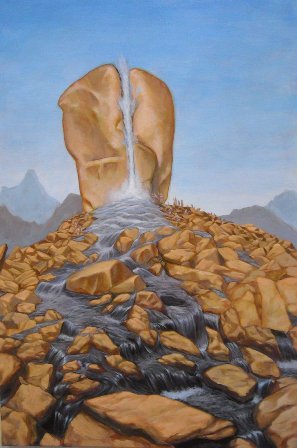
Rock of Horeb by Mariano David Otero ©2010-2014 MarianoDavidOtero

Rock of Horeb by Mariano David Otero ©2010-2014 MarianoDavidOtero

To get this week started on a Gospel note, I thought it would be fun to take a look at some of the foreshadowing of the Gospel of Jesus found in Exodus. Today, we’ll look at Jesus’s claims of being the bread and water of life. Let’s begin with a look at the account in Exodus.

Exodus 16:1-5 (ESV) | Bread from Heaven
1 They set out from Elim, and all the congregation of the people of Israel came to the wilderness of Sin, which is between Elim and Sinai, on the fifteenth day of the second month after they had departed from the land of Egypt. 2 And the whole congregation of the people of Israel grumbled against Moses and Aaron in the wilderness, 3 and the people of Israel said to them, “Would that we had died by the hand of the Lord in the land of Egypt, when we sat by the meat pots and ate bread to the full, for you have brought us out into this wilderness to kill this whole assembly with hunger.” 4 Then the Lord said to Moses, “Behold, I am about to rain bread from heaven for you, and the people shall go out and gather a day’s portion every day, that I may test them, whether they will walk in my law or not. 5 On the sixth day, when they prepare what they bring in, it will be twice as much as they gather daily.”

Exodus 16:31-34 (ESV)31 Now the house of Israel called its name manna. It was like coriander seed, white, and the taste of it was like wafers made with honey. 32 Moses said, “This is what the Lord has commanded: ‘Let an omer of it be kept throughout your generations, so that they may see the bread with which I fed you in the wilderness, when I brought you out of the land of Egypt.’” 33 And Moses said to Aaron, “Take a jar, and put an omer of manna in it, and place it before the Lord to be kept throughout your generations.” 34 As the Lord commanded Moses, so Aaron placed it before the testimony to be kept.

Now, if you remember back in our discussion of the Testimony, you know that here it references the Ark of the Testimony, later called the Ark of the Covenant. Inside of the Ark are the stone tablets of the Testimony, the 10 Commandments. If you read the full chapter, you will see that God also sent quail into the camp at night, so that the children of Israel can also have meat. We are skipping this portion for this study because Jesus did not refer back to the quail, but He did teach regarding the manna from heaven.

John 6:25-40 (ESV)25 When they found him on the other side of the sea, they said to him, “Rabbi, when did you come here?” 26 Jesus answered them, “Truly, truly, I say to you, you are seeking me, not because you saw signs, but because you ate your fill of the loaves. 27 Do not work for the food that perishes, but for the food that endures to eternal life, which the Son of Man will give to you. For on him God the Father has set his seal.” 28 Then they said to him, “What must we do, to be doing the works of God?” 29 Jesus answered them, “This is the work of God, that you believe in him whom he has sent.” 30 So they said to him, “Then what sign do you do, that we may see and believe you? What work do you perform?31 Our fathers ate the manna in the wilderness; as it is written, ‘He gave them bread from heaven to eat.’” 32 Jesus then said to them, “Truly, truly, I say to you, it was not Moses who gave you the bread from heaven, but my Father gives you the true bread from heaven. 33 For the bread of God is he who comes down from heaven and gives life to the world.” 34 They said to him, “Sir, give us this bread always.” 35 Jesus said to them, “I am the bread of life; whoever comes to me shall not hunger, and whoever believes in me shall never thirst. 36 But I said to you that you have seen me and yet do not believe. 37 All that the Father gives me will come to me, and whoever comes to me I will never cast out. 38 For I have come down from heaven, not to do my own will but the will of him who sent me. 39 And this is the will of him who sent me, that I should lose nothing of all that he has given me, but raise it up on the last day. 40 For this is the will of my Father, that everyone who looks on the Son and believes in him should have eternal life, and I will raise him up on the last day.”

Amen. Notice that the Jews with whom Jesus spoke knew the Law. They knew that the manna from heaven served as a testimony, only they were confused as to whom the manna testified. They believed it proved that Moses was giving them the Law from God. The error is slight, and it is subtle, but Jesus identifies it perfectly when He clarifies “it was not Moses who gave you the bread…” The testimony was not of Moses, it was of God the Father. Like the stone tablets of the Testimony, while the Law did come into their midst in the hands of Moses, it was to point the children of Israel to God the Father, not to Moses. Similarly, the Law and the manna were pointing to Jesus, the Son of Man. Jesus declared Himself to be both the Son of Man (descendant of Adam promised to crush the head of the serpent) AND the Manna Sent from Heaven, sent by God the Father to grant eternal life to everyone who looks on Him and Believes. This is another place where we see the “Fully Man” and “Fully God” identity of Jesus Christ laid out in Scripture by His own teaching. Notice here that Jesus is the bread of life and that whoever comes to Him will not hunger. We see in the Lord’s Prayer, “Give us this day our daily bread” and many times we see the double meaning of this passage as both asking God to meet our daily bodily need for food as well as spiritual nourishment in the Word of God. But we also see Jesus declare that whoever believes in me shall never thirst. Since this statement comes connected to His declaration that He is the manna sent from heaven, it stands to reason that the reference to thirst may also stem from Exodus, and it does. Let’s turn to the very next chapter in Exodus.

Exodus 17:1-7 (ESV) 1 All the congregation of the people of Israel moved on from the wilderness of Sin by stages, according to the commandment of the Lord, and camped at Rephidim, but there was no water for the people to drink. 2 Therefore the people quarreled with Moses and said, “Give us water to drink.” And Moses said to them, “Why do you quarrel with me? Why do you test the Lord?” 3 But the people thirsted there for water, and the people grumbled against Moses and said, “Why did you bring us up out of Egypt, to kill us and our children and our livestock with thirst?” 4 So Moses cried to the Lord, “What shall I do with this people? They are almost ready to stone me.” 5 And the Lord said to Moses, “Pass on before the people, taking with you some of the elders of Israel, and take in your hand the staff with which you struck the Nile, and go. 6 Behold, I will stand before you there on the rock at Horeb, and you shall strike the rock, and water shall come out of it, and the people will drink.” And Moses did so, in the sight of the elders of Israel. 7 And he called the name of the place Massah and Meribah, because of the quarreling of the people of Israel, and because they tested the Lord by saying, “Is the Lord among us or not?”

Here at the start of Chapter 17, we find the children of Israel leaving the wilderness of Sin. While the temptation to allegorize the English name of this wilderness, the Hebrew doesn’t quite point in that direction. The Hebrew word translated Sin here is (Ciyn) is different from the Hebrew word for sin as in something that is sinful (chatta’ath). Ciyn translates into “thorn” or “clay”, but here it is referencing an actual place, an area of wilderness where there is no water, especially not enough for all of the Israelites here.

There is significance in God’s command for Moses to take the staff with which he struck the Nile (as commanded by God)  when God turned the River Nile into blood as the first plague of judgement upon Pharaoh. Moses was to strike the rock at Horeb so that Israel would know that it was God who led them out of Egypt. The split in the rock comes after a blow of judgment, and from the split comes a flow of water to quench the thirst of the children of God. This also points ahead to the cross, where Christ would lay down His life and bear the full wrath of God that was due us for our sin, so that in Him we might have eternal life.

John 19:28-37 (ESV) 28 After this, Jesus, knowing that all was now finished, said (to fulfill the Scripture), “I thirst.” 29 A jar full of sour wine stood there, so they put a sponge full of the sour wine on a hyssop branch and held it to his mouth. 30 When Jesus had received the sour wine, he said, “It is finished,” and he bowed his head and gave up his spirit. 31 Since it was the day of Preparation, and so that the bodies would not remain on the cross on the Sabbath (for that Sabbath was a high day), the Jews asked Pilate that their legs might be broken and that they might be taken away. 32 So the soldiers came and broke the legs of the first, and of the other who had been crucified with him. 33 But when they came to Jesus and saw that he was already dead, they did not break his legs. 34 But one of the soldiers pierced his side with a spear, and at once there came out blood and water. 35 He who saw it has borne witness—his testimony is true, and he knows that he is telling the truth—that you also may believe. 36 For these things took place that the Scripture might be fulfilled: “Not one of his bones will be broken.” 37 And again another Scripture says, “They will look on him whom they have pierced.”

The water flowed after the Rock was pierced. By the blood of Jesus Christ, the debt we could not pay was paid for by Him. All who look upon the Son and believe in Him will never thirst, for in Him they will find Living Water. This is a call of the Gospel that goes out to all people, both Jew and Gentile.

John 7:37-39 (ESV) 37 On the last day of the feast [of booths], the great day, Jesus stood up and cried out, “If anyone thirsts, let him come to me and drink. 38 Whoever believes in me, as the Scripture has said, ‘Out of his heart will flow rivers of living water.’” 39 Now this he said about the Spirit, whom those who believed in him were to receive, for as yet the Spirit had not been given, because Jesus was not yet glorified.

John 4:7-15 (ESV) 7 A woman from Samaria came to draw water. Jesus said to her, “Give me a drink.” 8 (For his disciples had gone away into the city to buy food.) 9 The Samaritan woman said to him, “How is it that you, a Jew, ask for a drink from me, a woman of Samaria?” (For Jews have no dealings with Samaritans.) 10 Jesus answered her, “If you knew the gift of God, and who it is that is saying to you, ‘Give me a drink,’ you would have asked him, and he would have given you living water.” 11 The woman said to him, “Sir, you have nothing to draw water with, and the well is deep. Where do you get that living water? 12 Are you greater than our father Jacob? He gave us the well and drank from it himself, as did his sons and his livestock.” 13 Jesus said to her, “Everyone who drinks of this water will be thirsty again, 14 but whoever drinks of the water that I will give him will never be thirsty again. The water that I will give him will become in him a spring of water welling up to eternal life.” 15 The woman said to him, “Sir, give me this water, so that I will not be thirsty or have to come here to draw water.”

The call goes out to everyone, Gentile and Jew. At the feast of booths, Jesus is talking to Jews who are observing the Law. The call to come to Jesus all who are thirsty includes believers. We must not get so caught up in observing the Law that we lose sight of the Gospel and become thirsty ourselves.

The Gospel for Today and Tomorrow

The Jews in Jesus’s day looked back to the Law as testimony of Moses, but failed to recognize the fulfillment of the Law in their day, in the very body and ministry of Jesus. Sadly, I fear that many Christians fall in the same trap, only now they do it with the Gospel. They think of the Gospel as something they needed to “get saved” or “be born again” sometime in the past, and then go through life trying to sanctify themselves by works of the Law, forgetting that the Gospel isn’t just something you needed at one time or that took place once in your life, but the Gospel is for our every day. Give us this day our Daily Bread, the Gospel of Jesus Christ is needed every day. We need forgiveness and remission of sins daily, and we have not yet fully grasped the promise of the Gospel, for we each will still die for our earthly bodies are corrupt. The fountains of living water, the eternal life as a promise for all who believe are prizes that lay ahead of us, in the great tomorrow, the Day of our Salvation.

Revelation 7:9-17 (ESV) 9 After this I looked, and behold, a great multitude that no one could number, from every nation, from all tribes and peoples and languages, standing before the throne and before the Lamb, clothed in white robes, with palm branches in their hands, 10 and crying out with a loud voice, “Salvation belongs to our God who sits on the throne, and to the Lamb!” 11 And all the angels were standing around the throne and around the elders and the four living creatures, and they fell on their faces before the throne and worshiped God, 12 saying, “Amen! Blessing and glory and wisdom and thanksgiving and honor and power and might be to our God forever and ever! Amen.” 13 Then one of the elders addressed me, saying, “Who are these, clothed in white robes, and from where have they come?” 14 I said to him, “Sir, you know.” And he said to me, “These are the ones coming out of the great tribulation. They have washed their robes and made them white in the blood of the Lamb.

15 “Therefore they are before the throne of God,
and serve him day and night in his temple;
and he who sits on the throne will shelter them with his presence.
16 They shall hunger no more, neither thirst anymore;
the sun shall not strike them,
nor any scorching heat.
17 For the Lamb in the midst of the throne will be their shepherd,
and he will guide them to springs of living water,
and God will wipe away every tear from their eyes.”

There’s still more to come for God’s people. Don’t allow the charlatans and the peddlers of false gospels distract you from the Promise of the Kingdom to come. This temporal life is a but a vapor, a breath of time. While we are here, let us be faithful stewards, striving to do the works of God so that His Will might be done in all the earth. What is that work? Well, as Jesus said earlier, that we believe in Jesus Christ who was sent by God, so that whoever looks upon the Son and believes will have eternal life. This is the work of the Gospel, and our charge as stewards of the Gospel.

Matthew 28:18-20 (ESV)18 And Jesus came and said to them, “All authority in heaven and on earth has been given to me. 19 Go therefore and make disciples of all nations, baptizing them in the name of the Father and of the Son and of the Holy Spirit, 20 teaching them to observe all that I have commanded you. And behold, I am with you always, to the end of the age.”

May the Lord bless you and keep you firmly in His Will,
In Christ Jesus,
Jorge