CTT | Jesus Friend of Sinners?

jesus_eats_with_publicans_and_sinners_bidaDid Jesus walk this earth to befriend sinners? Does this partial quote justify hanging out with sinners without preaching Law and Gospel? Does this justify abandoning the purpose of the church found in Scripture (maturing the saints) in favor of creating a cool place for “unchurched” people to hang out, be entertained, and be encouraged regardless of whether or not they believe in the Son of God and what He did as a payment for what their sin deserves? Let’s look at the text.

Jesus, Friend of Sinners

The partial quote “Jesus friend of sinners” is found in the tail end of the account where disciples of John the Baptist come to Jesus on John’s behalf to ask if He was in-fact the Messiah. John had been thrown in jail shortly after Jesus’s ministry began, and he wanted encouragement. This account is recorded nearly verbatim in Matthew 11 and in Luke 7. Luke records a reaction from the crowd that I think is important for understanding the message, so we will begin in Luke.

Luke 7:18-35 (ESV) | Messengers from John the Baptist
18 The disciples of John reported all these things to him. And John, 19 calling two of his disciples to him, sent them to the Lord, saying, “Are you the one who is to come, or shall we look for another?” 20 And when the men had come to him, they said, “John the Baptist has sent us to you, saying, ‘Are you the one who is to come, or shall we look for another?’” 21 In that hour he healed many people of diseases and plagues and evil spirits, and on many who were blind he bestowed sight. 22 And he answered them, “Go and tell John what you have seen and heard: the blind receive their sight, the lame walk, lepers are cleansed, and the deaf hear, the dead are raised up, the poor have good news preached to them. 23 And blessed is the one who is not offended by me.” 24 When John’s messengers had gone, Jesus began to speak to the crowds concerning John: “What did you go out into the wilderness to see? A reed shaken by the wind? 25 What then did you go out to see? A man dressed in soft clothing? Behold, those who are dressed in splendid clothing and live in luxury are in kings’ courts. 26 What then did you go out to see? A prophet? Yes, I tell you, and more than a prophet. 27 This is he of whom it is written,

“‘Behold, I send my messenger before your face,
who will prepare your way before you.’

28 I tell you, among those born of women none is greater than John. Yet the one who is least in the kingdom of God is greater than he.” 29 (When all the people heard this, and the tax collectors too, they declared God just, having been baptized with the baptism of John, 30 but the Pharisees and the lawyers rejected the purpose of God for themselves, not having been baptized by him.)

31 “To what then shall I compare the people of this generation, and what are they like?32 They are like children sitting in the marketplace and calling to one another,

“‘We played the flute for you, and you did not dance;
    we sang a dirge, and you did not weep.’

33 For John the Baptist has come eating no bread and drinking no wine, and you say, ‘He has a demon.’ 34 The Son of Man has come eating and drinking, and you say, ‘Look at him! A glutton and a drunkard, a friend of tax collectors and sinners!’ 35 Yet wisdom is justified by all her children.”

Interesting. After such a powerful testimony of John the Baptist, Jesus then declares that the one who is least in the kingdom of God is greater than he. Why would the tax collectors resonate with this statement? In that day, the top rung of the social ladder was the chief priests and elders, and the lowest were the prostitutes and tax collectors. The tax collectors were equated with prostitutes in that they, being Jews, took money from Jews to pay tribute to Rome. Remember when we discussed in an earlier post, we saw that John’s baptism was one of Repentance. Let’s revisit how Jesus ended one of His parables to the chief priests and elders of the Temple.

Matthew 21:28-32 (ESV) | The Parable of the Two Sons
28 “What do you think? A man had two sons. And he went to the first and said, ‘Son, go and work in the vineyard today.’ 29 And he answered, ‘I will not,’ but afterward he changed his mind and went. 30 And he went to the other son and said the same. And he answered, ‘I go, sir,’ but did not go. 31 Which of the two did the will of his father?” They said, “The first.” Jesus said to them, “Truly, I say to you, the tax collectors and the prostitutes go into the kingdom of God before you. 32 For John came to you in the way of righteousness, and you did not believe him, but the tax collectors and the prostitutes believed him. And even when you saw it, you did not afterward change your minds and believe him.

John the Baptist Preached Repentance

Luke records the reaction of the people, specifying that tax collectors were present, demonstrates that Jesus wasn’t talking about John the Baptist to those who were completely ignorant of who he was. These people whom Jesus addressed had gone out to John the Baptist, and Jesus was reminding them of who they saw. Jesus was also explaining John’s significance. The least in the kingdom of Israel had gone out to John the Baptist, confessing their sins and repenting. The religious leaders, the Pharisees and Sadducees rejected the purpose of God for themselves… they did not believe in John’s baptism. John the Baptist was greater than all mankind (except Jesus because He is the Son of God), but the least in the Kingdom of God was greater than John. How? Because their entry into the Kingdom of God is by the Blood of Jesus, not by their own.

The People of This Generation

Getting back to our text, in Luke 7:32 Jesus transitions to describing the people of this generation. Notice how He chose to describe them, as children sitting in the marketplace calling to one another. Are the children encouraging each other? Are they celebrating each other? No… they are frustrated with each other for when they played the flute no one danced, so when they sang a dirge no one wept (a dirge being a mournful song, piece of music, or poem).  Jesus is setting up the next point He is going to make about the religious leaders and their whining excuses for rejecting the Kingdom of God.

Luke 7:33-35 (ESV) 33 For John the Baptist has come eating no bread and drinking no wine, and you say, ‘He has a demon.’ 34 The Son of Man has come eating and drinking, and you say, ‘Look at him! A glutton and a drunkard, a friend of tax collectors and sinners!’ 35 Yet wisdom is justified by all her children.”

John the Baptist came as a Nazirite from birth, eating no bread (locusts and honey) and drinking no wine or strong drink, and the religious leaders rejected him and his prophecy and told the people he had a demon (sang a dirge) . Now that Jesus, the Son of Man, had come eating and drinking, the religious leaders continue to reject Him and His Testimony while telling the people, “Look at him! A glutton and a drunkard, a friend of tax collectors and sinners!” (played the flute).

Immediate Context of the Quote

So, normally, I like to start with the immediate context of a CTT quote, but this time I really felt it necessary to begin with the full context. The immediate context is highly questionable… this “Jesus friend of sinners” is a quote of what the unbelieving Pharisees are saying about Jesus, but it doesn’t stand alone. The Pharisees are lining it up with declaring Jesus a glutton and a drunkard! This is levied as an insult to Jesus. They aren’t complimenting Him, nor is Jesus declaring this accusation to be true, because He also quoted their accusation of John the Baptist having a demon. The immediate context of this quote completely destroys the emergent, seeker-sensitive twist of this passage as somehow proclaim traditional Church to be Pharisaical and contrary to the ministry of Jesus. The greater context also draws that out, when we see that those in attendance knew and acknowledged the message of John the Baptist, who definitely hadn’t “befriended”, ate, and drank with them; rather, he called them to repent for the Kingdom of Heaven is at hand.

To Seek and to Save the Lost

To call Jesus a “friend of sinners” is to misunderstand either who the “sinners” are or to confuse why Jesus walked the earth. Unless you are acknowledging that we are all sinners, equally dead in our trespasses and sins, you are missing the point of who it was that Jesus befriended. Everyone Jesus spoke to, ate with, walked with, and met was a sinner. Everyone. The Pharisees didn’t get it, they didn’t understand that the call to repent was to them in equal measure as it was to the prostitutes and the tax collectors. Though pointing this out to a seeker-mergent ministry will get an emphatic “amen” it actually destroys their argument that Church needed to be re-envisioned for holding the attention of unbelievers because we are all sinners. We all need to repent and be forgiven every day we live on this Earth. So this partial quote cannot be “properly clarified” and still support the notion that Church that seeks to mature the saints are Pharisaical.

The more dangerous road this can take, is to minimize the work and ministry of Jesus Christ by suggesting that we should seek out sinful living and become a part of it as a form of befriending the sinner. That isn’t what Jesus did, that is what the Pharisees accused Him of doing (gluttony, drunkard, befriending, etc.). Jesus came to fulfill the Law and the Prophets on our behalf (for no one else could do it perfectly) and then lay down His life to suffer the wrath of God that we deserve so that the payment for our sin was made (substitutionary atonement) on our behalf. Let’s look at what Jesus did when He visited the home of Zacchaeus, the tax collector.

Luke 19:1-10 (ESV) | Jesus and Zacchaeus
1 He entered Jericho and was passing through. 2 And behold, there was a man named Zacchaeus. He was a chief tax collector and was rich. 3 And he was seeking to see who Jesus was, but on account of the crowd he could not, because he was small in stature. 4 So he ran on ahead and climbed up into a sycamore tree to see him, for he was about to pass that way. 5 And when Jesus came to the place, he looked up and said to him,“Zacchaeus, hurry and come down, for I must stay at your house today.” 6 So he hurried and came down and received him joyfully. 7 And when they saw it, they all grumbled, “He has gone in to be the guest of a man who is a sinner.” 8 And Zacchaeus stood and said to the Lord, “Behold, Lord, the half of my goods I give to the poor. And if I have defrauded anyone of anything, I restore it fourfold.” 9 And Jesus said to him, “Today salvation has come to this house, since he also is a son of Abraham. 10 For the Son of Man came to seek and to save the lost.”

What did Zacchaeus do when Jesus came to his home? Confessed and repented of his sin. Jesus responded by forgiving him and then declaring that salvation had come to Zacchaeus’s home. You see, brothers and sisters, it is a false dichotomy to assert that we need to act out the Gospel before or even instead of preaching it. By God’s Grace we should endeavor to live in step with the Holy Spirit, but we are all sinners in need of Grace.  The Gospel of Jesus Christ is the only power to save, not our own examples or interpretations. Zacchaeus knew who Jesus was, and wanted to see Him. We do need to go and preach Law and Gospel to the lost in this world, but that doesn’t require abandoning the feeding of God’s sheep for the maturing of the saints.

Who Did Jesus call His Friends?

We know that Jesus came, the first time, not to judge the world but to save it. The Son of Man came to seek and to save the lost, from every nation, both Jew and Gentile. He will return again and when He does it will be to Judge both the Living and the Dead. Jesus left us with our marching orders, and gave the Church the Holy Spirit and the Apostles to build her up on the foundation of the Gospel of Jesus Christ, with Christ as its corner-stone.

John 15:12-17 (ESV) 12 “This is my commandment, that you love one another as I have loved you. 13 Greater love has no one than this, that someone lay down his life for his friends. 14 You are my friends if you do what I command you. 15 No longer do I call you servants, for the servant does not know what his master is doing; but I have called you friends, for all that I have heard from my Father I have made known to you. 16 You did not choose me, but I chose you and appointed you that you should go and bear fruit and that your fruit should abide, so that whatever you ask the Father in my name, he may give it to you. 17 These things I command you, so that you will love one another.

Jesus didn’t call the sinner living in sin a friend. Make no mistake in what I am saying here, I am not saying Jesus didn’t die for the sinners (all of us) or that He didn’t minister to them or seek out the lost. I’m saying that when Jesus speaks of friendship, it is an upgrade from servant. For those who live in sin are enemies of God, that is what sin did to us in the Fall.

James 4:1-5 (ESV) | Warning Against Worldliness
1 What causes quarrels and what causes fights among you? Is it not this, that your passions are at war within you? 2 You desire and do not have, so you murder. You covet and cannot obtain, so you fight and quarrel. You do not have, because you do not ask. 3 You ask and do not receive, because you ask wrongly, to spend it on your passions. 4 You adulterous people! Do you not know that friendship with the world is enmity with God?Therefore whoever wishes to be a friend of the world makes himself an enemy of God. 5 Or do you suppose it is to no purpose that the Scripture says, “He yearns jealously over the spirit that he has made to dwell in us”?

Jesus Christ came to save the world, to redeem Mankind from sin… not to befriend the world. The most loving thing you can do is to love your brothers and sisters in Christ, and preach the Gospel. The Gospel is the only means of salvation for those who are perishing in their sin. What does it profit a man to gain the whole world yet lose his own soul? You can pour out good works on your neighbor, giving him everything he ever thought he could ever need, but if he does not hear the Word of God, he cannot gain faith, and without faith he cannot be saved. If you are going err, err on the side of preaching, so that the Word of God might work on the hearts of the lost and might grant them faith.

Galatians 6:1-10 (ESV) | Bear One Another’s Burdens
1 Brothers, if anyone is caught in any transgression, you who are spiritual should restore him in a spirit of gentleness. Keep watch on yourself, lest you too be tempted. 2 Bear one another’s burdens, and so fulfill the law of Christ. 3 For if anyone thinks he is something, when he is nothing, he deceives himself. 4 But let each one test his own work, and then his reason to boast will be in himself alone and not in his neighbor. 5 For each will have to bear his own load. 6 Let the one who is taught the word share all good things with the one who teaches. 7 Do not be deceived: God is not mocked, for whatever one sows, that will he also reap. 8 For the one who sows to his own flesh will from the flesh reap corruption, but the one who sows to the Spirit will from the Spirit reap eternal life. 9 And let us not grow weary of doing good, for in due season we will reap, if we do not give up. 10 So then, as we have opportunity, let us do good to everyone, and especially to those who are of the household of faith.

May the Grace of God be with you always,
In Christ Jesus,
Jorge

DiM | “How Sweet the Sound” by Citizen Way

Presentation1Today is “Discernment in Music” (DiM) day here at Faithful Stewardship.

2 Corinthians 10:4-6 (ESV)
4 For the weapons of our warfare are not of the flesh but have divine power to destroy strongholds. 5 We destroy arguments and every lofty opinion raised against the knowledge of God, and take every thought captive to obey Christ, 6 being ready to punish every disobedience, when your obedience is complete.

Well, it looks like 20theCountdownMagazine is the most reliably updated music chart. Having said that, I didn’t go with the highest “yet to be reviewed” song for today, I went with the song I caught myself singing in the shower. That I found it sitting at the #10 spot means that I get to review a song that I liked and hoped was a solid song.

Music Video

Lyrics (via Soundlyrics.com)

Yea though I walk through the valley
I know that You are always right beside me
And I will fear no evil
You’re my rock and my strength
You comfort me

Amazing grace how sweet the sound
I hear You singing over me
I once was lost but now I’m found
And it’s beautiful
Amazing grace how sweet the sound
It covers every part of me
My soul is silent, I am found
And it’s a beautiful sound
It’s a beautiful, beautiful sound

Carry me through the waters
Where Your peace clears away all my sorrow
And nothing can separate us from Your love
Oh Your love it will always be

Amazing grace how sweet the sound
I hear You singing over me
I once was lost but now I’m found
And it’s beautiful
Amazing grace how sweet the sound
It covers every part of me
My soul is silent, I am found
And it’s a beautiful sound
It’s a beautiful, beautiful sound

You were healing in the pain
You were shelter in the storm
Hallelujah You restore my soul
[x2]

Amazing grace how sweet the sound
I hear You singing over me
I once was lost but now I’m found
Amazing grace how sweet the sound
It covers every part of me
My soul is silent, I am found
And it’s a beautiful sound
A beautiful, beautiful sound

The very first line draws in the Christian with an immediate reference to Psalm 23, King James Version style. But it doesn’t really track with the 23rd Psalm, it sort of skips through a portion of it. Is that a concern? It is for the listener who doesn’t actually know Psalm 23, and even more so for the one who won’t look it up. We’ll do just that later.

The chorus immediately jumps in with “Amazing grace how sweet the sound” and my mind goes right to the old hymn, “Amazing Grace”. Does this song line up with that great hymn? Sadly, no, it doesn’t. We’ll take a look at the lyrics to that hymn (particularly for those who only know/sing 2 verses) later, also. Suffice it to say for now that the “beautiful sound” in this song seems to point to something different from Amazing Grace.

Verse 2 starts with “carry me through the waters”… Noah’s ark? Baptism? Jesus rescuing Peter from drowning? Well, the next line mentions peace, so maybe the referent is Jesus calming the storm. Either way the next thought is more clearly a reference to the security of the Love of the Father. I think this is the strongest element of the song, these 2 lines.

The bridge has me looking at my screen like Nipper (dog used for RCA logo). I’m vexed by the past tense of healing and shelter. The song is set up as a contrast between what I was before Amazing Grace and what I am now, right? So why the “were” here? It’s not a lyrical necessity, because “are” is just as lyrically sound. I have no clue, but it doesn’t sit well with me. The last line (repeated) is a return to Psalm 23. Again, I’m confused with the shift in tense, but at least this is in better keeping with the tense of the rest of the song, you restore (active present) my soul.

Positive Elements

That this song reminds me of Psalm 23 and Amazing Grace is a positive thing. The Grace of God is that He sent His Only Son Jesus to atone for the sin of mankind is indeed a beautiful sound, and that He rose from the grave and sits at the right hand of the Father until the Great Day when He will return for His Bride is just excellent. Sadly, none of this is explicit in the song. There are other nuggets of truth that can be extracted and expanded upon in Scripture (and we will do so), but unless these verses are already known to the listener, it’s like being stranded on a desert island and hoping that the pilot or passenger of a commercial airliner noticed your “help” written in the sand… from 35,000 feet.

I hear You singing over me. This line reminds me of Zephaniah 3:17, often referenced to demonstrate that we serve a Living God who loves His children exuberantly, that He sings over us. The full chapter isn’t all sunshine and lollipops, though. You see, this is a prophecy regarding the sin of Judah and Jerusalem during the time of the Exile. God, in His grace and mercy, preserves a remnant of believers who do not practice injustice. The prophecy then turns to the salvation (Jesus Christ) of Jerusalem and the Nations and finally, comes the portion of rejoicing in the Salvation of the Lord.

Zephaniah 3:14-20 (ESV) | Israel’s Joy and Restoration
14 Sing aloud, O daughter of Zion; shout, O Israel! Rejoice and exult with all your heart, O daughter of Jerusalem! 15 The Lord has taken away the judgments against you; he has cleared away your enemies. The King of Israel, the Lord, is in your midst; you shall never again fear evil. 16 On that day it shall be said to Jerusalem: “Fear not, O Zion; let not your hands grow weak. 17 The Lord your God is in your midst, a mighty one who will save; he will rejoice over you with gladness; he will quiet you by his love; he will exult over you with loud singing. 18 I will gather those of you who mourn for the festival, so that you will no longer suffer reproach. 19 Behold, at that time I will deal with all your oppressors. And I will save the lame and gather the outcast, and I will change their shame into praise and renown in all the earth. 20 At that time I will bring you in, at the time when I gather you together; for I will make you renowned and praised among all the peoples of the earth, when I restore your fortunes before your eyes,” says the Lord.

And nothing can separate us from Your love. Nothing can separate us from the Love of God through Jesus Christ our Savior. These two passages are very important for us to understand God’s Amazing Grace.

John 3:16-18 (ESV) | For God So Loved the World
16 “For God so loved the world, that he gave his only Son, that whoever believes in him should not perish but have eternal life. 17 For God did not send his Son into the world to condemn the world, but in order that the world might be saved through him. 18 Whoever believes in him is not condemned, but whoever does not believe is condemned already, because he has not believed in the name of the only Son of God.

John 10:22-30 (ESV) | I and the Father Are One
22 At that time the Feast of Dedication took place at Jerusalem. It was winter, 23 and Jesus was walking in the temple, in the colonnade of Solomon. 24 So the Jews gathered around him and said to him, “How long will you keep us in suspense? If you are the Christ, tell us plainly.” 25 Jesus answered them, “I told you, and you do not believe. The works that I do in my Father’s name bear witness about me, 26 but you do not believe because you are not among my sheep. 27 My sheep hear my voice, and I know them, and they follow me. 28 I give them eternal life, and they will never perish, and no one will snatch them out of my hand. 29 My Father, who has given them to me, is greater than all, and no one is able to snatch them out of the Father’s hand. 30 I and the Father are one.”

Carry me through the waters. I indicated earlier that my mind jumps to Noah’s Ark being in God’s Hands as He carried it through the waters of destruction and judgement upon the face of the Earth, or Israel’s crossing the Red Sea, and how both tie directly to Baptism.

1 Peter 3:18-22 (ESV) 18 For Christ also suffered once for sins, the righteous for the unrighteous, that he might bring us to God, being put to death in the flesh but made alive in the spirit, 19 in which he went and proclaimed to the spirits in prison, 20 because they formerly did not obey, when God’s patience waited in the days of Noah, while the ark was being prepared, in which a few, that is, eight persons, were brought safely through water. 21 Baptism, which corresponds to this, now saves you, not as a removal of dirt from the body but as an appeal to God for a good conscience, through the resurrection of Jesus Christ, 22 who has gone into heaven and is at the right hand of God, with angels, authorities, and powers having been subjected to him.

Concerns

The primary concern is, again, vagueness of the message. The listener who is spending time reading the scriptures will instinctively fill in the theological gaps of the song and find it encouraging. Unfortunately, so will the listener who has no scriptural knowledge, only that individual will fill in the gaps with whatever they like, think, or have heard.

Psalm 23. While the song’s title and first line of the chorus point to Amazing Grace, it spends most of its time paraphrasing Psalm 23. Let’s look at the Psalm, and I’ll highlight the snippets of from the song.

Psalm 23 (ESV) | The Lord Is My Shepherd
A Psalm of David.
1 The Lord is my shepherd; I shall not want.
2 He makes me lie down in green pastures.
He leads me beside still waters.
3 He restores my soul.
He leads me in paths of righteousness
for his name’s sake.
Even though I walk through the valley of the shadow of death,
I will fear no evil,
for you are with me;
your rod and your staff,
they comfort me.
5 You prepare a table before me
in the presence of my enemies;
you anoint my head with oil;
my cup overflows.
6 Surely goodness and mercy shall follow me
all the days of my life,
and I shall dwell in the house of the Lord
forever.

Okay, so calling it a paraphrase of the 23rd Psalm is a stretch. My primary concern here is that the song attempts to pluck out the “makes me feel good for free” bits for the song, while skipping over unpleasant notions of the rod of correction, paths of righteousness for His Name’s sake, the shadow of death, or even dining in the presence of our enemies. It focuses on the encouragement bits without addressing the focus on the Lord as the shepherd and we are the sheep. Notice the song says “You’re my rock, and my strength, You comfort me”. It skips over what the psalmist clearly point to for his comfort. The rod of correction and the staff of support. While we do find comfort in who God is, the psalmist is pointing out that we also find comfort in what He does, His correction and His provision.

Amazing Grace. This hymn is a beautifully written song with several verses that are rarely sung when this song is played.

Amazing grace! How sweet the sound
That saved a wretch like me!
I once was lost, but now am found;
Was blind, but now I see.

’Twas grace that taught my heart to fear,
And grace my fears relieved;
How precious did that grace appear
The hour I first believed.
Through many dangers, toils and snares,
I have already come;

’Tis grace hath brought me safe thus far,
And grace will lead me home.
The Lord has promised good to me,
His Word my hope secures;
He will my Shield and Portion be,
As long as life endures.

Yea, when this flesh and heart shall fail,
And mortal life shall cease,
I shall possess, within the veil,
A life of joy and peace.

The earth shall soon dissolve like snow,
The sun forbear to shine;
But God, who called me here below,
Will be forever mine.

When we’ve been there ten thousand years,
Bright shining as the sun,
We’ve no less days to sing God’s praise
Than when we’d first begun.

You see, as soon as the song clears the first line of Amazing Grace, it shifts away from the hymn and doesn’t look aback. The hymn makes clear that we were wretches, lost, and blind to the ways of God. By His Grace, we have been made to see, and we are now found. That the Grace of God has sustained us and will sustain us for the rest of our mortal life (filled with dangers, toils, and snares) and even into the next life will we continue to sing God’s praise for His Amazing Grace. That’s powerful and it is clear. In some ways I suppose the line “It covers every part of me” might be considered a reference to all of that… but that’s quite the shoe-horn in my view.

What sound is being described as sweet and beautiful? This is probably the biggest issue I have with this song, an issue I didn’t realize until I started looking at the lyrics. Is the artist describing the sound of the Gospel of Grace (which is what the song Amazing Grace is describing as the sweet sound)? Is it the sound of God singing over His people? Or is it the sound of a silent soul? Given the pace at which New Age Mysticism is invading the modern Church, I fear the answer is a combination of the last 2 with a mere nod to the first. There is a lot of contemplative prayer being taught (falsely) in youth conferences and in a broad spectrum of churches that employ 3rd century catholic mystic monastic practices supposedly designed to tune one’s spirit in to hear the voice of God the Holy Spirit speaking. I hope that is not what these guys are into, but their website was rather cumbersome to navigate and I gave up rather quickly.

Conclusion

This song suffers from the vagueness of presenting a lawless gospel. It has a Joel Osteen quality that seeks to encourage everyone with the hope of salvation by skipping over the need for salvation, or the need to confess and repent of our sins. The truth is that without the Law, without the conviction of sin, the significance, the beauty, and the wonder of the Gospel of Grace is diminished. In fact, it becomes a different gospel altogether. This is a song that disappointed me when I actually looked at the lyrics.  I’ll be honest, I really thought that I was singing a more modern take on Amazing Grace, but I wasn’t. Is it dangerous to me? Not really (especially not after having done this work). But this song is a concern for those who aren’t willing to search the scriptures or take these thoughts captive. I do think this is worse than the past few songs I’ve attempted to rescue by better defining (Biblically) the terms used in the song. Had they not invoked Psalm 23 (highlights only) or the first line in Amazing Grace, this song would be totally forgettable. At least, that’s my assessment.

Jude 1:24-25 (ESV)
24 Now to him who is able to keep you from stumbling and to present you blameless before the presence of his glory with great joy, 25 to the only God, our Savior, through Jesus Christ our Lord, be glory, majesty, dominion, and authority, before all time and now and forever. Amen.

In Christ,
Jorge

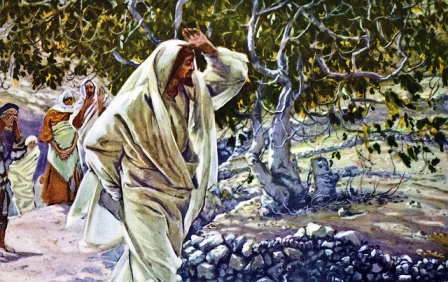
CTT | The Barren Fig Tree

Artist: J JAMES TISSOT

Artist: J JAMES TISSOT

Today, let’s take a look at the parable of the Barren Fig Tree and see if we can’t bring some context to some of the accounts that have perplexed me over the years. We will be looking through a few of the Gospel texts, but for starters, let’s turn to Luke 13.

Luke 13:1-9 (ESV)  1 There were some present at that very time who told him about the Galileans whose blood Pilate had mingled with their sacrifices. 2 And he answered them, “Do you think that these Galileans were worse sinners than all the other Galileans, because they suffered in this way? 3 No, I tell you; but unless you repent, you will all likewise perish. 4 Or those eighteen on whom the tower in Siloam fell and killed them: do you think that they were worse offenders than all the others who lived in Jerusalem? 5 No, I tell you; but unless you repent, you will all likewise perish.” 6 And he told this parable: “A man had a fig tree planted in his vineyard, and he came seeking fruit on it and found none. 7 And he said to the vinedresser, ‘Look, for three years now I have come seeking fruit on this fig tree, and I find none. Cut it down. Why should it use up the ground?’ 8 And he answered him, ‘Sir, let it alone this year also, until I dig around it and put on manure. 9 Then if it should bear fruit next year, well and good; but if not, you can cut it down.’”

Now, the ESV separates these into two different paragraphs, but for the purpose of this study I believe the two concepts go together. Jesus sets up this parable of the fig tree with a reminder of the call to repentance and the judgement that awaits all who refuse to repent. He clearly teaches that everyone is guilty of sin, not just those who seem to have received punishment while others lived. Jesus exposes the myth that those who die suddenly were being judged by God as special cases of sinfulness or offense, and those who lived where more righteous. The parable that follows this begins with a fig tree that was planted in the master’s vineyard, and for three years it bore no fruit. Judgement is coming to the barren fig tree, for the master is ready to cut it down. However, the vinedresser appeals to the master for grace, allow the tree one more year while special care is taken for the tree, fertilizer will be added. If after the year the tree still bears no fruit, then it shall be cut down. By Grace the fig tree was planted in the garden, and by the master’s Grace that tree was allowed to continue fruitlessness for three years, and by Grace it will be given another year with special attention. Judgement is coming, but by God’s Grace there is time for repentance.

In the Matthew 21, we see the account of the triumphal entry into Jerusalem. We are going to pick up in an awkward spot, so if you are unfamiliar with this passage, please read Matthew 21 in full. Here let us look at what happens when Jesus enters Jerusalem.

Matthew 21:10-32 (ESV)10 And when he entered Jerusalem, the whole city was stirred up, saying, “Who is this?” 11 And the crowds said, “This is the prophet Jesus, from Nazareth of Galilee.” 12 And Jesus entered the temple and drove out all who sold and bought in the temple, and he overturned the tables of the money-changers and the seats of those who sold pigeons. 13 He said to them, “It is written, ‘My house shall be called a house of prayer,’ but you make it a den of robbers.” 

14 And the blind and the lame came to him in the temple, and he healed them. 15 But when the chief priests and the scribes saw the wonderful things that he did, and the children crying out in the temple, “Hosanna to the Son of David!” they were indignant, 16 and they said to him, “Do you hear what these are saying?” And Jesus said to them,“Yes; have you never read,

“‘Out of the mouth of infants and nursing babies
you have prepared praise’?”

17 And leaving them, he went out of the city to Bethany and lodged there.

18 In the morning, as he was returning to the city, he became hungry. 19 And seeing a fig tree by the wayside, he went to it and found nothing on it but only leaves. And he said to it, “May no fruit ever come from you again!” And the fig tree withered at once. 20 When the disciples saw it, they marveled, saying, “How did the fig tree wither at once?” 21 And Jesus answered them, “Truly, I say to you, if you have faith and do not doubt, you will not only do what has been done to the fig tree, but even if you say to this mountain,‘Be taken up and thrown into the sea,’ it will happen. 22 And whatever you ask in prayer, you will receive, if you have faith.”

23 And when he entered the temple, the chief priests and the elders of the people came up to him as he was teaching, and said, “By what authority are you doing these things, and who gave you this authority?” 24 Jesus answered them, “I also will ask you one question, and if you tell me the answer, then I also will tell you by what authority I do these things. 25 The baptism of John, from where did it come? From heaven or from man?” And they discussed it among themselves, saying, “If we say, ‘From heaven,’ he will say to us, ‘Why then did you not believe him?’ 26 But if we say, ‘From man,’ we are afraid of the crowd, for they all hold that John was a prophet.” 27 So they answered Jesus, “We do not know.” And he said to them, “Neither will I tell you by what authority I do these things.

28 “What do you think? A man had two sons. And he went to the first and said, ‘Son, go and work in the vineyard today.’ 29 And he answered, ‘I will not,’ but afterward hechanged his mind and went. 30 And he went to the other son and said the same. And he answered, ‘I go, sir,’ but did not go. 31 Which of the two did the will of his father?” They said, “The first.” Jesus said to them, “Truly, I say to you, the tax collectors and the prostitutes go into the kingdom of God before you. 32 For John came to you in the way of righteousness, and you did not believe him, but the tax collectors and the prostitutes believed him. And even when you saw it, you did not afterward change your minds and believe him.

Now, this is a wonderful passage, filled with some extremely tense imagery. Jesus enters Jerusalem and clears out the temple of the money changers and the merchants. He rebukes them for what they have done to the House of the Lord God (for such was the Temple) and ministered to the lame and the blind, performing many wonderful works. The children sang a song of praise Hosanna to the Son of David and the Pharisees were indignant. Fig trees, planted in the Master’s vineyard as teachers and overseers of God’s people, bearing no fruit for a great many years. Jesus leaves Jerusalem and stays the night in Bethany.

When He returns to Jerusalem, He sees the barren fig tree and curses it, and it withers. Often when this passage is taught, the emphasis moves immediately to verses 20-22 to teach the power of prayer and faith and to look at “our potential” as Christians. Let’s not do that today, our focus is on the fig tree. Given our initial parable of the barren fig tree, and the events of the day prior to this morning, we are starting to see that this fig tree is a sign of unbelief. It will not be allowed to live on in selfish unrighteousness, refusing to bear fruit, forever.

Jesus enters the Temple and begins teaching. The chief priests and elders interrupt His teaching to demand that Jesus provide His credentials, by what authority and from whom did He receive said authority to do these things. These men didn’t make these demands the day prior when all where praising God, confessing Jesus as the Messiah (Son of David), or healing the lame and the blind, and they didn’t stop Him from clearing out the merchants and the money changers. No, they were indignant on that day… and then waited for the next day, when Jesus came to teach. Now, notice how Jesus responds. Is He playing coy? Absolutely not. Jesus has never denied that He was the Son of God, the promised Messiah, and He called the Lord God to be His Father. He did so the day prior, and the works He performed were a testimony of His authority to “do these things”. No, Jesus wasn’t playing coy… He was calling out the chief priests and elders, time to inspect the fruit of these trees.

Matthew 7:15-20 (ESV) | A Tree and Its Fruit
15 “Beware of false prophets, who come to you in sheep’s clothing but inwardly are ravenous wolves. 16 You will recognize them by their fruits. Are grapes gathered from thorn bushes, or figs from thistles? 17 So, every healthy tree bears good fruit, but the diseased tree bears bad fruit. 18 A healthy tree cannot bear bad fruit, nor can a diseased tree bear good fruit. 19 Every tree that does not bear good fruit is cut down and thrown into the fire. 20 Thus you will recognize them by their fruits.

You see, the chief priests and elders conferred among themselves and reasoned rightly that their answer would put them at odds with either the Messiah or with the People. For they realized that if they answered that John’s baptism was not of God, the people would revolt against them; however, if they declared John’s baptism was from God, they’d have to answer for their unbelief. They missed 2 major concepts, the first is that the problem was they needed to confess and repent of their unbelief, and the second was that in refusing to answer, they were not safe because any tree that does not bear good fruit is cut down and thrown into the fire. However, because these leaders were self-seeking, they were trees planted in the vineyard to display their own greatness in their leaves, but providing no fruit. Time and time again, God has granted to them grace and opportunity to repent. Luke records for us in the book of Acts, chapter 19, that Paul answered this question of John’s baptism to the disciples in Ephesus

Acts 19:1-7 (ESV) | Paul in Ephesus
19 And it happened that while Apollos was at Corinth, Paul passed through the inland country and came to Ephesus. There he found some disciples. 2 And he said to them, “Did you receive the Holy Spirit when you believed?” And they said, “No, we have not even heard that there is a Holy Spirit.” 3 And he said, “Into what then were you baptized?” They said, “Into John’s baptism.” 4 And Paul said, “John baptized with the baptism of repentance, telling the people to believe in the one who was to come after him, that is, Jesus.” 5 On hearing this, they were baptized in the name of the Lord Jesus. 6 And when Paul had laid his hands on them, the Holy Spirit came on them, and they began speaking in tongues and prophesying. 7 There were about twelve men in all.

John baptized with the baptism of repentance. Let us look to John’s baptism, of which Jesus tested the chief priests and elders at the Temple.

Matthew 3:1-12 (ESV) | John the Baptist Prepares the Way
1 In those days John the Baptist came preaching in the wilderness of Judea, 2 “Repent, for the kingdom of heaven is at hand.” 3 For this is he who was spoken of by the prophet Isaiah when he said,

“The voice of one crying in the wilderness:
‘Prepare the way of the Lord;
make his paths straight.’”

4 Now John wore a garment of camel’s hair and a leather belt around his waist, and his food was locusts and wild honey. 5 Then Jerusalem and all Judea and all the region about the Jordan were going out to him, 6 and they were baptized by him in the river Jordan, confessing their sins. 7 But when he saw many of the Pharisees and Sadducees coming to his baptism, he said to them, “You brood of vipers! Who warned you to flee from the wrath to come? 8 Bear fruit in keeping with repentance. 9 And do not presume to say to yourselves, ‘We have Abraham as our father,’ for I tell you, God is able from these stones to raise up children for Abraham. 10 Even now the axe is laid to the root of the trees. Every tree therefore that does not bear good fruit is cut down and thrown into the fire.

11 “I baptize you with water for repentance, but he who is coming after me is mightier than I, whose sandals I am not worthy to carry. He will baptize you with the Holy Spirit and fire. 12 His winnowing fork is in his hand, and he will clear his threshing floor and gather his wheat into the barn, but the chaff he will burn with unquenchable fire.”

Praise God. Repent, for the Kingdom of God is here. Bear fruit in keeping with repentance. Don’t presume that you are safe simply because God planted you in His vineyard (tying this thought in with our parable), for if you do not bear fruit in keeping with repentance, you will be cut down and thrown into the fire. Amen.

As Christians, we must bear the fruit of repentance. This is what taking our crosses daily and denying ourselves looks, when we remember (in active form) that we are sinful beings in need of a Savior. Repent, for the Kingdom of God is near. There is no “moving beyond the Gospel”, it is an ever present place of rest. It is also our mission, to preach the Gospel to all of creation, so that those who hear the Word of God might obtain Faith, confess their sin, and repent from their sinful ways and trust in Christ Jesus, the Way, the Truth, and the Life.

John 6:27-29 (ESV)27 Do not work for the food that perishes, but for the food that endures to eternal life, which the Son of Man will give to you. For on him God the Father has set his seal.” 28 Then they said to him, “What must we do, to be doing the works of God?” 29 Jesus answered them, “This is the work of God, that you believe in him whom he has sent.

1 John 5:9-11 (ESV)9 If we receive the testimony of men, the testimony of God is greater, for this is the testimony of God that he has borne concerning his Son. 10 Whoever believes in the Son of God has the testimony in himself. Whoever does not believe God has made him a liar, because he has not believed in the testimony that God has borne concerning his Son. 11 And this is the testimony, that God gave us eternal life, and this life is in his Son.

Amen. Bear the fruit of repentance, and believe in and confess the Son of God before mankind. Remain in Him, and trust that the Holy Spirit will bear fruit in you as you grow in Him, and you will never be cut away nor cast into the fire. The chief priests, the elders, the Sadducees and Pharisees did not repent, nor did they believe in the Son, and they were cut off.

In the last parable of the 2 sons, we see clearly that all who were lost and came to repentance are like the first son who defied their father, but later obeyed. The second son was the one who professed with his mouth to obey the father, but rejected his authority and commandments and did what was wrong in the end. He represents those chosen by God to be overseers and spiritual leaders who rejected the Law (instead honoring commandments of men that were self-serving) and the Gospel of Jesus Christ.

Matthew 21:31-32 (ESV) 31 Which of the two did the will of his father?” They said, “The first.” Jesus said to them,“ Truly, I say to you, the tax collectors and the prostitutes go into the kingdom of God before you. 32 For John came to you in the way of righteousness, and you did not believe him, but the tax collectors and the prostitutes believed him. And even when you saw it, you did not afterward change your minds and believe him.

The tax collectors and the prostitutes were among those who confessed their sins and repented in John’s baptism, thereby entering the kingdom of God before the Pharisees. And even after seeing the Gospel reach the lowly sinner, they still did not later change their minds and believe.

May the God the Holy Spirit minister to your hearts today and bring His Word to life and grant you understanding and wisdom and increase your faith. In the Name of Our Lord Jesus Christ, Amen.

In Christ Jesus,
Jorge

DiM | “Overwhelmed” by Big Daddy Weave

Today is “Discernment in Music” (DiM) day here at Faithful Stewardship.

2 Corinthians 10:4-6 (ESV)
4 For the weapons of our warfare are not of the flesh but have divine power to destroy strongholds. 5 We destroy arguments and every lofty opinion raised against the knowledge of God, and take every thought captive to obey Christ, 6 being ready to punish every disobedience, when your obedience is complete.

Today I wanted to take a look at the #7 song on K-Love’s top songs chart dated September 21. The song is Overwhelmed by Big Daddy Weave. I skipped over songs #5 and #6 because as soon as I saw the list I was already singing the chorus to Overwhelmed in my head. Let us begin with a refresher for those who might not have heard this song on the radio:

There is a portion at the end where children can be heard singing something in Swahili. Thanks to one of the comments on the video (and Google translate) those lyrics and their meaning are as follows:

wewe ni mzuri, wewe ni waajabu
You are beautiful, you are the extraordinary.

Wewe ni mtukufu, wewe ni mfalme wangu
You are exalted, you are my king

Overwhelmed | Lyrics (via Big Daddy Weave Website)

(Music & Lyrics: Mike Weaver / Phil Wickham)
I see the work of Your Hands
Galaxies spin in a Heavenly dance oh God
All that You are is so overwhelming

I hear the sound of Your Voice
All at once it’s a gentle and thundering noise oh God
All that You are is so overwhelming

I delight myself in You
Captivated by Your beauty
I’m overwhelmed, I’m overwhelmed by You

God, I run into Your arms
Unashamed because of mercy
I’m overwhelmed, I’m overwhelmed by You

I know the power of Your Cross
Forgiven and free forever You’ll be my God

All that You’ve done is so overwhelming
I delight myself in You
In the Glory of Your Presence
I’m overwhelmed, I’m overwhelmed by You

God, I run into Your arms
Unashamed because of mercy
I’m overwhelmed, I’m overwhelmed by You

You are Beautiful, You are Beautiful
Oh God, there is no one more Beautiful
You are Beautiful, God you are the most Beautiful

You are Wonderful, You are Wonderful
Oh God, there is no one more Wonderful
You are Wonderful, God You are the most Wonderful

You are Glorious, You are Glorious
Oh God, there is no one more Glorious
You are Glorious, God you are the most Glorious

Positive Elements

This song is more pointed at the God of the Bible than some of the songs we’ve reviewed. The first stanza identifies the object of worship as God, the Creator of the Universe.

Psalm 102:25-28 (ESV)
25 Of old you laid the foundation of the earth,
and the heavens are the work of your hands.
26 They will perish, but you will remain;
they will all wear out like a garment.
You will change them like a robe, and they will pass away,
27     but you are the same, and your years have no end.
28 The children of your servants shall dwell secure;
their offspring shall be established before you.

The next stanza starts a bit oddly. “I hear the sound of your voice…” could be artistic license or it could be leaning toward mysticism. We’ll put that thought on hold for a bit and continue on to acknowledge that there is a reference to both the gentle voice of God and the thundering voice of God. That’s positive, because throughout the Old Testament we see God speaking to His Anointed in large and small ways, by audible voice and by the Written Word. The children of Israel were frightened by the Voice of God at Horeb, and insisted that Moses go speak with God on their behalf. Being overwhelmed by the Creator of the Universe is a good thing, just as being overwhelmed by the fear of the Lord was a good thing at Horeb. In fact, let’s look at passage. Moses is recounting to the people of Israel how God spoke to them the 10 Commandments at Horeb.

Deuteronomy 5:22-29 (ESV) 22 “These words the Lord spoke to all your assembly at the mountain out of the midst of the fire, the cloud, and the thick darkness, with a loud voice; and he added no more. And he wrote them on two tablets of stone and gave them to me. 23 And as soon as you heard the voice out of the midst of the darkness, while the mountain was burning with fire, you came near to me, all the heads of your tribes, and your elders. 24 And you said, ‘Behold, the Lord our God has shown us his glory and greatness, and we have heard his voice out of the midst of the fire. This day we have seen God speak with man, and man still live. 25 Now therefore why should we die? For this great fire will consume us. If we hear the voice of the Lord our God any more, we shall die. 26 For who is there of all flesh, that has heard the voice of the living God speaking out of the midst of fire as we have, and has still lived? 27 Go near and hear all that the Lord our God will say, and speak to us all that the Lord our God will speak to you, and we will hear and do it.’

28 “And the Lord heard your words, when you spoke to me. And the Lord said to me, ‘I have heard the words of this people, which they have spoken to you. They are right in all that they have spoken. 29 Oh that they had such a heart as this always, to fear me and to keep all my commandments, that it might go well with them and with their descendants forever!

Being overwhelmed by God is a good thing, and oh that we had such a heart always, to fear God and to keep all His commandments. Which brings us to the chorus. The idea of delighting in God is one that we see reflected in the Psalms. However, this song doesn’t quite complete the thought like the Psalms did, because this song keeps it in sort of vague, mystical sense of delighting in God directly, delighting in His presence and running into His arms. While it makes for strong emotive poetry, it falls short of actually providing something we can do. Let’s see how the Psalmist completes the thought.

Psalm 119:9-16 (ESV)
9 How can a young man keep his way pure?
By guarding it according to your word.
10 With my whole heart I seek you;
 let me not wander from your commandments!
11 I have stored up your word in my heart,
that I might not sin against you.
12 Blessed are you, O Lord;
teach me your statutes!
13 With my lips I declare
all the rules of your mouth.
14 In the way of your testimonies I delight
    as much as in all riches.
15 I will meditate on your precepts
and fix my eyes on your ways.
16 I will delight in your statutes;
I will not forget your word.

So we see that the aim of our delight in Him is by keeping His Word in our hearts. Why is this important? Because there are many false religions who seek oneness with gods in creation without acknowledging the One True God and Creator of the Universe, for they reject His Word. What ends up happening is they fall into idolatry of the created over the Creator, or in the idolatry of self-worship. Delighting in God must be according to His Word and not left to our imaginations, impressions, or emotions alone. The line, “God, I run into Your arms” needs to be understood as Repentance and prayer, not just singing this song and praying for answers. I’m not sure if that is what the writers of the song intended, but that is the only way this song stays doctrinally sound. We are called to remain in the Lord, and as the Psalmist says by guarding our way according to His Word is the only way we can keep our way pure. So any notion that we have of running into the arms of the Lord must coincide with the need to repent from prior drifting or running away from Him, which is Sin. Repentance is also the way in which we practice running into the arms of God. Once we’ve repented from sin, then the next line “Unashamed because of mercy” holds true, because of His Great Mercy we are forgiven when we confess our sins and repent from them.

The second verse is really only one stanza, and then a return to the Chorus. This third stanza gives us a much-needed reference to the Cross of Jesus Christ. This is the mercy and grace of our Lord Jesus Christ, that He bore our sins, iniquities, and the full penalty of our unrighteousness on the cross.

Concerns

Our goal here is to practice Biblical discernment in the songs we hear played on the radio (maybe even sing along with) so that we are fully aware of what we are filling our hearts and minds with. The primary concern with this song is in the open door to a mystical interpretation of delighting in God’s Presence (presence theology like that taught at Bethel). The modern-day evangelical church has been flooded by New Age Mysticism that seeks to skip over the Written Word of God and dive right into “experiencing” supernatural communion and presence and imparting spiritual wisdom apart from the Bible. It is woefully dangerous theology and false doctrine. The Bible warns us time and time again not to accept false gods, false spirits, or doctrines of demons. Even from the Law the test of a true Prophet involved more than simply whether or not a sign or wonder was performed… but what they taught was to be scrutinized and examined for Truth. For the Law was a testimony of God. Moses and the Prophets testified of the Messiah to come, Jesus Christ, and God the Holy Spirit testifies of the Christ who came, died, ascended, and is returning to judge both the living and the dead. Do not skip the Written Word of God hoping to ascend into heavenly existence via mystical short-cuts, and do not listen to those who claim to teach such methods.

You might be thinking, “wow, I don’t see any of that in this song.” One of the methods taught by the 3rd Century Roman Catholic Mystics was to chant a word of scripture or phrase over, and over, and over again… to enter into a trance-like state until supposedly the hidden secret meaning of the scripture would be revealed. That is not what the Bible teaches. So when so much of this song is devoted to repetition, it makes me nervous. Also, having grown up in a lot of the “presence” approach to worship, I know that the intended purpose of these lyrics is to allow the music team to run these lines on repeat until “something happens” or “the spirit moves among the people”.

Conclusion

This song is a decent song in that it almost stands on its own.  Proper understanding of the fear of the Lord, and how we are to delight in Him is required to keep this song in its proper place. That prayerful confession and repentance from sin is how we are to “run into His arms”. It does seem to have been written in a way that it could be used by liberal, seeker-mergent, mystical forms of worship, so the context of this song being played is important. I enjoy hearing it my car and humming along as I go about my day, because I’m not engaging in mysticism, merely thinking about just how overwhelming our God is, His Holiness and His Grace that He should love a wretch like me. Whenever you hear this song played on the radio, it is my hope that you will be reminded to delight in God’s Word, in His Testimonies, in His Statutes, in His Commandments, and most importantly in His Son, Jesus, who lived, died, and rose again and is returning soon.

Jude 1:24-25 (ESV)
24 Now to him who is able to keep you from stumbling and to present you blameless before the presence of his glory with great joy, 25 to the only God, our Savior, through Jesus Christ our Lord, be glory, majesty, dominion, and authority, before all time and now and forever. Amen.

In Christ Jesus,
Jorge

“My Grace is Sufficient”

imagesToday, I wanted to look at closing up yesterday’s discussion, especially for those who struggle with the notion that “soul ties” aren’t biblical. If “soul ties” aren’t the answer, what is? The simple answer is, “the Grace of God”. Let us begin by looking to the Apostle Paul for some insight, because Paul often taught regarding the dual nature of Christians as being both sinner and saint. In his second letter to the Corinthians, Paul shares a personal plea to God and God’s answer to Paul should give us encouragement and comfort.

2 Corinthians 12:1-10 (ESV) | Paul’s Visions and His Thorn
1 I must go on boasting. Though there is nothing to be gained by it, I will go on to visions and revelations of the Lord. 2 I know a man in Christ who fourteen years ago was caught up to the third heaven—whether in the body or out of the body I do not know, God knows. 3 And I know that this man was caught up into paradise—whether in the body or out of the body I do not know, God knows— 4 and he heard things that cannot be told, which man may not utter. 5 On behalf of this man I will boast, but on my own behalf I will not boast, except of my weaknesses— 6 though if I should wish to boast, I would not be a fool, for I would be speaking the truth; but I refrain from it, so that no one may think more of me than he sees in me or hears from me. 7 So to keep me from becoming conceited because of the surpassing greatness of the revelations, a thorn was given me in the flesh, a messenger of Satan to harass me, to keep me from becoming conceited. 8 Three times I pleaded with the Lord about this, that it should leave me. 9 But he said to me, “My grace is sufficient for you, for my power is made perfect in weakness.” Therefore I will boast all the more gladly of my weaknesses, so that the power of Christ may rest upon me. 10 For the sake of Christ, then, I am content with weaknesses, insults, hardships, persecutions, and calamities. For when I am weak, then I am strong.

If this reference to boasting seems a bit awkward, in the previous chapter Paul is calling out the false apostles (sarcastically calling them ‘super apostles’), particularly pointing out their abuse, their boasting, and their financial exploitation of the Corinthians. Paul closed out the previous chapter boasting, so to speak, in his afflictions and hard work on their behalf rather than take from them, and he continues here boasting in a way that demonstrates that while the false apostles boasted illegitimately, Paul could boast all the more. Paul is one of the few who have ever been taking up into heaven (as a point of clarification, no one since Revelation has been shown heaven for the purpose of revealing or teaching the Church about it, and no one who claims to share details of Heaven is legitimate).

This thorn in the flesh that was given to Paul was given for a specific purpose, it was allowed to afflict Paul “so to keep him from becoming conceited because of the surpassing greatness of the revelations of heaven“. So, not only do we NOT get a detailed description of what Paul saw in Heaven, he was also allowed a tormentor, a messenger of Satan, to keep him from becoming conceited. You and I don’t need a thorn in our flesh, for our flesh is thorny enough on its own. Neither of us have been established as Apostles of Jesus Christ, and neither of us (I say with a great deal of confidence) have been taking up into Heaven. Notice here that if anyone had a special claim on an anointing from God the Holy Spirit, Paul did. If anyone could teach with authority the Word of Faith (WoF) doctrine, it would be Paul. But he doesn’t. We see here that he prayed three times to God that the thorn in his flesh, the harasser from Satan, be taken away from him, and God’s response wasn’t “you haven’t prayed the right prayer yet”, or “you still lack faith”, or even “this is to make you stronger”… no, God’s reply was simply

“My Grace is sufficient for you, for My power is made perfect in weakness”

We don’t have thorns placed in our flesh, but we must contend with the flesh nonetheless. Our flesh desires sin, it chases after sin. This thorn was above and beyond Paul’s flesh, and still the answer from God was, “My grace is sufficient for you…”.

How many times have you prayed and longed for God to miraculously remove your fleshly desire to…

  • lust after scantily clad women…
  • drown sorrow or pain in food or drink…
  • take just one more dose to remove the edge…
  • covet a neighbor’s lifestyle, possession, or spouse…

In all of these things, and all the other temptations of the flesh… your flesh… the flesh that wages war against the Spirit, the flesh that desires sin even when un-prompted by an outside agent (be it a person or an unclean spirit), the answer from God the Holy Spirit remains

“My Grace is sufficient for you, for My power is made perfect in weakness”

Can God the Holy Spirit miraculously heal addictions and mental illness? Yes. God was not incapable of removing the thorn in Paul’s flesh, and every demon and unclean spirit obeyed the commands of Jesus. The Sovereignty of God rests not only in His power, but in His Will as well. As we see in the book of Job, His Will isn’t always fully revealed to us, either. Nevertheless, we know that He works all things for good. All things… for good.

Romans 8:18-39 (ESV) | Future Glory
18 For I consider that the sufferings of this present time are not worth comparing with the glory that is to be revealed to us. 19 For the creation waits with eager longing for the revealing of the sons of God. 20 For the creation was subjected to futility, not willingly, but because of him who subjected it, in hope 21 that the creation itself will be set free from its bondage to corruption and obtain the freedom of the glory of the children of God. 22 For we know that the whole creation has been groaning together in the pains of childbirth until now. 23 And not only the creation, but we ourselves, who have the first-fruits of the Spirit, groan inwardly as we wait eagerly for adoption as sons, the redemption of our bodies. 24 For in this hope we were saved. Now hope that is seen is not hope. For who hopes for what he sees? 25 But if we hope for what we do not see, we wait for it with patience.

26 Likewise the Spirit helps us in our weakness. For we do not know what to pray for as we ought, but the Spirit himself intercedes for us with groanings too deep for words.27 And he who searches hearts knows what is the mind of the Spirit, because the Spirit intercedes for the saints according to the will of God. 28 And we know that for those who love God all things work together for good, for those who are called according to his purpose. 29 For those whom he foreknew he also predestined to be conformed to the image of his Son, in order that he might be the firstborn among many brothers. 30 And those whom he predestined he also called, and those whom he called he also justified, and those whom he justified he also glorified.

31 What then shall we say to these things? If God is for us, who can be against us? 32 He who did not spare his own Son but gave him up for us all, how will he not also with him graciously give us all things? 33 Who shall bring any charge against God’s elect? It is God who justifies. 34 Who is to condemn? Christ Jesus is the one who died—more than that, who was raised—who is at the right hand of God, who indeed is interceding for us. 35 Who shall separate us from the love of Christ? Shall tribulation, or distress, or persecution, or famine, or nakedness, or danger, or sword? 36 As it is written,

“For your sake we are being killed all the day long;
we are regarded as sheep to be slaughtered.”

37 No, in all these things we are more than conquerors through him who loved us. 38 For I am sure that neither death nor life, nor angels nor rulers, nor things present nor things to come, nor powers, 39 nor height nor depth, nor anything else in all creation, will be able to separate us from the love of God in Christ Jesus our Lord.

Paul is not talking about avoiding pain, or tribulation, or distress, or persecution, he is pointing to the promise of the Gospel of Jesus Christ. There are several verses that are pulled from this passage to push the WoF “declare victory now” over-realized eschatology, but when read in-context we know that the hope that lies ahead is far greater than our present circumstances. There will come a day when all of creation will be set free from its bondage to corruption, including our flesh. That nothing that “goes wrong” down here has any lasting consequences and that any suffering we might endure on this earth is not fit to be compared to the Glory that awaits us in Christ Jesus.

In this life we will face struggles, from outside agents and from our own fleshly desires, for it is corrupt. We must take up our crosses daily, and we must resist temptation and flee sexual immorality. But we are weak, and the Spirit of God helps us in our weakness. When we are weak, He is strong.

“My Grace is sufficient for you, for My power is made perfect in weakness”

The Grace of God is that He gave His One and Only Son Jesus to die on the cross as payment for our sin. Sin still has consequences in this life, and our flesh is corrupt.

Galatians 6:7-9 (ESV) 7 Do not be deceived: God is not mocked, for whatever one sows, that will he also reap. 8 For the one who sows to his own flesh will from the flesh reap corruption, but the one who sows to the Spirit will from the Spirit reap eternal life. 9 And let us not grow weary of doing good, for in due season we will reap, if we do not give up.

This isn’t about lawlessness and carnal living without consequences. This is about understanding that while we live in these fallen earthly bodies, we will sin. Our very flesh wars against our Spirit, compelling us to sin. Think of it in terms of addiction… only rather than being limited to a particular sin (drunkenness, gluttony, sexual immorality, etc.) our flesh is addicted to self-seeking, self-gratification (as a goal), and all manner of sin. The Grace of God brings our spirit to life, pulled out of the kingdom of darkness and sealed by the Holy Spirit for the Day of Christ’s Return. We must walk in the Spirit, resist the devil, and crucify our flesh daily. As Paul described it in Romans 6, we are to consider ourselves dead to sin, and alive to God, being slaves to righteousness. But we do so without condemnation, for the Grace of the Cross says that it is by His Blood we have been made righteous, not by our actions.

I pray that each of you will be set free from addictions and habitual sins. When you are going through the storm of temptation, trust in Him. The desire will be there, because your flesh craves sin, but know that the Spirit wages war against the flesh. There is no hidden secret to making the desire just go away. Trust in the Lord, God the Holy Spirit living inside of you to make a way of escape. Temptations will come… and often they come from within your very flesh. That will not always be the case. Sanctification is a life-long process, as we learn to live according to the Spirit and not according to the flesh. Press on toward the goal of the upward call of God, the Great Day of His Return. In the meantime, do not be ensnared by condemnation by the accuser. Remember the cross, remember the Grace of God, for His Grace is sufficient, and His power is made perfect in our weakness.

1 John 1 (ESV) 1 That which was from the beginning, which we have heard, which we have seen with our eyes, which we looked upon and have touched with our hands, concerning the word of life— 2 the life was made manifest, and we have seen it, and testify to it and proclaim to you the eternal life, which was with the Father and was made manifest to us— 3 that which we have seen and heard we proclaim also to you, so that you too may have fellowship with us; and indeed our fellowship is with the Father and with his Son Jesus Christ. 4 And we are writing these things so that our joy may be complete. 5 This is the message we have heard from him and proclaim to you, that God is light, and in him is no darkness at all. 6 If we say we have fellowship with him while we walk in darkness, we lie and do not practice the truth. 7 But if we walk in the light, as he is in the light, we have fellowship with one another, and the blood of Jesus his Son cleanses us from all sin. 8 If we say we have no sin, we deceive ourselves, and the truth is not in us. 9 If we confess our sins, he is faithful and just to forgive us our sins and to cleanse us from all unrighteousness. 10 If we say we have not sinned, we make him a liar, and his word is not in us.

May the peace of God reign in your hearts this day and every day,
In Christ Jesus,
Jorge