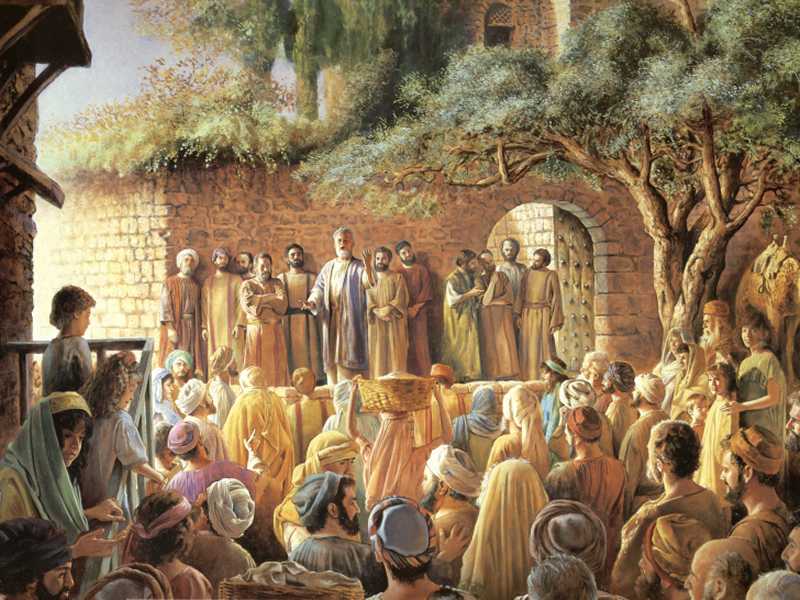
I tried to find the original of this image for proper citation, if you know the artist or title of this work please inform me.
I’ve made references to Peter’s first sermon a few times in prior posts, and today I thought it would be awesome to take a look at this first sermon preached by Peter. Our text will be Acts 2. If you’ve been following our bible studies here, you should remember that Acts 2 begins with the promise of God the Holy Spirit being poured out on the day of Pentecost. The Day of Pentecost is not a “new testament” thing, it is in-fact a Jewish celebration of the Feast of Weeks (Leviticus 23:15-22). Pentecost is the Greek word (the fiftieth day) referring to this Hebrew Festival. This festival is particularly important, because it was listed as one of the 3 festivals that all Jewish men were required to appear before the Lord God of Israel (Exodus 34:22-23), which by the time Jesus arrived on the earth, the Lord God had already declared His presence to be made at the Temple in Jerusalem. Therefore, all Jewish men had to make pilgrimage to Jerusalem 3 times a year, one of these times is for the Feast of Weeks, or Pentecost (in Greek). Jews from around the world were in Jerusalem to appear before the Lord God of Israel for Pentecost. It is on this day, that the Promise of God the Holy Spirit as spoken by Jesus Christ, was delivered. The first Gift of God the Holy Spirit manifested is the gift of different tongues/languages so that the men from all over the world would hear the Glory of God proclaimed in their native tongues, not just in Galilean Aramaic. So, Peter’s first sermon was not to Gentiles, it was to Jews. Devout, learned Jews who were observing the Feast of Weeks in keeping with the Law of Moses. These were not strangers to the Law or of the Prophets, they were familiar with the Holy Scriptures. However, in their knowledge, the did not recognize Jesus of Nazareth as the Christ, the Messiah. So, Peter’s first audience was a tough one. Thank God for His Holy Spirit. Now that we’ve set the stage, let us take a look at his sermon:
14 But Peter, standing with the eleven, lifted up his voice and addressed them: “Men of Judea and all who dwell in Jerusalem, let this be known to you, and give ear to my words. 15 For these people are not drunk, as you suppose, since it is only the third hour of the day. 16 But this is what was uttered through the prophet Joel:
17 “‘And in the last days it shall be, God declares,
that I will pour out my Spirit on all flesh,
and your sons and your daughters shall prophesy,
and your young men shall see visions,
and your old men shall dream dreams;
18 even on my male servants and female servants
in those days I will pour out my Spirit, and they shall prophesy.
19 And I will show wonders in the heavens above
and signs on the earth below,
blood, and fire, and vapor of smoke;
20 the sun shall be turned to darkness
and the moon to blood,
before the day of the Lord comes, the great and magnificent day.
21 And it shall come to pass that everyone who calls upon the name of the Lord shall be saved.’
I just wanted to take a moment to highlight that Peter is quoting from Joel 2:28-32. This prophecy starts in Joel 1:1 and runs throughout the book of Joel. It is all one prophecy. Peter is quoting the portion that rests between the Lord taking pity on His people, and sitting in Judgment over the nations. These are the last days in which we find ourselves, for the Lord had taken pity upon His creation and gave to us the ultimate sacrifice for the remission of sin, the Gospel of Jesus Christ, the Gift of God. We also await the day of His Glorious return, when He will redeem all who have called upon the Name of the Lord and He will sit in Judgment over creation. Why did Peter go to Joel first? Well, clearly the God the Holy Spirit was giving Peter the words to speak in that very hour (as Jesus told the disciples would happen), but notice the entrance into this sermon comes as a response to the accusations against the manifestation of the Gift of the Holy Spirit as mere drunkenness. The first visit to Scripture is a clear statement of the outpouring of the Holy Spirit as foretold by Joel (who prophesied by the Spirit of God). Peter was also clearly marking the present age, the need for repentance and acceptance of the gift of God and the need to do so before the coming judgement. The book of Joel is not long, and I encourage you to take some time to read through it. However, let us continue for now in Peter’s sermon.
22 “Men of Israel, hear these words: Jesus of Nazareth, a man attested to you by God with mighty works and wonders and signs that God did through him in your midst, as you yourselves know— 23 this Jesus, delivered up according to the definite plan and foreknowledge of God, you crucified and killed by the hands of lawless men. 24 God raised him up, loosing the pangs of death, because it was not possible for him to be held by it. 25 For David says concerning him,
“‘I saw the Lord always before me,
for he is at my right hand that I may not be shaken;
26 therefore my heart was glad, and my tongue rejoiced;
my flesh also will dwell in hope.
27 For you will not abandon my soul to Hades,
or let your Holy One see corruption.
28 You have made known to me the paths of life;
you will make me full of gladness with your presence.’29 “Brothers, I may say to you with confidence about the patriarch David that he both died and was buried, and his tomb is with us to this day. 30 Being therefore a prophet, and knowing that God had sworn with an oath to him that he would set one of his descendants on his throne, 31 he foresaw and spoke about the resurrection of the Christ, that he was not abandoned to Hades, nor did his flesh see corruption. 32 This Jesus God raised up, and of that we all are witnesses. 33 Being therefore exalted at the right hand of God, and having received from the Father the promise of the Holy Spirit, he has poured out this that you yourselves are seeing and hearing. 34 For David did not ascend into the heavens, but he himself says,
“‘The Lord said to my Lord,
“Sit at my right hand,
35 until I make your enemies your footstool.”’36 Let all the house of Israel therefore know for certain that God has made him both Lord and Christ, this Jesus whom you crucified.”
37 Now when they heard this they were cut to the heart, and said to Peter and the rest of the apostles, “Brothers, what shall we do?” 38 And Peter said to them, “Repent and be baptized every one of you in the name of Jesus Christ for the forgiveness of your sins, and you will receive the gift of the Holy Spirit. 39 For the promise is for you and for your children and for all who are far off, everyone whom the Lord our God calls to himself.” 40 And with many other words he bore witness and continued to exhort them, saying, “Save yourselves from this crooked generation.” 41 So those who received his word were baptized, and there were added that day about three thousand souls.
Amen. Peter points out that the Jews were guilty of putting Jesus to death, by the hands of lawless men (Romans). Once Peter explained in Scriptures that the Jews were witness to the outpouring of the Holy Spirit, he then moved to identifying Jesus as the Christ. When he quotes from the Psalms of David, he first goes to Psalm 16. I have to be honest, had I read this Psalm without knowing Peter’s interpretation of the Psalm, I wouldn’t have read it as a prophetic Psalm about Jesus. However, Peter makes it clear that since David’s body did see corruption (his body rotted in the grave), it wasn’t about himself that he was speaking; rather, David was referring to the death and resurrection of Jesus Christ. So awesome. The new testament provides us with clear insight into how we should read the old testament to see Jesus (not ourselves, because the bible is not about us).
The next Psalm Peter visits is Psalms 110. Here, however, Peter quotes the introduction to the Psalm. Read the rest of the Psalm, because David is again prophesying of Jesus but he is doing so regarding the Day of Judgement, the Day of Christ’s Return. So, again, we have Peter explaining from scriptures that we find ourselves in the last days, between the salvation of the Lord and His Judgement. Notice, in verse 37, that all who heard these words understood the gravity of what was being taught and their guilt was before them, something they dare not proceed into judgement with, “Brothers, what shall we do?” Peter’s response is great direct and powerful. He also returns to the initial point of the sermon, the outpouring of the Holy Spirit. They don’t have to wait, because they (as are we all) are in the last days when the Spirit of God is poured out.
Peter preaches the Gospel of Jesus Christ from the Scriptures, clearly identifies their sin and need of a Savior (these being folks who follow the Law and the Prophets, not a Godless group of people, but one still perishing nonetheless for they have not yet believed in Jesus as the Christ) and then offers them the Way of escape. He also is quick to relay the promise of God the Holy Spirit. The disciples had just received the very gift that Jesus instructed them to wait for and they knew immediately that this Gift was promised to all who believe and are baptized in the Name of the Lord Jesus Christ.
That same Holy Spirit that gave Peter the words to speak, lives within each of us who call upon the Name of the Lord and have our names written in the Lamb’s book of life. We may not move as powerfully in the Holy Spirit, but I think that is due to a lack of knowledge of the Scriptures, and poor discipleship. Peter walked with the Son of God for years. That’s powerful discipleship. We have a great deal of it, but we don’t have all of what Jesus did (John 21:25), so we don’t have the fullness by which the 12 Apostles were taught. Remember in John 14:26 that the Holy Spirit is promised to both teach and remind them of all that Jesus had said to them. That is critical for us to have the New Testament written, but also as a promise to us that He will remind us of His Word that we have buried in our hearts (Psalms 119:9-16).
Brothers and sisters, please become life-long students of the Word of God. Pray in the Spirit, always, AND edify your mind by drinking in the written Word of God. If you look around the web, you’ll see that gallop estimates that 40% of Americans attend church daily. However, a Hartford Institute of Religion study indicates that only half of those are telling the truth. But that is only the tip of the iceberg, so to speak. If 20% attend church weekly, how much of each service is actually devoted to studying and exegeting properly the Word of God? If the typical Sunday morning service runs from 10:30am to Noon, with the first 45 minutes of a concert, 10 minutes of announcements, intro videos, skits, collecting of tithe/offerings, that leaves roughly 30 minutes for a sermon. Now, what if the sermon is geared more toward sloganeering of a self-help book, or casting the vision of the pastor rather than teaching the text of the Bible? It can become all to easy to lose sight of the Word of God even while conducting the business of church. I pray your church experience is nothing like what I’ve detailed above. Still, even if that 1.5 hrs of Sunday Morning church were devoted to biblical study, it wouldn’t be enough. That is why I am so eager to share what I am studying throughout the week, and am so excited that you are reading here today. Even if you disagree with everything I write, at least you are reading the Word of God that is copy-and-pasted into these posts and hopefully following the external links to bible references. 😉
In closing, I’d like to echo Paul’s benediction from 2 Thessalonians 3:16 (ESV) “Now may the Lord of peace himself give you peace at all times in every way. The Lord be with you all.”
In Him,
Jorge
 Faithful Stewardship
You must be logged in to post a comment.