Delegation of Authority: The Holy Spirit

dove

…the Holy Spirit descended upon Him in bodily form like a dove…
(Luke Chapter 3)

When we last spoke about how Authority had been delegated to Adam, and that God did not take it back immediately when Adam sinned, I couldn’t leave it alone without pointing out that one of the many awesome truths of the purpose that Jesus came to fulfill was in taking the Authority that man forfeited. We looked at how Jesus had to be born a man, but not from man’s seed (to inherit sin), so the virgin birth was required so that Jesus (the Word Made Flesh) could come and lay down His life:

John 10:11-18 (ESV) 11 I am the good shepherd. The good shepherd lays down his life for the sheep. 12 He who is a hired hand and not a shepherd, who does not own the sheep, sees the wolf coming and leaves the sheep and flees, and the wolf snatches them and scatters them. 13 He flees because he is a hired hand and cares nothing for the sheep. 14 I am the good shepherd. I know my own and my own know me, 15 just as the Father knows me and I know the Father; and I lay down my life for the sheep. 16 And I have other sheep that are not of this fold. I must bring them also, and they will listen to my voice. So there will be one flock, one shepherd. 17 For this reason the Father loves me, because I lay down my life that I may take it up again. 18 No one takes it from me, but I lay it down of my own accord. I have authority to lay it down, and I have authority to take it up again. This charge I have received from my Father.”

Praise the Lord! Notice here, that Jesus clearly states His purpose, His Authority, and that He received it from God the Father. Now, remember that our charge is given to us in the Great Commission, but let’s look at it again in Matthew:

Matthew 28:16-20 (ESV) 16 Now the eleven disciples went to Galilee, to the mountain to which Jesus had directed them. 17 And when they saw him they worshiped him, but some doubted. 18 And Jesus came and said to them, “All authority in heaven and on earth has been given to me. 19 Go therefore and make disciples of all nations, baptizing them in the name of the Father and of the Son and of the Holy Spirit, 20 teaching them to observe all that I have commanded you. And behold, I am with you always, to the end of the age.”

Notice the “therefore”. A cute little saying I heard growing up in Sunday School regarding taking the time to understand the context of scriptures was, What’s the ‘therefore’ there for? Here, it is telling us that our charge to Go and make disciples of all nations… is based in the fact that All authority in heaven and on earth has been given to Jesus… who is then giving us the charge to Go…

Now, let’s talk about the Holy Spirit. In the book of John, we see Jesus making several attempts at preparing the disciples for what was about to take place (crucifixion, resurrection, & ascension). In hindsight, we can see that Jesus was speaking quite plainly. But He knew (and said as much) that they just wouldn’t understand what He was telling them. Let’s take a look at the promise of Jesus to send a Helper:

John 15:18-27 (ESV) 18 “If the world hates you, know that it has hated me before it hated you. 19 If you were of the world, the world would love you as its own; but because you are not of the world, but I chose you out of the world, therefore the world hates you. 20 Remember the word that I said to you: ‘A servant is not greater than his master.’ If they persecuted me, they will also persecute you. If they kept my word, they will also keep yours. 21 But all these things they will do to you on account of my name, because they do not know him who sent me. 22 If I had not come and spoken to them, they would not have been guilty of sin, but now they have no excuse for their sin. 23 Whoever hates me hates my Father also. 24 If I had not done among them the works that no one else did, they would not be guilty of sin, but now they have seen and hated both me and my Father. 25 But the word that is written in their Law must be fulfilled: ‘They hated me without a cause.’ 26 “But when the Helper comes, whom I will send to you from the Father, the Spirit of truth, who proceeds from the Father, He will bear witness about Me. 27 And you also will bear witness, because you have been with me from the beginning.

John 16:1-15(ESV) 1 “I have said all these things to you to keep you from falling away. 2 They will put you out of the synagogues. Indeed, the hour is coming when whoever kills you will think he is offering service to God. 3 And they will do these things because they have not known the Father, nor me. 4 But I have said these things to you, that when their hour comes you may remember that I told them to you. “I did not say these things to you from the beginning, because I was with you. 5 But now I am going to him who sent me, and none of you asks me, ‘Where are you going?’ 6 But because I have said these things to you, sorrow has filled your heart. 7 Nevertheless, I tell you the truth: it is to your advantage that I go away, for if I do not go away, the Helper will not come to you. But if I go, I will send him to you. 8 And when he comes, he will convict the world concerning sin and righteousness and judgment: 9 concerning sin, because they do not believe in me; 10 concerning righteousness, because I go to the Father, and you will see me no longer; 11 concerning judgment, because the ruler of this world is judged. 12 “I still have many things to say to you, but you cannot bear them now. 13 When the Spirit of truth comes, he will guide you into all the truth, for he will not speak on his own authority, but whatever he hears he will speak, and he will declare to you the things that are to come. 14 He will glorify me, for he will take what is mine and declare it to you. 15 All that the Father has is mine; therefore I said that he will take what is mine and declare it to you.

The Holy Spirit is called our Helper, (the Greek word here is Paracletos, one called alongside to help; or Comforter, Advocate, Intercessor) and the Spirit of Truth. But Jesus doesn’t just identify Whom He will send, but for what purpose, to bear witness about Jesus. But here is something very cool (at least, I thought so)… this was already the role of the Holy Spirit. Only before, He took His marching orders from God the Father.

Luke 3:21-22 (ESV) 21 Now when all the people were baptized, and when Jesus also had been baptized and was praying, the heavens were opened, 22 and the Holy Spirit descended on him in bodily form, like a dove; and a voice came from heaven, “You are my beloved Son; with you I am well pleased.”

Praise the Lord. What is different now, is that before Christ, God sent His Spirit to speak the Word of the Lord through Prophets, Priests, and Judges over Israel. The Spirit of God was only available to whom God had called for His purpose. Now Jesus is sending the Holy Spirit to all who hear and place their faith in the Gospel of Jesus Christ, being baptized in the Name of the Father, of the Son, and of the Holy Spirit!

Remember, that God keeps His promises. In Acts 2, the promise of Jesus Christ to send the Holy Spirit takes place on the day of Pentecost. It is a momentous event. Peter’s first sermon is amazing, and I strongly recommend studying it closely. But for this blog, we are going to key in on how the crowd responds to the conclusion of the sermon, and Peter’s response to the question:

Acts 2:36-41 (ESV) 36 Let all the house of Israel therefore know for certain that God has made him both Lord and Christ, this Jesus whom you crucified.” 37 Now when they heard this they were cut to the heart, and said to Peter and the rest of the apostles, “Brothers, what shall we do?” 38 And Peter said to them, “Repent and be baptized every one of you in the name of Jesus Christ for the forgiveness of your sins, and you will receive the gift of the Holy Spirit. 39 For the promise is for you and for your children and for all who are far off, everyone whom the Lord our God calls to himself.” 40 And with many other words he bore witness and continued to exhort them, saying, “Save yourselves from this crooked generation.” 41 So those who received his word were baptized, and there were added that day about three thousand souls.

Praise the Lord! This promise is for us, we who are far off, those of us whom the Lord Our God has called to Himself through His Word! I want to turn quickly to one more passage of scripture before we close this out. Now, remember that role for which Jesus said He was going to send the Holy Spirit. Bearing that in mind, let us look to 1 John 4:

1 John 4:1-6 (ESV) 4 Beloved, do not believe every spirit, but test the spirits to see whether they are from God, for many false prophets have gone out into the world. 2 By this you know the Spirit of God: every spirit that confesses that Jesus Christ has come in the flesh is from God, 3 and every spirit that does not confess Jesus is not from God. This is the spirit of the antichrist, which you heard was coming and now is in the world already. 4 Little children, you are from God and have overcome them, for he who is in you is greater than he who is in the world. 5 They are from the world; therefore they speak from the world, and the world listens to them. 6 We are from God. Whoever knows God listens to us; whoever is not from God does not listen to us. By this we know the Spirit of truth and the spirit of error.

It is not a sign of doubt, unbelief, or insubordination to test the spirits to see whether they are from God. We are told to do so. Don’t let anyone silence you out of fear of being labeled a “critical person” or worse, for having a “spirit of criticism” simply because you aren’t yielding to the move of every spirit. For the role of the Holy Spirit is not to bring glory to Himself… but to Jesus Christ. Do we rely on our emotions? No. Remember that Jesus is the Word made flesh (John 1:14), so knowing the Word of God is critical to identifying rightly the Spirit of Truth from the many spirits of error. I hope to dive into 1 Corinthians 12-14 sometime, but I will say that spiritual discernment is one of the gifts of the Holy Spirit given to the body of believers (the Church), but knowledge of the Word of God is still necessary to properly operate in the Gifts of the Spirit.

I pray you have a wonderful weekend, and that you’ve found some blessing in these bible studies. May the Lord bless you and keep you in His Will,
In Him,
Jorge
And when you pray…

PrayingIt has been a couple of months since we last looked at prayer. Since then, we’ve been reviewing Sovereignty of God, His Word, the Gospel of Jesus, Discipleship… and I think it is important to revisit the topic of prayer. So, lets start with a quick review of how our Lord and Savior, Jesus Christ, taught his disciples to pray:

Matthew 6:7-15 (ESV)
7 “And when you pray, do not heap up empty phrases as the Gentiles do, for they think that they will be heard for their many words. 8 Do not be like them, for your Father knows what you need before you ask him. 9 Pray then like this:

“Our Father in heaven,
hallowed be your name.
10 Your kingdom come,
your will be done,
on earth as it is in heaven.
11 Give us this day our daily bread,
12 and forgive us our debts,
as we also have forgiven our debtors.
13 And lead us not into temptation,
but deliver us from evil.

 14 For if you forgive others their trespasses, your heavenly Father will also forgive you, 15 but if you do not forgive others their trespasses, neither will your Father forgive your trespasses.

Notice the first half of the prayer begins in full acknowledgement and praise of the sovereignty of God. Our Father in heaven, hallowed be your name sets the stage for the foundational basis of prayer. Jesus prayed to His Father in Heaven and He taught us to do likewise (because in/through Jesus we are made free to call the Lord God our Father). The next part of the prayer is where I really want to focus on today. Your Kingdom come, Your Will be done on earth as it is in Heaven.  Our first request does not come from us. Our first request is that God’s Kingdom come, and that God’s Will be done on earth, as it is done in Heaven. His Sovereignty. His Will.

God’s Will is done in Heaven. Jesus isn’t instructing us to pray that God’s will be done in Heaven, we are to ask that God’s Will be done on earth, in the same way that it is done in Heaven. This is to keep us, and our prayers, firmly rooted in the Will of God. Any attempt to twist this into somehow us giving God permission to execute His Will on Earth is false. The sovereignty of God is immutable. This is an acknowledgement that while we will make our petitions to God in prayer, He remains sovereign, and we acknowledge that above all else, it is His Will we desire to be done on earth just as it is done in Heaven. This is about submission to God, our Heavenly Father, in prayer. Now, I encourage you to take some time to read the context of this instruction fully, so start in Matthew 5 and read all the way through Matthew 7. I believe that the overall theme of this sermon is to clarify the role of Jesus Christ (to fulfill the Law & Prophets Matt 5:15), even to the extend that He clearly makes the case that apart from Him no one has access to Heaven because they are incapable of fulfilling the Law themselves (v22). In Chapter 6, Jesus moves into the need for total submission to God the Father in all things, even our good works according to the Law, and that we stop doing good things for our own glory. Including how we are to pray by specifying that we pray in accordance with His Will.

Matthew 6:3-4 (ESV) 3 But when you give to the needy, do not let your left hand know what your right hand is doing, 4 so that your giving may be in secret. And your Father who sees in secret will reward you.
Matthew 6:6 (ESV) 6 But when you pray, go into your room and shut the door and pray to your Father who is in secret. And your Father who sees in secret will reward you.
Matthew 6:16-18 (ESV) 16 “And when you fast, do not look gloomy like the hypocrites, for they disfigure their faces that their fasting may be seen by others. Truly, I say to you, they have received their reward. 17 But when you fast, anoint your head and wash your face, 18 that your fasting may not be seen by others but by your Father who is in secret. And your Father who sees in secret will reward you.

And now, Jesus moves into addressing our motives. So, we’ve seen Jesus address the practice of good deeds not for recognition of men, but in full submission to God who sees in secret. Now he’s moving our motives.

Matthew 6:19-21 (ESV) 19 “Do not lay up for yourselves treasures on earth, where moth and rust destroy and where thieves break in and steal, 20 but lay up for yourselves treasures in heaven, where neither moth nor rust destroys and where thieves do not break in and steal. 21 For where your treasure is, there your heart will be also. 22 “The eye is the lamp of the body. So, if your eye is healthy, your whole body will be full of light, 23 but if your eye is bad, your whole body will be full of darkness. If then the light in you is darkness, how great is the darkness! 24 “No one can serve two masters, for either he will hate the one and love the other, or he will be devoted to the one and despise the other. You cannot serve God and money.

Interesting. We’ve been taught how to be blessed by God if we improve the way we give to the needy, pray, and fast… and immediately Jesus addresses money. Often, blessings are interpreted as money. Why? We walk in the flesh and are easily tempted. But Jesus makes a very strong point here, that we are NOT to lay up for ourselves treasures on earth; rather, we are to lay up for ourselves treasures in heaven. You see, when we seek the blessings of God in such a way that demands we receive our blessings on earth, we are trading permanent, heavenly treasures for temporary ones where moth and rust destroy. But it isn’t just about making a poor trade, it’s about who we are submitting ourselves to. No one can serve two masters… Jesus didn’t leave a third option, either you are serving money (wealth, prosperity, Mammon), or you are serving God. Again, you cannot serve God and Mammon.

Jesus moves straight from there, back to addressing the basic needs of mankind. He does so, by highlighting again the Sovereignty of God, but also His Goodness.

Matthew 6:25-33 (ESV) 25 “Therefore I tell you, do not be anxious about your life, what you will eat or what you will drink, nor about your body, what you will put on. Is not life more than food, and the body more than clothing? 26 Look at the birds of the air: they neither sow nor reap nor gather into barns, and yet your heavenly Father feeds them. Are you not of more value than they? 27 And which of you by being anxious can add a single hour to his span of life? 28 And why are you anxious about clothing? Consider the lilies of the field, how they grow: they neither toil nor spin, 29 yet I tell you, even Solomon in all his glory was not arrayed like one of these. 30 But if God so clothes the grass of the field, which today is alive and tomorrow is thrown into the oven, will he not much more clothe you, O you of little faith? 31 Therefore do not be anxious, saying, ‘What shall we eat?’ or ‘What shall we drink?’ or ‘What shall we wear?’ 32 For the Gentiles seek after all these things, and your heavenly Father knows that you need them all. 33 But seek first the kingdom of God and his righteousness, and all these things will be added to you.

Seek first the kingdom of God… and again, take another look at how we are told to pray up in v9-14. “Your kingdom come” is also included in the prayer taught in the account in Luke 11 when the lesson is a response to the disciples asking Jesus how they should pray. That prayer is shorter, and I believe that praying for God’s kingdom to come is praying for God’s Will to be done on earth as it is in Heaven, and no doubt it served as a reminder of the full lesson Jesus taught here in Matthew. Because nothing happens in God’s Kingdom that is not within His Will. Nothing. That is the immutable sovereignty of God.

Whenever the topic of prayer comes up, the enemy will attempt to silence you and your prayers. He does so in many ways, but we’ve seen here a few already

  • Unforgiveness (v14)
  • Vanity/Self-righteousness (v1,5,16)
  • Lust of the eyes (v22)
  • Slavery to Mammon (v24)
  • Anxiety (v25)

These are big items found in this one chapter. Now, let me take a moment to ask you to turn to James 4. You may have read this a few times before, but take a moment now to read what James had to say in light of Matthew 6, 7 (I know we didn’t really cover Ch7 here, but I will leave that for your study, or if God allows, a subsequent post).

James 4 (ESV)
4 What causes quarrels and what causes fights among you? Is it not this, that your passions are at war within you? 2 You desire and do not have, so you murder. You covet and cannot obtain, so you fight and quarrel. You do not have, because you do not ask. 3 You ask and do not receive, because you ask wrongly, to spend it on your passions. 4 You adulterous people! Do you not know that friendship with the world is enmity with God? Therefore whoever wishes to be a friend of the world makes himself an enemy of God. 5 Or do you suppose it is to no purpose that the Scripture says, “He yearns jealously over the spirit that he has made to dwell in us”? 6 But he gives more grace. Therefore it says, “God opposes the proud, but gives grace to the humble.” 7 Submit yourselves therefore to God. Resist the devil, and he will flee from you. 8 Draw near to God, and he will draw near to you. Cleanse your hands, you sinners, and purify your hearts, you double-minded. 9 Be wretched and mourn and weep. Let your laughter be turned to mourning and your joy to gloom. 10 Humble yourselves before the Lord, and he will exalt you.

11 Do not speak evil against one another, brothers. The one who speaks against a brother or judges his brother, speaks evil against the law and judges the law. But if you judge the law, you are not a doer of the law but a judge. 12 There is only one lawgiver and judge, he who is able to save and to destroy. But who are you to judge your neighbor?

13 Come now, you who say, “Today or tomorrow we will go into such and such a town and spend a year there and trade and make a profit”— 14 yet you do not know what tomorrow will bring. What is your life? For you are a mist that appears for a little time and then vanishes. 15 Instead you ought to say, “If the Lord wills, we will live and do this or that.” 16 As it is, you boast in your arrogance. All such boasting is evil. 17 So whoever knows the right thing to do and fails to do it, for him it is sin.

The question or objection that comes up whenever the subject of prayer is discussed generally falls under “yeah, I tried that, I prayed, and nothing happened”. Now there are so many reasons why a prayer may not have been fulfilled, that I generally take a deep breath and wait for a softening in the countenance of the person posing the question (because it’s normally presented as an accusation). Against whom is the accusation being levied? Is it against me? What have I taught that is of myself? Hopefully nothing; therefore, there is no need to be offended, or to take offense at the accusation neither should I worry about defending myself. But I was sharing what Jesus said in Matthew Ch 6. So, is the accusation against Jesus or God, the Father? I don’t need to speak for Him. James cuts to the heart of the matter, and I think it reflects the instruction we received in Matthew 6.

Prayer was an essential part of Jesus’ life, and should be an essential part of our lives. There are no secrets to prayer. There are no secrets to unlocking the key to prayer. Jesus openly taught how to pray, and again gave instruction to His disciples and God the Father ensured that the lessons would be preserved for us in His Scriptures. We must submit to God’s sovereignty, and make our petitions to Him fully acknowledging His Will. We don’t always get our way, because it’s not our will, but God’s Will. Let’s look at Jesus’ prayer in the garden of Gethsemane:

Matthew 26:39 (ESV) 39 And going a little farther he fell on his face and prayed, saying, “My Father, if it be possible, let this cup pass from me; nevertheless, not as I will, but as you will.

In closing, I don’t want to pluck prayer out as some request roulette mechanic. The goal of prayer must be submission to God, and He does speak to us through His Word and by His Spirit so that we are not left completely unaware of what His Will is. Your kingdom come... He has shared so much with us already if we would just… read… the… Bible. Anyway, I love the way the Apostle Paul closes the letter to the Thessalonians.

1 Thessalonians 5:12-28 (ESV) 12 We ask you, brothers, to respect those who labor among you and are over you in the Lord and admonish you, 13 and to esteem them very highly in love because of their work. Be at peace among yourselves. 14 And we urge you, brothers, admonish the idle, encourage the fainthearted, help the weak, be patient with them all. 15 See that no one repays anyone evil for evil, but always seek to do good to one another and to everyone. 16 Rejoice always, 17 pray without ceasing, 18 give thanks in all circumstances; for this is the will of God in Christ Jesus for you. 19 Do not quench the Spirit. 20 Do not despise prophecies, 21 but test everything; hold fast what is good. 22 Abstain from every form of evil.
23 Now may the God of peace himself sanctify you completely, and may your whole spirit and soul and body be kept blameless at the coming of our Lord Jesus Christ. 24 He who calls you is faithful; he will surely do it.
25 Brothers, pray for us.
26 Greet all the brothers with a holy kiss.
27 I put you under oath before the Lord to have this letter read to all the brothers.
28 The grace of our Lord Jesus Christ be with you.

May the grace of our Lord Jesus Christ be with you, too.
FS

The Righteousness of Biblical Submission

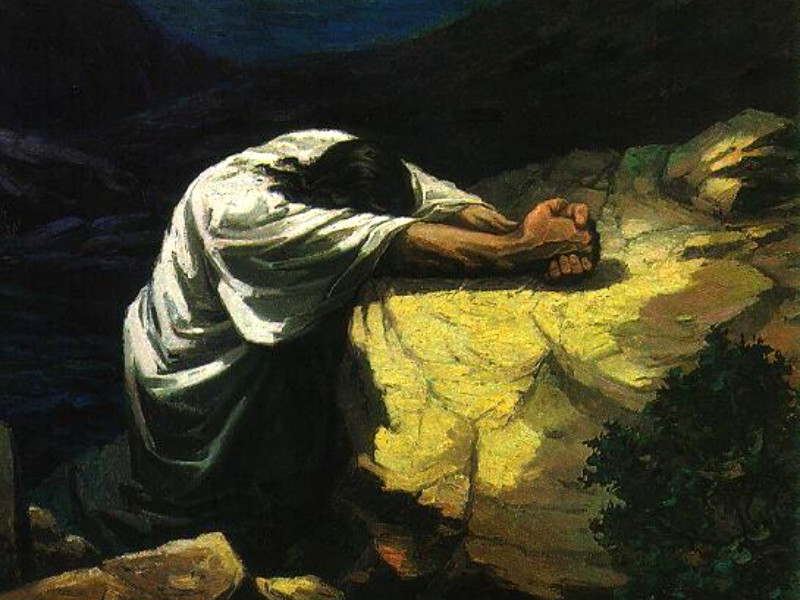
Christ in Gethsemane by Heinrich Hofmann

Christ in Gethsemane by Heinrich Hofmann

We live in a society that absolutely rejects the notion of submission. For most Americans, submission is a sign of weakness, inferiority, and failure. What’s worse, there is a disturbing upward trend in deviant fetishism that seeks to add a very sick and twisted meaning to submission, due in large part to a recent publication of filth I don’t care to mention. To put it bluntly, submission is a dirty word in our society. There is a very good reason the enemy works so diligently to pervert, distort, and redefine “submission” and what it means to submit. As we will see in the Scriptures, the reason is that submission to God and the authority of His Word is our only hope for salvation. While that may seem like a “given”, I urge you to bear with me and see if we might dig a bit deeper into what it means to submit to God and His Word.

In the first chapter of the Gospel of John, we have the following introduction of Jesus Christ:

John 1:1-5 (NASB) The Deity of Jesus Christ
1 In the beginning was the Word, and the Word was with God, and the Word was God. 2 He was in the beginning with God. 3 All things came into being through Him, and apart from Him nothing came into being that has come into being. 4 In Him was life, and the life was the Light of men. 5 The Light shines in the darkness, and the darkness did not comprehend it.

John 1:14-18 (NASB) The Word Made Flesh
14 And the Word became flesh, and dwelt among us, and we saw His glory, glory as of the only begotten from the Father, full of grace and truth. 15 John *testified about Him and cried out, saying, “This was He of whom I said, ‘He who comes after me has a higher rank than I, for He existed before me.’” 16 For of His fullness we have all received, and grace upon grace. 17 For the Law was given through Moses; grace and truth were realized through Jesus Christ. 18 No one has seen God at any time; the only begotten God who is in the bosom of the Father, He has explained Him.

I like to start in the book of John, because I find that his intro does a wonderful job of introducing the Christ in such a manner that unifies the whole Bible. Right off the bat it is clear that in order to fully understand what it means to know Jesus involves studying all of God’s Word from Genesis through Revelation. If you’ll remember the wording of the prophecy in Isaiah 9:6 regarding the Messiah, “For a child will be born to us, a son will be given to us”, you see here that John was pointing out that while His flesh was born that day, Jesus was given to us… ,”And the Word became flesh”.

Now, as Christians, we are to take Jesus as our example. What did Jesus have to say about the Law and the Prophets?

Matthew 5:17-19 (NASB)
17 “Do not think that I came to abolish the Law or the Prophets; I did not come to abolish but to fulfill. 18 For truly I say to you, until heaven and earth pass away, not the smallest letter or stroke shall pass from the Law until all is accomplished. 19 Whoever then annuls one of the least of these commandments, and teaches others to do the same, shall be called least in the kingdom of heaven; but whoever keeps and teaches them, he shall be called great in the kingdom of heaven.

Jesus had every right, being God, to simply speak truth from His own authority. Why did He choose to return to scriptures time and time again? A common quick-answer given today is simply that He did so to demonstrate to us how we might live our lives. While there is truth in that, I believe that answer to be incomplete, and it leaves too much room for the enemy to inject into our minds doubts and false doctrines regarding the person of Jesus and the role of  biblical submission to Divine Authority. Jesus wasn’t just demonstrating submission to the scriptures and to God the Father, He submitted to the Father’s Will.  When He fasted for 40 days (Matt 4), He submitted to the Spirit, was led into the wilderness to be tempted, and He was hungry. Not an act just for demonstration’s sake, it was real. He resisted the temptation of the devil by referring to the Scriptures. That alone would make the point I’m trying to make, but look at His response to the second temptation.

Matthew 4:7 Jesus said to him, “On the other hand, it is written, ‘You shall not put the Lord your God to the test.’”

Jesus isn’t directing the quote at Satan, He presents the quote as a standard by which He must resist the temptation to put the Lord God to the test. Jesus is saying that He will not do what Satan suggested He do, because Scriptures clearly stay that we are not to test the Lord our God. Submission. Likewise in the response to the third and final temptation, Jesus isn’t commanding Satan ‘You shall worship the Lord your God, and serve Him only.’ He is saying that He is to worship the Lord God and serve Him only; therefore, He will resist the final temptation. Submission. Satan had to flee… and after he had run away, the angels came to minister to Jesus. I think that it is from this example that James writes

James 4:7-10 (NASB)
7 Submit therefore to God. Resist the devil and he will flee from you. 8 Draw near to God and He will draw near to you. Cleanse your hands, you sinners; and purify your hearts, you double-minded. 9 Be miserable and mourn and weep; let your laughter be turned into mourning and your joy to gloom. 10 Humble yourselves in the presence of the Lord, and He will exalt you.

I look forward to returning to James 4 at a later date, but for now, I just wanted to point out that the Apostles understood submission because they saw it in the life of Jesus. In your own private reading time, examine for yourselves all of the times Jesus deferred to His Father in Heaven. In the book of John, He made it very clear to the Pharisees that He was the Son of God, and that He was sent by Him, and that His authority over sin, sickness, even the Sabbath was from God; however, He also deferred to God’s Will and Authority. Let’s go to another truly desperate and painful times when Jesus submitted to God the Father

Mark 14:36 (NASB) (Luke 22:39-46; Matthew 26:36-46; Mark 14:32-42)
36 And He was saying, “Abba! Father! All things are possible for You; remove this cup from Me; yet not what I will, but what You will.”

Luke 23:34 (NASB) (On the Cross)
34 But Jesus was saying, “Father, forgive them; for they do not know what they are doing.” And they cast lots, dividing up His garments among themselves.

Luke 23:46 (NASB) 46 And Jesus, crying out with a loud voice, said, “Father, into Your hands I commit My spirit.” Having said this, He breathed His last.

Amen. Yes, Jesus demonstrated complete and total submission to God the Father… by being fully and completely submitted to God the Father. It is this point, this point exactly, that lead me to share this message today. If Jesus, being the Son of God, the Word of God, equal to God was righteous in His submission to God and the Word of God… where is it that we get this false notion that submission denotes inferiority? We submit to God not only because He is superior to us (because we are, in-fact, inferior to God) but because it is Right that we do so. If submission were based solely on inferiority of being then Jesus could not have submitted to God the Father, for He is in no way an inferior being. He submitted to the Authority of God the Father, because that is the design of God’s creation.

Pray about this, and settle it in your spirits. Biblical submission is righteousness in the sight of God. Submit therefore to God. There is much more to discuss concerning the righteousness of biblical submission. Know that the basis for subsequent discussion has been presented here, in that we must first submit to God, His Word, His Son, His Spirit, and His Will. We will take a prayerful look at what the scriptures have to say about submission, particularly in how we are to live our lives as Christians in society, family, and within the Church.

Until next time, May the Lord bless and keep you in His Will,

In Him,
FS

Related articles

Reaching forward to what lies ahead in 2014…

Happy New Year 2014In my family, New Years is the big holiday for the family to gather together and thank God for the year that has drawn to a close, and pray for His blessing on the year to come.  I am still on vacation, so this post will be rather short today; however, I did want to share what has been on my mind for 2014. A close brother in Christ shared the Sunday morning message at our church and he highlighted the following passage in Philippians.

Philippians 3:13-16 (NASB)
13 Brethren, I do not regard myself as having laid hold of it yet; but one thing I do: forgetting what lies behind and reaching forward to what lies ahead, 14 I press on toward the goal for the prize of the upward call of God in Christ Jesus. 15 Let us therefore, as many as are perfect, have this attitude; and if in anything you have a different attitude, God will reveal that also to you; 16 however, let us keep living by that same standard to which we have attained.

My wife and I have spent a great deal of time in December, discussing all of the ways that God has matured us and blessed us. We do tend to focus a bit too much on the various “growth opportunities” (trials) we faced in 2013.

I am not writing to tell you what God has in store for you in 2014… not specifically anyway. Rather, I know that to move on with the proper attitude, Paul begins his advice with the phrase, “forgetting what lies behind”. One thing I noticed here is that Paul didn’t specify “just the bad things that lie behind”. He said to forget what lies behind. That’s important, because too often we become so focused on the good things God did in the past that we fail to recognize any of God’s blessings that don’t look exactly like the blessings of the past. In doing so, we limit God and hurt ourselves and those around us by not being in a position/mindset to fully recognize and acknowledge the blessings of God. But holding on to the trials too tightly can be even worse. Not only can that rob us of future blessings, and blind us of future trials, but holding on too tightly to the trials themselves can rob us of the very lesson God had intended for us to learn from it. Additionally, we can leave room for the enemy to plant seeds of bitterness when hold on too tightly to the trials of the past.

I am writing this to encourage you (and me) to seek the Will of God for 2014. Our church begins each New Year with prayer and fasting. What is God calling you to do in 2014? What is the prize for upon which you need to set your gaze? I recommend, keeping a prayer journal, and writing down what you feel the Holy Spirit speaking to you. Once you’ve written down what you feel is God’s call for you this year, search out the Scriptures for what you’ve written down. Once you’ve found the scriptural basis for what you’ve written down, you can be confident that you heard from God and rest in the fact that He has called you to do good works. If you cannot find scriptural basis, maybe ask a brother or sister in Christ to pray with you and search the scriptures with you.  It could also be that you’ve injected your own desires or what you think God would want you to do. We’ve all done this at one time or another and to varying degrees. Here again, is why we need to be surrounded by Godly council and brotherly love.

I’m looking forward to 2014. I pray that this blog will be an encouragement to your lives in the upcoming year, and that you might share with us the great things He has done in your lives. May the Lord Bless you and keep you this year.

In Him,
FS

In this world you will have trouble…

trialsWe are currently living in some stressful times. Even if you are blessed by  not being subjected to mainstream “news” media, you’ve undoubtedly heard from friends and family who are concerned about their lives and livelihood in the next several years. As Christians, we have been given the keys to life and living that we can use to reach the lost and the hurting. Unfortunately, there is a lot of false doctrine out there. Perhaps the most damaging, is the idea that if you just have enough faith (and do certain things in that faith) that you will be free from trials, tribulation, persecution, hunger, thirst, and every other imaginable hardship. That is not in keeping with the teaching given to us in the New Testament. Yes, God loves us, and has promised to meet our every need. We serve a sovereign God… He is Lord over everything. Nothing happens that He does not allow to happen. Lets begin with some references from the Gospels:

John 16:3 (NIV)
33 “I have told you these things, so that in me you may have peace. In this world you will have trouble. But take heart! I have overcome the world.”

Jesus stated very plainly that in this world we will have trouble. He is preparing His disciples for what was about to come, and His encouragement wasn’t “but if you have faith, you will be exempted from troubles”… it was “But take heart! I have overcome the world”. But why? Why allow us to face troubles? If God is sovereign, why not simply exempt His faithful followers? Let’s take a look at Peter, one of his star pupils.

Luke 22:31-32 (NIV)
31 “Simon, Simon, Satan has asked to sift all of you as wheat. 32 But I have prayed for you, Simon, that your faith may not fail. And when you have turned back, strengthen your brothers.”

Indeed, we see that we serve a Sovereign God. But there is a reason why God allows the trials to come. Do you know why wheat needs to be sifted? Because not all of it is fitting for consumption. If you don’t sift the wheat, you’ll end up introducing impurities into the food. Notice Jesus’s prayer on Simon’s behalf… “that your faith may not fail”. You see, faith isn’t designed to grant you the power to avoid trouble, its purpose is to sustain you in Him through the trials. These are general truths. In each of our lives, God also has specific goals and purposes in mind for our individual struggles. In this case, He wanted Simon to endure the trial, and when he had recovered from it, he was to strengthen his brothers. God continues to work through His Church in this same fashion. When we go through trials and struggles, God sustains us through it all so that we might give Him praise and thanks and that we might strengthen our brothers and sisters in Christ.

Without taking away a single letter of the Law or of the many promises of God for His Love, Mercy, Provision, and desire to answer prayer, I want to present several examples throughout the new testament of the reality of trials, tribulations, and hardships that we Christians should expect until the day of Christ’s return, or until God the Father has appointed each of us to leave this world. The Apostle Paul included this truth in many of his letters to the churches:

2 Corinthians 7:8-11 (NASB)

For we do not want you to be unaware, brethren, of our affliction which came to us inAsia, that we were burdened excessively, beyond our strength, so that we despaired even of life; 9indeed, we had the sentence of death within ourselves so that we would not trust in ourselves, but in God who raises the dead; 10 who delivered us from so great a peril of death, and will deliver us, He on whom we have set our hope. And He will yet deliver us, 11 you also joining in helping us through your prayers, so that thanks may be given by many persons on our behalf for the favor bestowed on us through the prayers of many.

And this was on a “missions trip” so to speak. This was not an isolated trial or event; rather, it became a way of life for Paul, something he learned to take joy in.

Colossians 1:24 (NASB)
24 Now I rejoice in my sufferings for your sake, and in my flesh I do my share on behalf of His body, which is the church, in filling up what is lacking in Christ’s afflictions.

Paul often wrote of how we are to identify with Christ in His death, resurrection, and ascension. He also recognized that while we walk this earth in our fleshly bodies, we are to share in Christ’s afflictions, for the Church is the Body of Christ, with Christ as the Head of the body (1 Cor 12). Just as Christ endured trials, suffering, and afflictions in obedience to God the Father, how much more so should we endure for His Name sake? But it is a point of rejoicing for Paul. And he was not alone in this view/mindset.

James 1: 2-4 (NASB)

Consider it all joy, my brethren, when you encounter various trials, knowing that the testing of your faith produces endurance. And let endurance have its perfect result, so that you may be perfect and complete, lacking in nothing.

Again, as with Jesus’ plan for Simon (Peter), there is a purpose for the suffering/trials/tribulations. We are perfected in our faith and in our understanding of Christ and the Kingdom of Heaven through our trials. The athlete who never struggles quickly grows weak. The mind that isn’t challenged grows numb. The Christian that does not face hardship will slip into sin and fall away from the faith.

In closing, let us look at what the Apostle Peter had to say:

1 Peter 5:6-11 (NASB)
Therefore humble yourselves under the mighty hand of God, that He may exalt you at the proper time, casting all your anxiety on Him, because He cares for you. Be of sober spirit, be on the alert. Your adversary, the devil, prowls around like a roaring lion, seeking someone to devour. 9But resist him, firm in your faith, knowing that the same experiences of suffering are being accomplished by your brethren who are in the world. 10 After you have suffered for a little while, the God of all grace, who called you to His eternal glory in Christ, will Himself perfect, confirm, strengthen and establish you. 11 To Him be dominion forever and ever. Amen.

In Him,
FS