
Social Gospel? You keep using that word…

GospelIf I may be a bit blunt… I’m tired of reading/hearing about the so-called “social gospel”. There is no “social gospel”. There is only the Gospel of Jesus Christ. Let’s begin by reminding ourselves of what “Gospel” means and where the term comes from:

From Bible.org:
The term gospel is found ninety-nine times in the NASB and ninety-two times in the NET Bible. In the Greek New Testament, gospel is the translation of the Greek noun euangelion (occurring 76 times) “good news,” and the verb euangelizo„ (occurring 54 times), meaning “to bring or announce good news.” Both words are derived from the noun angelos, “messenger.” In classical Greek, an euangelos was one who brought a message of victory or other political or personal news that caused joy. In addition, euangelizomai (the middle voice form of the verb) meant “to speak as a messenger of gladness, to proclaim good news.”Further, the noun euangelion became a technical term for the message of victory, though it was also used for a political or private message that brought joy.

So what is this “Social Gospel” people keep talking about? Does the Bible speak some good news about society or the world being made better by the Church? That we don’t need to preach on sin or repentance; rather, we should just “live out the Christian” life and the world will simply bow its knee under the superior living of the Church? Is that the good news? That Christians will “change the world”? Not even remotely. I believe the roots of this “social gospel” thing to be decided anti-christian, because it de-emphasizes the preaching of Law and Gospel and instead burdens people with law-only living and universalism (allowing others to remain in their false theology as long as they live outwardly godly lives). But is it even remotely Biblical?

The first point I’d like to address is this whole “befriend the world to earn the right to share the Gospel” nonsense. I’d like to jump straight to the book of James, since it is fresh in my mind after our last CTT post. I’m going to be hopping a little bit through James, but I want to remind the reader that the Book of James begins by addressing the purpose of trials and tribulation (debunking “prosperity doctrine”) and then to address strongly those who profess empty faith while living worldly lives. We see him state this quite plainly in the first chapter:

James 1:19-27 (ESV) 19 Know this, my beloved brothers: let every person be quick to hear, slow to speak, slow to anger; 20 for the anger of man does not produce the righteousness of God. 21 Therefore put away all filthiness and rampant wickedness and receive with meekness the implanted word, which is able to save your souls. 22 But be doers of the word, and not hearers only, deceiving yourselves. 23 For if anyone is a hearer of the word and not a doer, he is like a man who looks intently at his natural face in a mirror. 24 For he looks at himself and goes away and at once forgets what he was like. 25 But the one who looks into the perfect law, the law of liberty, and perseveres, being no hearer who forgets but a doer who acts, he will be blessed in his doing. 26 If anyone thinks he is religious and does not bridle his tongue but deceives his heart, this person’s religion is worthless. 27 Religion that is pure and undefiled before God, the Father, is this: to visit orphans and widows in their affliction, and to keep oneself unstained from the world.

Notice here that there is to be a separation from the world, such that we are to be kept unstained from the world. James returns to this point again in chapter 4:

James 4:4-5 (ESV) 4 You adulterous people! Do you not know that friendship with the world is enmity with God? Therefore whoever wishes to be a friend of the world makes himself an enemy of God. 5 Or do you suppose it is to no purpose that the Scripture says, “He yearns jealously over the spirit that he has made to dwell in us”?

A major problem with the theology of a “social gospel” is the idea that the world can be “made a better place” by works apart from the Word of God. Jesus, God the Son, didn’t come to fix governments, end wars, make peace, repair the environment and eradicate hunger. The clearest passage of scripture that refutes this “social gospel” can be found in Matthew 10:

Matthew 10:16-42 (ESV) 16 “Behold, I am sending you out as sheep in the midst of wolves, so be wise as serpents and innocent as doves. 17 Beware of men, for they will deliver you over to courts and flog you in their synagogues, 18 and you will be dragged before governors and kings for my sake, to bear witness before them and the Gentiles. 19 When they deliver you over, do not be anxious how you are to speak or what you are to say, for what you are to say will be given to you in that hour. 20 For it is not you who speak, but the Spirit of your Father speaking through you. 21 Brother will deliver brother over to death, and the father his child, and children will rise against parents and have them put to death, 22 and you will be hated by all for my name’s sake. But the one who endures to the end will be saved. 23 When they persecute you in one town, flee to the next, for truly, I say to you, you will not have gone through all the towns of Israel before the Son of Man comes.

24 “A disciple is not above his teacher, nor a servant above his master. 25 It is enough for the disciple to be like his teacher, and the servant like his master. If they have called the master of the house Beelzebul, how much more will they malign those of his household.

26 “So have no fear of them, for nothing is covered that will not be revealed, or hidden that will not be known. 27 What I tell you in the dark, say in the light, and what you hear whispered, proclaim on the housetops. 28 And do not fear those who kill the body but cannot kill the soul. Rather fear him who can destroy both soul and body in hell. 29 Are not two sparrows sold for a penny? And not one of them will fall to the ground apart from your Father. 30 But even the hairs of your head are all numbered. 31 Fear not, therefore; you are of more value than many sparrows. 32 So everyone who acknowledges me before men, I also will acknowledge before my Father who is in heaven, 33 but whoever denies me before men, I also will deny before my Father who is in heaven.

34 “Do not think that I have come to bring peace to the earth. I have not come to bring peace, but a sword. 35 For I have come to set a man against his father, and a daughter against her mother, and a daughter-in-law against her mother-in-law. 36 And a person’s enemies will be those of his own household. 37 Whoever loves father or mother more than me is not worthy of me, and whoever loves son or daughter more than me is not worthy of me. 38 And whoever does not take his cross and follow me is not worthy of me. 39 Whoever finds his life will lose it, and whoever loses his life for my sake will find it. 

40 “Whoever receives you receives me, and whoever receives me receives him who sent me. 41 The one who receives a prophet because he is a prophet will receive a prophet’s reward, and the one who receives a righteous person because he is a righteous person will receive a righteous person’s reward. 42 And whoever gives one of these little ones even a cup of cold water because he is a disciple, truly, I say to you, he will by no means lose his reward.”

That’s rough… direct… and plainly spoken/written. Combine what Jesus told the disciples what they were being sent out for with what He said about the time of His return (Matthew 24), is there really any reason to accept a “social gospel” that suggests that the church will somehow make the world a better place before Christ’s return simply by “living out the Gospel”? Absolutely not. In fact, persecution is coming as a direct result of the world’s hatred of Jesus. We will be forced to either acknowledge Him or deny Him, before the world in their synagogues and before the Gentiles (interesting delineation there, don’t you think?).

How did Paul minister to the Gentiles? Would the Apostle Paul buy into the “social gospel” concept? Let’s look at his first trip to Athens.

Acts 17:16-34 (ESV) 16 Now while Paul was waiting for them[Silas and Timothy] at Athens, his spirit was provoked within him as he saw that the city was full of idols. 17 So he reasoned in the synagogue with the Jews and the devout persons, and in the marketplace every day with those who happened to be there. 18 Some of the Epicurean and Stoic philosophers also conversed with him. And some said, “What does this babbler wish to say?” Others said, “He seems to be a preacher of foreign divinities”—because he was preaching Jesus and the resurrection. 19 And they took him and brought him to the Areopagus, saying, “May we know what this new teaching is that you are presenting?20 For you bring some strange things to our ears. We wish to know therefore what these things mean.” 21 Now all the Athenians and the foreigners who lived there would spend their time in nothing except telling or hearing something new.
Paul Addresses the Areopagus

22 So Paul, standing in the midst of the Areopagus, said: “Men of Athens, I perceive that in every way you are very religious. 23 For as I passed along and observed the objects of your worship, I found also an altar with this inscription, ‘To the unknown god.’ What therefore you worship as unknown, this I proclaim to you. 24 The God who made the world and everything in it, being Lord of heaven and earth, does not live in temples made by man, 25 nor is he served by human hands, as though he needed anything, since he himself gives to all mankind life and breath and everything. 26 And he made from one man every nation of mankind to live on all the face of the earth, having determined allotted periods and the boundaries of their dwelling place, 27 that they should seek God, and perhaps feel their way toward him and find him. Yet he is actually not far from each one of us, 28 for

“‘In him we live and move and have our being’;

as even some of your own poets have said,

“‘For we are indeed his offspring.’

29 Being then God’s offspring, we ought not to think that the divine being is like gold or silver or stone, an image formed by the art and imagination of man. 30 The times of ignorance God overlooked, but now he commands all people everywhere to repent, 31 because he has fixed a day on which he will judge the world in righteousness by a man whom he has appointed; and of this he has given assurance to all by raising him from the dead.”

32 Now when they heard of the resurrection of the dead, some mocked. But others said, “We will hear you again about this.” 33 So Paul went out from their midst. 34 But some men joined him and believed, among whom also were Dionysius the Areopagite and a woman named Damaris and others with them.

Does it seem like Paul was interested in “earning” the right to preach the Gospel to these polytheists? Did he dance around their faith, or their religion, or their doctrine? No. He preached the Gospel both in the synagogue and in the market place, with whomever happened to be there. With their philosophers. And when brought to the Areopagus, he preached the direct and plain Gospel declaring their idols to be false and preached repentance from their ignorance for the coming judgement. I think it is safe to say that the Apostle Paul would take issue with the “social gospel”.

Galatians 1:6-10 (ESV) 6 I am astonished that you are so quickly deserting him who called you in the grace of Christ and are turning to a different gospel— 7 not that there is another one, but there are some who trouble you and want to distort the gospel of Christ. 8 But even if we or an angel from heaven should preach to you a gospel contrary to the one we preached to you, let him be accursed. 9 As we have said before, so now I say again: If anyone is preaching to you a gospel contrary to the one you received, let him be accursed. 10 For am I now seeking the approval of man, or of God? Or am I trying to please man? If I were still trying to please man, I would not be a servant of Christ.

Perhaps the most telling sign that the seeker-sensitive, purpose-driven, social-gospel, emergent relevancy is leading men and women astray is recent news of major denominations giving lip service to unity despite doctrine and the willingness of some churches to redefine sexual immorality in order to maintain friendship with the world. Doctrine matters… it is not a side-issue of what color carpet you think should be in a church.

2 Corinthians 11:1-15 (ESV) 11 I wish you would bear with me in a little foolishness. Do bear with me! 2 For I feel a divine jealousy for you, since I betrothed you to one husband, to present you as a pure virgin to Christ. 3 But I am afraid that as the serpent deceived Eve by his cunning, your thoughts will be led astray from a sincere and pure devotion to Christ.4 For if someone comes and proclaims another Jesus than the one we proclaimed, or if you receive a different spirit from the one you received, or if you accept a different gospel from the one you accepted, you put up with it readily enough. 5 Indeed, I consider that I am not in the least inferior to these super-apostles. 6 Even if I am unskilled in speaking, I am not so in knowledge; indeed, in every way we have made this plain to you in all things.

7 Or did I commit a sin in humbling myself so that you might be exalted, because I preached God’s gospel to you free of charge? 8 I robbed other churches by accepting support from them in order to serve you. 9 And when I was with you and was in need, I did not burden anyone, for the brothers who came from Macedonia supplied my need. So I refrained and will refrain from burdening you in any way. 10 As the truth of Christ is in me, this boasting of mine will not be silenced in the regions of Achaia. 11 And why? Because I do not love you? God knows I do!

12 And what I am doing I will continue to do, in order to undermine the claim of those who would like to claim that in their boasted mission they work on the same terms as we do. 13 For such men are false apostles, deceitful workmen, disguising themselves as apostles of Christ. 14 And no wonder, for even Satan disguises himself as an angel of light. 15 So it is no surprise if his servants, also, disguise themselves as servants of righteousness. Their end will correspond to their deeds.

Does it sound like the Apostle Paul would accept a CEO like lifestyle for preaching the Gospel of Jesus Christ? It doesn’t to me. Did he encourage Timothy or Titus to “live their best life now”?

2 Timothy 3 (ESV) 1 But understand this, that in the last days there will come times of difficulty. 2 For people will be lovers of self, lovers of money, proud, arrogant, abusive, disobedient to their parents, ungrateful, unholy, 3 heartless, unappeasable, slanderous, without self-control, brutal, not loving good, 4 treacherous, reckless, swollen with conceit, lovers of pleasure rather than lovers of God, 5 having the appearance of godliness, but denying its power. Avoid such people. 6 For among them are those who creep into households and capture weak women, burdened with sins and led astray by various passions, 7 always learning and never able to arrive at a knowledge of the truth. 8 Just as Jannes and Jambres opposed Moses, so these men also oppose the truth, men corrupted in mind and disqualified regarding the faith. 9 But they will not get very far, for their folly will be plain to all, as was that of those two men. 10 You, however, have followed my teaching, my conduct, my aim in life, my faith, my patience, my love, my steadfastness, 11 my persecutions and sufferings that happened to me at Antioch, at Iconium, and at Lystra—which persecutions I endured; yet from them all the Lord rescued me. 12 Indeed, all who desire to live a godly life in Christ Jesus will be persecuted, 13 while evil people and impostors will go on from bad to worse, deceiving and being deceived. 14 But as for you, continue in what you have learned and have firmly believed, knowing from whom you learned it 15 and how from childhood you have been acquainted with the sacred writings, which are able to make you wise for salvation through faith in Christ Jesus. 16 All Scripture is breathed out by God and profitable for teaching, for reproof, for correction, and for training in righteousness, 17 that the man of God may be complete, equipped for every good work.

Nope… not to Timothy.

Titus 2 (ESV) 1 But as for you, teach what accords with sound doctrine. 2 Older men are to be sober-minded, dignified, self-controlled, sound in faith, in love, and in steadfastness. 3 Older women likewise are to be reverent in behavior, not slanderers or slaves to much wine. They are to teach what is good, 4 and so train the young women to love their husbands and children, 5 to be self-controlled, pure, working at home, kind, and submissive to their own husbands, that the word of God may not be reviled. 6 Likewise, urge the younger men to be self-controlled. 7 Show yourself in all respects to be a model of good works, and in your teaching show integrity, dignity, 8 and sound speech that cannot be condemned, so that an opponent may be put to shame, having nothing evil to say about us. 9 Bondservants are to be submissive to their own masters in everything; they are to be well-pleasing, not argumentative, 10 not pilfering, but showing all good faith, so that in everything they may adorn the doctrine of God our Savior. 11 For the grace of God has appeared, bringing salvation for all people, 12 training us to renounce ungodliness and worldly passions, and to live self-controlled, upright, and godly lives in the present age, 13 waiting for our blessed hope, the appearing of the glory of our great God and Savior Jesus Christ, 14 who gave himself for us to redeem us from all lawlessness and to purify for himself a people for his own possession who are zealous for good works.

15 Declare these things; exhort and rebuke with all authority. Let no one disregard you.

This one definitely reads better, but Titus is told specifically to preach. There is still renouncing ungodliness and worldly passions, and exhortation and rebuke with all authority. Contrary to popular evangelical myth, Jesus didn’t “hang out with sinners” he ate with them, healed them, called them to repentance, and forgave them. That’s not really “hanging out with” them. That is the work of the ministry, repentance and forgiveness. He had mercy on us, and gave His life as payment for our sin, not that we go on sinning, and let the world continue in its sin without offending them with the spoken Gospel, but that we might proclaim the Gospel of Grace to those who were born dead in their sins and trespasses.

The Gospel of Jesus Christ is that He came to pay the ultimate price of sin on our behalf, so that we will be spared on the final day, when Christ comes to Judge both the Living and the Dead. That is the good news. That through His atoning sacrifice, by His shed blood on the cross and His subsequent resurrection, we have been brought out of darkness and into the Kingdom of Heaven. That when this Earth is finally judged, and the present heaven and earth are destroyed and a God creates a New Heaven and a New Earth… we will be with Him, adopted in Christ as heirs and joint heirs to the Kingdom of God. There is no other “Gospel”.

1 Thessalonians 4:13-18 (ESV) 13 But we do not want you to be uninformed, brothers, about those who are asleep, that you may not grieve as others do who have no hope. 14 For since we believe that Jesus died and rose again, even so, through Jesus, God will bring with him those who have fallen asleep. 15 For this we declare to you by a word from the Lord, that we who are alive, who are left until the coming of the Lord, will not precede those who have fallen asleep. 16 For the Lord himself will descend from heaven with a cry of command, with the voice of an archangel, and with the sound of the trumpet of God. And the dead in Christ will rise first. 17 Then we who are alive, who are left, will be caught up together with them in the clouds to meet the Lord in the air, and so we will always be with the Lord. 18 Therefore encourage one another with these words.

Amen. May the Lord Bless you and keep you,
In Him,
Jorge
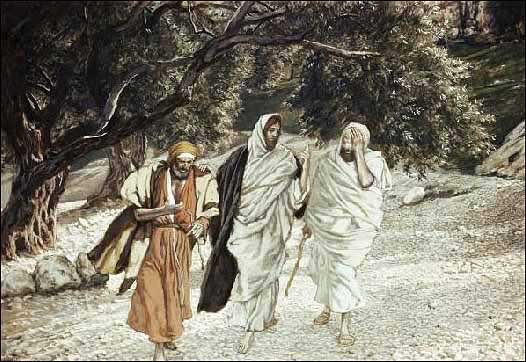
Confessions of the Christ | What Israel was waiting for

Road to Emmaus  by James J. Tissot

Road to Emmaus
by James J. Tissot

I shared a couple of weeks ago that I was working on this topic. I realized that I had gotten sucked into the trap of researching nuggets when in-fact the entirety of the Bible points to Jesus as the Messiah, the Christ, the Anointed One. So, this won’t be a singular post type of topic; rather, this is the central issue, the basis of our entire faith. I think the distraction was amplified by a desire to really make an impactful post in time for Easter, but thankfully, everything went wrong on many fronts. Thankfully? Yes. Sometimes things have to go wrong, for us to realize we’ve become too wrapped up in our own devices/plans/schemes/agendas. So, let’s get back to the basics of sharing Bible Studies as often as I can find the time, without worrying so much about “making something” of this blog. Forgive me for losing sight so quickly.

Confessions of the Christ

Our first stop will be the Gospel written by John. Please take a moment now to read John Chapter 1 in its entirety. Remember when we talked about the Sin of the Pharisee, we noted that John the Baptist knew what the Pharisees were getting at when they asked him who he was.

John 1:19-20 (ESV) 19 And this is the testimony of John, when the Jews sent priests and Levites from Jerusalem to ask him, “Who are you?” 20 He confessed, and did not deny, but confessed, “I am not the Christ.”

So without hesitation, he makes it clear to them that he is not the Christ. Now, when Jesus does step forward, John introduces Jesus to the people in a way that doesn’t fit with what they were looking for in the Christ:

John 1:29 (ESV) The next day he saw Jesus coming toward him, and said, “Behold, the Lamb of God, who takes away the sin of the world!…

At this time, sacrifices are a regular occurrence at the Temple. How did they miss this introduction as what is clearly a declaration of Jesus being the atoning sacrifice? They didn’t catch it, because they weren’t looking for it. Let us see what they were looking for:

John 1:30-34 (ESV) 30 This is he of whom I said, ‘After me comes a man who ranks before me, because he was before me.’ 31 I myself did not know him, but for this purpose I came baptizing with water, that he might be revealed to Israel.” 32 And John bore witness: “I saw the Spirit descend from heaven like a dove, and it remained on him. 33 I myself did not know him, but he who sent me to baptize with water said to me, ‘He on whom you see the Spirit descend and remain, this is he who baptizes with the Holy Spirit.’ 34 And I have seen and have borne witness that this is the Son of God.

Okay, so here we have a flat-out declaration of Jesus not only being named “The Christ” but now He is plainly declared to be the Son of God. Now, let’s look at the reactions of the early disciples to Him.

John 1:35-51 (ESV) 35 The next day again John was standing with two of his disciples, 36 and he looked at Jesus as he walked by and said, “Behold, the Lamb of God!” 37 The two disciples heard him say this, and they followed Jesus. 38 Jesus turned and saw them following and said to them, “What are you seeking?” And they said to him, “Rabbi” (which means Teacher), “where are you staying?” 39 He said to them, “Come and you will see.” So they came and saw where he was staying, and they stayed with him that day, for it was about the tenth hour. 40 One of the two who heard John speak and followed Jesus was Andrew, Simon Peter’s brother. 41 He first found his own brother Simon and said to him, “We have found the Messiah” (which means Christ). 42 He brought him to Jesus. Jesus looked at him and said, “You are Simon the son of John. You shall be called Cephas” (which means Peter).43 The next day Jesus decided to go to Galilee. He found Philip and said to him, “Follow me.” 44 Now Philip was from Bethsaida, the city of Andrew and Peter. 45 Philip found Nathanael and said to him, “We have found him of whom Moses in the Law and also the prophets wrote, Jesus of Nazareth, the son of Joseph.” 46 Nathanael said to him, “Can anything good come out of Nazareth?” Philip said to him, “Come and see.” 47 Jesus saw Nathanael coming toward him and said of him, “Behold, an Israelite indeed, in whom there is no deceit!” 48 Nathanael said to him, “How do you know me?” Jesus answered him, “Before Philip called you, when you were under the fig tree, I saw you.” 49 Nathanael answered him, “Rabbi, you are the Son of God! You are the King of Israel!” 50 Jesus answered him, “Because I said to you, ‘I saw you under the fig tree,’ do you believe? You will see greater things than these.” 51 And he said to him, “Truly, truly, I say to you, you will see heaven opened, and the angels of God ascending and descending on the Son of Man.”

Now, when these two disciples of John the Baptist hear Jesus identified as the “Lamb of God”, they understand that He is the One for whom John the Baptist was preparing them. So they follow Jesus. Here, we have the author explaining that the Hebrew word for “Messiah” is synonymous with the Greek word “Christ”. Neither word is actually translated into English, we’ve simply changed the way they are pronounced. They both translate to “Anointed”, and in the specific case of Jesus, “the Anointed One”. For those who might be new to the faith, or for those who simply have never asked, “Christ” isn’t part of Jesus name, it is a title. We notice also that Nathanael’s response to the news of Jesus was regarding Nazareth. Nazareth is never mentioned in the Law or the Prophets.  They were expecting the Messiah to come from the Bethlehem, the City of David (where Jesus was born). The Jewsish leaders of the day were looking for a descendant of David. Present-day Judaism still holds to these prophesies as indicators of the “end of days”, having missed their fulfillment in Jesus:

Jeremiah 23:5-6 (ESV)  5 “Behold, the days are coming, declares the Lord, when I will raise up for David a righteous Branch, and he shall reign as king and deal wisely, and shall execute justice and righteousness in the land. 6 In his days Judah will be saved, and Israel will dwell securely. And this is the name by which he will be called: ‘The Lord is our righteousness.’

Jeremiah 33:14-16 (ESV) 14 “Behold, the days are coming, declares the Lord, when I will fulfill the promise I made to the house of Israel and the house of Judah. 15 In those days and at that time I will cause a righteous Branch to spring up for David, and he shall execute justice and righteousness in the land. 16 In those days Judah will be saved, and Jerusalem will dwell securely. And this is the name by which it will be called: ‘The Lord is our righteousness.’ 17 “For thus says the Lord: David shall never lack a man to sit on the throne of the house of Israel, 18 and the Levitical priests shall never lack a man in my presence to offer burnt offerings, to burn grain offerings, and to make sacrifices forever.”

The prophet Isaiah also prophesied regarding Him in a similar phrasing (naturally, since these are the Words of God, not of men):

Isaiah 11:1-5 (ESV) 1 There shall come forth a shoot from the stump of Jesse, and a branch from his roots shall bear fruit.
2 And the Spirit of the Lord shall rest upon him,
the Spirit of wisdom and understanding,
the Spirit of counsel and might,
the Spirit of knowledge and the fear of the Lord.
3 And his delight shall be in the fear of the Lord.
He shall not judge by what his eyes see,
or decide disputes by what his ears hear,
4 but with righteousness he shall judge the poor,
and decide with equity for the meek of the earth;
and he shall strike the earth with the rod of his mouth,
and with the breath of his lips he shall kill the wicked.
5 Righteousness shall be the belt of his waist,
and faithfulness the belt of his loins.

So we see clearly between the confessions of John the Baptist, and the Prophecies of Jeremiah and Isaiah, that Jesus came as the atoning sacrifice, the Lamb of God, the Messiah, the Christ, the Branch of David, who will be called “the Lord is our Righteousness”… this is the Gospel of Jesus, the Christ, the Son of God. God’s Word is so awesome.

It was not only the Pharisees and the disciples of John the Baptist who were looking for the Christ. As we see in John 4, even the lowly Samaritans where aware of the prophesied Messaiah:

John 4:16-26 (ESV) 16 Jesus said to her, “Go, call your husband, and come here.” 17 The woman answered him, “I have no husband.” Jesus said to her, “You are right in saying, ‘I have no husband’; 18 for you have had five husbands, and the one you now have is not your husband. What you have said is true.” 19 The woman said to him, “Sir, I perceive that you are a prophet. 20 Our fathers worshiped on this mountain, but you say that in Jerusalem is the place where people ought to worship.” 21 Jesus said to her, “Woman, believe me, the hour is coming when neither on this mountain nor in Jerusalem will you worship the Father. 22 You worship what you do not know; we worship what we know, for salvation is from the Jews. 23 But the hour is coming, and is now here, when the true worshipers will worship the Father in spirit and truth, for the Father is seeking such people to worship him. 24 God is spirit, and those who worship him must worship in spirit and truth.” 25 The woman said to him, “I know that Messiah is coming (he who is called Christ). When he comes, he will tell us all things.” 26 Jesus said to her, “I who speak to you am he.”

So awesome. Jesus tells her at the Samaritans (corporate “you”) worship what they do not know. To demonstrate what she does know, she shows us that they, too, were waiting for the Messiah to tell them all things. Samaritans were outsiders. They were of mixed blood and mixed faith, but they looked for the Messiah to come. Praise the Lord God for His faithfulness.

Now then, that we have seen some of what it was the Jews and even the Samaritans were looking for, lets look at Peter’s confession of Jesus.

Matthew 16:13-20 (ESV) 13 Now when Jesus came into the district of Caesarea Philippi, he asked his disciples, “Who do people say that the Son of Man is?” 14 And they said, “Some say John the Baptist, others say Elijah, and others Jeremiah or one of the prophets.” 15 He said to them, “But who do you say that I am?” 16 Simon Peter replied, “You are the Christ, the Son of the living God.” 17 And Jesus answered him, “Blessed are you, Simon Bar-Jonah! For flesh and blood has not revealed this to you, but my Father who is in heaven. 18 And I tell you, you are Peter, and on this rock I will build my church, and the gates of hell shall not prevail against it. 19 I will give you the keys of the kingdom of heaven, and whatever you bind on earth shall be bound in heaven, and whatever you loose on earth shall be loosed in heaven.” 20 Then he strictly charged the disciples to tell no one that he was the Christ.

This confession is huge. One into which Peter would yet need to grow, but he does by the Grace of God. Notice, that this confession/revelation is not by flesh and blood, but given as a gift from God the Father who is in heaven. This statement bears a strong resemblance to what Paul wrote in Ephesians 2:8 (ESV) “For by grace you have been saved through faith. And this is not your own doing; it is the gift of God…”

Peter was not alone in having to grow into the understanding of just what it meant to confess Jesus as the Christ, Son of the Living God. Martha had a very hard time of it, too when her brother, Lazarus, died.

John 11:17-27 (ESV) 17 Now when Jesus came, he found that Lazarus had already been in the tomb four days. 18 Bethany was near Jerusalem, about two miles off, 19 and many of the Jews had come to Martha and Mary to console them concerning their brother. 20 So when Martha heard that Jesus was coming, she went and met him, but Mary remained seated in the house. 21 Martha said to Jesus, “Lord, if you had been here, my brother would not have died. 22 But even now I know that whatever you ask from God, God will give you.” 23 Jesus said to her, “Your brother will rise again.” 24 Martha said to him, “I know that he will rise again in the resurrection on the last day.” 25 Jesus said to her, “I am the resurrection and the life. Whoever believes in me, though he die, yet shall he live, 26 and everyone who lives and believes in me shall never die. Do you believe this?” 27 She said to him, “Yes, Lord; I believe that you are the Christ, the Son of God, who is coming into the world.”

It is on this note, that I’d like to pause for a moment. We all, must come to faith in Jesus as the Christ, Son of the Living God. The Lamb of God who laid down His life as the perfect atonement for the sin of mankind, for our sins included. This faith comes as a Gift from God, that we might die to sin ourselves, so that in Him we might have everlasting life.

Ephesians 4:1-16 (ESV) 1 I therefore, a prisoner for the Lord, urge you to walk in a manner worthy of the calling to which you have been called, 2 with all humility and gentleness, with patience, bearing with one another in love, 3 eager to maintain the unity of the Spirit in the bond of peace. 4 There is one body and one Spirit—just as you were called to the one hope that belongs to your call— 5 one Lord, one faith, one baptism, 6 one God and Father of all, who is over all and through all and in all. 7 But grace was given to each one of us according to the measure of Christ’s gift. 8 Therefore it says,

“When he ascended on high he led a host of captives,and he gave gifts to men.”[Ps 68:18]

9 (In saying, “He ascended,” what does it mean but that he had also descended into the lower regions, the earth? 10 He who descended is the one who also ascended far above all the heavens, that he might fill all things.) 11 And he gave the apostles, the prophets, the evangelists, the shepherds and teachers, 12 to equip the saints for the work of ministry, for building up the body of Christ, 13 until we all attain to the unity of the faith and of the knowledge of the Son of God, to mature manhood, to the measure of the stature of the fullness of Christ, 14 so that we may no longer be children, tossed to and fro by the waves and carried about by every wind of doctrine, by human cunning, by craftiness in deceitful schemes. 15 Rather, speaking the truth in love, we are to grow up in every way into him who is the head, into Christ, 16 from whom the whole body, joined and held together by every joint with which it is equipped, when each part is working properly, makes the body grow so that it builds itself up in love.

In Jesus, the Christ, the Son of the Living God, through the working of God the Holy Spirit, we are being woven together, fitted together, into one body. I thank God for each of you who do the hard work of discernment in all things, and in sharing the Gospel of Jesus Christ, the Lamb of God, who has is called “the Lord is our righteousness”. We who are in Christ long for the day of His return, to reign forever as King of kings and Lord of lords. Until that day, let do the work the Lord predestined for us to do in Him, so that when the Master returns, He will find His servants hard at work. Study the Scriptures, Preach the Word, and Love your neighbors as yourselves. Amen.

In Him,
Jorge

Escape…Do not look back…lest you be swept away

This week my personal schedule got completely derailed and I allowed my Bible study time to suffer. It has been a mess. I thank God for His Mercy and Grace in giving me a loving, godly wife who reads me well and knows when to rebuke and when to encourage me.  Today, I’d like to share what has been rolling in my mind regarding the aftermath of the destruction of Sodom and Gomorrah, and what I think this points to for our understanding of repentance and the high cost of following Jesus Christ, or what it means to “be a Christian”.

Genesis 19:15-29 (ESV) 15 As morning dawned, the angels urged Lot, saying, “Up! Take your wife and your two daughters who are here, lest you be swept away in the punishment of the city.” 16 But he lingered. So the men seized him and his wife and his two daughters by the hand, the Lord being merciful to him, and they brought him out and set him outside the city. 17 And as they brought them out, one said, “Escape for your life. Do not look back or stop anywhere in the valley. Escape to the hills, lest you be swept away.” 18 And Lot said to them, “Oh, no, my lords. 19 Behold, your servant has found favor in your sight, and you have shown me great kindness in saving my life. But I cannot escape to the hills, lest the disaster overtake me and I die. 20 Behold, this city is near enough to flee to, and it is a little one. Let me escape there—is it not a little one?—and my life will be saved!” 21 He said to him, “Behold, I grant you this favor also, that I will not overthrow the city of which you have spoken. 22 Escape there quickly, for I can do nothing till you arrive there.” Therefore the name of the city was called Zoar.

23 The sun had risen on the earth when Lot came to Zoar. 24 Then the Lord rained on Sodom and Gomorrah sulfur and fire from the Lord out of heaven. 25 And he overthrew those cities, and all the valley, and all the inhabitants of the cities, and what grew on the ground. 26 But Lot’s wife, behind him, looked back, and she became a pillar of salt. 27 And Abraham went early in the morning to the place where he had stood before the Lord. 28 And he looked down toward Sodom and Gomorrah and toward all the land of the valley, and he looked and, behold, the smoke of the land went up like the smoke of a furnace. 29 So it was that, when God destroyed the cities of the valley, God remembered Abraham and sent Lot out of the midst of the overthrow when he overthrew the cities in which Lot had lived.

The Bible does not go into great detail on the particulars of Lot’s wife turning into salt, anymore than it does on why she turned. The point of this passage isn’t Lot’s wife, it is about God’s wrath and about His salvation, for God spared Lot because He remembered Abraham, with whom He made His covenant. Jewish tradition (outside of the Bible) generally holds to the notion that Lot’s wife saw God destroy Sodom and Gomorrah and that is how she was turned into a pillar of salt, because no one can see God and live. Possible, but not worth spending a great deal of time on here because it isn’t explained fully in Scripture. In 2 Peter 2, the Apostle links the destruction of Sodom and Gomorrah and the Flood during Noah’s time as examples of what is going to happen to the ungodly. Similarly, I believe the unique punishment of Lot’s wife also stands as an example. But of what? At face value, what we know is that all of them were commanded not to look back in their flight. I think there is a problem of unbelief or possibly a problem of unrepentance. Lot’s daughters were betrothed, but their would-be husbands thought Lot was joking, so they perished with the city. Lot was a righteous man (as attested to by the Apostle Peter), but his daughters would later conspire to do evil in the sight of God, thus becoming the mothers of the Moabites and the Ammonites. So, whether she doubted the word of the Lord regarding the destruction, and looked back out of disbelief, or she looked back because she couldn’t fully repent of that world, we don’t know. In researching another topic in the book of Luke, I came across another passage that always gave me pause to reflect:

Luke 9:57-62 (ESV) 57 As they were going along the road, someone said to him, “I will follow you wherever you go.” 58 And Jesus said to him, “Foxes have holes, and birds of the air have nests, but the Son of Man has nowhere to lay his head.” 59 To another he said, “Follow me.” But he said, “Lord, let me first go and bury my father.” 60 And Jesus[a] said to him, “Leave the dead to bury their own dead. But as for you, go and proclaim the kingdom of God.” 61 Yet another said, “I will follow you, Lord, but let me first say farewell to those at my home.” 62 Jesus said to him, “No one who puts his hand to the plow and looks back is fit for the kingdom of God.”

Now, lets look at the greater context of Luke 9 and what happens next in Luke 10. Jesus has been prepping His disciples for His upcoming death, the need to take up their crosses and follow Him, and He was also transfigured before Peter, James, and John who heard the voice of God the Father in Heaven. These are troubling times, and the disciples aren’t really getting it yet. People are still wanting to follow Jesus, but they each are being held back by the cares of this life.  In the next portion of Scripture, Luke 10, we see Jesus sending out the 72 disciples, pronouncing woe to unrepentant cities, and wrapping up the chapter we see Jesus give a gentle rebuke to Martha over being distracted from the important things.

First, let us address the primary lesson of repentance. The call to repentance, is to turn away from sin. In Genesis 19, this was quite literal. They were to flee, run, and not to look back lest they get swept away in the destruction. Today, we face a destruction that is every bit as real, and impending as what Lot’s family faced, only it is more subtle. The wages of sin is death, and the Holiness and Justice of the Lord God is not superseded by His Love, it is reinforced by it. We are born dead in sin and trespasses (Eph 2) and looking back toward the world of sin from which we are told to flee is sin. Repenting of this sin, means turning away from looking back. The Israelites whom the Lord God delivered out of Egypt frequently committed this sin of turning back toward Egypt, even inviting the bondage of slavery so that they might save their own lives.

Numbers 14:1-4 (ESV) 1 Then all the congregation raised a loud cry, and the people wept that night. 2 And all the people of Israel grumbled against Moses and Aaron. The whole congregation said to them, “Would that we had died in the land of Egypt! Or would that we had died in this wilderness! 3 Why is the Lord bringing us into this land, to fall by the sword? Our wives and our little ones will become a prey. Would it not be better for us to go back to Egypt?” 4 And they said to one another, “Let us choose a leader and go back to Egypt.”

Thankfully, Jesus Christ presented Himself as the atoning sacrifice for the sin of mankind. His blood paid the debt of sin, so that in Him we might be made free from the bondage of sin. There is forgiveness for sin, and we must die to our flesh daily, take up our cross, and follow Him without looking back.

A secondary lesson here is that you can’t plow a straight line by looking back. You can’t follow Jesus if you keep looking back toward the world, toward Sodom and Gomorrah. You can’t follow Jesus and try to manage all of the cares of this life on your own. We aren’t likely to face being literally turned into a pillar of salt, but if we are not careful we can become just as ineffective and distracted. Keep your eyes on Christ. Keep Him in your focus. This goes for the members of the Church, the Body of Christ, and for the Elders/Deacons/Pastors. Preach the Word of God. Keep Jesus Christ, the Word of God made flesh, as the central figure and focus of all of Scripture.

In closing, I’d like to take a moment to visit Matthew 6, at the promise we have from God that He will meet our needs and that He cares for us.

Matthew 6:25-34 (ESV) 25 “Therefore I tell you, do not be anxious about your life, what you will eat or what you will drink, nor about your body, what you will put on. Is not life more than food, and the body more than clothing? 26 Look at the birds of the air: they neither sow nor reap nor gather into barns, and yet your heavenly Father feeds them. Are you not of more value than they? 27 And which of you by being anxious can add a single hour to his span of life? 28 And why are you anxious about clothing? Consider the lilies of the field, how they grow: they neither toil nor spin, 29 yet I tell you, even Solomon in all his glory was not arrayed like one of these. 30 But if God so clothes the grass of the field, which today is alive and tomorrow is thrown into the oven, will he not much more clothe you, O you of little faith? 31 Therefore do not be anxious, saying, ‘What shall we eat?’ or ‘What shall we drink?’ or ‘What shall we wear?’ 32 For the Gentiles seek after all these things, and your heavenly Father knows that you need them all. 33 But seek first the kingdom of God and his righteousness, and all these things will be added to you. 34 “Therefore do not be anxious about tomorrow, for tomorrow will be anxious for itself. Sufficient for the day is its own trouble.

The Apostle Paul gave this instruction to the church at Philip

Philippians 3:12-16 (ESV) 12 Not that I have already obtained this or am already perfect, but I press on to make it my own, because Christ Jesus has made me his own. 13 Brothers, I do not consider that I have made it my own. But one thing I do: forgetting what lies behind and straining forward to what lies ahead, 14 I press on toward the goal for the prize of the upward call of God in Christ Jesus. 15 Let those of us who are mature think this way, and if in anything you think otherwise, God will reveal that also to you. 16 Only let us hold true to what we have attained.

Amen. May the Lord bless you and keep you,
In Him,
Jorge

Naaman the Leper | The Humbling Call of the Gospel

??????????I’d like to take a moment to share a beautiful story of the humbling call of the Gospel… from 2 Kings.

2 Kings 5:1-10 (ESV) 1 Naaman, commander of the army of the king of Syria, was a great man with his master and in high favor, because by him the Lord had given victory to Syria. He was a mighty man of valor, but he was a leper. 2 Now the Syrians on one of their raids had carried off a little girl from the land of Israel, and she worked in the service of Naaman’s wife. 3 She said to her mistress, “Would that my lord were with the prophet who is in Samaria! He would cure him of his leprosy.” 4 So Naaman went in and told his lord, “Thus and so spoke the girl from the land of Israel.” 5 And the king of Syria said, “Go now, and I will send a letter to the king of Israel.” So he went, taking with him ten talents of silver, six thousand shekels of gold, and ten changes of clothing. 6 And he brought the letter to the king of Israel, which read, “When this letter reaches you, know that I have sent to you Naaman my servant, that you may cure him of his leprosy.” 7 And when the king of Israel read the letter, he tore his clothes and said, “Am I God, to kill and to make alive, that this man sends word to me to cure a man of his leprosy? Only consider, and see how he is seeking a quarrel with me.” 8 But when Elisha the man of God heard that the king of Israel had torn his clothes, he sent to the king, saying, “Why have you torn your clothes? Let him come now to me, that he may know that there is a prophet in Israel.” 9 So Naaman came with his horses and chariots and stood at the door of Elisha’s house. 10 And Elisha sent a messenger to him, saying, “Go and wash in the Jordan seven times, and your flesh shall be restored, and you shall be clean.”

Naaman is a man of status, stature, and accomplishment. He is wealthy and a favored of the king of Syria. But he has leprosy. He is told that there is a prophet in Samaria (capital of the northern kingdom of Israel), and asks permission from the king of Syria to go to Israel to find this prophet.

2 Kings 5:11-19a (ESV) 11 But Naaman was angry and went away, saying, “Behold, I thought that he would surely come out to me and stand and call upon the name of the Lord his God, and wave his hand over the place and cure the leper. 12 Are not Abana and Pharpar, the rivers of Damascus, better than all the waters of Israel? Could I not wash in them and be clean?” So he turned and went away in a rage. 13 But his servants came near and said to him, “My father, it is a great word the prophet has spoken to you; will you not do it? Has he actually said to you, ‘Wash, and be clean’?” 14 So he went down and dipped himself seven times in the Jordan, according to the word of the man of God, and his flesh was restored like the flesh of a little child, and he was clean. 15 Then he returned to the man of God, he and all his company, and he came and stood before him. And he said, “Behold, I know that there is no God in all the earth but in Israel; so accept now a present from your servant.” 16 But he said, “As the Lord lives, before whom I stand, I will receive none.” And he urged him to take it, but he refused. 17 Then Naaman said, “If not, please let there be given to your servant two mule loads of earth, for from now on your servant will not offer burnt offering or sacrifice to any god but the Lord. 18 In this matter may the Lord pardon your servant: when my master goes into the house of Rimmon to worship there, leaning on my arm, and I bow myself in the house of Rimmon, when I bow myself in the house of Rimmon, the Lord pardon your servant in this matter.” 19 He said to him, “Go in peace.”

Naaman was angry at the simplicity of Elisha’s command. He expected ceremony, he expected penance, he expected to have to do something only a person of his status and stature could do, to gain a favor from God specially designed of a man of his caliber. However, in his anger he was not beyond heeding the wise counsel of his servants, who rightly rejoiced in the simplicity of the task. Therefore, Naaman, a wealthy and prominent pagan, humbled himself before the Lord God of Israel, and was healed of his disease, and was made clean. He confesses the sovereignty of the one True God of Israel, and commits to serving the God of Israel for the rest of his days. Pride almost prevented Naaman from knowing the God of Israel. He is not alone in this. Let’s take a moment to visit a similar encounter in Matthew 19.

Matthew 19:16-23 (ESV) 16 And behold, a man came up to him, saying, “Teacher, what good deed must I do to have eternal life?” 17 And he said to him, “Why do you ask me about what is good? There is only one who is good. If you would enter life, keep the commandments.” 18 He said to him, “Which ones?” And Jesus said, “You shall not murder, You shall not commit adultery, You shall not steal, You shall not bear false witness, 19 Honor your father and mother, and, You shall love your neighbor as yourself.” 20 The young man said to him, “All these I have kept. What do I still lack?” 21 Jesus said to him, “If you would be perfect, go, sell what you possess and give to the poor, and you will have treasure in heaven; and come, follow me.” 22 When the young man heard this he went away sorrowful, for he had great possessions. 23 And Jesus said to his disciples, “Truly, I say to you, only with difficulty will a rich person enter the kingdom of heaven.

In this case, the rich you man was looking at Jesus face to face, an his pride was too much to overcome (in this moment, at least. I often wonder if he might have repented later to follow Christ). This rich ruler already thought himself to be worthy of eternal life. He went away sorrowful at hearing that he needed to become perfect. He simply couldn’t let go of all that he based his identity on (his wealth) to follow Jesus and secure eternal life. Much like Naaman walked away angry. The Gospel requires humility. Such a simple plan, devoid of anything that men might boast. Naaman humbled himself, and I can only hope that the rich young man also humbled himself and repented later. The Apostle Paul had much to say about boasting in the wrong things; let’s look at a couple of examples:

Ephesians 2:8-10 (ESV) 8 For by grace you have been saved through faith. And this is not your own doing; it is the gift of God, 9 not a result of works, so that no one may boast. 10 For we are his workmanship, created in Christ Jesus for good works, which God prepared beforehand, that we should walk in them.

1 Corinthians 1:26-31 (ESV) 26 For consider your calling, brothers: not many of you were wise according to worldly standards, not many were powerful, not many were of noble birth. 27 But God chose what is foolish in the world to shame the wise; God chose what is weak in the world to shame the strong; 28 God chose what is low and despised in the world, even things that are not, to bring to nothing things that are, 29 so that no human being might boast in the presence of God. 30 And because of Him you are in Christ Jesus, who became to us wisdom from God, righteousness and sanctification and redemption, 31 so that, as it is written, “Let the one who boasts, boast in the Lord.”

Now, I want to also to point out what happens to Gehazi, when he decides to take advantage of the newly saved Naaman for selfish gain.

2 Kings 5:19b-27 (ESV) 19b But when Naaman had gone from him a short distance, 20 Gehazi, the servant of Elisha the man of God, said, “See, my master has spared this Naaman the Syrian, in not accepting from his hand what he brought. As the Lord lives, I will run after him and get something from him.” 21 So Gehazi followed Naaman. And when Naaman saw someone running after him, he got down from the chariot to meet him and said, “Is all well?” 22 And he said, “All is well. My master has sent me to say, ‘There have just now come to me from the hill country of Ephraim two young men of the sons of the prophets. Please give them a talent of silver and two changes of clothing.’” 23 And Naaman said, “Be pleased to accept two talents.” And he urged him and tied up two talents of silver in two bags, with two changes of clothing, and laid them on two of his servants. And they carried them before Gehazi. 24 And when he came to the hill, he took them from their hand and put them in the house, and he sent the men away, and they departed. 25 He went in and stood before his master, and Elisha said to him, “Where have you been, Gehazi?” And he said, “Your servant went nowhere.” 26 But he said to him, “Did not my heart go when the man turned from his chariot to meet you? Was it a time to accept money and garments, olive orchards and vineyards, sheep and oxen, male servants and female servants? 27 Therefore the leprosy of Naaman shall cling to you and to your descendants forever.” So he went out from his presence a leper, like snow.

Did not my heart go… Elisha was heartbroken by the foolishness and greed of Gehazi. Gehazi was a servant of the man of God, he had no need of anything. Naaman was made whole by God and had dedicated himself to service of the One True God. Elisha declared to Naaman “as the Lord lives” he would not accept payment from Naaman for that which God had done. Given Naaman’s problem of pride that almost made him miss out on his healing, perhaps there was a concern here that allowing Naaman to pay for his healing might leave a door open for the sin of pride to return? That is conjecture on my part, since we don’t have an explanation in this text. But what we do have, is Gehazi taking advantage of Naaman’s desire to return a blessing to Elisha so that he might become wealthy. In the end, he paid a horrible price, and the leprosy of Naaman came upon Gehazi and his descendants forever. This level of permanency we see echoed in 2 Peter 2, when the Apostle Peter is warning of false prophets and teachers:

2 Peter 2 (ESV) 1 But false prophets also arose among the people, just as there will be false teachers among you, who will secretly bring in destructive heresies, even denying the Master who bought them, bringing upon themselves swift destruction. 2 And many will follow their sensuality, and because of them the way of truth will be blasphemed. 3 And in their greed they will exploit you with false words. Their condemnation from long ago is not idle, and their destruction is not asleep…

Is it no wonder, then that in every discussion of the qualification of Church leaders we see a reference to dishonest gain? Paul, in his letter to Titus puts together both the standard and the warning quite well:

Titus 1:6-11 (ESV) 6 if anyone is above reproach, the husband of one wife, and his children are believers and not open to the charge of debauchery or insubordination. 7 For an overseer, as God’s steward, must be above reproach. He must not be arrogant or quick-tempered or a drunkard or violent or greedy for gain, 8 but hospitable, a lover of good, self-controlled, upright, holy, and disciplined. 9 He must hold firm to the trustworthy word as taught, so that he may be able to give instruction in sound doctrine and also to rebuke those who contradict it. 10 For there are many who are insubordinate, empty talkers and deceivers, especially those of the circumcision party. 11 They must be silenced, since they are upsetting whole families by teaching for shameful gain what they ought not to teach.

The role of Overseer is not to be taken lightly. The temptation of taking advantage of the children of God for personal gain is ever-present and never happens “all at once”. This is also why a plurality of elders is essential, so that they can keep each other in check. The penalty for false teaching or becoming a stumbling block to those young in the faith are severe, and to be avoided at all cost.

The story of God healing Naaman is a wonderful story, especially for those of us who are not born children of Israel. As the Lord lives… He is the One True God, who loved us so much that He gave His Son, Jesus, as the final atoning sacrifice for the sin of man, so that through Him we might be called sons and daughters of the Most High God.

Jude 1:24-25 (ESV) Now to him who is able to keep you from stumbling and to present you blameless before the presence of his glory with great joy, to the only God, our Savior, through Jesus Christ our Lord, be glory, majesty, dominion, and authority, before all time and now and forever. Amen.

May the Lord Bless you and keep you always,
In Him,
Jorge

When Artistic License is Unacceptable

On February 28th, 2014, the movie “Son of God” opened in theaters.  The film is simply a repackaging of the History Channel’s “The Bible” series. The promos for the movie demonstrate a complete disregard for the Biblical account of the events that took place. It is one thing to try to script moments in between Biblical accounts, but to completely retell events that are recorded in Scripture in an attempt to portray a different version of Jesus is reprehensible. One of the more popular scenes used for promos is the calling of Simon (whom Jesus renamed Peter according to John 1:42). I will not be watching the film. I questioned the authenticity of the film based on some of the individuals promoting it. However, lets just look at the promo I saw of Jesus calling Peter:

Yikes. For now, lets just ignore Max Lucado’s exegesis (from the film, NOT the Scripture) and focus on the film clips. By including the fishing event, I assume the film is at least inclined toward the Luke account. Let us look at what is recorded in Luke 5:

Luke 5:1-11 (ESV) 5 On one occasion, while the crowd was pressing in on him to hear the word of God, He was standing by the lake of Gennesaret, 2 and He saw two boats by the lake, but the fishermen had gone out of them and were washing their nets. 3 Getting into one of the boats, which was Simon’s, he asked him to put out a little from the land. And he sat down and taught the people from the boat. 4 And when he had finished speaking, he said to Simon, “Put out into the deep and let down your nets for a catch.” 5 And Simon answered, “Master, we toiled all night and took nothing! But at your word I will let down the nets.” 6 And when they had done this, they enclosed a large number of fish, and their nets were breaking. 7 They signaled to their partners in the other boat to come and help them. And they came and filled both the boats, so that they began to sink. 8 But when Simon Peter saw it, he fell down at Jesus’ knees, saying, “Depart from me, for I am a sinful man, O Lord.” 9 For he and all who were with him were astonished at the catch of fish that they had taken, 10 and so also were James and John, sons of Zebedee, who were partners with Simon. And Jesus said to Simon, “Do not be afraid; from now on you will be catching men.” 11 And when they had brought their boats to land, they left everything and followed him.

Not a lot of text here, yet the movie manages to ignore and change every line. Jesus was teaching when he came to the boat. The crowd was pressing in on Him, so He asked Simon to put out a little so He could continue teaching. No, Jesus did not wade out into the water to compel Simon to let him into the boat (something Max exegeted from the film that isn’t in scripture). They knew Jesus was a teacher, because they heard him teaching and knew the crowd was there. Jesus gives Simon the name Peter. When Jesus told him to go into deep water, Peter did let Jesus know that they had fished all night with no results, but he obeyed. The bit that gets me the most is the clip they like to throw in at the end of most of their promos, where Peter asks Jesus “what are we gonna do?” and Jesus responds, “change the world”.  It may seem like a subtle thing, but Jesus didn’t come to merely change the world. He came to take away the sins of the world (John 1:29-30). You see, as fishers of men, the disciples were not called to merely improve the social atmosphere, but to preach the Gospel of Jesus Christ, the Gospel of Salvation.

While we will undoubtedly have an impact on the world, it will not always look like a positive one, because our primary goal is not to “make the world a better place”; rather, it is to call those who are lost in the world to repentance so that in Christ they may have eternal life. The disciples, the Apostles, were persecuted. The early church faced horrific persecution. And we know that the Tribulation that is coming to the church before Christ’s return will be greater than ever before (Matt 24). But Jesus also had some tough things to say in Matthew 10:

Matthew 10:16-25 (ESV) 16 “Behold, I am sending you out as sheep in the midst of wolves, so be wise as serpents and innocent as doves. 17 Beware of men, for they will deliver you over to courts and flog you in their synagogues, 18 and you will be dragged before governors and kings for my sake, to bear witness before them and the Gentiles. 19 When they deliver you over, do not be anxious how you are to speak or what you are to say, for what you are to say will be given to you in that hour. 20 For it is not you who speak, but the Spirit of your Father speaking through you. 21 Brother will deliver brother over to death, and the father his child, and children will rise against parents and have them put to death, 22 and you will be hated by all for my name’s sake. But the one who endures to the end will be saved. 23 When they persecute you in one town, flee to the next, for truly, I say to you, you will not have gone through all the towns of Israel before the Son of Man comes. 24 “A disciple is not above his teacher, nor a servant above his master. 25 It is enough for the disciple to be like his teacher, and the servant like his master. If they have called the master of the house Beelzebul, how much more will they malign those of his household.

Matthew 10:34-39 (ESV) 34 “Do not think that I have come to bring peace to the earth. I have not come to bring peace, but a sword. 35 For I have come to set a man against his father, and a daughter against her mother, and a daughter-in-law against her mother-in-law. 36 And a person’s enemies will be those of his own household. 37 Whoever loves father or mother more than me is not worthy of me, and whoever loves son or daughter more than me is not worthy of me. 38 And whoever does not take his cross and follow me is not worthy of me. 39 Whoever finds his life will lose it, and whoever loses his life for my sake will find it.

The writers of the film went to great lengths to paint Jesus as a positive world changer. However, what He said of His purpose is far different. Jesus came to call sinners out of the world. That is going to divide the world in two: those who follow Christ versus everyone else who have rejected Him. The primary charge of the church is to preach the Gospel of Jesus Christ. We know that in Him, we are made free to do good works; however, that freedom is so that we can freely preach the Gospel, not so that our good works can become a goal on its own. A purpose-driven life doesn’t atone for your sins, repentance and faith in the atoning sacrifice of Jesus Christ on the cross does. Even if the church were capable of ending world hunger, that feat would not save a single person from the curse of sin. Only the Gospel is capable of such a feat. When you tell some random person, “you can change the world”, you are falsely elevating their level of impact in a humanistic attempt to motivate them to strive to be better than they are. Its one of those politically acceptable lies. However, when you say that Jesus came to change the world… you are diminishing and ignoring what He actually came for, and that is a tragedy of eternal proportions.

I’m sure some will be very emotionally touched by this film, after all it was very well produced by folks who know how work your emotions (that is what the film industry is excellent at… itching ears and all). I’m not worried about those who know the Scriptures and know the true Gospel. But how common is such a person in these days, even within the church? The Gospel that is presented in “Son of God” is a false gospel. The artistic license taken on this film is completely unacceptable. Not only are they ignoring and changing scripture, they got creative with the very words of God the Son, Jesus Christ. If you do take someone to see the film, please correct their false Christology as soon as possible by having them read the Word. What’s worse, is some might grow overly attached to scenes or comments that aren’t in the Bible, or are contradicted by the Bible… then you’ve got a real problem. Please pray for those who you know that are going to see the movie, or who have recently seen it. Challenge them to read their Bibles to get the real story.

May the Lord bless and keep you,
In Him,
Jorge