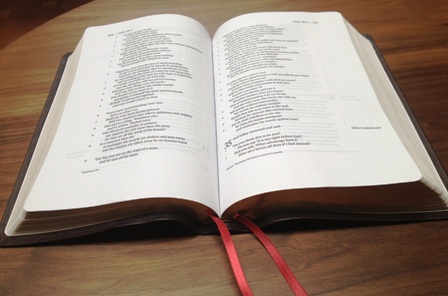
Gospel Wednesday | Matthew 12:22-45

bibleLast week, we took a look at the first portion of Matthew 12, where we saw Jesus declaring more boldly who He is. We saw Him clearly state that He is the Lord of the Sabbath. We also saw Him rebuke the man-made laws of the Pharisees regarding the Sabbath, thus exposing their murderous hearts. Jesus would not submit to ungodly laws made by men, and He would heal and deliver the lost sheep of Israel even on the Sabbath. We also saw Him urging those He healed not to make Him known in the streets. His time had not yet come, and the people were looking for the wrong type of Messiah. They were looking for an earthly king like David, and Jesus is far greater than David. Jesus came to do what only He could do, to set us free from sin and the grave forever.

Matthew 12:22-45 (ESV)

Matthew 12 (ESV) | Blasphemy Against the Holy Spirit

22 Then a demon-oppressed man who was blind and mute was brought to him, and he healed him, so that the man spoke and saw. 23 And all the people were amazed, and said, “Can this be the Son of David?” 24 But when the Pharisees heard it, they said, “It is only by Beelzebul, the prince of demons, that this man casts out demons.” 25 Knowing their thoughts, he said to them, “Every kingdom divided against itself is laid waste, and no city or house divided against itself will stand. 26 And if Satan casts out Satan, he is divided against himself. How then will his kingdom stand? 27 And if I cast out demons by Beelzebul, by whom do your sons cast them out? Therefore they will be your judges. 28 But if it is by the Spirit of God that I cast out demons, then the kingdom of God has come upon you. 29 Or how can someone enter a strong man’s house and plunder his goods, unless he first binds the strong man? Then indeed he may plunder his house. 30 Whoever is not with me is against me, and whoever does not gather with me scatters. 31 Therefore I tell you, every sin and blasphemy will be forgiven people, but the blasphemy against the Spirit will not be forgiven.32 And whoever speaks a word against the Son of Man will be forgiven, but whoever speaks against the Holy Spirit will not be forgiven, either in this age or in the age to come.

This passage is often used by those looking to sell how-to books on Spiritual Warfare to prop up their methodologies. The thing here is that Jesus isn’t teaching the art of spiritual warfare here… He isn’t even teaching exorcism. Jesus is rebuking the Pharisees and warning them that their current sin can forever separate them from God’s forgiveness. Rejecting the Holy Spirit, blaspheming Him to the extend of declaring His mighty works to be that of Beelzebul, will harden their hearts from the only means of salvation. To whom are the Pharisees referring when they accuse Jesus of casting out demons by Beelzebul? Let’s turn to 2 Kings 1.

2 Kings 1:1-8 (ESV) | Elijah Denounces Ahaziah

After the death of Ahab, Moab rebelled against Israel. Now Ahaziah fell through the lattice in his upper chamber in Samaria, and lay sick; so he sent messengers, telling them, “Go, inquire of Baal-zebub, the god of Ekron, whether I shall recover from this sickness.” But the angel of the Lord said to Elijah the Tishbite, “Arise, go up to meet the messengers of the king of Samaria, and say to them, ‘Is it because there is no God in Israel that you are going to inquire of Baal-zebub, the god of Ekron? Now therefore thus says the Lord, You shall not come down from the bed to which you have gone up, but you shall surely die.’” So Elijah went. The messengers returned to the king, and he said to them, “Why have you returned?” And they said to him, “There came a man to meet us, and said to us, ‘Go back to the king who sent you, and say to him, Thus says the Lord, Is it because there is no God in Israel that you are sending to inquire of Baal-zebub, the god of Ekron? Therefore you shall not come down from the bed to which you have gone up, but you shall surely die.’” He said to them, “What kind of man was he who came to meet you and told you these things?” They answered him, “He wore a garment of hair, with a belt of leather about his waist.” And he said, “It is Elijah the Tishbite.”

The charge levied against Jesus by the Pharisees wasn’t merely some academic theory, it was a pointed accusation. Remember how closely the Prophet Elijah is tied to the coming of the Messiah? Jesus spoke of John the Baptist as the Elijah who was to come. Jesus first points out the folly in suggesting that Satan would be in the business of casting other demons out of people so that they might be set free from Satan’s power.

Then there is a curious turn… Jesus points out that if He is casting demons out by demonic power, how can the Pharisees justify their own exorcisms? The Pharisees had their own rituals for exorcism (and for everything else you can think of). Okay, so usually I try to reflect back into the Old Testament, but for this point of interest, I’d like to fast-forward to the Acts of the Apostles.

Acts 19:11-20 (ESV) | The Sons of Sceva

11 And God was doing extraordinary miracles by the hands of Paul, 12 so that even handkerchiefs or aprons that had touched his skin were carried away to the sick, and their diseases left them and the evil spirits came out of them.13 Then some of the itinerant Jewish exorcists undertook to invoke the name of the Lord Jesus over those who had evil spirits, saying, “I adjure you by the Jesus whom Paul proclaims.” 14 Seven sons of a Jewish high priest named Sceva were doing this. 15 But the evil spirit answered them, “Jesus I know, and Paul I recognize, but who are you?” 16 And the man in whom was the evil spirit leaped on them, mastered all of them and overpowered them, so that they fled out of that house naked and wounded. 17 And this became known to all the residents of Ephesus, both Jews and Greeks. And fear fell upon them all, and the name of the Lord Jesus was extolled. 18 Also many of those who were now believers came, confessing and divulging their practices. 19 And a number of those who had practiced magic arts brought their books together and burned them in the sight of all. And they counted the value of them and found it came to fifty thousand pieces of silver. 20 So the word of the Lord continued to increase and prevail mightily.

Wow. Interesting wording in Luke’s account of the event, eh? Something to think about. Getting back to our text, Jesus returns to the matter at hand. Again, He isn’t there to argue demonology 101, He is proclaiming the Kingdom of Heaven is at hand. Jesus says to them, if it is by the Spirit of God that I cast out demons, then the kingdom of God has come upon you. What is Jesus saying here? He’s saying, quite plainly, that if He is casting out demons by the Spirit of God, they should understand a very clear sign that the Kingdom of God has come. This is what John the Baptist warned them about (Repent! For the Kingdom of Heaven is at Hand Matthew 3) and what Jesus preached throughout the region. The question of “could this be the Son of David” is the appropriate question, given the signs and wonders being performed as a testimony to Jesus as the Messiah. It is to this question the Pharisees launched a blasphemous counter-assertion. Now that we have this as our context, we have a better framework for understanding the binding of the strong-man. Again, this is not an instruction on how we can become better spiritual warriors. Jesus has come to set the captives free. From whom? The enemy, Satan. So when was the strong man (Satan) bound? The notes in the Reformation Study Bible makes an interesting point. Remember what we saw in Matthew 4:1-11? Jesus defeated Satan in the wilderness. Since then, we see the demons crying out for mercy, permission, and being silenced and cast out. We don’t see any of them contending with Him. The Kingdom of Heaven is indeed upon Israel, and the Pharisees are blinded and blaspheming the Holy Spirit out of their hate of Him. Jesus then draws a line in the sand, those who are not with Him are against Him. There is no neutral ground. Either we are with Jesus, or we are against Him.

John 3:16-18 (ESV) | For God So Loved the World

16 “For God so loved the world, that he gave his only Son, that whoever believes in him should not perish but have eternal life. 17 For God did not send his Son into the world to condemn the world, but in order that the world might be saved through him. 18 Whoever believes in him is not condemned, but whoever does not believe is condemned already, because he has not believed in the name of the only Son of God.

No middle ground. He silenced the Pharisees, and gave them grave warning for their sin. The Kingdom of Heaven was upon them, and they continue to plot against the Christ, the Son of the Living God. The tables have been turned, and Jesus isn’t finished exposing the sin of the Pharisees here. Let us continue in Matthew 12.

Matthew 12 | A Tree Is Known by Its Fruit

33 “Either make the tree good and its fruit good, or make the tree bad and its fruit bad, for the tree is known by its fruit. 34 You brood of vipers! How can you speak good, when you are evil? For out of the abundance of the heart the mouth speaks. 35 The good person out of his good treasure brings forth good, and the evil person out of his evil treasure brings forth evil. 36 I tell you, on the day of judgment people will give account for every careless word they speak,37 for by your words you will be justified, and by your words you will be condemned.”

They accused Jesus of serving a false god and they blasphemed the Holy Spirit. They will be held accountable for the words they speak, and unless they repent, their condemnation will remain upon their heads.

Matthew 12 | The Sign of Jonah

38 Then some of the scribes and Pharisees answered him, saying, “Teacher, we wish to see a sign from you.” 39 But he answered them, “An evil and adulterous generation seeks for a sign, but no sign will be given to it except the sign of the prophet Jonah. 40 For just as Jonah was three days and three nights in the belly of the great fish, so will the Son of Man be three days and three nights in the heart of the earth. 41 The men of Nineveh will rise up at the judgment with this generation and condemn it, for they repented at the preaching of Jonah, and behold, something greater than Jonah is here. 42 The queen of the South will rise up at the judgment with this generation and condemn it, for she came from the ends of the earth to hear the wisdom of Solomon, and behold, something greater than Solomon is here.

To defend themselves, it seems they demanded a sign, proof of who Jesus is claiming to be (the Messiah). Nevermind that they had just blasphemed at the casting out of a demon. They weren’t interested in repenting, they were simply trying to regain control of the situation, for that is their place. They measured, they weighed, they decreed, and they placed a heavy burden on God’s people. Jesus refuses, and prophesies of His own death and resurrection. Notice here, Jesus is also pointing out that the scriptures point to Him. Jonah was a foreshadow of Him. Solomon, too. A pale foreshadow of the Promised One, the Christ. The Son of God was standing in their midst, greater than Jonah, than Solomon, and they demand a sign that they might measure Him? They’ll be judged by the men of Nineveh in the day of judgment. That must have been hard to hear… if they’d had an ear to hear it.

Return of an Unclean Spirit

43 “When the unclean spirit has gone out of a person, it passes through waterless places seeking rest, but finds none. 44 Then it says, ‘I will return to my house from which I came.’ And when it comes, it finds the house empty, swept, and put in order. 45 Then it goes and brings with it seven other spirits more evil than itself, and they enter and dwell there, and the last state of that person is worse than the first. So also will it be with this evil generation.”

Again, this isn’t about teaching demonology. I believe Jesus is addressing both the man who had been set free from the demon that made him blind and mute as well as the Nation of Israel. He has come to set things in order, to clean the house. He performed many mighty works which testified of Him… for those who believed, their freedom is eternal. For those who still did not believe, their state will be worse than it was before the Kingdom of Heaven had arrived.

John 15:22-27 (ESV)

22 If I had not come and spoken to them, they would not have been guilty of sin, but now they have no excuse for their sin. 23 Whoever hates me hates my Father also.24 If I had not done among them the works that no one else did, they would not be guilty of sin, but now they have seen and hated both me and my Father.25 But the word that is written in their Law must be fulfilled: ‘They hated me without a cause.’

26 “But when the Helper comes, whom I will send to you from the Father, the Spirit of truth, who proceeds from the Father, he will bear witness about me.27 And you also will bear witness, because you have been with me from the beginning.

Until Next Week…

Next week, we will start looking at some of Jesus’ parables in Chapter 13. Until then, spend time in the Word and in prayer.

Jude 1:24-25 (ESV) 24 Now to him who is able to keep you from stumbling and to present you blameless before the presence of his glory with great joy, 25 to the only God, our Savior, through Jesus Christ our Lord, be glory, majesty, dominion, and authority, before all time and now and forever. Amen.

In Christ Jesus,
Jorge

DiM | “Brother” by NeedtoBreathe feat. Gavin DeGraw

Today is “Discernment in Music” (DiM) day here at Faithful Stewardship (2 Corinthians 10:4-6 (ESV)).

May 26, 2015. Today we’ll be taking a look at “Brother” by NeedtoBreathe which currently sits at #13 at 20theCountdownMagazine. It seems it’s now time for some of the newer songs on the top 20 to really start moving up, while long-time chart-topper Overwhelmed shows its lowest ranking in a long time.

We’ll continue using this top 20 song list until I find a better list. Your feedback in this would be greatly appreciated.

The best way I can summarize it is that it’s an anthem of coram mundo righteousness. The song is sung powerfully, with NeedtoBreathe always demonstrating masterful vocal skill while featuring the powerful added vocal talent of Gavin DeGraw. There are some odd uses of Gospel language here, though, that are misapplied. While we are to share the Gospel of Jesus Christ to all and demonstrate His love for us by loving others, this song seems to go the extra step of suggesting our good works make us our brother’s savior. We’ll take a look at the video and then read through the lyrics. KLove and Air1 both have incomplete lyrics on their sites, so we had to work through the lyrics in the bridge leading to the closeout of the repeated chorus.

Official Music Video

Lyrics (Partial Lyrics from KLove)

Brother

[Verse 1]

Ramblers in the wilderness
Yeah we can’t find what we need
We get a little restless from the searching
Get a little worn down in between
Like a bull chasing a matador is man left to his own schemes
But everybody needs someone beside them
Shining like a lighthouse from the sea

[Chorus]

Brother let me be your shelter
Never leave you all alone
I can be the one to call when you’re low
Brother let me be your fortress when the night winds are driving on
Be the one to light the way
Bring you home

[Verse 2]

Face down in the desert now
There’s a cage locked around my heart
I found a way to drop the key where my failures were,
now my hands can’t reach that far
I ain’t made for a rivalry and I could never take the world alone
I know that in my weakness I am stronger, but it’s your love that brings me home

[Bridge]

And when you call and need me near
Saying where’d you go?
Brother I’m right here
And on those days,
When the sky begins to fall
You’re the blood of my blood
We can get through it all

[Chorus] x 2

Be the one to light the way, bring you home

Discussion

Who is the singer and who is the hearer? Based on the video and the majority of the lyrics, the singer is a person reaching out to another person in brotherly love. In general, that’s a good thing. We are to love our neighbors as ourselves. This song isn’t doing proclaiming brotherly love in a generic sense, but one where the target audience is a brother in need. Let’s look at what Scripture has to say of this topic first, before we dig back into these lyrics.

Hebrews 13:1-16 (ESV) | Sacrifices Pleasing to God

Let brotherly love continue. Do not neglect to show hospitality to strangers, for thereby some have entertained angels unawares. Remember those who are in prison, as though in prison with them, and those who are mistreated, since you also are in the body.Let marriage be held in honor among all, and let the marriage bed be undefiled, for God will judge the sexually immoral and adulterous. Keep your life free from love of money, and be content with what you have, for he has said, “I will never leave you nor forsake you.” So we can confidently say,

“The Lord is my helper;
    I will not fear;
what can man do to me?”

Remember your leaders, those who spoke to you the word of God. Consider the outcome of their way of life, and imitate their faith. Jesus Christ is the same yesterday and today and forever. Do not be led away by diverse and strange teachings, for it is good for the heart to be strengthened by grace, not by foods, which have not benefited those devoted to them. 10 We have an altar from which those who serve the tent have no right to eat. 11 For the bodies of those animals whose blood is brought into the holy places by the high priest as a sacrifice for sin are burned outside the camp. 12 So Jesus also suffered outside the gate in order to sanctify the people through his own blood.13 Therefore let us go to him outside the camp and bear the reproach he endured.14 For here we have no lasting city, but we seek the city that is to come. 15 Through him then let us continually offer up a sacrifice of praise to God, that is, the fruit of lips that acknowledge his name. 16 Do not neglect to do good and to share what you have, for such sacrifices are pleasing to God.

Galatians 6:1-10 (ESV) | Bear One Another’s Burdens

Brothers, if anyone is caught in any transgression, you who are spiritual should restore him in a spirit of gentleness. Keep watch on yourself, lest you too be tempted.Bear one another’s burdens, and so fulfill the law of Christ.For if anyone thinks he is something, when he is nothing, he deceives himself.But let each one test his own work, and then his reason to boast will be in himself alone and not in his neighbor. For each will have to bear his own load. Let the one who is taught the word share all good things with the one who teaches. Do not be deceived: God is not mocked, for whatever one sows, that will he also reap. For the one who sows to his own flesh will from the flesh reap corruption, but the one who sows to the Spirit will from the Spirit reap eternal life. And let us not grow weary of doing good, for in due season we will reap, if we do not give up. 10 So then, as we have opportunity, let us do good to everyone, and especially to those who are of the household of faith.

James 5:19-20 (ESV)

19 My brothers, if anyone among you wanders from the truth and someone brings him back, 20 let him know that whoever brings back a sinner from his wandering will save his soul from death and will cover a multitude of sins.

The New Testament is full of encouragement to love our neighbors, and a special interest for our brothers and sisters in Christ Jesus (the Church). I simply selected the first major references that came to mind.

Now back to the song lyrics. Is the target audience a brother in the household of faith or an unbeliever? The song doesn’t say. An important thing to remember, is that while this song is getting most of its airplay on Christian radio stations, that doesn’t mean that the song carries a Gospel narrative. In fact, these lyrics can easily fly on secular radio without ever tripping a Christian flag. Gavin DeGraw brings a secular audience to the NeedtoBreathe venue. Let’s work through the sections of the song.

Verse 1. The song starts with a “we’ve all been there” plea of empathy. The singer shifts to the need for every one of us to have some help, someone who can show us the way, like a lighthouse for the ships lost at sea. If we are assuming a Gospel message in the song, this is where we would expect the Law to convict all mankind in sin, making way for the Gospel of God’s Saving Grace by the blood of His Son, Jesus. But the contrast being made in the turn of this verse isn’t between sin and repentance; rather, is between “going it alone” and “having someone to help you”.

Chorus. The chorus close out the turn immediately with, “Brother Let me be your shelter“. The singer is pointing to himself. Are we the shelter that the lost are in need of?

Psalm 91:1-2 (ESV) | My Refuge and My Fortress

He who dwells in the shelter of the Most High
    will abide in the shadow of the Almighty.
I will say to the Lord, “My refuge and my fortress,
    my God, in whom I trust.”

Revelation 7:13-17 (ESV)

13 Then one of the elders addressed me, saying, “Who are these, clothed in white robes, and from where have they come?” 14 I said to him, “Sir, you know.” And he said to me, “These are the ones coming out of the great tribulation. They have washed their robes and made them white in the blood of the Lamb.

15 “Therefore they are before the throne of God,
    and serve him day and night in his temple;
    and he who sits on the throne will shelter them with his presence.
16 They shall hunger no more, neither thirst anymore;
    the sun shall not strike them,
    nor any scorching heat.
17 For the Lamb in the midst of the throne will be their shepherd,
    and he will guide them to springs of living water,
and God will wipe away every tear from their eyes.”

Can we provide shelter? Absolutely, by God’s Grace and provision, we’ve been given the ability to grant shelter in the storm. Does that make us the shelter? Absolutely not. This is the sort of over-promise we come to expect in worldly music, where we use the most awesome and colorful language we can to exemplify our desire to do the right, loving, best thing for those we love knowing full well we will fail them in our own strength. We shouldn’t do it in our Christian Music, either. We just can’t guarantee that we will always be there (never leave you all alone), and in a Christian song, we shouldn’t be pointing to ourselves anyway, we should always be pointing others to the One who never fails and is ever-present. The closeout of the chorus always reminds me of James 5:19-20. However, the charge isn’t to bring the wandering saint to us but back to Christ, their first love. In my head, this chorus is somewhat remedied by correlating “home” to “faith in Christ, Jesus”. That is an adjustment I’ve made, not one that is ever fleshed out in the song.

Verse 2. Okay, singer change, so have we switched perspectives between singer and hearer? I think so. We see the singer now is the one face down in the desert. He’s dropped his keys where his mistakes were and now his hands can’t reach that far (I’m thinking toward the “home” at the end of the chorus). The singer here is answering the singer in verse 1 and the chorus. The last line throws it for me, though… the strength in our weakness isn’t our “willingness to ask for help” in a generic sense. Our weakness is only a strength inasmuch as we have been made humble in God’s sight.

James 4:5-7 (ESV) Or do you suppose it is to no purpose that the Scripture says, “He yearns jealously over the spirit that he has made to dwell in us”? But he gives more grace. Therefore it says, “God opposes the proud, but gives grace to the humble.” Submit yourselves therefore to God. Resist the devil, and he will flee from you.

2 Corinthians 12:8-10 (ESV) Three times I pleaded with the Lord about this, that it should leave me. But he said to me, “My grace is sufficient for you, for my power is made perfect in weakness.” Therefore I will boast all the more gladly of my weaknesses, so that the power of Christ may rest upon me. 10 For the sake of Christ, then, I am content with weaknesses, insults, hardships, persecutions, and calamities. For when I am weak, then I am strong.

And who’s love is bringing the lost one home? If this song had a clearer Gospel message, I’d be less picky on this line, but it doesn’t. It isn’t our love that brings others home. It might bring others closer to hear the message of the Gospel preached, but it does not produce faith in others directly. Only the Word of God can do that. Many false religions and false gospels do a great job of feigning love on individuals that in some ways might eclipse our daily activities… but none of their feigned love will grant them saving faith in Christ Jesus. Preach the Word.

Bridge. Well, here we have the sorts of promises only God can keep, but this isn’t a song of Promise from God. This is a song between people. It’s a song of extending brotherly love.

Conclusion

If this were playing on secular radio, we’d all nod our heads and say, “good to see something somewhat uplifting on the radio”, but we wouldn’t necessarily call it Christian. It’s a positive song in general, one encouraging us to look out for those in need of help. That’s awesome, and it’s Law. It needs the Gospel… WE need the Gospel… the audience of the song needs the Gospel. We sin. We fail to love our brothers (and sisters) faithfully. We fail to provide shelter, care, food, clothing for our brothers. We need His Grace and forgiveness when we sin against Him and against our neighbor. I wish this song had the Gospel… then it might indeed be a Christian song. In closing let us look at both Law and Gospel on this matter.

Matthew 25:31-40 (ESV) | The Final Judgment

31 “When the Son of Man comes in his glory, and all the angels with him, then he will sit on his glorious throne. 32 Before him will be gathered all the nations, and he will separate people one from another as a shepherd separates the sheep from the goats. 33 And he will place the sheep on his right, but the goats on the left. 34 Then the King will say to those on his right, ‘Come, you who are blessed by my Father, inherit the kingdom prepared for you from the foundation of the world. 35 For I was hungry and you gave me food, I was thirsty and you gave me drink, I was a stranger and you welcomed me, 36 I was naked and you clothed me, I was sick and you visited me, I was in prison and you came to me.’ 37 Then the righteous will answer him, saying, ‘Lord, when did we see you hungry and feed you, or thirsty and give you drink? 38 And when did we see you a stranger and welcome you, or naked and clothe you? 39 And when did we see you sick or in prison and visit you?’ 40 And the King will answer them, ‘Truly, I say to you, as you did it to one of the least of these my brothers, you did it to me.’

1 John 3:11-24 (ESV) | Love One Another

11 For this is the message that you have heard from the beginning, that we should love one another. 12 We should not be like Cain, who was of the evil one and murdered his brother. And why did he murder him? Because his own deeds were evil and his brother’s righteous. 13 Do not be surprised, brothers, that the world hates you. 14 We know that we have passed out of death into life, because we love the brothers. Whoever does not love abides in death.15 Everyone who hates his brother is a murderer, and you know that no murderer has eternal life abiding in him.

16 By this we know love, that he laid down his life for us, and we ought to lay down our lives for the brothers. 17 But if anyone has the world’s goods and sees his brother in need, yet closes his heart against him, how does God’s love abide in him? 18 Little children, let us not love in word or talk but in deed and in truth.

19 By this we shall know that we are of the truth and reassure our heart before him; 20 for whenever our heart condemns us, God is greater than our heart, and he knows everything. 21 Beloved, if our heart does not condemn us, we have confidence before God; 22 and whatever we ask we receive from him, because we keep his commandments and do what pleases him. 23 And this is his commandment, that we believe in the name of his Son Jesus Christ and love one another, just as he has commanded us. 24 Whoever keeps his commandments abides in God, and God in him. And by this we know that he abides in us, by the Spirit whom he has given us.

Amen.
In Christ Jesus,
Jorge

Gospel Wednesday | Matthew 12:1-21

bibleLast week, we took a look at Matthew 11, where we saw Jesus identifying Himself by means of reminding the crowd of who it was they went out to see in the wilderness, John the Baptist. Jesus clearly identified who John the Baptist as the great prophet (and more) prophesied in Scripture to come as the forerunner of the Messiah, Jesus. We closed with Jesus offering rest that only He can provide.

Matthew 11:27-30 (ESV)

27 All things have been handed over to me by my Father, and no one knows the Son except the Father, and no one knows the Father except the Son and anyone to whom the Son chooses to reveal him. 28 Come to me, all who labor and are heavy laden, and I will give you rest. 29 Take my yoke upon you, and learn from me, for I am gentle and lowly in heart, and you will find rest for your souls. 30 For my yoke is easy, and my burden is light.”

Beginning here, to what is Jesus comparing His yoke and His burden? What is Jesus offering for those who come to Him? Remember who His audience is, Jesus is speaking to Jews. Jesus is declaring Himself to have authority over all things because His Father, God the Father, has handed all things over to Jesus. That’s monumental, and worth taking a moment to ponder. Furthermore, Jesus is declaring that He alone knows the Father, and that Only the Father truly knows who Jesus is. In this statement, who is Jesus refuting? The Pharisees, the chief priests, the elders, and the scribes who have (and will) rejected Jesus. They hold themselves to be the knowledgeable ones, the teachers, the keepers of the keys to the Kingdom (where the Scriptures are kept). Jesus was offering rest to those who would come to Him. Coming to Jesus meant walking away from the Earthly Temple and its priests, the yoke of the Law and the burden of sin. Jesus the Messiah had come, to fulfill the Law and to take away the sin of the world, so that by His blood we might be made the righteousness of Christ, adopted as heirs to the Kingdom of God. His yoke is indeed easy and His burden is light, for only by Him can we find Life. With this in mind, let us continue into Chapter 12.

Matthew 12:1-21 (ESV) | A Rest Greater than the Sabbath

Matthew 12 | Jesus Is Lord of the Sabbath

At that time Jesus went through the grainfields on the Sabbath. His disciples were hungry, and they began to pluck heads of grain and to eat. But when the Pharisees saw it, they said to him, “Look, your disciples are doing what is not lawful to do on the Sabbath.” He said to them, “Have you not read what David did when he was hungry, and those who were with him: how he entered the house of God and ate the bread of the Presence, which it was not lawful for him to eat nor for those who were with him, but only for the priests?Or have you not read in the Law how on the Sabbath the priests in the temple profane the Sabbath and are guiltless? I tell you, something greater than the temple is here. And if you had known what this means, ‘I desire mercy, and not sacrifice,’ you would not have condemned the guiltless. For the Son of Man is lord of the Sabbath.”

The Pharisees accused the disciples of profaning the Sabbath by plucking the heads of grain and eating them on the Sabbath. Was their accusation valid? Not according to the Law. The Law stated that no one was to do any work on the Sabbath. The Pharisees were not judging by the Law; rather, they held to their own law, the oral tradition that they held equal to the written Scripture. Their oral tradition became the means by which the religious leaders would add definitions, restrictions, and ceremony to the Law of Moses so that they would be the ones who decided on all matters. They added so many rules and regulations to define what constituted “work” and what didn’t so that it was extra difficult and complicated to keep the Sabbath externally. They decided how far you could walk (a Sabbath day’s journey) and the maximum size something you could carry on the Sabbath without it being considered work. Jesus doesn’t blast them outright in this just yet; rather, He points out in Scripture that would constitute greater offenses of the Sabbath if the Pharisaical assertion were kept. David and his men ate the bread of the Presence (1 Samuel 21:1-6 ESV), which was not lawful for anyone but Priests to eat. But if you’ll read the text that I linked, David was in a time of great need and the Temple did not have any other food to provide, no common bread. Thus the ceremonial law of the bread was set aside to meet David’s (whom God had chosen as King to replace Saul whom God now rejected) need. Jesus is greater than David, and His disciples were hungry. But Jesus didn’t stop there, He also points out that the blanket prohibition from work on the Sabbath is set aside for the priests fulfilling their duties in the Temple on the Sabbath. This is huge, for there is simply no way for the Pharisees to wriggle out of this one, everything they did in the Temple is by any measure work. Now something greater than the Temple (Jesus) is here. The earthly temple is a foreshadow of Jesus. His disciples are serving a greater Temple, they serve the Messiah, the Son of God. So not only were the Pharisees wrongfully accusing the disciples of breaking the Sabbath according to the Law, their standards of Sabbath observance didn’t pass the test of Scripture. Their attempt to ensnare Jesus and His disciples in breach of the Sabbath falls flat because the authority of their oral tradition paled in comparison to the Authority of Jesus Christ, the Messiah.

Matthew 12 | A Man with a Withered Hand

He went on from there and entered their synagogue. 10 And a man was there with a withered hand. And they asked him, “Is it lawful to heal on the Sabbath?”—so that they might accuse him. 11 He said to them, “Which one of you who has a sheep, if it falls into a pit on the Sabbath, will not take hold of it and lift it out? 12 Of how much more value is a man than a sheep! So it is lawful to do good on the Sabbath.” 13 Then he said to the man, “Stretch out your hand.” And the man stretched it out, and it was restored, healthy like the other. 14 But the Pharisees went out and conspired against him, how to destroy him.

The Pharisees didn’t get it, and persisted in their attempts to ensnare Jesus. Their man-made definitions of work now pitted God’s miraculous works of healing against their own laws of the Sabbath. They didn’t get it. They attributed miraculous healing to being a work performed by men, rather than God. Check out the evil scenario that has unfolded… within the synagogue of the Pharisees who wrongly accused them of breaking the Sabbath already, there was a man with a withered hand. The Pharisees then ask Jesus if it is lawful to heal on the Sabbath… imagine what is going on in this man’s heart? Dare he hope for Jesus to heal him? And what if Jesus does, would that act condemn Him under the Law? Where you and I can only imagine what was stirring in this man’s heart, Jesus knew. I read Jesus’ response with a very hard tone of rebuke… I’m surprised we don’t get a “you hypocrites!” here. But I think His concern moved more toward the man with the withered hand than the Pharisees. Jesus looked at the man and told him to stretch out his hand. Praise the Lord. And these Pharisees… so blinded by their sin, their power, their position, they completely missed both the lesson of the Sabbath and the testimony of the Messiah standing in their midst… a man was healed miraculously, in a way that we do not see to this day, and they conspired against Him in how to destroy him.

Matthew 12 | God’s Chosen Servant

15 Jesus, aware of this, withdrew from there. And many followed him, and he healed them all 16 and ordered them not to make him known.17 This was to fulfill what was spoken by the prophet Isaiah:

18 “Behold, my servant whom I have chosen,
    my beloved with whom my soul is well pleased.
I will put my Spirit upon him,
    and he will proclaim justice to the Gentiles.
19 He will not quarrel or cry aloud,
    nor will anyone hear his voice in the streets;
20 a bruised reed he will not break,
    and a smoldering wick he will not quench,
until he brings justice to victory;
21     and in his name the Gentiles will hope.”

At first it might seem odd that Jesus would so plainly demonstrate who He is yet order those whom He heals not to make Him known. The Jews didn’t understand the prophecy of the Messiah, Who He was or what He planned to do. So, Jesus made known to many Who He was, but ordered them not to make it known.  Jesus came first to fulfill the Law, then to suffer and die in our place as the sacrificial Lamb of God, to be raised again on the 3rd day, to ascend into Heaven and send His Holy Spirit to all who believe in Him. The next time He comes to Earth… will be a lot different. He will come in Glory, and in Power, ready to judge both the Living and the Dead. Amen.

Until Next Week…

Matthew’s account takes a shift here in the middle of the chapter. Matthew has made a clear case for who Jesus is, by sharing who Jesus claimed to be. Now we will start seeing more focus on His teaching of the Kingdom of Heaven, on Salvation, and we will also see increased confrontation with the Pharisees and those plotting to kill Him. Until then, be faithful stewards of the Gospel of Grace, and preach the Word. Pray for wisdom and for boldness to speak the Truth of the Gospel of Jesus Christ, even when it isn’t politically correct or socially acceptable.

Amen.
In Christ Jesus,
Jorge

DiM | “Who I Am” by Blanca

Today is “Discernment in Music” (DiM) day here at Faithful Stewardship (2 Corinthians 10:4-6 (ESV)).

May 19, 2015. Today we’ll be taking a look at “Who I Am” by Blanca which currently sits at #15 at 20theCountdownMagazine.

We’ll continue using this top 20 song list until I find a better list. Your feedback in this would be greatly appreciated.

I hadn’t planned on reviewing this song for this week, because I was certain that we’d be looking at a song from NeedtoBreathe. However, with this week’s chart update, Bianca’s song came out above the other song, so it will have to wait. Let’s begin today with an Air1 interview of Blanca to see what the meaning behind the song might be:

Behind the Music

Well, that wasn’t very encouraging. Empowerment is clearly the theme. This is about giving yourself a pep talk to do what you want to do without fear. Not a single reference to Scripture, not even a proof text. It comes from a place of empty sloganeering, “when I know whose I am, I know who I am”… /sigh. I hear this sort of emotional elevation of self all of the time whenever I watch contestants on the Voice, America’s Got Talent, and American Idol wax eloquent about their “struggle to overcome doubt and to believe in themselves” to get onto the show. The frustrating thing about this interview is that there doesn’t even seem to be an attempt to point to God, the artist is perfectly comfortable taking a moment to talk about herself, her emotions, her “struggle” to write this first song. Why is that? Because Air1 isn’t expecting that sort of answer, and popular evangelicalism no longer requires it. Let’s move on to the song and its lyrics.

Official Audio (Static Album Cover)

Lyrics (via Air1)

Blanca – Who I Am Lyrics

Another voice, another choice
To listen to words somebody said
Another day
I replay
One too many doubts inside my head

Am I strong
Beautiful
Am I good enough
Do I belong
After all
That I’ve said and done
Is it real
When I feel
I don’t measure up
Am I loved

CHORUS
I’m running to the One who knows me
Who made every part of me in His hands
I’m holding to the One who holds me
‘Cause I know whose I am, I know who I am

I am sure I am Yours

Turning down
Tuning out
Every single word
That caused me pain
Unashamed
And unafraid
‘Cause I believe You mean it when You say

I am strong
Beautiful
I am good enough
I belong
After all
‘Cause of what You’ve done
This is real
What I feel
No one made it up
I am loved

CHORUS

I am sure I am Yours
I know who I am
I am sure I am Yours

Fearfully
Wonderfully
Perfectly
You have made me

I’m running to the One who knows me
I’m holding to the One who holds me

CHORUS

I am sure I am Yours
And I know who I am

Publishing: © 2015 Dayspring Music LLC / Group 1 Crew Music Publishing (BMI)(All rights Adm. by Dayspring Music, LLC)/ CentricSongs, 2 Hour Songs (SESAC) (Adm. by Music Services) / Sony/ATV Music Publishing LLC, Upside Down Under (BMI) (All rights on behalf of itself and Upside Down Under adm. by Sony/ATV Music Publishing LLC) Produced by Seth Mosley
Writer(s): Blanca Callahan / Seth Mosley / Mia Fieldes

Discussion

Who is the intended audience for this song, believers or unbelievers? We’re going to continue our review assuming the intended audience is believers because there is no Law or Gospel to be found in the song. None. So if this song is intended for believers, what is the message to the believer? Well, let’s work through the lyrics.

The song begins with doubts and questions in the first verse. What are the doubts in the singer’s head?

  1. Am I strong?
  2. (Am I) Beautiful?
  3. Am I good enough?
  4. Do I belong, After all, That I’ve said and done?
  5. Is it real, When I feel, I don’t measure up?
  6. Am I loved?

The song then answers these questions by simply rephrasing the questions into declarative statements.

  1. I am strong
  2. (I am) Beautiful
  3. I am good enough
  4. I belong, After all, ‘Cause of what You’ve done
  5. This is real, What I feel, No one made it up
  6. I am loved

So what changed? Who is the “You” in the 4th answer and what did “You” do? How does the 5th answer resolve its question? Let’s look at the chorus to see if it clarifies anything

I’m running to the One who knows me
Who made every part of me in His hands
I’m holding to the One who holds me
‘Cause I know whose I am, I know who I am
I am sure I am Yours

Is this the Gospel? That God knows us and He made us? No. It is true that He made us and knows us, but that doesn’t make it Gospel. How does the singer know for sure that she is God’s? She doesn’t share that in this song. Later, in the bridge, there is a reference to being fearfully and wonderfully (and perfectly?) made by God. So what is the message of this song?

I am exactly what God made me to be, He loves me as I am, the only thing about me that needs to change is how I talk about myself in my head.

What a tragic message, even for Christians.

The Call to Repent is for the Christian, too

There is a misconception in modern-day evangelicalism that anything that feels negative is of the devil and all things positive are godly. Discipline is negative, but necessary for godliness. Repentance is a turning away from sin, going the opposite direction from what your fleshly desires and temptations are leading you. In the moment, it feels very negative. That Law of God convicts us of our sin and kills our flesh. Let’s look at how the Apostle Paul explains this dynamic in Romans 7:

Romans 7:7-24 (ESV) | The Law and Sin
7 What then shall we say? That the law is sin? By no means! Yet if it had not been for the law, I would not have known sin. For I would not have known what it is to covet if the law had not said, “You shall not covet.” 8 But sin, seizing an opportunity through the commandment, produced in me all kinds of covetousness. For apart from the law, sin lies dead. 9 I was once alive apart from the law, but when the commandment came, sin came alive and I died.10 The very commandment that promised life proved to be death to me. 11 For sin, seizing an opportunity through the commandment, deceived me and through it killed me.12 So the law is holy, and the commandment is holy and righteous and good. 13 Did that which is good, then, bring death to me? By no means! It was sin, producing death in me through what is good, in order that sin might be shown to be sin, and through the commandment might become sinful beyond measure. 14 For we know that the law is spiritual, but I am of the flesh, sold under sin. 15 For I do not understand my own actions. For I do not do what I want, but I do the very thing I hate. 16 Now if I do what I do not want, I agree with the law, that it is good. 17 So now it is no longer I who do it, but sin that dwells within me. 18 For I know that nothing good dwells in me, that is, in my flesh. For I have the desire to do what is right, but not the ability to carry it out. 19 For I do not do the good I want, but the evil I do not want is what I keep on doing. 20 Now if I do what I do not want, it is no longer I who do it, but sin that dwells within me. 21 So I find it to be a law that when I want to do right, evil lies close at hand. 22 For I delight in the law of God, in my inner being, 23 but I see in my members another law waging war against the law of my mind and making me captive to the law of sin that dwells in my members. 24 Wretched man that I am! Who will deliver me from this body of death?

Paul makes clear “who I am”, even as Christians, we are wretched and sinful. Our flesh is sinful. By faith, we have joined in Christ’s death in baptism and in His resurrection to new life (Romans 6). We have been sealed by the Holy Spirit for the day of Resurrection, when we will at-last put off this mortal flesh of sin and be given new bodies in the Kingdom of Heaven. Until that great and glorious day, by faith we must repent of our sins daily and crucify our flesh and walk in the Spirit of the Living God. We walk in the already and the not yet. We Christians walk on this earth simultaneously sinners (by flesh) and justified (by faith in Christ).

Romans 8:1-4 (ESV) | Life in the Spirit
1 There is therefore now no condemnation for those who are in Christ Jesus.2 For the law of the Spirit of life has set you free in Christ Jesus from the law of sin and death. 3 For God has done what the law, weakened by the flesh, could not do. By sending his own Son in the likeness of sinful flesh and for sin, he condemned sin in the flesh, 4 in order that the righteous requirement of the law might be fulfilled in us, who walk not according to the flesh but according to the Spirit.

Galatians 5:16-26 (ESV) | Keep in Step with the Spirit
16 But I say, walk by the Spirit, and you will not gratify the desires of the flesh.17 For the desires of the flesh are against the Spirit, and the desires of the Spirit are against the flesh, for these are opposed to each other, to keep you from doing the things you want to do. 18 But if you are led by the Spirit, you are not under the law. 19 Now the works of the flesh are evident: sexual immorality, impurity, sensuality, 20 idolatry, sorcery, enmity, strife, jealousy, fits of anger, rivalries, dissensions, divisions, 21 envy, drunkenness, orgies, and things like these. I warn you, as I warned you before, that those who do such things will not inherit the kingdom of God. 22 But the fruit of the Spirit is love, joy, peace, patience, kindness, goodness, faithfulness, 23 gentleness, self-control; against such things there is no law. 24 And those who belong to Christ Jesus have crucified the flesh with its passions and desires. 25 If we live by the Spirit, let us also keep in step with the Spirit. 26 Let us not become conceited, provoking one another, envying one another.

Having been reminded of the who we are and who Christ is and the centrality of the Gospel of Jesus Christ, let us revisit the questions posed in this song, and give real answers to them.

  1. Am I strong?
    No child, you are weak in the flesh. Christ is our only strength, look to Him, not yourself.

    2 Corinthians 12:9-10 (ESV) 9 But he said to me, “My grace is sufficient for you, for my power is made perfect in weakness.” Therefore I will boast all the more gladly of my weaknesses, so that the power of Christ may rest upon me. 10 For the sake of Christ, then, I am content with weaknesses, insults, hardships, persecutions, and calamities. For when I am weak, then I am strong.
  2. (Am I) Beautiful?
    By what measure? Set your heart and mind on things above.

    1 Peter 3:3-4 (ESV) 3 Do not let your adorning be external—the braiding of hair and the putting on of gold jewelry, or the clothing you wear— 4 but let your adorning be the hidden person of the heart with the imperishable beauty of a gentle and quiet spirit, which in God’s sight is very precious.
    Romans 10:14-15 (ESV) 14 How then will they call on him in whom they have not believed? And how are they to believe in him of whom they have never heard? And how are they to hear without someone preaching? 15 And how are they to preach unless they are sent? As it is written, “How beautiful are the feet of those who preach the good news!”
  3. Am I good enough?
    No, you aren’t. There has only ever been One who is good enough, and He laid down His life on the cross, so that by His Blood, you might be saved.Romans 3:21-26 (ESV) | The Righteousness of God Through Faith
    21 But now the righteousness of God has been manifested apart from the law, although the Law and the Prophets bear witness to it— 22 the righteousness of God through faith in Jesus Christ for all who believe. For there is no distinction: 23 for all have sinned and fall short of the glory of God, 24 and are justified by his grace as a gift, through the redemption that is in Christ Jesus, 25 whom God put forward as a propitiation by his blood, to be received by faith. This was to show God’s righteousness, because in his divine forbearance he had passed over former sins. 26 It was to show his righteousness at the present time, so that he might be just and the justifier of the one who has faith in Jesus.
  4. Do I belong, After all, That I’ve said and done?
    If your place in the Kingdom of God, in the Body of Christ, were dependent upon what you’ve said and done, you wouldn’t belong, no. Praise be to Our God and Father that it isn’t about what we’ve said and done, but upon Christ’s finished work on the cross. Now humble yourself in the sight of the Lord, and repent of your sins and be forgiven, in Jesus’ Name.1 John 1:8-9 (ESV) 8 If we say we have no sin, we deceive ourselves, and the truth is not in us. 9 If we confess our sins, he is faithful and just to forgive us our sins and to cleanse us from all unrighteousness.
  5. Is it real, When I feel, I don’t measure up?
    Our hope is not in what we see or feel; rather, it is by faith that we hold onto the promise of forgiveness and eternal life in Jesus Christ Our Lord. Of your own, you don’t measure up; however, there is no condemnation for those who are in Christ by faith.Ephesians 2:8-10 (ESV) 8 For by grace you have been saved through faith. And this is not your own doing; it is the gift of God, 9 not a result of works, so that no one may boast.10 For we are his workmanship, created in Christ Jesus for good works, which God prepared beforehand, that we should walk in them.
  6. Am I loved?
    Absolutely. Your are loved. God loved you even when you were dead in your sins and trespasses, so much so, in fact that He gave His Only Begotten Son so that you might have eternal life.John 3:16-18 (ESV) | For God So Loved the World
    16 “For God so loved the world, that he gave his only Son, that whoever believes in him should not perish but have eternal life. 17 For God did not send his Son into the world to condemn the world, but in order that the world might be saved through him. 18 Whoever believes in him is not condemned, but whoever does not believe is condemned already, because he has not believed in the name of the only Son of God.

The song doesn’t share the gospel, not for the unbeliever nor for the believer. Some readers might argue that “running to the one who knows me” is code for repentance. While I disagree with that notion, if that is truly what you think when you hear the line, then God bless you for having the proper response to this song. My concern is for those less grounded in their faith to have a better footing in the Word of God.

In the end, I cannot endorse this song fully. It is my prayer that at least whenever the song plays on the radio, your mind will focus on the Truth of God’s word rather than on empty “empowerment”.

Hebrews 13:20-21 (ESV) | Benediction

20 Now may the God of peace who brought again from the dead our Lord Jesus,the great shepherd of the sheep, by the blood of the eternal covenant, 21 equip you with everything good that you may do his will, working in us that which is pleasing in his sight, through Jesus Christ, to whom be glory forever and ever. Amen.

Amen, Indeed.
In Christ Jesus,
Jorge

CTT | Salvation by Works?

Ask an evangelical Christian what distinguishes his/her church from the Roman Catholic Church and you may get a wide range of possible answers. These days, “I don’t know” might be the most honest and accurate response, based on what we are seeing among popular evangelical teachers/preachers/musicians. But there are still enclaves of protestant denominations where you’ll hear the answer, “Catholics believe in salvation by works, and we believe Salvation is by Grace Alone”. Though that answer is true, doctrinally, the phrasing is overly simplistic and might actually set up the young protestant for an ill-prepared defense of the Gospel of Grace from a studied Roman Catholic.

Roman Catholic Church Affirms Salvation (Being Born-Again) by Grace

While the Roman Catholic Church does have 7 Sacraments, Pergatory, Indulgences, etc. it does not teach that any of works can earn a sinner his salvation. They teach that we are all born sinners, dead in the sin of Adam, and thus are incapable of earning salvation or getting any credit for any of our so-called good works. Let’s look at some of the canons of the Council of Trent (the very council that anathematized Protestant teaching). We’ll just look at the first 3 canons:

  • CANON I.- If any one saith, that man may be justified before God by his own works, whether done through the teaching of human nature, or that of the law, without the grace of God through Jesus Christ; let him be anathema.
  • CANON II.- If any one saith, that the grace of God, through Jesus Christ, is given only for this, that man may be able more easily to live justly, and to merit eternal life, as if, by free will without grace, he were able to do both, though hardly indeed and with difficulty; let him be anathema.
  • CANON III.-If any one saith, that without the prevenient inspiration of the Holy Ghost, and without his help, man can believe, hope, love, or be penitent as he ought, so as that the grace of Justification may be bestowed upon him; let him be anathema.

So you see, this is why the aforementioned statement is overly simplistic. Their doctrine does have a role for the free Grace of God. Is it correct? Not really, but you have to follow the doctrine further on down the line to discover the error.

  • CANON IV.- If any one saith, that man’s free will moved and excited by God, by assenting to God exciting and calling, nowise co-operates towards disposing and preparing itself for obtaining the grace of Justification; that it cannot refuse its consent, if it would, but that, as something inanimate, it does nothing whatever and is merely passive; let him be anathema.

This canon specifically targets the teaching that is now considered the “I” in TULIP for those of the Calvinist framework. The teaching that God’s election of an individual to receive Salvation is irresistible, that man is just as incapable of denying saving grace as he is incapable of earning it. While some of the wording in this cannon also rubs against Lutheran and Arminian doctrines, I think the target with this one is pointedly Calvinist. We’re going to skip a few canons and get to the heart of the distinction between protestant and Catholic doctrine:

  • CANON IX.- If any one saith, that by faith alone the impious is justified; in such wise as to mean, that nothing else is required to co-operate in order to the obtaining the grace of Justification, and that it is not in any way necessary, that he be prepared and disposed by the movement of his own will; let him be anathema.
  • CANON XI.- If any one saith, that men are justified, either by the sole imputation of the justice of Christ, or by the sole remission of sins, to the exclusion of the grace and the charity which is poured forth in their hearts by the Holy Ghost, and is inherent in them; or even that the grace, whereby we are justified, is only the favour of God; let him be anathema.
  • CANON XII.- If any one saith, that justifying faith is nothing else but confidence in the divine mercy which remits sins for Christ’s sake; or, that this confidence alone is that whereby we are justified; let him be anathema.
  • CANON XIII.- If any one saith, that it is necessary for every one, for the obtaining the remission of sins, that he believe for certain, and without any wavering arising from his own infirmity and disposition, that his sins are forgiven him; let him be anathema.
  • CANON XIV.- If any one saith, that man is truly absolved from his sins and justified, because that he assuredly believed himself absolved and justified; or, that no one is truly justified but he who believes himself justified; and that, by this faith alone, absolution and justification are effected; let him be anathema

Whoa. The Catholic Church has declared anathema (accursed) any who would hold to these doctrines (and more). So, the trick here is to recognize the forced synergy in the theology. While they have a category of God’s Grace, it does not do the full work of salvation, man must do his/her part. Did the Roman Catholic Church invent this? No. The first form of this synergistic approach to the gospel is the central teaching that the Apostle Paul was confronting with his letter to the Galatians (interestingly enough, it is Paul’s writing that the Council of Trent emulates when it declares teaching to be anathema).

Galatians 3:1-9 (ESV) | By Faith, or by Works of the Law?

O foolish Galatians! Who has bewitched you? It was before your eyes that Jesus Christ was publicly portrayed as crucified. Let me ask you only this: Did you receive the Spirit by works of the law or by hearing with faith? Are you so foolish? Having begun by the Spirit, are you now being perfected by the flesh? Did you suffer so many things in vain—if indeed it was in vain? Does he who supplies the Spirit to you and works miracles among you do so by works of the law, or by hearing with faith— just as Abraham “believed God, and it was counted to him as righteousness”? Know then that it is those of faith who are the sons of Abraham. And the Scripture, foreseeing that God would justify the Gentiles by faith, preached the gospel beforehand to Abraham, saying, “In you shall all the nations be blessed.” So then, those who are of faith are blessed along with Abraham, the man of faith.

Galatians 5:1-15 (ESV) | Christ Has Set Us Free

For freedom Christ has set us free; stand firm therefore, and do not submit again to a yoke of slaveryLook: I, Paul, say to you that if you accept circumcision, Christ will be of no advantage to you. I testify again to every man who accepts circumcision that he is obligated to keep the whole law. You are severed from Christ, you who would be justified by the law; you have fallen away from grace. For through the Spirit, by faith, we ourselves eagerly wait for the hope of righteousness.For in Christ Jesus neither circumcision nor uncircumcision counts for anything, but only faith working through love. You were running well. Who hindered you from obeying the truth? This persuasion is not from him who calls you. A little leaven leavens the whole lump. 10 I have confidence in the Lord that you will take no other view, and the one who is troubling you will bear the penalty, whoever he is. 11 But if I, brothers, still preach circumcision, why am I still being persecuted? In that case the offense of the cross has been removed. 12 I wish those who unsettle you would emasculate themselves! 13 For you were called to freedom, brothers. Only do not use your freedom as an opportunity for the flesh, but through love serve one another. 14 For the whole law is fulfilled in one word: “You shall love your neighbor as yourself.”15 But if you bite and devour one another, watch out that you are not consumed by one another.

So, what we see happening in Galatians is a group of Judaizers came to the Galatians and gave verbal ascent to the Gospel of Grace as preached by Paul, but they would hijack the Gospel by insisting that in order to “truly live the Christian life” one would have to submit to keep the Law of Moses. Paul called this out plainly as submitting again to a yoke of slavery.  The Catholic Church has shuffled around words and definitions but has done essentially the same thing, only instead of the yoke of slavery belonging to the Mosaic Covenant, they’ve instituted their own church doctrines and their own list of sacraments. So, even though the first 3 canons seem to proclaim Gospel truth, the remaining list of canons are a return to Law and an all-out rejection of assurance of salvation. The Catholic church elevates “uncertainty” of one’s salvation to a level of virtue and a measure of piety. It is in this sense, that the Catholic Church indeed teaches Salvation by Works.

If Only it were limited to the Catholic Church

A lecture by Dr Rod Rosenbladt we shared recently took a hard look at where bad preaching even within Lutheran and Reformed churches has run afoul of this phenomenon. If you haven’t watched that lecture, I strongly encourage you to find some time to do so.

There is also a surprisingly strong connection to this works-based theology of the Catholic Church within the Pentecostal/Charismatic camp, where I grew up. Pentecostalism is emphatic in man’s synergistic role in salvation, as evidenced by the generic altar-call (every head bowed, every eye closed, no one looking around… raise your hand and then come forward), give your live to Jesus, give Jesus a try, just say the sinner’s prayer through the airwaves, etc. But these are not the major problem of works… it’s what happens after they’ve become members of that church… do they hear the Gospel preached to them? Not really, it become something that is recited for an altar call or summarized as “the day you were born again”, and from then on the focus is on being “baptized in the Holy Spirit” or “operating in the Gifts of the Spirit”, which then becomes a series of unofficial sacraments of Pentecostalism. Are you hearing from God in a still, small, voice? Are you experiencing life change? Are you walking in victory? Are your prayers being answered? Are you receiving healing? Are you in transition? Are you practicing spiritual warfare? Are you severing soul ties? Are you pressing into the Presence of the Holy Spirit?…

Even in the diluted Pentecostal churches who’ve dropped the Pentecostal affiliation and focus more on “churching the unchurched”, there is a hyper focus on good works. Are you progressing in your Christian walk steadily eliminating sin from your life? Is your marriage healthy/fulfilling/satisfying/exemplary? Do people look at your life and wonder what it is you have that they don’t? When the world looks at you do they see Jesus? Would your closest friends say that you have a heart that is after the things of God?

I’m not saying that each of these things is bad on their own, but we have become fixated on the externals of Christian living at the expense of the Gospel. We’ve become rather dismissive of the Gospel of Jesus Christ as merely a “step 1” to becoming saved and then we spend the rest of our energy trying to be perfected by the Law (3 principles to living a victorious life, 1 discipline to make your marriage fireproof, 5 fundamentals to financial freedom, etc). Stop. We are to lead in with the Law of God at full volume, so that it exposes sin in our lives, leading us to repentance… and then we are to be reminded of the Gospel of Grace, so that when we repent we KNOW with full assurance that He is faithful and just to forgive us our sins (1 John 1 ESV).

Philippians 3  (ESV) | Righteousness Through Faith in Christ

Finally, my brothers, rejoice in the Lord. To write the same things to you is no trouble to me and is safe for you. Look out for the dogs, look out for the evildoers, look out for those who mutilate the flesh. For we are the circumcision, who worship by the Spirit of God and glory in Christ Jesus and put no confidence in the flesh— though I myself have reason for confidence in the flesh also. If anyone else thinks he has reason for confidence in the flesh, I have more: circumcised on the eighth day, of the people of Israel, of the tribe of Benjamin, a Hebrew of Hebrews; as to the law, a Pharisee; as to zeal, a persecutor of the church; as to righteousness under the law, blameless. But whatever gain I had, I counted as loss for the sake of Christ. Indeed, I count everything as loss because of the surpassing worth of knowing Christ Jesus my Lord. For his sake I have suffered the loss of all things and count them as rubbish, in order that I may gain Christ and be found in him, not having a righteousness of my own that comes from the law, but that which comes through faith in Christ, the righteousness from God that depends on faith 10 that I may know him and the power of his resurrection, and may share his sufferings, becoming like him in his death, 11 that by any means possible I may attain the resurrection from the dead. 12 Not that I have already obtained this or am already perfect, but I press on to make it my own, because Christ Jesus has made me his own. 13 Brothers, I do not consider that I have made it my own. But one thing I do: forgetting what lies behind and straining forward to what lies ahead, 14 I press on toward the goal for the prize of the upward call of God in Christ Jesus. 15 Let those of us who are mature think this way, and if in anything you think otherwise, God will reveal that also to you. 16 Only let us hold true to what we have attained.

17 Brothers, join in imitating me, and keep your eyes on those who walk according to the example you have in us. 18 For many, of whom I have often told you and now tell you even with tears, walk as enemies of the cross of Christ. 19 Their end is destruction, their god is their belly, and they glory in their shame, with minds set on earthly things.20 But our citizenship is in heaven, and from it we await a Savior, the Lord Jesus Christ, 21 who will transform our lowly body to be like his glorious body, by the power that enables him even to subject all things to himself.

Amen.
In Christ Jesus,
Jorge

Read More on the Basic Catholic Doctrine of Justification by Faith