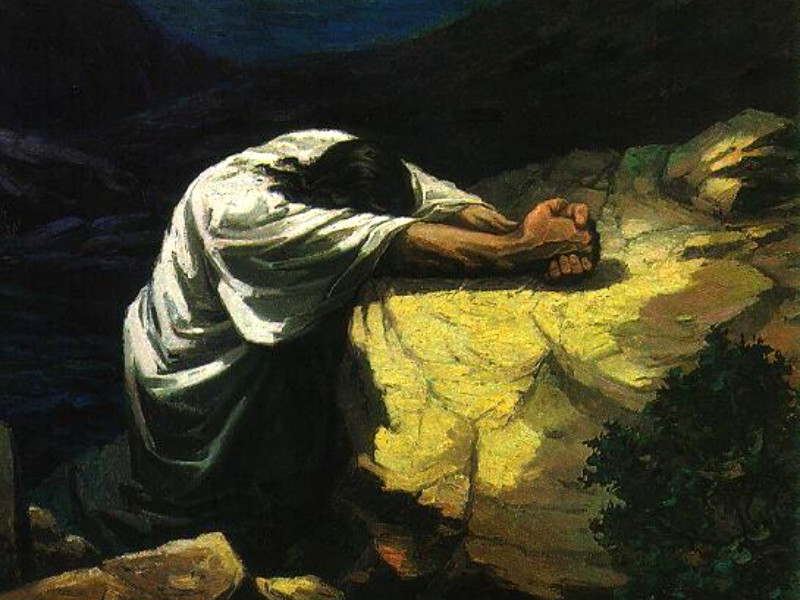
When prayer and warfare become idols

prayerI recently sat through a rather painful “bible study” on prayer. The text that was read at the beginning of the study was:

Matthew 16:13-19 (ESV) 13 Now when Jesus came into the district of Caesarea Philippi, he asked his disciples, “Who do people say that the Son of Man is?” 14 And they said, “Some say John the Baptist, others say Elijah, and others Jeremiah or one of the prophets.” 15 He said to them, “But who do you say that I am?” 16 Simon Peter replied, “You are the Christ, the Son of the living God.” 17 And Jesus answered him, “Blessed are you, Simon Bar-Jonah! For flesh and blood has not revealed this to you, but my Father who is in heaven. 18 And I tell you, you are Peter, and on this rock I will build my church, and the gates of hell shall not prevail against it. 19 I will give you the keys of the kingdom of heaven, and whatever you bind on earth shall be bound in heaven, and whatever you loose on earth shall be loosed in heaven.”

To be fair, I had happened upon a study that was in a series of studies, so there is naturally going to be some overlap of previous themes. However, when we got to verse 19 of this passage, we immediately lost sight of the meaning of the passage and of the notion of having a bible study. In a whirlwind of high-motivational pep speech (reminiscent of Joyce Myer or Beth Moore) the meaning of the passage was presented as follows

  • v17 Peter’s identification of Jesus as the Christ came by direct revelation (which was explained as being a result of having learned to pray)
  • v18 Jesus was going to build the church upon the revelation from the Father in heaven, not by flesh and blood (which was interpreted as prayer)
  • v19 the keys of the kingdom of heaven was prayer, and that having prayer as the key would grant authority to bind and loose (personal anecdote employed about how if I give a set of keys to my house to someone else, then I am giving that person authority to enter my house and use whatever is in there).

The point of the passage is the confession of Jesus as the Christ, Son of the living God. If the keys to the kingdom of heaven were “prayer”, the disciples had already been taught how to pray back in Matthew 6; however, Jesus clearly stated that He will give the keys, so there is more to this than prayer. I believe He is referring to the authority in Matthew 28:18 (ESV), “And Jesus came and said to them, “All authority in heaven and on earth has been given to me…” as a result of having laid down His life and raised it back up again. The Gospel of Jesus Christ is the keys to the kingdom of heaven, for by His Grace we are made righteous in the sight of the Lord and are granted entrance into the Kingdom of Heaven by the blood of the Lamb. If there remains any doubt, let us look at what Peter had to say in his Epistles. Surely since Jesus was building His church upon this rock, then Peter should at least echo this interpretation on some level, right? Well, prayer only gets mentioned 3 times in 1&2 Peter:

  1. 1 Peter 3:7 (ESV) 7 Likewise, husbands, live with your wives in an understanding way, showing honor to the woman as the weaker vessel, since they are heirs with you of the grace of life, so that your prayers may not be hindered.
  2. 1 Peter 3:8-12 (ESV) 8 Finally, all of you, have unity of mind, sympathy, brotherly love, a tender heart, and a humble mind. 9 Do not repay evil for evil or reviling for reviling, but on the contrary, bless, for to this you were called, that you may obtain a blessing. 10 For “Whoever desires to love life and see good days, let him keep his tongue from evil and his lips from speaking deceit; 11 let him turn away from evil and do good; let him seek peace and pursue it. 12 For the eyes of the Lord are on the righteous, and his ears are open to their prayer. But the face of the Lord is against those who do evil.” (Peter quoting Psalms 34)
  3. 1 Peter 4:6-8 (ESV) 6 For this is why the gospel was preached even to those who are dead, that though judged in the flesh the way people are, they might live in the spirit the way God does. 7 The end of all things is at hand; therefore be self-controlled and sober-minded for the sake of your prayers. 8 Above all, keep loving one another earnestly, since love covers a multitude of sins.

The over-arching theme of 1 & 2 Peter? I think it best to read the introduction to 1 Peter:

1 Peter 1:1-12 (ESV) 1 Peter, an apostle of Jesus Christ,
To those who are elect exiles of the Dispersion in Pontus, Galatia, Cappadocia, Asia, and Bithynia, 2 according to the foreknowledge of God the Father, in the sanctification of the Spirit, for obedience to Jesus Christ and for sprinkling with his blood: May grace and peace be multiplied to you.
3 Blessed be the God and Father of our Lord Jesus Christ! According to his great mercy, he has caused us to be born again to a living hope through the resurrection of Jesus Christ from the dead, 4 to an inheritance that is imperishable, undefiled, and unfading, kept in heaven for you, 5 who by God’s power are being guarded through faith for a salvation ready to be revealed in the last time. 6 In this you rejoice, though now for a little while, if necessary, you have been grieved by various trials, 7 so that the tested genuineness of your faith—more precious than gold that perishes though it is tested by fire—may be found to result in praise and glory and honor at the revelation of Jesus Christ. 8 Though you have not seen him, you love him. Though you do not now see him, you believe in him and rejoice with joy that is inexpressible and filled with glory, 9 obtaining the outcome of your faith, the salvation of your souls. 10 Concerning this salvation, the prophets who prophesied about the grace that was to be yours searched and inquired carefully, 11 inquiring what person or time the Spirit of Christ in them was indicating when he predicted the sufferings of Christ and the subsequent glories. 12 It was revealed to them that they were serving not themselves but you, in the things that have now been announced to you through those who preached the good news to you by the Holy Spirit sent from heaven, things into which angels long to look.

Peter understood the point of it all to be the Grace and Mercy of God the Father in sending His Son Jesus so that we might be saved. While Jesus did call Simon  “Peter” (which means rock) and said that “upon this rock I will build My church”, Peter clearly identifies Jesus Christ as the cornerstone in 1 Peter 2. Since Peter’s confession of Jesus Christ is the foundation of the church, it stands to reason that every stone laid on that foundation would in-turn be measured, trued, and lined up with Christ as the Cornerstone. I don’t think it was Peter (the man) who is the foundation of the church; rather, his confession of Jesus as the Christ, Son of the Living God is the foundation of the Church. Though, the argument could be made that both interpretations are valid given Peter was the first to preach on the Day of Pentecost, and was the first to be shown that God is calling Gentiles also into the fold.

The person conducting the study launched into what was clearly a personal soapbox issue. Once the confession of “being called to intercessory prayer” was made, I realized that there was a great deal of iesegisis at work, so I just let it go and smiled through it waiting for it to end. Do I have a problem with intercessory prayer? Absolutely not! There is a great need for intercessory prayer in the church. There are, however some problematic themes that come up whenever the topic of prayer becomes taught as a profession or ministry unto itself rather than a communion with a loving Heavenly Father, or an in-dwelling God the Holy Spirit.

The only text in the bible where we are specifically taught how to pray is when Jesus (God the Son) taught the disciples how to pray (Matt 6, Luke 11). We are told to pray without ceasing. We should live our lives in constant prayer, and we should also make daily time to pray. But the act of praying isn’t the point, it is to whom we pray and by whom we pray. Even in the realm of intercession, it is the Holy Spirit that intercedes for the saints, not the saints themselves (Romans 8:18-27), so we must not allow our fleshly need for credit to shade our speech/instruction in the discipline of prayer. Whether we are encouraging our brothers to seek the Will of God in their daily walk or for them to engage in intercessory prayer, we must always anchor the charge to pray onto the Holy Spirit of God dwelling within each of us who are called Children of God.  As we pointed out in our discussion of the Gifts of God the Holy Spirit, we must always keep our focus on the fact that it is God who does the work, not men. The individual giving the bible study had to stop several times to issue the caveat “not me, of course, but God working through me”. I’m very happy to have heard that confession in the form of a caveat so many times during the study; however, if a caveat needs to be issued that often then there is a language/emphasis problem with the discussion that should be addressed. Here, it was an over-selling of the “power of prayer”.

Prayer is not unique to Christianity… Our God is. Our understanding of God the Father, God the Son, and God the Holy Spirit is unique to our Biblical Christian faith. Stop looking at routines/ceremonies/principles for power, and look to the person of God the Holy Spirit and His work in our hearts. I want to take a few moments to include any discussion of “spiritual warfare” that focuses entirely too much on the redeemed rather than the Redeemer. Spiritual warfare takes place primarily in your mind and in your flesh. The Spirit of God dwelling within you has made your spirit alive and it wars against your flesh, and your flesh works against the Spirit (Galatians 5:16-26). When it comes to declaring the Word of God, our focus should be fixed on Preaching the Gospel of Jesus Christ. For Only by the Grace of God can anyone be made alive in Christ, set free from the bondage of sin and death, and made the recipient of the Holy Spirit. God the Holy Spirit does all of this work. We pray so that we can grow in the fullness of the Knowledge of Christ, and for boldness and for the Holy Spirit to give teach us how to speak and what to say in the hour of need.  We must guard ourselves against pride and folly. Our authority will forever be a derivative of Christ’s authority; therefore, we must never allow ourselves to lose sight or focus on the work of the Holy Spirit. Stop looking for some “extra outpouring” of the Spirit… God the Holy Spirit has already been promised to those who believe and are baptized in His Name. If you are in Him, then He is in you. There is no extra anything! Walk by faith, pray without ceasing, and remain vigilant in your focus upon the Gospel of Grace, of which you are a Steward. The role of the Church is to preach the Gospel, not to specialize in private prayer and launching special attacks on demons, principalities and powers. Christ defeated them, and it is only by His Blood that we have been made free from them. We expand the Kingdom of God by preaching the Gospel, not by “waging war in the heavenly”.  The Apostles were over-comers not because they were never jailed, hungry, thirsty, persecuted, killed… but because the Gospel of Jesus Christ was preached, and those who were dead in sins and trespasses were brought to salvation by Grace through Faith in Christ.

The Book of Jude stands as a strong warning against this sort of stepping beyond one’s authority. A single chapter full of wisdom and warning. Stepping back from that extreme, though, let us remember how Jesus introduced his lesson on prayer in Matthew 6:

Matthew 6:5-8 (ESV) 5 “And when you pray, you must not be like the hypocrites. For they love to stand and pray in the synagogues and at the street corners, that they may be seen by others. Truly, I say to you, they have received their reward. 6 But when you pray, go into your room and shut the door and pray to your Father who is in secret. And your Father who sees in secret will reward you. 7 “And when you pray, do not heap up empty phrases as the Gentiles do, for they think that they will be heard for their many words. 8 Do not be like them, for your Father knows what you need before you ask him.

Adorning your prayers with militancy is more likely to erode humility than it is to rightly charge your faith, or the faith of those around you. We pray to our Heavenly Father, not to the enemy. We declare the Gospel of Jesus Christ to those lost in the world, so that they might repent and be saved. As with prophecy, we do not presume to “declare the Word of the Lord” on our own, and we dare not blaspheme against things we do not understand. We yield in humble submission to God the Holy Spirit in all things.

Prayer is as essential as breathing. In the same way that breathing can become its own distraction (yoga, tantra, lamaze, etc.), so can an over-emphasis on the art of prayer, rather than the God to whom and by whom we pray. Is the focus of your intercessory prayer self-feeding? Do you spend more time reading about prayer than you do the Bible? Has your quest for spiritual warfare changed your study of the Bible into a search for special phrases to “declare” for defense and for offense (the Harry Potter approach to bible study)? Has your prayer specialization made you unavailable for sharing the Gospel, fellowship with the saints, and meeting the physical needs of the brethren? If so, then prayer and warfare might have become an idol. Just as the Praise and Worship Leader can allow music or his own ability to become an idol, or the pastor who preaches himself rather than Christ, or the affluent giver his affluence, etc. Idolatry is very subtle, and requires constant vigilance to avoid.

Jude 1:24-25 (ESV) Now to him who is able to keep you from stumbling and to present you blameless before the presence of his glory with great joy, to the only God, our Savior, through Jesus Christ our Lord, be glory, majesty, dominion, and authority, before all time and now and forever. Amen.

May the Lord bless and keep you,
In Him,
Jorge


Delegation of Authority: The Holy Spirit

dove

…the Holy Spirit descended upon Him in bodily form like a dove…
(Luke Chapter 3)

When we last spoke about how Authority had been delegated to Adam, and that God did not take it back immediately when Adam sinned, I couldn’t leave it alone without pointing out that one of the many awesome truths of the purpose that Jesus came to fulfill was in taking the Authority that man forfeited. We looked at how Jesus had to be born a man, but not from man’s seed (to inherit sin), so the virgin birth was required so that Jesus (the Word Made Flesh) could come and lay down His life:

John 10:11-18 (ESV) 11 I am the good shepherd. The good shepherd lays down his life for the sheep. 12 He who is a hired hand and not a shepherd, who does not own the sheep, sees the wolf coming and leaves the sheep and flees, and the wolf snatches them and scatters them. 13 He flees because he is a hired hand and cares nothing for the sheep. 14 I am the good shepherd. I know my own and my own know me, 15 just as the Father knows me and I know the Father; and I lay down my life for the sheep. 16 And I have other sheep that are not of this fold. I must bring them also, and they will listen to my voice. So there will be one flock, one shepherd. 17 For this reason the Father loves me, because I lay down my life that I may take it up again. 18 No one takes it from me, but I lay it down of my own accord. I have authority to lay it down, and I have authority to take it up again. This charge I have received from my Father.”

Praise the Lord! Notice here, that Jesus clearly states His purpose, His Authority, and that He received it from God the Father. Now, remember that our charge is given to us in the Great Commission, but let’s look at it again in Matthew:

Matthew 28:16-20 (ESV) 16 Now the eleven disciples went to Galilee, to the mountain to which Jesus had directed them. 17 And when they saw him they worshiped him, but some doubted. 18 And Jesus came and said to them, “All authority in heaven and on earth has been given to me. 19 Go therefore and make disciples of all nations, baptizing them in the name of the Father and of the Son and of the Holy Spirit, 20 teaching them to observe all that I have commanded you. And behold, I am with you always, to the end of the age.”

Notice the “therefore”. A cute little saying I heard growing up in Sunday School regarding taking the time to understand the context of scriptures was, What’s the ‘therefore’ there for? Here, it is telling us that our charge to Go and make disciples of all nations… is based in the fact that All authority in heaven and on earth has been given to Jesus… who is then giving us the charge to Go…

Now, let’s talk about the Holy Spirit. In the book of John, we see Jesus making several attempts at preparing the disciples for what was about to take place (crucifixion, resurrection, & ascension). In hindsight, we can see that Jesus was speaking quite plainly. But He knew (and said as much) that they just wouldn’t understand what He was telling them. Let’s take a look at the promise of Jesus to send a Helper:

John 15:18-27 (ESV) 18 “If the world hates you, know that it has hated me before it hated you. 19 If you were of the world, the world would love you as its own; but because you are not of the world, but I chose you out of the world, therefore the world hates you. 20 Remember the word that I said to you: ‘A servant is not greater than his master.’ If they persecuted me, they will also persecute you. If they kept my word, they will also keep yours. 21 But all these things they will do to you on account of my name, because they do not know him who sent me. 22 If I had not come and spoken to them, they would not have been guilty of sin, but now they have no excuse for their sin. 23 Whoever hates me hates my Father also. 24 If I had not done among them the works that no one else did, they would not be guilty of sin, but now they have seen and hated both me and my Father. 25 But the word that is written in their Law must be fulfilled: ‘They hated me without a cause.’ 26 “But when the Helper comes, whom I will send to you from the Father, the Spirit of truth, who proceeds from the Father, He will bear witness about Me. 27 And you also will bear witness, because you have been with me from the beginning.

John 16:1-15(ESV) 1 “I have said all these things to you to keep you from falling away. 2 They will put you out of the synagogues. Indeed, the hour is coming when whoever kills you will think he is offering service to God. 3 And they will do these things because they have not known the Father, nor me. 4 But I have said these things to you, that when their hour comes you may remember that I told them to you. “I did not say these things to you from the beginning, because I was with you. 5 But now I am going to him who sent me, and none of you asks me, ‘Where are you going?’ 6 But because I have said these things to you, sorrow has filled your heart. 7 Nevertheless, I tell you the truth: it is to your advantage that I go away, for if I do not go away, the Helper will not come to you. But if I go, I will send him to you. 8 And when he comes, he will convict the world concerning sin and righteousness and judgment: 9 concerning sin, because they do not believe in me; 10 concerning righteousness, because I go to the Father, and you will see me no longer; 11 concerning judgment, because the ruler of this world is judged. 12 “I still have many things to say to you, but you cannot bear them now. 13 When the Spirit of truth comes, he will guide you into all the truth, for he will not speak on his own authority, but whatever he hears he will speak, and he will declare to you the things that are to come. 14 He will glorify me, for he will take what is mine and declare it to you. 15 All that the Father has is mine; therefore I said that he will take what is mine and declare it to you.

The Holy Spirit is called our Helper, (the Greek word here is Paracletos, one called alongside to help; or Comforter, Advocate, Intercessor) and the Spirit of Truth. But Jesus doesn’t just identify Whom He will send, but for what purpose, to bear witness about Jesus. But here is something very cool (at least, I thought so)… this was already the role of the Holy Spirit. Only before, He took His marching orders from God the Father.

Luke 3:21-22 (ESV) 21 Now when all the people were baptized, and when Jesus also had been baptized and was praying, the heavens were opened, 22 and the Holy Spirit descended on him in bodily form, like a dove; and a voice came from heaven, “You are my beloved Son; with you I am well pleased.”

Praise the Lord. What is different now, is that before Christ, God sent His Spirit to speak the Word of the Lord through Prophets, Priests, and Judges over Israel. The Spirit of God was only available to whom God had called for His purpose. Now Jesus is sending the Holy Spirit to all who hear and place their faith in the Gospel of Jesus Christ, being baptized in the Name of the Father, of the Son, and of the Holy Spirit!

Remember, that God keeps His promises. In Acts 2, the promise of Jesus Christ to send the Holy Spirit takes place on the day of Pentecost. It is a momentous event. Peter’s first sermon is amazing, and I strongly recommend studying it closely. But for this blog, we are going to key in on how the crowd responds to the conclusion of the sermon, and Peter’s response to the question:

Acts 2:36-41 (ESV) 36 Let all the house of Israel therefore know for certain that God has made him both Lord and Christ, this Jesus whom you crucified.” 37 Now when they heard this they were cut to the heart, and said to Peter and the rest of the apostles, “Brothers, what shall we do?” 38 And Peter said to them, “Repent and be baptized every one of you in the name of Jesus Christ for the forgiveness of your sins, and you will receive the gift of the Holy Spirit. 39 For the promise is for you and for your children and for all who are far off, everyone whom the Lord our God calls to himself.” 40 And with many other words he bore witness and continued to exhort them, saying, “Save yourselves from this crooked generation.” 41 So those who received his word were baptized, and there were added that day about three thousand souls.

Praise the Lord! This promise is for us, we who are far off, those of us whom the Lord Our God has called to Himself through His Word! I want to turn quickly to one more passage of scripture before we close this out. Now, remember that role for which Jesus said He was going to send the Holy Spirit. Bearing that in mind, let us look to 1 John 4:

1 John 4:1-6 (ESV) 4 Beloved, do not believe every spirit, but test the spirits to see whether they are from God, for many false prophets have gone out into the world. 2 By this you know the Spirit of God: every spirit that confesses that Jesus Christ has come in the flesh is from God, 3 and every spirit that does not confess Jesus is not from God. This is the spirit of the antichrist, which you heard was coming and now is in the world already. 4 Little children, you are from God and have overcome them, for he who is in you is greater than he who is in the world. 5 They are from the world; therefore they speak from the world, and the world listens to them. 6 We are from God. Whoever knows God listens to us; whoever is not from God does not listen to us. By this we know the Spirit of truth and the spirit of error.

It is not a sign of doubt, unbelief, or insubordination to test the spirits to see whether they are from God. We are told to do so. Don’t let anyone silence you out of fear of being labeled a “critical person” or worse, for having a “spirit of criticism” simply because you aren’t yielding to the move of every spirit. For the role of the Holy Spirit is not to bring glory to Himself… but to Jesus Christ. Do we rely on our emotions? No. Remember that Jesus is the Word made flesh (John 1:14), so knowing the Word of God is critical to identifying rightly the Spirit of Truth from the many spirits of error. I hope to dive into 1 Corinthians 12-14 sometime, but I will say that spiritual discernment is one of the gifts of the Holy Spirit given to the body of believers (the Church), but knowledge of the Word of God is still necessary to properly operate in the Gifts of the Spirit.

I pray you have a wonderful weekend, and that you’ve found some blessing in these bible studies. May the Lord bless you and keep you in His Will,
In Him,
Jorge

An imperfect picture of the Perfect Love of the Father

I’ve been spending a great deal of time reading the Scriptures and praying for understanding of the whole of scriptures in relationship to the Gospel of Jesus Christ. There has been a great deal of growth, and yet I feel like I’m only scratching the surface. I hope you can relate to that feeling. Lately, I’ve been trying carefully to re-evaluate every aspect of my doctrine to make sure that what I believe is in line with the Scriptures. I’ll admit, it’s not fun. We usually like to start with those beliefs we didn’t trust, or that we suspected were unBiblical, but when it comes to challenging our own… *sigh*… it can be rough. My personal growth has been what I would call a Renaissance of the Preeminence of the Gospel of Jesus Christ in all of Scriptures.  I’m learning that a common pitfall in Evangelical circles, is to allow ourselves to somehow graduate from the Gospel and move on toward living a Holy life. The problem is in the false-notion that we can (or should) graduate from the Gospel. There is nothing beyond the Gospel, because the Gospel is everything. Outside of the Gospel, there is no hope of living a Holy life. So, instead of graduating, what happens is we allow our focus to fall from the grace of the Gospel, back under the Law.

Galatians 5:1-6 (ESV)
5 For freedom Christ has set us free; stand firm therefore, and do not submit again to a yoke of slavery.
2 Look: I, Paul, say to you that if you accept circumcision, Christ will be of no advantage to you. 3 I testify again to every man who accepts circumcision that he is obligated to keep the whole law. 4 You are severed from Christ, you who would be justified by the law; you have fallen away from grace. 5 For through the Spirit, by faith, we ourselves eagerly wait for the hope of righteousness. 6 For in Christ Jesus neither circumcision nor uncircumcision counts for anything, but only faith working through love.

The Apostle Paul is not encouraging any sense of Lawlessness. I have no desire to encourage or condone lawlessness. So where’s the balance? I can cite several places where Paul is rebuking those who fall from grace and back into Law… and also where James is rebuking lawlessness. I know (intellectually, theologically, scripturally) the answer is, “in Jesus Christ”.  I’d like to share an object lesson I believe the Holy Spirit gave me over the weekend.

Photo of my beautiful daughter

“Daddy… you mad?”

I am the father of a wonderful 4-year-old son, and a beautiful 2-year-old daughter. Lately, my daughter has been pushing the limits of her authority and testing the patience of her parents. She’s always been strong-willed, and quite the ham, but lately she has become very aware of her desires and quite capable to communicate those desires. She has been testing the waters in matching her will against ours. If you have toddlers now, or can remember when your kids were at this age, you know that this is simply a part of growing up. It isn’t rebellion, but it is a resistance to submission of will. Naturally, it is my duty to rebuke, reprimand, and even admonish such willful acts of disobedience, so I must, though it breaks my heart to do so. My son generally just needs a strong word. He may not understand (or even want to) why he was “in trouble” but he acknowledges he was reprimanded and then we have to build him back up. My daughter… will fight. Over the weekend, she disobeyed direct commands (stop that, don’t play with that, come here, pick that up) to varying degrees of defiance. In a few cases, this lead to punishment, tears, and a few instances of “telling on daddy” to mommy. A funny thing also kept coming up… once all was said and done, she apologized, we hugged, and reaffirmed our love for each other… she’d ask me later, “Daddy… you mad?”. I’d tell her, “no, honey, I’m not mad. It makes Daddy mad when you don’t do what I tell you to do, but I’m not mad now, and I still love you very, very much”. She’d smile at me and continue playing, sometimes hamming it up with an overwhelming tackle of a hug. As we were putting the kids to bed this past Saturday evening, and I started thinking about how I relate to our Heavenly Father.

Luke 11:11-13 (ESV) 11 What father among you, if his son asks for a fish, will instead of a fish give him a serpent; 12 or if he asks for an egg, will give him a scorpion? 13 If you then, who are evil, know how to give good gifts to your children, how much more will the heavenly Father give the Holy Spirit to those who ask him!”

As a father, I am an imperfect picture of the Perfect Love of Our Heavenly Father. Yes, my daughter is learning what it means to please and displease me, her earthly father. But those lessons are being taught and reinforced within the context of my love for her as my daughter. At no time… ever… is there any question that I love my daughter. None. And in my flesh, I am evil. How much more… is a powerful statement. One of the most dangerous lies of the devil, is when he accuses God of malice in His correction/punishment of our disobedience. Do not allow the enemy to twist the consequences of disobedience or the fleshly failings/stumblings that are going to happen, into doubt of your standing with God. Just as my daughter doesn’t stop being my daughter just because I had to correct her wrong doing, we don’t stop being Children of God simply because we failed to be Holy. Our performance was not what saved us in the first place!

Ephesians 2 (ESV)
2 And you were dead in the trespasses and sins 2 in which you once walked, following the course of this world, following the prince of the power of the air, the spirit that is now at work in the sons of disobedience— 3 among whom we all once lived in the passions of our flesh, carrying out the desires of the body and the mind, and were by nature children of wrath, like the rest of mankind. 4 But God, being rich in mercy, because of the great love with which he loved us, 5 even when we were dead in our trespasses, made us alive together with Christ—by grace you have been saved— 6 and raised us up with him and seated us with him in the heavenly places in Christ Jesus, 7 so that in the coming ages he might show the immeasurable riches of his grace in kindness toward us in Christ Jesus. 8 For by grace you have been saved through faith. And this is not your own doing; it is the gift of God, 9 not a result of works, so that no one may boast. 10 For we are his workmanship, created in Christ Jesus for good works, which God prepared beforehand, that we should walk in them. One in Christ 11 Therefore remember that at one time you Gentiles in the flesh, called “the uncircumcision” by what is called the circumcision, which is made in the flesh by hands— 12 remember that you were at that time separated from Christ, alienated from the commonwealth of Israel and strangers to the covenants of promise, having no hope and without God in the world. 13 But now in Christ Jesus you who once were far off have been brought near by the blood of Christ. 14 For he himself is our peace, who has made us both one and has broken down in his flesh the dividing wall of hostility 15 by abolishing the law of commandments expressed in ordinances, that he might create in himself one new man in place of the two, so making peace, 16 and might reconcile us both to God in one body through the cross, thereby killing the hostility. 17 And he came and preached peace to you who were far off and peace to those who were near. 18 For through him we both have access in one Spirit to the Father. 19 So then you are no longer strangers and aliens, but you are fellow citizens with the saints and members of the household of God, 20 built on the foundation of the apostles and prophets, Christ Jesus himself being the cornerstone, 21 in whom the whole structure, being joined together, grows into a holy temple in the Lord. 22 In him you also are being built together into a dwelling place for God by the Spirit.

The Christian life, is a life lived in Christ. We are being built together, joined together, grown into a holy temple in the Lord… but Jesus Christ is the cornerstone. You cannot make (or keep) a wall straight, if you take your eyes off of the cornerstone. When we fall out of alignment (and it will happen while we walk in the flesh), the Holy Spirit will work us back into alignment. Do not mistake the rebuke and correction of the Holy Spirit for malice. There is no room to question God’s love, for Scripture makes it clear that He loved us while we were dead in our sins. We don’t reject the Law and the Prophets, we don’t ignore them one bit, not a single iota, because in doing so we would lose sight of depth and width of that for which Jesus gave Himself as the final sacrifice.

2 Timothy 3:16-17 (ESV) 16 All Scripture is breathed out by God and profitable for teaching, for reproof, for correction, and for training in righteousness, 17 that the man of God may be complete, equipped for every good work.

The problem is not the Law and the Prophets, it’s in allowing your focus to move off of what Christ did for us and onto an obligation to fulfill the whole law ourselves, something we are incapable of doing apart from Christ! How does that pan out?

  • theology that declares that God hates you because you sinned
  • theology that limits the forgiveness paid by Christ to only those sins you committed before you were “saved” (leaving you to seek penance through the Law to make up for sins committed after you “received Christ”)
  • theology that declares you “owe it to God” to fulfill the Law
  • theology that tells you that you need to prove to God how much you love Him by performing works of the Law

So, in closing, we should expect to get corrected, rebuked, and punished for wrong doing… as Children of God in Christ Jesus, for the maturing of the Church. We will mess up and He will correct us. But we remain, forever, His children. Bless the Lord for His Love, His Kindness, His Mercy, and His Grace. Amen.

May the Lord bless you and keep you,
In Him,
Jorge

And when you pray…

PrayingIt has been a couple of months since we last looked at prayer. Since then, we’ve been reviewing Sovereignty of God, His Word, the Gospel of Jesus, Discipleship… and I think it is important to revisit the topic of prayer. So, lets start with a quick review of how our Lord and Savior, Jesus Christ, taught his disciples to pray:

Matthew 6:7-15 (ESV)
7 “And when you pray, do not heap up empty phrases as the Gentiles do, for they think that they will be heard for their many words. 8 Do not be like them, for your Father knows what you need before you ask him. 9 Pray then like this:

“Our Father in heaven,
hallowed be your name.
10 Your kingdom come,
your will be done,
on earth as it is in heaven.
11 Give us this day our daily bread,
12 and forgive us our debts,
as we also have forgiven our debtors.
13 And lead us not into temptation,
but deliver us from evil.

 14 For if you forgive others their trespasses, your heavenly Father will also forgive you, 15 but if you do not forgive others their trespasses, neither will your Father forgive your trespasses.

Notice the first half of the prayer begins in full acknowledgement and praise of the sovereignty of God. Our Father in heaven, hallowed be your name sets the stage for the foundational basis of prayer. Jesus prayed to His Father in Heaven and He taught us to do likewise (because in/through Jesus we are made free to call the Lord God our Father). The next part of the prayer is where I really want to focus on today. Your Kingdom come, Your Will be done on earth as it is in Heaven.  Our first request does not come from us. Our first request is that God’s Kingdom come, and that God’s Will be done on earth, as it is done in Heaven. His Sovereignty. His Will.

God’s Will is done in Heaven. Jesus isn’t instructing us to pray that God’s will be done in Heaven, we are to ask that God’s Will be done on earth, in the same way that it is done in Heaven. This is to keep us, and our prayers, firmly rooted in the Will of God. Any attempt to twist this into somehow us giving God permission to execute His Will on Earth is false. The sovereignty of God is immutable. This is an acknowledgement that while we will make our petitions to God in prayer, He remains sovereign, and we acknowledge that above all else, it is His Will we desire to be done on earth just as it is done in Heaven. This is about submission to God, our Heavenly Father, in prayer. Now, I encourage you to take some time to read the context of this instruction fully, so start in Matthew 5 and read all the way through Matthew 7. I believe that the overall theme of this sermon is to clarify the role of Jesus Christ (to fulfill the Law & Prophets Matt 5:15), even to the extend that He clearly makes the case that apart from Him no one has access to Heaven because they are incapable of fulfilling the Law themselves (v22). In Chapter 6, Jesus moves into the need for total submission to God the Father in all things, even our good works according to the Law, and that we stop doing good things for our own glory. Including how we are to pray by specifying that we pray in accordance with His Will.

Matthew 6:3-4 (ESV) 3 But when you give to the needy, do not let your left hand know what your right hand is doing, 4 so that your giving may be in secret. And your Father who sees in secret will reward you.
Matthew 6:6 (ESV) 6 But when you pray, go into your room and shut the door and pray to your Father who is in secret. And your Father who sees in secret will reward you.
Matthew 6:16-18 (ESV) 16 “And when you fast, do not look gloomy like the hypocrites, for they disfigure their faces that their fasting may be seen by others. Truly, I say to you, they have received their reward. 17 But when you fast, anoint your head and wash your face, 18 that your fasting may not be seen by others but by your Father who is in secret. And your Father who sees in secret will reward you.

And now, Jesus moves into addressing our motives. So, we’ve seen Jesus address the practice of good deeds not for recognition of men, but in full submission to God who sees in secret. Now he’s moving our motives.

Matthew 6:19-21 (ESV) 19 “Do not lay up for yourselves treasures on earth, where moth and rust destroy and where thieves break in and steal, 20 but lay up for yourselves treasures in heaven, where neither moth nor rust destroys and where thieves do not break in and steal. 21 For where your treasure is, there your heart will be also. 22 “The eye is the lamp of the body. So, if your eye is healthy, your whole body will be full of light, 23 but if your eye is bad, your whole body will be full of darkness. If then the light in you is darkness, how great is the darkness! 24 “No one can serve two masters, for either he will hate the one and love the other, or he will be devoted to the one and despise the other. You cannot serve God and money.

Interesting. We’ve been taught how to be blessed by God if we improve the way we give to the needy, pray, and fast… and immediately Jesus addresses money. Often, blessings are interpreted as money. Why? We walk in the flesh and are easily tempted. But Jesus makes a very strong point here, that we are NOT to lay up for ourselves treasures on earth; rather, we are to lay up for ourselves treasures in heaven. You see, when we seek the blessings of God in such a way that demands we receive our blessings on earth, we are trading permanent, heavenly treasures for temporary ones where moth and rust destroy. But it isn’t just about making a poor trade, it’s about who we are submitting ourselves to. No one can serve two masters… Jesus didn’t leave a third option, either you are serving money (wealth, prosperity, Mammon), or you are serving God. Again, you cannot serve God and Mammon.

Jesus moves straight from there, back to addressing the basic needs of mankind. He does so, by highlighting again the Sovereignty of God, but also His Goodness.

Matthew 6:25-33 (ESV) 25 “Therefore I tell you, do not be anxious about your life, what you will eat or what you will drink, nor about your body, what you will put on. Is not life more than food, and the body more than clothing? 26 Look at the birds of the air: they neither sow nor reap nor gather into barns, and yet your heavenly Father feeds them. Are you not of more value than they? 27 And which of you by being anxious can add a single hour to his span of life? 28 And why are you anxious about clothing? Consider the lilies of the field, how they grow: they neither toil nor spin, 29 yet I tell you, even Solomon in all his glory was not arrayed like one of these. 30 But if God so clothes the grass of the field, which today is alive and tomorrow is thrown into the oven, will he not much more clothe you, O you of little faith? 31 Therefore do not be anxious, saying, ‘What shall we eat?’ or ‘What shall we drink?’ or ‘What shall we wear?’ 32 For the Gentiles seek after all these things, and your heavenly Father knows that you need them all. 33 But seek first the kingdom of God and his righteousness, and all these things will be added to you.

Seek first the kingdom of God… and again, take another look at how we are told to pray up in v9-14. “Your kingdom come” is also included in the prayer taught in the account in Luke 11 when the lesson is a response to the disciples asking Jesus how they should pray. That prayer is shorter, and I believe that praying for God’s kingdom to come is praying for God’s Will to be done on earth as it is in Heaven, and no doubt it served as a reminder of the full lesson Jesus taught here in Matthew. Because nothing happens in God’s Kingdom that is not within His Will. Nothing. That is the immutable sovereignty of God.

Whenever the topic of prayer comes up, the enemy will attempt to silence you and your prayers. He does so in many ways, but we’ve seen here a few already

  • Unforgiveness (v14)
  • Vanity/Self-righteousness (v1,5,16)
  • Lust of the eyes (v22)
  • Slavery to Mammon (v24)
  • Anxiety (v25)

These are big items found in this one chapter. Now, let me take a moment to ask you to turn to James 4. You may have read this a few times before, but take a moment now to read what James had to say in light of Matthew 6, 7 (I know we didn’t really cover Ch7 here, but I will leave that for your study, or if God allows, a subsequent post).

James 4 (ESV)
4 What causes quarrels and what causes fights among you? Is it not this, that your passions are at war within you? 2 You desire and do not have, so you murder. You covet and cannot obtain, so you fight and quarrel. You do not have, because you do not ask. 3 You ask and do not receive, because you ask wrongly, to spend it on your passions. 4 You adulterous people! Do you not know that friendship with the world is enmity with God? Therefore whoever wishes to be a friend of the world makes himself an enemy of God. 5 Or do you suppose it is to no purpose that the Scripture says, “He yearns jealously over the spirit that he has made to dwell in us”? 6 But he gives more grace. Therefore it says, “God opposes the proud, but gives grace to the humble.” 7 Submit yourselves therefore to God. Resist the devil, and he will flee from you. 8 Draw near to God, and he will draw near to you. Cleanse your hands, you sinners, and purify your hearts, you double-minded. 9 Be wretched and mourn and weep. Let your laughter be turned to mourning and your joy to gloom. 10 Humble yourselves before the Lord, and he will exalt you.

11 Do not speak evil against one another, brothers. The one who speaks against a brother or judges his brother, speaks evil against the law and judges the law. But if you judge the law, you are not a doer of the law but a judge. 12 There is only one lawgiver and judge, he who is able to save and to destroy. But who are you to judge your neighbor?

13 Come now, you who say, “Today or tomorrow we will go into such and such a town and spend a year there and trade and make a profit”— 14 yet you do not know what tomorrow will bring. What is your life? For you are a mist that appears for a little time and then vanishes. 15 Instead you ought to say, “If the Lord wills, we will live and do this or that.” 16 As it is, you boast in your arrogance. All such boasting is evil. 17 So whoever knows the right thing to do and fails to do it, for him it is sin.

The question or objection that comes up whenever the subject of prayer is discussed generally falls under “yeah, I tried that, I prayed, and nothing happened”. Now there are so many reasons why a prayer may not have been fulfilled, that I generally take a deep breath and wait for a softening in the countenance of the person posing the question (because it’s normally presented as an accusation). Against whom is the accusation being levied? Is it against me? What have I taught that is of myself? Hopefully nothing; therefore, there is no need to be offended, or to take offense at the accusation neither should I worry about defending myself. But I was sharing what Jesus said in Matthew Ch 6. So, is the accusation against Jesus or God, the Father? I don’t need to speak for Him. James cuts to the heart of the matter, and I think it reflects the instruction we received in Matthew 6.

Prayer was an essential part of Jesus’ life, and should be an essential part of our lives. There are no secrets to prayer. There are no secrets to unlocking the key to prayer. Jesus openly taught how to pray, and again gave instruction to His disciples and God the Father ensured that the lessons would be preserved for us in His Scriptures. We must submit to God’s sovereignty, and make our petitions to Him fully acknowledging His Will. We don’t always get our way, because it’s not our will, but God’s Will. Let’s look at Jesus’ prayer in the garden of Gethsemane:

Matthew 26:39 (ESV) 39 And going a little farther he fell on his face and prayed, saying, “My Father, if it be possible, let this cup pass from me; nevertheless, not as I will, but as you will.

In closing, I don’t want to pluck prayer out as some request roulette mechanic. The goal of prayer must be submission to God, and He does speak to us through His Word and by His Spirit so that we are not left completely unaware of what His Will is. Your kingdom come... He has shared so much with us already if we would just… read… the… Bible. Anyway, I love the way the Apostle Paul closes the letter to the Thessalonians.

1 Thessalonians 5:12-28 (ESV) 12 We ask you, brothers, to respect those who labor among you and are over you in the Lord and admonish you, 13 and to esteem them very highly in love because of their work. Be at peace among yourselves. 14 And we urge you, brothers, admonish the idle, encourage the fainthearted, help the weak, be patient with them all. 15 See that no one repays anyone evil for evil, but always seek to do good to one another and to everyone. 16 Rejoice always, 17 pray without ceasing, 18 give thanks in all circumstances; for this is the will of God in Christ Jesus for you. 19 Do not quench the Spirit. 20 Do not despise prophecies, 21 but test everything; hold fast what is good. 22 Abstain from every form of evil.
23 Now may the God of peace himself sanctify you completely, and may your whole spirit and soul and body be kept blameless at the coming of our Lord Jesus Christ. 24 He who calls you is faithful; he will surely do it.
25 Brothers, pray for us.
26 Greet all the brothers with a holy kiss.
27 I put you under oath before the Lord to have this letter read to all the brothers.
28 The grace of our Lord Jesus Christ be with you.

May the grace of our Lord Jesus Christ be with you, too.
FS

Exegesis and Eisegesis

bookshelfI’ve been studying the Scriptures a lot lately, particularly the Old Testament. I’ve also been studying about the study of Scriptures. Side-note: I’m finding that I had to repent of some overly negative perspectives on some Christian denominations. There are a couple of terms that I seem to run into at every turn, and I thought maybe some of you have run into these terms a time or two. Any discussion, writing, speech, sermon, etc. of the Word of God that goes beyond reading the texts will fall under one of two categories exegesis or eisegesis (sometimes written “isogesis”).

  • Exegesis [ek-si-jee-sis] — noun, plural ex·e·ge·ses [ek-si-jee-seez] critical explanation or interpretation of a text or portion of a text, especially of the Bible.
    • Origin: 1610–20; < Greek exḗgēsis an interpretation, explanation, equivalent to ex- ex-3 + ( h ) ēgē- (verbid stem of hēgeîsthai to guide) + -sis -sis
  • Eisegesis [ahy-si-jee-sis] — noun, plural eis·e·ge·ses [ahy-si-jee-seez] an interpretation, especially of Scripture, that expresses the interpreter’s own ideas, bias, or the like, rather than the meaning of the text.
    • Origin: 1890–95; < Greek eisḗgesis, equivalent to eis- into + ( h ) ēge- (stem of hēgeîsthai to lead) + -sis -sis

As stewards of God’s Word, we should endeavor to keep our interpretation of Scripture fully within the realm of exegesis and we should avoid Eisegesis. The simplest example is what happens when false prophets predict the return of Christ despite Matt 24:36, Acts 1:6-7, and the clear warning in Rev 22:8, they put their own ideas, bias, calculations into the texts to come up with a date. Most of the time its far more subtle and usually involves taking a passage of scripture out of context. Eisegesis can be done in ignorance, fear, or for selfish gain. The motives are not for us to discern, but the Holy Spirit for only God knows the heart of man. We are, however, to discern sound doctrine (Titus 2) and Biblical teaching.

As always, our focus should be on the Gospel of Jesus Christ, not on seeking out false-gospels or false-prophets. We don’t need to study false teaching to identify that which is false. It is far better to devote yourself to the study of Truth, so that anything that contradicts Truth is false.  We would do well to guard our hearts so as not to give the devil an opportunity. Our zeal for the preservation of the Word of God must not become an occasion for sin. We must teach the word correctly, and we must endeavor to correct others in keeping with Galatians 1:6-9, Titus 1, 1 Timothy 1:3-7 while also keeping with Matthew 18:15-20, Galatians 6. For those teachers who are beyond our reach (sphere of influence, authority, etc.), we make every effort to share the Gospel of Jesus Christ (as indeed we should regardless of the presence or absence of false teaching) and trust in God to deal with those beyond our reach. When it comes to the leaders in your church, remain humble in your demeanor and tone.

Hebrews 13:7-9 (ESV) 7 Remember your leaders, those who spoke to you the word of God. Consider the outcome of their way of life, and imitate their faith. 8 Jesus Christ is the same yesterday and today and forever. 9 Do not be led away by diverse and strange teachings, for it is good for the heart to be strengthened by grace, not by foods, which have not benefited those devoted to them.

Hebrews 13:17 (ESV) 17 Obey your leaders and submit to them, for they are keeping watch over your souls, as those who will have to give an account. Let them do this with joy and not with groaning, for that would be of no advantage to you.

We must bring correction to the leaders (elders, pastors, overseers, deacons, etc.) when we feel they are in the wrong, in humility and appropriately according to scripture, so as not to be a burden to them. That submission does not mean that we are to accept everything they claim to be the Word of God. Hopefully, understanding the differences between exegesis and eisegesis will help identify warning flags.

So, how do we do this? Well, the first recommendation I have is to devote time throughout the week to read the Word of God. If the only time you open your Bible is when you are told to “open your bibles to…” on Sunday morning, I’m sorry to say that you will be ill-equipped to catch scripture being presented out of context. What’s worse, is that if eisegesis goes unchallenged for a long time, there will be less and less emphasis on the “open your bibles to…” and possibly some extra-biblical references or personal revelation presented as substantiation. By that point, many will be attending several sermons without ever opening the Bible, even within the sermon. If you are in such an assembly, you are fully reliant upon the teacher to be correct in all of his ways. So, step one is to read the Word of God. I also recommend taking notes, or taking the notes your Church gives the congregation home. During the week, explore the scriptures and see for yourself the context of the passages used, and ask the Holy Spirit to guide your study. I promise you that He will show you things, even if the sermon was perfect… because you are giving the Holy Spirit time to speak to you through His Word. Finally, if there is something that you find troubling, reach out to your leadership in private (Matt 18) and ask the questions. I find that most of the correspondence Pastors receive are either antagonistic, accusatory, or solicitation… rarely is it the result of careful study of Scripture. You may find the ensuing discussion very encouraging.

I pray the Lord God bless and keep you,
In Him,
FS