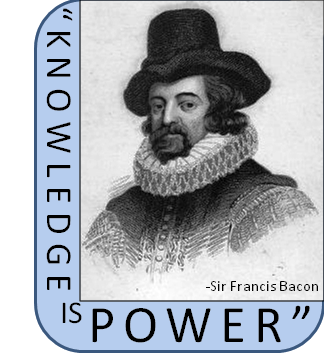
Knowledge is Power?

BaconQuoteThis past Labor Day I spent a little over 9 hours on the road unaccompanied. There was a billboard sign promoting some college or university that caught my attention and all it said was “Knowledge is Power”. A quote often attributed to Sir Francis Bacon, one of the so-called “great philosophers” you will undoubtedly study if you take a Philosophy or History of Philosophy class.

The thought that immediately came to mind was, “not all knowledge is power”. So, let’s take this oft-quoted truism and test it against the Word of God.

Did God Actually Say…?

Let’s start with the first appearance of “knowledge” in the Scriptures. For this, we reach all the way back to the Garden of Eden.

Genesis 2:8-9 (ESV) 8 And the Lord God planted a garden in Eden, in the east, and there he put the man whom he had formed. 9 And out of the ground the Lord God made to spring up every tree that is pleasant to the sight and good for food. The tree of life was in the midst of the garden, and the tree of the knowledge of good and evil.

Genesis 2:15-17 (ESV) 15 The Lord God took the man and put him in the garden of Eden to work it and keep it.16 And the Lord God commanded the man, saying, “You may surely eat of every tree of the garden, 17 but of the tree of the knowledge of good and evil you shall not eat, for in the day that you eat of it you shall surely die.”

Genesis 3:1-5 (ESV) 3 Now the serpent was more crafty than any other beast of the field that the Lord God had made. He said to the woman, “Did God actually say, ‘You shall not eat of any tree in the garden’?” 2 And the woman said to the serpent, “We may eat of the fruit of the trees in the garden, 3 but God said, ‘You shall not eat of the fruit of the tree that is in the midst of the garden, neither shall you touch it, lest you die.’” 4 But the serpent said to the woman, “You will not surely die. 5 For God knows that when you eat of it your eyes will be opened, and you will be like God, knowing good and evil.

Genesis 3:22-23 (ESV) 22 Then the Lord God said, “Behold, the man has become like one of us in knowing good and evil. Now, lest he reach out his hand and take also of the tree of life and eat, and live forever—” 23 therefore the Lord God sent him out from the garden of Eden to work the ground from which he was taken.

God forbade Adam to eat of one tree, the tree of the knowledge of good and evil. Satan steps in to tempt Eve to eat of the fruit of that tree, and notice how he did it. He offers Eve a “why” that was a lie. In so doing, he accuses God of withholding power from her. Satan tells her that the reason she is not allowed to eat of the fruit isn’t that she will die; rather, it is so that she will not have the power of knowledge thus keeping her from being like God. What knowledge did Adam and Eve gain from the fruit of the tree? Only the knowledge of evil. Notice the grace of God steps in immediately, in that He made sure to prevent man from eating of the fruit of the tree of Life. Spiritual death happened immediately in the sin. The flesh was defiled by the same sin and would complete the penalty required by sin, complete death. God did not let man live eternally in a cursed and fallen flesh. A way was already made for the redemption of mankind, in the death and resurrection of Jesus Christ; therefore, sinful man was prevented from partaking of the fruit of the tree of Life. Praise God.

Getting back to the knowledge gained, Adam already knew God; therefore, he already knew good. God is the very definition of good. Mark 10:18 (ESV) And Jesus said to him, “Why do you call me good? No one is good except God alone. Now Jesus is God and is also good, but the rich young ruler had not acknowledged Jesus as God; therefore, he had no basis upon which to call Jesus “good”. Which vaults us into the next topic, the Biblical definition of Knowledge that is Power.

Knowledge of Him

If you search the ESV for “knowledge” you get a lot of results, the vast majority of them would seem to support the truism “knowledge is power”; however, as we’ve established, that statement does not reflect truth on its own. There is knowledge that leads to death, as we saw in the garden. The knowledge of evil, of sin, leads to death. Man sinned in the garden, and died, separating us from the only knowledge that has any power, the knowledge of God. Let us look at some of the Biblical passages that clearly define what knowledge we are to be seeking.

2 Chronicles 1:7-13 (ESV) 7 In that night God appeared to Solomon, and said to him, “Ask what I shall give you.” 8 And Solomon said to God, “You have shown great and steadfast love to David my father, and have made me king in his place. 9 O Lord God, let your word to David my father be now fulfilled, for you have made me king over a people as numerous as the dust of the earth. 10 Give me now wisdom and knowledge to go out and come in before this people, for who can govern this people of yours, which is so great?” 11 God answered Solomon, “Because this was in your heart, and you have not asked for possessions, wealth, honor, or the life of those who hate you, and have not even asked for long life, but have asked for wisdom and knowledge for yourself that you may govern my people over whom I have made you king, 12 wisdom and knowledge are granted to you. I will also give you riches, possessions, and honor, such as none of the kings had who were before you, and none after you shall have the like.” 13 So Solomon came from the high place at Gibeon, from before the tent of meeting, to Jerusalem. And he reigned over Israel.

Luke 11:31 (ESV)31 The queen of the South will rise up at the judgment with the men of this generation and condemn them, for she came from the ends of the earth to hear the wisdom of Solomon, and behold, something greater than Solomon is here.

2 Corinthians 2:14-17 (ESV)14 But thanks be to God, who in Christ always leads us in triumphal procession, and through us spreads the fragrance of the knowledge of him everywhere. 15 For we are the aroma of Christ to God among those who are being saved and among those who are perishing, 16 to one a fragrance from death to death, to the other a fragrance from life to life. Who is sufficient for these things? 17 For we are not, like so many, peddlers of God’s word, but as men of sincerity, as commissioned by God, in the sight of God we speak in Christ.

Ephesians 1:16-21 (ESV)16 I do not cease to give thanks for you, remembering you in my prayers, 17 that the God of our Lord Jesus Christ, the Father of glory, may give you the Spirit of wisdom and of revelation in the knowledge of him, 18 having the eyes of your hearts enlightened, that you may know what is the hope to which he has called you, what are the riches of his glorious inheritance in the saints, 19 and what is the immeasurable greatness of his power toward us who believe, according to the working of his great might 20 that he worked in Christ when he raised him from the dead and seated him at his right hand in the heavenly places, 21 far above all rule and authority and power and dominion, and above every name that is named, not only in this age but also in the one to come.

Solomon’s great wisdom and knowledge came directly from God the Father, and from no other place. His sin was in allowing false knowledge, false doctrines, and false gods to take up residence in Israel, through his very own fleshly failings in the taking of brides from other nations and allowing their idolatry. Still we see Jesus teaching in reference to the wisdom of Solomon and immediately declaring that something greater than Solomon was in their midst. That something is Jesus Christ, the very standard of Good and the embodiment of Truth and Knowledge. We see plainly that Paul pointed to the Knowledge of Christ as the key factor for our salvation. For if we fail to accept the Knowledge of the Gospel of Christ, we remain powerlessly dead to sin. Notice also, that Paul separates himself from the peddlers of God’s word, in that only in the Gospel of Jesus Christ, the knowledge of Christ, are we made right with God. Many peddle the scriptures, tossing out verses, twisting God’s words for gain, or for a laugh, or to tempt and lead astray even the elect of God. Satan twisted God’s words in the garden by inserting lies. Satan twisted scripture in his temptation of Jesus in the wilderness. Peddlers of God’s Word. But as Paul said in 2 Corinthians “Thanks be to God” for giving us His Word and for sending us His Holy Spirit so that we might grow in the Knowledge of Christ.

False Knowledge Still Kills

1 Timothy 6:3-21 (ESV)If anyone teaches a different doctrine and does not agree with the sound words of our Lord Jesus Christ and the teaching that accords with godliness, 4 he is puffed up with conceit and understands nothing. He has an unhealthy craving for controversy and for quarrels about words, which produce envy, dissension, slander, evil suspicions, 5 and constant friction among people who are depraved in mind and deprived of the truth, imagining that godliness is a means of gain. 6 But godliness with contentment is great gain, 7 for we brought nothing into the world, and we cannot take anything out of the world. 8 But if we have food and clothing, with these we will be content. 9 But those who desire to be rich fall into temptation, into a snare, into many senseless and harmful desires that plunge people into ruin and destruction. 10 For the love of money is a root of all kinds of evils. It is through this craving that some have wandered away from the faith and pierced themselves with many pangs.

11 But as for you, O man of God, flee these things. Pursue righteousness, godliness, faith, love, steadfastness, gentleness. 12 Fight the good fight of the faith. Take hold of the eternal life to which you were called and about which you made the good confession in the presence of many witnesses. 13 I charge you in the presence of God, who gives life to all things, and of Christ Jesus, who in his testimony before Pontius Pilate made the good confession, 14 to keep the commandment unstained and free from reproach until the appearing of our Lord Jesus Christ, 15 which he will display at the proper time—he who is the blessed and only Sovereign, the King of kings and Lord of lords, 16 who alone has immortality, who dwells in unapproachable light, whom no one has ever seen or can see. To him be honor and eternal dominion. Amen. 17 As for the rich in this present age, charge them not to be haughty, nor to set their hopes on the uncertainty of riches, but on God, who richly provides us with everything to enjoy. 18 They are to do good, to be rich in good works, to be generous and ready to share, 19 thus storing up treasure for themselves as a good foundation for the future, so that they may take hold of that which is truly life.

20 O Timothy, guard the deposit entrusted to you. Avoid the irreverent babble and contradictions of what is falsely called “knowledge,” 21 for by professing it some have swerved from the faith. Grace be with you.

There is only one Truth, our Lord and Savior Jesus Christ. The truism, is misleading. It is often used to suggest that when one obtains knowledge, one obtains power. That isn’t true. For one, the only way to “obtain knowledge” is by grace, through faith, and that not of our selves, it is the gift of God (Ephesians 2). And faith comes through hearing and hearing through the Word of Christ (Romans 10:17). Knowledge is not a power for us to obtain; rather, it is the only way of salvation, the only way that we might be made alive in Christ rather than dead in our sin.

In Jesus Christ our Lord, to God be the glory forever, Amen.
Jorge

DiM | “Greater” by Mercy Me

Presentation1Today is “Discernment in Music” (DiM) day here at Faithful Stewardship.

2 Corinthians 10:4-6 (ESV)
4 For the weapons of our warfare are not of the flesh but have divine power to destroy strongholds. 5 We destroy arguments and every lofty opinion raised against the knowledge of God, and take every thought captive to obey Christ, 6 being ready to punish every disobedience, when your obedience is complete.

According to Billboard Music, the top song remains Oceans (Where Feet May Fail) by Hillsong United. Since we’ve already discussed that song, let’s move down the list. The #2 song on the list is climbing quickly and I think it is far superior to Oceans. Today, we will be taking a look at “Greater” by Mercy Me. If you haven’t heard it yet, check out their official lyrical video below:

Lyrics (via AZLyrics)

“Greater”
Bring your tired
Bring your shame
Bring your guilt
Bring your pain
Don’t you know that’s not you’re name
You will always be much more to me

Every day I wrestle with the voices
That keep telling me I’m not right
But that’s alright

‘Cause I hear a voice and He calls me redeemed
When others say I’ll never be enough
And greater is the One living inside of me
Than he who is living in the world
In the world
In the world
And greater is the One living inside of me
Than he who is living in the world

Bring your doubts
Bring your fears
Bring your hurt
Bring your tears
There’ll be no condemnation here
You are holy, righteous and redeemed

Every time I fall
There’ll be those who will call me
A mistake
Well that’s ok

There’ll be days I lose the battle
Grace says that it doesn’t matter
‘Cause the cross already won the war
He’s Greater
He’s Greater

I am learning to run freely
Understanding just how He sees me
And it makes me love Him more and more
He’s Greater
He’s Greater

So this song’s title and hook comes from a passage of scripture we refer to often here when we speak of discernment.

1 John 4:1-6 (ESV) 1 Beloved, do not believe every spirit, but test the spirits to see whether they are from God, for many false prophets have gone out into the world. 2 By this you know the Spirit of God: every spirit that confesses that Jesus Christ has come in the flesh is from God,3 and every spirit that does not confess Jesus is not from God. This is the spirit of the antichrist, which you heard was coming and now is in the world already. 4 Little children, you are from God and have overcome them, for he who is in you is greater than he who is in the world. 5 They are from the world; therefore they speak from the world, and the world listens to them. 6 We are from God. Whoever knows God listens to us; whoever is not from God does not listen to us. By this we know the Spirit of truth and the spirit of error.

Now, the focus of the song isn’t really the same as the focus John had. The focus of the song “greater” is one of resisting the enemy’s condemnation. It is intended as a song of encouragement to the weary Christian. What John is focused on here is discernment and understanding that we who have been redeemed have the Spirit of Living God dwelling inside of us as promised by Jesus Christ. I think that if we take some time to walk through some related scripture we can fill in some of the blank spots in the song to see how Scripture ties these 2 themes together nicely. Keeping the title of the song as both the starting point and the ending point, let us move through the verses of the song.

Positive Elements

The first verse is a call to the tired, shamed, guilty, and pained believers. The closing thought of the opening verse is to remember that those are not your name. As believers, your sin does not identify you. Now, here it is absolutely important to recognize that this song is NOT written for the lost. The unbeliever can derive no hope from this song, because the unbeliever does not have any of the promises in this song because he denies the cross of Jesus Christ. That is not to say that there isn’t any Gospel in this song, but the song is very clearly written to believers. Believers struggle with fatigue and are tempted to despair in their shame. In the second verse we also see that believers struggle with doubts, fears, hurts, and fears. All of these are common to man, but believers have a hope that is in Christ.

I love the second part of the verses that declare that we have been redeemed. That is powerful language if you rightly understand law and gospel. Too often we only think of  Jesus starting at the virgin birth, but He was with God in the beginning, and He is God. He came and gave up His life so that He could pay the debt we couldn’t not pay and in so doing He redeemed us to Himself.

Galatians 3:10-14 (ESV)10 For all who rely on works of the law are under a curse; for it is written, “Cursed be everyone who does not abide by all things written in the Book of the Law, and do them.” 11 Now it is evident that no one is justified before God by the law, for “The righteous shall live by faith.” 12 But the law is not of faith, rather “The one who does them shall live by them.” 13 Christ redeemed us from the curse of the law by becoming a curse for us—for it is written, “Cursed is everyone who is hanged on a tree”— 14 so that in Christ Jesus the blessing of Abraham might come to the Gentiles, so that we might receive the promised Spirit through faith.

Galatians 3:23-29 (ESV) 23 Now before faith came, we were held captive under the law, imprisoned until the coming faith would be revealed. 24 So then, the law was our guardian until Christ came,in order that we might be justified by faith. 25 But now that faith has come, we are no longer under a guardian, 26 for in Christ Jesus you are all sons of God, through faith. 27 For as many of you as were baptized into Christ have put on Christ. 28 There is neither Jew nor Greek, there is neither slave nor free, there is no male and female, for you are all one in Christ Jesus. 29 And if you are Christ’s, then you are Abraham’s offspring, heirs according to promise.

Finally, the second verse points out that there is no condemnation here. This is important for Christians who are striving to live holy lives, but stumble and fall. You are going to stumble and fall as long as you live on this earth in your fallen and sinful flesh. It wages war against the Spirit of God. Your temptations actually live in your flesh. That’s tough for many to hear, but that is precisely what it means to “take up your cross daily”. We must die to our flesh daily, because our flesh is sinful. That is why we look forward to the day when we will be given new, uncorrupted bodies by the grace of God through faith in the Gospel of Jesus Christ. Knowing this, we also must know that what Christ did on the cross still covers our sin. There will be conviction, and we must repent from our sin (die to the flesh and turn to Christ) daily, but there is no condemnation for believers.

Romans 8:1-4 (ESV) 8 There is therefore now no condemnation for those who are in Christ Jesus. 2 For the law of the Spirit of life has set you free in Christ Jesus from the law of sin and death.3 For God has done what the law, weakened by the flesh, could not do. By sending his own Son in the likeness of sinful flesh and for sin, he condemned sin in the flesh, 4 in order that the righteous requirement of the law might be fulfilled in us, who walk not according to the flesh but according to the Spirit.

Now, the phrase “walk NOT according to the flesh but according to the Spirit” is what we focus on in repentance. When we sin, it is because we’ve taken our eyes off of Christ and onto either idols or our own fleshly desires. It’s a constant struggle even within our flesh, and we have a true adversary who tempts us to sin and then tempts us to despair in our sin (condemnation) all in an effort to rob from us the promise we have in Christ. He cannot take you from God, just as he couldn’t remove Adam from God, but he will lie to you and discourage you and tempt you to reject the Creator to serve the created.

Now here is where we come full circle back to the title of the song, we must discern what is of the Spirit of God and what is of the spirits of error. Our flesh wages war against the Spirit. Satan tempts us. All who have been baptized in Christ have been given the Holy Spirit. We must discern conviction from condemnation, Truth from lies. That is why we must live in the Word of God.

1 Corinthians 2  (ESV) 1 And I, when I came to you, brothers, did not come proclaiming to you the testimony of God with lofty speech or wisdom. 2 For I decided to know nothing among you except Jesus Christ and him crucified. 3 And I was with you in weakness and in fear and much trembling, 4 and my speech and my message were not in plausible words of wisdom, but in demonstration of the Spirit and of power, 5 so that your faith might not rest in the wisdom of men but in the power of God. 6 Yet among the mature we do impart wisdom, although it is not a wisdom of this age or of the rulers of this age, who are doomed to pass away. 7 But we impart a secret and hidden wisdom of God, which God decreed before the ages for our glory. 8 None of the rulers of this age understood this, for if they had, they would not have crucified the Lord of glory. 9 But, as it is written,“What no eye has seen, nor ear heard, nor the heart of man imagined, what God has prepared for those who love him”— 10 these things God has revealed to us through the Spirit. For the Spirit searches everything, even the depths of God. 11 For who knows a person’s thoughts except the spirit of that person, which is in him? So also no one comprehends the thoughts of God except the Spirit of God. 12 Now we have received not the spirit of the world, but the Spirit who is from God, that we might understand the things freely given us by God.13 And we impart this in words not taught by human wisdom but taught by the Spirit, interpreting spiritual truths to those who are spiritual. 14 The natural person does not accept the things of the Spirit of God, for they are folly to him, and he is not able to understand them because they are spiritually discerned. 15 The spiritual person judges all things, but is himself to be judged by no one. 16 “For who has understood the mind of the Lord so as to instruct him?” But we have the mind of Christ.

Greater is the One living inside of me than he that is living in the world. God the Holy Spirit is greater than anyone and anything living in the world. Amen.

Concerns

As much as I like this song and its message, I am concerned by a couple of things. First, there is no call to repentance in the song. So, without repentance the line declaring the listener to be holy give me pause. In Romans 8, if you continue reading, Paul is very quick to move to an emphatic call to live according to the spirit and NOT according to the flesh. He’s not talking about mysticism or transcendence, he’s talking repentance. Denying the flesh that craves sin and obeying the Spirit of God that demands Holiness, not by the strength of our flesh but by the Grace of God. We cannot afford to super-spiritualize this, because the flesh is quick to engage in idolatry. So, the song is all affirmation without a call to repentance. I understand that it is a song of encouragement, and it should naturally be primarily focused on encouragement and affirmation, but completely skipping the call to repentance, I think, is a mistake. The other issue I have with the song which is more minor is the reference to the voices “telling me I’m not right” and “those who call me a mistake”. They are quick lines and I’m not entirely sure what is being said here by Mercy Me. If we are still talking about the world versus Christians, well then the world accuses our devotion to Jesus Christ and the Word of God as wrong, and they insist that we are all a cosmic accident (evolution) rather than a precious creation made by a God who loves us enough to have died for us. However, these are quick lines so my concern here is that some might (wrongly) take this as a blanket affirmation that whatever you think is right is right and anyone who tries to point out the wrong in your idea is clearly “he that is in the world”. Please understand that I am citing this only as a small concern, but given the kind of rampant progressive, seeker-mergent, false theology that has infected the church, it is worth mentioning.

Conclusion

This is one of the better Christian songs on the Billboard Chart today. It is not evangelistic song, especially due to its lack of a call to repentance, but it is clearly a biblical affirmation for the weary Christian to remember the cross. The Gospel is not simply something you heard once to “be born again”; rather, it is where we live, breath, and our daily bread. Christians who lose sight of the Gospel find themselves buried by the law, and need to be brought back to the cross, where Christ has already won the war.

I am also quite pleased to see “We Believe” by Newsboys still up near the top of the chart (#4 today). Both songs come as quite the breath of fresh air on the radio from all of the self-loving, self-aggrandizing, and new-age-spiritualism that dominates the Christian (or “Positive Alternative”) airwaves.

Jude 1:24-25 (ESV)
24 Now to him who is able to keep you from stumbling and to present you blameless before the presence of his glory with great joy, 25 to the only God, our Savior, through Jesus Christ our Lord, be glory, majesty, dominion, and authority, before all time and now and forever. Amen.

In Christ,
Jorge

Pentecostals|Help Me Help You

helpmehelpyouToday I want to speak to the Pentecostal (and/or) Charismatic audience. If the case for Pentecostalism is truly Biblical, then should we not be fully submitted to Scripture? The 5 Solas of the Reformation serve as a return to the Bible as the only source for Truth. It doesn’t mean that the Protestant denominations fully achieved it, nor does it mean they preserved it, but at least we affirm Sola Scriptura. I grew up as a Christian under the Pentecostal tradition. Sure, the names change and not every Pentecostal denomination calls themselves Pentecostal, but the doctrinal distinctive relating to the Gifts of the Spirit remain.

I’d like to begin by plainly stating that those of the Pentecostal and Reformed camps do a poor job of characterizing each other’s doctrines. Honest research is exceedingly and exhaustively replete with ad hominem attacks, straw-man arguments, and mockery… from both camps.  Both sides engage in some proof-texting while accusing the other of the same. I’ve read a great deal researching Lutheran and Reformed theology from sites like Monergism.com. Pentecostalism isn’t nearly as historic, only dating back to early 1900s, but one resource for that movement’s history is Dixon Pentecostal Research Center. For all of the zealous antagonism between them it can be easy to forget their commonalities: both camps point to the same Jesus Christ as the Way, the Truth, and the Life. Both acknowledge God the Father, God the Son (Jesus), and God the Holy Spirit. Both understand that salvation comes by grace, through faith in the life, death, and resurrection of Jesus Christ, and both hold to the same Bible as the Word of God. There are major differences, and they are not negligible; therefore, we should address them humbly, faithfully, lovingly, and truthfully according to the Written Word of God.

Is the Pentecostal “Speaking in Tongues” the same thing that happened at Pentecost?

No, it isn’t. Pentecostals point to the outpouring of the Holy Spirit that took place on the day of Pentecost, and the filling of the room by the presence of the Holy Spirit is central to their form of worship. Let’s look at what took place at Pentecost just before Peter’s sermon:

Acts 2:1-12 (ESV)
1 When the day of Pentecost arrived, they were all together in one place. 2 And suddenly there came from heaven a sound like a mighty rushing wind, and it filled the entire house where they were sitting. 3 And divided tongues as of fire appeared to them and rested on each one of them. 4 And they were all filled with the Holy Spirit and began to speak in other tongues as the Spirit gave them utterance.

5 Now there were dwelling in Jerusalem Jews, devout men from every nation under heaven. 6 And at this sound the multitude came together, and they were bewildered, because each one was hearing them speak in his own language. 7 And they were amazed and astonished, saying, “Are not all these who are speaking Galileans? 8 And how is it that we hear, each of us in his own native language? 9 Parthians and Medes and Elamites and residents of Mesopotamia, Judea and Cappadocia, Pontus and Asia,10 Phrygia and Pamphylia, Egypt and the parts of Libya belonging to Cyrene, and visitors from Rome, 11 both Jews and proselytes, Cretans and Arabians—we hear them telling in our own tongues the mighty works of God.” 12 And all were amazed and perplexed, saying to one another, “What does this mean?”

The non-Christians (though devout Jews) understood what they were saying. What where they speaking? They were declaring the mighty works of God. They were proclaiming the testimony of God. Some have argued that this miracle was of interpretation, that God opened the ears of the hearers so that they could understand what was being spoken. That doesn’t fit the text. While one of the gifts of the Holy spirit is indeed interpretation of tongues, the Holy Spirit hadn’t fallen on the masses, He filled the saints, the Christians, who were following the Lord’s last instructions before He ascended into Heaven. The miracle here, is in the speaking not in the hearing. Notice in Peter’s sermon when he quotes Joel 2:28-32a:

Acts 2:16-21 (ESV) 16 But this is what was uttered through the prophet Joel:
17 “‘And in the last days it shall be, God declares, that I will pour out my Spirit on all flesh, and your sons and your daughters shall prophesy, and your young men shall see visions, and your old men shall dream dreams; 18 even on my male servants and female servants in those days I will pour out my Spirit, and they shall prophesy. 19 And I will show wonders in the heavens above and signs on the earth below, blood, and fire, and vapor of smoke; 20 the sun shall be turned to darkness
and the moon to blood, before the day of the Lord comes, the great and magnificent day. 21 And it shall come to pass that everyone who calls upon the name of the Lord shall be saved.’

What happened on the day of Pentecost was not how modern-day Pentecostals should claim as “speaking in tongues”, for Peter recognized it as prophecy. What did they prophesy? The mighty works of God. What did Peter preach?

Acts 2:36-40 (ESV)36 Let all the house of Israel therefore know for certain that God has made him both Lord and Christ, this Jesus whom you crucified.” 37 Now when they heard this they were cut to the heart, and said to Peter and the rest of the apostles, “Brothers, what shall we do?” 38 And Peter said to them, “Repent and be baptized every one of you in the name of Jesus Christ for the forgiveness of your sins, and you will receive the gift of the Holy Spirit. 39 For the promise is for you and for your children and for all who are far off, everyone whom the Lord our God calls to himself.” 40 And with many other words he bore witness and continued to exhort them, saying, “Save yourselves from this crooked generation.”

Of whom did Peter bear witness? of Jesus the Christ. What was his exhortation? Repent and be baptized in the Name of Jesus Christ for the forgiveness of sins. The key here is not in some hidden meaning of “other tongues”; rather, in that the others understood what the Holy Spirit was speaking through His disciples, the Word of God, Testimony of God’s greatness, leading to the Testimony of Jesus Christ. As we are told in Revelation 19:10 (ESV), “Then I fell down at his feet to worship him, but he said to me, “You must not do that! I am a fellow servant with you and your brothers who hold to the testimony of Jesus. Worship God.” For the testimony of Jesus is the spirit of prophecy.

Notice that in all of Acts 2, the only thing being taught is the Gospel of Jesus Christ. Everything else in that section is descriptive, a testimony of what God the Holy Spirit did on that day. God moved through His people, to give testimony of His Son, Jesus. If you want to prescribe any Christian doctrine from this text, let it be the testimony of Jesus Christ found in the sermon uttered by Peter who was filled by the Holy Spirit. To God be the glory.

What is the Pentecostal “Speaking in Tongues”?

What the Pentecostal refers to as “speaking in tongues” comes from Paul’s first letter to the Corinthians, chapters 12-14. How does the Apostle Paul describe it? Let’s look briefly in 1 Corinthians 14.

1 Corinthians 14:1-5 (ESV) 1 Pursue love, and earnestly desire the spiritual gifts, especially that you may prophesy. 2 For one who speaks in a tongue speaks not to men but to God; for no one understands him, but he utters mysteries in the Spirit. 3 On the other hand, the one who prophesies speaks to people for their upbuilding and encouragement and consolation. 4 The one who speaks in a tongue builds up himself, but the one who prophesies builds up the church. 5 Now I want you all to speak in tongues, but even more to prophesy. The one who prophesies is greater than the one who speaks in tongues, unless someone interprets, so that the church may be built up.

So, in a sense, the Pentecostal should desire to prophesy as Disciples did on the day of Pentecost. However, that is not to say that every time the tongue fires off in unintelligible speech that they are prophesying. In fact, if there is no interpretation, they are decidedly NOT prophesying, for no one is being built up. Paul goes on to say that if the Holy Spirit doesn’t grant them understanding of what the Spirit is saying, then their mind is unfruitful. Therefore, Paul explains that he prays both with his mind and in his spirit.

Now, here is the part where today’s title comes into play. While I can see in God’s Written Word the basis and the instruction for the Gifts of God the Holy Spirit, I find it difficult argue on your behalf in most cases. Why? Because of the very same abuses Paul was addressing in his letter to the Corinthians. We cannot wave the first half of 1 Corinthians 14 as a banner of justification while simultaneously ignoring the latter portion of the very same chapter.

Help me, Help you.

While I do plan on eventually addressing doctrinal concerns I have with Reformed and Lutheran theology, but given the current state of the visible church and the pervasiveness of Mysticism and False teaching, I need to first address (biblically) the most obvious problems.

1. “Speaking in Tongues” in a loud voice for all of the congregation to hear (sometimes in a microphone) is NOT prophecy without the interpretation. The church is NOT edified by it. God is NOT glorified by it. It only serves to draw attention to the speaker, whose mind is unfruitful if he is not granted the understanding of what was uttered.

1 Corinthians 14:13-19 (ESV) 13 Therefore, one who speaks in a tongue should pray that he may interpret. 14 For if I pray in a tongue, my spirit prays but my mind is unfruitful. 15 What am I to do? I will pray with my spirit, but I will pray with my mind also; I will sing praise with my spirit, but I will sing with my mind also. 16 Otherwise, if you give thanks with your spirit, how can anyone in the position of an outsider say “Amen” to your thanksgiving when he does not know what you are saying? 17 For you may be giving thanks well enough, but the other person is not being built up. 18 I thank God that I speak in tongues more than all of you. 19 Nevertheless, in church I would rather speak five words with my mind in order to instruct others, than ten thousand words in a tongue.

2. Understanding is not a matter of a level of faith; therefore, there is no benefit to pretending you understand what is being uttered without interpretation. It’s not “a faith thing”. Either God is speaking, or He isn’t. We don’t just accept it as the Word of God without testing it against Scripture. The first test is this, “is there an interpretation?”. If there is an interpretation, is it Biblically sound? Does it point to Jesus Christ?

3. Pandemonium, chaos, and sensuality do not bring Glory to God or edify His church.

1 Corinthians 14:26-32 (ESV)26 What then, brothers? When you come together, each one has a hymn, a lesson, a revelation, a tongue, or an interpretation. Let all things be done for building up. 27 If any speak in a tongue, let there be only two or at most three, and each in turn, and let someone interpret. 28But if there is no one to interpret, let each of them keep silent in church and speak to himself and to God. 29 Let two or three prophets speak, and let the others weigh what is said. 30 If a revelation is made to another sitting there, let the first be silent. 31 For you can all prophesy one by one, so that all may learn and all be encouraged, 32 and the spirits of prophets are subject to prophets.

Why did I include sensuality? Well, it’s the only way I can cover things like the “drunk in the spirit” or the “high on Jesus” or the “holy laughter” manifestations. It is a craving for an experience measured by the senses rather than by the Word of God. I’ve witnessed the full gambit of these experiences growing up, and I’ve never seen discernment exercised. I’ve been in church services where the preaching of the Word of God was cancelled due to 3 hour “Praise and Worship”, where the worship was either the same song being played over and over with long instrumentals, or a lot of “spiritual (tongues) worship” is sung or spoken or declared without interpretation. I’ve seen what amounts to “open-mic night” where everyone is claiming to prophesy, well beyond the two or three limitation provided. Sure, some might say “well, that’s why we have special services apart from church”. Paul didn’t say “when you meet on Sunday mornings”, he said “When you come together…”.

4. God the Holy Spirit is not the only spirit; however, He is the only True God. There are evil spirits, as well as the fact that our flesh is sinful and actively works against the Spirit of God. Even within Christians, the war wages on between our flesh and the Holy Spirit (Galatians 5). The ONLY way we know we are hearing from God is by His Written Word. Your emotions are tied to the flesh, and the flesh is weak and sinful. Faith is a gift from God, and comes by hearing the Word of God. God has given us His Written Word. Start there. You cannot skip over the written Word of God and expect to just “know” or “recognize” the voice of God or to feel which spirits are of God and which are of error. You cannot rely on goose bumps… pagan films can elicit the same response. Without interpretation, you have no idea what is being said “in strange tongues”… none; therefore, you have no way of knowing if it is indeed the Holy Spirit or if it is man, or demon. If it is of the Holy Spirit, He will submit to the Written Word of God, for He is unchanging. John 1 tells us that in the beginning the Word was with God, and the Word was God, and the Word became flesh, Jesus Christ. This isn’t “putting God in a box”, this is identifying what might be God by comparing it to what we know is God (His Word). Refusal to submit to Biblical discernment is a HUGE red flag.

5. God will not reveal something of Himself now that He hasn’t already revealed of Himself in Scriptures. When Jesus walked the earth, He fulfilled the Law and the Prophets, and then He established a New Covenant with His Apostles before ascending into Heaven. He granted John the final Revelation and then warned not to add to or take away from that Book. Any prophecy that makes a completely new claim about God, His Son, His Spirit, or His return that cannot be found in Scripture is false. That excludes the vast majority of prophetic visions turned into marketing campaigns for profit we see today. God the Holy Spirit is sovereign, and may grant a word of wisdom, knowledge, or insight for a specific people. Such a word, however, MUST point to Jesus as God and Savior and must be tested to see if it is true. If it doesn’t come to pass IT WAS NOT GOD. If it does come to pass, but the prophet preaches a different gospel, IT IS NOT OF GOD. If it comes true, is biblically sound, and Jesus Christ is glorified, then rejoice in the Word of the Lord and proclaim His kindness and mercy.

6. God’s primary language isn’t KJV. I say this, because I have heard a lot of “prophecy” spoken in King James English despite the speaker NOT quoting scripture. If you are quoting scripture and you’ve memorized most of it in KJV, fine… but if you aren’t quoting Scripture and are speaking words given to you by the Holy Spirit, why the KJV? It would be like an Arabic-English interpreter putting on an Australian accent to let folks know which words he’s translating from Arabic, and then dropping the accent to signify that he’s speaking of his own accord. Just odd. Additionally, just because a scripture was quoted does not mean it’s God providing the prophecy. Satan quoted scripture in his temptation of Jesus Christ. His twisting of scripture was quite subtle compared to what we hear these days. Which brings me to my final point.

7. If the person claiming to be anointed of God, His prophet, His apostle, or messenger demonstrates an inability to rightly handle Scripture, then we have no reason to believe he is speaking prophetically. The Written Word of God IS the Word of God. One who has mishandled the written Word of God cannot be trusted to rightly handle the spoken word of God. Now, God is still God, and He is still sovereign over His gifts and callings. Yes, God opened the mouth of Balaam’s donkey, but the donkey didn’t deliver the Word of the Lord, the Angel of the Lord (Jesus) did.

Lately, I’ve come to realize that the vast majority of the Pentecostal / Charismatic church has lost its way. Before writing this, I spent some time reading through the Way articles from 1906, and saw so much focus and attention on the “gifts” and so little on Jesus Christ. I read through popular charismatic teacher Facebook pages, and saw so very little scripture. Lots of appeals to “trust the spirit” and “experiencing power” and “soaking in His presence” but so very little teaching from the Scriptures. Is that what Paul would support based on his teaching in 1 Corinthians 14?

The reformed camp has its problems, too. If Pentecostals struggle with mysticism and winds of doctrine, then the Reformed struggle with legalism, particularly of the Law ► Gospel ► Law variety. They preach law to convict of sin, then Gospel for the forgiveness of sin, and then burden the Christian with Law to prove themselves “true” Christians. The error in both camps ends is the same, the error of Peter on the water, the error of taking our eyes off of Jesus Christ and placing them on ourselves, our works, or our own righteousness.

This ended up being much longer than I had intended. If you feel I’ve misrepresented Pentecostalism, feel free to contact me. In closing, I leave you with the exhortation of the Apostle Paul in the closing of his first letter.

1 Corinthians 16:13 (ESV) 13 Be watchful, stand firm in the faith, act like men, be strong.

May the Lord Bless you and keep you,
In Jesus Christ our Lord and Savior,
Jorge

DiM | Modernity and Tradition are Irrelevant

Presentation1Today is “Discernment in Music” day here at Faithful Stewardship. As this is a new feature here at Faithful Stewardship, I wanted to make clear that this is an exercise in Biblical Discernment, not in favoritism or piety. Traditional Hymns do not “get a pass”; modern music isn’t preemptively condemned. To demonstrate this, we’ll be looking at a Hymn that seems a bit confused and a modern hymn that is absolutely phenomenal in my view.

I’d like to take a moment to remind everyone that there is plenty of room to agree/disagree on issues of taste or flavor. Personally, I find the sound of an organ to be most unpleasant, especially if it is front and center in the music. That’s a matter of taste. I’m not here to tell you what you should like or dislike. My purpose here is strictly to look at the lyrical content of these songs and to determine their Biblical soundness. Whether or not you still “like” a song that has been demonstrated to bear little-to-no Biblical value, remains between you and the Holy Spirit. There are secular songs that I enjoy hearing, but I know full well the lyrics are not in any way Biblically sound. One such song I have mentioned before is “I’m feelin’ good” by Michael Bublé. However, that I like to listen to that song is a far cry from me considering “Christian” and would in no way serve as an endorsement of that song being played in a Praise and Worship setting. Similarly, songs labeled “Christian” need to be tested for conveying a Biblical Message. A “Christian” song being elevated to “Praise/Worship” status most definitely be tested/scrutinized according to the Scriptures. We dare not engage in public confession of false doctrine/teaching or misguided praise and worship.

Hymn 1: Christ, or Else I Die

Link: http://hopehymns.bandcamp.com/track/christ-or-else-i-die
Words: William Hammond, 1745
Music: Drew Holcomb
Arr: Tim Johnson and Matt Patrick

Lyrics
Gracious Lord, incline Thine ear;
My request vouchsafe to hear;
Hear my never-ceasing cry;
Give me Christ, or else I die.

Wealth and honor I disdain,
Earthly comforts, Lord, are vain;
These can never satisfy:
Give me Christ, or else I die.

All unholy and unclean,
I am weighted by my sin;
On thy mercy I rely;
Give me Christ, or else I die

Thou dost freely save the lost;
In Thy grace alone I trust.
With my earnest plea comply;
Give me Christ, or else I die.

All unholy and unclean,
I am weighted by my sin;
On thy mercy I rely;
Give me Christ, or else I die

Thou hast promised to forgive
All who in thy Son believe;
Lord, I know Thou cannot lie;
Give me Christ, or else I die

All unholy and unclean,
I am weighted by my sin;
On thy mercy I rely;
Give me Christ, or else I die

The problem with this Hymn, is one of confusion. Beginning with the Title and the closing line of very stanza, “Give me Christ, or else I die“, we have an odd declaration that sort of rings of a “give me liberty or give me death” vibe (though that famous quote dates back to 1775, while this hymn was written in 1745). If the statement being made her is “Without Christ I will die”, we have a doctrinal problem with this statement. If we are speaking of physical death… all die, with or without Christ.

Hebrews 9:24-28 (ESV) 24 For Christ has entered, not into holy places made with hands, which are copies of the true things, but into heaven itself, now to appear in the presence of God on our behalf. 25 Nor was it to offer himself repeatedly, as the high priest enters the holy places every year with blood not his own, 26 for then he would have had to suffer repeatedly since the foundation of the world. But as it is, he has appeared once for all at the end of the ages to put away sin by the sacrifice of himself. 27 And just as it is appointed for man to die once, and after that comes judgment, 28 so Christ, having been offered once to bear the sins of many, will appear a second time, not to deal with sin but to save those who are eagerly waiting for him.

If we are speaking of spiritual death, then we are speaking of it in the wrong order. Without Christ, we are already dead.

Ephesians 2:1-7 (ESV) 2 And you were dead in the trespasses and sins 2 in which you once walked, following the course of this world, following the prince of the power of the air, the spirit that is now at work in the sons of disobedience— 3 among whom we all once lived in the passions of our flesh, carrying out the desires of the body and the mind, and were by nature children of wrath, like the rest of mankind. 4 But God, being rich in mercy, because of the great love with which he loved us, 5 even when we were dead in our trespasses, made us alive together with Christ—by grace you have been saved— 6 and raised us up with him and seated us with him in the heavenly places in Christ Jesus, 7 so that in the coming ages he might show the immeasurable riches of his grace in kindness toward us in Christ Jesus.

One might argue “artistic license” to keep it “singable”, but I give no license for changing truth for the sake of a melody. Now, the audience of this song is God the Father. So, the entire song is an appeal to God, “give me Christ, or else I die”. Well, then… so is this the song of a believer or an unbeliever? I matters not, really… since God has already given us Christ. We saw in the Hebrews verse already that Christ died once… was given to us once. He declared, “It is finished“. But let’s look also in John 3

John 3:16-21 (ESV) 16 “For God so loved the world, that he gave his only Son, that whoever believes in him should not perish but have eternal life. 17 For God did not send his Son into the world to condemn the world, but in order that the world might be saved through him. 18 Whoever believes in him is not condemned, but whoever does not believe is condemned already, because he has not believed in the name of the only Son of God. 19 And this is the judgment: the light has come into the world, and people loved the darkness rather than the light because their works were evil. 20 For everyone who does wicked things hates the light and does not come to the light, lest his works should be exposed. 21 But whoever does what is true comes to the light, so that it may be clearly seen that his works have been carried out in God.”

Christ was already given, all that remains is that we believe in Him. Now, if we took the first sentence (first to lines) of every stanza, we’d have a solid hymn (thought it wouldn’t have the same ring). However, with the inclusion of the closing phrase, what remains of the hymn is total confusion. It is an old hymn, but it wasn’t always an old hymn. At one time, it was cutting edge. When we exercise discernment in the lyrical content of modern songs, understand that the same method holds true and should be exercised regardless of when the song was written.

Now, the folks over at TGC (The Gospel Coalition) launched a project a while back to write Gospel-centered Praise and Worship. I do not simply accept that every song they write is sound, but I applaud the Gospel focus in the endeavor. After hearing the hymn above, I then heard the following hymn (modern hymn written in an older style), “Not in Me”.

Not In Me

Words and Music by Eric Schumacher and David L. Ward, “Not In Me” Songs for the Book of Luke by The Gospel Coalition. ©ThousandTongues.org
Source: http://www.wogmagazine.com/2013/06/not-in-me-by-the-gospel-coalition/

No list of sins I have not done, no list of virtues I pursue,
No list of those I am not like can earn myself a place with you.
O God! Be merciful to me. I am a sinner through and through.
My only hope of righteousness is not in me, but only you.

No humble dress, no fervent prayer, no lifted hands no tearful song,
No recitation of the truth can justify a single wrong.
My righteousness is Jesus’ life. My debt was paid by Jesus death.
My weary load was borne by Him And He alone can give me rest.

No separation from the world, no work I do, no gift I give
Can cleanse my conscience, cleanse my hands,
I cannot cause my soul to live.
But Jesus died and rose again. The pow’r of death is overthrown!

My God is merciful to me and merciful in Christ alone.
My righteousness is Jesus’ life. My debt was paid by Jesus death.
My weary load was borne by him, and He alone can give me rest,
And He alone can give me rest.

Great song. The first verse echos Ephesians 2:1-9. We were all dead in sin. Our salvation is by Grace through Faith, not by works so that no one can boast. Solid verse. The second verse addresses piety and good works as not being our assurance of Salvation. Our assurance is in the Righteousness of Jesus Christ, not in our own which echoes Romans 3:21-31 well. The next verse echoes the previous verses, but I’d like to include Romans 8:1-11. The final verse echoes the same truths throughout, but also notice the references to rest. There is much to be said of entering God’s rest, but a good place to see it condensed a bit would be Hebrews 4:1-10. For the sake of this song, let us look at the concluding verses:

Hebrews 4:9-10 (ESV) 9 So then, there remains a Sabbath rest for the people of God, 10 for whoever has entered God’s rest has also rested from his works as God did from His.

Conclusion

I absolutely loved the second song (Not In Me), lyrically. I’d love to hear it performed in every popular musical style imaginable (provided the music doesn’t drown out the lyric). Wonderful song. The first song, is confused. I think the writer sacrificed accuracy for poetry, and I’d rather not sing it. It isn’t so wrong that I’d levy a formal complaint with the pastors or elders, but if asked, “what do you think about this song” my reply would be simply, “I think it’s a confused song”.

Today, I wanted to refute the notion that I simply rejected all things new and grant preferential treatment for “sacred” hymns. There are good hymns that sound great, there are good hymns that sound awful (to my ears at least) and there are confused hymns and other hymns that are just biblically unsound. I will not actively seek those out, because I’m not trying to create lyrical punching bags here. The goal of these posts is to practice Biblical discernment in music. From here on out, my focus will be on what is currently “popular” within Christendom, because that is what we are consuming in large quantities. Let us make sure it is spiritually healthy food.

Jude 1:24-25 (ESV)
24 Now to him who is able to keep you from stumbling and to present you blameless before the presence of his glory with great joy, 25 to the only God, our Savior, through Jesus Christ our Lord, be glory, majesty, dominion, and authority, before all time and now and forever. Amen.

In Christ,
Jorge

The Parable of the Good Samaritan | Law & Gospel

??????????This week I had the good pleasure of hearing 2 sermons on this parable from pastors with whom I was unfamiliar. While one sermon was vastly superior to the other, I gained insight from each and thought this would be a good topic for us to discuss today. From time to time you will see me talk about the need to preach both Law and Gospel. In the today’s church we seem to find some emergent/seeker-driven churches attempting to skip Law and only focus on Gospel. The problem with that (aside from not teaching the full counsel of Scripture) is that without the Law we are not convicted of sin. Without a conviction of sin, we cannot fully appreciate or grasp the Gospel. Other churches tend to err in the other direction. They consider Gospel just what you need to “be born again” and then they teach all Law… this is also dangerous, for the Law convicts us of our sin… and we live in a sinful world and our flesh is sinful. We still sin, and we need the Gospel every day of our lives. For we walk by grace, and we need to be reminded of the power of God’s grace every day of our lives, lest we slip into condemnation for our lack of perfection. Our primary text for today comes from Luke 10, and we will see how a single parable effectively teaches both Law and Gospel. 

The Parable of the Good Samaritan

Luke 10:25-37 (ESV)
25 And behold, a lawyer stood up to put him to the test, saying, “Teacher, what shall I do to inherit eternal life?” 26 He said to him, “What is written in the Law? How do you read it?” 27 And he answered, “You shall love the Lord your God with all your heart and with all your soul and with all your strength and with all your mind, and your neighbor as yourself.” 28 And he said to him, “You have answered correctly; do this, and you will live.”

29 But he, desiring to justify himself, said to Jesus, “And who is my neighbor?” 30 Jesus replied, “A man was going down from Jerusalem to Jericho, and he fell among robbers, who stripped him and beat him and departed, leaving him half dead. 31 Now by chance a priest was going down that road, and when he saw him he passed by on the other side. 32 So likewise a Levite, when he came to the place and saw him, passed by on the other side. 33 But a Samaritan, as he journeyed, came to where he was, and when he saw him, he had compassion. 34 He went to him and bound up his wounds, pouring on oil and wine. Then he set him on his own animal and brought him to an inn and took care of him. 35 And the next day he took out two denarii and gave them to the innkeeper, saying, ‘Take care of him, and whatever more you spend, I will repay you when I come back.’ 36 Which of these three, do you think, proved to be a neighbor to the man who fell among the robbers?” 37 He said, “The one who showed him mercy.” And Jesus said to him, “You go, and do likewise.”

For a little bit of context, Jesus had just pronounced Woes to the cities of Chorazin and Bethsaida for their unbelief and unrepentant hearts. The seventy-two disciples who had been sent out returned praising God and giving a joyful report. Jesus was careful to refocus their excitement away from the fact that the demons were submitted to them and onto the fact that their names had been written Heaven. Jesus then praises God aloud and I think we should look at this portion before diving into the parable.

Luke 10:21-24 (ESV)
21 In that same hour he rejoiced in the Holy Spirit and said, “I thank you, Father, Lord of heaven and earth, that you have hidden these things from the wise and understanding and revealed them to little children; yes, Father, for such was your gracious will. 22 All things have been handed over to me by my Father, and no one knows who the Son is except the Father, or who the Father is except the Son and anyone to whom the Son chooses to reveal him.” 23 Then turning to the disciples he said privately, “Blessed are the eyes that see what you see! 24 For I tell you that many prophets and kings desired to see what you see, and did not see it, and to hear what you hear, and did not hear it.”

And let it be known that we are recipients of that blessing, for by the Grace of God we now have the record of these events in God’s Holy Word, Amen. Look at the excitement in Jesus’ praise. Notice that he turns privately to His disciples to call them blessed. I mention this because I do believe that the events that take place in verse 25 take place soon afterward. Luke doesn’t specify a time-frame, but he does write “and behold” so I think this Lawyer’s test of Jesus came suddenly.

The Lawyer’s test

Now we are not talking about a Lawyer in the sense of a trial lawyer; rather, he was most likely an expert in the Law of Moses. Now, the lawyer was asking Jesus how he might inherit eternal life. Notice, however, that Luke clearly identifies this as a test (ESV) or that he tempted (KJV) Jesus with this question. He was looking for Jesus to give an unlawful answer. What kind of answer was he looking for? We don’t know, because Jesus turned the answer back onto the lawyer, “What is written in the Law? How do you read it”? Let’s look at the answer the Lawyer gives. “You shall love the Lord your God with all your heart and with all your soul and with all your strength and with all your mind, and your neighbor as yourself.” Jesus commends him for his lawful answer to the question and then tells him that if he does that he will live. Jesus confirmed the Law of Moses, and the Lawyer stood convicted by it. Let’s examine 2 portions of the Law related to the mans answer.

Deuteronomy 6:1-5 (ESV) 1 “Now this is the commandment—the statutes and the rules—that the Lord your God commanded me to teach you, that you may do them in the land to which you are going over, to possess it, 2 that you may fear the Lord your God, you and your son and your son’s son, by keeping all his statutes and his commandments, which I command you, all the days of your life, and that your days may be long. 3 Hear therefore, O Israel, and be careful to do them, that it may go well with you, and that you may multiply greatly,as the Lord, the God of your fathers, has promised you, in a land flowing with milk and honey. 4 “Hear, O Israel: The Lord our God, the Lord is one. 5 You shall love the Lord your God with all your heart and with all your soul and with all your might.

Leviticus 19:9-18 (ESV) 9 “When you reap the harvest of your land, you shall not reap your field right up to its edge, neither shall you gather the gleanings after your harvest. 10 And you shall not strip your vineyard bare, neither shall you gather the fallen grapes of your vineyard. You shall leave them for the poor and for the sojourner: I am the Lord your God. 11 “You shall not steal; you shall not deal falsely; you shall not lie to one another.12 You shall not swear by my name falsely, and so profane the name of your God: I am the Lord. 13 “You shall not oppress your neighbor or rob him. The wages of a hired worker shall not remain with you all night until the morning. 14 You shall not curse the deaf or put a stumbling block before the blind, but you shall fear your God: I am the Lord. 15 “You shall do no injustice in court. You shall not be partial to the poor or defer to the great, but in righteousness shall you judge your neighbor. 16 You shall not go around as a slanderer among your people, and you shall not stand up against the life of your neighbor: I am the Lord. 17 “You shall not hate your brother in your heart, but you shall reason frankly with your neighbor, lest you incur sin because of him. 18 You shall not take vengeance or bear a grudge against the sons of your own people, but you shall love your neighbor as yourself: I am the Lord.

Now immediately we are presented with the greatest and second commandments. In Matthew, Jesus was asked what the Greatest Commandment was and His answer to them was the same. Now the first commandment is one that is easier to claim (and harder to disprove) than the second. This lawyer might have been willing to claim ownership of the first law; however, in order to justify himself, clearly he needed a favorable definition of “neighbor”.

The Parable at Face Value | Law

This parable of the good Samaritan simultaneously teaches Law as well as the Gospel. Let us first see how the parable teaches the Law of God. This is how it would most likely initially have been interpreted by the Lawyer and those present at the time.

Luke 10:30-32 (ESV) 30 Jesus replied, “A man was going down from Jerusalem to Jericho, and he fell among robbers, who stripped him and beat him and departed, leaving him half dead. 31 Now by chance a priest was going down that road, and when he saw him he passed by on the other side. 32 So likewise a Levite, when he came to the place and saw him, passed by on the other side.

The hearers of this parable would likely place themselves in the position of either the victim, the Priest, or the Levite. This lawyer probably pictured himself as either the Priest of the Levite due to his level of study and expertise in the Law. At this point in the story, however, it is not clear that what either of these character did was wrong. That might be hard for us to understand but remember, the Law had specific rules regarding cleanliness and the dead. This takes place on the road between Jericho and Jerusalem (city of the Temple). When the scripture describes the man as being “half dead”, it is saying that he appeared to be dead. One would have to inspect him, check on him to determine if he were dead. This presents a Legal dilemma for the Priest and the Levite. Let’s turn for a moment to Levitical Law.

Leviticus 21:1-3 (ESV)
21 And the Lord said to Moses, “Speak to the priests, the sons of Aaron, and say to them, No one shall make himself unclean for the dead among his people, 2 except for his closest relatives, his mother, his father, his son, his daughter, his brother, 3 or his virgin sister (who is near to him because she has had no husband; for her he may make himself unclean).

So, a Priest would not touch a dead person unless it was clearly one of the aforementioned exceptions. The High Priest is afforded no exceptions at all. The Law acknowledges that we are incapable of keeping it, and even specifies purification rituals. Let’s look at those in Numbers.

Numbers 19:11-13 (ESV)
11 “Whoever touches the dead body of any person shall be unclean seven days. 12 He shall cleanse himself with the water on the third day and on the seventh day, and so be clean. But if he does not cleanse himself on the third day and on the seventh day, he will not become clean. 13 Whoever touches a dead person, the body of anyone who has died, and does not cleanse himself, defiles the tabernacle of the Lord, and that person shall be cut off from Israel; because the water for impurity was not thrown on him, he shall be unclean. His uncleanness is still on him.

Yikes. This portion of the Law applies to Priests and Levites, so it includes both passers-by in the parable. Touching a dead body, even to see if he might still be alive, would make them unclean for seven days. They’d have to wash on the 3rd and 7th day to be made clean again and not to defile the Temple of the Lord. In order for the Priest or the Levite to assist the half-dead man, they’d have to be willing to give up their Legal cleanliness, for if the man is dead they would have been made unclean while still not being able to do anything for the dead man. Therefore, they passed by on the other side of the street (probably as a part of tradition) to fully demonstrate their acknowledgement that they must remain clean as they continue walking. “Someone else will take care of it”… someone not baring the responsibility of being a Levite or a Priest. After all, they have important business to attend to, they have a “calling” that does not include touching dead bodies. There are plenty of others who can render aid or bury the dead without jeopardizing their calling. This is Law. Let’s continue.

Luke 10:33-35 (ESV) 33 But a Samaritan, as he journeyed, came to where he was, and when he saw him, he had compassion. 34 He went to him and bound up his wounds, pouring on oil and wine. Then he set him on his own animal and brought him to an inn and took care of him.35 And the next day he took out two denarii and gave them to the innkeeper, saying, ‘Take care of him, and whatever more you spend, I will repay you when I come back.’

Now, the Samaritans weren’t simply a “lower class citizen”, they were outsiders, foreigners, gentiles. They were mixed in blood (due to the Assyrian defeat and occupation of the northern kingdom of Israel) and in religion (they worshiped in the “high places” those that were built to other gods). Remember what the law says about this sort of thing, they are to be cut off. The Samaritans were not granted access to the Temple in Jerusalem. The Samaritans were well aware of where they stood in the eyes of the Jews. This animosity, this separation was lawful. For us to better understand this, let us look to John Chapter 4.

John 4:7-9 (ESV) 7 A woman from Samaria came to draw water. Jesus said to her, “Give me a drink.” 8 (For his disciples had gone away into the city to buy food.) 9 The Samaritan woman said to him, “How is it that you, a Jew, ask for a drink from me, a woman of Samaria?” (For Jews have no dealings with Samaritans.)

John 4:19-20 (ESV) 19 The woman said to him, “Sir, I perceive that you are a prophet. 20 Our fathers worshiped on this mountain, but you say that in Jerusalem is the place where people ought to worship.”

John 4:22 (ESV) 22 You worship what you do not know; we worship what we know, for salvation is from the Jews.

Remember, that the man who half-dead in the road is assumed to be a Jew. Jesus merely says “a man” but given the context He wouldn’t need to identify the man as a Jew, for that is the norm. Jesus identified the Levite and the Priest for a specific purpose. He also identifies the Samaritan for a purpose. He is an outsider and regarded as hostile. Jews have no dealing with Samaritans. Yet, this Samaritan had compassion on the half-dead Jew. Forsaking everything he had planned for that day, this man took the time to bandage (to bind up) his wounds, washing and cleansing him with oil and wine, and lifting the man and setting him on his own donkey and taking him to an inn and continued to care for him. Notice, that it isn’t until the next day that the Samaritan leaves his side, but he does so having paid for the inn and securing care and provision for the man while the Samaritan is away. He urges the inn keeper, the designated caregiver, to do what is necessary to care for the man with a promise that he will return and will repay any expense that wasn’t already covered. This Samaritan not only bandaged, washed, anointed, and carried the man out of the street, he brought him to a place of rest having paid the price for him to live and to continue healing.

Luke 10:36-37 (ESV) 36 Which of these three, do you think, proved to be a neighbor to the man who fell among the robbers?” 37 He said, “The one who showed him mercy.” And Jesus said to him, “You go, and do likewise.

Here, we have the Legal answer to the question, “how do I inherit eternal life”? There are no loopholes, no caveats in the law. To love your neighbor as yourself and to love the Lord your God with all your heart, soul, and mind is a high mark, who can pass this test? According to the Law? No one born of Adam. It isn’t enough to be justified in not taking action as in the case of the Levite and the Priest, for in doing so, you fail the commandment of loving your neighbor as yourself.

The Parable of the Samaritan | Gospel

Now, let’s take a slightly different look at this parable… one that likely didn’t resonate with the Apostles until long after these things took place, possibly not until God the Holy Spirit was reminding them of all that Jesus had taught. What if the first man in our story represents all of mankind, who had fallen to robbers and been left for dead? And we being dead in sin and trespasses, were too unclean to be rescued by the Law (Priests and Levites) for its requirements for cleanliness kept it on the far side of the road? What if the Samaritan in this story, is Jesus Christ? Who, having looked upon us in our mortal condition of sin… and loved us enough to bind up our wounds, wash away our iniquities, and pay the price that we could not pay, to enter in His rest. Not only did He pay for our healing, He promised to return again and will pay whatever expenses remained, and he didn’t leave us alone, but left us in the care of the Inn keeper? Let’s look at what the Scriptures say of Jesus Christ.

John 10:9-11 (ESV) 9 I am the door. If anyone enters by me, he will be saved and will go in and out and find pasture. 10 The thief comes only to steal and kill and destroy. I came that they may have life and have it abundantly. 11 I am the good shepherd. The good shepherd lays down his life for the sheep.

Isaiah 53:1-6 (ESV)
53 Who has believed what he has heard from us?
And to whom has the arm of the Lord been revealed?
2 For he grew up before him like a young plant,
and like a root out of dry ground;
he had no form or majesty that we should look at him,
    and no beauty that we should desire him.
3 He was despised and rejected by men;
    a man of sorrows, and acquainted with grief;
and as one from whom men hide their faces
    he was despised, and we esteemed him not.
4 Surely he has borne our griefs
and carried our sorrows;
yet we esteemed him stricken,
smitten by God, and afflicted.
5 But he was pierced for our transgressions;
he was crushed for our iniquities;
upon him was the chastisement that brought us peace,
    and with his wounds we are healed.
6 All we like sheep have gone astray;
we have turned—every one—to his own way;
and the Lord has laid on him
    the iniquity of us all.

John 14:18-19 (ESV) 18 “I will not leave you as orphans; I will come to you. 19 Yet a little while and the world will see me no more, but you will see me. Because I live, you also will live.

Hebrews 9:27-28 (ESV) 27 And just as it is appointed for man to die once, and after that comes judgment, 28 so Christ, having been offered once to bear the sins of many, will appear a second time, not to deal with sin but to save those who are eagerly waiting for him.

Matthew 5:17 (ESV) 17 “Do not think that I have come to abolish the Law or the Prophets; I have not come to abolish them but to fulfill them.

Praise the Lord. The Law of the Lord is perfect, but we who are dead in sin cannot find salvation by works of the Law, because the Law convicts us of our sin and separation from God. I’m sure you felt it as we worked through the legal implications of the Parable. But how beautiful is the Gospel once we’ve been confronted by our sin?

Romans 3:20-26 (ESV)
20 For by works of the law no human being will be justified in his sight, since through the law comes knowledge of sin. 21 But now the righteousness of God has been manifested apart from the law, although the Law and the Prophets bear witness to it— 22 the righteousness of God through faith in Jesus Christ for all who believe. For there is no distinction: 23 for all have sinned and fall short of the glory of God, 24 and are justified by his grace as a gift, through the redemption that is in Christ Jesus, 25 whom God put forward as a propitiation by his blood, to be received by faith. This was to show God’s righteousness, because in his divine forbearance he had passed over former sins. 26 It was to show his righteousness at the present time, so that he might be just and the justifier of the one who has faith in Jesus.

Amen. The beauty and wonder of the Gospel of Jesus Christ is brought into clear focus when we examine the Law and the Prophets. How gracious is our God. How Wonderful is His Gospel.

Revelation 22:10-17 (ESV)
10 And he said to me, “Do not seal up the words of the prophecy of this book, for the time is near. 11 Let the evildoer still do evil, and the filthy still be filthy, and the righteous still do right, and the holy still be holy.”

12 “Behold, I am coming soon, bringing my recompense with me, to repay each one for what he has done. 13 I am the Alpha and the Omega, the first and the last, the beginning and the end.”

14 Blessed are those who wash their robes, so that they may have the right to the tree of life and that they may enter the city by the gates. 15 Outside are the dogs and sorcerers and the sexually immoral and murderers and idolaters, and everyone who loves and practices falsehood.

16 “I, Jesus, have sent my angel to testify to you about these things for the churches. I am the root and the descendant of David, the bright morning star.”

17 The Spirit and the Bride say, “Come.” And let the one who hears say, “Come.” And let the one who is thirsty come; let the one who desires take the water of life without price.

Amen. Come, Lord Jesus, come. May the Lord bless you and keep you,
In Him,
Jorge