Justified By His Grace – Broadcasts – Truth For Life.
Today, I spent my blog time trying out a new Welcome page and moving the blog roll.
I found this broadcast to be a refreshing reminder.
May the Lord Bless you and Keep you,
In Him,
FS
Justified By His Grace – Broadcasts – Truth For Life.
Today, I spent my blog time trying out a new Welcome page and moving the blog roll.
I found this broadcast to be a refreshing reminder.
May the Lord Bless you and Keep you,
In Him,
FS

Repro. of painting by Emile Adan, copyrighted by Braun & Co., N.Y.
So, we’ve spoken a bit about delegated authority within the Scriptures. I’d like to continue in that thought by looking at several examples throughout the Old Testament. But I don’t want to lose sight of the end-goal of this series, so I want to anchor each post in this series in the Great Commission found in the book of Matthew:
Matthew 28:16-20 (NASB) The Great Commission
16 But the eleven disciples proceeded to Galilee, to the mountain which Jesus had designated. 17 When they saw Him, they worshiped Him; but some were doubtful. 18 And Jesus came up and spoke to them, saying, “All authority has been given to Me in heaven and on earth. 19 Go therefore and make disciples of all the nations, baptizing them in the name of the Father and the Son and the Holy Spirit, 20 teaching them to observe all that I commanded you; and lo, I am with you always, even to the end of the age.”
This is our mission. All of the scriptures are about Jesus Christ, and He left us with this charge before He ascended into Heaven. The book of Mark also records the Great Commission and summarizes the portion that I want to focus on for this study. The two accounts should be taken together. I believe that a strong case can be made for the modern church having made huge strides at following the “preaching the Gospel” as summarized by Mark (though the argument wains a bit when we look at the signs that follow believers)… but what I struggle to find is a modern-day understanding of “making disciples”. I suspect it will become increasingly difficult to connect or appreciate what it means to make disciples or to even be a disciple, because I believe that culturally we have lost sight of the concept of apprenticeship. Why? I blame individualism; however, having something to blame does not in itself address the problem. So, to explore the concept of Discipleship, I want to start out by breaking down discipleship into 3 major steps or phases: the calling, apprenticeship, and ministry. Taking the 2 accounts of the Great Commission, we are called by Him through the preaching of the Gospel, then we are to become disciples of the Word (apprenticeship) and then go out and be partakers in the Great Commission ourselves. I’m breaking this down only as a generalized theme, and am in no way trying to make hard-lined separations so that you must be in one phase or the other.
Let’s start by returning to the Genesis account of Adam and the Garden of Eden.
Genesis 1:26 (NASB) 26 Then God said, “Let Us make man in Our image, according to Our likeness; and let them rule over the fish of the sea and over the birds of the sky and over the cattle and over all the earth, and over every creeping thing that creeps on the earth.”
Here we have God announcing the purpose of man before He creates man, “…let them rule…”. We have our calling. Our purpose was determined before we were created. Now, on the grand scale, since we know that in the Kingdom of Heaven we will reign and rule with Christ; therefore all of man’s earthly existence fits in the apprenticeship phase… sure, but that is not where I want to go. For apprenticeship, and what that means in our daily walks, lets look at the individual call of Adam.
Genesis 2:8,9,15 (NASB) 8 The Lord God planted a garden toward the east, in Eden; and there He placed the man whom He had formed. 9 Out of the ground the Lord God caused to grow every tree that is pleasing to the sight and good for food…15 Then the Lord God took the man and put him into the garden of Eden to cultivate it and keep it…
Here, we have a garden that God planted and caused to grow, and then He places Adam in the garden to cultivate it. Here we have our first apprenticeship. God showed Adam how to cultivate His garden. Adam sins against God and fails his task, sending all of mankind into darkness and cursing the very ground he was supposed to cultivate and forfeiting his delegated authority over to whom had fathered Adam’s sin, the devil.
Genesis 3:21-23 (NASB) 21 The Lord God made garments of skin for Adam and his wife, and clothed them. 22 Then the Lord God said, “Behold, the man has become like one of Us, knowing good and evil; and now, he might stretch out his hand, and take also from the tree of life, and eat, and live forever”— 23 therefore the Lord God sent him out from the garden of Eden, to cultivate the ground from which he was taken.
Now, here our phases are broken somewhat, because the story of Adam is one of man’s failure and of God’s Sovereignty, Grace, Love and provision. We’ve already looked at how Jesus came to fulfill God’s plan and redeem all of mankind by paying the debt of Adam, by offering Himself as the Pure Spotless Lamb of Sacrifice. However, even after the fall, we have Adam being given his ministry, “to cultivate the ground from which he was taken“. I also like that we still have Adam being taught by God in that He, “made garments of skin…and clothed them“.
Let us now jump ahead a bit to another individual about whom we’ve discussed recently. Paul writes in Romans 4 about how Abram’s faith in God was credited to him as righteousness before the covenant of circumcision. Let us turn now to Genesis 12 which starts out with God’s calling of Abram:
Genesis 12:1-4 (NASB)
12 Now the Lord said to Abram,
“Go forth from your country,
And from your relatives
And from your father’s house,
To the land which I will show you;
2 And I will make you a great nation,
And I will bless you,
And make your name great;
And so you shall be a blessing;
3 And I will bless those who bless you,
And the one who curses you I will curse.
And in you all the families of the earth will be blessed.”
4 So Abram went forth as the Lord had spoken to him; and Lot went with him. Now Abram was seventy-five years old when he departed from Haran.
Seventy-five years old when God first calls Abram! I remember wringing my hands unsure of what God wanted from me as a 20yr old college failure. But I digress, here in Genesis we have a rather sudden and out-of-the-blue call of God to Abram. In Chapter 11 we have the lineage from Noah to Abram, Sarai, and Lot. Aside from some basic family data, the only thing we know about Abram at this point is that God has a plan and a calling for Abram… and its BIG. To this point, Abram has done nothing deserving of the call of God, just as Adam had done nothing to deserve his calling. The Bible… is about God. Also notice that there is no delay in moving from Calling to Apprenticeship, “So Abram went forth as the Lord had spoken to him“. What we will see here is that Abram has a long way to go before he can start experiencing the call on his life. He lies to Pharaoh in Egypt which almost leads to adultery (however, God intervenes), he and Lot have to part ways due to land not supporting both their wealth, and Lot takes the better looking land. Not exactly an explosive start to his calling, eh? Then the Lord speaks to him again
Genesis 13:14-17 (NASB) 14 The Lord said to Abram, after Lot had separated from him, “Now lift up your eyes and look from the place where you are, northward and southward and eastward and westward; 15 for all the land which you see, I will give it to you and to your descendants forever. 16 I will make your descendants as the dust of the earth, so that if anyone can number the dust of the earth, then your descendants can also be numbered. 17 Arise, walk about the land through its length and breadth; for I will give it to you.”
So, we see here God is continuing to reveal to Abram all that He intends to do in Abram’s life, and for his descendants. In Gen 14, we see 4 kings (Chedorlaomer’s team) come against 5 kings in the region (Bera king of Sodom’s team), and prevail against them, ransacking Sodom and taking with them Lot and his possessions. Abram rises up and defeats Cherdorlaomer and the kings with him and rescues Lot. That’s no small feat, not in the slightest. The Bible is quick to point out to whom goes the credit for such a feat…
Genesis 14:18-23 (NASB)
18 And Melchizedek king of Salem brought out bread and wine; now he was a priest of God Most High.19 He blessed him and said,
“Blessed be Abram of God Most High,
Possessor of heaven and earth;
20 And blessed be God Most High,
Who has delivered your enemies into your hand.”He gave him a tenth of all. 21 The king of Sodom said to Abram, “Give the people to me and take the goods for yourself.” 22 Abram said to the king of Sodom, “I have sworn to the Lord God Most High, possessor of heaven and earth, 23 that I will not take a thread or a sandal thong or anything that is yours, for fear you would say, ‘I have made Abram rich.’
Abram declines the “fulfill your calling quick” scheme. No doubt with all of the spoils of war, Abram could indeed have made himself a great nation. But he knew better, because he feared the One who had called him, and remembered that it would be He who would bring His Will to pass. Abram’s faith was not in the schemes of men (though he will still falter on this point regarding his wife… but hey… God’s Grace is truly amazing!); rather, it was in the Word of God. In Chapter 15, we see Abram ask God directly, “Oh Lord God what will you give me since I am childless…” and God answers him with a promise that his heir would come from his own body. It is then, that Abram believed in the Lord God and it was credited to him as righteousness (now we’ve come full-circle to Paul’s explanation of justification by faith in Romans 4). God’s call to Abram was a mighty call. And God had to work with Abram for many years. God changed Abram’s name to Abraham after establishing the covenant of circumcision and He had to deal with Abraham both in blessings and in rebukes. Twenty-five years after being called by God, Abraham finally has his son, Isaac. Abraham is 100 years old by the time a son is born to him. In the very next chapter, God tests Abraham. Now, I pray that we never have to deal with this level of testing to move on from apprenticeship to ministry, but Abraham passes the test for which he had been studying for 25 years (since the God called him):
Genesis 22:15-18 (NASB) 15 Then the angel of the Lord called to Abraham a second time from heaven, 16 and said, “By Myself I have sworn, declares the Lord, because you have done this thing and have not withheld your son, your only son, 17 indeed I will greatly bless you, and I will greatly multiply your seed as the stars of the heavens and as the sand which is on the seashore; and your seed shall possess the gate of their enemies. 18 In your seed all the nations of the earth shall be blessed, because you have obeyed My voice.”
Abraham didn’t do anything to invite God’s call on his life, anymore than Adam did. But what Abraham did after God initiated the call on his life: he believed in the Lord, and obeyed His voice. As Christians, we’ve been grafted into God’s everlasting covenant with Abraham through Jesus Christ, who bore within Himself the punishment for the sin of all mankind. We’ve been granted an inheritance in the Kingdom of Heaven, where we will reign and rule with Christ as heirs and joint heirs.
But what is our calling now? Remember the Great Commission (Mark 16 & Matthew 28). That is a calling for all of us who’ve answered the call of the Holy Spirit on our lives, to accept Jesus as our Lord and Savior. That is not to say that we don’t have individual callings. God has a plan for each of us made before we were born (Psalm 139:16) and when we are made alive in Christ, He gives us gifts and callings:
Ephesians 4:11-16 (NASB) 11 And He gave some as apostles, and some as prophets, and some as evangelists, and some as pastors and teachers, 12 for the equipping of the saints for the work of service, to the building up of the body of Christ; 13 until we all attain to the unity of the faith, and of the knowledge of the Son of God, to a mature man, to the measure of the stature which belongs to the fullness of Christ. 14 As a result, we are no longer to be children, tossed here and there by waves and carried about by every wind of doctrine, by the trickery of men, by craftiness in deceitful scheming; 15 but speaking the truth in love, we are to grow up in all aspects into Him who is the head, even Christ, 16 from whom the whole body, being fitted and held together by what every joint supplies, according to the proper working of each individual part, causes the growth of the body for the building up of itself in love.
It takes time, we will stumble along the way, but God is faithful to complete His work in each of us. Not everyone has the same calling, and we really have no say in what our calling will be, nor can we randomly pick a calling from the Bible and implore to grant us that calling. God does the calling, and the teaching, and the perfecting. What do we do? In closing this post (we’ll be revisiting this topic), let us turn to James 4:
James 4:7-10 (NASB) 7 Submit therefore to God. Resist the devil and he will flee from you. 8 Draw near to God and He will draw near to you. Cleanse your hands, you sinners; and purify your hearts, you double-minded. 9 Be miserable and mourn and weep; let your laughter be turned into mourning and your joy to gloom. 10 Humble yourselves in the presence of the Lord, and He will exalt you.
We submit to God. Please know that I am in no way claiming to have succeeded in this myself. I struggle as you. I stumble just as you stumble (maybe even in the same areas). And like you, I put my hope in Jesus Christ. For apart from Him, I am nothing.
May the Lord bless and keep you,
In Him,
FS
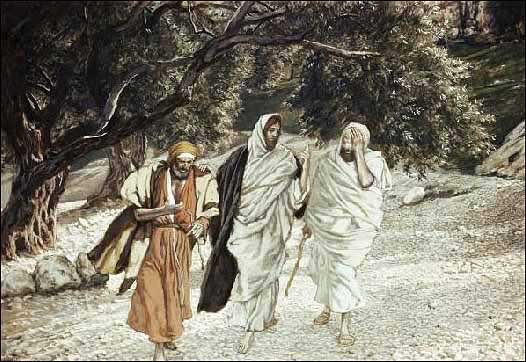
Road to Emmaus
by James J. Tissot
I had hoped to have written today’s post a bit sooner; nevertheless, I am grateful that God has granted me the grace and mercy to share another post on this fine Monday morning. As I have been spending a great deal of time in prayer regarding His plans for my life and my involvement within the local church (each year, twice a year, our local church engages in 21 days of prayer and fasting seeking God’s Will for our fellowship, our families, and our individual walks), this blog has come to mind repeatedly. I am reminded that I am not to take this blog lightly, that I cannot simply post what I like and rely on the first amendment to shield me from these writings. Rather, that as I commit myself to the study of God’s Word, and share here what I learn in the Scriptures, by the Grace of God by His Holy Spirit, that I do so prayerfully and humbly.
In the last post, we started to look at the subject of Biblical submission, that is, submitting to God and His Word in righteousness. Before continuing, I do think it important that we spend time again looking at the authority of the Scriptures. So, consider this a companion to the last post, because one cannot effectively discuss submission, without clearly and completely discussing authority.
Let us begin with the Apostle Paul’s instruction to Timothy, in which he declares:
2 Timothy 3:16 (NASB, emphasis mine) 16 All Scripture is [a]inspired by God and profitable for teaching, for reproof, for correction, for training in righteousness;
Footnote: [a] 2 Timothy 3:16 Lit God-breathed
I don’t normally include the footnotes in these posts; however, I couldn’t find a translation of the this passage that included the literal meaning of the Greek in the text. Every translation I searched included the literal meaning of the Greek as a footnote, and I believe it is important for us to recognize. Now, there is nothing wrong with the word “inspired” here, but I want to examine the literal “God-breathed” for a few moments.
Psalm 33:6 (NASB, emphasis mine) 6 By the word of the Lord the heavens were made, And by the breath of His mouth all their host.
Genesis 2:7 (NASB emphasis mine) 7 Then the Lord God formed man of dust from the ground, and breathed into his nostrils the breath of life; and man became a living being.
So, you see, the connection of all of Scripture to the Breath of God is an important one to maintain. As Paul wrote in Acts 17:28a (KJV), “For in him we live, and move, and have our being;” {oh yeah… I went old-school on that one 😉 }.
I mention this because in the past couple of decades we’ve seen a surge in the number of non-denominational Churches both here and abroad. There is a breaking away from the major hierarchies and set doctrines of these Churches that can be traced back to the reformation of the Roman Catholic Church. No doubt breaking away from false teaching, false doctrine, and corrupt leadership is necessary, but to do so without reconnecting to the authority of Scripture only leaves you floating aimlessly in a sea of organizations of men. Without a firm grasp on the authority of Scriptures, we cannot hope to remain submitted to God in keeping with His word, thus our attempts at reformation degrade into mere rebellion. I’ve spoken to so many Christians who have left the church because they were hurt, mistreated, or lied to… only to reject all authority and to purpose within their hearts never to submit to “anyone but the Holy Spirit”. But to do so without acknowledging fully the authority of Scriptures is both reckless and rebellious and is a popular snare of the devil in our present culture and age. It is to this generation that I hope to reach and reaffirm the authority of whole of Scriptures and the Gospel of Jesus Christ. It is why I’m focusing primarily in the New Testament affirmations of the Divine authority of scriptures. Let us continue on then…
I’d like to take a moment to look at one of the coolest accounts of Jesus after His resurrection found in Luke 24. I urge you strongly, to read the whole chapter… and then re-read it. It happens that as the women returned from finding the tomb of Jesus empty, and having been spoken to by Angels of the Lord, and shared their testimony with the disciples, that most did not believe. They were in mourning. Imagine for a moment, that only 3 days ago you saw your mentor, beloved teacher, Savior tortured and killed… you would undoubtedly have clouded judgement as well, would you not? But Peter took off running to see for himself. I love Peter… but that’s not where we are going right now, just setting up the backdrop for begins in verse 13:
Luke 24:13-17 (NASB, emphasis mine) 13 And behold, two of them were going that very day to a village named Emmaus, which was about seven miles from Jerusalem. 14 And they were talking with each other about all these things which had taken place. 15 While they were talking and discussing, Jesus Himself approached and began traveling with them. 16 But their eyes were prevented from recognizing Him. 17 And He said to them, “What are these words that you are exchanging with one another as you are walking?” And they stood still, looking sad.
The “them” in v13 refers to those disciples who heard the testimony of the women who had seen the empty tomb. But why did Jesus not just appear in full glory like, “here I am, BAM”? let’s read on, because the answer to this question is absolutely beautiful…
Luke 24:18-27 (NASB, emphasis mine) 18 One of them, named Cleopas, answered and said to Him, “Are You the only one visiting Jerusalem and unaware of the things which have happened here in these days?” 19 And He said to them, “What things?” And they said to Him, “The things about Jesus the Nazarene, who was a prophet mighty in deed and word in the sight of God and all the people, 20 and how the chief priests and our rulers delivered Him to the sentence of death, and crucified Him. 21 But we were hoping that it was He who was going to redeem Israel. Indeed, besides all this, it is the third day since these things happened. 22 But also some women among us amazed us. When they were at the tomb early in the morning, 23 and did not find His body, they came, saying that they had also seen a vision of angels who said that He was alive. 24 Some of those who were with us went to the tomb and found it just exactly as the women also had said; but Him they did not see.” 25 And He said to them, “O foolish men and slow of heart to believe in all that the prophets have spoken! 26 Was it not necessary for the Christ to suffer these things and to enter into His glory?” 27 Then beginning with Moses and with all the prophets, He explained to them the things concerning Himself in all the Scriptures.
Wow. You see… Jesus wanted His disciples to understand who He was and what had just happened in context of the Scriptures. He later reveals Himself to His disciples… but first, He chose to explain to them what they needed to know about Him… beginning with Moses and with all the prophets… Praise the Lord! While Jesus, being the Son of God, and already the first-born from the grave (resurrected) already bears all Authority in Heaven and Earth, He still chose to demonstrate His authority to His disciples by walking them through the scriptures. If Jesus chose to reveal Himself to His disciples in this manner, then we, too should likewise turn to the whole of Scripture to understand, proclaim, and reveal Jesus, the King of kings, and Lord of lords.
One more example before we close today. Let us return to the Apostle Paul for an example of how we are to share the Gospel as stewards of His word. Lets look at his letter to the Thessalonians. In the opening chapters of this letter, Paul is giving thanks for the faithfulness of the believers. One of the things for which Paul expresses thankfulness is particularly striking:
1 Thessalonians 2:13 (NASB) 13 For this reason we also constantly thank God that when you received the word of God which you heard from us, you accepted it not as the word of men, but for what it really is, the word of God, which also performs its work in you who believe.
So we have here that the Apostle is thankful that the believers accepted their words as the Word of God. But how is it, then, that such Authority could have been given to Paul by these believers? That they would not only accept their words as being of God, but that they “became imitators of the churches of God in Christ Jesus that are in Judea, for you also endured the same sufferings at the hands of your own countrymen…(v14)”. Thankfully, we have the account in Acts to bring us up-to-speed on what took place.
Acts 17:1-4(NASB) Paul at Thessalonica
17 Now when they had traveled through Amphipolis and Apollonia, they came to Thessalonica, where there was a synagogue of the Jews. 2 And according to Paul’s custom, he went to them, and for three Sabbaths reasoned with them from the Scriptures, 3 explaining and giving evidence that the Christ had to suffer and rise again from the dead, and saying, “This Jesus whom I am proclaiming to you is the Christ.” 4 And some of them were persuaded and joined Paul and Silas, along with a large number of the God-fearing Greeks and a number of the leading women.
“This Jesus…is the Christ.” Paul reasoned with them from the Scriptures. That is where he derived his authority to preach, proclaiming the Jesus who had stopped him on the road to Damascus was in-fact the Christ. The authority isn’t in the vision, it’s in the Scriptures. Paul’s eyes needed to be opened, just as the eyes of the disciples that were walking on the road to Emmaus needed their eyes to be open.
It is my sincere prayer, that these posts spark a desire in your heart to read these scriptures for yourselves, and to get the full context of each passage. As I read/hear these passages I get a sense of what the disciples shared with one another after Jesus revealed Himself to them.
Luke 24:31-32 (NASB) 31 Then their eyes were opened and they recognized Him; and He vanished from their sight. 32 They said to one another, “Were not our hearts burning within us while He was speaking to us on the road, while He was explaining the Scriptures to us?”
May the Holy Spirit do likewise in your hearts as you search the Scriptures, and submit to the authority of God and His Word.
In Him,
FS
 Faithful Stewardship
You must be logged in to post a comment.