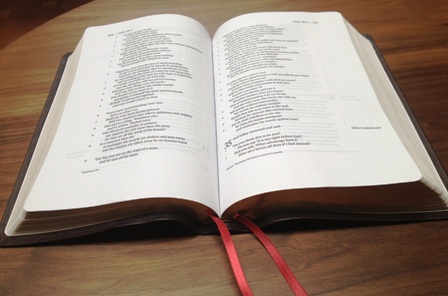
Be Encouraged, Do Not Fear

GospelOn this man-made holiday, there is a lot going on in the world that brings confusion, anxiety, and even fear in the Church. Confusion because the visible church doesn’t seem to make a firm stand against the pagan-centered revelry of a holiday that celebrates falsehood, false theology, and false deities. Anxiety because the church has forgotten the message of the Gospel, and in doing so have ascribed falsely some extra power of the enemy defeated by Christ on the Cross. It is finished means just that, by the way.

John 19:28-30 (ESV)

28 After this, Jesus, knowing that all was now finished, said (to fulfill the Scripture), “I thirst.” 29 A jar full of sour wine stood there, so they put a sponge full of the sour wine on a hyssop branch and held it to his mouth. 30 When Jesus had received the sour wine, he said, It is finished,” and he bowed his head and gave up his spirit.

Next week’s OT study we will look at this finishing work of Christ on the Cross more closely, but for now be encouraged, and do not fear the defeated enemy, for Christ already finished the work of Salvation at the cross. We walk by faith, and not by sight. The enemy is a liar. Let’s look at the encouragement Paul wrote to Timothy as he faced the daunting task of leading the church while Paul was in prison.

2 Timothy 1:1-14 (ESV)

Paul, an apostle of Christ Jesus by the will of God according to the promise of the life that is in Christ Jesus,To Timothy, my beloved child:
Grace, mercy, and peace from God the Father and Christ Jesus our Lord.
I thank God whom I serve, as did my ancestors, with a clear conscience, as I remember you constantly in my prayers night and day. As I remember your tears, I long to see you, that I may be filled with joy. I am reminded of your sincere faith, a faith that dwelt first in your grandmother Lois and your mother Eunice and now, I am sure, dwells in you as well. For this reason I remind you to fan into flame the gift of God, which is in you through the laying on of my hands, for God gave us a spirit not of fear but of power and love and self-control.

Therefore do not be ashamed of the testimony about our Lord, nor of me his prisoner, but share in suffering for the gospel by the power of God, who saved us and called us to a holy calling, not because of our works but because of his own purpose and grace, which he gave us in Christ Jesus before the ages began, 10 and which now has been manifested through the appearing of our Savior Christ Jesus, who abolished death and brought life and immortality to light through the gospel, 11 for which I was appointed a preacher and apostle and teacher, 12 which is why I suffer as I do. But I am not ashamed, for I know whom I have believed, and I am convinced that he is able to guard until that Day what has been entrusted to me. 13 Follow the pattern of the sound words that you have heard from me, in the faith and love that are in Christ Jesus. 14 By the Holy Spirit who dwells within us, guard the good deposit entrusted to you.

This so-called holiday has no power over the Gospel of Jesus Christ. None. You who have believed in the Gospel of Jesus Christ have been sealed by God the Holy Spirit, and that is not a spirit of fear, but of power, love, and of self-control. Do not be conformed to this world and its fear and its customs. Speak life to those who are celebrating death. The Gospel of Jesus Christ is life to those who would believe the Word of God.

Jude 1:24-25 (ESV) Doxology

24 Now to him who is able to keep you from stumbling and to present you blameless before the presence of his glory with great joy, 25 to the only God, our Savior, through Jesus Christ our Lord, be glory, majesty, dominion, and authority, before all time and now and forever. Amen.

Amen.
In Christ Jesus,
Jorge

(Bonus) Voddie Baucham|”What is the Gospel?”

Today, I’d like to close by sharing a good sermon by Voddie Baucham, Pastor of Grace Family Baptist Church in Texas.

http://www.sermonaudio.com/code_sourcefeatured.asp?iframe=TRUE&reversecolor=FALSE&showoverview=FALSE&flashplayer=TRUE&tiny=FALSE&minimal=TRUE&eventtype=EVENTID&series=SUBTITLE&speaker=SPEAKERNAME&sermonid=42511113392

Their website makes a transcript for the sermon available: http://media.sermonaudio.com/mediapdf/42511113392.pdf

The sermon is an hour long, and the transcript is approximately 7K words long. Voddie does a great job of taking a hard look at how the Gospel is misrepresented and how we need to get back to the Gospel of Jesus Christ. He is primarily teaching from Romans 9. The sermon can be broken down into the following major points:

  1. The gospel is not just how we get saved. You talk to the average Christian and you ask them what the gospel is and more than likely they are going to give you a plan of salvation. The gospel is not the plan of salvation. The gospel is not the four spiritual laws. The gospel is not just how we get saved.
  2. The gospel is not just the two great commandments. And that is what is popular in our day. You just boil it down to love God and love people. Listen to Carson’s word on this. “Other voices identify the gospel with the first and second commandments, the commandments to love God with heart, soul, mind and strength and our neighbor as ourself. These commandments are so central that Jesus himself insists that all the prophets and the law hang on them, but, most emphatically, they are not the gospel.” Love God, it is not the gospel. In fact, here is the irony. That phrase, love God, love people, is actually a summary of the law.
  3. The gospel is not the moral teachings of Jesus. Ok? Listen to this one carefully, especially those of us who live in home school circles, because you hear this one a lot. The gospel is all of the moral teachings of Jesus. The third option today is to treat the ethical teaching of Jesus found in the gospel as the gospel. Yet it is the ethical teaching of Jesus abstracted from the passion and resurrection narrative found in each gospel. Think about this for a moment. If we say that the gospel is all the moral teachings of Jesus found in the gospels, then here is what we have said. You see, God in the Old Testament gave us a law, but that law either wasn’t righteous enough, wasn’t clear enough or wasn’t effective enough. So Jesus came and gave us another law so that that one could be kept, because our problem wasn’t us. It was God. Made a mistake the first time, had to come correct it. The first law didn’t work, gave us another law. All that stuff about his Son dying, don’t know how that fits into this mindset if all he came was to just give us another law. Folks, that is not the gospel.
  4. The Gospel is God-centered, Christ-centered, and Grace-centered.

OT | Consecration of the Firstborn

Christ in Gethsemane by Heinrich Hofmann

Christ in Gethsemane by Heinrich Hofmann

Last week, in our Old Testament Study, we looked at The Passover Lamb  in Exodus 12 and how it points to Christ as explained in Hebrews. This week, we will move ahead in Exodus to see how the consecration of the firstborn of Israel also continues to point to the Messiah, Jesus the Christ, Son of the Living God.


Consecration of the Firstborn

Exodus 13 (ESV) | Consecration of the Firstborn

13 The Lord said to Moses, Consecrate to me all the firstborn. Whatever is the first to open the womb among the people of Israel, both of man and of beast, is mine.”

The Feast of Unleavened Bread

Then Moses said to the people, “Remember this day in which you came out from Egypt, out of the house of slavery, for by a strong hand the Lord brought you out from this place. No leavened bread shall be eaten. Today, in the month of Abib, you are going out.And when the Lord brings you into the land of the Canaanites, the Hittites, the Amorites, the Hivites, and the Jebusites, which he swore to your fathers to give you, a land flowing with milk and honey, you shall keep this service in this month. Seven days you shall eat unleavened bread, and on the seventh day there shall be a feast to the Lord. Unleavened bread shall be eaten for seven days; no leavened bread shall be seen with you, and no leaven shall be seen with you in all your territory. You shall tell your son on that day, ‘It is because of what the Lord did for me when I came out of Egypt.’ And it shall be to you as a sign on your hand and as a memorial between your eyes, that the law of the Lordmay be in your mouth. For with a strong hand the Lord has brought you out of Egypt.10 You shall therefore keep this statute at its appointed time from year to year.

11 “When the Lord brings you into the land of the Canaanites, as he swore to you and your fathers, and shall give it to you, 12 you shall set apart to the Lord all that first opens the womb. All the firstborn of your animals that are males shall be the Lord‘s. 13 Every firstborn of a donkey you shall redeem with a lamb, or if you will not redeem it you shall break its neck. Every firstborn of man among your sons you shall redeem. 14 And when in time to come your son asks you, ‘What does this mean?’ you shall say to him, ‘By a strong hand the Lord brought us out of Egypt, from the house of slavery. 15 For when Pharaoh stubbornly refused to let us go, the Lord killed all the firstborn in the land of Egypt, both the firstborn of man and the firstborn of animals. Therefore I sacrifice to the Lord all the males that first open the womb, but all the firstborn of my sons I redeem.’16 It shall be as a mark on your hand or frontlets between your eyes, for by a strong hand the Lord brought us out of Egypt.”

Here we again see that God is instituting a statute of reminder for the people in that context, and we also see a shadow of God’s coming Salvation, the promised seed that would crush the head of the serpent. As with the feast of unleavened bread, the offering of a sacrificial lamb for the redemption of the firstborn is to serve as a reminder of what God has done for Israel, and for what He will do for Creation. The latter might be more difficult to see since what takes place here is a shadow of things to come. As always, to rightly understand the Old Testament, we need to draw our understanding from the New Testament. There are two key terms or concepts that connect this statute of the Law to the Gospel of Jesus Christ: Redemption and Firstborn.

Redemption. Now, in our culture we feel we have an understanding of the concept of redemption. When a store issues us a 25% off coupon, we know that if we decide to shop at that store and present the coupon, the redemption of which means that the store pays for 25% of the item, and we pay only 75%. The store redeems the coupon by paying for (or absorbing the cost of) the discount. But this is a poor explanation for the concept of our redemption. What we have here is a declaration that every firstborn belongs to God. Either it is redeemed by an atoning sacrifice of a lamb, or it must die. Clearly, this is only expected for livestock as all male children must be redeemed and not killed. Still the statute remains as both a reminder and a promise.

Firstborn. As soon as Adam sinned, and he and his wife were made aware of their nakedness in sin, blood was shed to cover their nakedness. This animal sacrifice was not enough to fully redeem Adam (the man, or all of mankind). God promised a seed of woman would crush the head of the serpent. We saw last week that the Passover Lamb pointed to Christ. Now we see that the Lamb is needed to redeem the firstborn. But we also know that Jesus is the firstborn (John 3:16-18) Son of God. Jesus is both the firstborn (that belongs to God) AND the sacrificial Passover Lamb. Now, there was no way of knowing this was God’s plan for redeeming all of mankind at this point, for God will continue to reveal His plan throughout the Law and the Prophets. For now, this is a statute of the Law set as a reminder of His favor, His love, His Grace, and His Mercy for the children of Israel. Let us now look at how the New Testament writers drew their understanding of the Law under the inspiration of God the Holy Spirit with the Gospel of the Cross as their focal point.

Ephesians 1:3-10 (ESV) 

Blessed be the God and Father of our Lord Jesus Christ, who has blessed us in Christ with every spiritual blessing in the heavenly places, even as he chose us in him before the foundation of the world, that we should be holy and blameless before him. In love he predestined us for adoption as sons through Jesus Christ, according to the purpose of his will, to the praise of his glorious grace, with which he has blessed us in the Beloved. In him we have redemption through his blood, the forgiveness of our trespasses, according to the riches of his grace, which he lavished upon us, in all wisdom and insight making known to us the mystery of his will, according to his purpose, which he set forth in Christ10 as a plan for the fullness of time, to unite all things in him, things in heaven and things on earth.

Colossians 1:15-23 (ESV) | Preeminence of Christ

15 He is the image of the invisible God, the firstborn of all creation. 16 For by him all things were created, in heaven and on earth, visible and invisible, whether thrones or dominions or rulers or authorities—all things were created through him and for him. 17 And he is before all things, and in him all things hold together. 18 And he is the head of the body, the church. He is the beginning, the firstborn from the dead, that in everything he might be preeminent. 19 For in him all the fullness of God was pleased to dwell, 20 and through him to reconcile to himself all things, whether on earth or in heaven, making peace by the blood of his cross.

21 And you, who once were alienated and hostile in mind, doing evil deeds, 22 he has now reconciled in his body of flesh by his death, in order to present you holy and blameless and above reproach before him, 23 if indeed you continue in the faith, stable and steadfast, not shifting from the hope of the gospel that you heard, which has been proclaimed in all creation under heaven, and of which I, Paul, became a minister.

Hebrews 9:11-28 (ESV) | Redemption Through the Blood of Christ

11 But when Christ appeared as a high priest of the good things that have come, then through the greater and more perfect tent (not made with hands, that is, not of this creation) 12 he entered once for all into the holy places, not by means of the blood of goats and calves but by means of his own blood, thus securing an eternal redemption.13 For if the blood of goats and bulls, and the sprinkling of defiled persons with the ashes of a heifer, sanctify for the purification of the flesh, 14 how much more will the blood of Christ, who through the eternal Spirit offered himself without blemish to God, purify our conscience from dead works to serve the living God.

15 Therefore he is the mediator of a new covenant, so that those who are called may receive the promised eternal inheritance, since a death has occurred that redeems them from the transgressions committed under the first covenant. 16 For where a will is involved, the death of the one who made it must be established. 17 For a will takes effect only at death, since it is not in force as long as the one who made it is alive. 18 Therefore not even the first covenant was inaugurated without blood. 19 For when every commandment of the law had been declared by Moses to all the people, he took the blood of calves and goats, with water and scarlet wool and hyssop, and sprinkled both the book itself and all the people, 20 saying, “This is the blood of the covenant that God commanded for you.” 21 And in the same way he sprinkled with the blood both the tent and all the vessels used in worship. 22 Indeed, under the law almost everything is purified with blood, and without the shedding of blood there is no forgiveness of sins.

23 Thus it was necessary for the copies of the heavenly things to be purified with these rites, but the heavenly things themselves with better sacrifices than these. 24 For Christ has entered, not into holy places made with hands, which are copies of the true things, but into heaven itself, now to appear in the presence of God on our behalf. 25 Nor was it to offer himself repeatedly, as the high priest enters the holy places every year with blood not his own, 26 for then he would have had to suffer repeatedly since the foundation of the world. But as it is, he has appeared once for all at the end of the ages to put away sin by the sacrifice of himself. 27 And just as it is appointed for man to die once, and after that comes judgment, 28 so Christ, having been offered once to bear the sins of many, will appear a second time, not to deal with sin but to save those who are eagerly waiting for him.

All praise, glory, and honor be to the our Lord and Savior, Jesus Christ. This week’s reading is a bit short because I want to save the crossing of the Red Sea for next week. For now, let us close this post with the realization and understanding that we, who are in Christ Jesus, have been fully redeemed by God in the sacrifice of the spotless Lamb of God, Jesus Christ, on the cross. By His blood you have been redeemed, once and for all. Remain in Him, holding firmly by faith to the promise of the inheritance of eternal life with Christ.

We will continue studying the Exodus and how it points to the redemptive work of Jesus Christ. I do hope you will join us again. if you have any questions or comments, please feel free to share.

Romans 16:25-27 (ESV) 25 Now to him who is able to strengthen you according to my gospel and the preaching of Jesus Christ, according to the revelation of the mystery that was kept secret for long ages 26 but has now been disclosed and through the prophetic writings has been made known to all nations, according to the command of the eternal God, to bring about the obedience of faith— 27 to the only wise God be glory forevermore through Jesus Christ! Amen.

May the Grace of God be with you today and always,
In Christ Jesus,
Jorge

Gospel Wednesday | Ephesians 4-5

bibleWelcome back to our Gospel Wednesday series. Last week we took a look at Ephesians 1-3 and we learned about the context of the Apostle Paul’s letter to the Church in Ephesus.  While Paul does a wonderful job of summarizing the Gospel to the elders, he does so by way of reminder of what he had already spent 3 years teaching them in person. Chapter 3 closes with a wonderful prayer, but Paul is not yet finished with his letter, so today we will continue reading in Chapter 4.

Unity in the Body of Christ

There are a lot of books and conferences on how Christians are supposed to live their lives now that they have been Saved from their just punishment of hell. Some good, and some not very good at all. Before jumping into one of those guides or studies, let’s see what the Word of God emphasizes for His Body, the Church. First and foremost, as a born-again believer, you’ve been brought into the Body of Christ, His body. While it may have taken place in a specific church congregation, your place in the Body of Christ is much bigger than the 4 walls and local leadership of your church. When we talk about Unity here, don’t limit your understanding to just your local membership to a congregation; rather, understand that our Unity is in Christ and His Word (Law and Gospel). We assemble with the brethren for the building up of the Body of Christ, to the maturing of the Saints. Unity in Christ isn’t defined by your local body of elders, nor by your church covenants, it is defined by the Word of God, for Christ is the Head of His Church.

Ephesians 4 (ESV)| Unity in the Body of Christ

I therefore, a prisoner for the Lord, urge you to walk in a manner worthy of the calling to which you have been called, with all humility and gentleness, with patience, bearing with one another in love, eager to maintain the unity of the Spirit in the bond of peace.There is one body and one Spirit—just as you were called to the one hope that belongs to your call— one Lord, one faith, one baptism, one God and Father of all, who is over all and through all and in all. But grace was given to each one of us according to the measure of Christ’s gift. Therefore it says,

“When he ascended on high he led a host of captives,
    and he gave gifts to men.”

(In saying, “He ascended,” what does it mean but that he had also descended into the lower regions, the earth? 10 He who descended is the one who also ascended far above all the heavens, that he might fill all things.) 11 And he gave the apostles, the prophets, the evangelists, the shepherds and teachers, 12 to equip the saints for the work of ministry, for building up the body of Christ, 13 until we all attain to the unity of the faith and of the knowledge of the Son of God, to mature manhood, to the measure of the stature of the fullness of Christ, 14 so that we may no longer be children, tossed to and fro by the waves and carried about by every wind of doctrine, by human cunning, by craftiness in deceitful schemes. 15 Rather, speaking the truth in love, we are to grow up in every way into him who is the head, into Christ, 16 from whom the whole body, joined and held together by every joint with which it is equipped, when each part is working properly, makes the body grow so that it builds itself up in love.

When we think about our modern-day church, it might seem difficult to fathom verse 5, that there is One Lord, One faith, and One baptism. When we focus in on our denomination, how lovingly are those of a different denomination portrayed? One Faith. Yes, there are a lot of major differences between Pentecostalism and Reformed, but they can’t both be completely right because there is only One Faith. The One Faith comes from the One Spirit (verse 4) and everything we know of God is by His Word. There is the ultimate standard of Truth, the Word of God. However, unity in the Body of Christ demands that we speak to our brothers and sisters in the Body of Christ with ALL humility, gentleness, patience and love. We have no right to vilify our brothers who do not agree with us. There is a difference between having a different understanding and holding to False Doctrine. Scripture exposes false doctrine, and we are never to accept or tolerate false doctrine, nor are we to allow any doctrines of men to rise to the level of Scripture.

Once we have been born again, made alive in Christ by grace, through faith granted as a gift from God by His Word, we need to grow in Christ so that we will no longer be children, easily mislead. Such growth isn’t a mystical endeavor filled with “spiritual trial and error”, it is a very real study and understanding of God’s Word, learning from the teachers and shepherds of the flock and studying the works of the Apostles and Prophets as recorded in Scripture.

Ephesians 4:17-32 (ESV) | The New Life

17 Now this I say and testify in the Lord, that you must no longer walk as the Gentiles do,in the futility of their minds. 18 They are darkened in their understanding, alienated from the life of God because of the ignorance that is in them, due to their hardness of heart.19 They have become callous and have given themselves up to sensuality, greedy to practice every kind of impurity.20 But that is not the way you learned Christ!—21 assuming that you have heard about him and were taught in him, as the truth is in Jesus, 22 to put off your old self, which belongs to your former manner of life and is corrupt through deceitful desires, 23 and to be renewed in the spirit of your minds, 24 and to put on the new self, created after the likeness of God in true righteousness and holiness.

25 Therefore, having put away falsehood, let each one of you speak the truth with his neighbor, for we are members one of another. 26 Be angry and do not sin; do not let the sun go down on your anger, 27 and give no opportunity to the devil. 28 Let the thief no longer steal, but rather let him labor, doing honest work with his own hands, so that he may have something to share with anyone in need. 29 Let no corrupting talk come out of your mouths, but only such as is good for building up, as fits the occasion, that it may give grace to those who hear. 30 And do not grieve the Holy Spirit of God, by whom you were sealed for the day of redemption. 31 Let all bitterness and wrath and anger and clamor and slander be put away from you, along with all malice.32 Be kind to one another, tenderhearted, forgiving one another, as God in Christ forgave you.

Our conduct should be an outward expression of our faith in Jesus Christ. For just as He has called us out of the world, and made the way for such by His Blood, by faith we are to walk in the Spirit of God rather than by our sinful flesh. If this thought worries you, remember the cross. We do not earn forgiveness, nor do we earn salvation, nor are we sanctified by our own works. To put off your old-self will be a daily, lifelong pursuit as long as we continue in this fallen flesh. No matter how much you grow in Christ, you will not outgrow the need to repent and be forgiven until the Day of Christ’s Return, when death will finally be defeated and we will all will be given new bodies, free from sin and the curse of death. We must always bear the fruit of repentance, and know that in Christ (and ONLY in Christ) there is the forgiveness of sin.

The putting on of the new self is done bit by bit, and not perfectly as long as we live here in this fallen world. As you learn the Scriptures, the Testimony of the Goodness of God, the Holy Spirit will give you understanding. Paul is echoing some of the basics as a reminder, put away falsehood by speaking the truth (You shall not bear false witness against your neighbor), let the thief no longer steal, but let him work honestly (You shall not steal), don’t sin in your anger (emotion) and settle the matter (particularly your anger) that same day, so the devil doesn’t have an opportunity to tempt you to bitterness and murder. Paul isn’t just giving a brand new list of commandments for Christians to obey in order to be righteous. None of these qualities are new to the Scriptures, but the Gospel of Jesus Christ means that the wrath of God (the righteous and just punishment for falling short of the Law) has already been poured out onto Jesus Christ in our place. In Him we are forgiven already, and by Him we are made free to walk in His Ways. Let’s explore this further in the next chapter.

Ephesians 5 (ESV) | Walk in Love

Therefore be imitators of God, as beloved children. And walk in love, as Christ loved us and gave himself up for us, a fragrant offering and sacrifice to God.

But sexual immorality and all impurity or covetousness must not even be named among you, as is proper among saints. Let there be no filthiness nor foolish talk nor crude joking, which are out of place, but instead let there be thanksgiving. For you may be sure of this, that everyone who is sexually immoral or impure, or who is covetous (that is, an idolater), has no inheritance in the kingdom of Christ and God. Let no one deceive you with empty words, for because of these things the wrath of God comes upon the sons of disobedience. Therefore do not become partners with them; for at one time you were darkness, but now you are light in the Lord. Walk as children of light (for the fruit of light is found in all that is good and right and true), 10 and try to discern what is pleasing to the Lord. 11 Take no part in the unfruitful works of darkness, but instead expose them. 12 For it is shameful even to speak of the things that they do in secret.13 But when anything is exposed by the light, it becomes visible, 14 for anything that becomes visible is light. Therefore it says,

“Awake, O sleeper, and arise from the dead, and Christ will shine on you.”

15 Look carefully then how you walk, not as unwise but as wise, 16 making the best use of the time, because the days are evil. 17 Therefore do not be foolish, but understand what the will of the Lord is. 18 And do not get drunk with wine, for that is debauchery, but be filled with the Spirit, 19 addressing one another in psalms and hymns and spiritual songs, singing and making melody to the Lord with your heart, 20 giving thanks always and for everything to God the Father in the name of our Lord Jesus Christ, 21 submitting to one another out of reverence for Christ.

Notice here that the Law is still the Law. The Law still identifies sin, and our flesh still desires sin. Sin still brings death (for we know we still face a physical death and after that judgement) under the Law. Our freedom from the Law is in Christ and as such cannot be separated from Christ. Christ fulfilled the Law perfectly and then laid down His life anyway taking the full punishment for our sake. We are vulnerable when we sin, and we dare not continue in sin for fear of making shipwreck of our faith. Expose sin, and don’t take part in it. This is particularly tough considering our flesh and its addiction to corruption. Immature Christians often invoke the devil as the root of their sin, but in truth they are simply obeying the cravings of the flesh rather than casting it off. I think it is helpful to think about alcohol, nicotine, or even caffeine addiction. The body craves these chemicals it has grown to love and will fight to convince you its a good idea, that it’s what you really want. The flesh does this to us with all sin. We don’t all have the exact same failings, but we are all the same in that we have all failed. Therefore, as brothers and sisters in Christ, we are to look after each other, in love, being ever mindful that none of us is made righteous by our own actions or endeavors, but by the Grace of God.

Next week, we’ll close out Paul’s letter to the Ephesians as he breaks down key relationships and their application to the Christian walk. Each of these are important and central to the Kingdom of Heaven so I’m excited to dive into them next week. For now, let us focus on how we are living our lives hour-by-hour and day-by-day. All men and women are sinful, the question is whether or not you remain repentant of your sin and ask God for forgiveness. The focus must be on the Cross, for had He not laid down His life for us, forgiveness would not be available to us. But because Christ came and died and rose again, we who believe in Him have everlasting life. In Christ, we have no right to attack our brothers and sisters, to speak falsely to our neighbor, nor to sin against them… we who are in Christ should treat others in a manner that is in keeping with our faith in Jesus Christ. As our Faith grows (by hearing the words of Christ) our walk will improve as an extension of our faith, and so we will grow in the Unity of the Body of Christ.

1 John 1 (ESV) | The Word of Life

That which was from the beginning, which we have heard, which we have seen with our eyes, which we looked upon and have touched with our hands, concerning the word of life— the life was made manifest, and we have seen it, and testify to it and proclaim to you the eternal life, which was with the Father and was made manifest to us— that which we have seen and heard we proclaim also to you, so that you too may have fellowship with us; and indeed our fellowship is with the Father and with his Son Jesus Christ. And we are writing these things so that our joy may be complete.

Walking in the Light

This is the message we have heard from him and proclaim to you, that God is light, and in him is no darkness at all. If we say we have fellowship with him while we walk in darkness, we lie and do not practice the truth. But if we walk in the light, as he is in the light, we have fellowship with one another, and the blood of Jesus his Son cleanses us from all sin. If we say we have no sin, we deceive ourselves, and the truth is not in us.If we confess our sins, he is faithful and just to forgive us our sins and to cleanse us from all unrighteousness. 10 If we say we have not sinned, we make him a liar, and his word is not in us.

In closing, let us revisit Paul’s written prayer in Ephesians 3.

Ephesians 3:14-21 (ESV) 

14 For this reason I bow my knees before the Father, 15 from whom every family in heaven and on earth is named, 16 that according to the riches of his glory he may grant you to be strengthened with power through his Spirit in your inner being, 17 so that Christ may dwell in your hearts through faith—that you, being rooted and grounded in love, 18 may have strength to comprehend with all the saints what is the breadth and length and height and depth, 19 and to know the love of Christ that surpasses knowledge, that you may be filled with all the fullness of God.

20 Now to him who is able to do far more abundantly than all that we ask or think,according to the power at work within us, 21 to him be glory in the church and in Christ Jesus throughout all generations, forever and ever. Amen.

Amen, indeed.
In Christ Jesus,

Jorge

CTT | the October 31 “holiday”

Jack-o'-Lantern_2003-10-31Today, I want to take some time to discuss the significance of October 31 from a Christian perspective. While I will be sharing passages of Scripture, the lesson being taught today will not be something pulled from Scripture as our normal approach. The reason being that there is absolutely, positively, unequivocally nothing Scriptural about Halloween, All Hallows’ Eve, or All Soul’s Day. Nothing. How Christians are to engage the culture in this season is an important discussion, but we must first dispense with the lies, rationalizations, and ignorance regarding this “holiday” so that we can address real concerns in a Biblical way.

Origin of Halloween | Samhain

Let’s start with the obvious, Halloween didn’t start in the Scriptures, nor in the Church.

Evolving from the ancient Celtic holiday of Samhain, modern Halloween has become less about literal ghosts and ghouls and more about costumes and candy. The Celts used the day to mark the end of the harvest season and the beginning of winter, and also believed that this transition between the seasons was a bridge to the world of the dead. Over the millennia the holiday transitioned from a somber pagan ritual to a day of merriment, costumes, parades and sweet treats for children and adults.

Halloween is a celebration of evil and sin. Ghouls, ghosts, witches, mediums, demons, prostitutes, divination, and sexual immorality are all celebrated (just think about the costumes). Even the non-occult costumes tend to be overly sexualized for teens.  Immodesty and cross-dressing is celebrated and tolerated on this night. This is a night of indulgence in sinful behavior while wearing a disguise, any attempt to argue to the contrary is dishonesty. If you are thinking, “what about All Hallow’s Eve?”… let’s talk about it next.

All Hallow’s Eve

The bulk of our research today will be from Catholic historians, since this is their creation. Let’s look at a snapshot of the history of All Hallows’ Eve from the following CatholicCulture.org.

The Solemnity of All Saints is celebrated on November 1. It is a holyday of obligation, and it is the day that the Church honors all of God’s saints, even those who have not been canonized by the Church. It is a family day of celebration — we celebrate the memory of our family members (members of the Mystical Body, the communion of saints) now sharing eternal happiness in the presence of God. We rejoice that they have reached their eternal goal and ask their prayers on our behalf so that we, too, may join them in heaven and praise God through all eternity.

The honoring of all Christian martyrs of the Faith was originally celebrated on May 13, the date established by the fourth century. Pope Boniface IV in 615 established it as the “Feast of All Martyrs” commemorating the dedication of the Pantheon, an ancient Roman temple, into a Christian church dedicated to the Blessed Virgin Mary and all the martyrs. In 844, Pope Gregory IV transferred the feast to November 1st. Some scholars believe this was to substitute a feast for the pagan celebrations during that time of year.

By 741, the feast included not only martyrs, but all the saints in heaven as well, with the title changing to “Feast of All Saints” by 840. Pope Sixtus IV in 1484 established November 1 as a holyday of obligation and gave it both a vigil (known today as “All Hallows’ Eve” or “Hallowe’en”) and an eight-day period or octave to celebrate the feast. By 1955, the octave of All Saints was removed.

Since Vatican II, some liturgical observances have been altered, one example being “fast before the feast” is no longer required. Originally, the days preceding great solemnities, like Christmas and All Saints Day, had a penitential nature, requiring abstinence from meat and fasting and prayer. Although not required by the Church, it is a good practice to prepare before great feast days, spiritually and physically.

Holyday of obligation, eh? On what authority? Definitely not Scripture. This was a man-made holiday commemorating all saints. But notice how quickly we are introduced to the notion of asking the dead to pray on our behalf “so that we, too, may join them in heaven”. None of this comes from scripture. The Roman Catholic traditions of purgatory and praying for the dead don’t come from scripture. They are derived from the Apocrypha, texts that were never recognized by Jews nor Christians as Scripture until the Roman Catholic Church cannonized them at the Council of Trent (1546 AD) (to justify their practices and to declare the doctrine of Salvation by Grace alone to be anathema).

So, on the one hand we have clear indication that this was purely a man-made tradition, though it might be considered to have been conceived from good intentions. However, remember the Roman Catholic Church’s false teachings on purgatory, Canonization of Saints, and prayer for the dead all come from II Maccabees, part of the Apocrypha that wasn’t officially canonized by the Roman Catholic Church until the Council of Trent (1546AD). These texts which were inserted into the Old Testament, were never found written in Hebrew, and have never been accepted as Scripture by the Jewish leaders. Josephus, the Dead Sea Scrolls, Miletus (170 AD), Origen, and Jerome (400AD) all rejected them, still they persisted.

If we set aside (briefly) the false doctrines of purgatory and praying for the dead that they might still be forgiven of sin; does inventing a holiday for “good reasons” and then superimposing it onto a different pagan holiday “redeem” both the date and customs of the pagan holiday?

Deuteronomy 12:29-31 (ESV) | Warning Against Idolatry
29 “When the Lord your God cuts off before you the nations whom you go in to dispossess, and you dispossess them and dwell in their land, 30 take care that you be not ensnared to follow them, after they have been destroyed before you, and that you do not inquire about their gods, saying, ‘How did these nations serve their gods?—that I also may do the same.’ 31 You shall not worship the Lord your God in that way, for every abominable thing that the Lord hates they have done for their gods, for they even burn their sons and their daughters in the fire to their gods.

We looked at this passage and its implications in You Shall Not Worship God That Way. Getting back to the false teachings regarding purgatory, we have serious theological problems. There is an unhealthy mixing of the concept of the spirit of men and that of unclean spirits or demons. How is that different, or set-apart, from pagan religions? There is neither Law nor Gospel in this doctrine, only traditions of men and doctrines of demons. If you feel I am exaggerating my case, then let’s look at another apologetic for this holyday from the Catholic Education Resource Center.

All Hallow’s Eve
MARY REED NEWLAND
One of the nicest surprises of living around the year with the Church is to find that Halloween is part of it. Not that the Mass of the day has mention of black cats, or the Divine Office of witches, but for so long Halloween meant nothing but parties and vandalism that when someone first proposed that it came out of the liturgy, I asked: “Are you sure?”

You still hear people doubt it, even when you show them that Halloween is All-Hallows’-Eve which is the night-before-All-Saints’- Day. Some tell me they understand that Halloween pranks were a post-Reformation contribution to plague Catholics who kept the vigil of All Saints. Now it is possible that Halloween was abused for such a purpose; nevertheless, during all the Christian centuries up until the simplification of the Church calendar in 1956, it was a liturgical vigil in its own right and thus has a reason for being….

It was in the eighth century that the Church appointed a special date for the feast of All Saints, followed by a day in honor of her soon-to-be saints, the feast of All Souls. She chose this time of year, it is supposed, because in her part of the world it was the time of barrenness on the earth. The harvest was in, the summer done, the world brown and drab and mindful of death. Snow had not yet descended to comfort and hide the bony trees or blackened fields; so with little effort man could look about and see a meditation on death and life hereafter.

Apparently how you spent the vigil of All Saints depended on where you lived in Christendom. In Brittany the night was solemn and without a trace of merriment. On their “night of the dead” and for forty-eight hours thereafter, the Bretons believed the poor souls were liberated from Purgatory and were free to visit their old homes

…Breton families prayed by their beloveds’ graves during the day, attended church for “black vespers” in the evening and in some parishes proceeded thence to the charnel house in the cemetery to pray by the bones of those not yet buried or for whom no room could be found in the cemetery. Here they sang hymns to call on all Christians to pray for the dead and, speaking for the dead, they asked prayers and more prayers.

Late in the evening in the country parishes, after supper was over, the housewives would spread a clean cloth on the table, set out pancakes, curds, and cider. And after the fire was banked and chairs set round the table for the returning loved ones, the family would recite the De Profundis (Psalm 129) again and go to bed. During the night a townsman would go about the streets ringing a bell to warn them that it was unwise to roam abroad at the time of returning souls

Still not even remotely resembling the Gospel of Jesus Christ, nor of the Christian faith. In fact, this is all reminding me a great deal of the warning of Jude.

Jude 1:3-13 (ESV) | Judgment on False Teachers
3 Beloved, although I was very eager to write to you about our common salvation, I found it necessary to write appealing to you to contend for the faith that was once for all delivered to the saints. 4 For certain people have crept in unnoticed who long ago were designated for this condemnation, ungodly people, who pervert the grace of our God into sensuality and deny our only Master and Lord, Jesus Christ.

5 Now I want to remind you, although you once fully knew it, that Jesus, who saved a people out of the land of Egypt, afterward destroyed those who did not believe. 6 And the angels who did not stay within their own position of authority, but left their proper dwelling, he has kept in eternal chains under gloomy darkness until the judgment of the great day— 7 just as Sodom and Gomorrah and the surrounding cities, which likewise indulged in sexual immorality and pursued unnatural desire, serve as an example by undergoing a punishment of eternal fire.

8 Yet in like manner these people also, relying on their dreams, defile the flesh, reject authority, and blaspheme the glorious ones. 9 But when the archangel Michael, contending with the devil, was disputing about the body of Moses, he did not presume to pronounce a blasphemous judgment, but said, “The Lord rebuke you.” 10 But these people blaspheme all that they do not understand, and they are destroyed by all that they, like unreasoning animals, understand instinctively. 11 Woe to them! For they walked in the way of Cain and abandoned themselves for the sake of gain to Balaam’s error and perished in Korah’s rebellion. 12 These are hidden reefs at your love feasts, as they feast with you without fear, shepherds feeding themselves; waterless clouds, swept along by winds; fruitless trees in late autumn, twice dead, uprooted; 13 wild waves of the sea, casting up the foam of their own shame; wandering stars, for whom the gloom of utter darkness has been reserved forever.

Brothers and sisters in Christ, this is serious. The false teachings that under-gird the All Hallows’ Eve and Halloween are decidedly anti-Christian. For anyone holding to Sola Scriptura, Sola Gratia, Sola Fide, Solus Christus, and Soli Deo Gloria as a standard for theology… this “holiday” earns a 0/5 rating.

Reformation Day | October 31, 1517

There is one event, worthy of remembrance at least for those of Protestant faith. Let’s read a portion from a 2-part series on Reformation Day on TheologicalMatters.com:

In the autumn of 1517, Martin Luther, professor at the newly formed University of Wittenberg, made history. As he nailed his debating points to the door of the Wittenberg Castle Church, he intended that the students in the small town university would be informed of his intent to debate on the posted subject. However, Luther’s 95 Theses did more than spark an academic debate. They set Germany ablaze. When word of Luther’s theses spread through the town, they were quickly sent to the printing press to be distributed in places much removed from the remote, German town. Years later, pastors and professors would look back at Oct. 31, 1517, as the day the Reformation began.

At the time, Martin Luther was merely trying to bring correction on the abuses of Church Doctrine, particularly with indulgences… but this was merely the beginning. In many ways, the work is still ongoing. Have we truly gone back to Sola Scriptura? I can’t truly say that we have. Extra-biblical writing is being falsely elevated to the level of Scripture today, some claiming to be “newly inspired works of direct revelation” while others claim to be “discovering doctrines long-buried and thought lost”. The reformation was no more a one-and-done event than our repentance for sinful behavior. The Bible warns us to guard our doctrine, to keep the faith, and to resist the devil. Spiritual warfare isn’t nearly as mystical as many would make it out to be. It begins and ends with Scripture.

2 Corinthians 10:1-6 (ESV) | Paul Defends His Ministry
1 I, Paul, myself entreat you, by the meekness and gentleness of Christ—I who am humble when face to face with you, but bold toward you when I am away!— 2 I beg of you that when I am present I may not have to show boldness with such confidence as I count on showing against some who suspect us of walking according to the flesh. 3 For though we walk in the flesh, we are not waging war according to the flesh. 4 For the weapons of our warfare are not of the flesh but have divine power to destroy strongholds.5 We destroy arguments and every lofty opinion raised against the knowledge of God, and take every thought captive to obey Christ, 6 being ready to punish every disobedience,when your obedience is complete.

Martin Luther wasn’t waging war according to the flesh, but he did take up the fight to destroy arguments and every lofty opinion raised against the knowledge of God, and so should we. His goal was to debate the Scriptures so that the Church might return to Truth. Why, then, are we so willing to accept error in these days, when each of us has ready access to the Inspired Word of God?

Conclusion

Is it a sin for Christians, who are made free by the Grace of God through faith in Jesus Christ, to attend a party, play dress-up, or greet trick-or-treaters warmly? Well, let’s throw out the obvious answers. How you dress (at all times), how you behave (at all times, particularly parties), and the theme or focus of your celebration is individually or as a whole become a witness or a stumbling block to both fellow Christian and lost person. “It’s Halloween” does NOTHING to excuse or exonerate someone for sinful living. Having said that, we all sin, daily… and we must always repent and ask God for forgiveness in Jesus Name. Regarding this pagan holiday, we dare not claim it to be a Holy Day, or any type of ordained observance for the Church. However, if Christians gather together in fellowship on this day in a manner that brings honor to God, and the Gospel of Jesus Christ, then who is to judge them?

Romans 14 (ESV) | Do Not Pass Judgment on One Another
1 As for the one who is weak in faith, welcome him, but not to quarrel over opinions. 2 One person believes he may eat anything, while the weak person eats only vegetables. 3 Let not the one who eats despise the one who abstains, and let not the one who abstains pass judgment on the one who eats, for God has welcomed him. 4 Who are you to pass judgment on the servant of another? It is before his own master that he stands or falls. And he will be upheld, for the Lord is able to make him stand.

5 One person esteems one day as better than another, while another esteems all days alike. Each one should be fully convinced in his own mind. 6 The one who observes the day, observes it in honor of the Lord. The one who eats, eats in honor of the Lord, since he gives thanks to God, while the one who abstains, abstains in honor of the Lord and gives thanks to God. 7 For none of us lives to himself, and none of us dies to himself. 8 For if we live, we live to the Lord, and if we die, we die to the Lord. So then, whether we live or whether we die, we are the Lord’s. 9 For to this end Christ died and lived again, that he might be Lord both of the dead and of the living.

10 Why do you pass judgment on your brother? Or you, why do you despise your brother? For we will all stand before the judgment seat of God; 11 for it is written,

“As I live, says the Lord, every knee shall bow to me,
and every tongue shall confess to God.”

12 So then each of us will give an account of himself to God. 13 Therefore let us not pass judgment on one another any longer, but rather decide never to put a stumbling block or hindrance in the way of a brother. 14 I know and am persuaded in the Lord Jesus that nothing is unclean in itself, but it is unclean for anyone who thinks it unclean. 15 For if your brother is grieved by what you eat, you are no longer walking in love. By what you eat, do not destroy the one for whom Christ died.16 So do not let what you regard as good be spoken of as evil. 17 For the kingdom of God is not a matter of eating and drinking but of righteousness and peace and joy in the Holy Spirit.18 Whoever thus serves Christ is acceptable to God and approved by men. 19 So then let us pursue what makes for peace and for mutual upbuilding.

20 Do not, for the sake of food, destroy the work of God. Everything is indeed clean, but it is wrong for anyone to make another stumble by what he eats. 21 It is good not to eat meat or drink wine or do anything that causes your brother to stumble. 22 The faith that you have, keep between yourself and God. Blessed is the one who has no reason to pass judgment on himself for what he approves. 23 But whoever has doubts is condemned if he eats, because the eating is not from faith. For whatever does not proceed from faith is sin.

The false doctrines of the Roman Catholic Church and of Samhain must be rebuked, that is not a matter of opinion. The prayer to and for the dead, fear of the wandering spirits on this night, reviling, debauchery, witchcraft,… all of it, must be rebuked and silenced. There is no redeeming the sinful practices of the world, for God has made clear in Scripture how He is to be worshiped. Does that mean that pumpkin pie, candied apples, and other seasonal food and drink are unclean? No, and we who are called to Life in the Body of Christ would do well to uplift one another in love. As far as the world is concerned, it is a ministry opportunity, inasmuch as you are willing to minister, to preach the Gospel of Jesus Christ to those who are perishing in their unbelief.

Jude 1:24-25 (ESV) Now to him who is able to keep you from stumbling and to present you blameless before the presence of his glory with great joy, to the only God, our Savior, through Jesus Christ our Lord, be glory, majesty, dominion, and authority, before all time and now and forever. Amen.

Amen, indeed.
In Christ Jesus,
Jorge
OT | The Passover Lamb

Christ in Gethsemane by Heinrich Hofmann

Christ in Gethsemane by Heinrich Hofmann

There has been a great deal of emphasis recently on Jewish traditions, calendars, and ceremonies in the books and sermons in evangelical circles. Some of it is good, but a lot of it is sketchy. We seem to have forgotten Sola Scriptura, and we’ve lost sight of the covenants in Scripture and their role in Christianity. We are of the New Covenant, bought by the blood of Jesus Christ. The Old Covenant points to Jesus, who then fulfilled the covenant in His body, as the Lamb of God. Over the next several weeks we will be looking at the Old Testament drawing our understanding of it not from the Midrash, but from the New Testament. Today, I want to start at the Exodus, with a look at the Passover.

The Passover

Exodus 12 (ESV) | The Passover
1 The Lord said to Moses and Aaron in the land of Egypt, 2 “This month shall be for you the beginning of months. It shall be the first month of the year for you. 3 Tell all the congregation of Israel that on the tenth day of this month every man shall take a lamb according to their fathers’ houses, a lamb for a household. 4 And if the household is too small for a lamb, then he and his nearest neighbor shall take according to the number of persons; according to what each can eat you shall make your count for the lamb. 5 Your lamb shall be without blemish, a male a year old. You may take it from the sheep or from the goats, 6 and you shall keep it until the fourteenth day of this month, when the whole assembly of the congregation of Israel shall kill their lambs at twilight.

7 “Then they shall take some of the blood and put it on the two doorposts and the lintel of the houses in which they eat it. 8 They shall eat the flesh that night, roasted on the fire; with unleavened bread and bitter herbs they shall eat it. 9 Do not eat any of it raw or boiled in water, but roasted, its head with its legs and its inner parts. 10 And you shall let none of it remain until the morning; anything that remains until the morning you shall burn. 11 In this manner you shall eat it: with your belt fastened, your sandals on your feet, and your staff in your hand. And you shall eat it in haste. It is the Lord’s Passover.12 For I will pass through the land of Egypt that night, and I will strike all the firstborn in the land of Egypt, both man and beast; and on all the gods of Egypt I will execute judgments: I am the Lord.13 The blood shall be a sign for you, on the houses where you are. And when I see the blood, I will pass over you, and no plague will befall you to destroy you, when I strike the land of Egypt.

14 “This day shall be for you a memorial day, and you shall keep it as a feast to the Lord; throughout your generations, as a statute forever, you shall keep it as a feast. 15 Seven days you shall eat unleavened bread. On the first day you shall remove leaven out of your houses, for if anyone eats what is leavened, from the first day until the seventh day, that person shall be cut off from Israel. 16 On the first day you shall hold a holy assembly, and on the seventh day a holy assembly. No work shall be done on those days. But what everyone needs to eat, that alone may be prepared by you. 17 And you shall observe the Feast of Unleavened Bread, for on this very day I brought your hosts out of the land of Egypt. Therefore you shall observe this day, throughout your generations, as a statute forever. 18 In the first month, from the fourteenth day of the month at evening, you shall eat unleavened bread until the twenty-first day of the month at evening. 19 For seven days no leaven is to be found in your houses. If anyone eats what is leavened, that person will be cut off from the congregation of Israel, whether he is a sojourner or a native of the land. 20 You shall eat nothing leavened; in all your dwelling places you shall eat unleavened bread.”

21 Then Moses called all the elders of Israel and said to them, “Go and select lambs for yourselves according to your clans, and kill the Passover lamb. 22 Take a bunch of hyssop and dip it in the blood that is in the basin, and touch the lintel and the two doorposts with the blood that is in the basin. None of you shall go out of the door of his house until the morning. 23 For the Lord will pass through to strike the Egyptians, and when he sees the blood on the lintel and on the two doorposts, the Lord will pass over the door and will not allow the destroyer to enter your houses to strike you. 24 You shall observe this rite as a statute for you and for your sons forever. 25 And when you come to the land that the Lord will give you, as he has promised, you shall keep this service. 26 And when your children say to you, ‘What do you mean by this service?’ 27 you shall say, ‘It is the sacrifice of the Lord’s Passover, for he passed over the houses of the people of Israel in Egypt, when he struck the Egyptians but spared our houses.’” And the people bowed their heads and worshiped. 28 Then the people of Israel went and did so; as the Lord had commanded Moses and Aaron, so they did.

Exodus 12:40-51 (ESV) | Institution of the Passover
40 The time that the people of Israel lived in Egypt was 430 years. 41 At the end of 430 years, on that very day, all the hosts of the Lord went out from the land of Egypt. 42 It was a night of watching by the Lord, to bring them out of the land of Egypt; so this same night is a night of watching kept to the Lord by all the people of Israel throughout their generations.

43 And the Lord said to Moses and Aaron, “This is the statute of the Passover: no foreigner shall eat of it, 44 but every slave that is bought for money may eat of it after you have circumcised him. 45 No foreigner or hired worker may eat of it. 46 It shall be eaten in one house; you shall not take any of the flesh outside the house, and you shall not break any of its bones. 47 All the congregation of Israel shall keep it. 48 If a stranger shall sojourn with you and would keep the Passover to the Lord, let all his males be circumcised. Then he may come near and keep it; he shall be as a native of the land. But no uncircumcised person shall eat of it. 49 There shall be one law for the native and for the stranger who sojourns among you.”

50 All the people of Israel did just as the Lord commanded Moses and Aaron. 51 And on that very day the Lord brought the people of Israel out of the land of Egypt by their hosts.

Okay, we’ve gone through a lot of text (we skipped some verses for time sake), let’s review what have thus far before moving on to Exodus 13. In verse 5, we see God demanding that the Passover Lamb had to be without blemish. This evaluation of the lamb from either the goats or the sheep had to be made physically; therefore, it was only a shadow of the true Passover Lamb, who is truly without blemish. This is why it was so significant that John the Baptist made the following declaration as recorded in John 1.

John 1:29-34 (ESV) | Behold, the Lamb of God
29 The next day he saw Jesus coming toward him, and said, “Behold, the Lamb of God, who takes away the sin of the world! 30 This is he of whom I said, ‘After me comes a man who ranks before me, because he was before me.’ 31 I myself did not know him, but for this purpose I came baptizing with water, that he might be revealed to Israel.” 32 And John bore witness: “I saw the Spirit descend from heaven like a dove, and it remained on him. 33 I myself did not know him, but he who sent me to baptize with water said to me, ‘He on whom you see the Spirit descend and remain, this is he who baptizes with the Holy Spirit.’ 34 And I have seen and have borne witness that this is the Son of God.”

Only the Son of God could be perfect and without blemish, and only He could truly be the Lamb of God, who takes away the sin of the world.

Now, the unleavened bread is very interesting here. Firstly, God is instituting the Passover as a remembrance of His deliverance of Israel out of Egypt. The entire service, really, as evidenced by the explanation given in verse 26 and 27. The point of the Passover is to remind them of what God had done. However, as the Passover and subsequent Exodus comes, there is no time to make extensive preparations for life in the wilderness, particularly in food. Egypt gives up its riches, but we see in Exodus 12:34,39 that they left Egypt in haste and didn’t have time to leaven their bread. This is important because while the unleavened bread points to the Passover, the Passover itself is accomplished by God and the Blood of the Lamb.

The leaven is added to the bread to cause it to raise, inflate, to give a sense of increase though it is a false sense. This understanding can be drawn from Jesus’s warning to His disciples in Matthew 16. We, the children of God adopted by the Blood of the Lamb, we preach the Gospel of Jesus Christ so that all who believe in Him will not perish in Egypt (death of sin), but be freed from Egypt and brought to the Promised Land (Heaven). We dare not add anything to the bread, to falsely inflate it, or to make it more palatable for those who would hear the Gospel. The unleavened bread was to be eaten with bitter herbs, a symbol and a reminder of the harshness of their enslavement, and for us it is of our sinfulness. They didn’t make cake, there was no frosting… and when we preach Law and Gospel, the Law is indicative of the bitter herbs, for the Law convicts us of our sin, and the pure, unleavened Gospel of Jesus Christ reminds us of His Body that was broken for us. Let’s look at how the Apostle Paul referred to the leaven in relation to Communion:

1 Corinthians 5:6-8 (ESV) 6 Your boasting is not good. Do you not know that a little leaven leavens the whole lump? 7 Cleanse out the old leaven that you may be a new lump, as you really are unleavened. For Christ, our Passover lamb, has been sacrificed. 8 Let us therefore celebrate the festival, not with the old leaven, the leaven of malice and evil, but with the unleavened bread of sincerity and truth.

In Exodus 12:43 we see prohibitions being added, that this Passover was not for the uncircumcised, not for the lost. Salvation, deliverance out of Egypt, is secured by no other means than Christ’s death on the cross, by the Passover Lamb. Communion is not for the unbeliever, for he who has not believed in Jesus stands condemned already.

John 3:16-21 (ESV) | For God So Loved the World
16 “For God so loved the world, that he gave his only Son, that whoever believes in him should not perish but have eternal life. 17 For God did not send his Son into the world to condemn the world, but in order that the world might be saved through him. 18 Whoever believes in him is not condemned, but whoever does not believe is condemned already, because he has not believed in the name of the only Son of God. 19 And this is the judgment: the light has come into the world, and people loved the darkness rather than the light because their works were evil. 20 For everyone who does wicked things hates the light and does not come to the light, lest his works should be exposed. 21 But whoever does what is true comes to the light, so that it may be clearly seen that his works have been carried out in God.”

That is not to say that Salvation isn’t available to all; rather, that Salvation (and by extension, Communion) is not available for those who do not believe in Christ. We preach both Law and Gospel, so that the lost might hear the Word of God and receive faith, a gift from God, to believe in Him and be delivered from Egypt, out of their sin and trespasses, so that they might join in the Communion of the Body of Christ.

Let us now look at how this Truth of the Passover is clarified in Hebrews.

Hebrews 10:1-18 (ESV) | Christ’s Sacrifice Once for All
10 For since the law has but a shadow of the good things to come instead of the true form of these realities, it can never, by the same sacrifices that are continually offered every year, make perfect those who draw near. 2 Otherwise, would they not have ceased to be offered, since the worshipers, having once been cleansed, would no longer have any consciousness of sins? 3 But in these sacrifices there is a reminder of sins every year. 4 For it is impossible for the blood of bulls and goats to take away sins.

5 Consequently, when Christ came into the world, he said,

“Sacrifices and offerings you have not desired, but a body have you prepared for me;
6 in burnt offerings and sin offerings you have taken no pleasure.
7 Then I said, ‘Behold, I have come to do your will, O God,
as it is written of me in the scroll of the book.’”

8 When he said above, “You have neither desired nor taken pleasure in sacrifices and offerings and burnt offerings and sin offerings” (these are offered according to the law), 9 then he added, “Behold, I have come to do your will.” He does away with the first in order to establish the second. 10 And by that will we have been sanctified through the offering of the body of Jesus Christ once for all.

11 And every priest stands daily at his service, offering repeatedly the same sacrifices, which can never take away sins. 12 But when Christ had offered for all time a single sacrifice for sins, he sat down at the right hand of God, 13 waiting from that time until his enemies should be made a footstool for his feet. 14 For by a single offering he has perfected for all time those who are being sanctified.

15 And the Holy Spirit also bears witness to us; for after saying,

16 “This is the covenant that I will make with them after those days, declares the Lord: I will put my laws on their hearts, and write them on their minds,

17 then he adds,

I will remember their sins and their lawless deeds no more.

18 Where there is forgiveness of these, there is no longer any offering for sin.

All praise, glory, and honor be to the our Lord and Savior, Jesus Christ. We will continue studying the Exodus and how it points to the redemptive work of Jesus Christ. I do hope you will join us again. if you have any questions or comments, please feel free to share.

Romans 16:25-27 (ESV) 25 Now to him who is able to strengthen you according to my gospel and the preaching of Jesus Christ, according to the revelation of the mystery that was kept secret for long ages 26 but has now been disclosed and through the prophetic writings has been made known to all nations, according to the command of the eternal God, to bring about the obedience of faith— 27 to the only wise God be glory forevermore through Jesus Christ! Amen.

May the Grace of God be with you today and always,
In Christ Jesus,
Jorge