CTT | Churching the unchurched?

day-of-pentecost-acts-2-38A theme or apologetic used by the seeker-sensitive and emergent (post-modern progressive christians) for taking it upon themselves to redefine the Church, Praise and Worship, and the role of the Pastor is their claim to be “churching the unchruched”. Is that valid? What does that even mean? Let’s discuss.

There’s a book?

So, there is a book entitled, “Church for the Unchurched” that I do not recommend anyone read. But I want to share an endorsement from the Amazon.com page:

“This is a groundbreaking book. What sets it apart from all the others is that it is based on hard data and real life examples…If you want to know what is really happening in the so-called Seeker churches, this book is a must read.” –Rick Warren, Senior Pastor, Saddleback Community Church, Mission Viejo, California

What sets this book apart is… being based on hard data and real life examples? Okay… should a book about Church and Evangelism be based on Scripture? Yes, actually, it should be.

Ephesians 2:19-21 (ESV) 19 So then you are no longer strangers and aliens, but you are fellow citizens with the saints and members of the household of God, 20 built on the foundation of the apostles and prophets, Christ Jesus himself being the cornerstone, 21 in whom the whole structure, being joined together, grows into a holy temple in the Lord.

Purpose of the Church for the Unchurched?

What is the purpose of the Church? The gathering of the assembly? The seeker-mergent belief (and teaching) is that the assembly of the saints is supposed to be where unbelievers are supposed to hear the Gospel and become believers. But what prevents an unbeliever from attending church in the first place? These seeker-mergent teachers would have you believe that how traditional churches present the Gospel (you know, preaching Law (sin) and Gospel (repentance) and the forgiveness of sins) that has been “failing”. So, they inevitably get caught up in dialing down the preaching of the Law (sins become “mistakes”) and over-emphasizing God’s Love (by avoiding His Holiness,  Justice, Righteousness) trying to compel unbelievers to first agree to attend this non-church style of Church and then later “make a decision for Christ” based on how “loving, warm, engaging, inviting, and welcoming” the congregation is. They are led in a prayer, told they are saved, and then they are fed a diet of self-help legalism that Christians must abide by to establish their Christian-ness. But that legalism isn’t based on Law-preaching, because now that they are “saved” the purpose of their church is no longer them, but the other “unchurched”. So they are expected to read the Bible on their own, while from the pulpit they hear life tips from the latest Christian self-help book, or simply from the pastor’s life experiences.

What does the Bible say about the purpose of Pastors and the Church?

I want to look at a couple of passages that help put together a picture of what it means first to be a pastor and also the role of the Church. Let’s begin in Matthew:

Matthew 16:5-20 (ESV) | The Leaven of the Pharisees and Sadducees
5 When the disciples reached the other side, they had forgotten to bring any bread. 6 Jesus said to them, “Watch and beware of the leaven of the Pharisees and Sadducees.” 7 And they began discussing it among themselves, saying, “We brought no bread.” 8 But Jesus, aware of this, said, “O you of little faith, why are you discussing among yourselves the fact that you have no bread? 9 Do you not yet perceive? Do you not remember the five loaves for the five thousand, and how many baskets you gathered? 10 Or the seven loaves for the four thousand, and how many baskets you gathered? 11 How is it that you fail to understand that I did not speak about bread? Beware of the leaven of the Pharisees and Sadducees.” 12 Then they understood that he did not tell them to beware of the leaven of bread, but of the teaching of the Pharisees and Sadducees.

13 Now when Jesus came into the district of Caesarea Philippi, he asked his disciples, “Who do people say that the Son of Man is?” 14 And they said, “Some say John the Baptist, others say Elijah, and others Jeremiah or one of the prophets.” 15 He said to them, “But who do you say that I am?” 16 Simon Peter replied, “You are the Christ, the Son of the living God.” 17 And Jesus answered him, “Blessed are you, Simon Bar-Jonah! For flesh and blood has not revealed this to you, but my Father who is in heaven. 18 And I tell you, you are Peter, and on this rock I will build my church, and the gates of hell shall not prevail against it. 19 I will give you the keys of the kingdom of heaven, and whatever you bind on earth shall be bound in heaven, and whatever you loose on earth shall be loosed in heaven.” 20 Then he strictly charged the disciples to tell no one that he was the Christ.

John 21:1-19 (ESV) | Jesus Appears to Seven Disciples
21 After this Jesus revealed himself again to the disciples by the Sea of Tiberias, and he revealed himself in this way. 2 Simon Peter, Thomas (called the Twin), Nathanael of Cana in Galilee, the sons of Zebedee, and two others of his disciples were together. 3 Simon Peter said to them, “I am going fishing.” They said to him, “We will go with you.” They went out and got into the boat, but that night they caught nothing. 4 Just as day was breaking, Jesus stood on the shore; yet the disciples did not know that it was Jesus. 5 Jesus said to them, “Children, do you have any fish?” They answered him, “No.” 6 He said to them, “Cast the net on the right side of the boat, and you will find some.” So they cast it, and now they were not able to haul it in, because of the quantity of fish. 7 That disciple whom Jesus loved therefore said to Peter, “It is the Lord!” When Simon Peter heard that it was the Lord, he put on his outer garment, for he was stripped for work, and threw himself into the sea. 8 The other disciples came in the boat, dragging the net full of fish, for they were not far from the land, but about a hundred yards off. 9 When they got out on land, they saw a charcoal fire in place, with fish laid out on it, and bread. 10 Jesus said to them, “Bring some of the fish that you have just caught.” 11 So Simon Peter went aboard and hauled the net ashore, full of large fish, 153 of them. And although there were so many, the net was not torn. 12 Jesus said to them, “Come and have breakfast.” Now none of the disciples dared ask him, “Who are you?” They knew it was the Lord. 13 Jesus came and took the bread and gave it to them, and so with the fish. 14 This was now the third time that Jesus was revealed to the disciples after he was raised from the dead. 15 When they had finished breakfast, Jesus said to Simon Peter, “Simon, son of John, do you love me more than these?” He said to him, “Yes, Lord; you know that I love you.” He said to him, “Feed my lambs.” 16 He said to him a second time, “Simon, son of John, do you love me?” He said to him, “Yes, Lord; you know that I love you.” He said to him,“Tend my sheep.” 17 He said to him the third time, “Simon, son of John, do you love me?”Peter was grieved because he said to him the third time, “Do you love me?” and he said to him, “Lord, you know everything; you know that I love you.” Jesus said to him, “Feed my sheep. 18 Truly, truly, I say to you, when you were young, you used to dress yourself and walk wherever you wanted, but when you are old, you will stretch out your hands, and another will dress you and carry you where you do not want to go.” 19 (This he said to show by what kind of death he was to glorify God.) And after saying this he said to him,“Follow me.”

So we have here a picture of teaching and preaching being presented in terms of food. I believe that when Jesus appeared on the shoreline, the disciples remembered what Jesus taught at Peter’s confession. We also see that the disciples understood the teaching of the leaven of the Pharisees and Sadducees was in their teaching, not in actual food. The religious leaders of that day taught themselves, their doctrines, and their righteousness. Jesus rebuked them repeatedly, pointing out to them that if they had indeed believed Moses and his teaching, they would believe in Jesus (John 5:45-47). They added to the Law and the Prophets with their oral tradition and interpretations of the Law and Prophets, they introduced their own leaven to the Bread of Life (Jesus, the Word made flesh).

At breakfast, Jesus addresses Peter specifically, and asks three times “do you love Me”. What goes on the Greek is fascinating, but for now, let us focus on Jesus’ response, “feed my lambs; tend my sheep, feed my sheep”. Is Jesus just talking about food here? No. Is he saying that Peter is supposed to find his own way to feed the sheep? Absolutely not. Looking back at Peter’s confession of Christ, notice that Jesus specifies that the revelation was from God; therefore, Peter’s confession is the rock upon which Jesus will build His Church, not Peter’s flesh (the Greek makes it very clear) though Peter’s name is changed. When we look back at Jesus’s rebuke of His disciples for worrying about not bringing bread, Jesus points out that He had already demonstrated that He will provide for our earthly needs, that clearly He is focused on more important things for the church. God provides the physical bread and fish, and He also provides the Spiritual bread, the Gospel of Jesus Christ, by which Peter is to feed and tend the flock of Christ (the Church).

The Early Church Evangelized the Synagogue

Yes, the early Church first evangelized the Temple (in Jerusalem) and the synagogues. Does that mean that the purpose of Church is to get unbelievers to attend so that they can become believers? No. Please don’t freak out on me just yet, let’s first discuss what was going on in the early church. After Christ’s ascension into Heaven, we see the first assembly of the Church.

Acts 1:12-19 (ESV) 12 Then they returned to Jerusalem from the mount called Olivet, which is near Jerusalem, a Sabbath day’s journey away. 13 And when they had entered, they went up to the upper room, where they were staying, Peter and John and James and Andrew, Philip and Thomas, Bartholomew and Matthew, James the son of Alphaeus and Simon the Zealot and Judas the son of James. 14 All these with one accord were devoting themselves to prayer, together with the women and Mary the mother of Jesus, and his brothers. 15 In those days Peter stood up among the brothers (the company of persons was in all about 120) and said, 16 “Brothers, the Scripture had to be fulfilled, which the Holy Spirit spoke beforehand by the mouth of David concerning Judas, who became a guide to those who arrested Jesus. 17 For he was numbered among us and was allotted his share in this ministry.” 18 (Now this man acquired a field with the reward of his wickedness, and falling headlong he burst open in the middle and all his bowels gushed out. 19 And it became known to all the inhabitants of Jerusalem, so that the field was called in their own language Akeldama, that is, Field of Blood.)

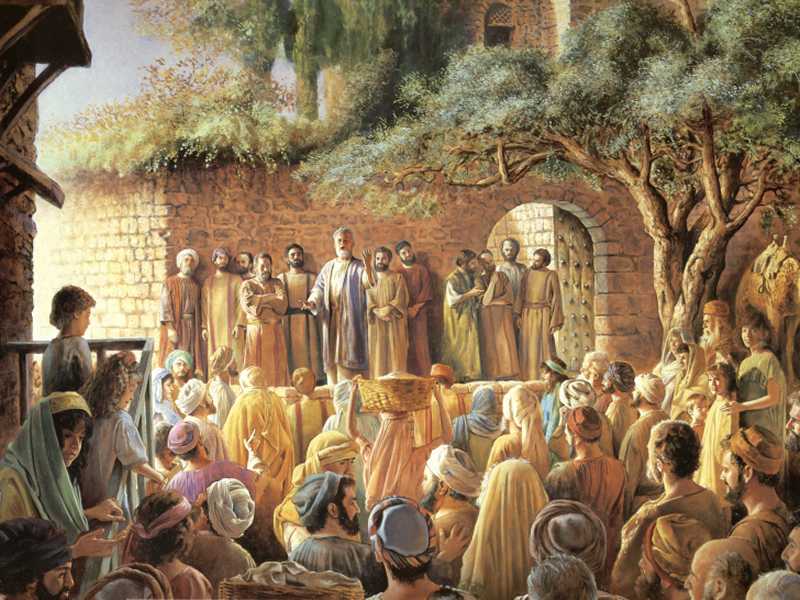
When the Day of Pentecost arrives, God pours out His Spirit upon His Church, all who were assembled in the upper room, and the sound of their worship of God in many languages (by a miracle of the Holy Spirit) drew a crowd and Peter preached Law and Gospel to them, and many were added to the Church on that day. After Peter’s sermon in chapter 2, let’s look at how the Church assembled:

Acts 2:42-47 (ESV) | The Fellowship of the Believers
42 And they devoted themselves to the apostles’ teaching and the fellowship, to the breaking of bread and the prayers. 43 And awe came upon every soul, and many wonders and signs were being done through the apostles. 44 And all who believed were together and had all things in common. 45 And they were selling their possessions and belongings and distributing the proceeds to all, as any had need. 46 And day by day, attending the temple together and breaking bread in their homes, they received their food with glad and generous hearts, 47 praising God and having favor with all the people. And the Lord added to their number day by day those who were being saved.

Does this look like a church whose focus is on attracting the “unchurched”? No. Who added to their number? The Lord did. Who was being added? Those who were being saved. The Church, God’s Church is for the Christians, those who have believed in the Gospel of Jesus Christ. Any attempt to tailor a Church for those who are unbelievers is an exercise in futility. Let’s see how Paul addressed this idea in his letter to the Romans. At the close of chapter 9, Paul is trying to fix some misconceptions some Gentiles had regarding the Jews. Let’s begin there and move into chapter 10.

Romans 9:30-33 (ESV) | Israel’s Unbelief
30 What shall we say, then? That Gentiles who did not pursue righteousness have attained it, that is, a righteousness that is by faith; 31 but that Israel who pursued a law that would lead to righteousness did not succeed in reaching that law. 32 Why? Because they did not pursue it by faith, but as if it were based on works. They have stumbled over the stumbling stone, 33 as it is written,

“Behold, I am laying in Zion a stone of stumbling, and a rock of offense;
and whoever believes in him will not be put to shame.”

Romans 10 (ESV) | The Message of Salvation to All
1 Brothers, my heart’s desire and prayer to God for them is that they may be saved. 2 For I bear them witness that they have a zeal for God, but not according to knowledge. 3 For, being ignorant of the righteousness of God, and seeking to establish their own, they did not submit to God’s righteousness. 4 For Christ is the end of the law for righteousness to everyone who believes.

5 For Moses writes about the righteousness that is based on the law, that the person who does the commandments shall live by them. 6 But the righteousness based on faith says,“Do not say in your heart, ‘Who will ascend into heaven?’” (that is, to bring Christ down) 7 “or ‘Who will descend into the abyss?’” (that is, to bring Christ up from the dead). 8 But what does it say? “The word is near you, in your mouth and in your heart” (that is, the word of faith that we proclaim); 9 because, if you confess with your mouth that Jesus is Lord and believe in your heart that God raised him from the dead, you will be saved. 10 For with the heart one believes and is justified, and with the mouth one confesses and is saved. 11 For the Scripture says, “Everyone who believes in him will not be put to shame.” 12 For there is no distinction between Jew and Greek; for the same Lord is Lord of all, bestowing his riches on all who call on him. 13 For “everyone who calls on the name of the Lord will be saved.”
14 How then will they call on him in whom they have not believed? And how are they to believe in him of whom they have never heard? And how are they to hear without someone preaching? 15 And how are they to preach unless they are sent? As it is written,“How beautiful are the feet of those who preach the good news!” 16 But they have not all obeyed the gospel. For Isaiah says, “Lord, who has believed what he has heard from us?” 17 So faith comes from hearing, and hearing through the word of Christ.
18 But I ask, have they not heard? Indeed they have, for
“Their voice has gone out to all the earth,
and their words to the ends of the world.”
19 But I ask, did Israel not understand? First Moses says,
“I will make you jealous of those who are not a nation;
with a foolish nation I will make you angry.”
20 Then Isaiah is so bold as to say,
“I have been found by those who did not seek me;
I have shown myself to those who did not ask for me.”
21 But of Israel he says, “All day long I have held out my hands to a disobedient and contrary people.”

We are not born with faith. We are in-fact born in unbelief, dead in sins and trespasses. Faith is a gift from God, one that comes only by hearing the word of Christ, the Bread of Life. The leaven of the Pharisees is to be avoided and has no part in Christ. It doesn’t matter how awesome/entertaining/welcoming your church service is to the unbeliever, unless they hear unleavened preaching, they will not obtain faith necessary for salvation. Your “testimony” of Christ’s forgiveness isn’t enough, neither is your band’s rendition of “Awesome God”. For it is by hearing the Word of Christ that faith comes.

Conclusion

The Church is the body of Christ, and there is no way to have a church that “churches” unbelievers. Unbelievers who come to the church should undeniably be presented Law and Gospel so that they might become believers (faith comes by hearing the Word of God), but the responsibility for bringing them in rests with the Christians, not the Church. Jesus told Peter to feed and tend His flock. Again, the Church is the body of Christ, Christ is the head of His body. We are to share the gospel with the unbelievers, and invite them to the Church of Jesus Christ, we don’t decide to change the focus of Christ’s Church so that it is more palatable for unbelievers.

1 Corinthians 1:18-25 (ESV) | Christ the Wisdom and Power of God
18 For the word of the cross is folly to those who are perishing, but to us who are being saved it is the power of God. 19 For it is written,
“I will destroy the wisdom of the wise,
and the discernment of the discerning I will thwart.”
20 Where is the one who is wise? Where is the scribe? Where is the debater of this age?Has not God made foolish the wisdom of the world? 21 For since, in the wisdom of God, the world did not know God through wisdom, it pleased God through the folly of what we preach to save those who believe. 22 For Jews demand signs and Greeks seek wisdom,23 but we preach Christ crucified, a stumbling block to Jews and folly to Gentiles, 24 but to those who are called, both Jews and Greeks, Christ the power of God and the wisdom of God. 25 For the foolishness of God is wiser than men, and the weakness of God is stronger than men.

There is only one way to the Father, and that is through Christ. Getting someone to join in an attendance ritual on Sunday morning isn’t going to grant faith, unless they are hearing the unleavened Word of God. Changing what is heard on Sunday morning so that unbelievers will “sign up” doesn’t bring them closer to repentance. Unless we preach Christ and Him crucified for our sin, we’ve simply invited lost sinners to a social club built around “positive messaging”.

Our Father in Heaven, Holy is Your Name. Your Kingdom come, Your Will be done on Earth as it is in Heaven. Give us this day our daily bread, and forgive us our sin as we forgive those who sin against us. Lead us not into temptation, but deliver us from evil. We thank you, Father, that there is now no condemnation for those who are in Christ Jesus. For the law of the Spirit of life has set us free in Christ Jesus from the law of sin and death. For You have done what the law, weakened by our flesh, could not do. By sending Your Own Son in the likeness of sinful flesh and for sin, You condemned sin in the flesh, in order that the righteous requirement of the law might be fulfilled in us. May we walk not according to the flesh but according to the Spirit, by Your Grace in Christ Jesus, Amen. (Matt 6, Romans 8)

In Christ Jesus,
Jorge

Why We Aren’t Cessationists

If you’ve been following us for some time, you’ll know that while we do preach Biblical discernment in all matters, we firmly assert that we are not cessationists. I think today we should clarify our position a bit so that there is no mystery on where we stand.

We are functionally cessationist while theologically we acknowledge
that God remains Sovereign over His gifts

First, let’s clearly define cessationism. Cessationsim is the assertion that certain gifts of the Holy Spirit listed in the Bible are no longer available or in operation today. That at some point in early church history, they ceased. Sometimes this assertion is tied to dispensationalism, at other times it is simply tied to the Apostles (or those upon whom the Apostles had directly laid their hands). When tied to dispensationalism, the assertion sometimes sounds like, “God doesn’t operate or deal with His people in that way anymore”, and when tied to the Apostles it sounds like, “those where only for a short time as a testimony of the authority given to the Apostles, and now that there are no more Apostles, the need for those gifts has gone away”. These views are held (in general) by both Lutherans (who generally take the Apostolic argument) and Calvinists (who generally take the dispensation argument). Our problem with the assertion of cessation of certain gifts of the Holy Spirit is that it isn’t taught in Scripture. That presents a bit of a problem when one considers Sola Scriptura as a major tenet of the Reformation.

Generally speaking, there is an argument within the cessation camp that pre-supposes a win as its fundamental argument for discernment. The argument is, “God doesn’t speak to people directly anymore; therefore, anyone who claims a direct revelation from God is either lying or deceived”. This is an argument that really should cease. If the Bible declared that God no longer speaks to His people directly, then there would be no further argument. That it doesn’t, means that we should drop this argument or at least demote it from being a foundational presupposition. At best, it is an empirical bias that may motivate an individual to exercise Biblical discernment, but the assertion should really be presented as a bias and not an objective Biblical truth.

Common Proof Texts for Cessation of Gifts

To Seal both Vision and Prophet

Perhaps one of my favorite pastors to listen to, whether it be one of his sermons or his discernment ministry, is Pastor Chris Rosebrough. When it comes to preaching the Word of God and practicing sound Biblical hermeneutics in breaking down bad teaching, I’ve not found anyone better. I haven’t heard him speak on this recently, but in the past on his program I’ve heard this approach taken a few times. This proof comes from Daniel 9:24. Let us start at the beginning of Daniel 9 so we understand the context of this passage.

Daniel 9:1-2 (ESV) 1 In the first year of Darius the son of Ahasuerus, by descent a Mede, who was made king over the realm of the Chaldeans— 2 in the first year of his reign, I, Daniel, perceived in the books the number of years that, according to the word of the Lord to Jeremiah the prophet, must pass before the end of the desolations of Jerusalem, namely, seventy years.

Okay, so we have Daniel, one of the exiles who feared the Lord God and was blessed by God and promoted to a leadership position in the realm of the Chaldeans. We see here that as he studied the Scriptures, he perceived the minimum number of years of the exile prophesied by Jeremiah as 70 years. What follows is Daniel’s prayer of repentance for himself and on behalf of Israel. In so doing, Daniel is following the instructions given to Solomon at the completion of the Temple.

2 Chronicles 7:11-22 (ESV) | If My People Pray
11 Thus Solomon finished the house of the Lord and the king’s house. All that Solomon had planned to do in the house of the Lord and in his own house he successfully accomplished.12 Then the Lord appeared to Solomon in the night and said to him: “I have heard your prayer and have chosen this place for myself as a house of sacrifice. 13 When I shut up the heavens so that there is no rain, or command the locust to devour the land, or send pestilence among my people, 14 if my people who are called by my name humble themselves, and pray and seek my face and turn from their wicked ways, then I will hear from heaven and will forgive their sin and heal their land. 15 Now my eyes will be open and my ears attentive to the prayer that is made in this place. 16 For now I have chosen and consecrated this house that my name may be there forever. My eyes and my heart will be there for all time. 17 And as for you, if you will walk before me as David your father walked, doing according to all that I have commanded you and keeping my statutes and my rules, 18 then I will establish your royal throne, as I covenanted with David your father, saying, ‘You shall not lack a man to rule Israel.’ 19 “But if you turn aside and forsake my statutes and my commandments that I have set before you, and go and serve other gods and worship them, 20 then I will pluck you up from my land that I have given you, and this house that I have consecrated for my name, I will cast out of my sight, and I will make it a proverb and a byword among all peoples. 21 And at this house, which was exalted, everyone passing by will be astonished and say, ‘Why has the Lord done thus to this land and to this house?’ 22 Then they will say, ‘Because they abandoned the Lord, the God of their fathers who brought them out of the land of Egypt, and laid hold on other gods and worshiped them and served them. Therefore he has brought all this disaster on them.’”

Solomon and Israel did not obey, and God kept His Word, as He always does. But now that the 70 years had been completed, Daniel sought the Lord in prayer.

Daniel 9:3-5 (ESV)3 Then I turned my face to the Lord God, seeking him by prayer and pleas for mercy with fasting and sackcloth and ashes. 4 I prayed to the Lord my God and made confession, saying, “O Lord, the great and awesome God, who keeps covenant and steadfast love with those who love him and keep his commandments, 5 we have sinned and done wrong and acted wickedly and rebelled, turning aside from your commandments and rules.

I encourage you to take some time and read his prayer in full. For now, let us skip to the response from the Lord given to Daniel by messenger, the Angel Gabriel.

Daniel 9:20-27 (ESV) | Gabriel Brings an Answer
20 While I was speaking and praying, confessing my sin and the sin of my people Israel, and presenting my plea before the Lord my God for the holy hill of my God, 21 while I was speaking in prayer, the man Gabriel, whom I had seen in the vision at the first, came to me in swift flight at the time of the evening sacrifice. 22 He made me understand, speaking with me and saying, “O Daniel, I have now come out to give you insight and understanding. 23 At the beginning of your pleas for mercy a word went out, and I have come to tell it to you, for you are greatly loved. Therefore consider the word and understand the vision. 24 “Seventy weeks are decreed about your people and your holy city, to finish the transgression, to put an end to sin, and to atone for iniquity, to bring in everlasting righteousness, to seal both vision and prophet, and to anoint a most holy place. 25 Know therefore and understand that from the going out of the word to restore and build Jerusalem to the coming of an anointed one, a prince, there shall be seven weeks. Then for sixty-two weeks it shall be built again with squares and moat, but in a troubled time.26 And after the sixty-two weeks, an anointed one shall be cut off and shall have nothing. And the people of the prince who is to come shall destroy the city and the sanctuary. Itsend shall come with a flood, and to the end there shall be war. Desolations are decreed.27 And he shall make a strong covenant with many for one week, and for half of the week he shall put an end to sacrifice and offering. And on the wing of abominations shall come one who makes desolate, until the decreed end is poured out on the desolator.”

So, our proof text for cessation comes from a Messianic Prophecy. This scripture gets presented as a declaration that when the second Temple is built both vision and prophet are sealed up, which is taken to mean “closed”. The Hebrew words used here can be legitimately interpreted in that light, so there is no point in digging into the roots of the words. There are 2 problems with using this passage, the first is that it comes in a prophecy regarding the Temple and the Anointed One (Messiah or Christ) which points to Jesus. So it is difficult to treat this text as a clear teaching text, because it was a specific message, to Daniel, regarding His plans for Judah and Jerusalem. The second problem is that if we are to take this as a definitive closing of both Prophet and Vision, well, then we have a problem because the New Testament has both visions and prophets revealed by God the Holy Spirit. So, in this text, there is no mechanism for putting this sealed up vision and prophet “on hold” until sometime after the John finishes writing the Book of Revelation on the Isle of Patmos.

This proof-text isn’t always used alone. It is often used in tandem with the following proof text.

But in These Last Days

Many will point to the introduction to the book of Hebrews as the proof that God no longer speaks directly to His people. The argument goes that the author is declaring that while God spoke in many ways to our fathers by the prophets, He now only speaks one way and that is by the Son. Let’s take a look at it.

Hebrews 1 (ESV) | The Supremacy of God’s Son
Long ago, at many times and in many ways, God spoke to our fathers by the prophets, 2 but in these last days he has spoken to us by his Son, whom he appointed the heir of all things, through whom also he created the world. 3 He is the radiance of the glory of God and the exact imprint of his nature, and he upholds the universe by the word of his power. After making purification for sins, he sat down at the right hand of the Majesty on high, 4 having become as much superior to angels as the name he has inherited is more excellent than theirs.
5 For to which of the angels did God ever say,
“You are my Son,
today I have begotten you”?
Or again,
“I will be to him a father,
and he shall be to me a son”?
6 And again, when he brings the firstborn into the world, he says,
“Let all God’s angels worship him.”
7 Of the angels he says,
“He makes his angels winds,
and his ministers a flame of fire.”
8 But of the Son he says,
“Your throne, O God, is forever and ever,
the scepter of uprightness is the scepter of your kingdom.
9 You have loved righteousness and hated wickedness;
therefore God, your God, has anointed you
with the oil of gladness beyond your companions.”
10 And,
“You, Lord, laid the foundation of the earth in the beginning,
and the heavens are the work of your hands;
11 they will perish, but you remain;
they will all wear out like a garment,
12 like a robe you will roll them up,
like a garment they will be changed.
But you are the same,
and your years will have no end.”
13 And to which of the angels has he ever said,
“Sit at my right hand until I make your enemies a footstool for your feet”?
14 Are they not all ministering spirits sent out to serve for the sake of those who are to inherit salvation?

But is the author making a declaration regarding how God will no longer speak, or is he pointing out that in Christ, the Son of the Living God, we now have something far better than Moses and the Prophets? I believe it is the latter. Why? Well, because this letter is first and foremost a letter to those who are familiar with the Law and the Prophets, but need better understanding and teaching on how Jesus fulfilled the Law and the Prophets and is now our perfect High Priest of a covenant superior to all previous covenants. There is also the matter of a member of the trinity not being included in this intro, namely, God the Holy Spirit. We know that God the Holy Spirit was promised to the Apostles to teach, remind, and grant power and gifts for the edification of the Church. Therefore, if the event that silenced God from speaking directly to His people by prophets was the virgin birth of Jesus, then why are we promised God the Holy Spirit?

Prophecies Will Pass Away; Tongues Will Cease

This one is less often used, but I have seen it so I want to point out the issue with using this one. It comes from 1 Corinthians 13.

1 Corinthians 13:8-12 (ESV) 8 Love never ends. As for prophecies, they will pass away; as for tongues, they will cease; as for knowledge, it will pass away. 9 For we know in part and we prophesy in part, 10 but when the perfect comes, the partial will pass away. 11 When I was a child, I spoke like a child, I thought like a child, I reasoned like a child. When I became a man, I gave up childish ways. 12 For now we see in a mirror dimly, but then face to face. Now I know in part; then I shall know fully, even as I have been fully known.

The idea behind using this proof-text is that this passage demonstrates that all of these gifts have a limit. What follows is usually an argument from silence or borrowing from the close of the Book of Revelation to suggest that tongues already ceased once we learned how to understand all of the major spoken languages and that prophecies have ceased since the canon of Scripture is now closed. The problem with using this text in that way is that its primary teaching is to demonstrate the eternal quality of love (a more excellent way). Paul explains that we see in part and prophesy in part but when the perfect comes… ah, Paul did insert a marker. To what is Paul referring here as when the perfect comes? The Return of Jesus Christ Our Lord. And that stands to reason, for once Jesus returns, we’ll have no need of prophecies or tongues or even knowledge, for all will know and bow down and confess that Jesus Christ is Lord. Of this I am quite confident, especially when we consider that the very next chapter is a prescriptive text on the primary gifts of the Holy Spirit that cessationists make off-limits, namely the gifts of Tongues and Prophecy.

Cessationism is Lazy Discernment

It would be very easy to rubber-stamp any claim to a direct revelation from God the Holy Spirit as clearly heretical (and many take that stance).  However, we know that God speaks to everyone through His Written Word, and we know that all scripture is God-breathed. We also know that God will not add to the Law, the Prophets, or Revelation and as such the canon of scripture is closed. We know that if anyone preaches a Gospel that does not agree with the Gospel revealed in Scripture, that person is to be accursed. We know that signs and wonders do not in themselves point to God or His blessing, nor do they prove the existence of an “anointing”. We know this from both the Old Testament Law regarding testing of the Prophets as well as in the New Testament warnings. We also have 1 Corinthians 12-14, we have the Book of Revelation, we have several mentions in Acts of prophets and prophetic words spoken over Timothy.

Biblical Discernment is a Mandate

While I do consider cessationsism to be lazy discernment, what I’ve found in the Pentecostal/Charismatic movement is that no one exercises discernment beyond their emotions, or what they call “feeling in their spirit that it isn’t right”. They seem to rely only on the Gift of the Holy Spirit listed:

1 Corinthians 12:4-11 (ESV) 4 Now there are varieties of gifts, but the same Spirit; 5 and there are varieties of service, but the same Lord; 6 and there are varieties of activities, but it is the same God who empowers them all in everyone. 7 To each is given the manifestation of the Spirit for the common good. 8 For to one is given through the Spirit the utterance of wisdom, and to another the utterance of knowledge according to the same Spirit, 9 to another faith by the same Spirit, to another gifts of healing by the one Spirit, 10 to another the working of miracles, to another prophecy, to another the ability to distinguish between spirits, to another various kinds of tongues, to another the interpretation of tongues. 11 All these are empowered by one and the same Spirit, who apportions to each one individually as he wills.

In the KJV, the highlighted portion phrases it “discerning of spirits”. So, they (in my experience) seem to rely on “those with that gift” to practice discernment just as they rely on those with the gift of prophecy to prophesy. In my opinion, that goes beyond lazy and into negligent. I have yet to find an online biblical discernment ministry from a Pentecostal/Charismatic point of view. I have come to believe (granted, by an argument from silence) that the movement(s) actively discourage Biblical discernment ministries and seeks to silence them. The seeker-mergent church actually teaches in their leadership conferences that those who question the pastor (exercise discernment) are wolves and need to be silenced, even going so far as practicing excommunication. Brothers and sisters in Christ, if you are standing on solid, Biblical foundation, there is no need to fear being challenged doctrinally. I’m not saying you have to stop mid-service to entertain a heckler every time, but the standard is Scripture, not the so-called “vision of the pastor”.

The Biggest Problem in Today’s Church

Cessationism is not the biggest doctrinal problem facing today’s Church. A Church that limits itself to only hearing from God the Holy Spirit as He speaks to them through the Written Word of Scripture has in no-way hamstrung itself, for the Word of God (in this case Written) will not return void. Some leaders take cessationism to an unhealthy extreme where they believe it is unbiblical to pray and ask for healing, or for wisdom, knowledge, etc… but in those cases the Scriptures refute their false teaching directly. Where cessationism is hurting the Church, is in its outreach to those who are lost in a sea of mysticism or being tossed about by every wind of doctrine. When one claims to be engaging in Biblical discernment, and starts with an assertion, that person has laid a stumbling block for the individual similar to that taught in 1 Corinthians 8. By all means, take every thought captive and submit it to Christ, and tear down every lofty opinion that raises itself against the knowledge of Christ. Expose the false teacher by his fruit, his false doctrine.

2 Timothy 3:16-17 (ESV) 16 All Scripture is breathed out by God and profitable for teaching, for reproof, for correction, and for training in righteousness, 17 that the man of God may be complete,equipped for every good work.

2 Timothy 4:2-4 (ESV) 2 preach the word; be ready in season and out of season; reprove, rebuke, and exhort, with complete patience and teaching. 3 For the time is coming when people will not endure sound teaching, but having itching ears they will accumulate for themselves teachers to suit their own passions, 4 and will turn away from listening to the truth and wander off into myths.

The biggest problem in today’s church, is that we’ve allowed the entertainment culture to supplant the preaching of the Word and sound doctrine. And many have turned away from listening to the truth and wandered off into myths. Mysticism has infiltrated every Christian denomination and many have abandoned the infallibility of Scripture because for too long they’ve ignored (or down-played) its sufficiency.

Not every direct revelation was included in Scripture, in-fact, we have record of some direct-revelation that were specifically prohibited from being recorded or spoken. The problem isn’t when someone says, “the Lord showed me” or “the Lord told me” or even “the Lord spoke to me”… the problem is when what is being claimed as coming from God the Holy Spirit isn’t Biblical. When someone claims “thus saith the Lord” when God has not spoken, that is blasphemy, and the individual is a false prophet. A teacher’s fruit is NOT how much money they raise, or how many disciples they gather; rather, it is their doctrine and what they teach.

In closing, if this is your first time visiting this site and you are worried about our non-cessation stance, here are some links to give a better picture of where we do stand. It could be argued that we are functionally cessationist while theologically we acknowledge that God remains Sovereign over His gifts.

Thank you for reading through to the end. Our desire is to study the Word of God in context, and as free from outside influence as possible, by God’s Grace. If you disagree with us, or feel we’ve missed a clear passage of scripture, do please share either in comments below or by contacting us directly. One final thought, in our understanding and application of Sola Scriptura, we affirm that unless a doctrine can be taught from scripture, it shouldn’t be taught from the pulpit. I don’t mind referencing a commentary or “church father” from time to time to maybe bring a different perspective, but we will not be “teaching” from the extra biblical texts. Sola Scriptura is indeed Scripture Alone. As Alistair Begg puts it, “the plain things are the main things, and the main things are the plain things”.

May the Grace of God be with you today and always,
In Christ Jesus,
Jorge

Looking for a New Church

churchBe blessed today and this weekend. So we made it through a 5-part series on The Church. I want to thank you for enduring what was essentially me laying out my understanding of what the Bible teaches regarding the Church and subsequently the church. I am really looking forward to moving on to different topics that have been placed on the back burner while I worked diligently to complete this series. However, I didn’t want to dive into anything new on a Friday, so I thought I might share some thoughts regarding the search for a new church body. I do not presume to be able to tell you exactly how to find a new church body for your family, but I would like to share some thoughts and some questions that I feel should be asked whenever the search for a church body is at hand.

Why are you looking for a new church body?

Aside from having to relocate due to work or family needs, this is perhaps the single most important question for which a Biblical answer must be found. Now, let me begin with the obvious and work toward the subtle. If the church you have been attending has wandered off into false doctrine, false teaching, or a different gospel then the “why” of the matter has been identified. We can then move on to the “how”. Are you leaving because of an individual? Personality Conflict? you were offended? These motivations are tougher to pin down, but they tend to be the vast majority of reasons that folks leave their local churches. I’ve made these categories quite broad because I don’t intend to give a panacea response for highly personal situations. I will say that personality conflicts exist everywhere, because each of us bears responsibility for our own conduct, speech, and personality. The Body of Christ is also composed of people, forgiven and adopted children of God who still walk in fleshly and sinful bodies. So, if your response to personality conflict is to leave the church, you will be leaving often. I’ve met a few church-hoppers who tend to only survive about a year or two before some drama “pops up out of nowhere” and they are “forced” to leave, usually creating as big a vacuum as possible either being on staff or in the worship team. Finally, there are those who want to leave because they (or their kids) just want to find something “cooler”, “more exciting”, or more “relevant”. This last group I can honestly say has the wrong “why”. They don’t understand the purpose for church and are instead looking to be entertained or have their itching ears scratched.

How did you leave the last church?

I have never been a fan of ultimatums. Anyone who demands the church bend to his or her will “or else I’m leaving and taking my money with me” is a carnal, fleshly, immature Christian at best. Similarly, causing a big scene to act out the fore-gone conclusion that you are leaving is equally infantile. So let us look at how the Scriptures tell us to address problems within the Church.

  • A problem of false teaching/doctrine/gospel. While I consider this to be the easiest “why”, it is perhaps the most heartbreaking, gut wrenching, and difficult “how” we will face. Depending on how long you’ve been a part of this congregation, how involved you and your family had become, and how your closest friends feel about the issue at hand, it can lead many to simply never say anything or to suddenly disappear without much explanation. Why? Because this is an issue of leadership in the church. Since we just finished examining 1 Timothy, we’ll start there and I am including old-testament foundation for these rules.
    • 1 Timothy 5:19-21 (ESV)
      19 Do not admit a charge against an elder except on the evidence of two or three witnesses. 20 As for those who persist in sin, rebuke them in the presence of all, so that the rest may stand in fear. 21 In the presence of God and of Christ Jesus and of the elect angels I charge you to keep these rules without prejudging, doing nothing from partiality.

      • Deuteronomy 19:15 (ESV)
        15 “A single witness shall not suffice against a person for any crime or for any wrong in connection with any offense that he has committed. Only on the evidence of two witnesses or of three witnesses shall a charge be established.
    • Galatians 1:6-9 (ESV)
      6 I am astonished that you are so quickly deserting him who called you in the grace of Christ and are turning to a different gospel— 7 not that there is another one, but there are some who trouble you and want to distort the gospel of Christ. 8 But even if we or an angel from heaven should preach to you a gospel contrary to the one we preached to you, let him be accursed. 9 As we have said before, so now I say again: If anyone is preaching to you a gospel contrary to the one you received, let him be accursed.

      • Deuteronomy 13:1-4 (ESV)
        13 “If a prophet or a dreamer of dreams arises among you and gives you a sign or a wonder, 2 and the sign or wonder that he tells you comes to pass, and if he says, ‘Let us go after other gods,’ which you have not known, ‘and let us serve them,’ 3 you shall not listen to the words of that prophet or that dreamer of dreams. For the Lord your God is testing you, to know whether you love the Lord your God with all your heart and with all your soul. 4 You shall walk after the Lord your God and fear him and keep his commandments and obey his voice, and you shall serve him and hold fast to him.
        Note: this holds true even if the sign/wonder/miracle actually happens. The miracle alone does not serve as proof.
    • One note I’ll make on this is that if the structure of the local church is in error (not in keeping with Acts, Titus, Timothy) then this matter can be very difficult to resolve. Pray, search out the scriptures, and ask for Wisdom from God the Holy Spirit, and do what is right, leaving the outcome in God’s hands. Something that is prevalent in today’s Evangelical churches is a false notion of “unity under the visionary” instead of Unity in the Word of God. It generally comes with a Mosaic church structure where everyone is expected to follow (and abide by) the word of one or two leaders and they have the final word (often times, preemptively).
  • Personal Conflict. This is a very broad category, but the Bible does cover how we are to respond in these matters.
    • Matthew 18:15-20 (ESV) 15 “If your brother sins against you, go and tell him his fault, between you and him alone. If he listens to you, you have gained your brother. 16 But if he does not listen, take one or two others along with you, that every charge may be established by the evidence of two or three witnesses. 17 If he refuses to listen to them, tell it to the church. And if he refuses to listen even to the church, let him be to you as a Gentile and a tax collector. 18 Truly, I say to you, whatever you bind on earth shall be bound in heaven, and whatever you loose on earth shall be loosed in heaven. 19 Again I say to you, if two of you agree on earth about anything they ask, it will be done for them by my Father in heaven. 20 For where two or three are gathered in my name, there am I among them.”
    • 1 Corinthians 6:1-8 (ESV) 1 When one of you has a grievance against another, does he dare go to law before the unrighteous instead of the saints? 2 Or do you not know that the saints will judge the world? And if the world is to be judged by you, are you incompetent to try trivial cases?3 Do you not know that we are to judge angels? How much more, then, matters pertaining to this life! 4 So if you have such cases, why do you lay them before those who have no standing in the church? 5 I say this to your shame. Can it be that there is no one among you wise enough to settle a dispute between the brothers, 6 but brother goes to law against brother, and that before unbelievers? 7 To have lawsuits at all with one another is already a defeat for you. Why not rather suffer wrong? Why not rather be defrauded? 8 But you yourselves wrong and defraud—even your own brothers!

Now, in the interest of full disclosure and transparency, these things are rarely easy or clean. We recently stopped attending a local church over doctrinal concerns and church-structure. We were very involved in the church and didn’t realize there any problems until some major shifts in doctrinal focus and awkward disciplinary calls forced my wife and me to start searching the Scriptures for answers. That search revealed a great deal. Still, we did not purpose to leave the church because we were sure that God had led us to that church (even more so now that we’ve grown so much as a family through the whole experience). I spent 2 months discussing doctrinal issues with the Pastor (at the time I was on staff) regarding what I believed to be mishandling of Scripture in sermon material taught nearly verbatim from popular mega-church leaders. After two months, I stepped down off of staff. A month later, another family was given a false rationale for why we stepped down and not a single elder of the church approached us. It was then that we decided we could no longer attend that church, though we longed to maintain relationships with those who truly considered us their brother and sister. We are currently being fed in a church of a different denomination, and completely different style of service from what I grew up with, but we are being fed well. We are not in a rush to become members, but we thank God for His Grace and Mercy for our family.

What should we be looking for in a church?

Who is being preached, Christ or man? First and foremost, you should be looking for a church that faithfully preaches the Word of God. This isn’t something you can determine in a single visit. If they post their sermons online, listen to them with an open bible and take notes. Pause the sermon, open to the scripture being referenced. Is the context being conveyed? Is it being used in context? Is it a full quote? Is the passage being defined by Scripture or by the speaker’s life experience? Are you being taught what the Word of God says or are you getting life advice loosely justified by a random scripture quoted out of context? Are you getting an anecdote to help understand what Scripture is teaching or is the anecdote being presented as proof that a life tip is valid? What is the scripture to pastor ratio?

Christian Denomination. This is NOT a denominational choice, because there isn’t a denomination that has a corner on the market. Denomination plays a major role in familiarity and a sense of commonality for many people, so if you are uncomfortable stepping outside of your denomination, then you must continue to focus on faithful preaching of the Word of God, you just might (depending on your geographical location and preferred denomination) be choosing from a very small pool of churches. When it comes to denominations, it is important to gauge each denomination’s doctrine against the Scriptures, not by what one denomination accuses the other denomination of believing. I find this particularly true of the “Reformed” (Calvinist) denominations who are very quick to call anyone who disagrees with TULIP a Pelagean. The best example of this is that despite the Catholic Church declaring Pelagianism heretical (Council of Trent) most Reformed Churches lump Catholics under the semi-Pelagean banner because of their emphasis on man’s response to the Gospel of Grace (Council of Trent also declared the doctrine of passive grace heretical, basically the U, I, P in TULIP). So yeah, take each doctrine and compare it to the Word of God, not to some other doctrine since not every point of each doctrine can be taught from Scripture because they attempt to explain in-depth what the Bible doesn’t explain. What the bible does explain, like the Gospel of Jesus Christ, they must agree upon (and for the most part Protestant denominations do agree on the Gospel). Now, among Protestants there are 2 major divisions, Monergists and Arminians. Monergism is a label that covers Lutheran and Calvinists (who disagree on double-predestination and sacraments). Calvinists are found in Baptist and Presbyterian traditions, though some Baptists lean more Arminian these days. Arminians disagree with TULIP in that they believe that Christ made the only way of salvation but did not preassign people to believe or not to believe; rather, they hold that in the hearing of the Gospel of Jesus Christ, man must choose whether to listen and accept the Word of God as the Only Way of Salvation, or reject it and be condemned my their lack of faith. This doctrine can generally be found in Wesleyan Methodist Churches, Pentecostal, Charismatic, and Free-Will Baptists. I’m still dealing with these categories in broad terms, but hopefully you can see that there are denominations you might actually find some common ground with you weren’t aware of before. Once again, the standard is the Word of God… not the denomination you grew up in.

Who is being praised and worshiped? Okay, so we haven’t spent a great deal of time on this one here at Faithful Stewardship. But who is being praised in the Praise and Worship at the church. Is it truly focused on God the Father, God the Son, and God the Holy Spirit? Or is it focused more on who we are, what we are doing, and what we are going to get? Are we worshiping the Biblical Savior or are we just sort of singing love songs understood to be pointed at Jesus, but not clearly articulated as such? Is it about praising and worshiping God or is the focus more on entertaining non-believers?

Non-Denominational or Evangelical? While each of these labels has some meaning to those who wear them, they lack any solid definition that could serve as a filter for looking for a new church.

  • Non-denominational. What it should mean is that they don’t point to any ideology of man and their aim is to stick with Biblically defined Christianity. In practice, what you will find is that they broke away from one of the denominations and still hold to most of that denomination’s doctrine except for a few key points. What makes them problematic is that you have no way of knowing up front what they do or do not believe/teach. You just have to talk it out, or attend their membership information classes (even then you still need to ask all of the questions that you can). Many take the road of dividing what they call “essentials” and “non-essentials” of the faith… but rarely are the “non essentials” clearly defined. I have also seen that most “non-denominational” churches are former Pentecostal or Charismatic churches looking to distance themselves from the label. Perhaps one of the most dangerous elements of non-denominational churches is that they are rarely held accountable by anyone. In the New Testament, the Church in Antioch looked to the Church in Jerusalem for encouragement, direction, and guidance. Paul strongly rebuked the Galatians for blindly accepting the false gospel of the Judaizers and exercised authority, correction, and instruction over them.
  • Evangelical. This is supposed to mean that the church’s focus is in Evangelism, or Preaching the Gospel of Jesus Christ. What has been taking root in modern Evangelical churches lately is a false social gospel, where the goal of the church is to entice non-believers to enter their doors and stay long enough to hear the Gospel. Much of the church-growth, seeker-sensitive, emergent theology expansion has been within evangelical churches. In order to achieve rapid growth and high attendance numbers, they’ve abandoned preaching Law in accordance with Gospel, therefore we get a half-picture of a Savior but we don’t get an understanding of our need for a savior. Prosperity and Word of Faith doctrines also thrive in non-Denominational/Evangelical circles.

Fathers, remember your role.

In closing, I want to remind fathers to remember your roles as heads of your house. You are the priest of your home. Whether you are members of a local church family, struggling through trials and tribulations, or searching for a new body of believers, your responsibility to feed, nurture, and instruct your family never goes away. Pray continuously, and dig into the Word of God and bury it in your heart and share it with your wife and kids. Church is not a means of offloading the responsibility of leading your family spiritually, church is where you get the training you need to better fulfill your responsibility. Plugging your family into church is essential for Christian living, so I’m not suggesting that a father can replace the church, he can’t. My point is that regardless of church membership, a father’s role remains the same.

Well, this ended up being longer than I anticipated. In trying to address a broad scope of issues, concerns, and categories of doctrines, it is possible that some may feel I misrepresented their denomination or church. That was not my intent, I’m just trying to give some broad-scope definitions for those who (like I was a year ago) might never have thought about what all of the denomination stuff really meant. I’m not interested in bolstering or attacking any denomination or doctrine of men here… my only focus, and sole purpose here is to point to the Word of God and what it teaches. As always, if you have additional or specific questions/concerns, feel free to comment or contact me directly.


Jude 1:24-25 (ESV)
24 Now to him who is able to keep you from stumbling and to present you blameless before the presence of his glory with great joy, 25 to the only God, our Savior, through Jesus Christ our Lord, be glory, majesty, dominion, and authority, before all time and now and forever. Amen.

In Him,
Jorge


The Church | Part 5

churchAs we close out our study series of the Biblical picture of the Church, I want to be absolutely clear that I am not trying to “call out” any specific churches, or fellowships, or pastors. I’m not trying to convince you to leave your church, or join mine. The purpose of this series is to clearly state my doctrine regarding church and to challenge individuals and heads of households to weigh everything they are taught in their church (down to the very structure of said church) against Scripture. I will endeavor to keep these discussions on prescriptive passages in God’s Word, plainly written for us to follow. If you take umbrage with any of my assessments or commentary, I ask that you take some time to share your thoughts or questions with me (either via comment below or personal message). If you take issue with what the Scriptures say… well, I leave that to you, your elders, and God the Holy Spirit.

Paul’s Closing Thoughts in 1 Timothy

Today, we will close out our reading in 1 Timothy, with a look at chapter 6.

1 Timothy 6 (ESV)
1 Let all who are under a yoke as bondservants regard their own masters as worthy of all honor, so that the name of God and the teaching may not be reviled. 2 Those who have believing masters must not be disrespectful on the ground that they are brothers; rather they must serve all the better since those who benefit by their good service are believers and beloved.

Teach and urge these things. 3 If anyone teaches a different doctrine and does not agree with the sound words of our Lord Jesus Christ and the teaching that accords with godliness, 4 he is puffed up with conceit and understands nothing. He has an unhealthy craving for controversy and for quarrels about words, which produce envy, dissension, slander, evil suspicions, 5 and constant friction among people who are depraved in mind and deprived of the truth, imagining that godliness is a means of gain. 6 But godliness with contentment is great gain, 7 for we brought nothing into the world, and we cannot take anything out of the world. 8 But if we have food and clothing, with these we will be content. 9 But those who desire to be rich fall into temptation, into a snare, into many senseless and harmful desires that plunge people into ruin and destruction. 10 For the love of money is a root of all kinds of evils. It is through this craving that some have wandered away from the faith and pierced themselves with many pangs.

I really should have included the beginning of chapter 6 in yesterday’s post, since Paul is closing out those thoughts. The “these things” are pointing back to all that was discussed in the previous chapter. Notice how Paul again revisits the charge to resist false doctrine. I find it interesting how in our modern-day liberalism often accuse those who dare to exercise Biblical discernment as being puffed up with conceit, and even having an unhealthy craving for controversy. Paul is making clear that it is not those who hold Scripture who are guilty of such sin; rather, those who teach a different doctrine that does not agree with the Word of Jesus Christ. We also see Paul warning of the trap of riches. Notice also the wording toward the end of verse 5, “…imagining that godliness is a means of gain“. As heirs to the Kingdom of God, through the blood of Jesus by His Grace and Mercy, we do have an inheritance… in Heaven. Jesus did not promise worldly riches, in fact, He specifically taught in Matthew 6:19-21 (ESV) 19 “Do not lay up for yourselves treasures on earth, where moth and rust destroy and where thieves break in and steal, 20 but lay up for yourselves treasures in heaven, where neither moth nor rust destroys and where thieves do not break in and steal. 21 For where your treasure is, there your heart will be also.” We live in a time where so many false teachers have become rich and living lavish lives preaching a false doctrine with false promises of earthly riches through living godly lives. Brothers and sisters in Christ… that is not the Gospel, and it is not our Promise. God blesses His children here on earth according to His Will and plan for us in this life, but the Promises laid out in Scripture primarily for the life that is to come, in the Great Day of Christ’s Return when we join Him in the Heavens.

11 But as for you, O man of God, flee these things. Pursue righteousness, godliness, faith, love, steadfastness, gentleness. 12 Fight the good fight of the faith. Take hold of the eternal life to which you were called and about which you made the good confession in the presence of many witnesses. 13 I charge you in the presence of God, who gives life to all things, and of Christ Jesus, who in his testimony before Pontius Pilate made the good confession, 14 to keep the commandment unstained and free from reproach until the appearing of our Lord Jesus Christ, 15 which he will display at the proper time—he who is the blessed and only Sovereign, the King of kings and Lord of lords, 16 who alone has immortality, who dwells in unapproachable light, whom no one has ever seen or can see. To him be honor and eternal dominion. Amen.

17 As for the rich in this present age, charge them not to be haughty, nor to set their hopes on the uncertainty of riches, but on God, who richly provides us with everything to enjoy. 18 They are to do good, to be rich in good works, to be generous and ready to share, 19 thus storing up treasure for themselves as a good foundation for the future, so that they may take hold of that which is truly life.

It is not impossible for the rich in this present age to be faithful stewards of God’s resources, though it brings along its own temptations. Namely, that earthly riches tempt man to set their hopes on their riches and themselves rather than on God.

20 O Timothy, guard the deposit entrusted to you. Avoid the irreverent babble and contradictions of what is falsely called “knowledge,” 21 for by professing it some have swerved from the faith. Grace be with you.

Did you know that the Greek philosophers Plato, Socrates, Euclid, and Aristotle all pre-date the virgin-birth? By hundreds of years. The Roman Empire replaced that of the Greeks, and had philosophers of their own (Cicero and Ptolemy), all pursuing earthly “knowledge” via metaphysics and philosophy. Many of the early heretics pulled from these “ancients” for their Gnosticism, Pantheism (multiple gods), and Panentheism (god is in everything). In our present culture, the temptation is to believe that due to man’s vastly superior scientific accomplishments, we should now change how we read Scripture (particularly the Genesis accounts of Creation and the Flood) based on what the world falsely calls “knowledge”.

My Closing Thoughts for this Series

The Bible lays out very plainly how God intends for His Church (and churches) are to be structured, managed, and overseen. God has made it clear how the church is to be led, what its focus should be, and its purpose. The Church is to build up the Body of Christ into the fullness of Christ who is the Head of His Church, and we who comprise the body of Christ are to preach the Gospel of Jesus Christ as ministers of reconciliation. The smallest unit of the church is the family, God’s first institution for man to embrace as a picture of the Kingdom of Heaven. Therefore, the Church should first seek to raise up fathers, priests and leaders of their households who raise up the next generation in Christ. After showing themselves approved, they should likewise raise up other fathers. Those who wish to teach and become overseers should therefore be tested and appointed as Paul laid out clearly in Titus and 1 Timothy. Regardless of what you might have heard from a celebrity seeker-mergent “pastor”, the role of the Church IS to feed God’s sheep. In some cases literally. Christians need to step up their game in sharing the Gospel with the lost in the world, but the role of the Church Elder (pastor, teacher, overseer) is to serve the Body of Christ as one who will give account.

Specific concerns and special cases

  • The Church was not granted the authority to determine itself, its doctrine, its structure, or its purpose. Christ is the Head of His Church, and the Apostles and the Prophets are its foundation, with Christ as the cornerstone. The Reformation was a move to return to Biblical doctrine, not a reinvention of the church. The Catholic church refused to repent, so the Protestant Church was born. The role of Elder is to preach the Word of God and to correct all false teaching. Elders do not have the authority to change Biblical doctrine. They have the authority to correct, rebuke, and training in righteousness according to the God-breathed Scriptures (2 Timothy 3). There is nothing in Scripture that leaves room for the Catholic doctrine of the Pope or Papal authority to pronounce unchangeable doctrine (ex cathedra). Such authority was not given to the Church. Additionally, there is no reason to believe that God would be raising up new Apostles to lay new foundations for the church. The foundation has long been laid in Scripture. I do believe that 1 Corinthians 12 through 14 remain as valid and instructive of the Gifts of God the Holy Spirit, but God is not changing the Body of Christ or Scriptures. We have been given the Word of God by which we are to test every spirit and every teaching to know if it is from God or from a spirit of error.
  • Churches with women pastors/elders/deacons.  As we saw in 1 Timothy 2 and in 1 Corinthians 14, having women in a position of authority over men is prohibited. When we see a church with a female pastor, we know that something is wrong. Either the church is completely lacking in godly men, or the church has simply decided to disregard Paul’s instructions to Timothy, Titus, and the Corinthians. I do believe Grace can be given to those in transitional periods, or newly formed churches planted within strongly matriarchal societies (such as in various African tribes); however, the Word of God is sufficient for all instruction and correction. God’s plan for mankind is for man to bear the mantle of leadership an its responsibility. Men cannot be expected to step up and perform their Scriptural role as men, when the church has willfully placed women into positions of leadership. A woman cannot Biblically disciple a man into his rightful place of leadership. In 2 Timothy 1, Paul praised Timothy’s mother and grandmother for planting the seed of God’s Word in his heart, and Timothy was charged to guard the gift given him. Paul took Timothy as a disciple, an adopted son, and trained him in the Word and the Ministry before setting him as an Elder.
  • Youth Ministries. This series was sparked by my post on How We Do Church. We don’t see anywhere in Scripture where the youth are separated from their parents and taught their own things. Throughout Scripture, the expectation is for fathers to raise their sons and daughters in the ways of God until the time comes when they leave their fathers and their mothers and cleave to their spouses, becoming one flesh and starting their own families. So, our modern “youth groups” present a problem of usurped authority (although often with permission). We’ve embraced the worldly messaging that says that parents just don’t understand their own kids, therefore we need a young pastor who can “speak their language” to reach them with the Gospel. How can we assess how a man manages his household when we’ve inserted others into the role of discipling his kids? How can we command the fathers to turn their hearts toward their children, and the children to honor their fathers, when in church we encourage them to look to a “youth pastor” for guidance, love, and instruction? Is there truly a way of “doing it right” if the Bible doesn’t provide us with a guideline or parameters for such a ministry? I think we should have outreach programs for lost youth, but we need to reach their fathers and mothers. We need to focus on equipping the fathers and mothers in our congregation to be the leaders, role models, teachers, and counselors for their children. That is what youth ministry should be focused on. Do I expect all churches to abandon their Sunday school and youth group models immediately? No. But we should return to Biblical standards of family and church guided by the power and wisdom of God the Holy Spirit.
  • What about the fatherless families? The young men in the congregation who do not have fathers at home are starving for mentors and discipleship more than anyone else. The answer is for the Elders and the other Fathers in the church to disciple them, and for the older women and mothers to gather around their mother to strengthen and nurture her. Divorce is more prevalent in our day than widow/widower. It is outside of God’s plan for us, and is far more difficult and treacherous as a result. We are the Body of Christ, and when one member of the body hurts, we all hurt; therefore, we are supposed to come together to help those caught in sin (guarding ourselves from sin) to restore one another into right standing with Christ. That doesn’t always mean the marriage gets restored, but repentance and the forgiveness of sin is available at the foot of the Cross.
  • Praise and Worship. Well, nothing has been addressed thus far by Paul in his letters regarding a “worship pastor”. The Elders are overseers of the church, and they are to teach the Word of God and discipline those who step outside of it. What we sing is more important than what instruments are involved in the accompaniment. What we do in church must always Glorify God and edify the Body of Christ. It must be orderly (1 Corinthians 14). I will say that since the Church is indeed for the believers, any attempt to manipulate the purpose of Praise and Worship so that the unbeliever can be entertained is foolishness and should be rebuked sharply. Christ must be our focus, now and forever, in our praise, in our worship, and in how we live our lives. To the unbeliever, we preach Law (repentance from sin) and Gospel (forgiveness by the blood of Christ). I care more about the conduct/focus/heart/content of worship than I do the method or technology employed.

Thank you for taking the time to read these posts and share your thoughts, questions, and comments. I pray that this has helped or challenged some to read the Word of God to test all that I’ve said here. As I hear from those at Stand Up for the Truth and from Chris Rosebrough, don’t ever read what I’m writing with an open mind; rather, do so with an open Bible. Test everything I share against the Word of God. Where I am found faulty or deficient, please point me to the proper Scripture.

I’d like to close with Paul’s charge to Timothy at the end of the second epistle:

2 Timothy 4:1-5 (ESV)
1 I charge you in the presence of God and of Christ Jesus, who is to judge the living and the dead, and by his appearing and his kingdom: 2 preach the word; be ready in season and out of season; reprove, rebuke, and exhort, with complete patience and teaching. 3 For the time is coming when people will not endure sound teaching, but having itching ears they will accumulate for themselves teachers to suit their own passions, 4 and will turn away from listening to the truth and wander off into myths. 5 As for you, always be sober-minded, endure suffering, do the work of an evangelist, fulfill your ministry.

Amen. May the Lord bless you and keep you.
In Him,
Jorge

Series: The Church | Part 1 | Part 2 | Part 3 | Part 4 | Part 5

The Church | Part 4

churchAs we continue in our study series of the Biblical picture of the Church, I want to be absolutely clear that I am not trying to “call out” any specific churches, or fellowships, or pastors. I’m not trying to convince you to leave your church, or join mine. The purpose of this series is to clearly state my doctrine regarding church and to challenge individuals and heads of households to weigh everything they are taught in their church (down to the very structure of said church) against Scripture. I will endeavor to keep these discussions on prescriptive passages in God’s Word, plainly written for us to follow. If you take umbrage with any of my assessments or commentary, I ask that you take some time to share your thoughts or questions with me (either via comment below or personal message). If you take issue with what the Scriptures say… well, I leave that to you, your elders, and God the Holy Spirit.

Qualifications of Overseers (Elders)

Today, we will continue reading in 1 Timothy, beginning in chapter 3.

1 Timothy 3:1-7 (ESV)
1 The saying is trustworthy: If anyone aspires to the office of overseer, he desires a noble task. 2 Therefore an overseer must be above reproach, the husband of one wife, sober-minded, self-controlled, respectable, hospitable, able to teach, 3 not a drunkard, not violent but gentle, not quarrelsome, not a lover of money. 4 He must manage his own household well, with all dignity keeping his children submissive, 5 for if someone does not know how to manage his own household, how will he care for God’s church? 6 He must not be a recent convert, or he may become puffed up with conceit and fall into the condemnation of the devil. 7 Moreover, he must be well thought of by outsiders, so that he may not fall into disgrace, into a snare of the devil.

Paul goes into greater detail in his letter to Timothy than we saw in Titus, though we see no contradiction. I have highlighted here what I mentioned back in Part 2 of our series, that a man must manage his own household well. It makes no different how knowledgeable, charismatic, or affluent, if his house is not in order he is not fit to manage God’s church. His attention should be firmly fixed upon his household, as his first duty and responsibility to God. This doesn’t mean he is unfit to share the Gospel, or serve his brothers and sisters in the Body of Christ, it means he is unfit to be an Elder or Overseer. I have also highlighted able to teach. You see, Paul will not be going into the qualifications of “teachers” or “pastors” because the role of pastor is to be performed by an Elder. How can one effectively “Shepherd the flock” if he is not qualified to serve as an Elder?

Qualifications of Deacons

1 Timothy 3:8-13 (ESV)
8 Deacons likewise must be dignified, not double-tongued, not addicted to much wine, not greedy for dishonest gain. 9 They must hold the mystery of the faith with a clear conscience. 10 And let them also be tested first; then let them serve as deacons if they prove themselves blameless. 11 Their wives likewise must be dignified, not slanderers, but sober-minded, faithful in all things. 12 Let deacons each be the husband of one wife, managing their children and their own households well. 13 For those who serve well as deacons gain a good standing for themselves and also great confidence in the faith that is in Christ Jesus.

The role of Deacon is one of service to the Body of Christ. This role began when the Early Church in Jerusalem had grown large and the widows of the Hellenist were being overlooked in the daily distribution (Acts 6). Now their task was to minister to the people so that the Elders would not be drawn away from their primary task of seeking the Lord in prayer and preaching the Word of God. That is not to say that these men did not minister or preach the Gospel themselves. Of the first 7 appointed as deacons of Christ’s Church, we Philip and Stephen being used mightily of God. They were servants in the Church, and they were Ambassadors of Jesus Christ outside the church (as are we regardless of our role within the church). While a deacon is not an overseer, he is still being entrusted with the task of ministering to the body of believers. The daily distribution was for the feeding of those in need, particularly the widows. The Church is to take care of its own. We are to serve one another in love and humility. Where did we get the idea that it was somehow wrong or out of the ordinary for Christians to seek help from the Church? May God have forgive us of our neglect.

I highlighted an interesting comment in verse 9, “They must hold to the mystery of the faith with a clear conscience”. Well, what does that mean? Thankfully, that is Paul’s next point in the chapter.

1 Timothy 3:14-16 (ESV)
The Mystery of Godliness
14 I hope to come to you soon, but I am writing these things to you so that, 15 if I delay, you may know how one ought to behave in the household of God, which is the church of the living God, a pillar and buttress of the truth. 16 Great indeed, we confess, is the mystery of godliness:

He was manifested in the flesh,
vindicated by the Spirit,
seen by angels,
proclaimed among the nations,
believed on in the world,
taken up in glory.

The Gospel of Jesus Christ. That Jesus, the Son of God, the Word of God was made flesh, vindicated (proven right, pure, justified) by the Spirit of God, seen by angels, proclaimed among the nations and believed on in the world ascended into heaven. So Paul has defined what he was referring to in verse 9 and notice how he continues in that thought at the start of chapter 4 (remember, these letters weren’t written in chapters and verses).

1 Timothy 4 (ESV)
1 Now the Spirit expressly says that in later times some will depart from the faith by devoting themselves to deceitful spirits and teachings of demons, 2 through the insincerity of liars whose consciences are seared, 3 who forbid marriage and require abstinence from foods that God created to be received with thanksgiving by those who believe and know the truth. 4 For everything created by God is good, and nothing is to be rejected if it is received with thanksgiving, 5 for it is made holy by the word of God and prayer.

6 If you put these things before the brothers, you will be a good servant of Christ Jesus, being trained in the words of the faith and of the good doctrine that you have followed. 7 Have nothing to do with irreverent, silly myths. Rather train yourself for godliness; 8 for while bodily training is of some value, godliness is of value in every way, as it holds promise for the present life and also for the life to come. 9 The saying is trustworthy and deserving of full acceptance. 10 For to this end we toil and strive, because we have our hope set on the living God, who is the Savior of all people, especially of those who believe.

11 Command and teach these things. 12 Let no one despise you for your youth, but set the believers an example in speech, in conduct, in love, in faith, in purity. 13 Until I come, devote yourself to the public reading of Scripture, to exhortation, to teaching. 14 Do not neglect the gift you have, which was given you by prophecy when the council of elders laid their hands on you. 15 Practice these things, immerse yourself in them, so that all may see your progress. 16 Keep a close watch on yourself and on the teaching. Persist in this, for by so doing you will save both yourself and your hearers.

Within the context of appointing deacons, those who look after the needs of the brethren, Paul reminds Timothy that the Holy Spirit has warned that in later times some will depart from the faith by devoting themselves to deceitful spirits and teachings of demons. Other things are included in this list, but Paul hits the biggest ones first. Timothy is to make sure that he is not placing into the role of deacon any who would fall into this category of apostasy (falling away). Notice that aberrant food myths will also play a role in the departure from the faith. We cannot simply dismiss these deviations from the faith as merely “nonessential” since Paul is warning of a departure from the faith by such devotions. While the brothers and sisters within the congregation will undoubtedly be at various stages in their walk and growing in the faith, and we are to extend grace to those whose faith is still weak, we are NOT to place such individuals into positions of leadership within the church. Paul then encourages Timothy directly to set for the brothers a role model. He is being charged with authority to lead the appointed Elders and Deacons in the way that they must go. He will undoubtedly be placing men who are older than he is as Overseers, and they will be expected to follow Timothy’s example. Paul encourages Timothy, and charges him to let no one despise you for your youth. I fear we have allowed this passage to serve as a proof text that age is irrelevant completely and that all one needs is a “calling” and “gifting” to preach, or at least a college degree (seminary) and you are good-to-go to lead a church body. Don’t get me wrong, I think a seminary degree is a good thing… but it isn’t a Scriptural requirement, it’s a fairly modern one. Leaders need to be discipled into leadership, tested and proved to be blameless. They must manage their households well, and be above reproach.

General Instructions for Church

1 Timothy 5  (ESV)
1 Do not rebuke an older man but encourage him as you would a father, younger men as brothers, 2 older women as mothers, younger women as sisters, in all purity.

Jesus told His disciples in John 13:35 (ESV) “By this all people will know that you are my disciples, if you have love for one another.” We must honor the older men and women as we would honor our own mothers and fathers. Open rebuke is not acceptable; rather, we must encourage them in the Word as we would our own parents. Younger men and women are to be regarded as brothers and sisters, in all purity. Sexual immorality is not to be tolerated in this sense, we do not allow a wolf in sheep’s clothing to pose as a brother only to defile younger women for his own pleasure (or vice versa).

3 Honor widows who are truly widows. 4 But if a widow has children or grandchildren, let them first learn to show godliness to their own household and to make some return to their parents, for this is pleasing in the sight of God. 5 She who is truly a widow, left all alone, has set her hope on God and continues in supplications and prayers night and day, 6 but she who is self-indulgent is dead even while she lives. 7 Command these things as well, so that they may be without reproach. 8 But if anyone does not provide for his relatives, and especially for members of his household, he has denied the faith and is worse than an unbeliever.

I find this to be extremely poignant and out-of-step with the present culture. We now see that the upholding of family as the smallest unit of the Church working in the other direction. We have clearly established that a man’s qualifications for leadership in the church are demonstrated by his management of the household. Here, we see that true widows are to be honored by the Church. True widows not having any remaining family are to be cared for by the Body of Christ. Notice, however, that Paul looks to the children or grandchildren of widows to demonstrate godliness in their household by taking care and honoring the widows, even compelling some to return to live with their mother. Can you imagine giving that sermon on “Mother’s Day”? We then see Paul warn against true widows taking the “retirement” mentality and becoming self-indulgent, for such a person is dead even while she lives. We are to care for and meet the needs of the true widows in the Body of Christ, but our young women need proper instruction, example, and encouragement from the older women.

9 Let a widow be enrolled if she is not less than sixty years of age, having been the wife of one husband, 10 and having a reputation for good works: if she has brought up children, has shown hospitality, has washed the feet of the saints, has cared for the afflicted, and has devoted herself to every good work. 11 But refuse to enroll younger widows, for when their passions draw them away from Christ, they desire to marry 12 and so incur condemnation for having abandoned their former faith. 13 Besides that, they learn to be idlers, going about from house to house, and not only idlers, but also gossips and busybodies, saying what they should not. 14 So I would have younger widows marry, bear children, manage their households, and give the adversary no occasion for slander. 15 For some have already strayed after Satan. 16 If any believing woman has relatives who are widows, let her care for them. Let the church not be burdened, so that it may care for those who are truly widows.

Here we see Paul addressing what might be considered “welfare”. This good work should be handled by the Church, not the State. We should be setting the standard for taking care of those in need, those without family. Having already set the standard for how the true widows should continue in godliness, he also warns against allowing younger widows to be enrolled without responsibilities. Paul’s concern is for their faith. While many will find such generalization insulting, do we not see such behavior now among the newly divorced? Sure, in our culture women are taking jobs and careers outside the home but don’t we see newly single women turning away from the faith chasing after carnality? We also see men failing (woefully) in this regard, but men are not provided the kind of enrollment being offered to widows here in scripture. Paul encourages young widows to remarry and lead godly faithful lives as wives and as mothers, thereby safeguarding themselves from many a temptation that is natural to fleshly man/woman. (Edit: As a point of clarification, I am in no way equivocating divorce and widowhood. Divorce is a sin that requires repentance and forgiveness)

17 Let the elders who rule well be considered worthy of double honor, especially those who labor in preaching and teaching. 18 For the Scripture says, “You shall not muzzle an ox when it treads out the grain,” and, “The laborer deserves his wages.” 19 Do not admit a charge against an elder except on the evidence of two or three witnesses.20 As for those who persist in sin, rebuke them in the presence of all, so that the rest may stand in fear. 21 In the presence of God and of Christ Jesus and of the elect angels I charge you to keep these rules without prejudging, doing nothing from partiality. 22 Do not be hasty in the laying on of hands, nor take part in the sins of others; keep yourself pure. 23 (No longer drink only water, but use a little wine for the sake of your stomach and your frequent ailments.) 24 The sins of some people are conspicuous, going before them to judgment, but the sins of others appear later. 25 So also good works are conspicuous, and even those that are not cannot remain hidden.

Finally, we see here that Elders are to be the pastors and teachers, and those who labor in such capacities are worthy of double honor. It is fitting to pay those who oversee the church well. Should they become affluent? I think not. Double portion… not 100 fold. Besides, affluence is a snare unto itself. But we will cover that tomorrow when we close out our study of 1 Timothy.

We gather together as a church body to encourage one another in the Spirit of Truth and Love. Christ have to the Church Apostles and prophets (foundations), and pastors, teachers, evangelists (elders), and deacons to minister to the body of Christ, teaching the Word, bearing one anothers burdens, honoring one another, confessing our sins and forgiving each other. One does not seek out or accept a position of authority to serve himself, rather, it is to serve others. In closing, I want to share some strong warnings regarding church leadership.

James 3:1 (ESV)
1 Not many of you should become teachers, my brothers, for you know that we who teach will be judged with greater strictness.

James 3:13-18 (ESV)
13 Who is wise and understanding among you? By his good conduct let him show his works in the meekness of wisdom. 14 But if you have bitter jealousy and selfish ambition in your hearts, do not boast and be false to the truth. 15 This is not the wisdom that comes down from above, but is earthly, unspiritual, demonic. 16 For where jealousy and selfish ambition exist, there will be disorder and every vile practice. 17 But the wisdom from above is first pure, then peaceable, gentle, open to reason, full of mercy and good fruits, impartial and sincere. 18 And a harvest of righteousness is sown in peace by those who make peace.

Hebrews 13:17 (ESV)
17 Obey your leaders and submit to them, for they are keeping watch over your souls, as those who will have to give an account. Let them do this with joy and not with groaning, for that would be of no advantage to you.

When was the last time you honored your Elders? I recommend taking some time this week to send them a letter, or a phone call, maybe invite them to lunch. They have accepted a noble task, one that can be quite a burden at times. In the meantime, our series on the Church is drawing to a close. In tomorrow’s post we will close out 1 Timothy, and then I will try to address some of the special cases I’ve witnessed and to which I’ve been made privy.

May the Lord bless you and keep you.
In Him,
Jorge

Series: The Church | Part 1 | Part 2 | Part 3 | Part 4 | Part 5