I was wonderfully blessed by this blog post. I pray that you, too, will find blessing in this as you pray and meditate on the call to repentance found in Joel 2:12-18.
Christianity
Delegation of Authority: Adam
We’ve been spending a great deal of time looking into the Authority of God and His Word, particularly at the Authority of Bible. The Bible declares God as the Sovereign ruler and creator of everything… by His Word. We’ve established that Jesus is the Word of God made flesh, and that He was with God in the beginning, and apart from Him nothing that has come into being has come into being (John 1, NASB), I love that wording! So, in the beginning there was God, His Word, and His Spirit… and all things were created by Him. As Creator, He is undoubtedly Sovereign in His dominion.
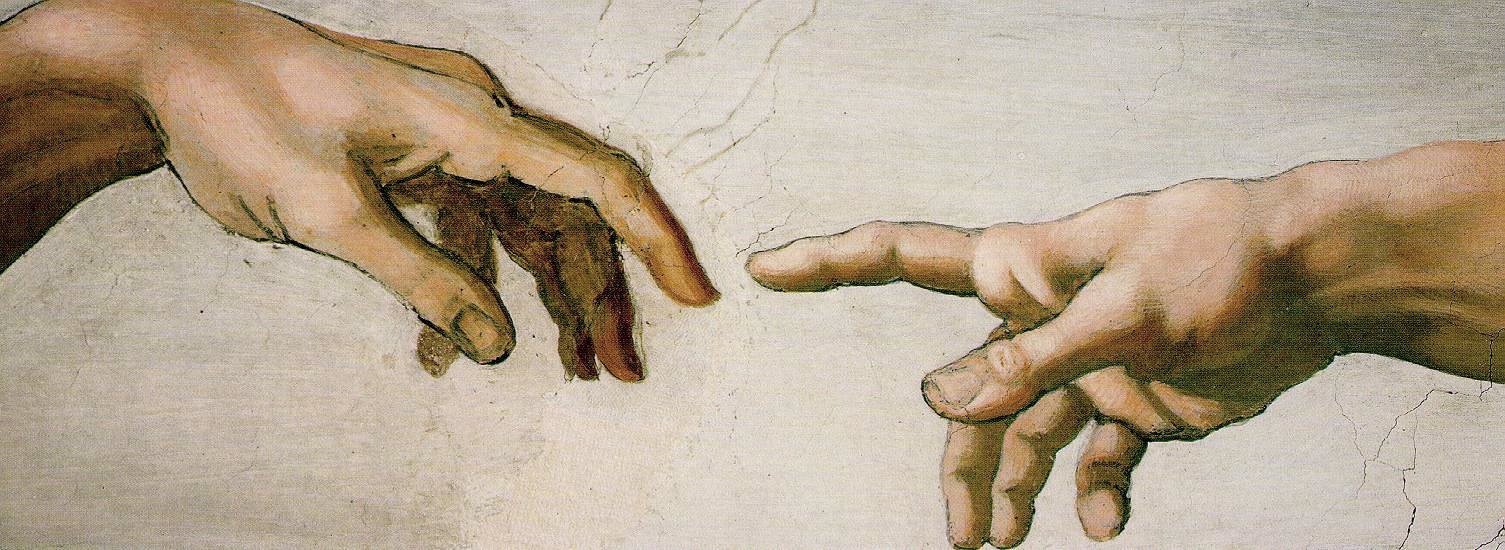
the Hands by Michelangelo
Genesis 1:26-31 (NASB) 26 Then God said, “Let Us make man in Our image, according to Our likeness; and let them rule over the fish of the sea and over the birds of the sky and over the cattle and over all the earth, and over every creeping thing that creeps on the earth.” 27 God created man in His own image, in the image of God He created him; male and female He created them. 28 God blessed them; and God said to them, “Be fruitful and multiply, and fill the earth, and subdue it; and rule over the fish of the sea and over the birds of the sky and over every living thing that moves on the earth.” 29 Then God said, “Behold, I have given you every plant yielding seed that is on the surface of all the earth, and every tree which has fruit yielding seed; it shall be food for you; 30 and to every beast of the earth and to every bird of the sky and to every thing that moves on the earth which has life, I have given every green plant for food”; and it was so. 31 God saw all that He had made, and behold, it was very good. And there was evening and there was morning, the sixth day.
Here we have the first instance of delegated authority. Man, having been formed from the very dust of the Earth, was now delegated authority over the Earth. Man is set to “rule over” everything on earth and in the sky above the earth and in the sea. In the next chapter, we get some specifics on that authority and how that played out for mankind.
Genesis 2:15-17 (NASB) 15 Then the Lord God took the man and put him into the garden of Eden to cultivate it and keep it. 16 The Lord God commanded the man, saying, “From any tree of the garden you may eat freely; 17 but from the tree of the knowledge of good and evil you shall not eat, for in the day that you eat from it you will surely die.”
I have always been fascinated with the garden of Eden. Particularly with the way it is introduced and how the Adam gets placed into it after he is created… and then booted out of it later on as a result of the fall of man. But for now, let us look at the authority and responsibility (the two concepts are inextricably linked, by the way) given to Adam. He was placed into the garden of Eden to cultivate it and keep it. Adam was given a task, and the authority to perform the task was delegated to him. How interesting to see that in the very next verse, we have the first instance of something in all of creation being “not good”. Continue on with me
Genesis 2:18-24(NASB) 18 Then the Lord God said, “It is not good for the man to be alone; I will make him a helper suitable for him.” 19 Out of the ground the Lord God formed every beast of the field and every bird of the sky, and brought them to the man to see what he would call them; and whatever the man called a living creature, that was its name. 20 The man gave names to all the cattle, and to the birds of the sky, and to every beast of the field, but for Adam there was not found a helper suitable for him. 21 So the Lord God caused a deep sleep to fall upon the man, and he slept; then He took one of his ribs and closed up the flesh at that place. 22 The Lord God fashioned into a woman the rib which He had taken from the man, and brought her to the man. 23 The man said,
“This is now bone of my bones,
And flesh of my flesh;
She shall be called Woman,
Because she was taken out of Man.”24 For this reason a man shall leave his father and his mother, and be joined to his wife; and they shall become one flesh.
It was not good for the man to be alone. He needed a helper. However, nothing that was formed from the ground was a suitable helper for Adam (sorry, guys… the notion of “man’s best friend” being a dog…simply isn’t biblical 😉 ). All joking aside, there are some key points I believe being made here.
The first one being that man was already created, and delegated authority and rule over all created things AND he’s been put to work while he was still alone. In his solitude, God saw that it was not good for him to be alone, so He decided man needed a helper. God had a plan the entire time, so the trotting out of all of the created beings before Adam was NOT an exercise of trial-and-error for God. It was for Adam’s benefit that God wanted to demonstrate to him that none of the other created beings were worthy of serving as helper to man. Why is that? Because man was of a different kind from the rest of creation, and man was to be set as ruler over all created beings in the sea, on the earth, and in the sky. For man to fulfill his charge, and execute his authority in ruling over the earth and filling the earth, he needed a helper of his own kind. Therefore, The Lord God fashioned into a woman the rib which He had taken from the man, and brought her to the man. Adam recognized the significance of what the Lord God had done here, which is why God saw fit that we maintain the quote from Adam. Now Adam was no longer alone, and in being joined with his wife, they shall become one flesh, and now they were given the ability to be fruitful and multiply and fill the earth, after their own kind (mankind).
The second point I’d like to make, is that there is no realignment of authority once the woman is created. Adam was already placed in charge, and given the task and its singular parameter (not to eat of the fruit of the tree of knowledge of good an evil, v17) to obey. The authority and responsibility to keep the law was placed upon Adam, before woman was created. Once Adam was given his helper, his wife, the order is not re-given to them. Adam is responsible and it will be Adam who will ultimately be held responsible. That is the nature of authority. So, mankind was created equal, male and female both equal because no other alternative was suitable for Adam. However, within that equality, there is still authority. Woman was created as a helper for man, enabling him to fulfill God’s commandment to man. Woman is equal to man, having been pulled out of his rib and formed to be joined with him. But it is Adam that was given authority.
Even was tempted by the serpent (Gen 3), and was apparently not properly instructed (v3) in the commandment of the Lord God, given to Adam (which was Adam’s responsibility) and she ate the fruit. She then handed it to Adam, and he joined her in her sin. So now what? Who’s in charge now? Remember that we serve an all-powerful, all-knowing, and ever-present God. So God knows exactly what happened, and who was at fault for each act. So, again, the investigation that takes place after the sin is not for God’s sake, but ours. God questions the Adam first, because it was to Adam that He gave the instruction, authority, and responsibility. Having failed to do what is right in the sight of God, Adam sought to escape judgement by assigning blame, interestingly he goes about it cleverly (though foolishly) in trying to get the Lord God to accept blame for having given the woman to Adam. Following the example set before her, she blames the serpent. Notice, none of them lied about what happened, but they both tried to avoid blame. This doesn’t go their way, and we have judgement issued from the bottom up, first the serpent, then the woman, and finally Adam.
Genesis 3:14-15 (NASB) 14 The Lord God said to the serpent,
“Because you have done this,
Cursed are you more than all cattle,
And more than every beast of the field;
On your belly you will go,
And dust you will eat All the days of your life;
15 And I will put enmity Between you and the woman,
And between your seed and her seed;
He shall bruise you on the head,
And you shall bruise him on the heel.”
The Lord God has a plan. God was not caught off-guard, nor was He caught unaware. He knows everything, and here, we see the Lord God declaring that the seed of woman would bruise (or crush) satan’s head, though satan will bruise him on the heel. Why her seed? because it has to be a human, but cannot come from Adam’s seed because it is now dead to sin. This is why the virgin birth is absolutely essential to the Gospel. The broken authority of mankind rests in man, not woman. It was by Adam’s sin that all of mankind fell into darkness, why we are born dead in sin (Romans 5:12-14) in need of a Savior, Jesus Christ.
Genesis 3:16-18 (NASB) 16 To the woman He said,
“I will greatly multiply Your pain in childbirth,
In pain you will bring forth children;
Yet your desire will be for your husband, And he will rule over you.”
I do not wish to spend a great deal of time on this point, but here we have God’s judgment on woman for her sin. My wife and I are strong believers in natural childbirth, and we believe that God has a plan for every aspect of our lives, including childbirth. Throughout the scriptures, God uses birth pains as an illustration of what is taking place on Earth. We’ve been blessed with 2 beautiful children by natural means. God is good, and He provides, Hallelujah! Notice the last portion… God is reiterating the roles of authority. Adam and Eve are still equal and when they are joined they are one flesh. But it is the husband who has authority over her. This is important to understanding much of the Gospel of Jesus Christ and the fullness of what He came to redeem, and for what He said He will return.
Genesis 3:17-19 (NASB) 17 Then to Adam He said, “Because you have listened to the voice of your wife, and have eaten from the tree about which I commanded you, saying, ‘You shall not eat from it’;
Cursed is the ground because of you;
In toil you will eat of it
All the days of your life.
18 “Both thorns and thistles it shall grow for you;
And you will eat the plants of the field;
19 By the sweat of your face
You will eat bread,
Till you return to the ground,
Because from it you were taken;
For you are dust,
And to dust you shall return.”
As Paul wrote in Romans 5, and really as the entirety of the Scriptures points out, the state of man is now complete separation from God. But our God is merciful and continually works to redeem His people and to gather all nations unto Him. But you see here that the very ground was cursed by Adam’s sin. What was Adam’s task in the Garden? To cultivate the garden and keep it. Now that very task is marred. This leads to another issue, that when you are given authority and responsibility over something, you are held accountable for it… and your failures/successes don’t just affect you, but to that over which you are responsible.
God will redeem His creation, but He cannot do it through Adam’s seed, it must be through the seed of the woman, where the Word of God will be made flesh, so that He can redeem His people. Jesus came to fulfill the Law and the Prophets. Jesus, having lived, died on the cross, and resurrected…has secured all authority in Heaven and Earth. Having paid the ultimate penalty for the sin of mankind, bearing within Himself the death that was required by Adam’s sin, He now is the authority over Heaven and Earth, at the Right Hand of God the Father. Jesus has perfected the relationship between man and Creator and through Him is made the only Way to God.
A common error in modern-day Christianity is to forget that Jesus is still fully man in addition to being fully God. He didn’t lose his perfected body when ascended into Heaven, He still has his perfected body… and He will return for His bride, the Church. I make this point to set up the next: Paul makes it very clear that Jesus Christ maintains absolute authority over the His people. The declaration takes various forms in the New Testament, so let’s look at some of them:
Colossians 1:18 (NASB) 18 [Jesus Christ] is also head of the body, the church; and He is the beginning, the firstborn from the dead, so that He Himself will come to have first place in everything.
1 Corinthians 11:3 (NASB) 3 But I want you to understand that Christ is the head of every man, and the man is the head of a woman, and God is the head of Christ.
Hebrews 4:14-16 (NASB) 14 Therefore, since we have a great high priest who has passed through the heavens, Jesus the Son of God, let us hold fast our confession. 15 For we do not have a high priest who cannot sympathize with our weaknesses, but One who has been tempted in all things as we are, yet without sin. 16 Therefore let us draw near with confidence to the throne of grace, so that we may receive mercy and find grace to help in time of need.
Revelation 19:11-16 (NASB) 11 And I saw heaven opened, and behold, a white horse, and He who sat on it is called Faithful and True, and in righteousness He judges and wages war. 12 His eyes are a flame of fire, and on His head are many diadems; and He has a name written on Him which no one knows except Himself. 13 He is clothed with a robe dipped in blood, and His name is called The Word of God. 14 And the armies which are in heaven, clothed in fine linen, white and clean, were following Him on white horses. 15 From His mouth comes a sharp sword, so that with it He may strike down the nations, and He will rule them with a rod of iron; and He treads the wine-press of the fierce wrath of God, the Almighty. 16 And on His robe and on His thigh He has a name written, “KING OF KINGS, AND LORD OF LORDS.”
I urge you, not to get caught so up modern feminism or misogyny that you miss out on the great picture of Jesus Christ, and the profound depth of God’s love and perfect planning in making for us a way of escape from our own sin. Jesus now fulfills every role of authority that man has messed up: man (second Adam), husband (to His bride, the church), judge, priest, and King. All authority. The Gospel of Jesus Christ is about so much more than just granting you a “get out of hell free” card… It’s about the Greatness of our Lord God. Praise be to God and His son, Jesus.
In Him,
FS
All Scripture is God-breathed…
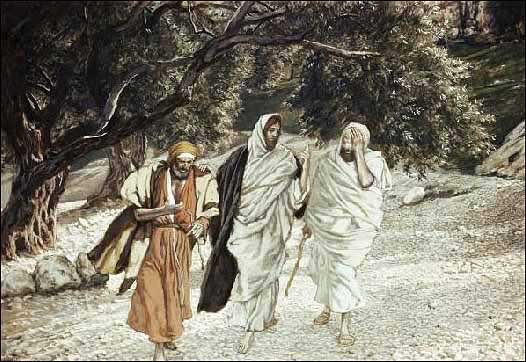
Road to Emmaus
by James J. Tissot
I had hoped to have written today’s post a bit sooner; nevertheless, I am grateful that God has granted me the grace and mercy to share another post on this fine Monday morning. As I have been spending a great deal of time in prayer regarding His plans for my life and my involvement within the local church (each year, twice a year, our local church engages in 21 days of prayer and fasting seeking God’s Will for our fellowship, our families, and our individual walks), this blog has come to mind repeatedly. I am reminded that I am not to take this blog lightly, that I cannot simply post what I like and rely on the first amendment to shield me from these writings. Rather, that as I commit myself to the study of God’s Word, and share here what I learn in the Scriptures, by the Grace of God by His Holy Spirit, that I do so prayerfully and humbly.
In the last post, we started to look at the subject of Biblical submission, that is, submitting to God and His Word in righteousness. Before continuing, I do think it important that we spend time again looking at the authority of the Scriptures. So, consider this a companion to the last post, because one cannot effectively discuss submission, without clearly and completely discussing authority.
Let us begin with the Apostle Paul’s instruction to Timothy, in which he declares:
2 Timothy 3:16 (NASB, emphasis mine) 16 All Scripture is [a]inspired by God and profitable for teaching, for reproof, for correction, for training in righteousness;
Footnote: [a] 2 Timothy 3:16 Lit God-breathed
I don’t normally include the footnotes in these posts; however, I couldn’t find a translation of the this passage that included the literal meaning of the Greek in the text. Every translation I searched included the literal meaning of the Greek as a footnote, and I believe it is important for us to recognize. Now, there is nothing wrong with the word “inspired” here, but I want to examine the literal “God-breathed” for a few moments.
Psalm 33:6 (NASB, emphasis mine) 6 By the word of the Lord the heavens were made, And by the breath of His mouth all their host.
Genesis 2:7 (NASB emphasis mine) 7 Then the Lord God formed man of dust from the ground, and breathed into his nostrils the breath of life; and man became a living being.
So, you see, the connection of all of Scripture to the Breath of God is an important one to maintain. As Paul wrote in Acts 17:28a (KJV), “For in him we live, and move, and have our being;” {oh yeah… I went old-school on that one 😉 }.
I mention this because in the past couple of decades we’ve seen a surge in the number of non-denominational Churches both here and abroad. There is a breaking away from the major hierarchies and set doctrines of these Churches that can be traced back to the reformation of the Roman Catholic Church. No doubt breaking away from false teaching, false doctrine, and corrupt leadership is necessary, but to do so without reconnecting to the authority of Scripture only leaves you floating aimlessly in a sea of organizations of men. Without a firm grasp on the authority of Scriptures, we cannot hope to remain submitted to God in keeping with His word, thus our attempts at reformation degrade into mere rebellion. I’ve spoken to so many Christians who have left the church because they were hurt, mistreated, or lied to… only to reject all authority and to purpose within their hearts never to submit to “anyone but the Holy Spirit”. But to do so without acknowledging fully the authority of Scriptures is both reckless and rebellious and is a popular snare of the devil in our present culture and age. It is to this generation that I hope to reach and reaffirm the authority of whole of Scriptures and the Gospel of Jesus Christ. It is why I’m focusing primarily in the New Testament affirmations of the Divine authority of scriptures. Let us continue on then…
I’d like to take a moment to look at one of the coolest accounts of Jesus after His resurrection found in Luke 24. I urge you strongly, to read the whole chapter… and then re-read it. It happens that as the women returned from finding the tomb of Jesus empty, and having been spoken to by Angels of the Lord, and shared their testimony with the disciples, that most did not believe. They were in mourning. Imagine for a moment, that only 3 days ago you saw your mentor, beloved teacher, Savior tortured and killed… you would undoubtedly have clouded judgement as well, would you not? But Peter took off running to see for himself. I love Peter… but that’s not where we are going right now, just setting up the backdrop for begins in verse 13:
Luke 24:13-17 (NASB, emphasis mine) 13 And behold, two of them were going that very day to a village named Emmaus, which was about seven miles from Jerusalem. 14 And they were talking with each other about all these things which had taken place. 15 While they were talking and discussing, Jesus Himself approached and began traveling with them. 16 But their eyes were prevented from recognizing Him. 17 And He said to them, “What are these words that you are exchanging with one another as you are walking?” And they stood still, looking sad.
The “them” in v13 refers to those disciples who heard the testimony of the women who had seen the empty tomb. But why did Jesus not just appear in full glory like, “here I am, BAM”? let’s read on, because the answer to this question is absolutely beautiful…
Luke 24:18-27 (NASB, emphasis mine) 18 One of them, named Cleopas, answered and said to Him, “Are You the only one visiting Jerusalem and unaware of the things which have happened here in these days?” 19 And He said to them, “What things?” And they said to Him, “The things about Jesus the Nazarene, who was a prophet mighty in deed and word in the sight of God and all the people, 20 and how the chief priests and our rulers delivered Him to the sentence of death, and crucified Him. 21 But we were hoping that it was He who was going to redeem Israel. Indeed, besides all this, it is the third day since these things happened. 22 But also some women among us amazed us. When they were at the tomb early in the morning, 23 and did not find His body, they came, saying that they had also seen a vision of angels who said that He was alive. 24 Some of those who were with us went to the tomb and found it just exactly as the women also had said; but Him they did not see.” 25 And He said to them, “O foolish men and slow of heart to believe in all that the prophets have spoken! 26 Was it not necessary for the Christ to suffer these things and to enter into His glory?” 27 Then beginning with Moses and with all the prophets, He explained to them the things concerning Himself in all the Scriptures.
Wow. You see… Jesus wanted His disciples to understand who He was and what had just happened in context of the Scriptures. He later reveals Himself to His disciples… but first, He chose to explain to them what they needed to know about Him… beginning with Moses and with all the prophets… Praise the Lord! While Jesus, being the Son of God, and already the first-born from the grave (resurrected) already bears all Authority in Heaven and Earth, He still chose to demonstrate His authority to His disciples by walking them through the scriptures. If Jesus chose to reveal Himself to His disciples in this manner, then we, too should likewise turn to the whole of Scripture to understand, proclaim, and reveal Jesus, the King of kings, and Lord of lords.
One more example before we close today. Let us return to the Apostle Paul for an example of how we are to share the Gospel as stewards of His word. Lets look at his letter to the Thessalonians. In the opening chapters of this letter, Paul is giving thanks for the faithfulness of the believers. One of the things for which Paul expresses thankfulness is particularly striking:
1 Thessalonians 2:13 (NASB) 13 For this reason we also constantly thank God that when you received the word of God which you heard from us, you accepted it not as the word of men, but for what it really is, the word of God, which also performs its work in you who believe.
So we have here that the Apostle is thankful that the believers accepted their words as the Word of God. But how is it, then, that such Authority could have been given to Paul by these believers? That they would not only accept their words as being of God, but that they “became imitators of the churches of God in Christ Jesus that are in Judea, for you also endured the same sufferings at the hands of your own countrymen…(v14)”. Thankfully, we have the account in Acts to bring us up-to-speed on what took place.
Acts 17:1-4(NASB) Paul at Thessalonica
17 Now when they had traveled through Amphipolis and Apollonia, they came to Thessalonica, where there was a synagogue of the Jews. 2 And according to Paul’s custom, he went to them, and for three Sabbaths reasoned with them from the Scriptures, 3 explaining and giving evidence that the Christ had to suffer and rise again from the dead, and saying, “This Jesus whom I am proclaiming to you is the Christ.” 4 And some of them were persuaded and joined Paul and Silas, along with a large number of the God-fearing Greeks and a number of the leading women.
“This Jesus…is the Christ.” Paul reasoned with them from the Scriptures. That is where he derived his authority to preach, proclaiming the Jesus who had stopped him on the road to Damascus was in-fact the Christ. The authority isn’t in the vision, it’s in the Scriptures. Paul’s eyes needed to be opened, just as the eyes of the disciples that were walking on the road to Emmaus needed their eyes to be open.
It is my sincere prayer, that these posts spark a desire in your heart to read these scriptures for yourselves, and to get the full context of each passage. As I read/hear these passages I get a sense of what the disciples shared with one another after Jesus revealed Himself to them.
Luke 24:31-32 (NASB) 31 Then their eyes were opened and they recognized Him; and He vanished from their sight. 32 They said to one another, “Were not our hearts burning within us while He was speaking to us on the road, while He was explaining the Scriptures to us?”
May the Holy Spirit do likewise in your hearts as you search the Scriptures, and submit to the authority of God and His Word.
In Him,
FS
The Righteousness of Biblical Submission

Christ in Gethsemane by Heinrich Hofmann
We live in a society that absolutely rejects the notion of submission. For most Americans, submission is a sign of weakness, inferiority, and failure. What’s worse, there is a disturbing upward trend in deviant fetishism that seeks to add a very sick and twisted meaning to submission, due in large part to a recent publication of filth I don’t care to mention. To put it bluntly, submission is a dirty word in our society. There is a very good reason the enemy works so diligently to pervert, distort, and redefine “submission” and what it means to submit. As we will see in the Scriptures, the reason is that submission to God and the authority of His Word is our only hope for salvation. While that may seem like a “given”, I urge you to bear with me and see if we might dig a bit deeper into what it means to submit to God and His Word.
In the first chapter of the Gospel of John, we have the following introduction of Jesus Christ:
John 1:1-5 (NASB) The Deity of Jesus Christ
1 In the beginning was the Word, and the Word was with God, and the Word was God. 2 He was in the beginning with God. 3 All things came into being through Him, and apart from Him nothing came into being that has come into being. 4 In Him was life, and the life was the Light of men. 5 The Light shines in the darkness, and the darkness did not comprehend it.John 1:14-18 (NASB) The Word Made Flesh
14 And the Word became flesh, and dwelt among us, and we saw His glory, glory as of the only begotten from the Father, full of grace and truth. 15 John *testified about Him and cried out, saying, “This was He of whom I said, ‘He who comes after me has a higher rank than I, for He existed before me.’” 16 For of His fullness we have all received, and grace upon grace. 17 For the Law was given through Moses; grace and truth were realized through Jesus Christ. 18 No one has seen God at any time; the only begotten God who is in the bosom of the Father, He has explained Him.
I like to start in the book of John, because I find that his intro does a wonderful job of introducing the Christ in such a manner that unifies the whole Bible. Right off the bat it is clear that in order to fully understand what it means to know Jesus involves studying all of God’s Word from Genesis through Revelation. If you’ll remember the wording of the prophecy in Isaiah 9:6 regarding the Messiah, “For a child will be born to us, a son will be given to us”, you see here that John was pointing out that while His flesh was born that day, Jesus was given to us… ,”And the Word became flesh”.
Now, as Christians, we are to take Jesus as our example. What did Jesus have to say about the Law and the Prophets?
Matthew 5:17-19 (NASB)
17 “Do not think that I came to abolish the Law or the Prophets; I did not come to abolish but to fulfill. 18 For truly I say to you, until heaven and earth pass away, not the smallest letter or stroke shall pass from the Law until all is accomplished. 19 Whoever then annuls one of the least of these commandments, and teaches others to do the same, shall be called least in the kingdom of heaven; but whoever keeps and teaches them, he shall be called great in the kingdom of heaven.
Jesus had every right, being God, to simply speak truth from His own authority. Why did He choose to return to scriptures time and time again? A common quick-answer given today is simply that He did so to demonstrate to us how we might live our lives. While there is truth in that, I believe that answer to be incomplete, and it leaves too much room for the enemy to inject into our minds doubts and false doctrines regarding the person of Jesus and the role of biblical submission to Divine Authority. Jesus wasn’t just demonstrating submission to the scriptures and to God the Father, He submitted to the Father’s Will. When He fasted for 40 days (Matt 4), He submitted to the Spirit, was led into the wilderness to be tempted, and He was hungry. Not an act just for demonstration’s sake, it was real. He resisted the temptation of the devil by referring to the Scriptures. That alone would make the point I’m trying to make, but look at His response to the second temptation.
Matthew 4:7 Jesus said to him, “On the other hand, it is written, ‘You shall not put the Lord your God to the test.’”
Jesus isn’t directing the quote at Satan, He presents the quote as a standard by which He must resist the temptation to put the Lord God to the test. Jesus is saying that He will not do what Satan suggested He do, because Scriptures clearly stay that we are not to test the Lord our God. Submission. Likewise in the response to the third and final temptation, Jesus isn’t commanding Satan ‘You shall worship the Lord your God, and serve Him only.’ He is saying that He is to worship the Lord God and serve Him only; therefore, He will resist the final temptation. Submission. Satan had to flee… and after he had run away, the angels came to minister to Jesus. I think that it is from this example that James writes
James 4:7-10 (NASB)
7 Submit therefore to God. Resist the devil and he will flee from you. 8 Draw near to God and He will draw near to you. Cleanse your hands, you sinners; and purify your hearts, you double-minded. 9 Be miserable and mourn and weep; let your laughter be turned into mourning and your joy to gloom. 10 Humble yourselves in the presence of the Lord, and He will exalt you.
I look forward to returning to James 4 at a later date, but for now, I just wanted to point out that the Apostles understood submission because they saw it in the life of Jesus. In your own private reading time, examine for yourselves all of the times Jesus deferred to His Father in Heaven. In the book of John, He made it very clear to the Pharisees that He was the Son of God, and that He was sent by Him, and that His authority over sin, sickness, even the Sabbath was from God; however, He also deferred to God’s Will and Authority. Let’s go to another truly desperate and painful times when Jesus submitted to God the Father
Mark 14:36 (NASB) (Luke 22:39-46; Matthew 26:36-46; Mark 14:32-42)
36 And He was saying, “Abba! Father! All things are possible for You; remove this cup from Me; yet not what I will, but what You will.”Luke 23:34 (NASB) (On the Cross)
34 But Jesus was saying, “Father, forgive them; for they do not know what they are doing.” And they cast lots, dividing up His garments among themselves.Luke 23:46 (NASB) 46 And Jesus, crying out with a loud voice, said, “Father, into Your hands I commit My spirit.” Having said this, He breathed His last.
Amen. Yes, Jesus demonstrated complete and total submission to God the Father… by being fully and completely submitted to God the Father. It is this point, this point exactly, that lead me to share this message today. If Jesus, being the Son of God, the Word of God, equal to God was righteous in His submission to God and the Word of God… where is it that we get this false notion that submission denotes inferiority? We submit to God not only because He is superior to us (because we are, in-fact, inferior to God) but because it is Right that we do so. If submission were based solely on inferiority of being then Jesus could not have submitted to God the Father, for He is in no way an inferior being. He submitted to the Authority of God the Father, because that is the design of God’s creation.
Pray about this, and settle it in your spirits. Biblical submission is righteousness in the sight of God. Submit therefore to God. There is much more to discuss concerning the righteousness of biblical submission. Know that the basis for subsequent discussion has been presented here, in that we must first submit to God, His Word, His Son, His Spirit, and His Will. We will take a prayerful look at what the scriptures have to say about submission, particularly in how we are to live our lives as Christians in society, family, and within the Church.
Until next time, May the Lord bless and keep you in His Will,
In Him,
FS
Related articles
- Jesus Christ on the Infallibility of Scripture (creation.com)
- The Sovereignty of the One True God (faithfulstewardship.wordpress.com)
- Finding the Gospel in the Whole Bible: An Interview with Graeme Goldsworthy (modernreformation.org)
Reaching forward to what lies ahead in 2014…
 In my family, New Years is the big holiday for the family to gather together and thank God for the year that has drawn to a close, and pray for His blessing on the year to come. I am still on vacation, so this post will be rather short today; however, I did want to share what has been on my mind for 2014. A close brother in Christ shared the Sunday morning message at our church and he highlighted the following passage in Philippians.
Philippians 3:13-16 (NASB)
13 Brethren, I do not regard myself as having laid hold of it yet; but one thing I do: forgetting what lies behind and reaching forward to what lies ahead, 14 I press on toward the goal for the prize of the upward call of God in Christ Jesus. 15 Let us therefore, as many as are perfect, have this attitude; and if in anything you have a different attitude, God will reveal that also to you; 16 however, let us keep living by that same standard to which we have attained.
My wife and I have spent a great deal of time in December, discussing all of the ways that God has matured us and blessed us. We do tend to focus a bit too much on the various “growth opportunities” (trials) we faced in 2013.
I am not writing to tell you what God has in store for you in 2014… not specifically anyway. Rather, I know that to move on with the proper attitude, Paul begins his advice with the phrase, “forgetting what lies behind”. One thing I noticed here is that Paul didn’t specify “just the bad things that lie behind”. He said to forget what lies behind. That’s important, because too often we become so focused on the good things God did in the past that we fail to recognize any of God’s blessings that don’t look exactly like the blessings of the past. In doing so, we limit God and hurt ourselves and those around us by not being in a position/mindset to fully recognize and acknowledge the blessings of God. But holding on to the trials too tightly can be even worse. Not only can that rob us of future blessings, and blind us of future trials, but holding on too tightly to the trials themselves can rob us of the very lesson God had intended for us to learn from it. Additionally, we can leave room for the enemy to plant seeds of bitterness when hold on too tightly to the trials of the past.
I am writing this to encourage you (and me) to seek the Will of God for 2014. Our church begins each New Year with prayer and fasting. What is God calling you to do in 2014? What is the prize for upon which you need to set your gaze? I recommend, keeping a prayer journal, and writing down what you feel the Holy Spirit speaking to you. Once you’ve written down what you feel is God’s call for you this year, search out the Scriptures for what you’ve written down. Once you’ve found the scriptural basis for what you’ve written down, you can be confident that you heard from God and rest in the fact that He has called you to do good works. If you cannot find scriptural basis, maybe ask a brother or sister in Christ to pray with you and search the scriptures with you. It could also be that you’ve injected your own desires or what you think God would want you to do. We’ve all done this at one time or another and to varying degrees. Here again, is why we need to be surrounded by Godly council and brotherly love.
I’m looking forward to 2014. I pray that this blog will be an encouragement to your lives in the upcoming year, and that you might share with us the great things He has done in your lives. May the Lord Bless you and keep you this year.
In Him,
FS
 Faithful Stewardship
You must be logged in to post a comment.