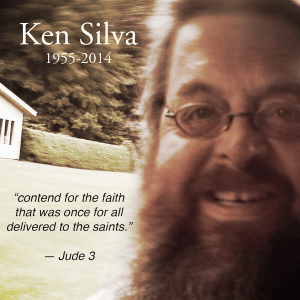
Pastor Ken Silva’s Passing

IKenSilva had only been made aware of his website less than a year ago. I learned a great deal from his writings and his research has helped me more than I can convey. The following is the note of his passing posted on his website:

PASTOR KEN SILVA’S PASSING

It is with mixed emotions that I take this time to write on behalf of Connecticut River Baptist Church to let you know of Pastor Ken Silva’s passing. Yesterday morning at around 10 a.m., 29 September 2014, Ken was found at home, having passed away. He had succumbed to the strain of the pain he had been enduring for the past few years.

The mixed emotions are sadness at losing our dear brother in Christ – I shall miss his wisdom and guidance – but also joy. Joy because, as Paul noted in 2 Cor. 5:8, ‘We are confident, I say, and willing rather to be absent from the body, and to be present with the Lord.’

Yes we know that Ken is now present with the Lord. We can also be thankful in knowing his pain has ended.

We will still miss him deeply.

Blessings,

David H. Moses
Associate Pastor
Connecticut River Baptist Church

I’ve started up a few blog posts that I hope to complete soon. Until then, I thought it would be nice to introduce some of his work, the fruits of his labor in Christ.

THE PAPACY OF THE ROMAN CATHOLIC CHURCH

THE ROMAN CATHOLIC CHURCH HASN’T CHANGED ITS CONDEMNATION OF THE GOSPEL

His passing has left many with heavy hearts. Our thoughts and prayers are with those who are mourning.  May the Lord bless you and give you peace.

In Christ Jesus,
Jorge

DiM | “Overwhelmed” by Big Daddy Weave

Today is “Discernment in Music” (DiM) day here at Faithful Stewardship.

2 Corinthians 10:4-6 (ESV)
4 For the weapons of our warfare are not of the flesh but have divine power to destroy strongholds. 5 We destroy arguments and every lofty opinion raised against the knowledge of God, and take every thought captive to obey Christ, 6 being ready to punish every disobedience, when your obedience is complete.

Today I wanted to take a look at the #7 song on K-Love’s top songs chart dated September 21. The song is Overwhelmed by Big Daddy Weave. I skipped over songs #5 and #6 because as soon as I saw the list I was already singing the chorus to Overwhelmed in my head. Let us begin with a refresher for those who might not have heard this song on the radio:

There is a portion at the end where children can be heard singing something in Swahili. Thanks to one of the comments on the video (and Google translate) those lyrics and their meaning are as follows:

wewe ni mzuri, wewe ni waajabu
You are beautiful, you are the extraordinary.

Wewe ni mtukufu, wewe ni mfalme wangu
You are exalted, you are my king

Overwhelmed | Lyrics (via Big Daddy Weave Website)

(Music & Lyrics: Mike Weaver / Phil Wickham)
I see the work of Your Hands
Galaxies spin in a Heavenly dance oh God
All that You are is so overwhelming

I hear the sound of Your Voice
All at once it’s a gentle and thundering noise oh God
All that You are is so overwhelming

I delight myself in You
Captivated by Your beauty
I’m overwhelmed, I’m overwhelmed by You

God, I run into Your arms
Unashamed because of mercy
I’m overwhelmed, I’m overwhelmed by You

I know the power of Your Cross
Forgiven and free forever You’ll be my God

All that You’ve done is so overwhelming
I delight myself in You
In the Glory of Your Presence
I’m overwhelmed, I’m overwhelmed by You

God, I run into Your arms
Unashamed because of mercy
I’m overwhelmed, I’m overwhelmed by You

You are Beautiful, You are Beautiful
Oh God, there is no one more Beautiful
You are Beautiful, God you are the most Beautiful

You are Wonderful, You are Wonderful
Oh God, there is no one more Wonderful
You are Wonderful, God You are the most Wonderful

You are Glorious, You are Glorious
Oh God, there is no one more Glorious
You are Glorious, God you are the most Glorious

Positive Elements

This song is more pointed at the God of the Bible than some of the songs we’ve reviewed. The first stanza identifies the object of worship as God, the Creator of the Universe.

Psalm 102:25-28 (ESV)
25 Of old you laid the foundation of the earth,
and the heavens are the work of your hands.
26 They will perish, but you will remain;
they will all wear out like a garment.
You will change them like a robe, and they will pass away,
27     but you are the same, and your years have no end.
28 The children of your servants shall dwell secure;
their offspring shall be established before you.

The next stanza starts a bit oddly. “I hear the sound of your voice…” could be artistic license or it could be leaning toward mysticism. We’ll put that thought on hold for a bit and continue on to acknowledge that there is a reference to both the gentle voice of God and the thundering voice of God. That’s positive, because throughout the Old Testament we see God speaking to His Anointed in large and small ways, by audible voice and by the Written Word. The children of Israel were frightened by the Voice of God at Horeb, and insisted that Moses go speak with God on their behalf. Being overwhelmed by the Creator of the Universe is a good thing, just as being overwhelmed by the fear of the Lord was a good thing at Horeb. In fact, let’s look at passage. Moses is recounting to the people of Israel how God spoke to them the 10 Commandments at Horeb.

Deuteronomy 5:22-29 (ESV) 22 “These words the Lord spoke to all your assembly at the mountain out of the midst of the fire, the cloud, and the thick darkness, with a loud voice; and he added no more. And he wrote them on two tablets of stone and gave them to me. 23 And as soon as you heard the voice out of the midst of the darkness, while the mountain was burning with fire, you came near to me, all the heads of your tribes, and your elders. 24 And you said, ‘Behold, the Lord our God has shown us his glory and greatness, and we have heard his voice out of the midst of the fire. This day we have seen God speak with man, and man still live. 25 Now therefore why should we die? For this great fire will consume us. If we hear the voice of the Lord our God any more, we shall die. 26 For who is there of all flesh, that has heard the voice of the living God speaking out of the midst of fire as we have, and has still lived? 27 Go near and hear all that the Lord our God will say, and speak to us all that the Lord our God will speak to you, and we will hear and do it.’

28 “And the Lord heard your words, when you spoke to me. And the Lord said to me, ‘I have heard the words of this people, which they have spoken to you. They are right in all that they have spoken. 29 Oh that they had such a heart as this always, to fear me and to keep all my commandments, that it might go well with them and with their descendants forever!

Being overwhelmed by God is a good thing, and oh that we had such a heart always, to fear God and to keep all His commandments. Which brings us to the chorus. The idea of delighting in God is one that we see reflected in the Psalms. However, this song doesn’t quite complete the thought like the Psalms did, because this song keeps it in sort of vague, mystical sense of delighting in God directly, delighting in His presence and running into His arms. While it makes for strong emotive poetry, it falls short of actually providing something we can do. Let’s see how the Psalmist completes the thought.

Psalm 119:9-16 (ESV)
9 How can a young man keep his way pure?
By guarding it according to your word.
10 With my whole heart I seek you;
 let me not wander from your commandments!
11 I have stored up your word in my heart,
that I might not sin against you.
12 Blessed are you, O Lord;
teach me your statutes!
13 With my lips I declare
all the rules of your mouth.
14 In the way of your testimonies I delight
    as much as in all riches.
15 I will meditate on your precepts
and fix my eyes on your ways.
16 I will delight in your statutes;
I will not forget your word.

So we see that the aim of our delight in Him is by keeping His Word in our hearts. Why is this important? Because there are many false religions who seek oneness with gods in creation without acknowledging the One True God and Creator of the Universe, for they reject His Word. What ends up happening is they fall into idolatry of the created over the Creator, or in the idolatry of self-worship. Delighting in God must be according to His Word and not left to our imaginations, impressions, or emotions alone. The line, “God, I run into Your arms” needs to be understood as Repentance and prayer, not just singing this song and praying for answers. I’m not sure if that is what the writers of the song intended, but that is the only way this song stays doctrinally sound. We are called to remain in the Lord, and as the Psalmist says by guarding our way according to His Word is the only way we can keep our way pure. So any notion that we have of running into the arms of the Lord must coincide with the need to repent from prior drifting or running away from Him, which is Sin. Repentance is also the way in which we practice running into the arms of God. Once we’ve repented from sin, then the next line “Unashamed because of mercy” holds true, because of His Great Mercy we are forgiven when we confess our sins and repent from them.

The second verse is really only one stanza, and then a return to the Chorus. This third stanza gives us a much-needed reference to the Cross of Jesus Christ. This is the mercy and grace of our Lord Jesus Christ, that He bore our sins, iniquities, and the full penalty of our unrighteousness on the cross.

Concerns

Our goal here is to practice Biblical discernment in the songs we hear played on the radio (maybe even sing along with) so that we are fully aware of what we are filling our hearts and minds with. The primary concern with this song is in the open door to a mystical interpretation of delighting in God’s Presence (presence theology like that taught at Bethel). The modern-day evangelical church has been flooded by New Age Mysticism that seeks to skip over the Written Word of God and dive right into “experiencing” supernatural communion and presence and imparting spiritual wisdom apart from the Bible. It is woefully dangerous theology and false doctrine. The Bible warns us time and time again not to accept false gods, false spirits, or doctrines of demons. Even from the Law the test of a true Prophet involved more than simply whether or not a sign or wonder was performed… but what they taught was to be scrutinized and examined for Truth. For the Law was a testimony of God. Moses and the Prophets testified of the Messiah to come, Jesus Christ, and God the Holy Spirit testifies of the Christ who came, died, ascended, and is returning to judge both the living and the dead. Do not skip the Written Word of God hoping to ascend into heavenly existence via mystical short-cuts, and do not listen to those who claim to teach such methods.

You might be thinking, “wow, I don’t see any of that in this song.” One of the methods taught by the 3rd Century Roman Catholic Mystics was to chant a word of scripture or phrase over, and over, and over again… to enter into a trance-like state until supposedly the hidden secret meaning of the scripture would be revealed. That is not what the Bible teaches. So when so much of this song is devoted to repetition, it makes me nervous. Also, having grown up in a lot of the “presence” approach to worship, I know that the intended purpose of these lyrics is to allow the music team to run these lines on repeat until “something happens” or “the spirit moves among the people”.

Conclusion

This song is a decent song in that it almost stands on its own.  Proper understanding of the fear of the Lord, and how we are to delight in Him is required to keep this song in its proper place. That prayerful confession and repentance from sin is how we are to “run into His arms”. It does seem to have been written in a way that it could be used by liberal, seeker-mergent, mystical forms of worship, so the context of this song being played is important. I enjoy hearing it my car and humming along as I go about my day, because I’m not engaging in mysticism, merely thinking about just how overwhelming our God is, His Holiness and His Grace that He should love a wretch like me. Whenever you hear this song played on the radio, it is my hope that you will be reminded to delight in God’s Word, in His Testimonies, in His Statutes, in His Commandments, and most importantly in His Son, Jesus, who lived, died, and rose again and is returning soon.

Jude 1:24-25 (ESV)
24 Now to him who is able to keep you from stumbling and to present you blameless before the presence of his glory with great joy, 25 to the only God, our Savior, through Jesus Christ our Lord, be glory, majesty, dominion, and authority, before all time and now and forever. Amen.

In Christ Jesus,
Jorge

“My Grace is Sufficient”

imagesToday, I wanted to look at closing up yesterday’s discussion, especially for those who struggle with the notion that “soul ties” aren’t biblical. If “soul ties” aren’t the answer, what is? The simple answer is, “the Grace of God”. Let us begin by looking to the Apostle Paul for some insight, because Paul often taught regarding the dual nature of Christians as being both sinner and saint. In his second letter to the Corinthians, Paul shares a personal plea to God and God’s answer to Paul should give us encouragement and comfort.

2 Corinthians 12:1-10 (ESV) | Paul’s Visions and His Thorn
1 I must go on boasting. Though there is nothing to be gained by it, I will go on to visions and revelations of the Lord. 2 I know a man in Christ who fourteen years ago was caught up to the third heaven—whether in the body or out of the body I do not know, God knows. 3 And I know that this man was caught up into paradise—whether in the body or out of the body I do not know, God knows— 4 and he heard things that cannot be told, which man may not utter. 5 On behalf of this man I will boast, but on my own behalf I will not boast, except of my weaknesses— 6 though if I should wish to boast, I would not be a fool, for I would be speaking the truth; but I refrain from it, so that no one may think more of me than he sees in me or hears from me. 7 So to keep me from becoming conceited because of the surpassing greatness of the revelations, a thorn was given me in the flesh, a messenger of Satan to harass me, to keep me from becoming conceited. 8 Three times I pleaded with the Lord about this, that it should leave me. 9 But he said to me, “My grace is sufficient for you, for my power is made perfect in weakness.” Therefore I will boast all the more gladly of my weaknesses, so that the power of Christ may rest upon me. 10 For the sake of Christ, then, I am content with weaknesses, insults, hardships, persecutions, and calamities. For when I am weak, then I am strong.

If this reference to boasting seems a bit awkward, in the previous chapter Paul is calling out the false apostles (sarcastically calling them ‘super apostles’), particularly pointing out their abuse, their boasting, and their financial exploitation of the Corinthians. Paul closed out the previous chapter boasting, so to speak, in his afflictions and hard work on their behalf rather than take from them, and he continues here boasting in a way that demonstrates that while the false apostles boasted illegitimately, Paul could boast all the more. Paul is one of the few who have ever been taking up into heaven (as a point of clarification, no one since Revelation has been shown heaven for the purpose of revealing or teaching the Church about it, and no one who claims to share details of Heaven is legitimate).

This thorn in the flesh that was given to Paul was given for a specific purpose, it was allowed to afflict Paul “so to keep him from becoming conceited because of the surpassing greatness of the revelations of heaven“. So, not only do we NOT get a detailed description of what Paul saw in Heaven, he was also allowed a tormentor, a messenger of Satan, to keep him from becoming conceited. You and I don’t need a thorn in our flesh, for our flesh is thorny enough on its own. Neither of us have been established as Apostles of Jesus Christ, and neither of us (I say with a great deal of confidence) have been taking up into Heaven. Notice here that if anyone had a special claim on an anointing from God the Holy Spirit, Paul did. If anyone could teach with authority the Word of Faith (WoF) doctrine, it would be Paul. But he doesn’t. We see here that he prayed three times to God that the thorn in his flesh, the harasser from Satan, be taken away from him, and God’s response wasn’t “you haven’t prayed the right prayer yet”, or “you still lack faith”, or even “this is to make you stronger”… no, God’s reply was simply

“My Grace is sufficient for you, for My power is made perfect in weakness”

We don’t have thorns placed in our flesh, but we must contend with the flesh nonetheless. Our flesh desires sin, it chases after sin. This thorn was above and beyond Paul’s flesh, and still the answer from God was, “My grace is sufficient for you…”.

How many times have you prayed and longed for God to miraculously remove your fleshly desire to…

  • lust after scantily clad women…
  • drown sorrow or pain in food or drink…
  • take just one more dose to remove the edge…
  • covet a neighbor’s lifestyle, possession, or spouse…

In all of these things, and all the other temptations of the flesh… your flesh… the flesh that wages war against the Spirit, the flesh that desires sin even when un-prompted by an outside agent (be it a person or an unclean spirit), the answer from God the Holy Spirit remains

“My Grace is sufficient for you, for My power is made perfect in weakness”

Can God the Holy Spirit miraculously heal addictions and mental illness? Yes. God was not incapable of removing the thorn in Paul’s flesh, and every demon and unclean spirit obeyed the commands of Jesus. The Sovereignty of God rests not only in His power, but in His Will as well. As we see in the book of Job, His Will isn’t always fully revealed to us, either. Nevertheless, we know that He works all things for good. All things… for good.

Romans 8:18-39 (ESV) | Future Glory
18 For I consider that the sufferings of this present time are not worth comparing with the glory that is to be revealed to us. 19 For the creation waits with eager longing for the revealing of the sons of God. 20 For the creation was subjected to futility, not willingly, but because of him who subjected it, in hope 21 that the creation itself will be set free from its bondage to corruption and obtain the freedom of the glory of the children of God. 22 For we know that the whole creation has been groaning together in the pains of childbirth until now. 23 And not only the creation, but we ourselves, who have the first-fruits of the Spirit, groan inwardly as we wait eagerly for adoption as sons, the redemption of our bodies. 24 For in this hope we were saved. Now hope that is seen is not hope. For who hopes for what he sees? 25 But if we hope for what we do not see, we wait for it with patience.

26 Likewise the Spirit helps us in our weakness. For we do not know what to pray for as we ought, but the Spirit himself intercedes for us with groanings too deep for words.27 And he who searches hearts knows what is the mind of the Spirit, because the Spirit intercedes for the saints according to the will of God. 28 And we know that for those who love God all things work together for good, for those who are called according to his purpose. 29 For those whom he foreknew he also predestined to be conformed to the image of his Son, in order that he might be the firstborn among many brothers. 30 And those whom he predestined he also called, and those whom he called he also justified, and those whom he justified he also glorified.

31 What then shall we say to these things? If God is for us, who can be against us? 32 He who did not spare his own Son but gave him up for us all, how will he not also with him graciously give us all things? 33 Who shall bring any charge against God’s elect? It is God who justifies. 34 Who is to condemn? Christ Jesus is the one who died—more than that, who was raised—who is at the right hand of God, who indeed is interceding for us. 35 Who shall separate us from the love of Christ? Shall tribulation, or distress, or persecution, or famine, or nakedness, or danger, or sword? 36 As it is written,

“For your sake we are being killed all the day long;
we are regarded as sheep to be slaughtered.”

37 No, in all these things we are more than conquerors through him who loved us. 38 For I am sure that neither death nor life, nor angels nor rulers, nor things present nor things to come, nor powers, 39 nor height nor depth, nor anything else in all creation, will be able to separate us from the love of God in Christ Jesus our Lord.

Paul is not talking about avoiding pain, or tribulation, or distress, or persecution, he is pointing to the promise of the Gospel of Jesus Christ. There are several verses that are pulled from this passage to push the WoF “declare victory now” over-realized eschatology, but when read in-context we know that the hope that lies ahead is far greater than our present circumstances. There will come a day when all of creation will be set free from its bondage to corruption, including our flesh. That nothing that “goes wrong” down here has any lasting consequences and that any suffering we might endure on this earth is not fit to be compared to the Glory that awaits us in Christ Jesus.

In this life we will face struggles, from outside agents and from our own fleshly desires, for it is corrupt. We must take up our crosses daily, and we must resist temptation and flee sexual immorality. But we are weak, and the Spirit of God helps us in our weakness. When we are weak, He is strong.

“My Grace is sufficient for you, for My power is made perfect in weakness”

The Grace of God is that He gave His One and Only Son Jesus to die on the cross as payment for our sin. Sin still has consequences in this life, and our flesh is corrupt.

Galatians 6:7-9 (ESV) 7 Do not be deceived: God is not mocked, for whatever one sows, that will he also reap. 8 For the one who sows to his own flesh will from the flesh reap corruption, but the one who sows to the Spirit will from the Spirit reap eternal life. 9 And let us not grow weary of doing good, for in due season we will reap, if we do not give up.

This isn’t about lawlessness and carnal living without consequences. This is about understanding that while we live in these fallen earthly bodies, we will sin. Our very flesh wars against our Spirit, compelling us to sin. Think of it in terms of addiction… only rather than being limited to a particular sin (drunkenness, gluttony, sexual immorality, etc.) our flesh is addicted to self-seeking, self-gratification (as a goal), and all manner of sin. The Grace of God brings our spirit to life, pulled out of the kingdom of darkness and sealed by the Holy Spirit for the Day of Christ’s Return. We must walk in the Spirit, resist the devil, and crucify our flesh daily. As Paul described it in Romans 6, we are to consider ourselves dead to sin, and alive to God, being slaves to righteousness. But we do so without condemnation, for the Grace of the Cross says that it is by His Blood we have been made righteous, not by our actions.

I pray that each of you will be set free from addictions and habitual sins. When you are going through the storm of temptation, trust in Him. The desire will be there, because your flesh craves sin, but know that the Spirit wages war against the flesh. There is no hidden secret to making the desire just go away. Trust in the Lord, God the Holy Spirit living inside of you to make a way of escape. Temptations will come… and often they come from within your very flesh. That will not always be the case. Sanctification is a life-long process, as we learn to live according to the Spirit and not according to the flesh. Press on toward the goal of the upward call of God, the Great Day of His Return. In the meantime, do not be ensnared by condemnation by the accuser. Remember the cross, remember the Grace of God, for His Grace is sufficient, and His power is made perfect in our weakness.

1 John 1 (ESV) 1 That which was from the beginning, which we have heard, which we have seen with our eyes, which we looked upon and have touched with our hands, concerning the word of life— 2 the life was made manifest, and we have seen it, and testify to it and proclaim to you the eternal life, which was with the Father and was made manifest to us— 3 that which we have seen and heard we proclaim also to you, so that you too may have fellowship with us; and indeed our fellowship is with the Father and with his Son Jesus Christ. 4 And we are writing these things so that our joy may be complete. 5 This is the message we have heard from him and proclaim to you, that God is light, and in him is no darkness at all. 6 If we say we have fellowship with him while we walk in darkness, we lie and do not practice the truth. 7 But if we walk in the light, as he is in the light, we have fellowship with one another, and the blood of Jesus his Son cleanses us from all sin. 8 If we say we have no sin, we deceive ourselves, and the truth is not in us. 9 If we confess our sins, he is faithful and just to forgive us our sins and to cleanse us from all unrighteousness. 10 If we say we have not sinned, we make him a liar, and his word is not in us.

May the peace of God reign in your hearts this day and every day,
In Christ Jesus,
Jorge

DiM | “Fix My Eyes” by for King & Country

Presentation1This DiM has been parsed out of a double DiM post back in September 9, 2014 for archival purposes. It was originally a part of this DiM post.

This week, “Greater” by MercyMe dropped to #3 due to the Lecrae marketing, so it’s nice to see that its drop is purely artificial. I am still holding out hope that it will topple the Ocean’s song. At #4 we find “Fix My Eyes” by for King & Country.

Music Video

Lyrics

“Fix My Eyes”
Hit rewind, Click delete
Stand face to face with the younger me
All of the mistakes, All of the heartbreak
Here’s what I’d do differently

I’d love like I’m not scared, Give when it’s not fair
Live life for another, Take time for a brother
Fight for the weak ones, Speak out for freedom
Find faith in the battle, Stand tall but above it all
Fix my eyes on you

I learned the lines and talked the talk (everybody knows that, everybody knows that)
But the road less traveled is hard to walk (everybody knows that, everybody knows)
It takes a soldier, Who knows his orders
To walk the walk I’m supposed to walk

And love like I’m not scared, Give when it’s not fair
Live life for another, Take time for a brother
Fight for the weak ones, Speak out for freedom
Find faith in the battle, Stand tall but above it all
Fix my eyes on you

The things of Earth are dimming, In the light of Your glory and grace
I’ll set my sights upon Heaven, I’m fixing my eyes on you
I’m fixing my eyes on you, I’m fixing my eyes

Love like I’m not scared, Give when it’s not fair
Live life for another, Take time for a brother
Fight for the weak ones, Speak out for freedom
Find faith in the battle, Stand tall but above it all
Fix my eyes on you, I fix my eyes on you
I fix my eyes on you

This song gets a lot of airtime on my local radio station. This song suffers from the same problem that we looked at in yesterday’s post in that it has the appearance of Gospel but is in-fact all Law.

Positive Elements

What the song declares to be good works are indeed Biblically-sound good works. To love without fear, to give gracefully, to love our neighbors, all very good things to do.

Concerns

The setup for the song is questionable. It seems to follow a sort of “If I could do it over” mantra. Well, the truth of the matter is that if we could do it all over, we’d still sin. We’d still fail to keep the Law. Under the Law, you don’t get credit for “trying”. We know from Hebrews 11 that those who were under the Law who were found righteous were not found righteous by their actions; rather, by faith.

Hebrews 11:1-13 (ESV) | By Faith
1 Now faith is the assurance of things hoped for, the conviction of things not seen. 2 For by it the people of old received their commendation. 3 By faith we understand that the universe was created by the word of God, so that what is seen was not made out of things that are visible. 4 By faith Abel offered to God a more acceptable sacrifice than Cain, through which he was commended as righteous, God commending him by accepting his gifts. And through his faith, though he died, he still speaks. 5 By faith Enoch was taken up so that he should not see death, and he was not found, because God had taken him. Now before he was taken he was commended as having pleased God. 6 And without faith it is impossible to please him, for whoever would draw near to God must believe that he exists and that he rewards those who seek him. 7 By faith Noah, being warned by God concerning events as yet unseen, in reverent fear constructed an ark for the saving of his household. By this he condemned the world and became an heir of the righteousness that comes by faith. 8 By faith Abraham obeyed when he was called to go out to a place that he was to receive as an inheritance. And he went out, not knowing where he was going. 9 By faith he went to live in the land of promise, as in a foreign land, living in tents with Isaac and Jacob, heirs with him of the same promise. 10 For he was looking forward to the city that has foundations, whose designer and builder is God. 11 By faith Sarah herself received power to conceive, even when she was past the age, since she considered him faithful who had promised. 12 Therefore from one man, and him as good as dead, were born descendants as many as the stars of heaven and as many as the innumerable grains of sand by the seashore. 13 These all died in faith, not having received the things promised, but having seen them and greeted them from afar, and having acknowledged that they were strangers and exiles on the earth.

Romans 4:1-3 (ESV) 1 What then shall we say was gained by Abraham, our forefather according to the flesh?2 For if Abraham was justified by works, he has something to boast about, but not before God. 3 For what does the Scripture say? “Abraham believed God, and it was counted to him as righteousness.”

So this song is lacking a Gospel message. The bridge of the song would have been a perfect place to insert a Gospel message, rather than the esoteric mystical reference to God’s glory and grace that leads into 3 more “I” statements. Perhaps use these lines to point out that repentance and forgiveness for sin is the best “reset” we have in this life and that the Gospel of Jesus Christ gives us the opportunity to grow in Him and do better by His Grace in keeping the Law, knowing we will fall short and sin but that God’s Grace is bigger than all of that.  We didn’t really need more of the “I’ll fix my eyes on you” in the bridge.

Conclusion

For a Christian who is firmly grounded and rooted in the Gospel of Jesus Christ, this song may serve as an encouragement to do good works, and to seek to honor God in everything we do. However, there is concern for a wearing down and crushing weight of the Law-presented-as-Gospel for those who are not firmly grounded in the knowledge of the Grace of God, the Gospel of Jesus Christ. For it is only as a result of the Gospel that we are made free to do good works. And we will fail, for our flesh is weak. Therefore, if we lose sight of the Gospel (that isn’t found in the song) we might slip into condemnation or despair and may God-forbid, we start to question the Gospel or our salvation that can only be found in a faith in Christ (not works of the Law).

I still catch myself singing along to this song whenever it plays, and I value the reminder of what the Law of God says about how we are to live by Faith. While not many songs seem to “pass the test” so to speak, I’m not advocating abandoning Christian music and going full-secular. There are some songs that prompt me to hit “power” and just pray for about 3 minutes or so… then I can turn the radio back on and hopefully enjoy the next song. At least I get some extra prayer time in.

May the Lord bless you and keep you firmly in His Grace
In Christ,
Jorge

Temptation, Rebuke, Repentance, & Forgiveness

Suffer the Children - Anthony van DyckWe’ve been spending a great deal of time discussing discernment matters and pointing out false teaching (and even some false teachers). While this is exceedingly important I don’t want to overlook the need for Christians to understand their call to forgive is just as strong as the call to repent. Today, let’s look at what Jesus taught concerning temptation, rebuke, repentance, and forgiveness.

In researching a couple of rather heavy blogs that are in the works, I came across a passage that really caught my attention and I thought it would be an excellent way to pause some of the other research for a bit. Our primary text will be short, but we will explore other texts to better understand how this passage works out in our day-to-day lives.

Luke 17:1-4 (ESV) | Temptations to Sin
1 And [Jesus] said to his disciples, “Temptations to sin are sure to come, but woe to the one through whom they come! 2 It would be better for him if a millstone were hung around his neck and he were cast into the sea than that he should cause one of these little ones to sin. 3 Pay attention to yourselves! If your brother sins, rebuke him, and if he repents,forgive him, 4 and if he sins against you seven times in the day, and turns to you seven times, saying, ‘I repent,’ you must forgive him.”

This portion in Luke is part of a series of parables and lessons taught by Jesus beginning roughly in Luke 15. Before we dive into the individual elements of this text, I want to reference Matthew 18 for clarity on who the “one of these little ones” was.

Matthew 18:1-7 (ESV) | Who Is the Greatest?
1 At that time the disciples came to Jesus, saying, “Who is the greatest in the kingdom of heaven?” 2 And calling to him a child, he put him in the midst of them 3 and said,“Truly, I say to you, unless you turn and become like children, you will never enter the kingdom of heaven. 4 Whoever humbles himself like this child is the greatest in the kingdom of heaven. 5 “Whoever receives one such child in my name receives me, 6 but whoever causes one of these little ones who believe in me to sin, it would be better for him to have a great millstone fastened around his neck and to be drowned in the depth of the sea. 7 “Woe to the world for temptations to sin! For it is necessary that temptations come, but woe to the one by whom the temptation comes!

The two passages capture the same event, but in neither case do we have a verbatim account of all that Jesus said and did on that day (John 21:25 (ESV) “Now there are also many other things that Jesus did. Were every one of them to be written, I suppose that the world itself could not contain the books that would be written.”); rather, what we have in Scripture is that the Holy Spirit recalled in the minds of the writers and inspired them to record for our eternal benefit.

Temptation to Sin

Jesus makes absolutely clear here that temptations to sin are going to come. In Matthew, we see Jesus add that in-fact the temptations to sin are necessary. It was necessary even in Jesus’s case where we see that immediately following His baptism the Holy Spirit led Him into the wilderness to be tempted.

Matthew 4:1-3 (ESV) | The Temptation of Jesus
1 Then Jesus was led up by the Spirit into the wilderness to be tempted by the devil. 2 And after fasting forty days and forty nights, he was hungry. 3 And the tempter came and said to him, “If you are the Son of God, command these stones to become loaves of bread.”…

Jesus faithfully resists the devil (the tempter) and remains free of sin. I bring this up because while Jesus clearly teaches that temptation is bound to come, and is in-fact necessary, the sin is not. Why is the temptation necessary? I believe the answer to that question can be found in the first and greatest commandment:

Matthew 22:36-38 (ESV) 36 “Teacher, which is the great commandment in the Law?” 37 And he said to him, “You shall love the Lord your God with all your heart and with all your soul and with all your mind. 38 This is the great and first commandment.

The temptation to sin, once faithfully resisted, becomes a demonstration of a love for the Lord your God with all your heart, soul, and mind. Jesus is the only person who fulfilled the Law, to include the first and greatest commandment. He never wavered, He never faltered. In His perfection, He offered Himself as the Lamb of God, the ultimate sacrifice as payment for our sin. And in Him, by His Grace, a way was made for us to demonstrate our love for Him whenever we resist a temptation to sin. When we succumb to temptation and sin, then we are guilty of sin and must confess the sin and repent from it and ask for forgiveness in the Name of Jesus Christ.

Woe to the one…

The problem of sin is not limited to the one committing the sin. The one through whom the temptation to sin manifests itself bears extra responsibility. When Christ pronounces a “Woe” it’s no small matter.

Matthew 11:20-22 (ESV) | Woe to Unrepentant Cities
20 Then he began to denounce the cities where most of his mighty works had been done, because they did not repent. 21 “Woe to you, Chorazin! Woe to you, Bethsaida! For if the mighty works done in you had been done in Tyre and Sidon, they would have repented long ago in sackcloth and ashes. 22 But I tell you, it will be more bearable on the day of judgment for Tyre and Sidon than for you.

Tyre and Sidon will fare better on the day of judgment than Chorazin and Bethsaida… that is indeed a case for woe. Similarly, the one through whom temptation comes, causing one of the little ones to sin, is indeed woefully damned. The Sovereignty of God means that God’s Will shall be done in the earth, and He can use anyone, even those who don’t know Him to accomplish His will. We’ve seen that God used Balaam (an unbelieving practitioner of divination) to turn what would have been a curse against Israel into blessings, and we’ve also seen God bless and use King Cyrus to restore Israel and Jerusalem after the Exile into Babylon. However, Jesus makes clear that while temptation to sin will take place, the tempter is never doing the Will of God and bears a heavy burden of guilt. God does not compel men to tempt other men; rather, He knows the hearts of men and uses their actions and deeds to bring about His Will, and punishes those who reject God in the process. Balaam and Cyrus did not follow God, they continued in their sin and were rightfully judged by God. Jesus warns that it would be better to die than to be the cause for temptation for another believer’s sin. This thought is carried throughout the rest of the New Testament as we see time and time again the warnings against false teachers, false prophets, and doctrines of demons. We can see this concept fully in the Garden of Eden.

Genesis 3:9-13 (ESV) 9 But the Lord God called to the man and said to him, “Where are you?” 10 And he said, “I heard the sound of you in the garden, and I was afraid, because I was naked, and I hid myself.” 11 He said, “Who told you that you were naked? Have you eaten of the tree of which I commanded you not to eat?” 12 The man said, “The woman whom you gave to be with me, she gave me fruit of the tree, and I ate.” 13 Then the Lord God said to the woman, “What is this that you have done?” The woman said, “The serpent deceived me, and I ate.

In the punishment that followed, none were spared. Woe to the tempter who causes the little ones to sin. Though all of Creation was fully mature, it was yet extremely young when Adam fell.

This past Monday, we looked at the problem of placing a stumbling block in front of our brethren. It didn’t fit in that topic, but I want to look at how Paul taught this concept in his letter to the Corinthians.

1 Corinthians 8 (ESV) | Food Offered to Idols
8 Now concerning food offered to idols: we know that “all of us possess knowledge.” This “knowledge” puffs up, but love builds up. 2 If anyone imagines that he knows something, he does not yet know as he ought to know. 3 But if anyone loves God, he is known by God. 4 Therefore, as to the eating of food offered to idols, we know that “an idol has no real existence,” and that “there is no God but one.” 5 For although there may be so-called gods in heaven or on earth—as indeed there are many “gods” and many “lords”— 6 yet for us there is one God, the Father, from whom are all things and for whom we exist, and one Lord, Jesus Christ, through whom are all things and through whom we exist. 7 However, not all possess this knowledge. But some, through former association with idols, eat food as really offered to an idol, and their conscience, being weak, is defiled. 8 Food will not commend us to God. We are no worse off if we do not eat, and no better off if we do. 9 But take care that this right of yours does not somehow become a stumbling block to the weak. 10 For if anyone sees you who have knowledge eating in an idol’s temple, will he not be encouraged, if his conscience is weak, to eat food offered to idols? 11 And so by your knowledge this weak person is destroyed, the brother for whom Christ died. 12 Thus, sinning against your brothers and wounding their conscience when it is weak, you sin against Christ. 13 Therefore, if food makes my brother stumble, I will never eat meat, lest I make my brother stumble.

Wow. So while we who are in Christ, built up in the knowledge of the Scriptures and Maturing in the faith know that since there are no other gods but the One True God, are free to eat any food without it being a sin if we willfully exercise that “right” in such a manner that causes a less mature Christian to stumble then we have now sinned against our brother and against Christ. For Christ died for the weaker brother in the same way that He died for us. Anchoring this in the Luke text, even if our actions in-and-of themselves are not sinful, if they are done to tempt another to sin, then we have sinned. In today’s culture, we may struggle a bit with connecting to the matter of food, but what about drink? How about in clothing or entertainment? Take care that this right of yours does not somehow become a stumbling block to the weak.

Rebuke, Repent, & Forgive

Let’s take a look at the closing portion of our text in Luke.

Luke 17:3-4 (ESV) 3 Pay attention to yourselves! If your brother sins, rebuke him, and if he repents, forgive him, 4 and if he sins against you seven times in the day, and turns to you seven times, saying, ‘I repent,’ you must forgive him.”

Now, today the warning, “Pay attention to yourselves”, seems to fit more as an end to verse 2 rather than the start of verse 3. But it could fit just as well at the end of verse 4. Jesus says very plainly that if your brother sins, rebuke him. That’s a command, a prescription, if you will. Rebuke him, out of love. The world would have you believe that a rebuke is the opposite of love. That is patently false. The only way a failure to rebuke sin could be a loving act is if there is no sin, or if there is no consequence for the sin. But we know that sin is clearly defined (the Law) and we know that no sin goes unpunished.

Romans 6:22-23 (ESV) 22 But now that you have been set free from sin and have become slaves of God, the fruit you get leads to sanctification and its end, eternal life. 23 For the wages of sin is death, but the free gift of God is eternal life in Christ Jesus our Lord.

Therefore, since we know that the wages of sin is death, we rebuke our brother who sins out of love for him and obedience to Christ. But the rebuke does not mark the limit of our responsibility. Jesus goes right on to say that if he repents, forgive him. Forgive him when he repents. He then says that if your brother sins against you (makes it personal) seven times a day and repents seven times, you must forgive him. While the Luke account records the commandment of Jesus, the Matthew 18 account sheds some light on what Jesus was addressing.

Matthew 18:21-35 (ESV) | The Parable of the Unforgiving Servant
21 Then Peter came up and said to him, “Lord, how often will my brother sin against me, and I forgive him? As many as seven times?” 22 Jesus said to him, “I do not say to you seven times, but seventy-seven times. 23 “Therefore the kingdom of heaven may be compared to a king who wished to settle accounts with his servants. 24 When he began to settle, one was brought to him who owed him ten thousand talents. 25 And since he could not pay, his master ordered him to be sold, with his wife and children and all that he had, and payment to be made. 26 So the servant fell on his knees, imploring him, ‘Have patience with me, and I will pay you everything.’ 27 And out of pity for him, the master of that servant released him and forgave him the debt. 28 But when that same servant went out, he found one of his fellow servants who owed him a hundred denarii, and seizing him, he began to choke him, saying, ‘Pay what you owe.’ 29 So his fellow servant fell down and pleaded with him, ‘Have patience with me, and I will pay you.’ 30 He refused and went and put him in prison until he should pay the debt. 31 When his fellow servants saw what had taken place, they were greatly distressed, and they went and reported to their master all that had taken place. 32 Then his master summoned him and said to him, ‘You wicked servant! I forgave you all that debt because you pleaded with me. 33 And should not you have had mercy on your fellow servant, as I had mercy on you?’ 34 And in anger his master delivered him to the jailers, until he should pay all his debt. 35 So also my heavenly Father will do to every one of you, if you do not forgive your brother from your heart.

Once again, we see Jesus flipping things around on us. At the start, Peter thought he was being generous in his guess at a 7 times a day limit for forgiving a brother who sins against us. In the end, Jesus not only declares that there be no such limit, but also stipulates that to the one who will not forgive, his own sin will not be forgiven. We know this to be a common theme since Jesus also taught of the connection between our receiving forgiveness in how we grant forgiveness when Jesus taught His disciples to pray, “forgive us our sins, as we forgive those who sin against us”.

Conclusion

As we grow in God’s Word, we will undoubtedly be faced with many temptations. Temptations to sin, temptations to tempt others to sin, and temptations to despise rebuke for our sin. We will also be tempted to be unmerciful, unforgiving… essentially we will be tempted to walk according to the flesh. The truth of the parable of the unforgiving servant is that it is a daily thing for us. For our flesh isn’t just susceptible to sin, it craves it, for it is utterly depraved and fallen. Our flesh wages war against the Spirit. That is why it is so important that we remain in the Word and submit to the Spirit of God rather than our own flesh. We live in God’s Grace every day, and with that truth fully in mind, we must rely on the Holy Spirit to move us to forgive our brother from our hearts every time he repents, regardless of how often or how grievous we perceive his sin to be, for such a sin is minuscule when compared to the mercy and grace we have received from Jesus Christ on the cross.  But we must also not allow our freedom in Christ to become an occasion (or a snare, trap, stumbling block, temptation) for the young/weak in the faith to sin. Knowledge puffs up, but Love builds up.

2 Peter 1:5-8 (ESV)5 For this very reason, make every effort to supplement your faith with virtue, and virtue with knowledge, 6 and knowledge with self-control, and self-control with steadfastness, and steadfastness with godliness, 7 and godliness with brotherly affection, and brotherly affection with love. 8 For if these qualities are yours and are increasing, they keep you from being ineffective or unfruitful in the knowledge of our Lord Jesus Christ.

Amen. May the Lord bless you and keep you firmly in His will,
In Christ Jesus,
Jorge