Jacob and Esau

??????????The story of Jacob and Esau has always bothered me. Now, I understand that the Old Testament is history more than prescription, and the point of the Old Testament isn’t man, but God and His promise to send the Messiah. Still, the story of Jacob “stealing his brother’s blessing” has always bothered me. Thanks to an episode of Fighting for the Faith (F4F), I no longer have a problem with this passage. F4F is usually a 2 hour program, so I don’t expect you to take time to listen to the whole broadcast for this point, so I thought I’d take some time to share the major points I got from the program, but I will also be exploring some additional Biblical research.

First of all, the story of Jacob tricking his father Isaac into blessing him rather than Esau is found in Genesis 27. However, rightly understanding what is taking place in Chapter 27 needs to begin in Chapter 25.

Genesis 25:19-28 (ESV)
19 These are the generations of Isaac, Abraham’s son: Abraham fathered Isaac, 20 and Isaac was forty years old when he took Rebekah, the daughter of Bethuel the Aramean of Paddan-aram, the sister of Laban the Aramean, to be his wife. 21 And Isaac prayed to the Lord for his wife, because she was barren. And the Lord granted his prayer, and Rebekah his wife conceived. 22 The children struggled together within her, and she said, “If it is thus, why is this happening to me?” So she went to inquire of the Lord. 23 And the Lord said to her,

“Two nations are in your womb,
and two peoples from within you shall be divided;
the one shall be stronger than the other,
the older shall serve the younger.”

24 When her days to give birth were completed, behold, there were twins in her womb. 25 The first came out red, all his body like a hairy cloak, so they called his name Esau. 26 Afterward his brother came out with his hand holding Esau’s heel, so his name was called Jacob. Isaac was sixty years old when she bore them.

27 When the boys grew up, Esau was a skillful hunter, a man of the field, while Jacob was a quiet man, dwelling in tents. 28 Isaac loved Esau because he ate of his game, but Rebekah loved Jacob.

Remember that we’ve spent a great amount of time looking at God’s promise to Abraham, the promise of his Descendent (Jesus Christ) that would be a blessing to all nations. The biggest problem with the Jacob and Esau story is that if you only read chapter 27, you might walk away with a twisted notion that in some instances God might bless acts of deception. But that is a lie of the enemy. Notice above, that when Rebekah inquired of the Lord, He told her that the older shall serve the younger. God had already clearly chosen Jacob for the lineage of the Messiah, not Esau. He chose Jacob before the twins were born. Now, scripture does not say how Rebekah inquired of the Lord. She could have gone to Melchizedek or someone of his order (this predates the Tabernacle and the Law of Moses, and the tribe of Levi), or she could have asked Isaac to seek counsel on her behalf, or it could have been direct communication… we just don’t know, because it isn’t written. Any attempt to explain this gap is conjecture. But that she received this answer from the Lord would have been made known to Isaac. It would not have remained a secret between God and Rebekah, because we are talking about the covenant of Abraham and the line of his descendents. That the Lord God would choose the younger over the older would have been a largely significant decree and extremely unorthodox. I don’t know if they would have shared this prophecy with their children. But what we do know is that despite the Word of the Lord, Isaac loved Esau, but Rebekah loved Jacob. Isaac favored Esau.

Genesis 25:29-34 (ESV) 29 Once when Jacob was cooking stew, Esau came in from the field, and he was exhausted. 30 And Esau said to Jacob, “Let me eat some of that red stew, for I am exhausted!” (Therefore his name was called Edom.) 31 Jacob said, “Sell me your birthright now.” 32 Esau said, “I am about to die; of what use is a birthright to me?” 33 Jacob said, “Swear to me now.” So he swore to him and sold his birthright to Jacob. 34 Then Jacob gave Esau bread and lentil stew, and he ate and drank and rose and went his way. Thus Esau despised his birthright.

Okay, so there is room to surmise from this passage that in her love for Jacob, Rebekah probably shared with Jacob the Word of the Lord concerning them. We don’t know if this was the first time Jacob went after the birthright, or if it was the first time Esau accepted an unreasonable deal for a bowl of food, we simply know that in this instance, Esau despised his birthright. This isn’t a mere mention of a simple mistake, nor of an honest man being duped by a con artist… this speaks to a character problem with Esau. In normal cases of the day, the first born son grew to take over all of his father’s possessions and lands, as ruler over the household. Over all of the livestock, the tents, the women, children, slaves, everything. That is his birthright. Additionally, Esau was third generation from Abraham. God’s promise to Abraham, His intervention in sparing the life of Isaac as a sacrifice, all recent history and part of Esau’s birthright. And he traded it all to Jacob for a bowl of lentil stew and some bread. I highlighted “Edom” as a reminder for you whenever you read later about the Edomites, that you would remember they are of Esau.

Now, interestingly enough chapter 26 for the most part makes no mention of Jacob, and only a single comment about Esau. So what is the focus of the chapter? God reminds Isaac of His promise to Abraham and subsequently to Isaac, but also we see God’s mighty hand on Isaac such that the Philistines envy and fear him and ask him to make an oath with them to do them no harm. That’s huge… and it is all part of the birthright that Esau despised earlier. Has Esau’s character improved? Well, lets look at the closing comment of the chapter…

Genesis 26:34-35 (ESV) When Esau was forty years old, he took Judith the daughter of Beeri the Hittite to be his wife, and Basemath the daughter of Elon the Hittite, and they made life bitter for Isaac and Rebekah.

Esau marries 2 Hittites and they make life bitter for Isaac and Rebekah. Skipping ahead briefly we see Rebekah expand on the bitterness brought by these women:

Genesis 27:46 (ESV) 46 Then Rebekah said to Isaac, “I loathe my life because of the Hittite women.[a] If Jacob marries one of the Hittite women like these, one of the women of the land, what good will my life be to me?”

Footnote:
[a] Genesis 27:46 Hebrew daughters of Heth

Who are the Hittites? Normally, I exclude the footnotes in the ESV in these posts, but this footnote is relevant for this post. Searching for Hittites alone doesn’t give a full picture of what is at play here.

Genesis 15:18-21 (ESV) 18 On that day the Lord made a covenant with Abram, saying, “To your offspring I give this land, from the river of Egypt to the great river, the river Euphrates, 19 the land of the Kenites, the Kenizzites, the Kadmonites, 20 the Hittites, the Perizzites, the Rephaim, 21 the Amorites, the Canaanites, the Girgashites and the Jebusites.”

God promised Abraham that his descendents would endure captivity for 400 years in a foreign land, but be delivered and given these lands. But why these lands? For that, we need to look at the name “Heth”.

Genesis 10:1 (ESV) These are the generations of the sons of Noah, Shem, Ham, and Japheth. Sons were born to them after the flood.
Genesis 10:6 (ESV) The sons of Ham: Cush, Egypt, Put, and Canaan.
Genesis 10:15-20 (ESV) 15 Canaan fathered Sidon his firstborn and Heth, 16 and the Jebusites, the Amorites, the Girgashites, 17 the Hivites, the Arkites, the Sinites, 18 the Arvadites, the Zemarites, and the Hamathites. Afterward the clans of the Canaanites dispersed. 19 And the territory of the Canaanites extended from Sidon in the direction of Gerar as far as Gaza, and in the direction of Sodom, Gomorrah, Admah, and Zeboiim, as far as Lasha. 20 These are the sons of Ham, by their clans, their languages, their lands, and their nations.

Quite the list of tribes. Recognize these names? Let’s go back one more chapter to see Noah’s response to the sin of Ham..

Genesis 9:24-27 (ESV) 24 When Noah awoke from his wine and knew what his youngest son had done to him, 25 he said,

 “Cursed be Canaan;
a servant of servants shall he be to his brothers.”

26 He also said,

“Blessed be the Lord, the God of Shem;
and let Canaan be his servant.
27 May God enlarge Japheth,
and let him dwell in the tents of Shem,
and let Canaan be his servant.”

This has been a bit of an aside, but all of this is important to understand in light of the Promise of God to Abraham. Esau had no business taking wives from the daughters of Heth/Canaan/Ham. So, Esau’s character issues have worsened. Let us continue now to Chapter 27:

Genesis 27 (ESV) 1 When Isaac was old and his eyes were dim so that he could not see, he called Esau his older son and said to him, “My son”; and he answered, “Here I am.” 2 He said, “Behold, I am old; I do not know the day of my death. 3 Now then, take your weapons, your quiver and your bow, and go out to the field and hunt game for me, 4 and prepare for me delicious food, such as I love, and bring it to me so that I may eat, that my soul may bless you before I die.”

Despite having sold his birthright, married two daughters of Heth, made the lives of Isaac and Rebekah bitter, and most importantly despite the Word of the Lord God to Rebekah that the older shall serve the younger, Isaac was determined to give Esau his blessing. We are not talking about a “bless you” you give when someone sneezes (odd that we do that, by the way) because Isaac is clearly connecting this even to the fact that he is growing old and might die soon. Therefore, Isaac wants to give his blessing (inheritance) before he dies. But Isaac is planning to give his blessing to the wrong son. Wrong not by custom, but according to the Word of the Lord.

Genesis 27:5-13 (ESV) 5 Now Rebekah was listening when Isaac spoke to his son Esau. So when Esau went to the field to hunt for game and bring it, 6 Rebekah said to her son Jacob, “I heard your father speak to your brother Esau, 7 ‘Bring me game and prepare for me delicious food, that I may eat it and bless you before the Lord before I die.’ 8 Now therefore, my son, obey my voice as I command you. 9 Go to the flock and bring me two good young goats, so that I may prepare from them delicious food for your father, such as he loves. 10 And you shall bring it to your father to eat, so that he may bless you before he dies.” 11 But Jacob said to Rebekah his mother, “Behold, my brother Esau is a hairy man, and I am a smooth man. 12 Perhaps my father will feel me, and I shall seem to be mocking him and bring a curse upon myself and not a blessing.” 13 His mother said to him, “Let your curse be on me, my son; only obey my voice, and go, bring them to me.”

Okay, so Rebekah overheard Isaac speaking to Esau. She heard that Isaac was about to bless Esau contrary to the Word of the Lord regarding Jacob and Esau. Does she act honorably? No, she engage in deception. The historical passages of the Old Testament are not always prescription for how we are to live our lives, they are to show God’s Greatness and that He keeps His Word. Forgive me a bit of armchair quarterbacking, but reminding Isaac of the Word of the Lord, or that Esau had already sold his birthright or both might have been better routes. However, the perfection in the Old Testament is God, not man. The biggest point here is that God doesn’t honor the blessing on Jacob because of this deception; rather, God had already chosen Jacob before he was born. The deception does not go unpunished… Jacob has to flee the wrath of Esau, and Rebekah has to deal with the pain of her sin of deception. Jacob has a long road ahead of him to grow into maturity.

It is my sincere prayer that if you’ve ever struggled with this story of Jacob and Esau and the blessing of Isaac, that perhaps this has shed some light on the subject. Even if you’ve never had an issue with the story, I hope that this has at least been an interesting look at how we strive to allow the Scriptures to define and explain Scriptures.

May the Lord Bless you and keep you,
In Him,
Jorge
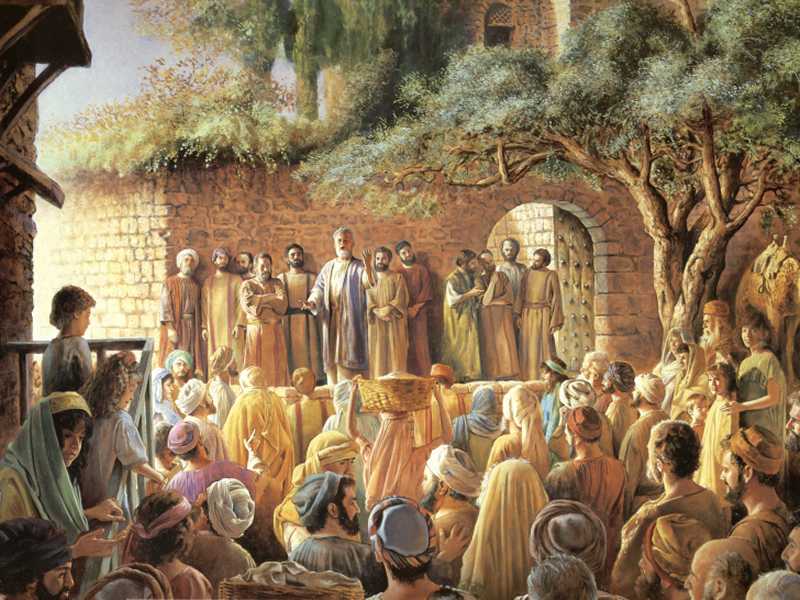
Peter’s first sermon

day-of-pentecost-acts-2-38

I tried to find the original of this image for proper citation, if you know the artist or title of this work please inform me.

I’ve made references to Peter’s first sermon a few times in prior posts, and today I thought it would be awesome to take a look at this first sermon preached by Peter. Our text will be Acts 2. If you’ve been following our bible studies here, you should remember that Acts 2 begins with the promise of God the Holy Spirit being poured out on the day of Pentecost. The Day of Pentecost is not a “new testament” thing, it is in-fact a Jewish celebration of the Feast of Weeks (Leviticus 23:15-22). Pentecost is the Greek word (the fiftieth day) referring to this Hebrew Festival. This festival is particularly important, because it was listed as one of the 3 festivals that all Jewish men were required to appear before the Lord God of Israel (Exodus 34:22-23), which by the time Jesus arrived on the earth, the Lord God had already declared His presence to be made at the Temple in Jerusalem. Therefore, all Jewish men had to make pilgrimage to Jerusalem 3 times a year, one of these times is for the Feast of Weeks, or Pentecost (in Greek). Jews from around the world were in Jerusalem to appear before the Lord God of Israel for Pentecost. It is on this day, that the Promise of God the Holy Spirit as spoken by Jesus Christ, was delivered. The first Gift of God the Holy Spirit manifested is the gift of different tongues/languages so that the men from all over the world would hear the Glory of God proclaimed in their native tongues, not just in Galilean Aramaic. So, Peter’s first sermon was not to Gentiles, it was to Jews. Devout, learned Jews who were observing the Feast of Weeks in keeping with the Law of Moses. These were not strangers to the Law or of the Prophets, they were familiar with the Holy Scriptures. However, in their knowledge, the did not recognize Jesus of Nazareth as the Christ, the Messiah. So, Peter’s first audience was a tough one. Thank God for His Holy Spirit. Now that we’ve set the stage, let us take a look at his sermon:

Acts 2:14-41 (ESV)

14 But Peter, standing with the eleven, lifted up his voice and addressed them: “Men of Judea and all who dwell in Jerusalem, let this be known to you, and give ear to my words. 15 For these people are not drunk, as you suppose, since it is only the third hour of the day. 16 But this is what was uttered through the prophet Joel:

17 “‘And in the last days it shall be, God declares,
that I will pour out my Spirit on all flesh,
and your sons and your daughters shall prophesy,
and your young men shall see visions,
and your old men shall dream dreams;
18 even on my male servants and female servants
in those days I will pour out my Spirit, and they shall prophesy.
19 And I will show wonders in the heavens above
and signs on the earth below,
blood, and fire, and vapor of smoke;
20 the sun shall be turned to darkness
and the moon to blood,
before the day of the Lord comes, the great and magnificent day.
21 And it shall come to pass that everyone who calls upon the name of the Lord shall be saved.’

I just wanted to take a moment to highlight that Peter is quoting from Joel 2:28-32. This prophecy starts in Joel 1:1 and runs throughout the book of Joel. It is all one prophecy. Peter is quoting the portion that rests between the Lord taking pity on His people, and sitting in Judgment over the nations. These are the last days in which we find ourselves, for the Lord had taken pity upon His creation and gave to us the ultimate sacrifice for the remission of sin, the Gospel of Jesus Christ, the Gift of God. We also await the day of His Glorious return, when He will redeem all who have called upon the Name of the Lord and He will sit in Judgment over creation. Why did Peter go to Joel first? Well, clearly the God the Holy Spirit was giving Peter the words to speak in that very hour (as Jesus told the disciples would happen), but notice the entrance into this sermon comes as a response to the accusations against the manifestation of the Gift of the Holy Spirit as mere drunkenness.  The first visit to Scripture is a clear statement of the outpouring of the Holy Spirit as foretold by Joel (who prophesied by the Spirit of God). Peter was also clearly marking the present age, the need for repentance and acceptance of the gift of God and the need to do so before the coming judgement. The book of Joel is not long, and I encourage you to take some time to read through it. However, let us continue for now in Peter’s sermon.

22 “Men of Israel, hear these words: Jesus of Nazareth, a man attested to you by God with mighty works and wonders and signs that God did through him in your midst, as you yourselves know— 23 this Jesus, delivered up according to the definite plan and foreknowledge of God, you crucified and killed by the hands of lawless men. 24 God raised him up, loosing the pangs of death, because it was not possible for him to be held by it. 25 For David says concerning him,

“‘I saw the Lord always before me,
for he is at my right hand that I may not be shaken;
26 therefore my heart was glad, and my tongue rejoiced;
my flesh also will dwell in hope.
27 For you will not abandon my soul to Hades,
or let your Holy One see corruption.
28 You have made known to me the paths of life;
you will make me full of gladness with your presence.’

29 “Brothers, I may say to you with confidence about the patriarch David that he both died and was buried, and his tomb is with us to this day. 30 Being therefore a prophet, and knowing that God had sworn with an oath to him that he would set one of his descendants on his throne, 31 he foresaw and spoke about the resurrection of the Christ, that he was not abandoned to Hades, nor did his flesh see corruption. 32 This Jesus God raised up, and of that we all are witnesses. 33 Being therefore exalted at the right hand of God, and having received from the Father the promise of the Holy Spirit, he has poured out this that you yourselves are seeing and hearing. 34 For David did not ascend into the heavens, but he himself says,

“‘The Lord said to my Lord,
“Sit at my right hand,
35 until I make your enemies your footstool.”’

36 Let all the house of Israel therefore know for certain that God has made him both Lord and Christ, this Jesus whom you crucified.”

37 Now when they heard this they were cut to the heart, and said to Peter and the rest of the apostles, “Brothers, what shall we do?” 38 And Peter said to them, “Repent and be baptized every one of you in the name of Jesus Christ for the forgiveness of your sins, and you will receive the gift of the Holy Spirit. 39 For the promise is for you and for your children and for all who are far off, everyone whom the Lord our God calls to himself.” 40 And with many other words he bore witness and continued to exhort them, saying, “Save yourselves from this crooked generation.” 41 So those who received his word were baptized, and there were added that day about three thousand souls.

Amen. Peter points out that the Jews were guilty of putting Jesus to death, by the hands of lawless men (Romans). Once Peter explained in Scriptures that the Jews were witness to the outpouring of the Holy Spirit, he then moved to identifying Jesus as the Christ. When he quotes from the Psalms of David, he first goes to Psalm 16. I have to be honest, had I read this Psalm without knowing Peter’s interpretation of the Psalm, I wouldn’t have read it as a prophetic Psalm about Jesus. However, Peter makes it clear that since David’s body did see corruption (his body rotted in the grave), it wasn’t about himself that he was speaking; rather, David was referring to the death and resurrection of Jesus Christ. So awesome. The new testament provides us with clear insight into how we should read the old testament to see Jesus (not ourselves, because the bible is not about us).

The next Psalm Peter visits is Psalms 110. Here, however, Peter quotes the introduction to the Psalm. Read the rest of the Psalm, because David is again prophesying of Jesus but he is doing so regarding the Day of Judgement, the Day of Christ’s Return. So, again, we have Peter explaining from scriptures that we find ourselves in the last days, between the salvation of the Lord and His Judgement. Notice, in verse 37, that all who heard these words understood the gravity of what was being taught and their guilt was before them, something they dare not proceed into judgement with, “Brothers, what shall we do?” Peter’s response is great direct and powerful. He also returns to the initial point of the sermon, the outpouring of the Holy Spirit. They don’t have to wait, because they (as are we all) are in the last days when the Spirit of God is poured out.

Peter preaches the Gospel of Jesus Christ from the Scriptures, clearly identifies their sin and need of a Savior (these being folks who follow the Law and the Prophets, not a Godless group of people, but one still perishing nonetheless for they have not yet believed in Jesus as the Christ) and then offers them the Way of escape. He also is quick to relay the promise of God the Holy Spirit. The disciples had just received the very gift that Jesus instructed them to wait for and they knew immediately that this Gift was promised to all who believe and are baptized in the Name of the Lord Jesus Christ.

That same Holy Spirit that gave Peter the words to speak, lives within each of us who call upon the Name of the Lord and have our names written in the Lamb’s book of life. We may not move as powerfully in the Holy Spirit, but I think that is due to a lack of knowledge of the Scriptures, and poor discipleship. Peter walked with the Son of God for years. That’s powerful discipleship. We have a great deal of it, but we don’t have all of what Jesus did (John 21:25), so we don’t have the fullness by which the 12 Apostles were taught. Remember in John 14:26 that the Holy Spirit is promised to both teach and remind them of all that Jesus had said to them. That is critical for us to have the New Testament written, but also as a promise to us that He will remind us of His Word that we have buried in our hearts (Psalms 119:9-16).

Brothers and sisters, please become life-long students of the Word of God. Pray in the Spirit, always, AND edify your mind by drinking in the written Word of God.  If you look around the web, you’ll see that gallop estimates that 40% of Americans attend church daily. However, a Hartford Institute of Religion study indicates that only half of those are telling the truth. But that is only the tip of the iceberg, so to speak. If 20% attend church weekly, how much of each service is actually devoted to studying and exegeting properly the Word of God? If the typical Sunday morning service runs from 10:30am to Noon, with the first 45 minutes of a concert, 10 minutes of announcements, intro videos, skits, collecting of tithe/offerings, that leaves roughly 30 minutes for a sermon. Now, what if the sermon is geared more toward sloganeering of a self-help book, or casting the vision of the pastor rather than teaching the text of the Bible? It can become all to easy to lose sight of the Word of God even while conducting the business of church. I pray your church experience is nothing like what I’ve detailed above. Still, even if that 1.5 hrs of Sunday Morning church were devoted to biblical study, it wouldn’t be enough. That is why I am so eager to share what I am studying throughout the week, and am so excited that you are reading here today. Even if you disagree with everything I write, at least you are reading the Word of God that is copy-and-pasted into these posts and hopefully following the external links to bible references. 😉

In closing, I’d like to echo Paul’s benediction from 2 Thessalonians 3:16 (ESV) “Now may the Lord of peace himself give you peace at all times in every way. The Lord be with you all.”

In Him,
Jorge

When prayer and warfare become idols

prayerI recently sat through a rather painful “bible study” on prayer. The text that was read at the beginning of the study was:

Matthew 16:13-19 (ESV) 13 Now when Jesus came into the district of Caesarea Philippi, he asked his disciples, “Who do people say that the Son of Man is?” 14 And they said, “Some say John the Baptist, others say Elijah, and others Jeremiah or one of the prophets.” 15 He said to them, “But who do you say that I am?” 16 Simon Peter replied, “You are the Christ, the Son of the living God.” 17 And Jesus answered him, “Blessed are you, Simon Bar-Jonah! For flesh and blood has not revealed this to you, but my Father who is in heaven. 18 And I tell you, you are Peter, and on this rock I will build my church, and the gates of hell shall not prevail against it. 19 I will give you the keys of the kingdom of heaven, and whatever you bind on earth shall be bound in heaven, and whatever you loose on earth shall be loosed in heaven.”

To be fair, I had happened upon a study that was in a series of studies, so there is naturally going to be some overlap of previous themes. However, when we got to verse 19 of this passage, we immediately lost sight of the meaning of the passage and of the notion of having a bible study. In a whirlwind of high-motivational pep speech (reminiscent of Joyce Myer or Beth Moore) the meaning of the passage was presented as follows

  • v17 Peter’s identification of Jesus as the Christ came by direct revelation (which was explained as being a result of having learned to pray)
  • v18 Jesus was going to build the church upon the revelation from the Father in heaven, not by flesh and blood (which was interpreted as prayer)
  • v19 the keys of the kingdom of heaven was prayer, and that having prayer as the key would grant authority to bind and loose (personal anecdote employed about how if I give a set of keys to my house to someone else, then I am giving that person authority to enter my house and use whatever is in there).

The point of the passage is the confession of Jesus as the Christ, Son of the living God. If the keys to the kingdom of heaven were “prayer”, the disciples had already been taught how to pray back in Matthew 6; however, Jesus clearly stated that He will give the keys, so there is more to this than prayer. I believe He is referring to the authority in Matthew 28:18 (ESV), “And Jesus came and said to them, “All authority in heaven and on earth has been given to me…” as a result of having laid down His life and raised it back up again. The Gospel of Jesus Christ is the keys to the kingdom of heaven, for by His Grace we are made righteous in the sight of the Lord and are granted entrance into the Kingdom of Heaven by the blood of the Lamb. If there remains any doubt, let us look at what Peter had to say in his Epistles. Surely since Jesus was building His church upon this rock, then Peter should at least echo this interpretation on some level, right? Well, prayer only gets mentioned 3 times in 1&2 Peter:

  1. 1 Peter 3:7 (ESV) 7 Likewise, husbands, live with your wives in an understanding way, showing honor to the woman as the weaker vessel, since they are heirs with you of the grace of life, so that your prayers may not be hindered.
  2. 1 Peter 3:8-12 (ESV) 8 Finally, all of you, have unity of mind, sympathy, brotherly love, a tender heart, and a humble mind. 9 Do not repay evil for evil or reviling for reviling, but on the contrary, bless, for to this you were called, that you may obtain a blessing. 10 For “Whoever desires to love life and see good days, let him keep his tongue from evil and his lips from speaking deceit; 11 let him turn away from evil and do good; let him seek peace and pursue it. 12 For the eyes of the Lord are on the righteous, and his ears are open to their prayer. But the face of the Lord is against those who do evil.” (Peter quoting Psalms 34)
  3. 1 Peter 4:6-8 (ESV) 6 For this is why the gospel was preached even to those who are dead, that though judged in the flesh the way people are, they might live in the spirit the way God does. 7 The end of all things is at hand; therefore be self-controlled and sober-minded for the sake of your prayers. 8 Above all, keep loving one another earnestly, since love covers a multitude of sins.

The over-arching theme of 1 & 2 Peter? I think it best to read the introduction to 1 Peter:

1 Peter 1:1-12 (ESV) 1 Peter, an apostle of Jesus Christ,
To those who are elect exiles of the Dispersion in Pontus, Galatia, Cappadocia, Asia, and Bithynia, 2 according to the foreknowledge of God the Father, in the sanctification of the Spirit, for obedience to Jesus Christ and for sprinkling with his blood: May grace and peace be multiplied to you.
3 Blessed be the God and Father of our Lord Jesus Christ! According to his great mercy, he has caused us to be born again to a living hope through the resurrection of Jesus Christ from the dead, 4 to an inheritance that is imperishable, undefiled, and unfading, kept in heaven for you, 5 who by God’s power are being guarded through faith for a salvation ready to be revealed in the last time. 6 In this you rejoice, though now for a little while, if necessary, you have been grieved by various trials, 7 so that the tested genuineness of your faith—more precious than gold that perishes though it is tested by fire—may be found to result in praise and glory and honor at the revelation of Jesus Christ. 8 Though you have not seen him, you love him. Though you do not now see him, you believe in him and rejoice with joy that is inexpressible and filled with glory, 9 obtaining the outcome of your faith, the salvation of your souls. 10 Concerning this salvation, the prophets who prophesied about the grace that was to be yours searched and inquired carefully, 11 inquiring what person or time the Spirit of Christ in them was indicating when he predicted the sufferings of Christ and the subsequent glories. 12 It was revealed to them that they were serving not themselves but you, in the things that have now been announced to you through those who preached the good news to you by the Holy Spirit sent from heaven, things into which angels long to look.

Peter understood the point of it all to be the Grace and Mercy of God the Father in sending His Son Jesus so that we might be saved. While Jesus did call Simon  “Peter” (which means rock) and said that “upon this rock I will build My church”, Peter clearly identifies Jesus Christ as the cornerstone in 1 Peter 2. Since Peter’s confession of Jesus Christ is the foundation of the church, it stands to reason that every stone laid on that foundation would in-turn be measured, trued, and lined up with Christ as the Cornerstone. I don’t think it was Peter (the man) who is the foundation of the church; rather, his confession of Jesus as the Christ, Son of the Living God is the foundation of the Church. Though, the argument could be made that both interpretations are valid given Peter was the first to preach on the Day of Pentecost, and was the first to be shown that God is calling Gentiles also into the fold.

The person conducting the study launched into what was clearly a personal soapbox issue. Once the confession of “being called to intercessory prayer” was made, I realized that there was a great deal of iesegisis at work, so I just let it go and smiled through it waiting for it to end. Do I have a problem with intercessory prayer? Absolutely not! There is a great need for intercessory prayer in the church. There are, however some problematic themes that come up whenever the topic of prayer becomes taught as a profession or ministry unto itself rather than a communion with a loving Heavenly Father, or an in-dwelling God the Holy Spirit.

The only text in the bible where we are specifically taught how to pray is when Jesus (God the Son) taught the disciples how to pray (Matt 6, Luke 11). We are told to pray without ceasing. We should live our lives in constant prayer, and we should also make daily time to pray. But the act of praying isn’t the point, it is to whom we pray and by whom we pray. Even in the realm of intercession, it is the Holy Spirit that intercedes for the saints, not the saints themselves (Romans 8:18-27), so we must not allow our fleshly need for credit to shade our speech/instruction in the discipline of prayer. Whether we are encouraging our brothers to seek the Will of God in their daily walk or for them to engage in intercessory prayer, we must always anchor the charge to pray onto the Holy Spirit of God dwelling within each of us who are called Children of God.  As we pointed out in our discussion of the Gifts of God the Holy Spirit, we must always keep our focus on the fact that it is God who does the work, not men. The individual giving the bible study had to stop several times to issue the caveat “not me, of course, but God working through me”. I’m very happy to have heard that confession in the form of a caveat so many times during the study; however, if a caveat needs to be issued that often then there is a language/emphasis problem with the discussion that should be addressed. Here, it was an over-selling of the “power of prayer”.

Prayer is not unique to Christianity… Our God is. Our understanding of God the Father, God the Son, and God the Holy Spirit is unique to our Biblical Christian faith. Stop looking at routines/ceremonies/principles for power, and look to the person of God the Holy Spirit and His work in our hearts. I want to take a few moments to include any discussion of “spiritual warfare” that focuses entirely too much on the redeemed rather than the Redeemer. Spiritual warfare takes place primarily in your mind and in your flesh. The Spirit of God dwelling within you has made your spirit alive and it wars against your flesh, and your flesh works against the Spirit (Galatians 5:16-26). When it comes to declaring the Word of God, our focus should be fixed on Preaching the Gospel of Jesus Christ. For Only by the Grace of God can anyone be made alive in Christ, set free from the bondage of sin and death, and made the recipient of the Holy Spirit. God the Holy Spirit does all of this work. We pray so that we can grow in the fullness of the Knowledge of Christ, and for boldness and for the Holy Spirit to give teach us how to speak and what to say in the hour of need.  We must guard ourselves against pride and folly. Our authority will forever be a derivative of Christ’s authority; therefore, we must never allow ourselves to lose sight or focus on the work of the Holy Spirit. Stop looking for some “extra outpouring” of the Spirit… God the Holy Spirit has already been promised to those who believe and are baptized in His Name. If you are in Him, then He is in you. There is no extra anything! Walk by faith, pray without ceasing, and remain vigilant in your focus upon the Gospel of Grace, of which you are a Steward. The role of the Church is to preach the Gospel, not to specialize in private prayer and launching special attacks on demons, principalities and powers. Christ defeated them, and it is only by His Blood that we have been made free from them. We expand the Kingdom of God by preaching the Gospel, not by “waging war in the heavenly”.  The Apostles were over-comers not because they were never jailed, hungry, thirsty, persecuted, killed… but because the Gospel of Jesus Christ was preached, and those who were dead in sins and trespasses were brought to salvation by Grace through Faith in Christ.

The Book of Jude stands as a strong warning against this sort of stepping beyond one’s authority. A single chapter full of wisdom and warning. Stepping back from that extreme, though, let us remember how Jesus introduced his lesson on prayer in Matthew 6:

Matthew 6:5-8 (ESV) 5 “And when you pray, you must not be like the hypocrites. For they love to stand and pray in the synagogues and at the street corners, that they may be seen by others. Truly, I say to you, they have received their reward. 6 But when you pray, go into your room and shut the door and pray to your Father who is in secret. And your Father who sees in secret will reward you. 7 “And when you pray, do not heap up empty phrases as the Gentiles do, for they think that they will be heard for their many words. 8 Do not be like them, for your Father knows what you need before you ask him.

Adorning your prayers with militancy is more likely to erode humility than it is to rightly charge your faith, or the faith of those around you. We pray to our Heavenly Father, not to the enemy. We declare the Gospel of Jesus Christ to those lost in the world, so that they might repent and be saved. As with prophecy, we do not presume to “declare the Word of the Lord” on our own, and we dare not blaspheme against things we do not understand. We yield in humble submission to God the Holy Spirit in all things.

Prayer is as essential as breathing. In the same way that breathing can become its own distraction (yoga, tantra, lamaze, etc.), so can an over-emphasis on the art of prayer, rather than the God to whom and by whom we pray. Is the focus of your intercessory prayer self-feeding? Do you spend more time reading about prayer than you do the Bible? Has your quest for spiritual warfare changed your study of the Bible into a search for special phrases to “declare” for defense and for offense (the Harry Potter approach to bible study)? Has your prayer specialization made you unavailable for sharing the Gospel, fellowship with the saints, and meeting the physical needs of the brethren? If so, then prayer and warfare might have become an idol. Just as the Praise and Worship Leader can allow music or his own ability to become an idol, or the pastor who preaches himself rather than Christ, or the affluent giver his affluence, etc. Idolatry is very subtle, and requires constant vigilance to avoid.

Jude 1:24-25 (ESV) Now to him who is able to keep you from stumbling and to present you blameless before the presence of his glory with great joy, to the only God, our Savior, through Jesus Christ our Lord, be glory, majesty, dominion, and authority, before all time and now and forever. Amen.

May the Lord bless and keep you,
In Him,
Jorge


CTT | As long as Christ is preached…

CTTI recently read a blog article that misapplied the following verse in Philippians.

Philippians 1:18 (ESV)  What then? Only that in every way, whether in pretense or in truth, Christ is proclaimed, and in that I rejoice.

I say it was misapplied, because it was inflated to cover all doctrine and practices of a mega-church pastor who has come under fire recently from secular and Christian media over money, messaging, branding, and doctrine. The odd thing here is, that the use of the Scripture did not, in any way,  defend the individual; rather, it got warped into an attack on any who would dare speak out against what may have been viewed to be out-of-step with Scripture. It is even issued as a blanket accusation of pride to any that would dare speak against this particular ministry, and issued a call for repentance. But was Paul attacking Timothy, accusing him of pride, calling Timothy to repentance? Let’s look at the verse in its immediate context:

Philippians 1:1-20 (ESV)
Paul and Timothy, servants of Christ Jesus,
To all the saints in Christ Jesus who are at Philippi, with the overseers and deacons:
Grace to you and peace from God our Father and the Lord Jesus Christ. I thank my God in all my remembrance of you, always in every prayer of mine for you all making my prayer with joy, because of your partnership in the gospel from the first day until now. And I am sure of this, that he who began a good work in you will bring it to completion at the day of Jesus Christ. It is right for me to feel this way about you all, because I hold you in my heart, for you are all partakers with me of grace, both in my imprisonment and in the defense and confirmation of the gospel. For God is my witness, how I yearn for you all with the affection of Christ Jesus. And it is my prayer that your love may abound more and more, with knowledge and all discernment, 10 so that you may approve what is excellent, and so be pure and blameless for the day of Christ, filled with the fruit of righteousness that comes through Jesus Christ, to the glory and praise of God. I want you to know, brothers, that what has happened to me has really served to advance the gospel, so that it has become known throughout the whole imperial guard and to all the rest that my imprisonment is for Christ. And most of the brothers, having become confident in the Lord by my imprisonment, are much more bold to speak the word without fear. Some indeed preach Christ from envy and rivalry, but others from good will. The latter do it out of love, knowing that I am put here for the defense of the gospel. The former proclaim Christ out of selfish ambition, not sincerely but thinking to afflict me in my imprisonment. What then? Only that in every way, whether in pretense or in truth, Christ is proclaimed, and in that I rejoice. Yes, and I will rejoice, for I know that through your prayers and the help of the Spirit of Jesus Christ this will turn out for my deliverance, as it is my eager expectation and hope that I will not be at all ashamed, but that with full courage now as always Christ will be honored in my body, whether by life or by death.

If Christ is proclaimed, then I can rejoice in that. If the motives of the proclaimers are wrong, but the proclamation or teaching of Christ is correct, then we can rejoice in the latter, but that does not remedy the former. The former is still a problem, for that person, and should not be emulated with reckless abandon. In this case, though, Paul identifies the wrong motive as an attempt to afflict Paul in his imprisonment. Interesting. Paul is forgiving the personal attack for the sake of the Gospel. Paul never forgives false teaching. In fact, look at how he instructs Timothy at the end of his first letter:

1 Timothy 6:3-10(ESV) If anyone teaches a different doctrine and does not agree with the sound words of our Lord Jesus Christ and the teaching that accords with godliness, he is puffed up with conceit and understands nothing. He has an unhealthy craving for controversy and for quarrels about words, which produce envy, dissension, slander, evil suspicions, and constant friction among people who are depraved in mind and deprived of the truth, imagining that godliness is a means of gain. But godliness with contentment is great gain, for we brought nothing into the world, and we cannot take anything out of the world. But if we have food and clothing, with these we will be content. But those who desire to be rich fall into temptation, into a snare, into many senseless and harmful desires that plunge people into ruin and destruction. For the love of money is a root of all kinds of evils. It is through this craving that some have wandered away from the faith and pierced themselves with many pangs.

The doctrine we preach/teach/share matters. If what we preach/teach/share isn’t plainly stated in the Gospel of Jesus, or in the teachings/writings of the Apostles in the New Testament, we need to be careful. There is a big difference between “words” and “Word”. Arguing over “-isms” without relying on the Word of God to explain the Word of God is tantamount to arguing over “words”. When we open our Bibles, the prevailing thought should be, “What does God’s Word say?” Too often, we skip that question and jump right into interpreting the meaning of bits and pieces of scripture without ever really understanding what it plainly says in context.

There is One Holy Spirit. If anyone thinks he has received a direct revelation that cannot be substantiated in the Word (by which the Holy Spirit teaches all Christians)… I recommend he test the spirit (1 John 4) behind that “revelation”.  Am I against mega-churches? Not if they preach sound doctrine. If they don’t preach sound doctrine, my heart breaks because their false teaching is affecting a much larger audience wholesale. We judge a tree by its fruit,  but “congregation size” isn’t included in the Fruit of the Spirit. If the one speaking out against a mega-church is doing so out of envy, then the accuser is wrong. However, accusing everyone who speaks out against a mega-church of doing so out of envy, is equally wrong.

1 Timothy 4:11-16 (ESV) Command and teach these things. Let no one despise you for your youth, but set the believers an example in speech, in conduct, in love, in faith, in purity. Until I come, devote yourself to the public reading of Scripture, to exhortation, to teaching. Do not neglect the gift you have, which was given you by prophecy when the council of elders laid their hands on you. Practice these things, immerse yourself in them, so that all may see your progress. Keep a close watch on yourself and on the teaching. Persist in this, for by so doing you will save both yourself and your hearers.

May the Lord bless and keep you,
In Him,
Jorge

Discipleship: Calling, Apprenticeship, & Ministry IV

Apprentice

Repro. of painting by Emile Adan, copyrighted by Braun & Co., N.Y.

Okay, so where has this week gone? I didn’t want the week to go without taking a look at a key figure in the Bible, his calling, apprenticeship, and ministry.  Today I want to return to the Old Testament, because I’d like to start looking at David. However, in order to get there, I felt it necessary to start with Samuel the Prophet of God.

Samuel

We’ve seen how God called, trained and sent out Gideon in the time of the Judges of Israel. In moving toward the time of the kings of Israel I’m excited about getting to the Throne of David, on whose throne Jesus is promised to reign forever (Gospel!). But I don’t want to skip straight there, because a key figure throughout this time period is Samuel. Now Samuel was called by God before birth, and his calling from God comes as an answer to prayer. So today’s story will be the first we look at that might be misconstrued a bit by some as prescription for obtaining the call of God on your life. Let us start by reading the setup directly from the Bible.

1 Samuel 1 (ESV)
1 There was a certain man of Ramathaim-zophim of the hill country of Ephraim whose name was Elkanah the son of Jeroham, son of Elihu, son of Tohu, son of Zuph, an Ephrathite. 2 He had two wives. The name of the one was Hannah, and the name of the other, Peninnah. And Peninnah had children, but Hannah had no children.

3 Now this man used to go up year by year from his city to worship and to sacrifice to the Lord of hosts at Shiloh, where the two sons of Eli, Hophni and Phinehas, were priests of the Lord. 4 On the day when Elkanah sacrificed, he would give portions to Peninnah his wife and to all her sons and daughters. 5 But to Hannah he gave a double portion, because he loved her, though the Lord had closed her womb. 6 And her rival used to provoke her grievously to irritate her, because the Lord had closed her womb. 7 So it went on year by year. As often as she went up to the house of the Lord, she used to provoke her. Therefore Hannah wept and would not eat. 8 And Elkanah, her husband, said to her, “Hannah, why do you weep? And why do you not eat? And why is your heart sad? Am I not more to you than ten sons?”

9 After they had eaten and drunk in Shiloh, Hannah rose. Now Eli the priest was sitting on the seat beside the doorpost of the temple of the Lord. 10 She was deeply distressed and prayed to the Lord and wept bitterly. 11 And she vowed a vow and said, “O Lord of hosts, if you will indeed look on the affliction of your servant and remember me and not forget your servant, but will give to your servant a son, then I will give him to the Lord all the days of his life, and no razor shall touch his head.

12 As she continued praying before the Lord, Eli observed her mouth. 13 Hannah was speaking in her heart; only her lips moved, and her voice was not heard. Therefore Eli took her to be a drunken woman. 14 And Eli said to her, “How long will you go on being drunk? Put your wine away from you.” 15 But Hannah answered, “No, my lord, I am a woman troubled in spirit. I have drunk neither wine nor strong drink, but I have been pouring out my soul before the Lord. 16 Do not regard your servant as a worthless woman, for all along I have been speaking out of my great anxiety and vexation.” 17 Then Eli answered, “Go in peace, and the God of Israel grant your petition that you have made to him.” 18 And she said, “Let your servant find favor in your eyes.” Then the woman went her way and ate, and her face was no longer sad.

19 They rose early in the morning and worshiped before the Lord; then they went back to their house at Ramah. And Elkanah knew Hannah his wife, and the Lord remembered her. 20 And in due time Hannah conceived and bore a son, and she called his name Samuel, for she said, “I have asked for him from the Lord.

Praise the Lord, for He is worthy to be praised. We serve a God who hears the prayers of our hearts, sees our distress, and answers our prayers. Now, I would like to caution you, to be very cautious in your vows. Making a vow to God is no small thing, and should not be engaged flippantly. While I do intend to present this story as an example of the Greatness, Love, Mercy, and Kindness of the Living God we serve, I’m not saying we should copy all of her steps; rather, that we pay attention to God’s response. She takes a dangerous road here in vowing a vow to God, but she remains faithful to her vow, so it works out here. Why the cautionary statement? Lets look at the strong warning in Ecclesiastes:

Ecclesiastes 5:1-7 (ESV) 1 Guard your steps when you go to the house of God. To draw near to listen is better than to offer the sacrifice of fools, for they do not know that they are doing evil. 2 Be not rash with your mouth, nor let your heart be hasty to utter a word before God, for God is in heaven and you are on earth. Therefore let your words be few. 3 For a dream comes with much business, and a fool’s voice with many words. 4 When you vow a vow to God, do not delay paying it, for he has no pleasure in fools. Pay what you vow. 5 It is better that you should not vow than that you should vow and not pay. 6 Let not your mouth lead you into sin, and do not say before the messenger that it was a mistake. Why should God be angry at your voice and destroy the work of your hands? 7 For when dreams increase and words grow many, there is vanity; but God is the one you must fear.

Aside from the vow, let’s look at what the Scriptures tell us about Hannah. She has endured a great amount of ridicule from the Peninnah, the other wife of Elkanah, their husband. Because she had no children, and was barren (the Lord closed up her womb). Her husband, is aware of her sadness and predicament, and it manifests itself in their worship (observing of the sacrifices/offerings). He tries to encourage her by saying, “Am I not more to you than ten sons?” Well, Elkanah cannot do anything more for her, and cannot provide children. So she takes her supplication to the Lord God. She prayed and wept bitterly. As she termed it, she poured out her soul to the Lord, that He would grant her a son. In asking the Lord for a son, she commits the gift of God (a son) back to God for the rest of his life. The comments she makes to Eli about not having had any wine or strong drink, and to the Lord God about no razor touching his head leads me to think she was committing him to a life-long Nazarite Vow similar to that of the calling of Samson (Judges 13). I don’t think Hannah is expecting to give birth to the next judge over Israel, she is dedicating a gift of thanksgiving to God in keeping with what is already in Scripture. She is asking that God would show mercy on her, and bless her with a son, and in return (thanksgiving) she will give back to the Lord what He has given her. What starts this blessing? What reaches the Lord’s heart? Her faith. She walks away from the Temple that day, assured that the Lord had heard her prayer, and that He will provide, “Then the woman went her way and ate, and her face was no longer sad“.

Hebrews 11:1-2 (ESV) 1 Now faith is the assurance of things hoped for, the conviction of things not seen. 2 For by it the people of old received their commendation.

If we are to emulate the people of old who received their commendation… we need to look to their faith, and the object of their faith, the Lord God of Israel. God gives her a son, and she is quick to complete her vow (please… don’t start making vows, especially vows you are not able to keep. Do not give the devil an opportunity to enslave you by the words of your own mouths). Make your requests known to God, and pray as Jesus taught us to pray (Matt 6; Luke 11)… and put your faith in Him. Will all of your prayers come true? No. God’s Sovereignty remains fully intact. We do not dictate to God anything. We make our requests known to Him through prayer, and we have the right by grace through faith in Jesus Christ. But God’s Will supersedes ours. Not every woman who prayed for a son received one. The Old Testament has a purpose, and that purpose is in the Promise of the Messiah. Let us continue with Samuel.

1 Samuel 1:21-28 (ESV) 21 The man Elkanah and all his house went up to offer to the Lord the yearly sacrifice and to pay his vow. 22 But Hannah did not go up, for she said to her husband, “As soon as the child is weaned, I will bring him, so that he may appear in the presence of the Lord and dwell there forever.” 23 Elkanah her husband said to her, “Do what seems best to you; wait until you have weaned him; only, may the Lord establish his word.” So the woman remained and nursed her son until she weaned him. 24 And when she had weaned him, she took him up with her, along with a three-year-old bull, an ephah of flour, and a skin of wine, and she brought him to the house of the Lord at Shiloh. And the child was young. 25 Then they slaughtered the bull, and they brought the child to Eli. 26 And she said, “Oh, my lord! As you live, my lord, I am the woman who was standing here in your presence, praying to the Lord. 27 For this child I prayed, and the Lord has granted me my petition that I made to him. 28 Therefore I have lent him to the Lord. As long as he lives, he is lent to the Lord.” And he worshiped the Lord there.

Good, she was faithful to her vow to God, and now Eli (who has 2 sons already serving as priests) has an apprentice. She has been dedicated to the House of the Lord, but is this his calling? Before we get to that, let us look at Hannah’s prayer of Thanksgiving and Prayer… because it’s awesome…

1 Samuel 2 (ESV) | Hannah’s Prayer

1 And Hannah prayed and said,
“My heart exults in the Lord;
my horn is exalted in the Lord.
My mouth derides my enemies,
because I rejoice in your salvation.
2 “There is none holy like the Lord:
for there is none besides you;
there is no rock like our God.
3 Talk no more so very proudly,
let not arrogance come from your mouth;
for the Lord is a God of knowledge,
and by him actions are weighed.
4 The bows of the mighty are broken,
but the feeble bind on strength.
5 Those who were full have hired themselves out for bread,
but those who were hungry have ceased to hunger.
The barren has borne seven,
but she who has many children is forlorn.
6 The Lord kills and brings to life;
he brings down to Sheol and raises up.
7 The Lord makes poor and makes rich;
he brings low and he exalts.
8 He raises up the poor from the dust;
he lifts the needy from the ash heap
to make them sit with princes
and inherit a seat of honor.
For the pillars of the earth are the Lord’s,
and on them he has set the world.
9 “He will guard the feet of his faithful ones,
but the wicked shall be cut off in darkness,
for not by might shall a man prevail.
10 The adversaries of the Lord shall be broken to pieces;
against them he will thunder in heaven.
The Lord will judge the ends of the earth;
he will give strength to his king
and exalt the horn of his anointed.”

11 Then Elkanah went home to Ramah. And the boy was ministering to the Lord in the presence of Eli the priest.

Here we have an apprenticeship beginning with only a partial calling. Hannah’s vow to the Lord committed Samuel to the service of the Lord as a Nazarite. God would soon Call on Samuel. Notice here that Eli isn’t exactly the most qualified (by human standards) to be Samuel’s mentor as evidenced by the next verse, “12 Now the sons of Eli were worthless men. They did not know the Lord.” Not good. Nevertheless, we see in v26, Now the boy Samuel continued to grow both in stature and in favor with the Lord and also with man.

Now, 1 Samuel 3 starts off with an interesting statement, “1 Now the boy Samuel was ministering to the Lord in the presence of Eli. And the word of the Lord was rare in those days; there was no frequent vision.” The Lord was about to change all of that, and He was about to make His Will known to Israel. Now, let’s look at what the Word of the Lord is to Samuel, when He finally Calls Samuel

1 Samuel 3:10-18 (ESV) 10 And the Lord came and stood, calling as at other times, “Samuel! Samuel!” And Samuel said, “Speak, for your servant hears.” 11 Then the Lord said to Samuel, “Behold, I am about to do a thing in Israel at which the two ears of everyone who hears it will tingle. 12 On that day I will fulfill against Eli all that I have spoken concerning his house, from beginning to end. 13 And I declare to him that I am about to punish his house forever, for the iniquity that he knew, because his sons were blaspheming God, and he did not restrain them. 14 Therefore I swear to the house of Eli that the iniquity of Eli’s house shall not be atoned for by sacrifice or offering forever.” 15 Samuel lay until morning; then he opened the doors of the house of the Lord. And Samuel was afraid to tell the vision to Eli. 16 But Eli called Samuel and said, “Samuel, my son.” And he said, “Here I am.” 17 And Eli said, “What was it that he told you? Do not hide it from me. May God do so to you and more also if you hide anything from me of all that he told you.” 18 So Samuel told him everything and hid nothing from him. And he said, “It is the Lord. Let him do what seems good to him.”

Woah… that’s rough. So here, we have the Word of the Lord coming to Samuel, at the end of his apprenticeship and his first task is to speak God’s judgement on the house of Eli. In obeying the Word of the Lord, the calling on Samuel’s life propels him into ministry as the Prophet of the Lord.

1 Samuel 3:19-20 (ESV) 19 And Samuel grew, and the Lord was with him and let none of his words fall to the ground. 20 And all Israel from Dan to Beersheba knew that Samuel was established as a prophet of the Lord.

Amen. We haven’t seen the last of Samuel. As I said at the beginning, we will see God use Samuel in mighty ways. But as we move through the first kings of Israel, I hope you remember that Samuel was a gift given to a woman, who placed her faith in God, and out of her blessing (from God) she returned to Him what she had promised. And she praised God and gave thanks to God. There is nothing here for Hannah, nor for Samuel to boast in, except the Grace and Mercy of a God who hears our prayers and commends faith (Hebrews 11) in His Word and in His Promise.

I pray you have a wonderful weekend, and may the Lord bless and keep you always,
In Him,
Jorge