
Eschatology: No Secret Rapture

sunriseIt has taken me quite a while to return to this subject. Toward the end of our previous discussion of Eschatology, I confessed that I saw no basis for any pre-Tribulation or even mid-Tribulation rapture of the Saints. I grew up in the “Left Behind” generation. I spent several years of my childhood fearful that Christ might have secretly raptured all of my friends and family, leaving me behind because of some unrepentant sin, or that I accidentally might have committed the unpardonable sin. Rough times for me, but eventually I learned to just ignore those fears. But why did I have those fears in the first place? Because I was taught that there would be some pre-tribulation rapture and that teaching was reinforced by the “Left Behind” movie. But is this concept taught in Scripture? Sure people pull together a lot of proof texts, but is the concept plainly taught in Scripture? In our last blog, we took a look at what Jesus had to say when His disciples asked Him about the end times. In that discourse, He made no mention of any rapture; rather, He made it clear that , “he who endures to the end would be saved”. He also says plainly that His return would happen “immediately after the tribulation” (Matt 24:31).  No one leaves early except those who die in Christ.

I believe there are a couple of definition problems at play in various eschatologies with regard to proof-texting efforts. The first is “tribulation”. To make the case for pre/mid-tribulation rapture, often times the definition of “tribulation” becomes carelessly intertwined with the definition of “judgement” or the “Wrath of God”. The Judgement of Jesus Christ comes after the tribulation. We who are in Christ will not be recipients of His judgement, for Christ has already paid the price for our sin. Those who remain will be those who have rejected the Gospel of Jesus Christ and persecuted the church. Another problem is the definition of “rapture”. It is not a Biblical term, it is one we have invented after the canon was closed, but most point to 1 Thessalonians 4:13-18 for its definition. Let’s look at that chapter of the Bible.

1 Thessalonians 4:13-18 (ESV) 13 But we do not want you to be uninformed, brothers, about those who are asleep, that you may not grieve as others do who have no hope. 14 For since we believe that Jesus died and rose again, even so, through Jesus, God will bring with him those who have fallen asleep. 15 For this we declare to you by a word from the Lord, that we who are alive, who are left until the coming of the Lord, will not precede those who have fallen asleep. 16 For the Lord himself will descend from heaven with a cry of command, with the voice of an archangel, and with the sound of the trumpet of God. And the dead in Christ will rise first. 17 Then we who are alive, who are left, will be caught up together with them in the clouds to meet the Lord in the air, and so we will always be with the Lord. 18 Therefore encourage one another with these words.

Praise the Lord. So this event, the resurrection of the dead in Christ and then those of us who remain until the coming of the Lord will be caught up together with our Lord in the air. This will happen once. Paul doesn’t leave room for this happening in stages. His encouragement to the Thessalonians continues in the next chapter (remember, Paul didn’t write in chapters and verses… he just wrote a letter)

1 Thessalonians 5:1-11 (ESV) 1 Now concerning the times and the seasons, brothers, you have no need to have anything written to you. 2 For you yourselves are fully aware that the day of the Lord will come like a thief in the night. 3 While people are saying, “There is peace and security,” then sudden destruction will come upon them as labor pains come upon a pregnant woman, and they will not escape. 4 But you are not in darkness, brothers, for that day to surprise you like a thief. 5 For you are all children of light, children of the day. We are not of the night or of the darkness. 6 So then let us not sleep, as others do, but let us keep awake and be sober. 7 For those who sleep, sleep at night, and those who get drunk, are drunk at night. 8 But since we belong to the day, let us be sober, having put on the breastplate of faith and love, and for a helmet the hope of salvation. 9 For God has not destined us for wrath, but to obtain salvation through our Lord Jesus Christ, 10 who died for us so that whether we are awake or asleep we might live with him. 11 Therefore encourage one another and build one another up, just as you are doing.

It is tempting to stop reading at verse 3 with an Aha, so it will be a secret event! However, in verse 4, Paul makes it clear that we (brothers and sisters in Christ) should not be surprised by the day (though, clearly, we don’t know what day or hour when it will come). Jesus explained the day of the Son of Man in much the same way in Luke.

Luke 17:22-37 (ESV) 22 And he said to the disciples, “The days are coming when you will desire to see one of the days of the Son of Man, and you will not see it. 23 And they will say to you, ‘Look, there!’ or ‘Look, here!’ Do not go out or follow them. 24 For as the lightning flashes and lights up the sky from one side to the other, so will the Son of Man be in his day. 25 But first he must suffer many things and be rejected by this generation. 26 Just as it was in the days of Noah, so will it be in the days of the Son of Man. 27 They were eating and drinking and marrying and being given in marriage, until the day when Noah entered the ark, and the flood came and destroyed them all. 28 Likewise, just as it was in the days of Lot—they were eating and drinking, buying and selling, planting and building, 29 but on the day when Lot went out from Sodom, fire and sulfur rained from heaven and destroyed them all— 30 so will it be on the day when the Son of Man is revealed. 31 On that day, let the one who is on the housetop, with his goods in the house, not come down to take them away, and likewise let the one who is in the field not turn back. 32 Remember Lot’s wife. 33 Whoever seeks to preserve his life will lose it, but whoever loses his life will keep it. 34 I tell you, in that night there will be two in one bed. One will be taken and the other left. 35 There will be two women grinding together. One will be taken and the other left.” 37 And they said to him, “Where, Lord?” He said to them, “Where the corpse is, there the vultures will gather.”

Again, the flood was not a surprise to Noah, who likely spent 60-70 years building the ark. Similarly, the Angels of the Lord made it clear to Abram and Lot that God was going to bring judgment upon Sodom and Gomorrah and that they must leave. It was only to the wicked, the lost, those living in darkness that the judgment of God came as a surprise. Another thing I’d like to point out here is that in verse 24, Jesus makes it clear that though the world will be caught completely unaware, it will not be a secret event. He warns his disciples not to be deceived, that His coming will be as unmistakable as lightning flashes and lights up the sky. It will be obvious to everyone, on the day when the Son of Man is revealed.

Let’s take a look at how Paul instructed and encouraged the Corinthians regarding the return of Christ.

1 Corinthians 15:42-58 (ESV) 42 So is it with the resurrection of the dead. What is sown is perishable; what is raised is imperishable. 43 It is sown in dishonor; it is raised in glory. It is sown in weakness; it is raised in power. 44 It is sown a natural body; it is raised a spiritual body. If there is a natural body, there is also a spiritual body. 45 Thus it is written, “The first man Adam became a living being”; the last Adam became a life-giving spirit. 46 But it is not the spiritual that is first but the natural, and then the spiritual. 47 The first man was from the earth, a man of dust; the second man is from heaven. 48 As was the man of dust, so also are those who are of the dust, and as is the man of heaven, so also are those who are of heaven. 49 Just as we have borne the image of the man of dust, we shall also bear the image of the man of heaven. 50 I tell you this, brothers: flesh and blood cannot inherit the kingdom of God, nor does the perishable inherit the imperishable. 51 Behold! I tell you a mystery. We shall not all sleep, but we shall all be changed, 52 in a moment, in the twinkling of an eye, at the last trumpet. For the trumpet will sound, and the dead will be raised imperishable, and we shall be changed. 53 For this perishable body must put on the imperishable, and this mortal body must put on immortality. 54 When the perishable puts on the imperishable, and the mortal puts on immortality, then shall come to pass the saying that is written:

“Death is swallowed up in victory.”
55 “O death, where is your victory?
O death, where is your sting?”

56 The sting of death is sin, and the power of sin is the law. 57 But thanks be to God, who gives us the victory through our Lord Jesus Christ. 58 Therefore, my beloved brothers, be steadfast, immovable, always abounding in the work of the Lord, knowing that in the Lord your labor is not in vain.

So here, Paul is instructing the Church of Corinth on the Resurrection. I recommend reading the whole chapter to see how he’s building up the concept of resurrection, culminating in an explanation of what we can expect when Jesus returns. Those who have not “fallen asleep” (euphemism for death used often in Scripture) will still have to be changed on the Day of Christ’s return. That change will happen in a “twinkling of an eye, at the last trumpet”.  When the trumpet of God sounds… all will hear it.

Whenever Paul points toward our goal, our end-state, he points to the Return of Jesus Christ and to the Resurrection. In the Book of Revelation, there are 2 resurrections mentioned.

Revelation 20:1-6 (ESV) | The Thousand Years
1 Then I saw an angel coming down from heaven, holding in his hand the key to the bottomless pit[a] and a great chain. 2 And he seized the dragon, that ancient serpent, who is the devil and Satan, and bound him for a thousand years, 3 and threw him into the pit, and shut it and sealed it over him, so that he might not deceive the nations any longer, until the thousand years were ended. After that he must be released for a little while.

4 Then I saw thrones, and seated on them were those to whom the authority to judge was committed. Also I saw the souls of those who had been beheaded for the testimony of Jesus and for the word of God, and those who had not worshiped the beast or its image and had not received its mark on their foreheads or their hands. They came to life and reigned with Christ for a thousand years. 5 The rest of the dead did not come to life until the thousand years were ended. This is the first resurrection. 6 Blessed and holy is the one who shares in the first resurrection! Over such the second death has no power, but they will be priests of God and of Christ, and they will reign with him for a thousand years.

The second resurrection will be for judgement before the White Throne (v11-15). I don’t know how to explain the details provided in v7-11, but notice that there are still saints mentioned, and a deception. Satan will at-last be permanently destroyed and then the final judgement will take place. I encourage each of you to read through the Book of Revelation. Just read it through. There is no “pre tribulation rapture” event described. It is a prophetic book, and as such there is a great deal that simply cannot be understood in advance. We should not add to it, nor take away from it no matter how noble we consider our motives to be.

Revelation 22:18-19 (ESV) 18 I warn everyone who hears the words of the prophecy of this book: if anyone adds to them, God will add to him the plagues described in this book, 19 and if anyone takes away from the words of the book of this prophecy, God will take away his share in the tree of life and in the holy city, which are described in this book.

I am not going to try to explain all of Revelation at this time, but I would like to point out some key phrases that point me away from any notion that simply being a Christian means that I should expect to be secretly spirited away from the Earth before the tribulation. Again, the driving force behind my rejection of pre-tribulation is how Jesus described the tribulation and His return and how Paul described it. If you’ve never read through Revelation in one sitting, please do so, even if only to try to prove me wrong here. Revelation opens up with letters to the churches, and the first prophetic visions described are of the throne room in Heaven and of a scroll with seven seals. As each seal is opened, events are foretold to take place. Notice this declaration between the fifth and sixth seals:

Revelation 6:9-11 (ESV) 9 When he opened the fifth seal, I saw under the altar the souls of those who had been slain for the word of God and for the witness they had borne. 10 They cried out with a loud voice, “O Sovereign Lord, holy and true, how long before you will judge and avenge our blood on those who dwell on the earth?” 11 Then they were each given a white robe and told to rest a little longer, until the number of their fellow servants and their brothers should be complete, who were to be killed as they themselves had been.

Here we have the souls of those who had been slain for the Word of God and for the witness they had borne under the altar. They long for God to judge and avenge their blood. They are told to rest a little longer… until the number of their fellow servants and their brothers should be complete… killed as they had been. There are still saints on the Earth at this time, still being persecuted, and martyred for the Word of God and for bearing witness to the Gospel of Jesus Christ.

Revelation 13:5-10 (ESV) 5 And the beast was given a mouth uttering haughty and blasphemous words, and it was allowed to exercise authority for forty-two months. 6 It opened its mouth to utter blasphemies against God, blaspheming his name and his dwelling, that is, those who dwell in heaven. 7 Also it was allowed to make war on the saints and to conquer them. And authority was given it over every tribe and people and language and nation, 8 and all who dwell on earth will worship it, everyone whose name has not been written before the foundation of the world in the book of life of the Lamb who was slain. 9 If anyone has an ear, let him hear:

10 If anyone is to be taken captive, to captivity he goes;
if anyone is to be slain with the sword, with the sword must he be slain.

Here is a call for the endurance and faith of the saints.

Revelation 14:9-13 (ESV) 9 And another angel, a third, followed them, saying with a loud voice, “If anyone worships the beast and its image and receives a mark on his forehead or on his hand, 10 he also will drink the wine of God’s wrath, poured full strength into the cup of his anger, and he will be tormented with fire and sulfur in the presence of the holy angels and in the presence of the Lamb. 11 And the smoke of their torment goes up forever and ever, and they have no rest, day or night, these worshipers of the beast and its image, and whoever receives the mark of its name.”

12 Here is a call for the endurance of the saints, those who keep the commandments of God and their faith in Jesus. 13 And I heard a voice from heaven saying, “Write this: Blessed are the dead who die in the Lord from now on.” “Blessed indeed,” says the Spirit, “that they may rest from their labors, for their deeds follow them!”

This takes place in the vision that follows after the 7 seals and the 7 trumpets. Even here, in the second half of the book (theologians divide Revelation into two major sections) we see the saints remaining on the Earth while these events take place. In the closing imagery of Revelation, we see God’s judgment against the Babylon, mother of prostitutes and of earth’s abominations (Rev 17:5). Early in His judgment, we see the following command to the saints:

Revelation 18:4 (ESV)4 Then I heard another voice from heaven saying, “Come out of her, my people, lest you take part in her sins, lest you share in her plagues;…

The Book of Revelation closes with a final exhortation:

Revelation 22:6-15 (ESV) | Jesus Is Coming

6 And he said to me, “These words are trustworthy and true. And the Lord, the God of the spirits of the prophets, has sent his angel to show his servants what must soon take place.”

7 “And behold, I am coming soon. Blessed is the one who keeps the words of the prophecy of this book.”

8 I, John, am the one who heard and saw these things. And when I heard and saw them, I fell down to worship at the feet of the angel who showed them to me, 9 but he said to me, “You must not do that! I am a fellow servant with you and your brothers the prophets, and with those who keep the words of this book. Worship God.”

10 And he said to me, “Do not seal up the words of the prophecy of this book, for the time is near. 11 Let the evildoer still do evil, and the filthy still be filthy, and the righteous still do right, and the holy still be holy.

12 “Behold, I am coming soon, bringing my recompense with me, to repay each one for what he has done. 13 I am the Alpha and the Omega, the first and the last, the beginning and the end.”

14 Blessed are those who wash their robes, so that they may have the right to the tree of life and that they may enter the city by the gates. 15 Outside are the dogs and sorcerers and the sexually immoral and murderers and idolaters, and everyone who loves and practices falsehood.

At the end of Revelation, is the Gospel of Jesus Christ, who paid the price for our sins, so that by His blood, we might wash our robes and gain access to the city by the gates. In closing, I wonder why it is that we’ve held on so tightly to a false hope that our faith in Jesus will allow us to escape tribulation or persecution? That certainly didn’t hold true for the Apostles, the Prophets, nor a great many of the early church, nor of the present day church in nations that are currently openly hostile to the Gospel of Jesus Christ (China, Sudan, Egypt, Syria, etc). We are called to bear witness to the Gospel of Jesus Christ… until the end. Until the final Judgement, where Jesus in His Justice and Righteousness will judge the Living and the dead and God’s Wrath will finally be poured out on all who have rejected Christ’s atoning work on the cross. Jesus will also reward us for our deeds, our testimony, and our faithfulness to endure until the end. As Paul and James put it, those of us who have been blessed to share in the persecution and afflictions of Christ.

I’d like to close again, by returning to Jude:

Jude 1:17-25 (ESV) 17 But you must remember, beloved, the predictions of the apostles of our Lord Jesus Christ. 18 They said to you, “In the last time there will be scoffers, following their own ungodly passions.” 19 It is these who cause divisions, worldly people, devoid of the Spirit. 20 But you, beloved, building yourselves up in your most holy faith and praying in the Holy Spirit, 21 keep yourselves in the love of God, waiting for the mercy of our Lord Jesus Christ that leads to eternal life. 22 And have mercy on those who doubt; 23 save others by snatching them out of the fire; to others show mercy with fear, hating even the garment stained by the flesh. 24 Now to him who is able to keep you from stumbling and to present you blameless before the presence of his glory with great joy, 25 to the only God, our Savior, through Jesus Christ our Lord, be glory, majesty, dominion, and authority, before all time and now and forever. Amen.

May the Lord Bless you and keep you, May He grant you peace and strength to endure until the end, firmly rooted and grounded in Christ Jesus.
Jorge

Prayer | To whom and for whom (part 2)

Today, I’d just like to look at what the Apostles taught regarding prayer. Our first look will be to James Chapter 5.

James 5 (ESV)
1 Come now, you rich, weep and howl for the miseries that are coming upon you. 2 Your riches have rotted and your garments are moth-eaten. 3 Your gold and silver have corroded, and their corrosion will be evidence against you and will eat your flesh like fire. You have laid up treasure in the last days. 4 Behold, the wages of the laborers who mowed your fields, which you kept back by fraud, are crying out against you, and the cries of the harvesters have reached the ears of the Lord of hosts. 5 You have lived on the earth in luxury and in self-indulgence. You have fattened your hearts in a day of slaughter. 6 You have condemned and murdered the righteous person. He does not resist you.
7 Be patient, therefore, brothers, until the coming of the Lord. See how the farmer waits for the precious fruit of the earth, being patient about it, until it receives the early and the late rains. 8 You also, be patient. Establish your hearts, for the coming of the Lord is at hand. 9 Do not grumble against one another, brothers, so that you may not be judged; behold, the Judge is standing at the door. 10 As an example of suffering and patience, brothers, take the prophets who spoke in the name of the Lord. 11 Behold, we consider those blessed who remained steadfast. You have heard of the steadfastness of Job, and you have seen the purpose of the Lord, how the Lord is compassionate and merciful.
12 But above all, my brothers, do not swear, either by heaven or by earth or by any other oath, but let your “yes” be yes and your “no” be no, so that you may not fall under condemnation.
13 Is anyone among you suffering? Let him pray. Is anyone cheerful? Let him sing praise. 14 Is anyone among you sick? Let him call for the elders of the church, and let them pray over him, anointing him with oil in the name of the Lord. 15 And the prayer of faith will save the one who is sick, and the Lord will raise him up. And if he has committed sins, he will be forgiven. 16 Therefore, confess your sins to one another and pray for one another, that you may be healed. The prayer of a righteous person has great power as it is working. 17 Elijah was a man with a nature like ours, and he prayed fervently that it might not rain, and for three years and six months it did not rain on the earth. 18 Then he prayed again, and heaven gave rain, and the earth bore its fruit.
19 My brothers, if anyone among you wanders from the truth and someone brings him back, 20 let him know that whoever brings back a sinner from his wandering will save his soul from death and will cover a multitude of sins.

I recommend reading all of the book of James as one continuous letter. It is far too easy for a Word of Faith teacher to pluck James 5:13-18 out of its context to suggest that Christians are called to live prosperous, rich, and healthy lives while here on Earth. At least in the immediate context, we see enough to know that such an interpretation is false, because we see James addressing the rich and then encouraging those who suffer to be patient. If we reflect back to our last post, “Give us this day our daily bread” is not the prayer of a wealthy, prospered individual; rather, it is the prayer of a humble servant of God, asking for his daily bread.

Now lets move on to read what the Apostle Paul had to say about prayer.

1 Timothy 2:1-8 (ESV) 1 First of all, then, I urge that supplications, prayers, intercessions, and thanksgivings be made for all people, 2 for kings and all who are in high positions, that we may lead a peaceful and quiet life, godly and dignified in every way. 3 This is good, and it is pleasing in the sight of God our Savior, 4 who desires all people to be saved and to come to the knowledge of the truth. 5 For there is one God, and there is one mediator between God and men, the man Christ Jesus, 6 who gave himself as a ransom for all, which is the testimony given at the proper time. 7 For this I was appointed a preacher and an apostle (I am telling the truth, I am not lying), a teacher of the Gentiles in faith and truth. 8 I desire then that in every place the men should pray, lifting holy hands without anger or quarreling;

1 Thessalonians 5:12-24 (ESV) 12 We ask you, brothers, to respect those who labor among you and are over you in the Lord and admonish you, 13 and to esteem them very highly in love because of their work. Be at peace among yourselves. 14 And we urge you, brothers, admonish the idle, encourage the fainthearted, help the weak, be patient with them all. 15 See that no one repays anyone evil for evil, but always seek to do good to one another and to everyone. 16 Rejoice always, 17 pray without ceasing, 18 give thanks in all circumstances; for this is the will of God in Christ Jesus for you. 19 Do not quench the Spirit. 20 Do not despise prophecies, 21 but test everything; hold fast what is good. 22 Abstain from every form of evil. 23 Now may the God of peace himself sanctify you completely, and may your whole spirit and soul and body be kept blameless at the coming of our Lord Jesus Christ. 24 He who calls you is faithful; he will surely do it.

1 Corinthians 14:1-25 (ESV) 14 Pursue love, and earnestly desire the spiritual gifts, especially that you may prophesy. 2 For one who speaks in a tongue speaks not to men but to God; for no one understands him, but he utters mysteries in the Spirit. 3 On the other hand, the one who prophesies speaks to people for their upbuilding and encouragement and consolation. 4 The one who speaks in a tongue builds up himself, but the one who prophesies builds up the church. 5 Now I want you all to speak in tongues, but even more to prophesy. The one who prophesies is greater than the one who speaks in tongues, unless someone interprets, so that the church may be built up.
6 Now, brothers, if I come to you speaking in tongues, how will I benefit you unless I bring you some revelation or knowledge or prophecy or teaching? 7 If even lifeless instruments, such as the flute or the harp, do not give distinct notes, how will anyone know what is played? 8 And if the bugle gives an indistinct sound, who will get ready for battle? 9 So with yourselves, if with your tongue you utter speech that is not intelligible, how will anyone know what is said? For you will be speaking into the air. 10 There are doubtless many different languages in the world, and none is without meaning, 11 but if I do not know the meaning of the language, I will be a foreigner to the speaker and the speaker a foreigner to me. 12 So with yourselves, since you are eager for manifestations of the Spirit, strive to excel in building up the church.
13 Therefore, one who speaks in a tongue should pray that he may interpret. 14 For if I pray in a tongue, my spirit prays but my mind is unfruitful. 15 What am I to do? I will pray with my spirit, but I will pray with my mind also; I will sing praise with my spirit, but I will sing with my mind also. 16 Otherwise, if you give thanks with your spirit, how can anyone in the position of an outsider say “Amen” to your thanksgiving when he does not know what you are saying? 17 For you may be giving thanks well enough, but the other person is not being built up. 18 I thank God that I speak in tongues more than all of you. 19 Nevertheless, in church I would rather speak five words with my mind in order to instruct others, than ten thousand words in a tongue.
20 Brothers, do not be children in your thinking. Be infants in evil, but in your thinking be mature. 21 In the Law it is written, “By people of strange tongues and by the lips of foreigners will I speak to this people, and even then they will not listen to me, says the Lord.” 22 Thus tongues are a sign not for believers but for unbelievers, while prophecy is a sign not for unbelievers but for believers. 23 If, therefore, the whole church comes together and all speak in tongues, and outsiders or unbelievers enter, will they not say that you are out of your minds? 24 But if all prophesy, and an unbeliever or outsider enters, he is convicted by all, he is called to account by all, 25 the secrets of his heart are disclosed, and so, falling on his face, he will worship God and declare that God is really among you.

1 Corinthians 14:36-40 (ESV) 36 Or was it from you that the word of God came? Or are you the only ones it has reached? 37 If anyone thinks that he is a prophet, or spiritual, he should acknowledge that the things I am writing to you are a command of the Lord. 38 If anyone does not recognize this, he is not recognized. 39 So, my brothers, earnestly desire to prophesy, and do not forbid speaking in tongues. 40 But all things should be done decently and in order.

Romans 8:22-27 (ESV) 22 For we know that the whole creation has been groaning together in the pains of childbirth until now. 23 And not only the creation, but we ourselves, who have the firstfruits of the Spirit, groan inwardly as we wait eagerly for adoption as sons, the redemption of our bodies. 24 For in this hope we were saved. Now hope that is seen is not hope. For who hopes for what he sees? 25 But if we hope for what we do not see, we wait for it with patience.26 Likewise the Spirit helps us in our weakness. For we do not know what to pray for as we ought, but the Spirit himself intercedes for us with groanings too deep for words. 27 And he who searches hearts knows what is the mind of the Spirit, because the Spirit intercedes for the saints according to the will of God.

Paul taught extensively about the gifts of the Holy Spirit, particularly in His help for us to pray, to build us up, and to edify the church. We are to pray for everyone… not just other Christians, and not just for the lost, not just for the poor, not just for the rich, not just for our enemies, not just for our loved ones, not just for those who believe in prayer… everyone. Do not despise prophecy, but test everything. An untested “prophetic word” is an extremely dangerous thing… because a false prophet is not to be feared, in fact they are to be silenced! We have no hope of discerning false prophets and teachers if we simply accept all manifestations and words of prophecies as valid.

I’d like to point out here that nowhere have we read in Scripture any example of praying against an adversary. We pray to God. We ask for His Will to be done on Earth, and we ask Him to deliver us from the evil one.

May the Lord bless and keep you in His Will,
In Him,
Jorge

Prayer | To whom and for whom (part 1)

Growing up in the church, I’ve been lead in a great many corporate prayers and have attended numerous prayer meetings. I’ve experienced a wide range of prayer styles and methodologies. I have an affinity for language and communication. I’m one who enjoys the music, but not apart from its lyric. The words being used matter a great deal to me. Whenever I hear someone lead a congregation or gathering in prayer, I’m not listening for impressive or colorful language, my first concern is the message of the prayer so that I know if it is something I can indeed say “Amen” to. Have you ever been part of a corporate prayer that left you wondering if it was a prayer or a lecture? Or worse, if it left you wondering exactly who was supposedly in charge of Creation? I’ve heard some prayers that went so outside of Biblical foundation that I caught myself repenting for my involvment, asking for forgiveness and protection in the middle of the prayer.

We’ve discussed prayer here before. The standard for any “How-To” for prayer is Matthew 6 and Luke 11. When God the Son is asked, “Lord, teach us to pray…” we would be foolish to presume that any other standard exists for prayer. Clearly the safest prayer is to repeat what we call the Lord’s Prayer and place all of our trust, hope, and faith in God the Father, God the Son, and God the Holy Spirit. While this instruction is the preeminent instruction/standard for prayer, it is not the only instruction we find in Scriptures. We will look at some of the other prayers in Scripture, but I first want to make one thing absolutely clear. The Written Word of God is the ONLY source of Truth. There nothing, NOTHING we can learn about prayer from any other source. Not from paganism, not from mysticism (eastern or western), not from new age, not from the occult. Nothing.

2 Timothy 3:10-17 (ESV) 10 You, however, have followed my teaching, my conduct, my aim in life, my faith, my patience, my love, my steadfastness, 11 my persecutions and sufferings that happened to me at Antioch, at Iconium, and at Lystra—which persecutions I endured; yet from them all the Lord rescued me. 12 Indeed, all who desire to live a godly life in Christ Jesus will be persecuted, 13 while evil people and impostors will go on from bad to worse, deceiving and being deceived. 14 But as for you, continue in what you have learned and have firmly believed, knowing from whom you learned it 15 and how from childhood you have been acquainted with the sacred writings, which are able to make you wise for salvation through faith in Christ Jesus. 16 All Scripture is breathed out by God and profitable for teaching, for reproof, for correction, and for training in righteousness, 17 that the man of God may be complete, equipped for every good work.

So, now that is out of the way, let us continue with looking at prayer in the Word of God.

For whom and to whom are your praying?

Throughout scripture, we have prayers written down and preserved for our benefit, for our training. As is the case in the aforementioned Luke 11, the Disciples asked Jesus to teach them to pray after He had finished praying. He taught them to pray to “Our Father in Heaven” to “give us this day our daily bread… forgive us our sins as we forgive those who sin against us…” Jesus often prayed in a quiet or secluded place. I believe that what His disciples were asking of Him was for how they were supposed to pray when they, too, were praying in secret. But let’s take a look at how He prayed before calling Lazarus to come out of the grave:

John 11:38-44 (ESV) 38 Then Jesus, deeply moved again, came to the tomb. It was a cave, and a stone lay against it. 39 Jesus said, “Take away the stone.” Martha, the sister of the dead man, said to him, “Lord, by this time there will be an odor, for he has been dead four days.” 40 Jesus said to her, “Did I not tell you that if you believed you would see the glory of God?” 41 So they took away the stone. And Jesus lifted up his eyes and said, “Father, I thank you that you have heard me. 42 I knew that you always hear me, but I said this on account of the people standing around, that they may believe that you sent me.” 43 When he had said these things, he cried out with a loud voice, “Lazarus, come out.” 44 The man who had died came out, his hands and feet bound with linen strips, and his face wrapped with a cloth. Jesus said to them, “Unbind him, and let him go.”

This audible prayer, was to God the Father, but it was for the people standing around, the witnesses, so that they may believe that God the Father had indeed sent His Son. This prayer, is also an example of “Holy is your Name“. In the very next chapter, we see a similar instance of prayer to God the Father for the benefit of the witnesses:

John 12:27-36 (ESV) 27 “Now is my soul troubled. And what shall I say? ‘Father, save me from this hour’? But for this purpose I have come to this hour. 28 Father, glorify your name.” Then a voice came from heaven: “I have glorified it, and I will glorify it again.” 29 The crowd that stood there and heard it said that it had thundered. Others said, “An angel has spoken to him.” 30 Jesus answered, “This voice has come for your sake, not mine. 31 Now is the judgment of this world; now will the ruler of this world be cast out. 32 And I, when I am lifted up from the earth, will draw all people to myself.” 33 He said this to show by what kind of death he was going to die. 34 So the crowd answered him, “We have heard from the Law that the Christ remains forever. How can you say that the Son of Man must be lifted up? Who is this Son of Man?” 35 So Jesus said to them, “The light is among you for a little while longer. Walk while you have the light, lest darkness overtake you. The one who walks in the darkness does not know where he is going. 36 While you have the light, believe in the light, that you may become sons of light.” When Jesus had said these things, he departed and hid himself from them.

In the previous example, we have the prayer of God the Son made audible for the benefit of the witnesses, and here we have the response of God the Father being made audible for the benefit of the witnesses not for God the Son. Again, all of this, points to “Holy is your Name“. It also points to “Your will be done on Earth as it is in Heaven“. Jesus knows what the Will of the Father is, and as the time draws near, His soul is troubled. It’s going to hurt. It’s going to be hell. But it is for this purpose that God the Son came to Earth, to do the Will of the Father.  We see it again in the Garden of Gethsemane.

Matthew 26:36-46 (ESV) 36 Then Jesus went with them to a place called Gethsemane, and he said to his disciples, “Sit here, while I go over there and pray.” 37 And taking with him Peter and the two sons of Zebedee, he began to be sorrowful and troubled. 38 Then he said to them, “My soul is very sorrowful, even to death; remain here, and watch with me.” 39 And going a little farther he fell on his face and prayed, saying, “My Father, if it be possible, let this cup pass from me; nevertheless, not as I will, but as you will.” 40 And he came to the disciples and found them sleeping. And he said to Peter, “So, could you not watch with me one hour? 41 Watch and pray that you may not enter into temptation. The spirit indeed is willing, but the flesh is weak.” 42 Again, for the second time, he went away and prayed, “My Father, if this cannot pass unless I drink it, your will be done.” 43 And again he came and found them sleeping, for their eyes were heavy. 44 So, leaving them again, he went away and prayed for the third time, saying the same words again. 45 Then he came to the disciples and said to them, “Sleep and take your rest later on. See, the hour is at hand, and the Son of Man is betrayed into the hands of sinners. 46 Rise, let us be going; see, my betrayer is at hand.”

Jesus wrestled with what He knew was coming. His flesh was not defiled, He was a pure and spotless Lamb of God, and still the flesh is tempted (Temptation isn’t sin, yielding to it would have been). Your will be done on Earth as it is in Heaven… I want to look at one more beautiful prayer uttered by God the Son.

John 17 (ESV) | The High Priestly Prayer

17 When Jesus had spoken these words, he lifted up his eyes to heaven, and said, “Father, the hour has come; glorify your Son that the Son may glorify you, 2 since you have given him authority over all flesh, to give eternal life to all whom you have given him. 3 And this is eternal life, that they know you the only true God, and Jesus Christ whom you have sent. 4 I glorified you on earth, having accomplished the work that you gave me to do. 5 And now, Father, glorify me in your own presence with the glory that I had with you before the world existed.

6 “I have manifested your name to the people whom you gave me out of the world. Yours they were, and you gave them to me, and they have kept your word. 7 Now they know that everything that you have given me is from you. 8 For I have given them the words that you gave me, and they have received them and have come to know in truth that I came from you; and they have believed that you sent me. 9 I am praying for them. I am not praying for the world but for those whom you have given me, for they are yours. 10 All mine are yours, and yours are mine, and I am glorified in them. 11 And I am no longer in the world, but they are in the world, and I am coming to you. Holy Father, keep them in your name, which you have given me, that they may be one, even as we are one. 12 While I was with them, I kept them in your name, which you have given me. I have guarded them, and not one of them has been lost except the son of destruction, that the Scripture might be fulfilled. 13 But now I am coming to you, and these things I speak in the world, that they may have my joy fulfilled in themselves. 14 I have given them your word, and the world has hated them because they are not of the world, just as I am not of the world. 15 I do not ask that you take them out of the world, but that you keep them from the evil one. 16 They are not of the world, just as I am not of the world. 17 Sanctify them in the truth; your word is truth. 18 As you sent me into the world, so I have sent them into the world. 19 And for their sake I consecrate myself, that they also may be sanctified in truth.

20 “I do not ask for these only, but also for those who will believe in me through their word, 21 that they may all be one, just as you, Father, are in me, and I in you, that they also may be in us, so that the world may believe that you have sent me. 22 The glory that you have given me I have given to them, that they may be one even as we are one, 23 I in them and you in me, that they may become perfectly one, so that the world may know that you sent me and loved them even as you loved me. 24 Father, I desire that they also, whom you have given me, may be with me where I am, to see my glory that you have given me because you loved me before the foundation of the world. 25 O righteous Father, even though the world does not know you, I know you, and these know that you have sent me. 26 I made known to them your name, and I will continue to make it known, that the love with which you have loved me may be in them, and I in them.”

Throughout this prayer, you can hear echos of, ” Our Father in Heaven, Holy is your Name. Your Kingdom come, your Will be done, on Earth as it is in Heaven. Give us this day our daily bread, and forgive us our debts as we forgive our debtors. And lead us not into temptation, but deliver us from evil” Whenever we pray, we must be certain that our right to approach the throne of God in prayer does not rest within ourselves; rather, in that we have believed in God the Son through the Gospel recorded in Scriptures. That we know that God the Son was sent by God the Father to save us by taking upon Himself the full punishment of sin. There for our “I” isn’t truly the same as Christ’s “I”, but He stands as our advocate, so that while we remain in Him, we have an audience with God.

So then we have our standard for the “to whom” and “for whom” prayers (for ourselves and for others). We will explore these concepts more, I’m sure, but I want to take a moment to caution what happens when we lose sight of to whom and for whom we are praying. In Matthew 6, Jesus pointed out 2 errors before giving instructions. First the error of the hypocrite (contextually the Pharisee, but we have many hypocrites by many names):

Matthew 6:5-6 (ESV) 5 “And when you pray, you must not be like the hypocrites. For they love to stand and pray in the synagogues and at the street corners, that they may be seen by others. Truly, I say to you, they have received their reward. 6 But when you pray, go into your room and shut the door and pray to your Father who is in secret. And your Father who sees in secret will reward you.

Matthew 6:7-8 (ESV) 7 “And when you pray, do not heap up empty phrases as the Gentiles do, for they think that they will be heard for their many words. 8 Do not be like them, for your Father knows what you need before you ask him.

The Gentiles covers all who are not Jews. Their phrases are empty because they do not know the One True God… their prayers are not heard because they do not know God. Why is Jesus warning the Jews not to pray like the Gentiles? Because they are and will continue to be guilty of being conformed to the world around them, a world that Hates God. If you look back at my introduction, I feel the same way… why am I warning against taking lessons on prayer from anything outside of scriptures if my target audience is Christians? Because we have fallen in the same trap. These are not the only pitfalls to prayer, as we will explore in the next post, but they are significant.

There is a lot of bad theology, false doctrine out there invading the church today. Labyrinth prayer, contemplative prayer, theophostic ministry, lectio divina,… some others less dangerous but no less out-of-focus. If you keep your focus on honoring God the Father, God the Son, and God the Holy Spirit in your prayers, to Glorify His name and to invite His Will to be done in your life regardless of the consequences, you will never need any so-called “new way to pray”. Make your requests to God, but do so without losing sight of to whom it is you are Praying. We will talk more about this final point in a later blog post.

In closing, I’d like to borrow from the Apostle Paul’s introduction to his letter to the Philippians:

Philippians 1:9-11 (ESV) 9 And it is my prayer that your love may abound more and more, with knowledge and all discernment, 10 so that you may approve what is excellent, and so be pure and blameless for the day of Christ, 11 filled with the fruit of righteousness that comes through Jesus Christ, to the glory and praise of God.

In Him,
Jorge

Abraham and Isaac | Pointing to the Cross

??????????Today, I wanted to share a wonderful look at Genesis 22, where God tests Abraham. Those of you who attend a foundational, bible-teaching, church should already have been presented with this view of the story. However, as society and the evangelical community drifts further and further away from bible teaching, I think we should take some time to check it out now.

Genesis 22 (ESV)

1 After these things God tested Abraham and said to him, “Abraham!” And he said, “Here I am.” 2 He said, “Take your son, your only son Isaac, whom you love, and go to the land of Moriah, and offer him there as a burnt offering on one of the mountains of which I shall tell you.”

His only son Isaac? Why is God ignoring the fact that Abram had already fathered Ishmael by Hagar? Abram was 86 years old when Ishmael was born. God changed Abram’s name to Abraham, and Sarai’s name to Sarah 13 years later. God’s covenant with Abraham (circumcision) was established when he was 99 years old. At the time of their circumcision, Ishmael is referred to as Abraham’s son. So is this a contradiction? Absolutely not. Let’s look at what God said of Ishmael specifically regarding God’s covenant with Abraham for all of mankind, His Promise of the Messiah.

Genesis 17:15-21 (ESV) 15 And God said to Abraham, “As for Sarai your wife, you shall not call her name Sarai, but Sarah shall be her name. 16 I will bless her, and moreover, I will give you a son by her. I will bless her, and she shall become nations; kings of peoples shall come from her.” 17 Then Abraham fell on his face and laughed and said to himself, “Shall a child be born to a man who is a hundred years old? Shall Sarah, who is ninety years old, bear a child?” 18 And Abraham said to God, “Oh that Ishmael might live before you!” 19 God said, “No, but Sarah your wife shall bear you a son, and you shall call his name Isaac. I will establish my covenant with him as an everlasting covenant for his offspring after him. 20 As for Ishmael, I have heard you; behold, I have blessed him and will make him fruitful and multiply him greatly. He shall father twelve princes, and I will make him into a great nation. 21 But I will establish my covenant with Isaac, whom Sarah shall bear to you at this time next year.”

God was very clear about Isaac being the son of Promise, the son with whom God will keep His covenant with Abraham. Yes, He heard Abraham’s request for Ishmael to be blessed, and Ishmael was blessed (while still being a wild donkey of a man…). But Sarah was upset when she witnessed Ishmael laughing at Isaac, and implored Abraham to send Hagar and Ishmael away.

Genesis 21:10-13 (ESV) 10 So she said to Abraham, “Cast out this slave woman with her son, for the son of this slave woman shall not be heir with my son Isaac.” 11 And the thing was very displeasing to Abraham on account of his son. 12 But God said to Abraham, “Be not displeased because of the boy and because of your slave woman. Whatever Sarah says to you, do as she tells you, for through Isaac shall your offspring be named. 13 And I will make a nation of the son of the slave woman also, because he is your offspring.”

God does make a nation of Ishmael. However, God’s promise to Abraham, for his namesake, for the lineage of the Messiah, is through Isaac, not Ishmael. Therefore, with respect to God’s promise to Abraham, God’s covenant with Abraham, there is only one son, Isaac. There is no “back-up”… plan B was rejected before plan A was even implemented. No turning back. Therefore, when God told Abraham to sacrifice “his only son”, He wasn’t miss counting offspring, He was letting Abraham know that He was fully aware that Isaac was the sole bearer of Abraham’s namesake, the only son by which God declared His promise to Abraham. This is significant, because what follows next points directly at the cross.

John 3:16-18 (ESV) 16 “For God so loved the world, that he gave his only Son, that whoever believes in him should not perish but have eternal life. 17 For God did not send his Son into the world to condemn the world, but in order that the world might be saved through him. 18 Whoever believes in him is not condemned, but whoever does not believe is condemned already, because he has not believed in the name of the only Son of God.

Praise the Lord. Next, let’s take a look at where God send Abraham for the sacrifice, to the land of Moriah, to a mountain He will show Abraham. Now, this is long before the captivity in Egypt, the Exodus, and the Law of Moses. Before Israel is lead into the Promised Land. Before King David and King Solomon. But notice the location of where King Solomon built the Temple of the Lord:

2 Chronicles 3:1 (ESV) 1 Then Solomon began to build the house of the Lord in Jerusalem on Mount Moriah, where the Lord had appeared to David his father, at the place that David had appointed, on the threshing floor of Ornan the Jebusite.

How cool is that? Even more interesting, is that if you’ll remember your history, when the Second Temple was built (after the Babylonian exile), the Temple remained in the same place, and maintained its same dimensions, but Herod wanted to make it more grand in nature, so he widened the temple mount… essentially creating a plateau of the hills around Mount Moriah, so that the Temple Mount was extended around the Temple. Jesus was crucified outside the city, on a hill of Moriah… where Abraham was lead to sacrifice “his only son” as a burnt offering to the Lord God. Let us continue on with the story.

Genesis 22:33 So Abraham rose early in the morning, saddled his donkey, and took two of his young men with him, and his son Isaac. And he cut the wood for the burnt offering and arose and went to the place of which God had told him. 4 On the third day Abraham lifted up his eyes and saw the place from afar. 5 Then Abraham said to his young men, “Stay here with the donkey; I and the boy will go over there and worship and come again to you.” 6 And Abraham took the wood of the burnt offering and laid it on Isaac his son. And he took in his hand the fire and the knife. So they went both of them together. 7 And Isaac said to his father Abraham, “My father!” And he said, “Here I am, my son.” He said, “Behold, the fire and the wood, but where is the lamb for a burnt offering?” 8 Abraham said, “God will provide for himself the lamb for a burnt offering, my son.” So they went both of them together.

Isaac carried the wood for the burnt offering, the sacrifice. We read in  John 19:16b-17 (ESV) “So he delivered him over to them to be crucified. So they took Jesus, 17 and he went out, bearing his own cross, to the place called The Place of a Skull, which in Aramaic is called Golgotha.” Praise the Lord.

Genesis 22:9 When they came to the place of which God had told him, Abraham built the altar there and laid the wood in order and bound Isaac his son and laid him on the altar, on top of the wood. 10 Then Abraham reached out his hand and took the knife to slaughter his son. 11 But the angel of the Lord called to him from heaven and said, “Abraham, Abraham!” And he said, “Here I am.” 12 He said, “Do not lay your hand on the boy or do anything to him, for now I know that you fear God, seeing you have not withheld your son, your only son, from me.” 13 And Abraham lifted up his eyes and looked, and behold, behind him was a ram, caught in a thicket by his horns. And Abraham went and took the ram and offered it up as a burnt offering instead of his son. 14 So Abraham called the name of that place, “The Lord will provide”; as it is said to this day, “On the mount of the Lord it shall be provided.”

Now here, we have the provision of God. God provides the sacrifice. Yes, Jesus was born of a virgin, and was fully man, the offspring of Abraham provided by God. God intervened so that mankind might by saved, spared from the judgement. Have you ever wondered about the crown of thorns they placed on Jesus head? Notice the ram provided by God as a substitutionary sacrifice on man’s behalf, is caught in a thicket by his horns.

15 And the angel of the Lord called to Abraham a second time from heaven 16 and said, “By myself I have sworn, declares the Lord, because you have done this and have not withheld your son, your only son, 17 I will surely bless you, and I will surely multiply your offspring as the stars of heaven and as the sand that is on the seashore. And your offspring shall possess the gate of his enemies, 18 and in your offspring shall all the nations of the earth be blessed, because you have obeyed my voice.”

We see here that God is again letting Abraham know that the Messiah is coming from his offspring because he obeyed the voice of the Lord God. Praise be to our Lord and Savior. In closing, I’d like to borrow from the Apostle Paul’s closing of his letter to the Romans:

Romans 16:25-27 (ESV) 16 Now to him who is able to strengthen you according to my gospel and the preaching of Jesus Christ, according to the revelation of the mystery that was kept secret for long ages 26 but has now been disclosed and through the prophetic writings has been made known to all nations, according to the command of the eternal God, to bring about the obedience of faith— 27 to the only wise God be glory forevermore through Jesus Christ! Amen.

May the Lord bless you and keep you,
In Him,

Jorge

Confessions of the Christ | What Israel was waiting for

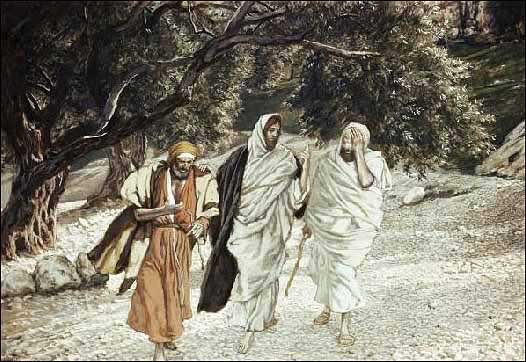
Road to Emmaus  by James J. Tissot

Road to Emmaus
by James J. Tissot

I shared a couple of weeks ago that I was working on this topic. I realized that I had gotten sucked into the trap of researching nuggets when in-fact the entirety of the Bible points to Jesus as the Messiah, the Christ, the Anointed One. So, this won’t be a singular post type of topic; rather, this is the central issue, the basis of our entire faith. I think the distraction was amplified by a desire to really make an impactful post in time for Easter, but thankfully, everything went wrong on many fronts. Thankfully? Yes. Sometimes things have to go wrong, for us to realize we’ve become too wrapped up in our own devices/plans/schemes/agendas. So, let’s get back to the basics of sharing Bible Studies as often as I can find the time, without worrying so much about “making something” of this blog. Forgive me for losing sight so quickly.

Confessions of the Christ

Our first stop will be the Gospel written by John. Please take a moment now to read John Chapter 1 in its entirety. Remember when we talked about the Sin of the Pharisee, we noted that John the Baptist knew what the Pharisees were getting at when they asked him who he was.

John 1:19-20 (ESV) 19 And this is the testimony of John, when the Jews sent priests and Levites from Jerusalem to ask him, “Who are you?” 20 He confessed, and did not deny, but confessed, “I am not the Christ.”

So without hesitation, he makes it clear to them that he is not the Christ. Now, when Jesus does step forward, John introduces Jesus to the people in a way that doesn’t fit with what they were looking for in the Christ:

John 1:29 (ESV) The next day he saw Jesus coming toward him, and said, “Behold, the Lamb of God, who takes away the sin of the world!…

At this time, sacrifices are a regular occurrence at the Temple. How did they miss this introduction as what is clearly a declaration of Jesus being the atoning sacrifice? They didn’t catch it, because they weren’t looking for it. Let us see what they were looking for:

John 1:30-34 (ESV) 30 This is he of whom I said, ‘After me comes a man who ranks before me, because he was before me.’ 31 I myself did not know him, but for this purpose I came baptizing with water, that he might be revealed to Israel.” 32 And John bore witness: “I saw the Spirit descend from heaven like a dove, and it remained on him. 33 I myself did not know him, but he who sent me to baptize with water said to me, ‘He on whom you see the Spirit descend and remain, this is he who baptizes with the Holy Spirit.’ 34 And I have seen and have borne witness that this is the Son of God.

Okay, so here we have a flat-out declaration of Jesus not only being named “The Christ” but now He is plainly declared to be the Son of God. Now, let’s look at the reactions of the early disciples to Him.

John 1:35-51 (ESV) 35 The next day again John was standing with two of his disciples, 36 and he looked at Jesus as he walked by and said, “Behold, the Lamb of God!” 37 The two disciples heard him say this, and they followed Jesus. 38 Jesus turned and saw them following and said to them, “What are you seeking?” And they said to him, “Rabbi” (which means Teacher), “where are you staying?” 39 He said to them, “Come and you will see.” So they came and saw where he was staying, and they stayed with him that day, for it was about the tenth hour. 40 One of the two who heard John speak and followed Jesus was Andrew, Simon Peter’s brother. 41 He first found his own brother Simon and said to him, “We have found the Messiah” (which means Christ). 42 He brought him to Jesus. Jesus looked at him and said, “You are Simon the son of John. You shall be called Cephas” (which means Peter).43 The next day Jesus decided to go to Galilee. He found Philip and said to him, “Follow me.” 44 Now Philip was from Bethsaida, the city of Andrew and Peter. 45 Philip found Nathanael and said to him, “We have found him of whom Moses in the Law and also the prophets wrote, Jesus of Nazareth, the son of Joseph.” 46 Nathanael said to him, “Can anything good come out of Nazareth?” Philip said to him, “Come and see.” 47 Jesus saw Nathanael coming toward him and said of him, “Behold, an Israelite indeed, in whom there is no deceit!” 48 Nathanael said to him, “How do you know me?” Jesus answered him, “Before Philip called you, when you were under the fig tree, I saw you.” 49 Nathanael answered him, “Rabbi, you are the Son of God! You are the King of Israel!” 50 Jesus answered him, “Because I said to you, ‘I saw you under the fig tree,’ do you believe? You will see greater things than these.” 51 And he said to him, “Truly, truly, I say to you, you will see heaven opened, and the angels of God ascending and descending on the Son of Man.”

Now, when these two disciples of John the Baptist hear Jesus identified as the “Lamb of God”, they understand that He is the One for whom John the Baptist was preparing them. So they follow Jesus. Here, we have the author explaining that the Hebrew word for “Messiah” is synonymous with the Greek word “Christ”. Neither word is actually translated into English, we’ve simply changed the way they are pronounced. They both translate to “Anointed”, and in the specific case of Jesus, “the Anointed One”. For those who might be new to the faith, or for those who simply have never asked, “Christ” isn’t part of Jesus name, it is a title. We notice also that Nathanael’s response to the news of Jesus was regarding Nazareth. Nazareth is never mentioned in the Law or the Prophets.  They were expecting the Messiah to come from the Bethlehem, the City of David (where Jesus was born). The Jewsish leaders of the day were looking for a descendant of David. Present-day Judaism still holds to these prophesies as indicators of the “end of days”, having missed their fulfillment in Jesus:

Jeremiah 23:5-6 (ESV)  5 “Behold, the days are coming, declares the Lord, when I will raise up for David a righteous Branch, and he shall reign as king and deal wisely, and shall execute justice and righteousness in the land. 6 In his days Judah will be saved, and Israel will dwell securely. And this is the name by which he will be called: ‘The Lord is our righteousness.’

Jeremiah 33:14-16 (ESV) 14 “Behold, the days are coming, declares the Lord, when I will fulfill the promise I made to the house of Israel and the house of Judah. 15 In those days and at that time I will cause a righteous Branch to spring up for David, and he shall execute justice and righteousness in the land. 16 In those days Judah will be saved, and Jerusalem will dwell securely. And this is the name by which it will be called: ‘The Lord is our righteousness.’ 17 “For thus says the Lord: David shall never lack a man to sit on the throne of the house of Israel, 18 and the Levitical priests shall never lack a man in my presence to offer burnt offerings, to burn grain offerings, and to make sacrifices forever.”

The prophet Isaiah also prophesied regarding Him in a similar phrasing (naturally, since these are the Words of God, not of men):

Isaiah 11:1-5 (ESV) 1 There shall come forth a shoot from the stump of Jesse, and a branch from his roots shall bear fruit.
2 And the Spirit of the Lord shall rest upon him,
the Spirit of wisdom and understanding,
the Spirit of counsel and might,
the Spirit of knowledge and the fear of the Lord.
3 And his delight shall be in the fear of the Lord.
He shall not judge by what his eyes see,
or decide disputes by what his ears hear,
4 but with righteousness he shall judge the poor,
and decide with equity for the meek of the earth;
and he shall strike the earth with the rod of his mouth,
and with the breath of his lips he shall kill the wicked.
5 Righteousness shall be the belt of his waist,
and faithfulness the belt of his loins.

So we see clearly between the confessions of John the Baptist, and the Prophecies of Jeremiah and Isaiah, that Jesus came as the atoning sacrifice, the Lamb of God, the Messiah, the Christ, the Branch of David, who will be called “the Lord is our Righteousness”… this is the Gospel of Jesus, the Christ, the Son of God. God’s Word is so awesome.

It was not only the Pharisees and the disciples of John the Baptist who were looking for the Christ. As we see in John 4, even the lowly Samaritans where aware of the prophesied Messaiah:

John 4:16-26 (ESV) 16 Jesus said to her, “Go, call your husband, and come here.” 17 The woman answered him, “I have no husband.” Jesus said to her, “You are right in saying, ‘I have no husband’; 18 for you have had five husbands, and the one you now have is not your husband. What you have said is true.” 19 The woman said to him, “Sir, I perceive that you are a prophet. 20 Our fathers worshiped on this mountain, but you say that in Jerusalem is the place where people ought to worship.” 21 Jesus said to her, “Woman, believe me, the hour is coming when neither on this mountain nor in Jerusalem will you worship the Father. 22 You worship what you do not know; we worship what we know, for salvation is from the Jews. 23 But the hour is coming, and is now here, when the true worshipers will worship the Father in spirit and truth, for the Father is seeking such people to worship him. 24 God is spirit, and those who worship him must worship in spirit and truth.” 25 The woman said to him, “I know that Messiah is coming (he who is called Christ). When he comes, he will tell us all things.” 26 Jesus said to her, “I who speak to you am he.”

So awesome. Jesus tells her at the Samaritans (corporate “you”) worship what they do not know. To demonstrate what she does know, she shows us that they, too, were waiting for the Messiah to tell them all things. Samaritans were outsiders. They were of mixed blood and mixed faith, but they looked for the Messiah to come. Praise the Lord God for His faithfulness.

Now then, that we have seen some of what it was the Jews and even the Samaritans were looking for, lets look at Peter’s confession of Jesus.

Matthew 16:13-20 (ESV) 13 Now when Jesus came into the district of Caesarea Philippi, he asked his disciples, “Who do people say that the Son of Man is?” 14 And they said, “Some say John the Baptist, others say Elijah, and others Jeremiah or one of the prophets.” 15 He said to them, “But who do you say that I am?” 16 Simon Peter replied, “You are the Christ, the Son of the living God.” 17 And Jesus answered him, “Blessed are you, Simon Bar-Jonah! For flesh and blood has not revealed this to you, but my Father who is in heaven. 18 And I tell you, you are Peter, and on this rock I will build my church, and the gates of hell shall not prevail against it. 19 I will give you the keys of the kingdom of heaven, and whatever you bind on earth shall be bound in heaven, and whatever you loose on earth shall be loosed in heaven.” 20 Then he strictly charged the disciples to tell no one that he was the Christ.

This confession is huge. One into which Peter would yet need to grow, but he does by the Grace of God. Notice, that this confession/revelation is not by flesh and blood, but given as a gift from God the Father who is in heaven. This statement bears a strong resemblance to what Paul wrote in Ephesians 2:8 (ESV) “For by grace you have been saved through faith. And this is not your own doing; it is the gift of God…”

Peter was not alone in having to grow into the understanding of just what it meant to confess Jesus as the Christ, Son of the Living God. Martha had a very hard time of it, too when her brother, Lazarus, died.

John 11:17-27 (ESV) 17 Now when Jesus came, he found that Lazarus had already been in the tomb four days. 18 Bethany was near Jerusalem, about two miles off, 19 and many of the Jews had come to Martha and Mary to console them concerning their brother. 20 So when Martha heard that Jesus was coming, she went and met him, but Mary remained seated in the house. 21 Martha said to Jesus, “Lord, if you had been here, my brother would not have died. 22 But even now I know that whatever you ask from God, God will give you.” 23 Jesus said to her, “Your brother will rise again.” 24 Martha said to him, “I know that he will rise again in the resurrection on the last day.” 25 Jesus said to her, “I am the resurrection and the life. Whoever believes in me, though he die, yet shall he live, 26 and everyone who lives and believes in me shall never die. Do you believe this?” 27 She said to him, “Yes, Lord; I believe that you are the Christ, the Son of God, who is coming into the world.”

It is on this note, that I’d like to pause for a moment. We all, must come to faith in Jesus as the Christ, Son of the Living God. The Lamb of God who laid down His life as the perfect atonement for the sin of mankind, for our sins included. This faith comes as a Gift from God, that we might die to sin ourselves, so that in Him we might have everlasting life.

Ephesians 4:1-16 (ESV) 1 I therefore, a prisoner for the Lord, urge you to walk in a manner worthy of the calling to which you have been called, 2 with all humility and gentleness, with patience, bearing with one another in love, 3 eager to maintain the unity of the Spirit in the bond of peace. 4 There is one body and one Spirit—just as you were called to the one hope that belongs to your call— 5 one Lord, one faith, one baptism, 6 one God and Father of all, who is over all and through all and in all. 7 But grace was given to each one of us according to the measure of Christ’s gift. 8 Therefore it says,

“When he ascended on high he led a host of captives,and he gave gifts to men.”[Ps 68:18]

9 (In saying, “He ascended,” what does it mean but that he had also descended into the lower regions, the earth? 10 He who descended is the one who also ascended far above all the heavens, that he might fill all things.) 11 And he gave the apostles, the prophets, the evangelists, the shepherds and teachers, 12 to equip the saints for the work of ministry, for building up the body of Christ, 13 until we all attain to the unity of the faith and of the knowledge of the Son of God, to mature manhood, to the measure of the stature of the fullness of Christ, 14 so that we may no longer be children, tossed to and fro by the waves and carried about by every wind of doctrine, by human cunning, by craftiness in deceitful schemes. 15 Rather, speaking the truth in love, we are to grow up in every way into him who is the head, into Christ, 16 from whom the whole body, joined and held together by every joint with which it is equipped, when each part is working properly, makes the body grow so that it builds itself up in love.

In Jesus, the Christ, the Son of the Living God, through the working of God the Holy Spirit, we are being woven together, fitted together, into one body. I thank God for each of you who do the hard work of discernment in all things, and in sharing the Gospel of Jesus Christ, the Lamb of God, who has is called “the Lord is our righteousness”. We who are in Christ long for the day of His return, to reign forever as King of kings and Lord of lords. Until that day, let do the work the Lord predestined for us to do in Him, so that when the Master returns, He will find His servants hard at work. Study the Scriptures, Preach the Word, and Love your neighbors as yourselves. Amen.

In Him,
Jorge