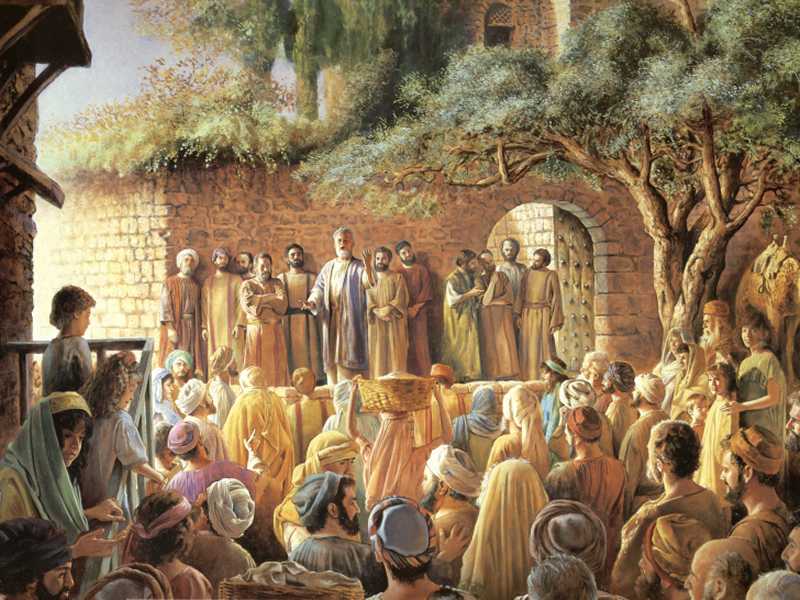
A Notable Sign, Evident to All

day-of-pentecost-acts-2-38The topic of “faith healers” is growing around the world. Today we will look at what God actually did in the early church and highlight the problems with this fraudulent, self-aggrandizing faith healing “ministry”. We, the American Evangelical complex, exported this form of evangelism to places in Africa and South America where so-called faith healers rake in money. There is rampant fraud, false teaching, and false signs & wonders. To dig into each false ministry would consume all of our time here and would ultimately end in despair for the state of the church. Instead of doing that, let’s look to the Scriptures to see what is of the Spirit of Truth and what is of error.

I’ve said this a few times before, but I am not a cessationist. The question here isn’t whether or not God performs miracles today, it is whether or not He does them at the command of self-proclaimed “anointed ones” who mishandle God’s Word when they preach and can never seem to produce evidence of their claims of miraculous healing. When God performs a miracle, a sign, or a wonder, it is to glorify Him (Soli Deo Gloria). It was no different in the early church. The signs and wonders that accompanied the Apostles were to give authority to the Gospel they preached, and that Gospel was Jesus Christ. They did not preach themselves, they did not preach for selfish gain, they did not seek the approval of men. In fact, they were persecuted, beaten, and killed for the sake of Jesus Christ. I have absolutely no doubt that we serve a Living God who is the same God who created everything out of nothing and is able to heal. I’ve witnessed Him heal my Father of cancer and my little sister’s failing kidney. These miracles were unquestionably the work of God the Holy Spirit, and we give all Glory and Honor and Praise to God. No faith-healer was involved, none was needed.

The Lame Beggar Healed

In the book of Acts, Luke begins by recording Jesus’ final statements before ascending into Heaven. In them, Jesus promised they would receive the Gift of God the Holy Spirit. In Acts 2 we see that promise fulfilled and we see the resulting miracle of tongues and the boldness of Peter to preach to all who had gathered to witness the miracle of hearing the wonders of God being proclaimed in each of their native languages, and many heard the call of the Gospel, to repent and be baptized in the Name of Jesus Christ for the forgiveness of sins and the gift of the Holy Spirit. And many were added to the church on that day. Now, we will pick up at the start of chapter 3.

Acts 3 (ESV) | The Lame Beggar Healed
1 Now Peter and John were going up to the temple at the hour of prayer, the ninth hour. 2 And a man lame from birth was being carried, whom they laid daily at the gate of the temple that is called the Beautiful Gate to ask alms of those entering the temple. 3 Seeing Peter and John about to go into the temple, he asked to receive alms. 4 And Peter directed his gaze at him, as did John, and said, “Look at us.” 5 And he fixed his attention on them, expecting to receive something from them. 6 But Peter said, “I have no silver and gold, but what I do have I give to you. In the name of Jesus Christ of Nazareth, rise up and walk!” 7 And he took him by the right hand and raised him up, and immediately his feet and ankles were made strong. 8 And leaping up he stood and began to walk, and entered the temple with them, walking and leaping and praising God. 9 And all the people saw him walking and praising God, 10 and recognized him as the one who sat at the Beautiful Gate of the temple, asking for alms. And they were filled with wonder and amazement at what had happened to him.11 While he clung to Peter and John, all the people, utterly astounded, ran together to them in the portico called Solomon’s.

Praise God. As you can see from the highlighting, this was no secret or private event. The Temple was the center of Jewish life, and this lame beggar was carried to the Beautiful Gate daily. The people knew who he was. They saw him as they entered the Temple and might have even given alms from time to time. Not only did he rise up and walk, but he leaped and entered the temple with Peter and John, praising God. Praising God… in the temple… for what He had done to him. And all the people saw him, recognized him, and were filled with wonder and amazement. Notice that this man didn’t just go away, never to be heard from again, he remained and in-fact clung to Peter and John.

Acts 3:12 And when Peter saw it he addressed the people: “Men of Israel, why do you wonder at this, or why do you stare at us, as though by our own power or piety we have made him walk? 13 The God of Abraham, the God of Isaac, and the God of Jacob, the God of our fathers, glorified his servant Jesus, whom you delivered over and denied in the presence of Pilate, when he had decided to release him.14 But you denied the Holy and Righteous One, and asked for a murderer to be granted to you, 15 and you killed the Author of life, whom God raised from the dead. To this we are witnesses. 16 And his name—by faith in his name—has made this man strong whom you see and know, and the faith that is through Jesus has given the man this perfect health in the presence of you all.

17 “And now, brothers, I know that you acted in ignorance, as did also your rulers. 18 But what God foretold by the mouth of all the prophets, that his Christ would suffer, he thus fulfilled. 19 Repent therefore, and turn back, that your sins may be blotted out, 20 that times of refreshing may come from the presence of the Lord, and that he may send the Christ appointed for you, Jesus, 21 whom heaven must receive until the time for restoring all the things about which God spoke by the mouth of his holy prophets long ago. 22 Moses said, ‘The Lord God will raise up for you a prophet like me from your brothers. You shall listen to him in whatever he tells you. 23 And it shall be that every soul who does not listen to that prophet shall be destroyed from the people.’ 24 And all the prophets who have spoken, from Samuel and those who came after him, also proclaimed these days.25 You are the sons of the prophets and of the covenant that God made with your fathers, saying to Abraham, ‘And in your offspring shall all the families of the earth be blessed.’26 God, having raised up his servant, sent him to you first, to bless you by turning every one of you from your wickedness.”

Peter makes plain that it was neither by their power nor their piety that made this lame man walk; rather, it was faith in the Name of Jesus that the man was made perfect in their presence. Faith in the Name of Jesus, for the Glory of His Name. Peter then reminds those in the temple of Moses who told them the Lord would raise up a prophet like Moses, and that they should listen to Him. He then reminds them that all prophets proclaimed the days of the Messiah, the very days in which they lived, (the Law and the Prophets) and Peter declared the Gospel of Jesus Christ, that He whom they killed was the Christ, Son of the Living God.

Acts 4 (ESV) | Peter and John Before the Council
4 And as they were speaking to the people, the priests and the captain of the temple and the Sadducees came upon them, 2 greatly annoyed because they were teaching the people and proclaiming in Jesus the resurrection from the dead. 3 And they arrested them and put them in custody until the next day, for it was already evening. 4 But many of those who had heard the word believed, and the number of the men came to about five thousand.

This was a whole-day affair. The Sadducees were greatly annoyed for 2 reasons. Firstly, they were greatly annoyed that Peter and John were teaching the people within the temple courts. How dare they! They are not scribes, teachers, lawyers, or priests! They have not been certified! Secondly, in their teaching of Jesus, they were proclaiming the resurrection from the dead. The Sadduccees did not believe in resurrection (Matt 22:23-33), one of the differences between them and the Pharisees. So they had Peter and John arrested and held over night since it was already evening.

Acts 4:5 On the next day their rulers and elders and scribes gathered together in Jerusalem, 6 with Annas the high priest and Caiaphas and John and Alexander, and all who were of the high-priestly family. 7 And when they had set them in the midst, they inquired, “By what power or by what name did you do this?

Now, don’t just breeze through this question. This isn’t merely an inquiry. What we have assembled here is a tribunal of sorts, those who were of the high-priestly family. It is of no little significance that Luke begins the next verse by specifying that God the Holy Spirit guided Peter’s response. This was a test that could very well lead to their death according to the Law of Moses in Deuteronomy 13. For that test didn’t rely on whether or not the sign or wonder had come true (clearly, the lame beggar was in-fact healed); rather, it hinged upon whether they pointed to the God of Abraham, Isaac, and Jacob. Let’s see Peter’s answer (prompted by the Holy Spirit).

Acts 4:8 Then Peter, filled with the Holy Spirit, said to them, “Rulers of the people and elders, 9 if we are being examined today concerning a good deed done to a crippled man, by what means this man has been healed, 10 let it be known to all of you and to all the people of Israel that by the name of Jesus Christ of Nazareth, whom you crucified, whom God raised from the dead—by him this man is standing before you well. 11 This Jesus is the stone that was rejected by you, the builders, which has become the cornerstone. 12 And there is salvation in no one else, for there is no other name under heaven given among men by which we must be saved.

Wow. Straight to the Gospel, then the Psalms, then the Gospel. Declaring Jesus as the Christ, the only Name under heaven by which we must be saved. This is a huge statement. Let’s look at the Psalm to which verse 11 refers.

Psalm 118:19-24 (ESV)
19 Open to me the gates of righteousness,
that I may enter through them
and give thanks to the Lord.
20 This is the gate of the Lord;
the righteous shall enter through it.
21 I thank you that you have answered me
and have become my salvation.
22 The stone that the builders rejected
    has become the cornerstone.
23 This is the Lord’s doing;
it is marvelous in our eyes.
24 This is the day that the Lord has made;
let us rejoice and be glad in it.

So these members of the high-priestly family would not only have recognized the line quoted by Peter, they would undoubtedly have recalled the psalm and its prophetic implication. In such a short discourse Peter turned what was a test of a false prophet into a proclamation of Jesus as the Christ, the Son of David, the Messiah. Let’s continue reading in Acts 4.

Acts 4:13 Now when they saw the boldness of Peter and John, and perceived that they were uneducated, common men, they were astonished. And they recognized that they had been with Jesus. 14 But seeing the man who was healed standing beside them, they had nothing to say in opposition. 15 But when they had commanded them to leave the council, they conferred with one another, 16 saying, “What shall we do with these men? For that a notable sign has been performed through them is evident to all the inhabitants of Jerusalem, and we cannot deny it. 17 But in order that it may spread no further among the people, let us warn them to speak no more to anyone in this name.” 18 So they called them and charged them not to speak or teach at all in the name of Jesus. 19 But Peter and John answered them, “Whether it is right in the sight of God to listen to you rather than to God, you must judge, 20 for we cannot but speak of what we have seen and heard.” 21 And when they had further threatened them, they let them go, finding no way to punish them, because of the people, for all were praising God for what had happened. 22 For the man on whom this sign of healing was performed was more than forty years old.

The man was still there, standing with Peter and John before the council and all the people as a testimony to the Name of Jesus Christ, and His Gospel preached by Peter and John. Why could they not punish these men? Because the people were praising God for what had happened. No one could deny that a notable sing had been performed and it was evident to all the inhabitants.

The Focus of Ministry is the Gospel

The focus of ministry is the Gospel of Jesus Christ, not the signs and wonders. A point we will continue to try to make here is that “signs and wonders” are meaningless on their own. Even according to the Law we know that what is taught is the measure by which we identify a false prophet, NOT whether or not the sign or wonder comes to pass! The teaching, the doctrine, the Scriptures far exceed the manifestations and signs and miracles. Our sense are easily manipulated and deceived. So many of these so-called faith healers preach false doctrines as a means of selfish gain. Many resort to parlor tricks and misdirection to ensnare the weak and immature. If salvation is a gift from God freely given, how then do we accept the false teaching that healing or blessings from God require “planting a financial seed” into the hands of the self-proclaimed anointed one? Paul talked about these, pejoratively calling them “super apostles” in 2 Corinthians 11.

2 Corinthians 11:1-15 (ESV) | Paul and the False Apostles
11 I wish you would bear with me in a little foolishness. Do bear with me! 2 For I feel a divine jealousy for you, since I betrothed you to one husband, to present you as a pure virgin to Christ. 3 But I am afraid that as the serpent deceived Eve by his cunning, your thoughts will be led astray from a sincere and pure devotion to Christ. 4 For if someone comes and proclaims another Jesus than the one we proclaimed, or if you receive a different spirit from the one you received, or if you accept a different gospel from the one you accepted, you put up with it readily enough. 5 Indeed, I consider that I am not in the least inferior to these super-apostles. 6 Even if I am unskilled in speaking, I am not so in knowledge; indeed, in every way we have made this plain to you in all things. 7 Or did I commit a sin in humbling myself so that you might be exalted, because I preached God’s gospel to you free of charge? 8 I robbed other churches by accepting support from them in order to serve you. 9 And when I was with you and was in need, I did not burden anyone, for the brothers who came from Macedonia supplied my need. So I refrained and will refrain from burdening you in any way. 10 As the truth of Christ is in me, this boasting of mine will not be silenced in the regions of Achaia. 11 And why?Because I do not love you? God knows I do! 12 And what I am doing I will continue to do, in order to undermine the claim of those who would like to claim that in their boasted mission they work on the same terms as we do.13 For such men are false apostles, deceitful workmen, disguising themselves as apostles of Christ. 14 And no wonder, for even Satan disguises himself as an angel of light. 15 So it is no surprise if his servants, also, disguise themselves as servants of righteousness. Their end will correspond to their deeds.

2 Corinthians 11:19-20 (ESV) 19 For you gladly bear with fools, being wise yourselves! 20 For you bear it if someone makes slaves of you, or devours you, or takes advantage of you, or puts on airs, or strikes you in the face.

Very strong words from the Apostle Paul. These false Apostles enslaved those who should have known better, for they had been taught the pure Word by Paul. Yet these so-called apostles came in and deceived the church, taught a different Jesus, imparted a different spirit, and took money from them, took advantage of them, put on airs, and even struck them in the face, and they endured the foolishness. Paul is enraged by the super-apostles and disappointed in the sheep who allowed themselves to be mislead. However, he loves them in Christ, enough to rebuke them and set them straight in his letter. To think that in this day we still bear with the likes of Todd Bentley, Benny Hinn, and T.B. Joshua.

We have so much more available to us today than what Peter and John had to work with in Acts 3. They had only the Law and the Prophets and God the Holy Spirit by which they could teach the Gospel of Christ to the people. And they could not carry with them the Law and the Prophets, they relied completely on God the Holy Spirit to guide them. We have that same Spirit as a promised by Jesus, and we also have ready access to the Law and the Prophets, and the New Testament foundation laid by the Apostles. With so much given to us by God the Holy Spirit, there is no excuse to still be carried about by every wind of doctrine. In closing, let us look to how Paul closes out this letter to the Corinthians.

2 Corinthians 13:2-14 (ESV) 2 I warned those who sinned before and all the others, and I warn them now while absent, as I did when present on my second visit, that if I come again I will not spare them—3 since you seek proof that Christ is speaking in me. He is not weak in dealing with you, but is powerful among you. 4 For he was crucified in weakness, but lives by the power of God. For we also are weak in him, but in dealing with you we will live with him by the power of God. 5 Examine yourselves, to see whether you are in the faith. Test yourselves. Or do you not realize this about yourselves, that Jesus Christ is in you?—unless indeed you fail to meet the test! 6 I hope you will find out that we have not failed the test. 7 But we pray to God that you may not do wrong—not that we may appear to have met the test, but that you may do what is right, though we may seem to have failed. 8 For we cannot do anything against the truth, but only for the truth. 9 For we are glad when we are weak and you are strong. Your restoration is what we pray for. 10 For this reason I write these things while I am away from you, that when I come I may not have to be severe in my use of the authority that the Lord has given me for building up and not for tearing down.

11 Finally, brothers, rejoice. Aim for restoration, comfort one another, agree with one another, live in peace; and the God of love and peace will be with you. 12 Greet one another with a holy kiss. 13 All the saints greet you.

14 The grace of the Lord Jesus Christ and the love of God and the fellowship of the Holy Spirit be with you all.

Amen. Remain in the Word of God, and continue preaching repentance and the Gospel of Jesus Christ for the forgiveness of sin and the promise of the Holy Spirit.

In Christ Jesus,
Jorge

The Parable of the Good Samaritan | Law & Gospel

??????????This week I had the good pleasure of hearing 2 sermons on this parable from pastors with whom I was unfamiliar. While one sermon was vastly superior to the other, I gained insight from each and thought this would be a good topic for us to discuss today. From time to time you will see me talk about the need to preach both Law and Gospel. In the today’s church we seem to find some emergent/seeker-driven churches attempting to skip Law and only focus on Gospel. The problem with that (aside from not teaching the full counsel of Scripture) is that without the Law we are not convicted of sin. Without a conviction of sin, we cannot fully appreciate or grasp the Gospel. Other churches tend to err in the other direction. They consider Gospel just what you need to “be born again” and then they teach all Law… this is also dangerous, for the Law convicts us of our sin… and we live in a sinful world and our flesh is sinful. We still sin, and we need the Gospel every day of our lives. For we walk by grace, and we need to be reminded of the power of God’s grace every day of our lives, lest we slip into condemnation for our lack of perfection. Our primary text for today comes from Luke 10, and we will see how a single parable effectively teaches both Law and Gospel. 

The Parable of the Good Samaritan

Luke 10:25-37 (ESV)
25 And behold, a lawyer stood up to put him to the test, saying, “Teacher, what shall I do to inherit eternal life?” 26 He said to him, “What is written in the Law? How do you read it?” 27 And he answered, “You shall love the Lord your God with all your heart and with all your soul and with all your strength and with all your mind, and your neighbor as yourself.” 28 And he said to him, “You have answered correctly; do this, and you will live.”

29 But he, desiring to justify himself, said to Jesus, “And who is my neighbor?” 30 Jesus replied, “A man was going down from Jerusalem to Jericho, and he fell among robbers, who stripped him and beat him and departed, leaving him half dead. 31 Now by chance a priest was going down that road, and when he saw him he passed by on the other side. 32 So likewise a Levite, when he came to the place and saw him, passed by on the other side. 33 But a Samaritan, as he journeyed, came to where he was, and when he saw him, he had compassion. 34 He went to him and bound up his wounds, pouring on oil and wine. Then he set him on his own animal and brought him to an inn and took care of him. 35 And the next day he took out two denarii and gave them to the innkeeper, saying, ‘Take care of him, and whatever more you spend, I will repay you when I come back.’ 36 Which of these three, do you think, proved to be a neighbor to the man who fell among the robbers?” 37 He said, “The one who showed him mercy.” And Jesus said to him, “You go, and do likewise.”

For a little bit of context, Jesus had just pronounced Woes to the cities of Chorazin and Bethsaida for their unbelief and unrepentant hearts. The seventy-two disciples who had been sent out returned praising God and giving a joyful report. Jesus was careful to refocus their excitement away from the fact that the demons were submitted to them and onto the fact that their names had been written Heaven. Jesus then praises God aloud and I think we should look at this portion before diving into the parable.

Luke 10:21-24 (ESV)
21 In that same hour he rejoiced in the Holy Spirit and said, “I thank you, Father, Lord of heaven and earth, that you have hidden these things from the wise and understanding and revealed them to little children; yes, Father, for such was your gracious will. 22 All things have been handed over to me by my Father, and no one knows who the Son is except the Father, or who the Father is except the Son and anyone to whom the Son chooses to reveal him.” 23 Then turning to the disciples he said privately, “Blessed are the eyes that see what you see! 24 For I tell you that many prophets and kings desired to see what you see, and did not see it, and to hear what you hear, and did not hear it.”

And let it be known that we are recipients of that blessing, for by the Grace of God we now have the record of these events in God’s Holy Word, Amen. Look at the excitement in Jesus’ praise. Notice that he turns privately to His disciples to call them blessed. I mention this because I do believe that the events that take place in verse 25 take place soon afterward. Luke doesn’t specify a time-frame, but he does write “and behold” so I think this Lawyer’s test of Jesus came suddenly.

The Lawyer’s test

Now we are not talking about a Lawyer in the sense of a trial lawyer; rather, he was most likely an expert in the Law of Moses. Now, the lawyer was asking Jesus how he might inherit eternal life. Notice, however, that Luke clearly identifies this as a test (ESV) or that he tempted (KJV) Jesus with this question. He was looking for Jesus to give an unlawful answer. What kind of answer was he looking for? We don’t know, because Jesus turned the answer back onto the lawyer, “What is written in the Law? How do you read it”? Let’s look at the answer the Lawyer gives. “You shall love the Lord your God with all your heart and with all your soul and with all your strength and with all your mind, and your neighbor as yourself.” Jesus commends him for his lawful answer to the question and then tells him that if he does that he will live. Jesus confirmed the Law of Moses, and the Lawyer stood convicted by it. Let’s examine 2 portions of the Law related to the mans answer.

Deuteronomy 6:1-5 (ESV) 1 “Now this is the commandment—the statutes and the rules—that the Lord your God commanded me to teach you, that you may do them in the land to which you are going over, to possess it, 2 that you may fear the Lord your God, you and your son and your son’s son, by keeping all his statutes and his commandments, which I command you, all the days of your life, and that your days may be long. 3 Hear therefore, O Israel, and be careful to do them, that it may go well with you, and that you may multiply greatly,as the Lord, the God of your fathers, has promised you, in a land flowing with milk and honey. 4 “Hear, O Israel: The Lord our God, the Lord is one. 5 You shall love the Lord your God with all your heart and with all your soul and with all your might.

Leviticus 19:9-18 (ESV) 9 “When you reap the harvest of your land, you shall not reap your field right up to its edge, neither shall you gather the gleanings after your harvest. 10 And you shall not strip your vineyard bare, neither shall you gather the fallen grapes of your vineyard. You shall leave them for the poor and for the sojourner: I am the Lord your God. 11 “You shall not steal; you shall not deal falsely; you shall not lie to one another.12 You shall not swear by my name falsely, and so profane the name of your God: I am the Lord. 13 “You shall not oppress your neighbor or rob him. The wages of a hired worker shall not remain with you all night until the morning. 14 You shall not curse the deaf or put a stumbling block before the blind, but you shall fear your God: I am the Lord. 15 “You shall do no injustice in court. You shall not be partial to the poor or defer to the great, but in righteousness shall you judge your neighbor. 16 You shall not go around as a slanderer among your people, and you shall not stand up against the life of your neighbor: I am the Lord. 17 “You shall not hate your brother in your heart, but you shall reason frankly with your neighbor, lest you incur sin because of him. 18 You shall not take vengeance or bear a grudge against the sons of your own people, but you shall love your neighbor as yourself: I am the Lord.

Now immediately we are presented with the greatest and second commandments. In Matthew, Jesus was asked what the Greatest Commandment was and His answer to them was the same. Now the first commandment is one that is easier to claim (and harder to disprove) than the second. This lawyer might have been willing to claim ownership of the first law; however, in order to justify himself, clearly he needed a favorable definition of “neighbor”.

The Parable at Face Value | Law

This parable of the good Samaritan simultaneously teaches Law as well as the Gospel. Let us first see how the parable teaches the Law of God. This is how it would most likely initially have been interpreted by the Lawyer and those present at the time.

Luke 10:30-32 (ESV) 30 Jesus replied, “A man was going down from Jerusalem to Jericho, and he fell among robbers, who stripped him and beat him and departed, leaving him half dead. 31 Now by chance a priest was going down that road, and when he saw him he passed by on the other side. 32 So likewise a Levite, when he came to the place and saw him, passed by on the other side.

The hearers of this parable would likely place themselves in the position of either the victim, the Priest, or the Levite. This lawyer probably pictured himself as either the Priest of the Levite due to his level of study and expertise in the Law. At this point in the story, however, it is not clear that what either of these character did was wrong. That might be hard for us to understand but remember, the Law had specific rules regarding cleanliness and the dead. This takes place on the road between Jericho and Jerusalem (city of the Temple). When the scripture describes the man as being “half dead”, it is saying that he appeared to be dead. One would have to inspect him, check on him to determine if he were dead. This presents a Legal dilemma for the Priest and the Levite. Let’s turn for a moment to Levitical Law.

Leviticus 21:1-3 (ESV)
21 And the Lord said to Moses, “Speak to the priests, the sons of Aaron, and say to them, No one shall make himself unclean for the dead among his people, 2 except for his closest relatives, his mother, his father, his son, his daughter, his brother, 3 or his virgin sister (who is near to him because she has had no husband; for her he may make himself unclean).

So, a Priest would not touch a dead person unless it was clearly one of the aforementioned exceptions. The High Priest is afforded no exceptions at all. The Law acknowledges that we are incapable of keeping it, and even specifies purification rituals. Let’s look at those in Numbers.

Numbers 19:11-13 (ESV)
11 “Whoever touches the dead body of any person shall be unclean seven days. 12 He shall cleanse himself with the water on the third day and on the seventh day, and so be clean. But if he does not cleanse himself on the third day and on the seventh day, he will not become clean. 13 Whoever touches a dead person, the body of anyone who has died, and does not cleanse himself, defiles the tabernacle of the Lord, and that person shall be cut off from Israel; because the water for impurity was not thrown on him, he shall be unclean. His uncleanness is still on him.

Yikes. This portion of the Law applies to Priests and Levites, so it includes both passers-by in the parable. Touching a dead body, even to see if he might still be alive, would make them unclean for seven days. They’d have to wash on the 3rd and 7th day to be made clean again and not to defile the Temple of the Lord. In order for the Priest or the Levite to assist the half-dead man, they’d have to be willing to give up their Legal cleanliness, for if the man is dead they would have been made unclean while still not being able to do anything for the dead man. Therefore, they passed by on the other side of the street (probably as a part of tradition) to fully demonstrate their acknowledgement that they must remain clean as they continue walking. “Someone else will take care of it”… someone not baring the responsibility of being a Levite or a Priest. After all, they have important business to attend to, they have a “calling” that does not include touching dead bodies. There are plenty of others who can render aid or bury the dead without jeopardizing their calling. This is Law. Let’s continue.

Luke 10:33-35 (ESV) 33 But a Samaritan, as he journeyed, came to where he was, and when he saw him, he had compassion. 34 He went to him and bound up his wounds, pouring on oil and wine. Then he set him on his own animal and brought him to an inn and took care of him.35 And the next day he took out two denarii and gave them to the innkeeper, saying, ‘Take care of him, and whatever more you spend, I will repay you when I come back.’

Now, the Samaritans weren’t simply a “lower class citizen”, they were outsiders, foreigners, gentiles. They were mixed in blood (due to the Assyrian defeat and occupation of the northern kingdom of Israel) and in religion (they worshiped in the “high places” those that were built to other gods). Remember what the law says about this sort of thing, they are to be cut off. The Samaritans were not granted access to the Temple in Jerusalem. The Samaritans were well aware of where they stood in the eyes of the Jews. This animosity, this separation was lawful. For us to better understand this, let us look to John Chapter 4.

John 4:7-9 (ESV) 7 A woman from Samaria came to draw water. Jesus said to her, “Give me a drink.” 8 (For his disciples had gone away into the city to buy food.) 9 The Samaritan woman said to him, “How is it that you, a Jew, ask for a drink from me, a woman of Samaria?” (For Jews have no dealings with Samaritans.)

John 4:19-20 (ESV) 19 The woman said to him, “Sir, I perceive that you are a prophet. 20 Our fathers worshiped on this mountain, but you say that in Jerusalem is the place where people ought to worship.”

John 4:22 (ESV) 22 You worship what you do not know; we worship what we know, for salvation is from the Jews.

Remember, that the man who half-dead in the road is assumed to be a Jew. Jesus merely says “a man” but given the context He wouldn’t need to identify the man as a Jew, for that is the norm. Jesus identified the Levite and the Priest for a specific purpose. He also identifies the Samaritan for a purpose. He is an outsider and regarded as hostile. Jews have no dealing with Samaritans. Yet, this Samaritan had compassion on the half-dead Jew. Forsaking everything he had planned for that day, this man took the time to bandage (to bind up) his wounds, washing and cleansing him with oil and wine, and lifting the man and setting him on his own donkey and taking him to an inn and continued to care for him. Notice, that it isn’t until the next day that the Samaritan leaves his side, but he does so having paid for the inn and securing care and provision for the man while the Samaritan is away. He urges the inn keeper, the designated caregiver, to do what is necessary to care for the man with a promise that he will return and will repay any expense that wasn’t already covered. This Samaritan not only bandaged, washed, anointed, and carried the man out of the street, he brought him to a place of rest having paid the price for him to live and to continue healing.

Luke 10:36-37 (ESV) 36 Which of these three, do you think, proved to be a neighbor to the man who fell among the robbers?” 37 He said, “The one who showed him mercy.” And Jesus said to him, “You go, and do likewise.

Here, we have the Legal answer to the question, “how do I inherit eternal life”? There are no loopholes, no caveats in the law. To love your neighbor as yourself and to love the Lord your God with all your heart, soul, and mind is a high mark, who can pass this test? According to the Law? No one born of Adam. It isn’t enough to be justified in not taking action as in the case of the Levite and the Priest, for in doing so, you fail the commandment of loving your neighbor as yourself.

The Parable of the Samaritan | Gospel

Now, let’s take a slightly different look at this parable… one that likely didn’t resonate with the Apostles until long after these things took place, possibly not until God the Holy Spirit was reminding them of all that Jesus had taught. What if the first man in our story represents all of mankind, who had fallen to robbers and been left for dead? And we being dead in sin and trespasses, were too unclean to be rescued by the Law (Priests and Levites) for its requirements for cleanliness kept it on the far side of the road? What if the Samaritan in this story, is Jesus Christ? Who, having looked upon us in our mortal condition of sin… and loved us enough to bind up our wounds, wash away our iniquities, and pay the price that we could not pay, to enter in His rest. Not only did He pay for our healing, He promised to return again and will pay whatever expenses remained, and he didn’t leave us alone, but left us in the care of the Inn keeper? Let’s look at what the Scriptures say of Jesus Christ.

John 10:9-11 (ESV) 9 I am the door. If anyone enters by me, he will be saved and will go in and out and find pasture. 10 The thief comes only to steal and kill and destroy. I came that they may have life and have it abundantly. 11 I am the good shepherd. The good shepherd lays down his life for the sheep.

Isaiah 53:1-6 (ESV)
53 Who has believed what he has heard from us?
And to whom has the arm of the Lord been revealed?
2 For he grew up before him like a young plant,
and like a root out of dry ground;
he had no form or majesty that we should look at him,
    and no beauty that we should desire him.
3 He was despised and rejected by men;
    a man of sorrows, and acquainted with grief;
and as one from whom men hide their faces
    he was despised, and we esteemed him not.
4 Surely he has borne our griefs
and carried our sorrows;
yet we esteemed him stricken,
smitten by God, and afflicted.
5 But he was pierced for our transgressions;
he was crushed for our iniquities;
upon him was the chastisement that brought us peace,
    and with his wounds we are healed.
6 All we like sheep have gone astray;
we have turned—every one—to his own way;
and the Lord has laid on him
    the iniquity of us all.

John 14:18-19 (ESV) 18 “I will not leave you as orphans; I will come to you. 19 Yet a little while and the world will see me no more, but you will see me. Because I live, you also will live.

Hebrews 9:27-28 (ESV) 27 And just as it is appointed for man to die once, and after that comes judgment, 28 so Christ, having been offered once to bear the sins of many, will appear a second time, not to deal with sin but to save those who are eagerly waiting for him.

Matthew 5:17 (ESV) 17 “Do not think that I have come to abolish the Law or the Prophets; I have not come to abolish them but to fulfill them.

Praise the Lord. The Law of the Lord is perfect, but we who are dead in sin cannot find salvation by works of the Law, because the Law convicts us of our sin and separation from God. I’m sure you felt it as we worked through the legal implications of the Parable. But how beautiful is the Gospel once we’ve been confronted by our sin?

Romans 3:20-26 (ESV)
20 For by works of the law no human being will be justified in his sight, since through the law comes knowledge of sin. 21 But now the righteousness of God has been manifested apart from the law, although the Law and the Prophets bear witness to it— 22 the righteousness of God through faith in Jesus Christ for all who believe. For there is no distinction: 23 for all have sinned and fall short of the glory of God, 24 and are justified by his grace as a gift, through the redemption that is in Christ Jesus, 25 whom God put forward as a propitiation by his blood, to be received by faith. This was to show God’s righteousness, because in his divine forbearance he had passed over former sins. 26 It was to show his righteousness at the present time, so that he might be just and the justifier of the one who has faith in Jesus.

Amen. The beauty and wonder of the Gospel of Jesus Christ is brought into clear focus when we examine the Law and the Prophets. How gracious is our God. How Wonderful is His Gospel.

Revelation 22:10-17 (ESV)
10 And he said to me, “Do not seal up the words of the prophecy of this book, for the time is near. 11 Let the evildoer still do evil, and the filthy still be filthy, and the righteous still do right, and the holy still be holy.”

12 “Behold, I am coming soon, bringing my recompense with me, to repay each one for what he has done. 13 I am the Alpha and the Omega, the first and the last, the beginning and the end.”

14 Blessed are those who wash their robes, so that they may have the right to the tree of life and that they may enter the city by the gates. 15 Outside are the dogs and sorcerers and the sexually immoral and murderers and idolaters, and everyone who loves and practices falsehood.

16 “I, Jesus, have sent my angel to testify to you about these things for the churches. I am the root and the descendant of David, the bright morning star.”

17 The Spirit and the Bride say, “Come.” And let the one who hears say, “Come.” And let the one who is thirsty come; let the one who desires take the water of life without price.

Amen. Come, Lord Jesus, come. May the Lord bless you and keep you,
In Him,
Jorge

Why This List Should Just Go Away

nopeI see this Internet Meme or Poster passed around on Facebook and included in Blogs and church marketing campaigns and it always grieves me. It popped up again twice this week, so I’ve decided it’s time to debunk this message. Now, I am certain that many of you have “liked” or “shared” something of this sort before in social media or in email. I’ve seen it and refrained from commenting on it before. My desire here is not to condemn anyone for sharing something that they thought was good or helpful or even accurate. At first glance, it seems like a good thing, right? I mean, how could encouraging folks that they aren’t beyond God’s reach possibly be bad? I think that such an approach to this meme is innocent enough, but once you look at the details, I think you’ll realize that nothing with these types of errors and falsehood could ever be considered “good”. In fact, there is no redeeming this concept, it is fundamentally flawed in its approach and execution.

I chose this particular iteration because it took the route of placing in a Scripture reference as “fine print” as if to say that the poster is Biblically accurate. We’ll get to that a little later, but I want to address the heart of the problem with this poster first.

Do You Seriously Think God Can’t Use You?

Okay, so right at the start, we are in a bad spot. The person who is thinking, “God can’t use me” needs to be corrected in their thinking. The Bible isn’t about us, it’s about God. The Gospel isn’t about us, or our potential, or whether or not God can use us. So, the person to whom this poster is speaking is already suffering from false doctrine, and a poor understanding of the Gospel. Our salvation isn’t dependent upon what God can use us for… it is wholly and completely dependent upon what Jesus Christ did upon the Cross for us. That He bore our punishment as the final atoning sacrifice so that in Him we are free from our sin, free to serve God, free to love Him.

Genesis 1:1 (ESV) 1 In the beginning, God created the heavens and the earth.

John 1:1-3 (ESV) 1 In the beginning was the Word, and the Word was with God, and the Word was God.2 He was in the beginning with God. 3 All things were made through him, and without him was not any thing made that was made.

We serve a God who created everything out of nothing. Whatever He does, He does by His Will, for His purpose, for His glory. That we get to play any part is by His Grace and Mercy. He doesn’t need anyone or anything to bring about His Purposes.

Another problem with this premise, is it is born out of this “God sees potential in you…” or “God has a destiny for you…” false Gospel narrative. It comes from the notion that God has planned some level of greatness for each Christian. This is heavily marketed to Youth Ministries. I suppose the desire to inspire and motivate young Christians to be faithful to God and to have a desire for good works is a good desire, but this method is abusive. Not everyone is called to be a patriarch or a revolutionary. In all of the Bible, only one person got to be a Moses, a Joshua, a Peter. Moreover, God isn’t limited to only using heroes of the faith, or believers for that matter… He used King Cyrus to restore Jerusalem after the Exile… a pantheist! There are millions of faithful followers of Christ whose names never made history, and that’s okay, so long as their names are written in the Lamb’s Book of Life. The truly frustrating part about this point is that the “fine print” passage of scripture resolves all of this bad teaching if it would just be given proper attention in full context. So, Let’s look at what Paul wrote in 1 Corinthians 1 (we’ll underline the portion that appears on the poster).

1 Corinthians 1:18-31 (ESV)
18 For the word of the cross is folly to those who are perishing, but to us who are being saved it is the power of God. 19 For it is written,

“I will destroy the wisdom of the wise,
and the discernment of the discerning I will thwart.”

20 Where is the one who is wise? Where is the scribe? Where is the debater of this age?Has not God made foolish the wisdom of the world? 21 For since, in the wisdom of God, the world did not know God through wisdom, it pleased God through the folly of what we preach to save those who believe. 22 For Jews demand signs and Greeks seek wisdom, 23 but we preach Christ crucified, a stumbling block to Jews and folly to Gentiles, 24 but to those who are called, both Jews and Greeks, Christ the power of God and the wisdom of God. 25 For the foolishness of God is wiser than men, and the weakness of God is stronger than men.

26 For consider your calling, brothers: not many of you were wise according to worldly standards, not many were powerful, not many were of noble birth. 27 But God chose what is foolish in the world to shame the wise; God chose what is weak in the world to shame the strong; 28 God chose what is low and despised in the world, even things that are not, to bring to nothing things that are, 29 so that no human being might boast in the presence of God. 30 And because of him you are in Christ Jesus, who became to us wisdom from God, righteousness and sanctification and redemption, 31 so that, as it is written, “Let the one who boasts, boast in the Lord.”

The real question isn’t about how many failed people God has used before, it should be about whether or not you believe your sins are covered by the Blood of Jesus. Who are you to question whether or not the blood of Christ has the power to cleanse you of your unrighteousness? Either you’ve accepted the Gospel of Jesus Christ or you haven’t. If you have, accept what the Bible says of you, and “let the one who boasts, boast in the Lord”. If God had ruled anyone out due to their sin, we wouldn’t have the Gospel of Jesus Christ.

Ephesians 2:1-10 (ESV)
2 And you were dead in the trespasses and sins 2 in which you once walked, following the course of this world, following the prince of the power of the air, the spirit that is now at work in the sons of disobedience— 3 among whom we all once lived in the passions of our flesh, carrying out the desires of the body and the mind, and were by nature children of wrath, like the rest of mankind. 4 But God, being rich in mercy,because of the great love with which he loved us, 5 even when we were dead in our trespasses, made us alive together with Christ—by grace you have been saved— 6 and raised us up with him and seated us with him in the heavenly places in Christ Jesus,7 so that in the coming ages he might show the immeasurable riches of his grace in kindness toward us in Christ Jesus. 8 For by grace you have been saved through faith. And this is not your own doing; it is the gift of God, 9 not a result of works, so that no one may boast. 10 For we are his workmanship, created in Christ Jesus for good works,which God prepared beforehand, that we should walk in them.

The answer to “can God really use me” isn’t “well, He’s used a lot worse”. The answer to that question should be, “…if it were about who can be used of God there wouldn’t be anyone left, God would have judged us all long ago. It’s not about what we can do for Him, it’s about what He did for us.”

Artistic License or Falsehood?

Now that we’ve settled that matter, we have a whole different problem to contend with. The laundry list of characters and character flaws that are supposed to demonstrate God’s ability to use us is filled with… well… falsehood. Some of them I’ll accept as Artistic License… but they are still presented in support of a false narrative concerning the Gospel and Christian walk.

  • NOAH WAS A DRUNK Really? Who writes this garbage? He got drunk once and became the first recorded victim of incestuous rape. Let’s look at what the Bible says about Noah.
    • Genesis 6:6-9 (ESV) 6 And the Lord regretted that he had made man on the earth, and it grieved him to his heart. 7 So the Lord said, “I will blot out man whom I have created from the face of the land, man and animals and creeping things and birds of the heavens, for I am sorry that I have made them.” 8 But Noah found favor in the eyes of the Lord. 9 These are the generations of Noah. Noah was a righteous man, blameless in his generation. Noah walked with God.
    • 2 Peter 2:4-10a (ESV) 4 For if God did not spare angels when they sinned, but cast them into hell and committed them to chains of gloomy darkness to be kept until the judgment; 5 if he did not spare the ancient world, but preserved Noah, a herald of righteousness, with seven others, when he brought a flood upon the world of the ungodly; 6 if by turning the cities of Sodom and Gomorrah to ashes he condemned them to extinction, making them an example of what is going to happen to the ungodly; 7 and if he rescued righteous Lot, greatly distressed by the sensual conduct of the wicked 8 (for as that righteous man lived among them day after day, he was tormenting his righteous soul over their lawless deeds that he saw and heard); 9 then the Lord knows how to rescue the godly from trials, and to keep the unrighteous under punishment until the day of judgment,10 and especially those who indulge in the lust of defiling passion and despise authority.
  • ABRAHAM WAS TOO OLD Too old for what? Here we have a shifting sense of the point being conveyed. Are we now saying Abraham was too old for God to use him,ortoo old for Abraham to have a child? Even that is wrong, because he firstfatheredIshamel by Sarah’s slave. So he wasn’t too old for procreation. Even after God gave him the son of promise, Isaac, Abraham lived another 75 years… that’s nearly an entire lifespan for us now.
    • Genesis 17:15-21 (ESV) 15 And God said to Abraham, “As for Sarai your wife, you shall not call her name Sarai, but Sarah shall be her name. 16 I will bless her, and moreover, I will give you a son by her. I will bless her, and she shall become nations; kings of peoples shall come from her.” 17 Then Abraham fell on his face and laughed and said to himself, “Shall a child be born to a man who is a hundred years old? Shall Sarah, who is ninety years old, bear a child?” 18 And Abraham said to God, “Oh that Ishmael might live before you!” 19 God said, “No, but Sarah your wife shall bear you a son, and you shall call his name Isaac. I will establish my covenant with him as an everlasting covenant for his offspring after him. 20 As for Ishmael, I have heard you; behold, I have blessed him and will make him fruitful and multiply him greatly. He shall father twelve princes, and I will make him into a great nation. 21 But I will establish my covenant with Isaac, whom Sarah shall bear to you at this time next year.”
    • Abraham was making excuses and trying to get God to take Ishamel as the son of promise. God refused the request, but made it clear that Ishmael would become a great nation, just outside of His covenant.
  • ISAAC WAS A DAYDREAMER Seriously… whoever came up with this nonsense hasn’t read the Bible. Nowhere in Genesis 22-27 is there any indication of a proclivity for daydreaming, especially not in the sense that this is somehow a character flaw that God needed to overcome. The closest we can come is in Genesis 24 when Abraham sends for a wife for Isaac. In the past chapter, Sarah has died and been buried. This is important to remember since the bulk of 24 tells of events taking place far away from Isaac.
    • Genesis 24:58-67 (ESV) 58 And they called Rebekah and said to her, “Will you go with this man?” She said, “I will go.” 59 So they sent away Rebekah their sister and her nurse, and Abraham’s servant and his men. 60 And they blessed Rebekah and said to her,
      “Our sister, may you become
      thousands of ten thousands,
      and may your offspring possess
      the gate of those who hate him!”61 Then Rebekah and her young women arose and rode on the camels and followed the man. Thus the servant took Rebekah and went his way. 62 Now Isaac had returned from Beer-lahai-roi and was dwelling in the Negeb. 63 And Isaac went out to meditate in the field toward evening. And he lifted up his eyes and saw, and behold, there were camels coming. 64 And Rebekah lifted up her eyes, and when she saw Isaac, she dismounted from the camel 65 and said to the servant, “Who is that man, walking in the field to meet us?” The servant said, “It is my master.” So she took her veil and covered herself. 66 And the servant told Isaac all the things that he had done. 67 Then Isaac brought her into the tent of Sarah his mother and took Rebekah, and she became his wife, and he loved her. So Isaac was comforted after his mother’s death.
    • So where is this Beer-lahai-roi? It is the place where the Word of the Lord came to Hagai, after Sarah had treated her harshly and caused her to flee. It is the name of the well and it means “the well of the Living One who sees me” (Genesis 16 (ESV))
  • JACOB WAS A LIAR I’ll concede this point as “Artistic License”. Yes, Jacob lied, and it didn’t go well for him. Still, Jacob was chosen by God as the heir of Promise over Esau while still in the womb. He lived a hard life, and wrestled with God and walked away with a permanent limp.
  • LEAH WAS UGLY That’s quite a stretch. We know only that her eyes were weak (or soft), and we know that Jacob’s desire was for Rachel. Now, she might have had a lazy eye or poor eyesight, the text doesn’t go into detail, but to say that this means she was ugly is a fabrication. It is also guilty of presenting a false notion that maybe it’s easier for God to work with pretty people, since this list is supposedly about the kinds of character flaws God has overcome so He could use certain people. Rank falsehood.
    • Genesis 16:13-14 (ESV) 13 So she called the name of the Lord who spoke to her, “You are a God of seeing,” for she said, “Truly here I have seen him who looks after me.” 14 Therefore the well was called Beer-lahai-roi; it lies between Kadesh and Bered.
    • It just occurred to me that this might be an attempt to address those Christians who are crippled by ugly duckling syndrome (of which I was for a very long time). Is pointing to Leah really the answer to this false premise? Laban tricked Jacob by swapping daughters for the wedding, and then God opened Leah’s womb before Rachel’s because of Jacob’s treatment of Leah. This is the kind of garbage that comes from trying to inject human reason into Biblical historical narrative and then allegorizing it for today’s “hardships” rather than simply preaching law and Gospel.
  • JOSEPH WAS ABUSED First of all, Joseph was abused because his brothers hated him for giving a bad report of them and for sharing his dreams. Prophetic dreams, given to him by God. But this list isn’t about teaching Biblical truth (clearly), this list is someone’s human attempt to reach hurting Christians by twisting Scripture. All of it under a false premise that somehow we need to believe in ourselves that God can use us. That is a false Gospel. We need only believe in Jesus as the Christ, our atoning sacrifice, our Redeemer, who loved us enough to die on a cross for our sin.
  • MOSES HAD A STUTTERING PROBLEMUhm, No. This is a common myth. First of all, Moses was making excuses and trying to back out of God’s calling.
    • Exodus 4:10-17 (ESV) 10 But Moses said to the Lord, “Oh, my Lord, I am not eloquent, either in the past or since you have spoken to your servant, but I am slow of speech and of tongue.” 11 Then the Lord said to him, “Who has made man’s mouth? Who makes him mute, or deaf, or seeing, or blind? Is it not I, the Lord? 12 Now therefore go, and I will be with your mouth and teach you what you shall speak.” 13 But he said, “Oh, my Lord, please send someone else.” 14 Then the anger of the Lord was kindled against Moses and he said, “Is there not Aaron, your brother, the Levite? I know that he can speak well. Behold, he is coming out to meet you, and when he sees you, he will be glad in his heart. 15 You shall speak to him and put the words in his mouth, and I will be with your mouth and with his mouth and will teach you both what to do. 16 He shall speak for you to the people, and he shall be your mouth, and you shall be as God to him. 17 And take in your hand this staff, with which you shall do the signs.”
    • Acts 7:17-22 (ESV) 17 “But as the time of the promise drew near, which God had granted to Abraham, the people increased and multiplied in Egypt 18 until there arose over Egypt another kingwho did not know Joseph. 19 He dealt shrewdly with our race and forced our fathers to expose their infants, so that they would not be kept alive. 20 At this time Moses was born; and he was beautiful in God’s sight. And he was brought up for three months in his father’s house, 21 and when he was exposed, Pharaoh’s daughter adopted him and brought him up as her own son. 22 And Moses was instructed in all the wisdom of the Egyptians, and he was mighty in his words and deeds.
  • GIDEON WAS AFRAID Yes, yes he was, and rightfully so. However, God called Gideon. I’ll give this one an “Artistic license” pass.
  • SAMSON HAD LONG HAIR AND WAS A WOMANIZER If we are going for the whole “Champions of old had major flaws, too” bit… Solomon wins in the category of womanizer. But are you KIDDING ME with the long hair bit? No really… (I confess, I’m more than a little frustrated by this list) how does this even fit into this list at all. Trying to reach out to the “long-haired hippy” crowd or the “pony-tailed biker gang” by having them equated with Samson? Let’s look at why Samson had long hair, shall we?
    • Judges 13:1-7 (ESV) 1 And the people of Israel again did what was evil in the sight of the Lord, so theLord gave them into the hand of the Philistines for forty years. 2 There was a certain man of Zorah, of the tribe of the Danites, whose name was Manoah. And his wife was barren and had no children. 3 And the angel of the Lord appeared to the woman and said to her, “Behold, you are barren and have not borne children, but you shall conceive and bear a son. 4 Therefore be careful and drink no wine or strong drink, and eat nothing unclean, 5 for behold, you shall conceive and bear a son. No razor shall come upon his head, for the child shall be a Nazirite to God from the womb, and he shall begin to save Israel from the hand of the Philistines.” 6 Then the woman came and told her husband, “A man of God came to me, and his appearance was like the appearance of the angel of God, very awesome. I did not ask him where he was from, and he did not tell me his name, 7 but he said to me, ‘Behold, you shall conceive and bear a son. So then drink no wine or strong drink, and eat nothing unclean, for the child shall be a Nazirite to God from the womb to the day of his death.’”
    • His long hair was commanded by God. I’m going to close out this list with Scripture references only, and we’ll close briefly. Wow… what a horrible meme.
  • RAHAB WAS A PROSTITUTE Yes, before the Israel came and she served Israel. James mentioned her in his teaching James 2:24-26 (ESV).
  • JEREMIAH AND TIMOTHY WERE TOO YOUNG God chose Jeremiah as His Prophet, and Timothy had some of the best training possible since Christ ascended into Heaven. He was discipled by the Apostle Paul, and his Jewish mother and grandmother had taught him the Scriptures from a young age.
  • DAVID HAD AN AFFAIR AND WAS A MURDERER Yes. Internal inconsistency, for by then God had already used him mightily. What makes David special is his heart of repentance, a heart that was after God.
  • ELIJAH WAS SUICIDAL I can’t… ugh… no, this is false. We covered this recently in a CTT post, and you can read the account in 1 Kings 19 (ESV). He felt like he failed God and asked God to kill him (for his perceived error).
  • ISAIAH PREACHED NAKED … any research at all, here?… God told him to do this, just read the text. Isaiah 20 (ESV).
  • JONAH RAN FROM GOD Yes, he did. Because he didn’t want Nineveh to repent, for he knew God would forgive them if they did, and he wanted Nineveh to be judged. Book of Jonah.
  • NAOMI WAS A WIDOW How is this even on this list? This isn’t even remotely a character flaw or a sin.
  • JOB WENT BANKRUPT This is just… I mean I can’t… *sigh*. Book of Job. The steadfastness of Job.
  • PETER DENIED CHRIST Yes. Jesus warned him he’d do it, and it happened. He repented and was restored.
  • THE DISCIPLES FELL ASLEEP WHILE PRAYING Yes, they did… and then they fled when Jesus was arrested.
  • MARTHA WORRIED ABOUT EVERYTHING “everything” is a stretch. Jesus pointed out that Mary had chosen the better thing to focus on (Luke 10:40-42 ESV).
  • THE SAMARITAN WOMAN WAS DIVORCED Yes. But why stop there? She was a Samaritan, She had been married 5 times, and was currently sleeping with a man who was not her husband. And yet, God loved her enough to point out her sin and presented Himself as the source of life.
  • ZACCHEUS WAS TOO SMALL … that’s just petty, even for this list. Why even include him on this list? He was rich.
  • PAUL WAS TOO RELIGIOUS No, he was wrong. He persecuted the church with great zeal out of ignorance. He didn’t realize that Jesus was the Christ until Jesus met him on the road to Damascus. I hate that the seeker-sensitive crowd throws this out as an attack at those like myself who insist on taking everything to the Scriptures, but I digress… this pain is almost over.
  • TIMOTHY HAD AN ULCER Yes, and Paul encouraged him to drink a little wine for his stomach. You see, Timothy was trying to just drink water even though Paul taught at length about the food and drink laws no longer applying. Perhaps Timothy was struggling with religiosity? Let’s face it… we all will struggle with this from time to time.
  • LAZARUS WAS DEAD Yes, and his death was part of God’s plan to demonstrate His Lordship over death and the grave. John 11 (ESV)

This list is not only unnecessary (for the lost or the saved) it is wrong. Bible twisting is evident in the majority of the examples cited, and the aim of the meme shifts in odd ways as the list progresses. Just… stop. This is not what we, the Church, are supposed to be doing to God’s Word. This is NOT faithful stewardship of the Gospel of Jesus Christ. This is falsehood. This is wrong. In closing, let’s look to Paul’s encouragement to Timothy:

2 Timothy 4:1-5 (ESV)
1 I charge you in the presence of God and of Christ Jesus, who is to judge the living and the dead, and by his appearing and his kingdom: 2 preach the word; be ready in season and out of season; reprove, rebuke, and exhort, with complete patience and teaching. 3 For the time is coming when people will not endure sound teaching, but having itching ears they will accumulate for themselves teachers to suit their own passions, 4 and will turn away from listening to the truth and wander off into myths.5 As for you, always be sober-minded, endure suffering, do the work of an evangelist,fulfill your ministry.

May the Lord bless you and keep you,
In Him,
Jorge

What is your Testimony?

Stiftshuette Modell

Stiftshuette Modell Timnapark CC BY-SA 3.0

Growing up in Evangelical churches, we heard often from folks who wanted to share their testimony with the church. A lot of weight was given to the sharing of one’s testimony. In fact, it was weighted so heavily that many times I heard caveats that both disturbed and discouraged me in my faith. Caveats such as, “well, my testimony isn’t nearly as powerful as that of brother so-and-so” or “I don’t have much of a testimony, because I grew up in a Christian home”. Such rubbish. This is NOT Biblical, and I want to end the week by looking at what our testimony is.

Your Testimony isn’t about you

We will look at the Biblical definition of what a testimony is, and what our testimony is supposed to be in a minute, but I want to point out that the major flaw in the caveats I mentioned is that they betray a fundamentally flawed view that a testimony is about the person giving it. It isn’t. Have you ever heard someone give their testimony and start to get a little uncomfortable about how they keep going on and on about how bad they were? We get into weird competitions over who was the “most bad” person was before they were saved.

Everyone born of man is born equally dead in sin. Sin isn’t a merely list of wrongdoings, it is a state of being.

Ephesians 2:1-3 (ESV)
1 And you were dead in the trespasses and sins 2 in which you once walked, following the course of this world, following the prince of the power of the air, the spirit that is now at work in the sons of disobedience— 3 among whom we all once lived in the passions of our flesh, carrying out the desires of the body and the mind, and were by nature children of wrath, like the rest of mankind.

Romans 3:9-20 (ESV)
9 What then? Are we Jews any better off? No, not at all. For we have already charged that all, both Jews and Greeks, are under sin, 10 as it is written:

None is righteous, no, not one;
11     no one understands;
no one seeks for God.
12 All have turned aside; together they have become worthless;
no one does good,
not even one.”
13 “Their throat is an open grave;
they use their tongues to deceive.”
“The venom of asps is under their lips.”
14     “Their mouth is full of curses and bitterness.”
15 “Their feet are swift to shed blood;
16     in their paths are ruin and misery,
17 and the way of peace they have not known.”
18     “There is no fear of God before their eyes.”

19 Now we know that whatever the law says it speaks to those who are under the law,so that every mouth may be stopped, and the whole world may be held accountable to God. 20 For by works of the law no human being will be justified in his sight, since through the law comes knowledge of sin.

Apart from the Gospel, no one is righteous, nor can they be made righteous or justified in God’s sight, even by the Law. Man’s need for Jesus Christ is Universal. In the same way, all who have come to the knowledge of the Gospel of Jesus Christ share in that same testimony, that we all need Jesus. We don’t need to add to our sinfulness to amplify the Gospel. On some levels, we want people to know that the Gospel finding ME was such a super big deal that no one should ever doubt in it. But that isn’t the focus of the Gospel, it is a blanket truth for all of mankind. Unless the Gospel of Jesus Christ finds you, you have no hope of salvation. And that is why we preach the Gospel of Jesus Christ. Our testimony isn’t supposed to glorify our sin; rather, it is supposed to focus on the Word of God.

Now, let us take a look at some Biblical foundations of what a Testimony truly is so that we might have a better understanding of what it means to share your testimony.

The Ark of the Covenant

If you remember in a post from earlier in the week I made reference to how the Passover Lamb pointed to Jesus on the Cross, as an atonement, the final atonement for all our sin. How in the Israelites leaving Egypt points to our being rescued out of the kingdom of Darkness, and how their passing through the Red Sea points to our water Baptism which represents joining Christ in His death and burial and resurrection to a new life in Him. We also compared the wandering of Israel for a generation in the wilderness to our living in a fallen and sinful world as we make our way to the Promised Land which in our case is the Kingdom of Heaven by the blood of Jesus Christ. In keeping with that same imagery, let us now turn to Exodus 25, when God commanded Moses to build an ark.

Exodus 25:10-22 (ESV)
10 “They shall make an ark of acacia wood. Two cubits and a half shall be its length, a cubit and a half its breadth, and a cubit and a half its height. 11 You shall overlay it with pure gold, inside and outside shall you overlay it, and you shall make on it a molding of gold around it. 12 You shall cast four rings of gold for it and put them on itsfour feet, two rings on the one side of it, and two rings on the other side of it. 13 You shall make poles of acacia wood and overlay them with gold. 14 And you shall put the poles into the rings on the sides of the ark to carry the ark by them. 15 The poles shall remain in the rings of the ark; they shall not be taken from it. 16 And you shall put into the ark the testimony that I shall give you.

17 “You shall make a mercy seat of pure gold. Two cubits and a half shall be its length, and a cubit and a half its breadth. 18 And you shall make two cherubim of gold; of hammered work shall you make them, on the two ends of the mercy seat. 19 Make one cherub on the one end, and one cherub on the other end. Of one piece with the mercy seat shall you make the cherubim on its two ends. 20 The cherubim shall spread out their wings above, overshadowing the mercy seat with their wings, their faces one to another; toward the mercy seat shall the faces of the cherubim be. 21 And you shall put the mercy seat on the top of the ark, and in the ark you shall put the testimony that I shall give you. 22 There I will meet with you, and from above the mercy seat, from between the two cherubim that are on the ark of the testimony, I will speak with you about all that I will give you in commandment for the people of Israel.

Now, outside of the Law of Moses, this ark is most commonly referred to in the Bible as the Ark of the Covenant. What we see in Exodus and in Numbers, though, is that it is referred to several times as the Ark of the Testimony. I hadn’t noticed that before, so it’s very exciting for me to read now. We see here God instructing the building of the ark, and he tells Moses that he will be giving him a testimony that should be placed into the ark. Before we get to that, notice where the mercy seat of God is placed… over the testimony. We can already see here, that the Mercy Seat of God rests atop the Testimony that God will give. Let us move ahead a bit as we follow the instructions regarding the ark.

Exodus 26:31-35 (ESV)
31 “And you shall make a veil of blue and purple and scarlet yarns and fine twined linen. It shall be made with cherubim skillfully worked into it. 32 And you shall hang it on four pillars of acacia overlaid with gold, with hooks of gold, on four bases of silver. 33 And you shall hang the veil from the clasps, and bring the ark of the testimony in there within the veil. And the veil shall separate for you the Holy Place from the Most Holy.34 You shall put the mercy seat on the ark of the testimony in the Most Holy Place.35 And you shall set the table outside the veil, and the lampstand on the south side of the tabernacle opposite the table, and you shall put the table on the north side.

This veil, is the one that was found split when Christ died on the cross. Notice that before Christ, the veil separated God’s people from the mercy seat except for certain times, and then only by proxy (the High Priest). Now, let’s jump ahead a bit (Moses was given a lot of instructions here) to chapter 34.

Exodus 34:27-35 (ESV)
27 And the Lord said to Moses, “Write these words, for in accordance with these words I have made a covenant with you and with Israel.” 28 So he was there with the Lord forty days and forty nights. He neither ate bread nor drank water. And he wrote on the tablets the words of the covenant, the Ten Commandments.

29 When Moses came down from Mount Sinai, with the two tablets of the testimony in his hand as he came down from the mountain, Moses did not know that the skin of his face shone because he had been talking with God. 30 Aaron and all the people of Israel saw Moses, and behold, the skin of his face shone, and they were afraid to come near him. 31 But Moses called to them, and Aaron and all the leaders of the congregation returned to him, and Moses talked with them. 32 Afterward all the people of Israel came near, and he commanded them all that the Lord had spoken with him in Mount Sinai.33 And when Moses had finished speaking with them, he put a veil over his face.

34 Whenever Moses went in before the Lord to speak with him, he would remove the veil, until he came out. And when he came out and told the people of Israel what he was commanded, 35 the people of Israel would see the face of Moses, that the skin of Moses’ face was shining. And Moses would put the veil over his face again, until he went in to speak with him.

Praise the Lord. The testimony is the Law of God, the 10 Commandments. They were given to Israel as a testimony to His Covenant with them. If you read from the beginning of the chapter, you see God instructing Moses to bring 2 fresh tablets to replace the ones that he smashed after seeing the sin of Israel at the foot of Mount Sinai. Those, too, were called the tablets of the testimony.

Exodus 31:18 (ESV)
18 And he gave to Moses, when he had finished speaking with him on Mount Sinai, the two tablets of the testimony, tablets of stone, written with the finger of God.

Exodus 32:15-16 (ESV)
15 Then Moses turned and went down from the mountain with the two tablets of the testimony in his hand, tablets that were written on both sides; on the front and on the back they were written. 16 The tablets were the work of God, and the writing was the writing of God, engraved on the tablets.

Exodus Chapter 40 concludes the instructions given to Moses regarding the tabernacle and the ark.

Exodus 40:16-21 (ESV)
16 This Moses did; according to all that the Lord commanded him, so he did. 17 In the first month in the second year, on the first day of the month, the tabernacle was erected. 18 Moses erected the tabernacle. He laid its bases, and set up its frames, and put in its poles, and raised up its pillars. 19 And he spread the tent over the tabernacle and put the covering of the tent over it, as the Lord had commanded Moses. 20 He took the testimony and put it into the ark, and put the poles on the ark and set the mercy seat above on the ark. 21 And he brought the ark into the tabernacle and set up the veil of the screen, and screened the ark of the testimony, as the Lord had commanded Moses.

The Day of Atonement

Now that we know that the testimony Moses was to place inside the ark was the two tablets of the testimony. They were placed into the ark of the Testimony, upon which rested the Mercy Seat of God, and all of it was behind the veil. Let us skip ahead to Leviticus to see the Ark of the Testimony and the Mercy Seat.

Leviticus 16:1-5 (ESV)
1 The Lord spoke to Moses after the death of the two sons of Aaron, when they drew near before the Lord and died, 2 and the Lord said to Moses, “Tell Aaron your brother not to come at any time into the Holy Place inside the veil, before the mercy seat that is on the ark, so that he may not die. For I will appear in the cloud over the mercy seat.3 But in this way Aaron shall come into the Holy Place: with a bull from the herd for a sin offering and a ram for a burnt offering. 4 He shall put on the holy linen coat and shall have the linen undergarment on his body, and he shall tie the linen sash around his waist, and wear the linen turban; these are the holy garments. He shall bathe his body in water and then put them on. 5 And he shall take from the congregation of the people of Israel two male goats for a sin offering, and one ram for a burnt offering.

Leviticus 16:11-16 (ESV)
11 “Aaron shall present the bull as a sin offering for himself, and shall make atonement for himself and for his house. He shall kill the bull as a sin offering for himself. 12 And he shall take a censer full of coals of fire from the altar before the Lord, and two handfuls of sweet incense beaten small, and he shall bring it inside the veil 13 and put the incense on the fire before the Lord, that the cloud of the incense may cover the mercy seat that is over the testimony, so that he does not die. 14 And he shall take some of the blood of the bull and sprinkle it with his finger on the front of the mercy seat on the east side, and in front of the mercy seat he shall sprinkle some of the blood with his finger seven times.

15 “Then he shall kill the goat of the sin offering that is for the people and bring its blood inside the veil and do with its blood as he did with the blood of the bull, sprinkling it over the mercy seat and in front of the mercy seat. 16 Thus he shall make atonement for the Holy Place, because of the uncleannesses of the people of Israel and because of their transgressions, all their sins. And so he shall do for the tent of meeting, which dwells with them in the midst of their uncleannesses.

We see a great deal going on here, but I wanted to point out this Day of Atonement and the special place of the ark of the Testimony and the Mercy Seat, and the blood of the atoning sacrifice. All of this points to Christ.

Jesus the guarantor of a better covenant*

In closing, I recommend reading the book of Hebrews. The writer of Hebrews explains the 2 covenants beautifully, and when you read through it, take the time to cross-reference the Old Testament passages.

Hebrews 8 (ESV)
1 Now the point in what we are saying is this: we have such a high priest, one who is seated at the right hand of the throne of the Majesty in heaven, 2 a minister in the holy places, in the true tent that the Lord set up, not man. 3 For every high priest is appointed to offer gifts and sacrifices; thus it is necessary for this priest also to have something to offer. 4 Now if he were on earth, he would not be a priest at all, since there are priests who offer gifts according to the law. 5 They serve a copy and shadow of the heavenly things. For when Moses was about to erect the tent, he was instructed by God, saying, “See that you make everything according to the pattern that was shown you on the mountain.” 6 But as it is, Christ has obtained a ministry that is as much more excellent than the old as the covenant he mediates is better, since it is enacted on better promises. 7 For if that first covenant had been faultless, there would have been no occasion to look for a second.

8 For he finds fault with them when he says:

“Behold, the days are coming, declares the Lord,
when I will establish a new covenant with the house of Israel
and with the house of Judah,
9 not like the covenant that I made with their fathers
on the day when I took them by the hand to bring them out of the land of Egypt.
For they did not continue in my covenant,
and so I showed no concern for them, declares the Lord.
10 For this is the covenant that I will make with the house of Israel
after those days, declares the Lord:
I will put my laws into their minds,
and write them on their hearts,
and I will be their God,
and they shall be my people.
11 And they shall not teach, each one his neighbor
and each one his brother, saying, ‘Know the Lord,’
for they shall all know me,
from the least of them to the greatest.
12 For I will be merciful toward their iniquities,
and I will remember their sins no more.”

13 In speaking of a new covenant, he makes the first one obsolete. And what is becoming obsolete and growing old is ready to vanish away.

And the Gospel of Jesus Christ to the Gentiles, is that this new covenant is available to all people, not just the Jew. And our testimony, is the Gospel of Jesus Christ.

Revelation 19:9-10 (ESV)
9 And the angel said to me, “Write this: Blessed are those who are invited to the marriage supper of the Lamb.” And he said to me, “These are the true words of God.”10 Then I fell down at his feet to worship him, but he said to me, “You must not do that! I am a fellow servant with you and your brothers who hold to the testimony of Jesus. Worship God.” For the testimony of Jesus is the spirit of prophecy.

Amen. Whenever you share your testimony, know that what you are sharing is not supposed to point to you; rather, it is to point to a risen Savior, whose blood was shed on your behalf, so that you can stand before the Mercy Seat of God without fear of judgement.

Hebrews 10:19-25 (ESV)
19 Therefore, brothers, since we have confidence to enter the holy places by the blood of Jesus, 20 by the new and living way that he opened for us through the curtain, that is, through his flesh, 21 and since we have a great priest over the house of God, 22 let us draw near with a true heart in full assurance of faith, with our hearts sprinkled clean from an evil conscience and our bodies washed with pure water. 23 Let us hold fast the confession of our hope without wavering, for he who promised is faithful. 24 And let us consider how to stir up one another to love and good works, 25 not neglecting to meet together, as is the habit of some, but encouraging one another, and all the more as you see the Day drawing near.

Grace and Peace to you in the Name of Jesus Christ our Lord,
Jorge

The Church | Part 5

churchAs we close out our study series of the Biblical picture of the Church, I want to be absolutely clear that I am not trying to “call out” any specific churches, or fellowships, or pastors. I’m not trying to convince you to leave your church, or join mine. The purpose of this series is to clearly state my doctrine regarding church and to challenge individuals and heads of households to weigh everything they are taught in their church (down to the very structure of said church) against Scripture. I will endeavor to keep these discussions on prescriptive passages in God’s Word, plainly written for us to follow. If you take umbrage with any of my assessments or commentary, I ask that you take some time to share your thoughts or questions with me (either via comment below or personal message). If you take issue with what the Scriptures say… well, I leave that to you, your elders, and God the Holy Spirit.

Paul’s Closing Thoughts in 1 Timothy

Today, we will close out our reading in 1 Timothy, with a look at chapter 6.

1 Timothy 6 (ESV)
1 Let all who are under a yoke as bondservants regard their own masters as worthy of all honor, so that the name of God and the teaching may not be reviled. 2 Those who have believing masters must not be disrespectful on the ground that they are brothers; rather they must serve all the better since those who benefit by their good service are believers and beloved.

Teach and urge these things. 3 If anyone teaches a different doctrine and does not agree with the sound words of our Lord Jesus Christ and the teaching that accords with godliness, 4 he is puffed up with conceit and understands nothing. He has an unhealthy craving for controversy and for quarrels about words, which produce envy, dissension, slander, evil suspicions, 5 and constant friction among people who are depraved in mind and deprived of the truth, imagining that godliness is a means of gain. 6 But godliness with contentment is great gain, 7 for we brought nothing into the world, and we cannot take anything out of the world. 8 But if we have food and clothing, with these we will be content. 9 But those who desire to be rich fall into temptation, into a snare, into many senseless and harmful desires that plunge people into ruin and destruction. 10 For the love of money is a root of all kinds of evils. It is through this craving that some have wandered away from the faith and pierced themselves with many pangs.

I really should have included the beginning of chapter 6 in yesterday’s post, since Paul is closing out those thoughts. The “these things” are pointing back to all that was discussed in the previous chapter. Notice how Paul again revisits the charge to resist false doctrine. I find it interesting how in our modern-day liberalism often accuse those who dare to exercise Biblical discernment as being puffed up with conceit, and even having an unhealthy craving for controversy. Paul is making clear that it is not those who hold Scripture who are guilty of such sin; rather, those who teach a different doctrine that does not agree with the Word of Jesus Christ. We also see Paul warning of the trap of riches. Notice also the wording toward the end of verse 5, “…imagining that godliness is a means of gain“. As heirs to the Kingdom of God, through the blood of Jesus by His Grace and Mercy, we do have an inheritance… in Heaven. Jesus did not promise worldly riches, in fact, He specifically taught in Matthew 6:19-21 (ESV) 19 “Do not lay up for yourselves treasures on earth, where moth and rust destroy and where thieves break in and steal, 20 but lay up for yourselves treasures in heaven, where neither moth nor rust destroys and where thieves do not break in and steal. 21 For where your treasure is, there your heart will be also.” We live in a time where so many false teachers have become rich and living lavish lives preaching a false doctrine with false promises of earthly riches through living godly lives. Brothers and sisters in Christ… that is not the Gospel, and it is not our Promise. God blesses His children here on earth according to His Will and plan for us in this life, but the Promises laid out in Scripture primarily for the life that is to come, in the Great Day of Christ’s Return when we join Him in the Heavens.

11 But as for you, O man of God, flee these things. Pursue righteousness, godliness, faith, love, steadfastness, gentleness. 12 Fight the good fight of the faith. Take hold of the eternal life to which you were called and about which you made the good confession in the presence of many witnesses. 13 I charge you in the presence of God, who gives life to all things, and of Christ Jesus, who in his testimony before Pontius Pilate made the good confession, 14 to keep the commandment unstained and free from reproach until the appearing of our Lord Jesus Christ, 15 which he will display at the proper time—he who is the blessed and only Sovereign, the King of kings and Lord of lords, 16 who alone has immortality, who dwells in unapproachable light, whom no one has ever seen or can see. To him be honor and eternal dominion. Amen.

17 As for the rich in this present age, charge them not to be haughty, nor to set their hopes on the uncertainty of riches, but on God, who richly provides us with everything to enjoy. 18 They are to do good, to be rich in good works, to be generous and ready to share, 19 thus storing up treasure for themselves as a good foundation for the future, so that they may take hold of that which is truly life.

It is not impossible for the rich in this present age to be faithful stewards of God’s resources, though it brings along its own temptations. Namely, that earthly riches tempt man to set their hopes on their riches and themselves rather than on God.

20 O Timothy, guard the deposit entrusted to you. Avoid the irreverent babble and contradictions of what is falsely called “knowledge,” 21 for by professing it some have swerved from the faith. Grace be with you.

Did you know that the Greek philosophers Plato, Socrates, Euclid, and Aristotle all pre-date the virgin-birth? By hundreds of years. The Roman Empire replaced that of the Greeks, and had philosophers of their own (Cicero and Ptolemy), all pursuing earthly “knowledge” via metaphysics and philosophy. Many of the early heretics pulled from these “ancients” for their Gnosticism, Pantheism (multiple gods), and Panentheism (god is in everything). In our present culture, the temptation is to believe that due to man’s vastly superior scientific accomplishments, we should now change how we read Scripture (particularly the Genesis accounts of Creation and the Flood) based on what the world falsely calls “knowledge”.

My Closing Thoughts for this Series

The Bible lays out very plainly how God intends for His Church (and churches) are to be structured, managed, and overseen. God has made it clear how the church is to be led, what its focus should be, and its purpose. The Church is to build up the Body of Christ into the fullness of Christ who is the Head of His Church, and we who comprise the body of Christ are to preach the Gospel of Jesus Christ as ministers of reconciliation. The smallest unit of the church is the family, God’s first institution for man to embrace as a picture of the Kingdom of Heaven. Therefore, the Church should first seek to raise up fathers, priests and leaders of their households who raise up the next generation in Christ. After showing themselves approved, they should likewise raise up other fathers. Those who wish to teach and become overseers should therefore be tested and appointed as Paul laid out clearly in Titus and 1 Timothy. Regardless of what you might have heard from a celebrity seeker-mergent “pastor”, the role of the Church IS to feed God’s sheep. In some cases literally. Christians need to step up their game in sharing the Gospel with the lost in the world, but the role of the Church Elder (pastor, teacher, overseer) is to serve the Body of Christ as one who will give account.

Specific concerns and special cases

  • The Church was not granted the authority to determine itself, its doctrine, its structure, or its purpose. Christ is the Head of His Church, and the Apostles and the Prophets are its foundation, with Christ as the cornerstone. The Reformation was a move to return to Biblical doctrine, not a reinvention of the church. The Catholic church refused to repent, so the Protestant Church was born. The role of Elder is to preach the Word of God and to correct all false teaching. Elders do not have the authority to change Biblical doctrine. They have the authority to correct, rebuke, and training in righteousness according to the God-breathed Scriptures (2 Timothy 3). There is nothing in Scripture that leaves room for the Catholic doctrine of the Pope or Papal authority to pronounce unchangeable doctrine (ex cathedra). Such authority was not given to the Church. Additionally, there is no reason to believe that God would be raising up new Apostles to lay new foundations for the church. The foundation has long been laid in Scripture. I do believe that 1 Corinthians 12 through 14 remain as valid and instructive of the Gifts of God the Holy Spirit, but God is not changing the Body of Christ or Scriptures. We have been given the Word of God by which we are to test every spirit and every teaching to know if it is from God or from a spirit of error.
  • Churches with women pastors/elders/deacons.  As we saw in 1 Timothy 2 and in 1 Corinthians 14, having women in a position of authority over men is prohibited. When we see a church with a female pastor, we know that something is wrong. Either the church is completely lacking in godly men, or the church has simply decided to disregard Paul’s instructions to Timothy, Titus, and the Corinthians. I do believe Grace can be given to those in transitional periods, or newly formed churches planted within strongly matriarchal societies (such as in various African tribes); however, the Word of God is sufficient for all instruction and correction. God’s plan for mankind is for man to bear the mantle of leadership an its responsibility. Men cannot be expected to step up and perform their Scriptural role as men, when the church has willfully placed women into positions of leadership. A woman cannot Biblically disciple a man into his rightful place of leadership. In 2 Timothy 1, Paul praised Timothy’s mother and grandmother for planting the seed of God’s Word in his heart, and Timothy was charged to guard the gift given him. Paul took Timothy as a disciple, an adopted son, and trained him in the Word and the Ministry before setting him as an Elder.
  • Youth Ministries. This series was sparked by my post on How We Do Church. We don’t see anywhere in Scripture where the youth are separated from their parents and taught their own things. Throughout Scripture, the expectation is for fathers to raise their sons and daughters in the ways of God until the time comes when they leave their fathers and their mothers and cleave to their spouses, becoming one flesh and starting their own families. So, our modern “youth groups” present a problem of usurped authority (although often with permission). We’ve embraced the worldly messaging that says that parents just don’t understand their own kids, therefore we need a young pastor who can “speak their language” to reach them with the Gospel. How can we assess how a man manages his household when we’ve inserted others into the role of discipling his kids? How can we command the fathers to turn their hearts toward their children, and the children to honor their fathers, when in church we encourage them to look to a “youth pastor” for guidance, love, and instruction? Is there truly a way of “doing it right” if the Bible doesn’t provide us with a guideline or parameters for such a ministry? I think we should have outreach programs for lost youth, but we need to reach their fathers and mothers. We need to focus on equipping the fathers and mothers in our congregation to be the leaders, role models, teachers, and counselors for their children. That is what youth ministry should be focused on. Do I expect all churches to abandon their Sunday school and youth group models immediately? No. But we should return to Biblical standards of family and church guided by the power and wisdom of God the Holy Spirit.
  • What about the fatherless families? The young men in the congregation who do not have fathers at home are starving for mentors and discipleship more than anyone else. The answer is for the Elders and the other Fathers in the church to disciple them, and for the older women and mothers to gather around their mother to strengthen and nurture her. Divorce is more prevalent in our day than widow/widower. It is outside of God’s plan for us, and is far more difficult and treacherous as a result. We are the Body of Christ, and when one member of the body hurts, we all hurt; therefore, we are supposed to come together to help those caught in sin (guarding ourselves from sin) to restore one another into right standing with Christ. That doesn’t always mean the marriage gets restored, but repentance and the forgiveness of sin is available at the foot of the Cross.
  • Praise and Worship. Well, nothing has been addressed thus far by Paul in his letters regarding a “worship pastor”. The Elders are overseers of the church, and they are to teach the Word of God and discipline those who step outside of it. What we sing is more important than what instruments are involved in the accompaniment. What we do in church must always Glorify God and edify the Body of Christ. It must be orderly (1 Corinthians 14). I will say that since the Church is indeed for the believers, any attempt to manipulate the purpose of Praise and Worship so that the unbeliever can be entertained is foolishness and should be rebuked sharply. Christ must be our focus, now and forever, in our praise, in our worship, and in how we live our lives. To the unbeliever, we preach Law (repentance from sin) and Gospel (forgiveness by the blood of Christ). I care more about the conduct/focus/heart/content of worship than I do the method or technology employed.

Thank you for taking the time to read these posts and share your thoughts, questions, and comments. I pray that this has helped or challenged some to read the Word of God to test all that I’ve said here. As I hear from those at Stand Up for the Truth and from Chris Rosebrough, don’t ever read what I’m writing with an open mind; rather, do so with an open Bible. Test everything I share against the Word of God. Where I am found faulty or deficient, please point me to the proper Scripture.

I’d like to close with Paul’s charge to Timothy at the end of the second epistle:

2 Timothy 4:1-5 (ESV)
1 I charge you in the presence of God and of Christ Jesus, who is to judge the living and the dead, and by his appearing and his kingdom: 2 preach the word; be ready in season and out of season; reprove, rebuke, and exhort, with complete patience and teaching. 3 For the time is coming when people will not endure sound teaching, but having itching ears they will accumulate for themselves teachers to suit their own passions, 4 and will turn away from listening to the truth and wander off into myths. 5 As for you, always be sober-minded, endure suffering, do the work of an evangelist, fulfill your ministry.

Amen. May the Lord bless you and keep you.
In Him,
Jorge

Series: The Church | Part 1 | Part 2 | Part 3 | Part 4 | Part 5