Friday Sermon | Christians and the Covenants

Today’s “Friday Sermon” comes from Pastor Chris Rosebrough, but not from his sermons at Kongsvinger Lutheran Church; rather, it comes by way of his online discernment radio ministry Fighting for the Faith.
In this episode of Fighting for the Faith, Chris Rosebrough departs a bit from his typical format (hour 1 starting with updates on various heretics, celebrity pastors, or self-proclaimed apostles/prophets with hour 2 being a sermon review). He begins by reading from Acts 15 and Galatians exegeting what the Bible teaches regarding the covenants and our relationship with them as Christians in the New Covenant. He will also deal with tithing directly by reading from Paul’s letters to the Corinthians. Rightly understanding the covenants is critical to understanding the Gospel of Jesus Christ and discerning the false gospels and false teachings of modern-day Judaizers and hucksters. Modern-day Judaizers don’t push circumcision necessarily, but they push the tithe… hard. Why? To preach for selfish gain what they ought not preach.

Titus 1:10-11 (ESV)

10 For there are many who are insubordinate, empty talkers and deceivers, especially those of the circumcision party. 11 They must be silenced, since they are upsetting whole families by teaching for shameful gain what they ought not to teach.

After he teaches the proper understanding of the covenants, he works through the basic discernment exercise of Jessie Duplantis and Kenneth Copeland as a warm-up for the full sermon review of the present-day king of Tithe preachers in the evangelical world, Robert Morris.

January 29, 2015 | Blessed Life or Curse of the Law?

If you don’t have time to listen to the full show, at least catch the first hour of teaching before the Jessie Duplantis/Kenneth Copeland exercise.

In Christ Jesus,
Jorge

Christmas | Gospel According to Matthew

bible

As we move into another Christmas season, we plan on working our way through the Book of Matthew for our Gospel Wednesday study.

On a personal note, I dislike referring to this book (and the other three) as “the Gospel of Matthew”. there is only one Gospel, and that is of Jesus Christ, not Matthew, Mark, Luke, or John. Thankfully, I’m not alone in this and when researching the Encyclopedia of the Bible, I found the following discourse on the title of this book:

2. The title. The title of this gospel in most modern Bibles reads, “The Gospel According to St. Matthew.” This wording is an exact tr. of the title in many Gr. MSS which reads Εὐαγγέλιον Κατα Μαθαῖον, “The Gospel According To Matthew.” But the oldest Gr. copies of the gospel have the shortened form, “According to Matthew” (Κατα Μαθαῖον). Most scholars believe the original text had no title at all. When the early Christians wished to distinguish one gospel from another, they called the first gospel not the “Gospel of Matthew,” as we often say, but “The Gospel According to Matthew,” to distinguish it from the other VSS of Mark, Luke and John. There is only one Gospel, but four VSS or accounts of it. The term “Gospel According to Matthew” is, therefore, not the “Good News of Matthew,” but Matthew’s VS of the “Good News from God.” The Gospel is “God’s Story” of salvation and life, the best news story the world has ever heard. The earliest Church Fathers, for example, Irenaeus (a.d. 180), spoke of the fourfold Gospel canon in this manner; that is, that there is only one Gospel according to four different authors (Against Heresies III. 11, 8).

I will be referring to these from now on as The Gospel According to Matthew. Let us turn to the first chapter of Matthew. It is critically important that we remember that Matthew 1 isn’t the beginning of the story of God’s relationship with His Creation, it is in-fact the start of the final chapter, the last days. God is bringing about the fulfillment of His promise to crush the head of the serpent back in Genesis 3. Let that sink in… while it might be said that for the Gentile everything begins at the Gospel of Jesus Christ and then we have to learn the Law to grow in our faith in God; for Israel, God’s chosen ones, they are awaiting the promised Messiah.

Matthew 1 (ESV)

The Genealogy of Jesus Christ

The book of the genealogy of Jesus Christ, the son of David, the son of Abraham.

Abraham was the father of Isaac, and Isaac the father of Jacob, and Jacob the father of Judah and his brothers, and Judah the father of Perez and Zerah by Tamar, and Perez the father of Hezron, and Hezron the father of Ram, and Ram the father of Amminadab, and Amminadab the father of Nahshon, and Nahshon the father of Salmon, and Salmon the father of Boaz by Rahab, and Boaz the father of Obed by Ruth, and Obed the father of Jesse, and Jesse the father of David the king.

And David was the father of Solomon by the wife of Uriah, and Solomon the father of Rehoboam, and Rehoboam the father of Abijah, and Abijah the father of Asaph, and Asaph the father of Jehoshaphat, and Jehoshaphat the father of Joram, and Joram the father of Uzziah, and Uzziah the father of Jotham, and Jotham the father of Ahaz, and Ahaz the father of Hezekiah, 10 and Hezekiah the father of Manasseh, and Manasseh the father of Amos, and Amos the father of Josiah, 11 and Josiah the father of Jechoniah and his brothers, at the time of the deportation to Babylon.

12 And after the deportation to Babylon: Jechoniah was the father of Shealtiel,and Shealtiel the father of Zerubbabel, 13 and Zerubbabel the father of Abiud, and Abiud the father of Eliakim, and Eliakim the father of Azor, 14 and Azor the father of Zadok, and Zadok the father of Achim, and Achim the father of Eliud,15 and Eliud the father of Eleazar, and Eleazar the father of Matthan, and Matthan the father of Jacob, 16 and Jacob the father of Joseph the husband of Mary, of whom Jesus was born, who is called Christ.

17 So all the generations from Abraham to David were fourteen generations, and from David to the deportation to Babylon fourteen generations, and from the deportation to Babylon to the Christ fourteen generations.

I don’t want to get into the weeds in this geneology, but this was recorded for a purpose, for God the Holy Spirit’s purpose. For now, I want to highlight that Matthew was being very intentional here to point out how perfectly Christ completes God’s Promise to Abraham. He points out the following:

Abraham –  King David – Babylonian Exile – Christ

 God promised Abraham the land of Canaan, and King David ruled over it, but Israel fell away after David, and were sent into Exile. God promised Israel that He would send an Anointed One (Messiah / Christ) to sit on the Throne of David again… and He sent His One and Only Son, Jesus. I feel this is significant for understanding the framework of Matthew’s narrative, considering that the Gospel According to John began “in the Beginning was the Word…”, focusing on the Deity of Christ from before Creation.

Matthew 1 | The Birth of Jesus Christ

18 Now the birth of Jesus Christ took place in this way. When his mother Mary had been betrothed to Joseph, before they came together she was found to be with child from the Holy Spirit. 19 And her husband Joseph, being a just man and unwilling to put her to shame, resolved to divorce her quietly. 20 But as he considered these things, behold, an angel of the Lord appeared to him in a dream, saying, “Joseph, son of David, do not fear to take Mary as your wife, for that which is conceived in her is from the Holy Spirit. 21 She will bear a son, and you shall call his name Jesus, for he will save his people from their sins.” 22 All this took place to fulfill what the Lord had spoken by the prophet:

23 “Behold, the virgin shall conceive and bear a son,
    and they shall call his name Immanuel”

(which means, God with us). 24 When Joseph woke from sleep, he did as the angel of the Lord commanded him: he took his wife, 25 but knew her not until she had given birth to a son. And he called his name Jesus.

The Gospel according to Luke spent a great deal of time on Mary and the immaculate conception, but here Matthew jumps straight to Joseph. Here, we see Joseph desiring to show mercy to Mary by not putting her to shame. Apart from the intervention of God the Holy Spirit, there was no way for Mary to be pregnant without having had unlawful sex. Joseph is a popular name in this culture, but have you thought about why? Let’s look back in Genesis at one of the patriarchs whose name was Joseph, the son of Jacob/Israel.

Genesis 37:1-3 (ESV) 1 Jacob lived in the land of his father’s sojournings, in the land of Canaan. 2 These are the generations of Jacob. Joseph, being seventeen years old, was pasturing the flock with his brothers. He was a boy with the sons of Bilhah and Zilpah, his father’s wives. And Joseph brought a bad report of them to their father. 3 Now Israel loved Joseph more than any other of his sons, because he was the son of his old age. And he made him a robe of many colors.

Jacob, whose name God changed to Israel, loved Joseph more than any other of his sons. He was a favored son, and he made him a robe of many colors. Fast-forward to Matthew, and we have Joseph, favored of God to serve as an earthly guardian of Mary and Jesus. And the angel of the Lord appeared to Joesph in a dream. No doubt the Jewish readers/hearers of this Gospel account would already be thinking on Joseph. Where did the dreams given to Joseph, son of Jacob, lead him? To Egypt. Eventually God would preserve Israel in the land of Egypt during the 7 year famine. Let’s continue in Matthew where we will see this connection revisited.

Matthew 2 (ESV)

The Visit of the Wise Men

Now after Jesus was born in Bethlehem of Judea in the days of Herod the king, behold, wise men from the east came to Jerusalem, saying, “Where is he who has been born king of the Jews? For we saw his star when it rose and have come to worship him.” 3 When Herod the king heard this, he was troubled, and all Jerusalem with him; and assembling all the chief priests and scribes of the people, he inquired of them where the Christ was to be born. They told him, “In Bethlehem of Judea, for so it is written by the prophet:

“‘And you, O Bethlehem, in the land of Judah,
    are by no means least among the rulers of Judah;
for from you shall come a ruler
    who will shepherd my people Israel.’”

Then Herod summoned the wise men secretly and ascertained from them what time the star had appeared. And he sent them to Bethlehem, saying, “Go and search diligently for the child, and when you have found him, bring me word, that I too may come and worship him.” After listening to the king, they went on their way. And behold, the star that they had seen when it rose went before them until it came to rest over the place where the child was. 10 When they saw the star, they rejoiced exceedingly with great joy. 11 And going into the house they saw the child with Mary his mother, and they fell down and worshiped him. Then, opening their treasures, they offered him gifts, gold and frankincense and myrrh. 12 And being warned in a dream not to return to Herod, they departed to their own country by another way.

So we have the Wise Men from the east coming because they recognized the sign in the heavens, a star, marking the birth of the king of the Jews. Where were they from? Most likely from Babylon, from where Israel spent so much time in Exile (remember how Matthew set apart this event as significant). These wise men were not quoting prophecy as we tend to think of quoting, they were giving their understanding of the meaning of two different prophetic passages (Micah 5:2 and Ezekiel 34:23). Quoting the prophets directly wasn’t necessary given their audience was all of the chief priests and scribes, they needed to convey the interpretation that was undoubtedly revealed to them by God of the fulfillment of these 2 prophetic passages. Reflecting on the life of Joseph, son of Israel, notice that this news troubled Herod and all Jerusalem with him. This is analogous to the response of Joseph’s brothers. Let’s look at some of the their thoughts toward Joseph recorded in Genesis 37 (ESV):

4 But when his brothers saw that their father loved him more than all his brothers, they hated him and could not speak peacefully to him. Now Joseph had a dream, and when he told it to his brothers they hated him even more. He said to them, “Hear this dream that I have dreamed: Behold, we were binding sheaves in the field, and behold, my sheaf arose and stood upright. And behold, your sheaves gathered around it and bowed down to my sheaf.” His brothers said to him, “Are you indeed to reign over us? Or are you indeed to rule over us?” So they hated him even more for his dreams and for his words

18 They saw him from afar, and before he came near to them they conspired against him to kill him. 19 They said to one another, “Here comes this dreamer.20 Come now, let us kill him and throw him into one of the pits. Then we will say that a fierce animal has devoured him, and we will see what will become of his dreams.”

They hated their brother. Herod and all of Jerusalem were troubled by the news of the birth of the king of the Jews. Now, these parallels aren’t provided to suggest that “they should have seen it coming”; rather, they are being examined to point to God and His Sovereignty. Let’s continue in Matthew 2.

Matthew 2 | The Flight to Egypt

13 Now when they had departed, behold, an angel of the Lord appeared to Joseph in a dream and said, “Rise, take the child and his mother, and flee to Egypt, and remain there until I tell you, for Herod is about to search for the child, to destroy him.14 And he rose and took the child and his mother by night and departed to Egypt 15 and remained there until the death of Herod. This was to fulfill what the Lord had spoken by the prophet, “Out of Egypt I called my son.”

Herod Kills the Children

16 Then Herod, when he saw that he had been tricked by the wise men, became furious, and he sent and killed all the male children in Bethlehem and in all that region who were two years old or under, according to the time that he had ascertained from the wise men. 17 Then was fulfilled what was spoken by the prophet Jeremiah:

18 “A voice was heard in Ramah,
    weeping and loud lamentation,
Rachel weeping for her children;
    she refused to be comforted, because they are no more.”

Herod was indeed evil. God warned Joseph in a dream (again) of Herod’s plot to kill Jesus, so Joseph took Mary and Jesus and fled to Egypt until Herod’s death. What I find fascinating here is that Matthew (via the Holy Spirit) points to Jesus as a picture of Israel when he quotes Hosea 11:1 (ESV), When Israel was a child, I loved him, and out of Egypt I called my son”. This is right in line with how we’ve been reading the Exodus account and how it points to Jesus. This is how the Book of Hebrews approaches the message of the Gospel. Hosea was prophetically looking backward to the shadow of Christ in the Nation of Israel, as well as pointing forward to Jesus the Messiah. Praise God. 

Matthew 2 | The Return to Nazareth

19 But when Herod died, behold, an angel of the Lord appeared in a dream to Joseph in Egypt, 20 saying, “Rise, take the child and his mother and go to the land of Israel, for those who sought the child’s life are dead.” 21 And he rose and took the child and his mother and went to the land of Israel. 22 But when he heard that Archelaus was reigning over Judea in place of his father Herod, he was afraid to go there, and being warned in a dream he withdrew to the district of Galilee. 23 And he went and lived in a city called Nazareth, so that what was spoken by the prophets might be fulfilled, that he would be called a Nazarene.

With another dream, Joseph brings his wife and Jesus out of Egypt and settled down in Nazareth. Now, there is no direct quote that I could find pointing to His being called a Nazarene. Again, Matthew seems to be conveying understanding of prophecy (revealed by the Holy Spirit) more than actually quoting it. Being called a Nazarene bore with it some disdain, because there was nothing special about Nazareth, and that was part of God’s point. Let’s look at a few verses that suggest this could be a way of rightly understanding this point.

John 7:40-52 (ESV) | Division Among the People
40 When they heard these words, some of the people said, “This really is the Prophet.” 41 Others said, “This is the Christ.” But some said, “Is the Christ to come from Galilee? 42 Has not the Scripture said that the Christ comes from the offspring of David, and comes from Bethlehem, the village where David was?” 43 So there was a division among the people over him. 44 Some of them wanted to arrest him, but no one laid hands on him. 45 The officers then came to the chief priests and Pharisees, who said to them, “Why did you not bring him?” 46 The officers answered, “No one ever spoke like this man!” 47 The Pharisees answered them, “Have you also been deceived? 48 Have any of the authorities or the Pharisees believed in him? 49 But this crowd that does not know the law is accursed.” 50 Nicodemus, who had gone to him before, and who was one of them, said to them, 51 “Does our law judge a man without first giving him a hearing and learning what he does?” 52 They replied, “Are you from Galilee too? Search and see that no prophet arises from Galilee.”

Had Jesus begun his ministry having grown up in Bethlehem, he would have had instant buy-in. Instead, God chose a different route. Indeed, Jesus was born in Bethlehem, the City of David, but by the time of His ministry He was known as a Galilean, a Nazarene.

John 1:43-51 (ESV) | Jesus Calls Philip and Nathanael
43 The next day Jesus decided to go to Galilee. He found Philip and said to him,“Follow me.” 44 Now Philip was from Bethsaida, the city of Andrew and Peter.45 Philip found Nathanael and said to him, “We have found him of whom Moses in the Law and also the prophets wrote, Jesus of Nazareth, the son of Joseph.” 46 Nathanael said to him, “Can anything good come out of Nazareth?” Philip said to him, “Come and see.” 47 Jesus saw Nathanael coming toward him and said of him, “Behold, an Israelite indeed, in whom there is no deceit!” 48 Nathanael said to him, “How do you know me?” Jesus answered him, “Before Philip called you, when you were under the fig tree, I saw you.” 49 Nathanael answered him,“Rabbi, you are the Son of God! You are the King of Israel!” 50 Jesus answered him, “Because I said to you, ‘I saw you under the fig tree,’ do you believe? You will see greater things than these.” 51 And he said to him, “Truly, truly, I say to you, you will see heaven opened, and the angels of God ascending and descending on the Son of Man.”

Nazareth had a reputation. Even Nathanael, of whom Jesus said, “Behold, an Israelite indeed, in whom there is no deceit!” held an unfavorable view of Nazareth. How does all of this point to what the Prophet said of Jesus? Let’s look to Isaiah 53.

Isaiah 53:3 (ESV) 3 He was despised and rejected by men;
a man of sorrows, and acquainted with grief;
and as one from whom men hide their faces
he was despised, and we esteemed him not.

This was by design, according to His purpose. Jesus humbled Himself in order to redeem mankind. He created all things in the beginning, yet He came to save wicked sinners like you and me. Let us close on this thought, wonderfully conveyed by the Apostle Paul in his letter to the Philippians.

Philippians 2:1-13 (ESV)

Christ’s Example of Humility

So if there is any encouragement in Christ, any comfort from love, any participation in the Spirit, any affection and sympathy, complete my joy by being of the same mind, having the same love, being in full accord and of one mind. Do nothing from selfish ambition or conceit, but in humility count others more significant than yourselves. Let each of you look not only to his own interests, but also to the interests of others. Have this mind among yourselves, which is yours in Christ Jesus, who, though he was in the form of God, did not count equality with God a thing to be grasped, but emptied himself, by taking the form of a servant, being born in the likeness of men.And being found in human form, he humbled himself by becoming obedient to the point of death, even death on a cross. Therefore God has highly exalted him and bestowed on him the name that is above every name, 10 so that at the name of Jesus every knee should bow, in heaven and on earth and under the earth, 11 and every tongue confess that Jesus Christ is Lord, to the glory of God the Father. 12 Therefore, my beloved, as you have always obeyed, so now, not only as in my presence but much more in my absence, work out your own salvation with fear and trembling, 13 for it is God who works in you, both to will and to work for his good pleasure.

Amen.
In Christ Jesus,
Jorge

Gospel Wednesday | Colossians 3-4

bibleAs we continue working through the fundamentals of the Gospel as explained in the New Testament, it is our hope that you will also explore our Old Testament (OT) studies and see how the Bible truly is one complete document, the very Word of God.

Last week we started in Colossians 2. We looked at what it means to be made alive in Christ and how important it is that we not allow false teaching lead us away from Christ and His Gospel. We see Paul progressing in his letter to the church he hadn’t visited in person from the Person of Jesus and the truth of His Gospel as the central focus of the Christian Life. Brothers and sisters, there will be many false teacher majoring in the minor things of life, seeking to profit from you while getting you off-track from the central focus of Christianity… the Gospel of Jesus Christ. There is so much we can dive into in these last two chapters of Colossians, but for now let’s do a high-altitude flyover of the text to see how the Christian life should look. So, without further adieu, let’s continue in our study of Colossians.

Living the Christian Life

Colossians 3 (ESV)

Put On the New Self

If then you have been raised with Christ, seek the things that are above, where Christ is, seated at the right hand of God. Set your minds on things that are above, not on things that are on earth. For you have died, and your life is hidden with Christ in God.When Christ who is your life appears, then you also will appear with him in glory.

Seek the things that are above. This utterly destroys any so-called “prosperity gospel”. Paul isn’t inventing this teaching, either… Jesus taught us to “lay up for yourselves treasures in heaven, where neither moth nor rust destroys and where thieves do not break in and steal (Matthew 6:20)” The Truth of the Gospel is that in Christ we are over-comers… but not as the world defines over-comer with untouchable health, wealth, and prosperity… those are earthy treasures where moth and rust destroy, and thieves steal.

Put to death therefore what is earthly in you: sexual immorality, impurity, passion, evil desire, and covetousness, which is idolatry. On account of these the wrath of God is coming. In these you too once walked, when you were living in them. But now you must put them all away: anger, wrath, malice, slander, and obscene talk from your mouth. Do not lie to one another, seeing that you have put off the old self with its practices 10 and have put on the new self, which is being renewed in knowledge after the image of its creator. 11 Here there is not Greek and Jew, circumcised and uncircumcised, barbarian, Scythian, slave, free; but Christ is all, and in all.

This is the hard part, this is where the Law of God continues to work in us. The purpose of the Law is to convict us of sin… and the wages of sin is death. Now, Christ died as a substitutionary atonement for our sin so that we needn’t fear eternal death, Christ paid that price. However, Jesus told us that to follow him we’ll have to take up our cross (Luke 9:23-27) … we are to die to our sinful natures daily. Notice the wording of the first list “what is earthly in you”. These are the sins of the heart that we’ve inherited in our flesh, born of the seed of Adam. Sexual Immorality is a broad sin… it covers everything that isn’t within God’s design for sexual intimacy which is the union of one man and one woman for life. Any and all deviation from this design is Sexual Immorality. Homosexuality, pre-marital sex, extra-marital sex, rape, incest, adultery… all of it. That’s the first item… impurity, passion, and evil desire are next in the same list… lust, fantasizing of sexual immorality, pornography, emotional intimacy with someone other than your spouse… these are all bad copies/replacements for God’s love for us, how He designed us to love our spouses and how we are to love our brothers and sisters in the Body of Christ. And your flesh craves it all. Paul is urging/reminding his readers that we must put to death that which is sin in our flesh. We do not have the strength (or even the will) to do this apart from faith in Jesus Christ. For in Him we have forgiveness and the hope of resurrection in Christ at the last day. In Him we the genuine article… Love. The second list refers to the corruption of sin in our emotions. Anger for the wrong reasons (sinful selfishness) is a fallen version of righteous anger against sin and unrighteousness. Wrath… it’s not our place. We deserve, have earned, the wrath of God… and Jesus bore the full brunt of God’s Wrath in our stead. Slander has no place in our dealings with brothers and sisters in Christ, they are His children. Slander is pointless with the lost… for they are condemned by their unbelief and destined for destruction. They don’t need slander, they need the Gospel of Jesus Christ… they need Grace… they need Faith. There is no Greek or Jew, there are no haves and have-nots within the Church… we are all equally free in Christ for He is in all who have been Saved by Him.

But the Christian life isn’t just about “thou shalt not”. The Law has both prohibitions and commandments… and in Christ all have been fulfilled. In Christ we are made free to do the works of God. So, while we put to death the sin of our flesh, we should also seek to put on the righteousness of Christ.

12 Put on then, as God’s chosen ones, holy and beloved, compassionate hearts, kindness, humility, meekness, and patience, 13 bearing with one another and, if one has a complaint against another, forgiving each other; as the Lord has forgiven you, so you also must forgive. 14 And above all these put on love, which binds everything together in perfect harmony.15 And let the peace of Christ rule in your hearts, to which indeed you were called in one body. And be thankful.16 Let the word of Christ dwell in you richly, teaching and admonishing one another in all wisdom, singing psalms and hymns and spiritual songs, with thankfulness in your hearts to God.17 And whatever you do, in word or deed, do everything in the name of the Lord Jesus, giving thanks to God the Father through him.

The world specializing in lies. The world will tell you, that you should keep silent regarding their sin or their need for a Savior because in their eyes that’s unloving. They are lying. Some of our Christian brothers and sisters will try to tell you that rebuke for sinful living or false doctrine is unloving, that’s also a lie. Silence in the face of sin is unloving. People don’t stay silent in the face of sin for the sake of the sinner, but for their own sake. Have compassion on those who are trapped in sin, and also for the lowly and the downtrodden, and for those being persecuted for the sake of the Gospel. Speak and walk in kindness, humility, meekness and patience. Remember, there is forgiveness available for us when we fail (and we will fail) and if we keep that in the forefront of our mind then we should also extend forgiveness for others who have wronged us.

This is tough, and it cannot be done out of pride or effort, but only by faith in Christ. The take overall can be quite daunting and if you lose sight of the core of the Gospel, and start buying into false notions of “inner purpose” or “the champion within you” discouragement is inevitable. It’s not about you, it’s about Christ. Start small, start with your family. God instituted the family as a picture of the Kingdom of Heaven.

Rules for Christian Households

18 Wives, submit to your husbands, as is fitting in the Lord. 19 Husbands, love your wives, and do not be harsh with them. 20 Children, obey your parents in everything, for this pleases the Lord. 21 Fathers, do not provoke your children, lest they become discouraged.22 Bondservants, obey in everything those who are your earthly masters, not by way of eye-service, as people-pleasers, but with sincerity of heart, fearing the Lord. 23 Whatever you do, work heartily, as for the Lord and not for men, 24 knowing that from the Lord you will receive the inheritance as your reward. You are serving the Lord Christ. 25 For the wrongdoer will be paid back for the wrong he has done, and there is no partiality.

The first relationship in the family that needs to be set straight is that of husband and wives. It points to the relationship between Christ (husband) and the Church (wife). Children are to obey their parents, fathers are not to provoke their children. Here we have bonservants and masters all included in the household. What took place in the U.S. under slavery was sinful in the sight of the Lord. Don’t let anyone get away with twisting this scripture. The better picture of what this bondservant thing would look like (when done scripturally) would be like Alfred serving Bruce Wayne, or Higgens serving Magnum P.I., or Baileywick serving King Roland. If I’ve managed to miss every pop culture reference that matters to you, then I suppose it would be best to think of this proper bondservant would be a live-in nanny or house keeper. It would also be wise to extend the rules of the master-servant relationship found in the New Testament to the Employer-Employee relationships in business.

Colossians 4 (ESV)

Masters, treat your bondservants justly and fairly, knowing that you also have a Master in heaven.

Further Instructions

Continue steadfastly in prayer, being watchful in it with thanksgiving. At the same time, pray also for us, that God may open to us a door for the word, to declare the mystery of Christ, on account of which I am in prison— that I may make it clear, which is how I ought to speak.

Walk in wisdom toward outsiders, making the best use of the time. Let your speech always be gracious, seasoned with salt, so that you may know how you ought to answer each person.

Notice that this is the first time we have a direct command regarding outsiders or unbelievers. The purpose of the Church is to grow in Christ, to mature the saints. There is a lot of bad theology out there, particularly with a complete misunderstanding of the role of the Church. The purpose of the Church is to mature the saints so they can be edified and grow in the fullness of Christ. We are all called to preach the Gospel of Jesus Christ to the lost, but the role of the Church is to nurture the infants in the faith into men and women of God. The role of the pastor isn’t just to preach the Gospel to the lost… it’s to feed Christ’s sheep… to tend His flock. In his closing remarks, Paul names his fellow workers in Christ… the elders and pastors/teachers. Quite the list of names, because Paul wants this church to know who is faithfully working on their behalf, for the edification of the Church.

Final Greetings

Tychicus will tell you all about my activities. He is a beloved brother and faithful minister and fellow servant in the Lord. I have sent him to you for this very purpose, that you may know how we are and that he may encourage your hearts, and with him Onesimus, our faithful and beloved brother, who is one of you. They will tell you of everything that has taken place here.

10 Aristarchus my fellow prisoner greets you, and Mark the cousin of Barnabas (concerning whom you have received instructions—if he comes to you, welcome him), 11 and Jesus who is called Justus. These are the only men of the circumcision among my fellow workers for the kingdom of God, and they have been a comfort to me. 12 Epaphras, who is one of you, a servant of Christ Jesus, greets you, always struggling on your behalf in his prayers, that you may stand mature and fully assured in all the will of God. 13 For I bear him witness that he has worked hard for you and for those in Laodicea and in Hierapolis.14 Luke the beloved physician greets you, as does Demas. 15 Give my greetings to the brothers at Laodicea, and to Nympha and the church in her house. 16 And when this letter has been read among you, have it also read in the church of the Laodiceans; and see that you also read the letter from Laodicea. 17 And say to Archippus, “See that you fulfill the ministry that you have received in the Lord.”

18 I, Paul, write this greeting with my own hand. Remember my chains. Grace be with you.

Such great love, to take the time to write to this young church whose congregation he never met. Paul loves them, and they are also loved by several other servants of God. This is the role of the pastor/elder. This letter isn’t a long one… and yes, there is more to learn of the mystery of God… but this letter covers the essentials, the supremacy of Christ and the need to guard your doctrine and love your family and the Family of Jesus Christ. In closing, let’s turn to the Apostle Peter’s prayer in his first letter.

1 Peter 4:7-11 (ESV) 7 The end of all things is at hand; therefore be self-controlled and sober-minded for the sake of your prayers. 8 Above all, keep loving one another earnestly, since love covers a multitude of sins. 9 Show hospitality to one another without grumbling. 10 As each has received a gift, use it to serve one another, as good stewards of God’s varied grace:11 whoever speaks, as one who speaks oracles of God; whoever serves, as one who serves by the strength that God supplies—in order that in everything God may be glorified through Jesus Christ. To him belong glory and dominion forever and ever. Amen.

Amen, indeed.
In Christ Jesus,
Jorge

CTT | Confession, Repentance, & Absolution

Iglesia de San Joaquín Confessional

Iglesia de San Joaquín Confessional

Good Monday morning. In a conversation I had recently with a loved-one regarding sound doctrine and the various Christian denominations, I was reminded of one of the strongest objections within Christian denominations, the practice of private confession and absolution. It is generally considered “a Catholic thing” but Lutherans also maintain this practice as one of the roles of the office of Pastor. I’m not here to review/critique their practice. I am interested, however, in the subject of confession, repentance, & absolution from a Biblical perspective. I could not find a way to discuss confession and repentance apart from Church Discipline.

Gospel of Grace

While the topic for today is one of practices within the Church, the Body of Christ, I do not want to skip over this by way of assumption. Regardless of your church practice, this discussion is not about absolving the unbeliever of sin. To enter the Body of Christ, one must be Converted or Born-Again by Grace, through Faith.

Acts 16:25-34 (ESV) | The Philippian Jailer Converted
25 About midnight Paul and Silas were praying and singing hymns to God, and the prisoners were listening to them, 26 and suddenly there was a great earthquake, so that the foundations of the prison were shaken. And immediately all the doors were opened, and everyone’s bonds were unfastened. 27 When the jailer woke and saw that the prison doors were open, he drew his sword and was about to kill himself, supposing that the prisoners had escaped. 28 But Paul cried with a loud voice, “Do not harm yourself, for we are all here.” 29 And the jailer called for lights and rushed in, and trembling with fear he fell down before Paul and Silas. 30 Then he brought them out and said, “Sirs, what must I do to be saved?” 31 And they said, “Believe in the Lord Jesus, and you will be saved, you and your household.” 32 And they spoke the word of the Lord to him and to all who were in his house. 33 And he took them the same hour of the night and washed their wounds; and he was baptized at once, he and all his family. 34 Then he brought them up into his house and set food before them. And he rejoiced along with his entire household that he had believed in God.

Praise the Lord. Now, those who are saved in Jesus Christ still live in sinful flesh, and are in need of forgiveness and restoration every day until the hope of the upward call of Jesus (the Day of His Return and of our Resurrection in Christ). So, for those who do not believe in the Lord Jesus, what follows is of lesser concern.

Jesus Taught Us to Forgive Each Other

Undoubtedly the primary point of the Gospel is the forgiveness of sin through the life, death, and resurrection of Jesus Christ. Jesus also commanded His disciples to forgiven one another and tied it to how we are to pray. Let’s look in Matthew what follows right after the Lord’s Prayer:

Matthew 6:14-15 (ESV) 14 For if you forgive others their trespasses, your heavenly Father will also forgive you,15 but if you do not forgive others their trespasses, neither will your Father forgive your trespasses.

Still, this is not yet pointing to our topic of the day. There is something interesting that Jesus says to His disciples later in the text after Peter’s confession of Jesus as the Christ, Son of the Living God.

Matthew 16:13-20 (ESV) | Peter Confesses Jesus as the Christ
13 Now when Jesus came into the district of Caesarea Philippi, he asked his disciples, “Who do people say that the Son of Man is?” 14 And they said, “Some say John the Baptist, others say Elijah, and others Jeremiah or one of the prophets.” 15 He said to them, “But who do you say that I am?” 16 Simon Peter replied, “You are the Christ, the Son of the living God.” 17 And Jesus answered him, “Blessed are you, Simon Bar-Jonah! For flesh and blood has not revealed this to you, but my Father who is in heaven. 18 And I tell you, you are Peter, and on this rock I will build my church, and the gates of hell shall not prevail against it. 19 I will give you the keys of the kingdom of heaven, and whatever you bind on earth shall be bound in heaven, and whatever you loose on earth shall be loosed in heaven.” 20 Then he strictly charged the disciples to tell no one that he was the Christ.

Interesting. Growing up in a Pentecostal / Charismatic tradition, I’ve always heard this passage (highlighted portion) taught in the “spiritual warfare” sense. But here, it follows Jesus saying He will build His Church upon the confession of Jesus as the Christ, and that nothing will prevail against His Church. Rather than expound upon this further, let’s look at how this phrasing comes back up later in the text.

Matthew 18:7-22 (ESV)
Temptations to Sin
7 “Woe to the world for temptations to sin! For it is necessary that temptations come, but woe to the one by whom the temptation comes! 8 And if your hand or your foot causes you to sin, cut it off and throw it away. It is better for you to enter life crippled or lame than with two hands or two feet to be thrown into the eternal fire. 9 And if your eye causes you to sin, tear it out and throw it away. It is better for you to enter life with one eye than with two eyes to be thrown into the hell of fire.

The Parable of the Lost Sheep
10 “See that you do not despise one of these little ones. For I tell you that in heaven their angels always see the face of my Father who is in heaven. 12 What do you think? If a man has a hundred sheep, and one of them has gone astray, does he not leave the ninety-nine on the mountains and go in search of the one that went astray? 13 And if he finds it, truly, I say to you, he rejoices over it more than over the ninety-nine that never went astray. 14 So it is not the will of my Father who is in heaven that one of these little ones should perish.

If Your Brother Sins Against You
15 “If your brother sins against you, go and tell him his fault, between you and him alone. If he listens to you, you have gained your brother. 16 But if he does not listen, take one or two others along with you, that every charge may be established by the evidence of two or three witnesses. 17 If he refuses to listen to them, tell it to the church. And if he refuses to listen even to the church, let him be to you as a Gentile and a tax collector. 18 Truly, I say to you, whatever you bind on earth shall be bound in heaven, and whatever you loose on earth shall be loosed in heaven. 19 Again I say to you, if two of you agree on earth about anything they ask, it will be done for them by my Father in heaven. 20 For where two or three are gathered in my name, there am I among them.”

The Parable of the Unforgiving Servant
21 Then Peter came up and said to him, “Lord, how often will my brother sin against me, and I forgive him? As many as seven times?” 22 Jesus said to him, “I do not say to you seven times, but seventy-seven times.

I decided to leave the ESV section headings in this portion to better illustrate what the immediate context of this passage conveys. The context is within the Church. The Kingdom of Heaven, the sheep fold, is where the sheep have heard the Voice of Jesus, their Shepherd. Temptations will come, some will be led astray, and the Shepherd goes in search for the one who is lost and rejoices over its restoration. In verse 15, Jesus isn’t talking about “the world”; rather, He is talking about “your brother”. It is in this context that we see, again, whatever you bind on earth shall be bound in heaven… Interesting. Now, before we get too far beyond the fulcrum (thus tipping the lever too far in the other direction) notice that Peter’s question seeks a “limit” of sorts. This power of binding is understood as a responsibility rather than a privilege, and Peter is seeking an upper limit. Jesus doesn’t provide one; rather, He says that as long as your brother repents, you are to forgive. Remember what Jesus taught when the Disciples asked how to pray; If they do not forgive the sins of others, their sins will not be forgiven them. Still, this responsibility of binding and loosing remains. So, avoiding the sin of taking one passage over another, let us hold both to be true.

On the Day of Christ Jesus’s resurrection, He says something very interesting when He breathes on them. Let’s turn to John chapter 20.

John 20:17-23 (ESV) | Jesus Appears to the Disciples
17 Jesus said to her, “Do not cling to me, for I have not yet ascended to the Father; but go to my brothers and say to them, ‘I am ascending to my Father and your Father, to my God and your God.’” 18 Mary Magdalene went and announced to the disciples, “I have seen the Lord”—and that he had said these things to her. 19 On the evening of that day, the first day of the week, the doors being locked where the disciples were for fear of the Jews, Jesus came and stood among them and said to them,“Peace be with you.” 20 When he had said this, he showed them his hands and his side. Then the disciples were glad when they saw the Lord. 21 Jesus said to them again, “Peace be with you. As the Father has sent me, even so I am sending you.” 22 And when he had said this, he breathed on them and said to them, “Receive the Holy Spirit. 23 If you forgive the sins of any, they are forgiven them; if you withhold forgiveness from any, it is withheld.”

Binding and Loosing on earth as it is in heaven. This is nothing to play around with, particularly given the counterpoint of the weight of failing to forgive others. This responsibility and charge is given in conjunction with receiving the Holy Spirit. This is the passage of scripture invoked by the Lutheran explanation of the practice of Confession and Absolution. As I read this passage again, I cannot help but read this in light of their missionary journey when Jesus sent out the 12:

Matthew 10:5-15 (ESV) | Jesus Sends Out the Twelve Apostles
5 These twelve Jesus sent out, instructing them, “Go nowhere among the Gentiles and enter no town of the Samaritans, 6 but go rather to the lost sheep of the house of Israel. 7 And proclaim as you go, saying, ‘The kingdom of heaven is at hand.’ 8 Heal the sick, raise the dead, cleanse lepers, cast out demons. You received without paying; give without pay. 9 Acquire no gold or silver or copper for your belts, 10 no bag for your journey, or two tunics or sandals or a staff, for the laborer deserves his food. 11 And whatever town or village you enter, find out who is worthy in it and stay there until you depart. 12 As you enter the house, greet it. 13 And if the house is worthy, let your peace come upon it, but if it is not worthy, let your peace return to you. 14 And if anyone will not receive you or listen to your words, shake off the dust from your feet when you leave that house or town. 15 Truly, I say to you, it will be more bearable on the day of judgment for the land of Sodom and Gomorrah than for that town.

Withholding forgiveness for the lost sheep must be a matter of judgement/discipline here, not just of a mere unbelief as would be expected of the Gentiles. For we see here in Matthew 10 that Jesus is first sending them to those who should know better, the lost sheep of Israel. We also see in Chapter 18 that there are many attempts to point out the sin of a brother before treating them as a Gentile or tax collector. There is a blatant lack of repentance in that passage that leads up to the binding and loosing charge.

A Practical Example in Corinthians

Thankfully, we are not left completely without an example of what this form this Church discipline is to take. The Apostle Paul, in his writings to the Church at Corinth, issues a judgement in his first letter, then offers praise and comfort in his second regarding what seems to be the same individual and situation.  Let us turn to 1 Corinthians chapter 5.

1 Corinthians 5 (ESV) | Sexual Immorality Defiles the Church
1 It is actually reported that there is sexual immorality among you, and of a kind that is not tolerated even among pagans, for a man has his father’s wife. 2 And you are arrogant! Ought you not rather to mourn? Let him who has done this be removed from among you.

3 For though absent in body, I am present in spirit; and as if present, I have already pronounced judgment on the one who did such a thing. 4 When you are assembled in the name of the Lord Jesus and my spirit is present, with the power of our Lord Jesus, 5 you are to deliver this man to Satan for the destruction of the flesh, so that his spirit may be saved in the day of the Lord.

6 Your boasting is not good. Do you not know that a little leaven leavens the whole lump? 7 Cleanse out the old leaven that you may be a new lump, as you really are unleavened. For Christ, our Passover lamb, has been sacrificed. 8 Let us therefore celebrate the festival, not with the old leaven, the leaven of malice and evil, but with the unleavened bread of sincerity and truth.

9 I wrote to you in my letter not to associate with sexually immoral people— 10 not at all meaning the sexually immoral of this world, or the greedy and swindlers, or idolaters, since then you would need to go out of the world. 11 But now I am writing to you not to associate with anyone who bears the name of brother if he is guilty of sexual immorality or greed, or is an idolater, reviler, drunkard, or swindler—not even to eat with such a one. 12 For what have I to do with judging outsiders? Is it not those inside the church whom you are to judge? 13 God judges those outside. “Purge the evil person from among you.”

Wow… so much for the whole “thou shall not judge” that Christians wrongfully throw about, eh? God judges the world with Himself as the standard (the Law). We are to hold each other, within the Body of Christ, accountable to the Word of God, both for their benefit and for the building up of the Saints. Notice the strong language in verse 5. This isn’t the only time Paul phrases it this way, but Paul is issuing the order for the Church in Corinth to carry out. This is the Word of the Lord. The sinner, who bears the name of brother, is to be rebuked and delivered to Satan for the destruction of the flesh (the part of us that remains sinful) so that his spirit may be saved in teh day of the Lord. The purpose is for repentance, but if repentance does not come he is to be purged from among the brethren.

2 Corinthians 7 (ESV) | Paul’s Joy
1 Since we have these promises, beloved, let us cleanse ourselves from every defilement of body and spirit, bringing holiness to completion in the fear of God. 2 Make room in your hearts for us. We have wronged no one, we have corrupted no one, we have taken advantage of no one. 3 I do not say this to condemn you, for I said before that you are in our hearts, to die together and to live together. 4 I am acting with great boldness toward you; I have great pride in you; I am filled with comfort. In all our affliction, I am overflowing with joy.

5 For even when we came into Macedonia, our bodies had no rest, but we were afflicted at every turn—fighting without and fear within. 6 But God, who comforts the downcast, comforted us by the coming of Titus, 7 and not only by his coming but also by the comfort with which he was comforted by you, as he told us of your longing, your mourning, your zeal for me, so that I rejoiced still more. 8 For even if I made you grieve with my letter, I do not regret it—though I did regret it, for I see that that letter grieved you, though only for a while. 9 As it is, I rejoice, not because you were grieved, but because you were grieved into repenting. For you felt a godly grief, so that you suffered no loss through us. 10 For godly grief produces a repentance that leads to salvation without regret, whereas worldly grief produces death. 11 For see what earnestness this godly grief has produced in you, but also what eagerness to clear yourselves, what indignation, what fear, what longing, what zeal, what punishment! At every point you have proved yourselves innocent in the matter. 12 So although I wrote to you, it was not for the sake of the one who did the wrong, nor for the sake of the one who suffered the wrong, but in order that your earnestness for us might be revealed to you in the sight of God. 13 Therefore we are comforted. And besides our own comfort, we rejoiced still more at the joy of Titus, because his spirit has been refreshed by you all. 14 For whatever boasts I made to him about you, I was not put to shame. But just as everything we said to you was true, so also our boasting before Titus has proved true. 15 And his affection for you is even greater, as he remembers the obedience of you all, how you received him with fear and trembling. 16 I rejoice, because I have complete confidence in you.

There was repentance, and it was felt by the body of Christ. Paul doesn’t just single out the individual in this letter; rather, he points to assembly. Paul wasn’t just dealing with the singular matter issued in 1 Corinthians. Paul’s closing comments in Chapter 13 offer some encouragement (both tough and kind).

2 Corinthians 13:5-14 (ESV) 5 Examine yourselves, to see whether you are in the faith. Test yourselves. Or do you not realize this about yourselves, that Jesus Christ is in you?—unless indeed you fail to meet the test! 6 I hope you will find out that we have not failed the test. 7 But we pray to God that you may not do wrong—not that we may appear to have met the test, but that you may do what is right, though we may seem to have failed. 8 For we cannot do anything against the truth, but only for the truth. 9 For we are glad when we are weak and you are strong. Your restoration is what we pray for. 10 For this reason I write these things while I am away from you, that when I come I may not have to be severe in my use of the authority that the Lord has given me for building up and not for tearing down. 11 Finally, brothers, rejoice. Aim for restoration, comfort one another, agree with one another, live in peace; and the God of love and peace will be with you. 12 Greet one another with a holy kiss. 13 All the saints greet you. 14 The grace of the Lord Jesus Christ and the love of God and the fellowship of the Holy Spirit be with you all.

Conclusion

The Church is to encourage and build up one another, and that includes rebuking sin. We see that for those who repent of their sin, forgiveness is assured. We who are called brothers and sisters in Christ, have been filled with the Holy Spirit and charged with binding and loosing. We’ve also been charged to forgive our brother and sister who repents of their sin against us. Is taking confession and pronouncing absolution a specific role of the Pastor? I don’t see that in Scripture. However, I do see that we need to confess our sins, repent, and forgive others, and I know that in Christ we find our forgiveness. I don’t like the formulaic approach to routine confession-absolution in private, nor of the ceremony of corporate absolution (Lutheran Liturgy) mainly because I know that “going through the motions” is a big problem for me. What I would like to say is that people need to hear “your sins are forgiven” regularly. We need the Gospel of Jesus Christ daily, for we have not yet attained the perfection of Christ (and will not until we join in His resurrection on the final Day). Whether it is in Bible study, personal counselling, or mentorship, each member of the Body of Christ needs to understand the need to confess their sin one to another, knowing that in Christ there is the Forgiveness of sin. We need to hear “you are forgiven” from a reliable source, the Word of God. And sometimes, it really helps to hear these words spoken over us, particularly in the midst of godly grief. The world understands this need, but their answer is to gossip and to tell each other that what they did wasn’t wrong and that they are better people for it. They invent “laws of attraction” and “positive thinking”… actually… it seems much of the visible church has been selling these same lies lately. The tyranny of “positive thinking” is that it prevents Christians from confessing and repenting of their sin. In some cases… it prevents even acknowledging sin to be sin… May God forgive us for calling good evil, and evil good.

In closing, let us turn to James

James 5:13-20 (ESV) | The Prayer of Faith
13 Is anyone among you suffering? Let him pray. Is anyone cheerful? Let him sing praise.14 Is anyone among you sick? Let him call for the elders of the church, and let them pray over him, anointing him with oil in the name of the Lord. 15 And the prayer of faith will save the one who is sick, and the Lord will raise him up. And if he has committed sins, he will be forgiven. 16 Therefore, confess your sins to one another and pray for one another, that you may be healed. The prayer of a righteous person has great power as it is working. 17 Elijah was a man with a nature like ours, and he prayed fervently that it might not rain, and for three years and six months it did not rain on the earth. 18 Then he prayed again, and heaven gave rain, and the earth bore its fruit. 19 My brothers, if anyone among you wanders from the truth and someone brings him back, 20 let him know that whoever brings back a sinner from his wandering will save his soul from death and will cover a multitude of sins.

Rebuke a brother/sister who has sinned against you in love, confess your sin against your brother/sister to him/her in love, and forgiven each other and pray for one another in love. For those who are constantly looking to define “Advanced Christianity”… this is it, and it is not of ourselves, it is a Gift from God.

May the Love of Christ fill you to overflowing that the Body of Christ is blessed,
In Christ Jesus,
Jorge

OT | Bread from Heaven (Exodus 16)

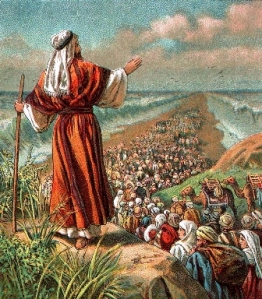
Bible card Illustration published 1907  by Providence Lithograph Company

Bible card Illustration published 1907
by Providence Lithograph Company

Last week, in our Old Testament Study, we looked at the Song of Moses and how it served as a model for true worship and thanksgiving to our Heavenly Father.

As a quick review, the nation of Israel has been led out of Egypt. By the Mighty Hand of God Pharoah was utterly defeated and put to open shame before the nations as his army was utterly destroyed by God who parted the Red Sea for His people and then closed upon the Egyptian Army. In the aftermath of that destruction, the nation of Israel praised God and they sang the Song of Moses, praising God for His might work of Salvation. A song that we, too, will sing standing along the shores of the great sea of glass mingled with fire (Revelation 15), praising God for His work of Salvation.

The Provision of God

Now, Israel is truly free from the slavery of Egypt. They are separated from the house of slavery by the waters that God had used to crush the Egyptian army. Though they have been delivered out of the hands of Pharaoh and are now clearly under the protection of the One True God (who could deny His Mighty Works?) under the supervision of Moses. While we might be tempted to simply read on through as though reading a novel, stop and think about all that has happened. If this were a movie, the ending credits would have been rolling during the Song of Moses and the film would fade to black. But this isn’t a movie, these are real events in history. The biggest question probably in many minds is, “Now what?” As long as Israel is looking at the waters and the floating debris they are thinking about how awesomely God worked to rescue them from that army, but as soon as they turn around, they realize they are not in the Promised Land, they are in-fact in the wilderness. That would be daunting enough a thought if you were standing with your family, extended family, maybe even your church congregation. Do you remember how many people had left Egypt? Let’s turn back to chapter 12 for just a moment:

Exodus 12:37-39 (ESV) 37 And the people of Israel journeyed from Rameses to Succoth, about six hundred thousand men on foot, besides women and children. 38 A mixed multitude also went up with them, and very much livestock, both flocks and herds.39 And they baked unleavened cakes of the dough that they had brought out of Egypt, for it was not leavened, because they were thrust out of Egypt and could not wait, nor had they prepared any provisions for themselves.

Woah! 600,000 men plus women, children, and a mixed multitude and livestock. Remember that livestock was what the sons of Israel noted as their profession when they were given the land of Goshen by Pharaoh in the time of Joseph. Before they were slaves, they were herdsmen.

Genesis 47:1-3 (ESV) | Jacob’s Family Settles in Goshen
47 So Joseph went in and told Pharaoh, “My father and my brothers, with their flocks and herds and all that they possess, have come from the land of Canaan. They are now inthe land of Goshen.” 2 And from among his brothers he took five men and presented them to Pharaoh. 3 Pharaoh said to his brothers, “What is your occupation?” And they said to Pharaoh, “Your servants are shepherds, as our fathers were.

Now they were all on the other side of the Red Sea, in the wilderness, without provisions. They had unleavened bread, but for a people who knew no such luxuries as grocery stores, convenience stores, nor fast-food restaurants, the idea of making provisions for a long journey extend well beyond having some unleavened bread. How do the children of Israel respond? Let us turn now to Exodus 16.

Exodus 16 (ESV) | Bread from Heaven

They set out from Elim, and all the congregation of the people of Israel came to the wilderness of Sin, which is between Elim and Sinai, on the fifteenth day of the second month after they had departed from the land of Egypt. And the whole congregation of the people of Israel grumbled against Moses and Aaron in the wilderness, and the people of Israel said to them, “Would that we had died by the hand of the Lord in the land of Egypt, when we sat by the meat pots and ate bread to the full, for you have brought us out into this wilderness to kill this whole assembly with hunger.”

I’m actually fairly impressed that so many people walking in the wilderness went that long (2.5 months?) on the scant provisions they had left Egypt with. Nevertheless, they burn through what little they had from Egypt and by now the Mighty Hand of God was sooo 2 months ago. Do people evolve? No, no we don’t. Our technology might, but we don’t. The whole congregation grumbled against Moses and Aaron. And what are they saying? Would that we had died by the hand of the Lord in the land of Egypt, when we sat by the meat pots and ate bread to the full… our fallen flesh is so weak and completely turned in on itself. They would rather die in slavery with full stomachs than be free, following Moses toward the Land of Promise on an empty stomach. Not only that, but they accuse Moses and Aaron of malice, having brought all of these people into the wilderness to die of hunger. They’ve lost sight of the Promise, and long for what used to be considered comfort… in the house of slavery. In the Parable of the Sower, the children of Israel here are demonstrating the rocky soil, Matthew 13:21 (ESV)21 yet he has no root in himself, but endures for a while, and when tribulation or persecution arises on account of the word, immediately he falls away.” We mentioned it before when Israel thought they were going to get slaughtered by Pharaoh’s army, but now their hunger is what has them falling away, losing their faith in the Promise.

Then the Lord said to Moses, “Behold, I am about to rain bread from heaven for you, and the people shall go out and gather a day’s portion every day, that I may test them, whether they will walk in my law or not. On the sixth day, when they prepare what they bring in, it will be twice as much as they gather daily.” So Moses and Aaron said to all the people of Israel, “At evening you shall know that it was the Lord who brought you out of the land of Egypt, and in the morning you shall see the glory of the Lord, because he has heard your grumbling against the Lord. For what are we, that you grumble against us?” And Moses said, “When the Lord gives you in the evening meat to eat and in the morning bread to the full, because the Lord has heard your grumbling that you grumble against him—what are we? Your grumbling is not against us but against the Lord.”

So, hold on just a second… the Law has not yet been officially given. I’m not saying God hasn’t revealed His laws, or statutes, but when we currently talk about the Law, we look back to when God gives Moses the Law on the tablets of the Testimony on Mount Sinai. But in this story we have not yet reached Mount Sinai. God has issued commands and in this new command God specifies that He is testing His people, the ones He has already pulled out of Egypt, whether they will walk in His Law or not. God already knows the hearts of every person, He’s not testing for His sake, but for ours. What is the purpose of the Law? To expose sin. No one will walk in His Law until Jesus Christ comes to fulfill the Law for us. Here we see the first Law regarding the Sabbath, and it comes in reference to the provision of the Lord God. God will rain down bread from heaven, to meet their needs for the day, until the 6th day, where they will receive a double portion.

Then Moses said to Aaron, “Say to the whole congregation of the people of Israel, ‘Come near before the Lord, for he has heard your grumbling.’” 10 And as soon as Aaron spoke to the whole congregation of the people of Israel, they looked toward the wilderness, and behold, the glory of the Lord appeared in the cloud. 11 And the Lord said to Moses, 12 “I have heard the grumbling of the people of Israel. Say to them, ‘At twilight you shall eat meat, and in the morning you shall be filled with bread. Then you shall know that I am the Lord your God.’

13 In the evening quail came up and covered the camp, and in the morning dew lay around the camp. 14 And when the dew had gone up, there was on the face of the wilderness a fine, flake-like thing, fine as frost on the ground. 15 When the people of Israel saw it, they said to one another, “What is it?” For they did not know what it was. And Moses said to them, “It is the bread that the Lord has given you to eat. 16 This is what the Lord has commanded: ‘Gather of it, each one of you, as much as he can eat. You shall each take an omer, according to the number of the persons that each of you has in his tent.’” 17 And the people of Israel did so. They gathered, some more, some less. 18 But when they measured it with an omer, whoever gathered much had nothing left over, and whoever gathered little had no lack. Each of them gathered as much as he could eat.19 And Moses said to them, “Let no one leave any of it over till the morning.” 20 But they did not listen to Moses. Some left part of it till the morning, and it bred worms and stank. And Moses was angry with them. 21 Morning by morning they gathered it, each as much as he could eat; but when the sun grew hot, it melted.

22 On the sixth day they gathered twice as much bread, two omers each. And when all the leaders of the congregation came and told Moses, 23 he said to them, “This is what the Lord has commanded: ‘Tomorrow is a day of solemn rest, a holy Sabbath to the Lord; bake what you will bake and boil what you will boil, and all that is left over lay aside to be kept till the morning.’” 24 So they laid it aside till the morning, as Moses commanded them, and it did not stink, and there were no worms in it. 25 Moses said, “Eat it today, fortoday is a Sabbath to the Lord; today you will not find it in the field. 26 Six days you shall gather it, but on the seventh day, which is a Sabbath, there will be none.”

The Lord will provide for His people, so that they will know that He is the Lord their God. They needed to let go of Egypt. They were free from the house of slavery, by a Mighty Hand of God, but their hearts still turned toward Egypt whenever they grumbled against the Lord. God now demonstrates His superior greatness by raining bread from heaven to meet all of their needs. Those who gathered much did not have excess and those who gathered little lacked nothing. How were they performing in their test? Not well. A stark reminder that our sinful state isn’t just a matter of a lack of effort or knowledge, it is a failure in our being, our flesh is cursed by sin, and we have fallen away from the perfection of God.

27 On the seventh day some of the people went out to gather, but they found none. 28 And the Lord said to Moses, “How long will you refuse to keep my commandments and my laws? 29 See! The Lord has given you the Sabbath; therefore on the sixth day he gives you bread for two days. Remain each of you in his place; let no one go out of his place on the seventh day.” 30 So the people rested on the seventh day.

Notice the wording God used in his rebuke directed at the people in verse 29, “the Lord has given you the Sabbath”. Let’s jump ahead at how Jesus responded to the Pharisees who accused Jesus and His disciples of breaking the Sabbath according to their tradition.

Mark 2:27-28 (ESV) 27 And he said to them, “The Sabbath was made for man, not man for the Sabbath. 28 So the Son of Man is lord even of the Sabbath.”

The failure of Israel to obey is foreshadowing the reality that despite the Grace and Mercy of God the Father throughout the history of Israel, man will refuse to keep His commandments and laws. With this question fresh in our minds, let’s take a peek at what Jesus said in Matthew 5:

Matthew 5:17-18 (ESV)| Christ Came to Fulfill the Law
17 “Do not think that I have come to abolish the Law or the Prophets; I have not come to abolish them but to fulfill them. 18 For truly, I say to you, until heaven and earth pass away, not an iota, not a dot, will pass from the Law until all is accomplished.

The Law continues to do what it was intended to do, convict us of sin while testifying of God’s Greatness and Perfection. But Christ came to fulfill the Law and the Prophets, and when He returns all will be accomplished. The keeping the Law is not the means of Salvation; it points out how lost we are. Salvation is by faith in the Promise of God. The Apostle Paul lays this out very well in Romans (particularly the first 8 chapters), but let us look at just a portion for now.

Romans 3:19-31 (ESV) | The Righteousness of God Through Faith
19 Now we know that whatever the law says it speaks to those who are under the law, so that every mouth may be stopped, and the whole world may be held accountable to God.20 For by works of the law no human being will be justified in his sight, since through the law comes knowledge of sin.

21 But now the righteousness of God has been manifested apart from the law, although the Law and the Prophets bear witness to it— 22 the righteousness of God through faith in Jesus Christ for all who believe. For there is no distinction: 23 for all have sinned and fall short of the glory of God, 24 and are justified by his grace as a gift, through the redemption that is in Christ Jesus, 25 whom God put forward as a propitiation by his blood, to be received by faith. This was to show God’s righteousness, because in his divine forbearance he had passed over former sins. 26 It was to show his righteousness at the present time, so that he might be just and the justifier of the one who has faith in Jesus.

27 Then what becomes of our boasting? It is excluded. By what kind of law? By a law of works? No, but by the law of faith. 28 For we hold that one is justified by faith apart from works of the law. 29 Or is God the God of Jews only? Is he not the God of Gentiles also? Yes, of Gentiles also, 30 since God is one—who will justify the circumcised by faith and the uncircumcised through faith. 31 Do we then overthrow the law by this faith? By no means! On the contrary, we uphold the law.

We will jump more heavily into Hebrews and in Romans once we reach the Law given at Horeb (Mt Sinai), but for now, let us close out Exodus chapter 16.

Exodus 16:31-36 (ESV)

31 Now the house of Israel called its name manna. It was like coriander seed, white, and the taste of it was like wafers made with honey. 32 Moses said, “This is what the Lord has commanded: ‘Let an omer of it be kept throughout your generations, so that they may see the bread with which I fed you in the wilderness, when I brought you out of the land of Egypt.’” 33 And Moses said to Aaron, “Take a jar, and put an omer of manna in it, and place it before the Lord to be kept throughout your generations.” 34 As the Lord commanded Moses, so Aaron placed it before the testimony to be kept. 35 The people of Israel ate the manna forty years, till they came to a habitable land. They ate the manna till they came to the border of the land of Canaan. 36 (An omer is the tenth part of an ephah.)

I love how this reminder of what God had done for Israel, this miraculous provision doesn’t point backward to Egypt, rather, it points forward to Christ. So often we get this wrong picture in our minds that sharing a testimony involves highlighting the sin in our lives “before we were Saved”, but that only glorifies Egypt, the house of slavery. The testimony that matters, is the one that points to Christ. In closing, let us turn now to John 6, where Jesus taught us how to rightly understand what God was doing here in Exodus 16.

John 6:26-71 (ESV)26 Jesus answered them, “Truly, truly, I say to you, you are seeking me, not because you saw signs, but because you ate your fill of the loaves. 27 Do not work for the food that perishes, but for the food that endures to eternal life, which the Son of Man will give to you. For on him God the Father has set his seal.” 28 Then they said to him, “What must we do, to be doing the works of God?” 29 Jesus answered them, “This is the work of God, that you believe in him whom he has sent.” 30 So they said to him, “Then what sign do you do, that we may see and believe you? What work do you perform? 31 Our fathers ate the manna in the wilderness; as it is written, ‘He gave them bread from heaven to eat.’”32 Jesus then said to them, “Truly, truly, I say to you, it was not Moses who gave you the bread from heaven, but my Father gives you the true bread from heaven. 33 For the bread of God is he who comes down from heaven and gives life to the world.” 34 They said to him, “Sir, give us this bread always.”

35 Jesus said to them, “I am the bread of life; whoever comes to me shall not hunger, and whoever believes in me shall never thirst. 36 But I said to you that you have seen me and yet do not believe. 37 All that the Father gives me will come to me, and whoever comes to me I will never cast out. 38 For I have come down from heaven, not to do my own will but the will of him who sent me. 39 And this is the will of him who sent me, that I should lose nothing of all that he has given me, but raise it up on the last day. 40 For this is the will of my Father, that everyone who looks on the Son and believes in him should have eternal life, and I will raise him up on the last day.”

41 So the Jews grumbled about him, because he said, “I am the bread that came down from heaven.” 42 They said, “Is not this Jesus, the son of Joseph, whose father and mother we know? How does he now say, ‘I have come down from heaven’?” 43 Jesus answered them, “Do not grumble among yourselves. 44 No one can come to me unless the Father who sent me draws him. And I will raise him up on the last day. 45 It is written in the Prophets, ‘And they will all be taught by God.’ Everyone who has heard and learned from the Father comes to me— 46 not that anyone has seen the Father except he who is from God; he has seen the Father. 47 Truly, truly, I say to you, whoever believes has eternal life. 48 I am the bread of life. 49 Your fathers ate the manna in the wilderness, and they died. 50 This is the bread that comes down from heaven, so that one may eat of it and not die. 51 I am the living bread that came down from heaven. If anyone eats of this bread, he will live forever. And the bread that I will give for the life of the world is my flesh.

52 The Jews then disputed among themselves, saying, “How can this man give us his flesh to eat?” 53 So Jesus said to them, “Truly, truly, I say to you, unless you eat the flesh of the Son of Man and drink his blood, you have no life in you. 54 Whoever feeds on my flesh and drinks my blood has eternal life, and I will raise him up on the last day. 55 For my flesh is true food, and my blood is true drink. 56 Whoever feeds on my flesh and drinks my blood abides in me, and I in him. 57 As the living Father sent me, and I live because of the Father, so whoever feeds on me, he also will live because of me. 58 This is the bread that came down from heaven, not like the bread the fathers ate, and died. Whoever feeds on this bread will live forever.” 59 Jesus said these things in the synagogue, as he taught at Capernaum.

60 When many of his disciples heard it, they said, “This is a hard saying; who can listen to it?” 61 But Jesus, knowing in himself that his disciples were grumbling about this, said to them, “Do you take offense at this? 62 Then what if you were to see the Son of Man ascending to where he was before? 63 It is the Spirit who gives life; the flesh is no help at all. The words that I have spoken to you are spirit and life. 64 But there are some of you who do not believe.” (For Jesus knew from the beginning who those were who did not believe, and who it was who would betray him.) 65 And he said, “This is why I told you that no one can come to me unless it is granted him by the Father.”

66 After this many of his disciples turned back and no longer walked with him. 67 So Jesus said to the Twelve, “Do you want to go away as well?” 68 Simon Peter answered him, “Lord, to whom shall we go? You have the words of eternal life, 69 and we have believed, and have come to know, that you are the Holy One of God.” 70 Jesus answered them, “Did I not choose you, the Twelve? And yet one of you is a devil.” 71 He spoke of Judas the son of Simon Iscariot, for he, one of the Twelve, was going to betray him.

I know we took this well beyond our target word limit, but I firmly believe this was well worth it. What we feast on here is the Word of God, the Words of Life, the Testimony and the Gospel of Jesus Christ, Son of the Living God, our Savior and Our Lord. He is the mana from Heaven, who ascended back into Heaven and who is returning to take His people to the Promised Land, where we will be with Him forever, Amen.

1 Thessalonians 4:13-18 (ESV)| The Coming of the Lord
13 But we do not want you to be uninformed, brothers, about those who are asleep, that you may not grieve as others do who have no hope. 14 For since we believe that Jesus died and rose again, even so, through Jesus, God will bring with him those who have fallen asleep. 15 For this we declare to you by a word from the Lord, that we who are alive, who are left until the coming of the Lord, will not precede those who have fallen asleep. 16 For the Lord himself will descend from heaven with a cry of command, with the voice of an archangel, and with the sound of the trumpet of God. And the dead in Christ will rise first. 17 Then we who are alive, who are left, will be caught up together with them in the clouds to meet the Lord in the air, and so we will always be with the Lord. 18 Therefore encourage one another with these words.

May the Grace of God be with you today and forever,
In Christ Jesus,
Jorge