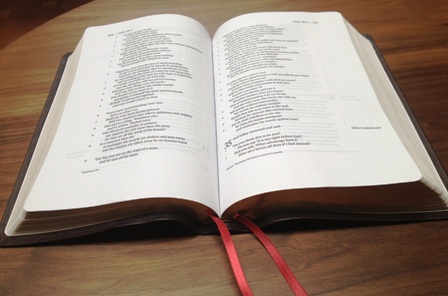
Gospel Wednesday | Matthew 4:1-11

bibleLast week, we looked at the Baptism of Jesus by John the Baptist, and we saw how God the Holy Spirit descended upon Jesus and all who were there heard the voice of God the Father testifying of Jesus. What takes place next is titled “The Temptation of Jesus”. Let’s take a look at this encounter with the enemy and see what Scripture is telling us.

Matthew 4:1-11 (ESV) | The Temptation of Jesus

Then Jesus was led up by the Spirit into the wilderness to be tempted by the devil. And after fasting forty days and forty nights, he was hungry. And the tempter came and said to him, “If you are the Son of God, command these stones to become loaves of bread.” But he answered, “It is written,

“‘Man shall not live by bread alone,
    but by every word that comes from the mouth of God.’”

Then the devil took him to the holy city and set him on the pinnacle of the temple and said to him, “If you are the Son of God, throw yourself down, for it is written,

“‘He will command his angels concerning you,’

and

“‘On their hands they will bear you up,
    lest you strike your foot against a stone.’”

Jesus said to him, “Again it is written, ‘You shall not put the Lord your God to the test.’” Again, the devil took him to a very high mountain and showed him all the kingdoms of the world and their glory. And he said to him, “All these I will give you, if you will fall down and worship me.” 10 Then Jesus said to him,“Be gone, Satan! For it is written,

“‘You shall worship the Lord your God
    and him only shall you serve.’”

11 Then the devil left him, and behold, angels came and were ministering to him.

Amen. So what we have here is the conclusion of a 40-day battle. Jesus, the Son of God, being filled with the Holy Spirit was led into the wilderness specifically to be tempted by the devil. He never knew sin, but he was about to know weakness and temptation fully, without falling to it. Is this the only time Jesus is tempted? I think not, but this is the primary battle with temptation directly from Satan, the father of lies. I believe later Jesus continues to be tempted by the weakness of the flesh, my mind jumping directly to His prayer in the Garden of Gethsemane, “My Father, if it be possible, let this cup pass from me; nevertheless, not as I will, but as you will.” Jesus never sinned, but it wasn’t for a lack of temptation. In our text for today, we see 3 specific temptations crafted by the devil to attack Jesus. We will look at each temptation individually and then collectively to identify what is going on here.

If you are the Son of God, command these stones…

Right out of the gate, Satan attacks the deity of Jesus Christ in light of His humanity. Yes, Jesus is hungry after His 40-day fast, but that is not the full extent of this particular temptation. Matthew is writing to a Jewish crowd, and the significance of the 40 days in the wilderness pointing to the 40 years that Israel wandered in the desert is plain. However, Satan didn’t challenge Jesus to rain manna from heaven nor did he urge Him to make water spring from a rock. Where did this stones to bread come from? I believe it came from the words of John the Baptist. Why? To point back to the most recent confirmation witness from Heaven that Jesus was indeed the Son of God. Let’s review what John the Baptist was preaching before Jesus presented Himself to him.

Matthew 3:7-12 (ESV) But when he saw many of the Pharisees and Sadducees coming to his baptism, he said to them, “You brood of vipers! Who warned you to flee from the wrath to come? Bear fruit in keeping with repentance. And do not presume to say to yourselves, ‘We have Abraham as our father,’ for I tell you, God is able from these stones to raise up children for Abraham. 10 Even now the axe is laid to the root of the trees. Every tree therefore that does not bear good fruit is cut down and thrown into the fire. 11 “I baptize you with water for repentance, but he who is coming after me is mightier than I, whose sandals I am not worthy to carry. He will baptize you with the Holy Spirit and fire. 12 His winnowing fork is in his hand, and he will clear his threshing floor and gather his wheat into the barn, but the chaff he will burn with unquenchable fire.”

Satan’s temptation is to have Jesus demonstrate is Deity by satisfying His flesh. When you think about it… it doesn’t really square. Remember, Satan is the father of lies. Remember the lie in the Garden, “…and you will be like God…” (Genesis 3).

It is actually Jesus who refers back to the Law in Deuteronomy to refute Satan. Let us look at the reference.

Deuteronomy 8:1-3 (ESV) “The whole commandment that I command you today you shall be careful to do, that you may live and multiply, and go in and possess the land that the Lord swore to give to your fathers. And you shall remember the whole way that the Lord your God has led you these forty years in the wilderness, that he might humble you, testing you to know what was in your heart, whether you would keep his commandments or not. And he humbled you and let you hunger and fed you with manna, which you did not know, nor did your fathers know, that he might make you know that man does not live by bread alone, but man lives by every word that comes from the mouth of the Lord.

Amen. It was the Holy Spirit who led Him into the wilderness for testing. Jesus was not going to cut it short simply to feed His flesh. His flesh didn’t need bread only, but it would live by every word that comes from the mouth of the Lord. Satan went after the most recent testimony (a fresh word) and Jesus responded in Scripture.

Throw yourself down, for it is written…

Satan knows Scripture, too. Extremely well, in fact, for he is a master at twisting and perverting it and leading man away after idols and doctrines of demons. Satan slams Jesus with a proof-texts from Psalm 91.

Psalm 91:1-13 (ESV)| My Refuge and My Fortress

91 He who dwells in the shelter of the Most High
    will abide in the shadow of the Almighty.
I will say to the Lord, “My refuge and my fortress,
    my God, in whom I trust.”

For he will deliver you from the snare of the fowler
    and from the deadly pestilence.
He will cover you with his pinions,
    and under his wings you will find refuge;
    his faithfulness is a shield and buckler.
You will not fear the terror of the night,
    nor the arrow that flies by day,
nor the pestilence that stalks in darkness,
    nor the destruction that wastes at noonday.

A thousand may fall at your side,
    ten thousand at your right hand,
    but it will not come near you.
You will only look with your eyes
    and see the recompense of the wicked.

Because you have made the Lord your dwelling place—
    the Most High, who is my refuge—
10 no evil shall be allowed to befall you,
    no plague come near your tent.

11 For he will command his angels concerning you
    to guard you in all your ways.
12 On their hands they will bear you up,
    lest you strike your foot against a stone.
13 You will tread on the lion and the adder;
    the young lion and the serpent you will trample underfoot.

This temptation here is where much of the visible, modern-day, seeker-sensitive church resides. It is here where professing Christians no longer know how to read the Bible for what it says, because they’ve grown up feeding on narcissistic eisegesis. They turn to “anointed ones” to hear their lectures and buy up their books to see what “that scripture means for me”. They can’t come to the same conclusions themselves because the texts aren’t about them. It almost sounds right, here. Almost. We know it wasn’t because Jesus quickly dismisses it in a fashion that truly those peddling the Word of Faith heresy should heed.

Deuteronomy 6:13-19 (ESV) 14 You shall not go after other gods, the gods of the peoples who are around you— 15 for the Lord your God in your midst is a jealous God—lest the anger of the Lord your God be kindled against you, and he destroy you from off the face of the earth. 16 You shall not put the Lord your God to the test, as you tested him at Massah. 17 You shall diligently keep the commandments of the Lord your God, and his testimonies and his statutes, which he has commanded you. 18 And you shall do what is right and good in the sight of the Lord, that it may go well with you, and that you may go in and take possession of the good land that the Lord swore to give to your fathers 19 by thrusting out all your enemies from before you, as the Lord has promised.

If you’ve been following our reading of the Book of Hebrews, you will understand that such promises of God point toward Jesus, and that the “good Land” of promise is in-fact pointing to the Kingdom of Heaven. Satan’s final temptation is an attempt to convince Jesus to accept “another way” to accomplish His mission… a shortcut, if you will.

All these I will give you, if…

Satan offered a trade. Jesus would have NONE of it. Jesus declares the truth of the Law in what He would later teach as the First and Greatest Commandment, Deuteronomy 6:4-5;13-14 (ESV) 4 “Hear, O Israel: The Lord our God, the Lord is one. 5 You shall love the Lord your God with all your heart and with all your soul and with all your might….13 It is the Lord your God you shall fear. Him you shall serve and by his name you shall swear. 14 You shall not go after other gods…

Then the devil left Him…

The battle is the Lord’s. By His mighty Hand, He has delivered us from the snare of the fowler. You see, Psalm 91 is true, and it points to Christ and the protection, provision, and life that can be found nowhere else but in Christ Jesus. This life is not our home, this isn’t the promised land… for all of this is temporary.

1 Peter 1:2b-9 (ESV) | Born Again to a Living Hope
2 …May grace and peace be multiplied to you. 3 Blessed be the God and Father of our Lord Jesus Christ! According to his great mercy, he has caused us to be born again to a living hope through the resurrection of Jesus Christ from the dead, 4 to an inheritance that is imperishable, undefiled, and unfading, kept in heaven for you, 5 who by God’s power are being guarded through faith for a salvation ready to be revealed in the last time. 6 In this you rejoice, though now for a little while, if necessary, you have been grieved by various trials, 7 so that the tested genuineness of your faith—more precious than gold that perishes though it is tested by fire—may be found to result in praise and glory and honor at the revelation of Jesus Christ. 8 Though you have not seen him, you love him. Though you do not now see him, you believe in him and rejoice with joy that is inexpressible and filled with glory, 9 obtaining the outcome of your faith, the salvation of your souls.

Amen. May the Lord bless you and keep you in Him until that great day.

In Christ Jesus,
Jorge

Gospel Wednesday | Matthew 3:13 – 17

bibleLast week, we picked up our Gospel Wednesday posts continuing in the Gospel According to Matthew, Chapter 3. After some feedback from my extended family and close friends, we’ve cut back on the amount of Scripture we aim to cover in a single post. While these posts are primarily the result of our family Bible studies, we’d love your feedback to see if we might better present our studies and make them available to you, the reader.

In our last post, we looked John the Baptist and how he fulfilled prophecy as the precursor to the arrival of the Messiah. Today, we will look at the Messiah entering the Account of Matthew continuing to fulfill all righteousness.

Matthew 3:13-17 (ESV) | The Baptism of Jesus

13 Then Jesus came from Galilee to the Jordan to John, to be baptized by him.14 John would have prevented him, saying, “I need to be baptized by you, and do you come to me?” 15 But Jesus answered him, “Let it be so now, for thus it is fitting for us to fulfill all righteousness.” Then he consented. 16 And when Jesus was baptized, immediately he went up from the water, and behold, the heavens were opened to him, and he saw the Spirit of God descending like a dove and coming to rest on him; 17 and behold, a voice from heaven said, “This is my beloved Son, with whom I am well pleased.”

This point has always perplexed me a bit. Why did Jesus need to be baptized? Much false christology has been birthed from bad rationalization of this portion of scripture. Firstly, let’s look at Jesus’s response, “Let it be so now, for thus it is fitting for us to fulfill all righteousness”. If we look for a ceremony of Baptism in the Old Testament that matches what John the Baptist was doing, we won’t find an exact copy. There are ceremonial cleansing laws for going outside the camp, bathing, and washing of garments worn at the time of having become unclean, but these on their own don’t fully define what John was doing. All of Jerusalem were coming out to John the Baptist confessing sins and being baptized for the forgiveness of sins, they weren’t going out there because they had touched a dead body or an unclean animal per se. The baptism for the forgiveness of sins what the ceremonial cleansing laws were pointing forward to, not the other way around. When John was baptizing by water, he also pointed forward to the one who would come after him to baptize by the Holy Spirit and with fire. Now that He has arrived on the scene, He is asking John to baptize Him for the sake of fulfilling all righteousness. At this command, John concedes. Jesus had no sins to confess or need for repentance, He was blameless.

One way to look at this comes from our having been blessed with the complete written Word of God so we can draw from Paul’s second letter to the church in Corinth:

2 Corinthians 5:16-21 (ESV) 16 From now on, therefore, we regard no one according to the flesh. Even though we once regarded Christ according to the flesh, we regard him thus no longer. 17 Therefore, if anyone is in Christ, he is a new creation. The old has passed away; behold, the new has come. 18 All this is from God, who through Christ reconciled us to himself and gave us the ministry of reconciliation; 19 that is, in Christ God was reconciling the world to himself, not counting their trespasses against them, and entrusting to us the message of reconciliation.20 Therefore, we are ambassadors for Christ, God making his appeal through us. We implore you on behalf of Christ, be reconciled to God. 21 For our sake he made him to be sin who knew no sin, so that in him we might become the righteousness of God.

Christ shed his blood on that cross as the ultimate payment for our sins, and now we join with Christ via Baptism. The Apostle Peter taught of water baptism in this way. Another way of looking at this which comes from a typological view of Scripture is to see that Jesus is Israel in the flesh. We know that Jesus is the very fulfillment of the Law and the Prophets. In Him, was the whole of the Scriptures fulfilled. We understand this from the clear teaching in the book of Hebrews. With this view in mind, let us turn to Ezekiel, chapter 36.

Ezekiel 36:22-32 (ESV) | I Will Put My Spirit Within You
22 “Therefore say to the house of Israel, Thus says the Lord God: It is not for your sake, O house of Israel, that I am about to act, but for the sake of my holy name, which you have profaned among the nations to which you came. 23 And I will vindicate the holiness of my great name, which has been profaned among the nations, and which you have profaned among them. And the nations will know that I am the Lord, declares the Lord God, when through you I vindicate my holiness before their eyes. 24 I will take you from the nations and gather you from all the countries and bring you into your own land. 25 I will sprinkle clean water on you, and you shall be clean from all your uncleannesses, and from all your idols I will cleanse you. 26 And I will give you a new heart, and a new spirit I will put within you. And I will remove the heart of stone from your flesh and give you a heart of flesh. 27 And I will put my Spirit within you, and cause you to walk in my statutes and be careful to obey my rules. 28 You shall dwell in the land that I gave to your fathers, and you shall be my people, and I will be your God. 29 And I will deliver you from all your uncleannesses. And I will summon the grain and make it abundant and lay no famine upon you. 30 I will make the fruit of the tree and the increase of the field abundant, that you may never again suffer the disgrace of famine among the nations. 31 Then you will remember your evil ways, and your deeds that were not good, and you will loathe yourselves for your iniquities and your abominations. 32 It is not for your sake that I will act, declares the Lord God; let that be known to you. Be ashamed and confounded for your ways, O house of Israel.

Now this prophecy pointed both to God’s bringing Israel out of the Exile into Babylon, but also points to the greater promise of the Messiah, a promise initially made in the Garden, when God said that the seed of woman would crush the head of the serpent. Jesus bore no uncleaness in His person, for He is the Word, God the Son; however, the Word became flesh to stand in our place. He fulfilled the Law and the Prophets on behalf of Israel, the Children of God. Wonderful stuff. Before we move on, I’d like to point out how Jesus brought up this baptism to the Pharisees when they questioned His authority.

Matthew 21:23-27 (ESV) | The Authority of Jesus Challenged
23 And when he entered the temple, the chief priests and the elders of the people came up to him as he was teaching, and said, “By what authority are you doing these things, and who gave you this authority?” 24 Jesus answered them, “I also will ask you one question, and if you tell me the answer, then I also will tell you by what authority I do these things. 25 The baptism of John, from where did it come? From heaven or from man?” And they discussed it among themselves, saying, “If we say, ‘From heaven,’ he will say to us, ‘Why then did you not believe him?’ 26 But if we say, ‘From man,’ we are afraid of the crowd, for they all hold that John was a prophet.” 27 So they answered Jesus, “We do not know.” And he said to them, “Neither will I tell you by what authority I do these things.

Jesus is clearly placing the Baptism of John as a Divinely inspired act. God is the author of the Baptism, not John. This is why I can say that the cleansing laws pointed forward to this Baptism and not the other way around.

As we continue in the Matthew 3 text, notice that the Spirit of God descends upon Jesus immediately following His baptism. This is why we went to the prophecy in Ezekiel, though we could find other references. God’s promise to send His spirit upon the righteous is being fulfilled here in Matthew 3. This promise is made available to all who believe in Him and are baptized in His name, just as Peter told his audience in Acts 2:36-41. Not only did the witnesses see the Heavens opened up to Jesus, and the Spirit of God descending upon Him, God the Father gave an audible testimony of Jesus as the Christ, “This is my beloved Son, with whom I am well pleased.

Next week, we will take a look at the battle fought out in the wilderness where the Holy Spirit of God led Jesus.

Colossians 3:16-17 (ESV) 16 Let the word of Christ dwell in you richly, teaching and admonishing one another in all wisdom, singing psalms and hymns and spiritual songs, with thankfulness in your hearts to God. 17 And whatever you do, in word or deed, do everything in the name of the Lord Jesus, giving thanks to God the Father through him.

In Christ Jesus,
Jorge

Gospel Wednesday | Matthew 3:1-12

bibleIt has been quite the time away from posting. We were greatly blessed with extended family time. It was a time of fellowship and adventure for our little ones.

Regarding Faithful Stewardship, some of the feedback we’ve received was that there was simply too much volume on a daily basis, that the posts were just so long that folks felt they didn’t have enough time to get into a serious read. I can definitely understand that sentiment. We discussed possibly moving the Biblical text to end-note references or hyperlinks, but I don’t want to highlight my own words so much as God’s Word. Therefore, we will simply try break up how much text we are covering in a single post. Picking up where we left off in our Gospel Wednesday posts, we will return to the Gospel According to Matthew, Chapter 3.

Matthew 3 (ESV)

John the Baptist Prepares the Way

In those days John the Baptist came preaching in the wilderness of Judea,“Repent, for the kingdom of heaven is at hand.” For this is he who was spoken of by the prophet Isaiah when he said,

“The voice of one crying in the wilderness:
‘Prepare the way of the Lord;
    make his paths straight.’”

Now John wore a garment of camel’s hair and a leather belt around his waist, and his food was locusts and wild honey. Then Jerusalem and all Judea and all the region about the Jordan were going out to him, and they were baptized by him in the river Jordan, confessing their sins.

But when he saw many of the Pharisees and Sadducees coming to his baptism, he said to them, “You brood of vipers! Who warned you to flee from the wrath to come? Bear fruit in keeping with repentance. And do not presume to say to yourselves, ‘We have Abraham as our father,’ for I tell you, God is able from these stones to raise up children for Abraham. 10 Even now the axe is laid to the root of the trees. Every tree therefore that does not bear good fruit is cut down and thrown into the fire.

11 “I baptize you with water for repentance, but he who is coming after me is mightier than I, whose sandals I am not worthy to carry. He will baptize you with the Holy Spirit and fire. 12 His winnowing fork is in his hand, and he will clear his threshing floor and gather his wheat into the barn, but the chaff he will burn with unquenchable fire.”

Those of you who attend liturgical churches probably already dug into this text during Advent (the season before Christmas). We looked at the prophesy regarding John in our examination of just what Mary might have known. There are some curious descriptions of John that bear mentioning, particularly given that Matthew’s primary audience was the Jewish believer. Mathew’s account begins with Joseph and his dreams (reminiscent of Joseph, the son of Isaac/Israel), and here we see John the Baptist described in verse 4, “Now John wore a garment of camel’s hair and a leather belt around his waist, and his food was locusts and wild honey.” Interesting what God the Holy Spirit prompted Matthew to write here. Remember in Luke 1:17, the angel Gabriel told Zechariah regarding John “and he will go before him in the spirit and power of Elijah, to turn the hearts of the fathers to the children, and the disobedient to the wisdom of the just, to make ready for the Lord a people prepared“. Could Matthew’s description of John the Baptist be a sign or a reminder to the people of Elijah?

2 Kings 1:1-8 (ESV)

Elijah Denounces Ahaziah

After the death of Ahab, Moab rebelled against Israel.

Now Ahaziah fell through the lattice in his upper chamber in Samaria, and lay sick; so he sent messengers, telling them, “Go, inquire of Baal-zebub, the god of Ekron, whether I shall recover from this sickness.” But the angel of the Lordsaid to Elijah the Tishbite, “Arise, go up to meet the messengers of the king of Samaria, and say to them, ‘Is it because there is no God in Israel that you are going to inquire of Baal-zebub, the god of Ekron? Now therefore thus says the Lord, You shall not come down from the bed to which you have gone up, but you shall surely die.’” So Elijah went.

The messengers returned to the king, and he said to them, “Why have you returned?” And they said to him, “There came a man to meet us, and said to us, ‘Go back to the king who sent you, and say to him, Thus says the Lord, Is it because there is no God in Israel that you are sending to inquire of Baal-zebub, the god of Ekron? Therefore you shall not come down from the bed to which you have gone up, but you shall surely die.’” He said to them, “What kind of man was he who came to meet you and told you these things?” They answered him, “He wore a garment of hair, with a belt of leather about his waist.” And he said, “It is Elijah the Tishbite.”

Very interesting. Yes, God’s word is revealing that John the Baptist had indeed come onto the scene in the spirit and power of Elijah. I find it interesting, too, that in the 2 Kings account above, Elijah shows up unannounced, declaring a word of rebuke for the sin of idolatry. Ahaziah didn’t send for a Prophet of the Lord God; rather, he sent for a word from a mute idol. Judgement was coming, and the Lord God sent His servant, Elijah. But the occasion for John the Baptist was different… he was preaching repentance and preparing the way for the Messiah, the Christ. John baptized with water, but the Messiah would baptize with the Holy Spirit and with Fire.

Another interesting note from Matthew’s description of John the Baptist is that his food was locusts and wild honey. As odd as such a diet might seem, it met the Levitical standard for clean food.

Leviticus 11:20-23 (ESV)

20 “All winged insects that go on all fours are detestable to you. 21 Yet among the winged insects that go on all fours you may eat those that have jointed legs above their feet, with which to hop on the ground.22 Of them you may eat: the locust of any kind, the bald locust of any kind, the cricket of any kind, and the grasshopper of any kind.23 But all other winged insects that have four feet are detestable to you.

Now that Christ declared all foods clean, we needn’t worry too much about the culinary restrictions of the Mosaic covenant, but understand that this took place before Christ had done so, and any uncleanness on the part of John the Baptist would have disqualified him as a Prophet of God, especially in his baptism.

When the Pharisees and Sadducees came to John, his words are very direct and ominous. Judgement was being spoken against the leaders. Elijah rebuked the kings of Israel, and John the Baptist rebuked the spiritual leaders of Jerusalem. Elijah pointed Israel back to the Word of God, and John the Baptist prepared the way for the people to see the Word Made Flesh, Jesus Christ.

We will continue working our way through the Gospel according to Matthew next week. Until then, may the Lord Bless you and keep you always.

In Christ Jesus,
Jorge

Christmas | Gospel According to Matthew

bible

As we move into another Christmas season, we plan on working our way through the Book of Matthew for our Gospel Wednesday study.

On a personal note, I dislike referring to this book (and the other three) as “the Gospel of Matthew”. there is only one Gospel, and that is of Jesus Christ, not Matthew, Mark, Luke, or John. Thankfully, I’m not alone in this and when researching the Encyclopedia of the Bible, I found the following discourse on the title of this book:

2. The title. The title of this gospel in most modern Bibles reads, “The Gospel According to St. Matthew.” This wording is an exact tr. of the title in many Gr. MSS which reads Εὐαγγέλιον Κατα Μαθαῖον, “The Gospel According To Matthew.” But the oldest Gr. copies of the gospel have the shortened form, “According to Matthew” (Κατα Μαθαῖον). Most scholars believe the original text had no title at all. When the early Christians wished to distinguish one gospel from another, they called the first gospel not the “Gospel of Matthew,” as we often say, but “The Gospel According to Matthew,” to distinguish it from the other VSS of Mark, Luke and John. There is only one Gospel, but four VSS or accounts of it. The term “Gospel According to Matthew” is, therefore, not the “Good News of Matthew,” but Matthew’s VS of the “Good News from God.” The Gospel is “God’s Story” of salvation and life, the best news story the world has ever heard. The earliest Church Fathers, for example, Irenaeus (a.d. 180), spoke of the fourfold Gospel canon in this manner; that is, that there is only one Gospel according to four different authors (Against Heresies III. 11, 8).

I will be referring to these from now on as The Gospel According to Matthew. Let us turn to the first chapter of Matthew. It is critically important that we remember that Matthew 1 isn’t the beginning of the story of God’s relationship with His Creation, it is in-fact the start of the final chapter, the last days. God is bringing about the fulfillment of His promise to crush the head of the serpent back in Genesis 3. Let that sink in… while it might be said that for the Gentile everything begins at the Gospel of Jesus Christ and then we have to learn the Law to grow in our faith in God; for Israel, God’s chosen ones, they are awaiting the promised Messiah.

Matthew 1 (ESV)

The Genealogy of Jesus Christ

The book of the genealogy of Jesus Christ, the son of David, the son of Abraham.

Abraham was the father of Isaac, and Isaac the father of Jacob, and Jacob the father of Judah and his brothers, and Judah the father of Perez and Zerah by Tamar, and Perez the father of Hezron, and Hezron the father of Ram, and Ram the father of Amminadab, and Amminadab the father of Nahshon, and Nahshon the father of Salmon, and Salmon the father of Boaz by Rahab, and Boaz the father of Obed by Ruth, and Obed the father of Jesse, and Jesse the father of David the king.

And David was the father of Solomon by the wife of Uriah, and Solomon the father of Rehoboam, and Rehoboam the father of Abijah, and Abijah the father of Asaph, and Asaph the father of Jehoshaphat, and Jehoshaphat the father of Joram, and Joram the father of Uzziah, and Uzziah the father of Jotham, and Jotham the father of Ahaz, and Ahaz the father of Hezekiah, 10 and Hezekiah the father of Manasseh, and Manasseh the father of Amos, and Amos the father of Josiah, 11 and Josiah the father of Jechoniah and his brothers, at the time of the deportation to Babylon.

12 And after the deportation to Babylon: Jechoniah was the father of Shealtiel,and Shealtiel the father of Zerubbabel, 13 and Zerubbabel the father of Abiud, and Abiud the father of Eliakim, and Eliakim the father of Azor, 14 and Azor the father of Zadok, and Zadok the father of Achim, and Achim the father of Eliud,15 and Eliud the father of Eleazar, and Eleazar the father of Matthan, and Matthan the father of Jacob, 16 and Jacob the father of Joseph the husband of Mary, of whom Jesus was born, who is called Christ.

17 So all the generations from Abraham to David were fourteen generations, and from David to the deportation to Babylon fourteen generations, and from the deportation to Babylon to the Christ fourteen generations.

I don’t want to get into the weeds in this geneology, but this was recorded for a purpose, for God the Holy Spirit’s purpose. For now, I want to highlight that Matthew was being very intentional here to point out how perfectly Christ completes God’s Promise to Abraham. He points out the following:

Abraham –  King David – Babylonian Exile – Christ

 God promised Abraham the land of Canaan, and King David ruled over it, but Israel fell away after David, and were sent into Exile. God promised Israel that He would send an Anointed One (Messiah / Christ) to sit on the Throne of David again… and He sent His One and Only Son, Jesus. I feel this is significant for understanding the framework of Matthew’s narrative, considering that the Gospel According to John began “in the Beginning was the Word…”, focusing on the Deity of Christ from before Creation.

Matthew 1 | The Birth of Jesus Christ

18 Now the birth of Jesus Christ took place in this way. When his mother Mary had been betrothed to Joseph, before they came together she was found to be with child from the Holy Spirit. 19 And her husband Joseph, being a just man and unwilling to put her to shame, resolved to divorce her quietly. 20 But as he considered these things, behold, an angel of the Lord appeared to him in a dream, saying, “Joseph, son of David, do not fear to take Mary as your wife, for that which is conceived in her is from the Holy Spirit. 21 She will bear a son, and you shall call his name Jesus, for he will save his people from their sins.” 22 All this took place to fulfill what the Lord had spoken by the prophet:

23 “Behold, the virgin shall conceive and bear a son,
    and they shall call his name Immanuel”

(which means, God with us). 24 When Joseph woke from sleep, he did as the angel of the Lord commanded him: he took his wife, 25 but knew her not until she had given birth to a son. And he called his name Jesus.

The Gospel according to Luke spent a great deal of time on Mary and the immaculate conception, but here Matthew jumps straight to Joseph. Here, we see Joseph desiring to show mercy to Mary by not putting her to shame. Apart from the intervention of God the Holy Spirit, there was no way for Mary to be pregnant without having had unlawful sex. Joseph is a popular name in this culture, but have you thought about why? Let’s look back in Genesis at one of the patriarchs whose name was Joseph, the son of Jacob/Israel.

Genesis 37:1-3 (ESV) 1 Jacob lived in the land of his father’s sojournings, in the land of Canaan. 2 These are the generations of Jacob. Joseph, being seventeen years old, was pasturing the flock with his brothers. He was a boy with the sons of Bilhah and Zilpah, his father’s wives. And Joseph brought a bad report of them to their father. 3 Now Israel loved Joseph more than any other of his sons, because he was the son of his old age. And he made him a robe of many colors.

Jacob, whose name God changed to Israel, loved Joseph more than any other of his sons. He was a favored son, and he made him a robe of many colors. Fast-forward to Matthew, and we have Joseph, favored of God to serve as an earthly guardian of Mary and Jesus. And the angel of the Lord appeared to Joesph in a dream. No doubt the Jewish readers/hearers of this Gospel account would already be thinking on Joseph. Where did the dreams given to Joseph, son of Jacob, lead him? To Egypt. Eventually God would preserve Israel in the land of Egypt during the 7 year famine. Let’s continue in Matthew where we will see this connection revisited.

Matthew 2 (ESV)

The Visit of the Wise Men

Now after Jesus was born in Bethlehem of Judea in the days of Herod the king, behold, wise men from the east came to Jerusalem, saying, “Where is he who has been born king of the Jews? For we saw his star when it rose and have come to worship him.” 3 When Herod the king heard this, he was troubled, and all Jerusalem with him; and assembling all the chief priests and scribes of the people, he inquired of them where the Christ was to be born. They told him, “In Bethlehem of Judea, for so it is written by the prophet:

“‘And you, O Bethlehem, in the land of Judah,
    are by no means least among the rulers of Judah;
for from you shall come a ruler
    who will shepherd my people Israel.’”

Then Herod summoned the wise men secretly and ascertained from them what time the star had appeared. And he sent them to Bethlehem, saying, “Go and search diligently for the child, and when you have found him, bring me word, that I too may come and worship him.” After listening to the king, they went on their way. And behold, the star that they had seen when it rose went before them until it came to rest over the place where the child was. 10 When they saw the star, they rejoiced exceedingly with great joy. 11 And going into the house they saw the child with Mary his mother, and they fell down and worshiped him. Then, opening their treasures, they offered him gifts, gold and frankincense and myrrh. 12 And being warned in a dream not to return to Herod, they departed to their own country by another way.

So we have the Wise Men from the east coming because they recognized the sign in the heavens, a star, marking the birth of the king of the Jews. Where were they from? Most likely from Babylon, from where Israel spent so much time in Exile (remember how Matthew set apart this event as significant). These wise men were not quoting prophecy as we tend to think of quoting, they were giving their understanding of the meaning of two different prophetic passages (Micah 5:2 and Ezekiel 34:23). Quoting the prophets directly wasn’t necessary given their audience was all of the chief priests and scribes, they needed to convey the interpretation that was undoubtedly revealed to them by God of the fulfillment of these 2 prophetic passages. Reflecting on the life of Joseph, son of Israel, notice that this news troubled Herod and all Jerusalem with him. This is analogous to the response of Joseph’s brothers. Let’s look at some of the their thoughts toward Joseph recorded in Genesis 37 (ESV):

4 But when his brothers saw that their father loved him more than all his brothers, they hated him and could not speak peacefully to him. Now Joseph had a dream, and when he told it to his brothers they hated him even more. He said to them, “Hear this dream that I have dreamed: Behold, we were binding sheaves in the field, and behold, my sheaf arose and stood upright. And behold, your sheaves gathered around it and bowed down to my sheaf.” His brothers said to him, “Are you indeed to reign over us? Or are you indeed to rule over us?” So they hated him even more for his dreams and for his words

18 They saw him from afar, and before he came near to them they conspired against him to kill him. 19 They said to one another, “Here comes this dreamer.20 Come now, let us kill him and throw him into one of the pits. Then we will say that a fierce animal has devoured him, and we will see what will become of his dreams.”

They hated their brother. Herod and all of Jerusalem were troubled by the news of the birth of the king of the Jews. Now, these parallels aren’t provided to suggest that “they should have seen it coming”; rather, they are being examined to point to God and His Sovereignty. Let’s continue in Matthew 2.

Matthew 2 | The Flight to Egypt

13 Now when they had departed, behold, an angel of the Lord appeared to Joseph in a dream and said, “Rise, take the child and his mother, and flee to Egypt, and remain there until I tell you, for Herod is about to search for the child, to destroy him.14 And he rose and took the child and his mother by night and departed to Egypt 15 and remained there until the death of Herod. This was to fulfill what the Lord had spoken by the prophet, “Out of Egypt I called my son.”

Herod Kills the Children

16 Then Herod, when he saw that he had been tricked by the wise men, became furious, and he sent and killed all the male children in Bethlehem and in all that region who were two years old or under, according to the time that he had ascertained from the wise men. 17 Then was fulfilled what was spoken by the prophet Jeremiah:

18 “A voice was heard in Ramah,
    weeping and loud lamentation,
Rachel weeping for her children;
    she refused to be comforted, because they are no more.”

Herod was indeed evil. God warned Joseph in a dream (again) of Herod’s plot to kill Jesus, so Joseph took Mary and Jesus and fled to Egypt until Herod’s death. What I find fascinating here is that Matthew (via the Holy Spirit) points to Jesus as a picture of Israel when he quotes Hosea 11:1 (ESV), When Israel was a child, I loved him, and out of Egypt I called my son”. This is right in line with how we’ve been reading the Exodus account and how it points to Jesus. This is how the Book of Hebrews approaches the message of the Gospel. Hosea was prophetically looking backward to the shadow of Christ in the Nation of Israel, as well as pointing forward to Jesus the Messiah. Praise God. 

Matthew 2 | The Return to Nazareth

19 But when Herod died, behold, an angel of the Lord appeared in a dream to Joseph in Egypt, 20 saying, “Rise, take the child and his mother and go to the land of Israel, for those who sought the child’s life are dead.” 21 And he rose and took the child and his mother and went to the land of Israel. 22 But when he heard that Archelaus was reigning over Judea in place of his father Herod, he was afraid to go there, and being warned in a dream he withdrew to the district of Galilee. 23 And he went and lived in a city called Nazareth, so that what was spoken by the prophets might be fulfilled, that he would be called a Nazarene.

With another dream, Joseph brings his wife and Jesus out of Egypt and settled down in Nazareth. Now, there is no direct quote that I could find pointing to His being called a Nazarene. Again, Matthew seems to be conveying understanding of prophecy (revealed by the Holy Spirit) more than actually quoting it. Being called a Nazarene bore with it some disdain, because there was nothing special about Nazareth, and that was part of God’s point. Let’s look at a few verses that suggest this could be a way of rightly understanding this point.

John 7:40-52 (ESV) | Division Among the People
40 When they heard these words, some of the people said, “This really is the Prophet.” 41 Others said, “This is the Christ.” But some said, “Is the Christ to come from Galilee? 42 Has not the Scripture said that the Christ comes from the offspring of David, and comes from Bethlehem, the village where David was?” 43 So there was a division among the people over him. 44 Some of them wanted to arrest him, but no one laid hands on him. 45 The officers then came to the chief priests and Pharisees, who said to them, “Why did you not bring him?” 46 The officers answered, “No one ever spoke like this man!” 47 The Pharisees answered them, “Have you also been deceived? 48 Have any of the authorities or the Pharisees believed in him? 49 But this crowd that does not know the law is accursed.” 50 Nicodemus, who had gone to him before, and who was one of them, said to them, 51 “Does our law judge a man without first giving him a hearing and learning what he does?” 52 They replied, “Are you from Galilee too? Search and see that no prophet arises from Galilee.”

Had Jesus begun his ministry having grown up in Bethlehem, he would have had instant buy-in. Instead, God chose a different route. Indeed, Jesus was born in Bethlehem, the City of David, but by the time of His ministry He was known as a Galilean, a Nazarene.

John 1:43-51 (ESV) | Jesus Calls Philip and Nathanael
43 The next day Jesus decided to go to Galilee. He found Philip and said to him,“Follow me.” 44 Now Philip was from Bethsaida, the city of Andrew and Peter.45 Philip found Nathanael and said to him, “We have found him of whom Moses in the Law and also the prophets wrote, Jesus of Nazareth, the son of Joseph.” 46 Nathanael said to him, “Can anything good come out of Nazareth?” Philip said to him, “Come and see.” 47 Jesus saw Nathanael coming toward him and said of him, “Behold, an Israelite indeed, in whom there is no deceit!” 48 Nathanael said to him, “How do you know me?” Jesus answered him, “Before Philip called you, when you were under the fig tree, I saw you.” 49 Nathanael answered him,“Rabbi, you are the Son of God! You are the King of Israel!” 50 Jesus answered him, “Because I said to you, ‘I saw you under the fig tree,’ do you believe? You will see greater things than these.” 51 And he said to him, “Truly, truly, I say to you, you will see heaven opened, and the angels of God ascending and descending on the Son of Man.”

Nazareth had a reputation. Even Nathanael, of whom Jesus said, “Behold, an Israelite indeed, in whom there is no deceit!” held an unfavorable view of Nazareth. How does all of this point to what the Prophet said of Jesus? Let’s look to Isaiah 53.

Isaiah 53:3 (ESV) 3 He was despised and rejected by men;
a man of sorrows, and acquainted with grief;
and as one from whom men hide their faces
he was despised, and we esteemed him not.

This was by design, according to His purpose. Jesus humbled Himself in order to redeem mankind. He created all things in the beginning, yet He came to save wicked sinners like you and me. Let us close on this thought, wonderfully conveyed by the Apostle Paul in his letter to the Philippians.

Philippians 2:1-13 (ESV)

Christ’s Example of Humility

So if there is any encouragement in Christ, any comfort from love, any participation in the Spirit, any affection and sympathy, complete my joy by being of the same mind, having the same love, being in full accord and of one mind. Do nothing from selfish ambition or conceit, but in humility count others more significant than yourselves. Let each of you look not only to his own interests, but also to the interests of others. Have this mind among yourselves, which is yours in Christ Jesus, who, though he was in the form of God, did not count equality with God a thing to be grasped, but emptied himself, by taking the form of a servant, being born in the likeness of men.And being found in human form, he humbled himself by becoming obedient to the point of death, even death on a cross. Therefore God has highly exalted him and bestowed on him the name that is above every name, 10 so that at the name of Jesus every knee should bow, in heaven and on earth and under the earth, 11 and every tongue confess that Jesus Christ is Lord, to the glory of God the Father. 12 Therefore, my beloved, as you have always obeyed, so now, not only as in my presence but much more in my absence, work out your own salvation with fear and trembling, 13 for it is God who works in you, both to will and to work for his good pleasure.

Amen.
In Christ Jesus,
Jorge

Gospel Wednesday | Colossians 3-4

bibleAs we continue working through the fundamentals of the Gospel as explained in the New Testament, it is our hope that you will also explore our Old Testament (OT) studies and see how the Bible truly is one complete document, the very Word of God.

Last week we started in Colossians 2. We looked at what it means to be made alive in Christ and how important it is that we not allow false teaching lead us away from Christ and His Gospel. We see Paul progressing in his letter to the church he hadn’t visited in person from the Person of Jesus and the truth of His Gospel as the central focus of the Christian Life. Brothers and sisters, there will be many false teacher majoring in the minor things of life, seeking to profit from you while getting you off-track from the central focus of Christianity… the Gospel of Jesus Christ. There is so much we can dive into in these last two chapters of Colossians, but for now let’s do a high-altitude flyover of the text to see how the Christian life should look. So, without further adieu, let’s continue in our study of Colossians.

Living the Christian Life

Colossians 3 (ESV)

Put On the New Self

If then you have been raised with Christ, seek the things that are above, where Christ is, seated at the right hand of God. Set your minds on things that are above, not on things that are on earth. For you have died, and your life is hidden with Christ in God.When Christ who is your life appears, then you also will appear with him in glory.

Seek the things that are above. This utterly destroys any so-called “prosperity gospel”. Paul isn’t inventing this teaching, either… Jesus taught us to “lay up for yourselves treasures in heaven, where neither moth nor rust destroys and where thieves do not break in and steal (Matthew 6:20)” The Truth of the Gospel is that in Christ we are over-comers… but not as the world defines over-comer with untouchable health, wealth, and prosperity… those are earthy treasures where moth and rust destroy, and thieves steal.

Put to death therefore what is earthly in you: sexual immorality, impurity, passion, evil desire, and covetousness, which is idolatry. On account of these the wrath of God is coming. In these you too once walked, when you were living in them. But now you must put them all away: anger, wrath, malice, slander, and obscene talk from your mouth. Do not lie to one another, seeing that you have put off the old self with its practices 10 and have put on the new self, which is being renewed in knowledge after the image of its creator. 11 Here there is not Greek and Jew, circumcised and uncircumcised, barbarian, Scythian, slave, free; but Christ is all, and in all.

This is the hard part, this is where the Law of God continues to work in us. The purpose of the Law is to convict us of sin… and the wages of sin is death. Now, Christ died as a substitutionary atonement for our sin so that we needn’t fear eternal death, Christ paid that price. However, Jesus told us that to follow him we’ll have to take up our cross (Luke 9:23-27) … we are to die to our sinful natures daily. Notice the wording of the first list “what is earthly in you”. These are the sins of the heart that we’ve inherited in our flesh, born of the seed of Adam. Sexual Immorality is a broad sin… it covers everything that isn’t within God’s design for sexual intimacy which is the union of one man and one woman for life. Any and all deviation from this design is Sexual Immorality. Homosexuality, pre-marital sex, extra-marital sex, rape, incest, adultery… all of it. That’s the first item… impurity, passion, and evil desire are next in the same list… lust, fantasizing of sexual immorality, pornography, emotional intimacy with someone other than your spouse… these are all bad copies/replacements for God’s love for us, how He designed us to love our spouses and how we are to love our brothers and sisters in the Body of Christ. And your flesh craves it all. Paul is urging/reminding his readers that we must put to death that which is sin in our flesh. We do not have the strength (or even the will) to do this apart from faith in Jesus Christ. For in Him we have forgiveness and the hope of resurrection in Christ at the last day. In Him we the genuine article… Love. The second list refers to the corruption of sin in our emotions. Anger for the wrong reasons (sinful selfishness) is a fallen version of righteous anger against sin and unrighteousness. Wrath… it’s not our place. We deserve, have earned, the wrath of God… and Jesus bore the full brunt of God’s Wrath in our stead. Slander has no place in our dealings with brothers and sisters in Christ, they are His children. Slander is pointless with the lost… for they are condemned by their unbelief and destined for destruction. They don’t need slander, they need the Gospel of Jesus Christ… they need Grace… they need Faith. There is no Greek or Jew, there are no haves and have-nots within the Church… we are all equally free in Christ for He is in all who have been Saved by Him.

But the Christian life isn’t just about “thou shalt not”. The Law has both prohibitions and commandments… and in Christ all have been fulfilled. In Christ we are made free to do the works of God. So, while we put to death the sin of our flesh, we should also seek to put on the righteousness of Christ.

12 Put on then, as God’s chosen ones, holy and beloved, compassionate hearts, kindness, humility, meekness, and patience, 13 bearing with one another and, if one has a complaint against another, forgiving each other; as the Lord has forgiven you, so you also must forgive. 14 And above all these put on love, which binds everything together in perfect harmony.15 And let the peace of Christ rule in your hearts, to which indeed you were called in one body. And be thankful.16 Let the word of Christ dwell in you richly, teaching and admonishing one another in all wisdom, singing psalms and hymns and spiritual songs, with thankfulness in your hearts to God.17 And whatever you do, in word or deed, do everything in the name of the Lord Jesus, giving thanks to God the Father through him.

The world specializing in lies. The world will tell you, that you should keep silent regarding their sin or their need for a Savior because in their eyes that’s unloving. They are lying. Some of our Christian brothers and sisters will try to tell you that rebuke for sinful living or false doctrine is unloving, that’s also a lie. Silence in the face of sin is unloving. People don’t stay silent in the face of sin for the sake of the sinner, but for their own sake. Have compassion on those who are trapped in sin, and also for the lowly and the downtrodden, and for those being persecuted for the sake of the Gospel. Speak and walk in kindness, humility, meekness and patience. Remember, there is forgiveness available for us when we fail (and we will fail) and if we keep that in the forefront of our mind then we should also extend forgiveness for others who have wronged us.

This is tough, and it cannot be done out of pride or effort, but only by faith in Christ. The take overall can be quite daunting and if you lose sight of the core of the Gospel, and start buying into false notions of “inner purpose” or “the champion within you” discouragement is inevitable. It’s not about you, it’s about Christ. Start small, start with your family. God instituted the family as a picture of the Kingdom of Heaven.

Rules for Christian Households

18 Wives, submit to your husbands, as is fitting in the Lord. 19 Husbands, love your wives, and do not be harsh with them. 20 Children, obey your parents in everything, for this pleases the Lord. 21 Fathers, do not provoke your children, lest they become discouraged.22 Bondservants, obey in everything those who are your earthly masters, not by way of eye-service, as people-pleasers, but with sincerity of heart, fearing the Lord. 23 Whatever you do, work heartily, as for the Lord and not for men, 24 knowing that from the Lord you will receive the inheritance as your reward. You are serving the Lord Christ. 25 For the wrongdoer will be paid back for the wrong he has done, and there is no partiality.

The first relationship in the family that needs to be set straight is that of husband and wives. It points to the relationship between Christ (husband) and the Church (wife). Children are to obey their parents, fathers are not to provoke their children. Here we have bonservants and masters all included in the household. What took place in the U.S. under slavery was sinful in the sight of the Lord. Don’t let anyone get away with twisting this scripture. The better picture of what this bondservant thing would look like (when done scripturally) would be like Alfred serving Bruce Wayne, or Higgens serving Magnum P.I., or Baileywick serving King Roland. If I’ve managed to miss every pop culture reference that matters to you, then I suppose it would be best to think of this proper bondservant would be a live-in nanny or house keeper. It would also be wise to extend the rules of the master-servant relationship found in the New Testament to the Employer-Employee relationships in business.

Colossians 4 (ESV)

Masters, treat your bondservants justly and fairly, knowing that you also have a Master in heaven.

Further Instructions

Continue steadfastly in prayer, being watchful in it with thanksgiving. At the same time, pray also for us, that God may open to us a door for the word, to declare the mystery of Christ, on account of which I am in prison— that I may make it clear, which is how I ought to speak.

Walk in wisdom toward outsiders, making the best use of the time. Let your speech always be gracious, seasoned with salt, so that you may know how you ought to answer each person.

Notice that this is the first time we have a direct command regarding outsiders or unbelievers. The purpose of the Church is to grow in Christ, to mature the saints. There is a lot of bad theology out there, particularly with a complete misunderstanding of the role of the Church. The purpose of the Church is to mature the saints so they can be edified and grow in the fullness of Christ. We are all called to preach the Gospel of Jesus Christ to the lost, but the role of the Church is to nurture the infants in the faith into men and women of God. The role of the pastor isn’t just to preach the Gospel to the lost… it’s to feed Christ’s sheep… to tend His flock. In his closing remarks, Paul names his fellow workers in Christ… the elders and pastors/teachers. Quite the list of names, because Paul wants this church to know who is faithfully working on their behalf, for the edification of the Church.

Final Greetings

Tychicus will tell you all about my activities. He is a beloved brother and faithful minister and fellow servant in the Lord. I have sent him to you for this very purpose, that you may know how we are and that he may encourage your hearts, and with him Onesimus, our faithful and beloved brother, who is one of you. They will tell you of everything that has taken place here.

10 Aristarchus my fellow prisoner greets you, and Mark the cousin of Barnabas (concerning whom you have received instructions—if he comes to you, welcome him), 11 and Jesus who is called Justus. These are the only men of the circumcision among my fellow workers for the kingdom of God, and they have been a comfort to me. 12 Epaphras, who is one of you, a servant of Christ Jesus, greets you, always struggling on your behalf in his prayers, that you may stand mature and fully assured in all the will of God. 13 For I bear him witness that he has worked hard for you and for those in Laodicea and in Hierapolis.14 Luke the beloved physician greets you, as does Demas. 15 Give my greetings to the brothers at Laodicea, and to Nympha and the church in her house. 16 And when this letter has been read among you, have it also read in the church of the Laodiceans; and see that you also read the letter from Laodicea. 17 And say to Archippus, “See that you fulfill the ministry that you have received in the Lord.”

18 I, Paul, write this greeting with my own hand. Remember my chains. Grace be with you.

Such great love, to take the time to write to this young church whose congregation he never met. Paul loves them, and they are also loved by several other servants of God. This is the role of the pastor/elder. This letter isn’t a long one… and yes, there is more to learn of the mystery of God… but this letter covers the essentials, the supremacy of Christ and the need to guard your doctrine and love your family and the Family of Jesus Christ. In closing, let’s turn to the Apostle Peter’s prayer in his first letter.

1 Peter 4:7-11 (ESV) 7 The end of all things is at hand; therefore be self-controlled and sober-minded for the sake of your prayers. 8 Above all, keep loving one another earnestly, since love covers a multitude of sins. 9 Show hospitality to one another without grumbling. 10 As each has received a gift, use it to serve one another, as good stewards of God’s varied grace:11 whoever speaks, as one who speaks oracles of God; whoever serves, as one who serves by the strength that God supplies—in order that in everything God may be glorified through Jesus Christ. To him belong glory and dominion forever and ever. Amen.

Amen, indeed.
In Christ Jesus,
Jorge