CTT | Mockery is Condemnation

18 century icon painter - Iconostasis of Kizhi monastery, Karelia, Russia

18 century icon painter – Iconostasis of Kizhi monastery, Karelia, Russia

We need to practice Biblical discernment in everything we do. We must share the Truth in Love. Rebuke and Admonition are unpleasant and often despised and resisted. We are often tempted to resort to mockery of those who refuse to repent. When we engage in mockery, we are pronouncing judgment and condemning the object of our mockery. We are no longer seeking repentance from the one being mocked, and this can be problematic even if we are in the right. Today I want to address the topic of bringing correction to those who are stubborn in their sin or false doctrine and reject sound doctrine and what is at stake when we resort to mockery… when we are in the right. A fool mocks from a position of error, and that is not what we will be addressing today.

Elijah Mocked the Prophets of Baal

Yes, he did. Some point to Elijah as their justification for engaging in mockery. I want to take a look at what is happening in context so that there is no mistaking what is going on in the story. To rightly understand the story of Elijah confronting the prophets of Baal, we need to first understand who Ahab was. For that, let’s begin in 1 Kings 16.

1 Kings 16:29-34 (ESV)29 In the thirty-eighth year of Asa king of Judah, Ahab the son of Omri began to reign over Israel, and Ahab the son of Omri reigned over Israel in Samaria twenty-two years. 30 And Ahab the son of Omri did evil in the sight of the Lord, more than all who were before him. 31 And as if it had been a light thing for him to walk in the sins of Jeroboam the son of Nebat, he took for his wife Jezebel the daughter of Ethbaal king of the Sidonians, and went and served Baal and worshiped him. 32 He erected an altar for Baal in the house of Baal, which he built in Samaria. 33 And Ahab made an Asherah. Ahab did more to provoke the Lord, the God of Israel, to anger than all the kings of Israel who were before him. 34 In his days Hiel of Bethel built Jericho. He laid its foundation at the cost of Abiram his firstborn, and set up its gates at the cost of his youngest son Segub, according to the word of the Lord, which he spoke by Joshua the son of Nun.

Now, not to get too sidetracked, did you notice that in the days of Ahab, Hiel built Jericho at the cost of 2 sons? Well, it points all of the way back to the days of Joshua, when the God destroyed Jericho on behalf of His people, Israel. If we turn briefly to Joshua 6.

Joshua 6:26-27 (ESV) 26 Joshua laid an oath on them at that time, saying, “Cursed before the Lord be the man who rises up and rebuilds this city, Jericho. “At the cost of his firstborn shall he lay its foundation, and at the cost of his youngest son shall he set up its gates.” 27 So the Lord was with Joshua, and his fame was in all the land.

Okay, so here we have a wicked King over the northern kingdom of Israel. More wicked than any before him. His wickedness trumps that of Jeroboam in that he takes as a bride the daughter of the king of Sidon. Ahab then worships Baal, builds a temple for Baal in Samaria (the capital city of the northern Kingdom of Israel) and sets up an Asherah. Idolatry. Ahab provoked the Lord, the God of Israel to anger. So God sends His prophet to Ahab.

1 Kings 17:1 (ESV) 17 Now Elijah the Tishbite, of Tishbe in Gilead, said to Ahab, “As the Lord, the God of Israel, lives, before whom I stand, there shall be neither dew nor rain these years, except by my word.”

Now, the story follows Elijah as he goes into hiding while the judgment of the Lord falls upon Israel. Judgement provoked by the sin of Ahab.

1 Kings 18:1-6 (ESV)  18 After many days the word of the Lord came to Elijah, in the third year, saying, “Go, show yourself to Ahab, and I will send rain upon the earth.” 2 So Elijah went to show himself to Ahab. Now the famine was severe in Samaria. 3 And Ahab called Obadiah, who was over the household. (Now Obadiah feared the Lord greatly, 4 and when Jezebel cut off the prophets of the Lord, Obadiah took a hundred prophets and hid them by fifties in a cave and fed them with bread and water.) 5 And Ahab said to Obadiah, “Go through the land to all the springs of water and to all the valleys. Perhaps we may find grass and save the horses and mules alive, and not lose some of the animals.” 6 So they divided the land between them to pass through it. Ahab went in one direction by himself, and Obadiah went in another direction by himself.

Now we see that Jezebel began killing the prophets of the Lord, and Obadiah hid 100 prophets in groups of 50 and fed them in secret. So, not only is Ahab worshiping a false God, his wife had also openly attack the prophets of the Lord God. It had not rained for 3 years, and the famine was rough. While Elijah was indeed a prophet of God, and heard from God directly, the shutting of the sky as a punishment for the sin of Israel is not spontaneous nor should it have been unexpected. Why? Because according to the Law, the Covenant with Moses, God already warned Israel of the punishments or curses for disobedience. We can find it in Deuteronomy 28, but specifically verse 24 states, “The Lord will make the rain of your land powder. From heaven dust shall come down on you until you are destroyed.” So, the Prophet Elijah brought the Word of the Lord to Ahab, and the sign given (lack of rain) points back to the Law of Moses. Ahab doesn’t get, as we’ll see in a moment, but the sign and wonder doesn’t point to Elijah, it points to God. This is Ahab’s first recorded warning, 3 years of drought.

1 Kings 18:17-19 (ESV) 17 When Ahab saw Elijah, Ahab said to him, “Is it you, you troubler of Israel?” 18 And he answered, “I have not troubled Israel, but you have, and your father’s house, because you have abandoned the commandments of the Lord and followed the Baals. 19 Now therefore send and gather all Israel to me at Mount Carmel, and the 450 prophets of Baal and the 400 prophets of Asherah, who eat at Jezebel’s table.

Ahab doesn’t get it. He had completely forgotten who was God of Israel, and considered Israel his own, a nation of his making, a nation that followed Baal. He did not recognize the true cause for the drought and accused Elijah of being the troubler of Israel. While 450 prophets of Baal and 400 prophets of Asherah ate at Jezebel’s table.

1 Kings 18:20-24 (ESV)  20 So Ahab sent to all the people of Israel and gathered the prophets together at Mount Carmel. 21 And Elijah came near to all the people and said, “How long will you go limping between two different opinions? If the Lord is God, follow him; but if Baal, then follow him.” And the people did not answer him a word. 22 Then Elijah said to the people, “I, even I only, am left a prophet of the Lord, but Baal’s prophets are 450 men. 23 Let two bulls be given to us, and let them choose one bull for themselves and cut it in pieces and lay it on the wood, but put no fire to it. And I will prepare the other bull and lay it on the wood and put no fire to it. 24 And you call upon the name of your god, and I will call upon the name of the Lord, and the God who answers by fire, he is God.” And all the people answered, “It is well spoken.”

Elijah called an assembly of the people of Israel and charged them to choose whom they will serve, whether the One True God of Israel, or Baal. And the people remained silent. This was a second appeal to the Children of Israel to repent and reject the idols and false god Baal, and return to the True God of Israel. The Israelites responded properly to Joshua, but those assembled before Elijah fell silent. Repentance would not come without a sign. Whenever I read Matthew 12, I wonder if this very moment is part of what went through Jesus’ mind when he responded to the scribes, “An evil and adulterous generation seeks for a sign…” (Matthew 12:38-42).

1 Kings 18:25-40 (ESV) 25 Then Elijah said to the prophets of Baal, “Choose for yourselves one bull and prepare it first, for you are many, and call upon the name of your god, but put no fire to it.” 26 And they took the bull that was given them, and they prepared it and called upon the name of Baal from morning until noon, saying, “O Baal, answer us!” But there was no voice, and no one answered. And they limped around the altar that they had made. 27 And at noon Elijah mocked them, saying, “Cry aloud, for he is a god. Either he is musing, or he is relieving himself, or he is on a journey, or perhaps he is asleep and must be awakened.”28 And they cried aloud and cut themselves after their custom with swords and lances, until the blood gushed out upon them. 29 And as midday passed, they raved on until the time of the offering of the oblation, but there was no voice. No one answered; no one paid attention.

30 Then Elijah said to all the people, “Come near to me.” And all the people came near to him. And he repaired the altar of the Lord that had been thrown down. 31 Elijah took twelve stones, according to the number of the tribes of the sons of Jacob, to whom the word of the Lord came, saying, “Israel shall be your name,” 32 and with the stones he built an altar in the name of the Lord. And he made a trench about the altar, as great as would contain two seahs of seed. 33 And he put the wood in order and cut the bull in pieces and laid it on the wood. And he said, “Fill four jars with water and pour it on the burnt offering and on the wood.” 34 And he said, “Do it a second time.” And they did it a second time. And he said, “Do it a third time.” And they did it a third time. 35 And the water ran around the altar and filled the trench also with water.

36 And at the time of the offering of the oblation, Elijah the prophet came near and said, “O Lord, God of Abraham, Isaac, and Israel, let it be known this day that you are God in Israel, and that I am your servant, and that I have done all these things at your word.37 Answer me, O Lord, answer me, that this people may know that you, O Lord, are God, and that you have turned their hearts back.” 38 Then the fire of the Lord fell and consumed the burnt offering and the wood and the stones and the dust, and licked up the water that was in the trench. 39 And when all the people saw it, they fell on their faces and said, “The Lord, he is God; the Lord, he is God.” 40 And Elijah said to them, “Seize the prophets of Baal; let not one of them escape.” And they seized them. And Elijah brought them down to the brook Kishon and slaughtered them there.

The false prophets stood condemned long before God consumed the altar with fire. Their fate was already sealed according to the Law of Moses.

Deuteronomy 13:4-5 (ESV) 4 You shall walk after the Lord your God and fear him and keep his commandments and obey his voice, and you shall serve him and hold fast to him. 5 But that prophet or that dreamer of dreams shall be put to death, because he has taught rebellion against the Lord your God, who brought you out of the land of Egypt and redeemed you out of the house of slavery, to make you leave the way in which the Lord your God commanded you to walk. So you shall purge the evil from your midst.

Judgement had come to Israel. So why did Elijah mock the false prophets? Not for their sake, not for their repentance; rather, so that they would double-down and leave no room for doubt that they had fully exhausted everything they had into their apostasy, for the sake of the witness of Israel. Israel’s silence, while a failure, at least shielded them from being put to death along with the false prophets. They repented immediately at the sign of the Lord God, and they obeyed Elijah’s command to seize the false prophets. Elijah put them to death, as required by the Law.

Now lets look at something very cool. Turn with me to 2 Chronicles 7 (yes, this is before the events in 1 Kings 18) to the dedication of the Temple built by King Solomon.

2 Chronicles 7:1-3 (ESV)7 As soon as Solomon finished his prayer, fire came down from heaven and consumed the burnt offering and the sacrifices, and the glory of the Lord filled the temple. 2 And the priests could not enter the house of the Lord, because the glory of the Lord filled the Lord’s house. 3 When all the people of Israel saw the fire come down and the glory of the Lord on the temple, they bowed down with their faces to the ground on the pavement and worshiped and gave thanks to the Lord, saying, “For he is good, for his steadfast love endures forever.”

2 Chronicles 7:11-14 (ESV) 11 Thus Solomon finished the house of the Lord and the king’s house. All that Solomon had planned to do in the house of the Lord and in his own house he successfully accomplished.12 Then the Lord appeared to Solomon in the night and said to him: “I have heard your prayer and have chosen this place for myself as a house of sacrifice. 13 When I shut up the heavens so that there is no rain, or command the locust to devour the land, or send pestilence among my people, 14 if my people who are called by my name humble themselves, and pray and seek my face and turn from their wicked ways, then I will hear from heaven and will forgive their sin and heal their land.

The people should have recognized the 3 year drought as a sign of rebuke for their sin. They should have repented. They did not. Notice also here that the fire being called down from heaven was not new to Israel. This is how the Lord God answered Solomon’s prayer that began 2 Chronicles 6. So even the sign that Elijah proposed points back to the Lord God. God had already done this for His people. And the significance of that fire points back to when God lead the Children of Israel in the wilderness at night. How great is the Mercy and Grace of our God!

Conclusion

There is a time for mockery, but it is always a sign of judgement and condemnation. Israel will continue to sin and chase after false gods, and God makes a mockery of her among the nations. Hence the eventual scattering of the 10 tribes of Israel, leaving only Judah and Levi. They, too, are sent into Exile for 70 years, when they can repent and cry out to God.

We must rebuke false teaching, and silence false teachers. We must do so in love and humility, for it is not by our power or authority, but by the Word of God. You cannot mock a professing Christian in the name of “reaching out to them that they might repent”, that is not what mockery does. One who continues in sin, rejecting the Gospel of Jesus Christ and sound doctrine (defined by the Word of God, not the doctrines of men), then mockery may be in order so that the one who stands condemned by their own might be a warning to all who believe. Mocking someone who is caught in sin will harden his/her heart before it leads to repentance. Elijah didn’t begin with mockery, he closed with it… and then he put the false prophets to death.  Notice, this entire study has been under the singular premise that the one mocking was undeniably correct and spoke the Word of the Lord. Mocking someone from a position of error adds sin upon sin and invites condemnation of its own. Ultimately, we should be slow to mock, quick to forgive, and we should always point others to the Word of God and to Jesus Christ our Lord and Savior.

May the Peace of God remain with you,
In Christ Jesus,
Jorge
Knowledge is Power?

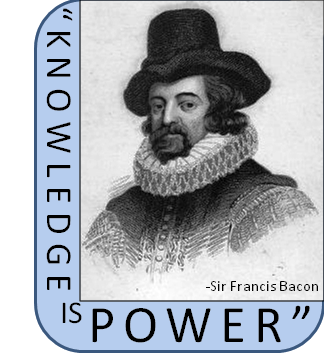
BaconQuoteThis past Labor Day I spent a little over 9 hours on the road unaccompanied. There was a billboard sign promoting some college or university that caught my attention and all it said was “Knowledge is Power”. A quote often attributed to Sir Francis Bacon, one of the so-called “great philosophers” you will undoubtedly study if you take a Philosophy or History of Philosophy class.

The thought that immediately came to mind was, “not all knowledge is power”. So, let’s take this oft-quoted truism and test it against the Word of God.

Did God Actually Say…?

Let’s start with the first appearance of “knowledge” in the Scriptures. For this, we reach all the way back to the Garden of Eden.

Genesis 2:8-9 (ESV) 8 And the Lord God planted a garden in Eden, in the east, and there he put the man whom he had formed. 9 And out of the ground the Lord God made to spring up every tree that is pleasant to the sight and good for food. The tree of life was in the midst of the garden, and the tree of the knowledge of good and evil.

Genesis 2:15-17 (ESV) 15 The Lord God took the man and put him in the garden of Eden to work it and keep it.16 And the Lord God commanded the man, saying, “You may surely eat of every tree of the garden, 17 but of the tree of the knowledge of good and evil you shall not eat, for in the day that you eat of it you shall surely die.”

Genesis 3:1-5 (ESV) 3 Now the serpent was more crafty than any other beast of the field that the Lord God had made. He said to the woman, “Did God actually say, ‘You shall not eat of any tree in the garden’?” 2 And the woman said to the serpent, “We may eat of the fruit of the trees in the garden, 3 but God said, ‘You shall not eat of the fruit of the tree that is in the midst of the garden, neither shall you touch it, lest you die.’” 4 But the serpent said to the woman, “You will not surely die. 5 For God knows that when you eat of it your eyes will be opened, and you will be like God, knowing good and evil.

Genesis 3:22-23 (ESV) 22 Then the Lord God said, “Behold, the man has become like one of us in knowing good and evil. Now, lest he reach out his hand and take also of the tree of life and eat, and live forever—” 23 therefore the Lord God sent him out from the garden of Eden to work the ground from which he was taken.

God forbade Adam to eat of one tree, the tree of the knowledge of good and evil. Satan steps in to tempt Eve to eat of the fruit of that tree, and notice how he did it. He offers Eve a “why” that was a lie. In so doing, he accuses God of withholding power from her. Satan tells her that the reason she is not allowed to eat of the fruit isn’t that she will die; rather, it is so that she will not have the power of knowledge thus keeping her from being like God. What knowledge did Adam and Eve gain from the fruit of the tree? Only the knowledge of evil. Notice the grace of God steps in immediately, in that He made sure to prevent man from eating of the fruit of the tree of Life. Spiritual death happened immediately in the sin. The flesh was defiled by the same sin and would complete the penalty required by sin, complete death. God did not let man live eternally in a cursed and fallen flesh. A way was already made for the redemption of mankind, in the death and resurrection of Jesus Christ; therefore, sinful man was prevented from partaking of the fruit of the tree of Life. Praise God.

Getting back to the knowledge gained, Adam already knew God; therefore, he already knew good. God is the very definition of good. Mark 10:18 (ESV) And Jesus said to him, “Why do you call me good? No one is good except God alone. Now Jesus is God and is also good, but the rich young ruler had not acknowledged Jesus as God; therefore, he had no basis upon which to call Jesus “good”. Which vaults us into the next topic, the Biblical definition of Knowledge that is Power.

Knowledge of Him

If you search the ESV for “knowledge” you get a lot of results, the vast majority of them would seem to support the truism “knowledge is power”; however, as we’ve established, that statement does not reflect truth on its own. There is knowledge that leads to death, as we saw in the garden. The knowledge of evil, of sin, leads to death. Man sinned in the garden, and died, separating us from the only knowledge that has any power, the knowledge of God. Let us look at some of the Biblical passages that clearly define what knowledge we are to be seeking.

2 Chronicles 1:7-13 (ESV) 7 In that night God appeared to Solomon, and said to him, “Ask what I shall give you.” 8 And Solomon said to God, “You have shown great and steadfast love to David my father, and have made me king in his place. 9 O Lord God, let your word to David my father be now fulfilled, for you have made me king over a people as numerous as the dust of the earth. 10 Give me now wisdom and knowledge to go out and come in before this people, for who can govern this people of yours, which is so great?” 11 God answered Solomon, “Because this was in your heart, and you have not asked for possessions, wealth, honor, or the life of those who hate you, and have not even asked for long life, but have asked for wisdom and knowledge for yourself that you may govern my people over whom I have made you king, 12 wisdom and knowledge are granted to you. I will also give you riches, possessions, and honor, such as none of the kings had who were before you, and none after you shall have the like.” 13 So Solomon came from the high place at Gibeon, from before the tent of meeting, to Jerusalem. And he reigned over Israel.

Luke 11:31 (ESV)31 The queen of the South will rise up at the judgment with the men of this generation and condemn them, for she came from the ends of the earth to hear the wisdom of Solomon, and behold, something greater than Solomon is here.

2 Corinthians 2:14-17 (ESV)14 But thanks be to God, who in Christ always leads us in triumphal procession, and through us spreads the fragrance of the knowledge of him everywhere. 15 For we are the aroma of Christ to God among those who are being saved and among those who are perishing, 16 to one a fragrance from death to death, to the other a fragrance from life to life. Who is sufficient for these things? 17 For we are not, like so many, peddlers of God’s word, but as men of sincerity, as commissioned by God, in the sight of God we speak in Christ.

Ephesians 1:16-21 (ESV)16 I do not cease to give thanks for you, remembering you in my prayers, 17 that the God of our Lord Jesus Christ, the Father of glory, may give you the Spirit of wisdom and of revelation in the knowledge of him, 18 having the eyes of your hearts enlightened, that you may know what is the hope to which he has called you, what are the riches of his glorious inheritance in the saints, 19 and what is the immeasurable greatness of his power toward us who believe, according to the working of his great might 20 that he worked in Christ when he raised him from the dead and seated him at his right hand in the heavenly places, 21 far above all rule and authority and power and dominion, and above every name that is named, not only in this age but also in the one to come.

Solomon’s great wisdom and knowledge came directly from God the Father, and from no other place. His sin was in allowing false knowledge, false doctrines, and false gods to take up residence in Israel, through his very own fleshly failings in the taking of brides from other nations and allowing their idolatry. Still we see Jesus teaching in reference to the wisdom of Solomon and immediately declaring that something greater than Solomon was in their midst. That something is Jesus Christ, the very standard of Good and the embodiment of Truth and Knowledge. We see plainly that Paul pointed to the Knowledge of Christ as the key factor for our salvation. For if we fail to accept the Knowledge of the Gospel of Christ, we remain powerlessly dead to sin. Notice also, that Paul separates himself from the peddlers of God’s word, in that only in the Gospel of Jesus Christ, the knowledge of Christ, are we made right with God. Many peddle the scriptures, tossing out verses, twisting God’s words for gain, or for a laugh, or to tempt and lead astray even the elect of God. Satan twisted God’s words in the garden by inserting lies. Satan twisted scripture in his temptation of Jesus in the wilderness. Peddlers of God’s Word. But as Paul said in 2 Corinthians “Thanks be to God” for giving us His Word and for sending us His Holy Spirit so that we might grow in the Knowledge of Christ.

False Knowledge Still Kills

1 Timothy 6:3-21 (ESV)If anyone teaches a different doctrine and does not agree with the sound words of our Lord Jesus Christ and the teaching that accords with godliness, 4 he is puffed up with conceit and understands nothing. He has an unhealthy craving for controversy and for quarrels about words, which produce envy, dissension, slander, evil suspicions, 5 and constant friction among people who are depraved in mind and deprived of the truth, imagining that godliness is a means of gain. 6 But godliness with contentment is great gain, 7 for we brought nothing into the world, and we cannot take anything out of the world. 8 But if we have food and clothing, with these we will be content. 9 But those who desire to be rich fall into temptation, into a snare, into many senseless and harmful desires that plunge people into ruin and destruction. 10 For the love of money is a root of all kinds of evils. It is through this craving that some have wandered away from the faith and pierced themselves with many pangs.

11 But as for you, O man of God, flee these things. Pursue righteousness, godliness, faith, love, steadfastness, gentleness. 12 Fight the good fight of the faith. Take hold of the eternal life to which you were called and about which you made the good confession in the presence of many witnesses. 13 I charge you in the presence of God, who gives life to all things, and of Christ Jesus, who in his testimony before Pontius Pilate made the good confession, 14 to keep the commandment unstained and free from reproach until the appearing of our Lord Jesus Christ, 15 which he will display at the proper time—he who is the blessed and only Sovereign, the King of kings and Lord of lords, 16 who alone has immortality, who dwells in unapproachable light, whom no one has ever seen or can see. To him be honor and eternal dominion. Amen. 17 As for the rich in this present age, charge them not to be haughty, nor to set their hopes on the uncertainty of riches, but on God, who richly provides us with everything to enjoy. 18 They are to do good, to be rich in good works, to be generous and ready to share, 19 thus storing up treasure for themselves as a good foundation for the future, so that they may take hold of that which is truly life.

20 O Timothy, guard the deposit entrusted to you. Avoid the irreverent babble and contradictions of what is falsely called “knowledge,” 21 for by professing it some have swerved from the faith. Grace be with you.

There is only one Truth, our Lord and Savior Jesus Christ. The truism, is misleading. It is often used to suggest that when one obtains knowledge, one obtains power. That isn’t true. For one, the only way to “obtain knowledge” is by grace, through faith, and that not of our selves, it is the gift of God (Ephesians 2). And faith comes through hearing and hearing through the Word of Christ (Romans 10:17). Knowledge is not a power for us to obtain; rather, it is the only way of salvation, the only way that we might be made alive in Christ rather than dead in our sin.

In Jesus Christ our Lord, to God be the glory forever, Amen.
Jorge

DiM | “Greater” by Mercy Me

Presentation1Today is “Discernment in Music” (DiM) day here at Faithful Stewardship.

2 Corinthians 10:4-6 (ESV)
4 For the weapons of our warfare are not of the flesh but have divine power to destroy strongholds. 5 We destroy arguments and every lofty opinion raised against the knowledge of God, and take every thought captive to obey Christ, 6 being ready to punish every disobedience, when your obedience is complete.

According to Billboard Music, the top song remains Oceans (Where Feet May Fail) by Hillsong United. Since we’ve already discussed that song, let’s move down the list. The #2 song on the list is climbing quickly and I think it is far superior to Oceans. Today, we will be taking a look at “Greater” by Mercy Me. If you haven’t heard it yet, check out their official lyrical video below:

Lyrics (via AZLyrics)

“Greater”
Bring your tired
Bring your shame
Bring your guilt
Bring your pain
Don’t you know that’s not you’re name
You will always be much more to me

Every day I wrestle with the voices
That keep telling me I’m not right
But that’s alright

‘Cause I hear a voice and He calls me redeemed
When others say I’ll never be enough
And greater is the One living inside of me
Than he who is living in the world
In the world
In the world
And greater is the One living inside of me
Than he who is living in the world

Bring your doubts
Bring your fears
Bring your hurt
Bring your tears
There’ll be no condemnation here
You are holy, righteous and redeemed

Every time I fall
There’ll be those who will call me
A mistake
Well that’s ok

There’ll be days I lose the battle
Grace says that it doesn’t matter
‘Cause the cross already won the war
He’s Greater
He’s Greater

I am learning to run freely
Understanding just how He sees me
And it makes me love Him more and more
He’s Greater
He’s Greater

So this song’s title and hook comes from a passage of scripture we refer to often here when we speak of discernment.

1 John 4:1-6 (ESV) 1 Beloved, do not believe every spirit, but test the spirits to see whether they are from God, for many false prophets have gone out into the world. 2 By this you know the Spirit of God: every spirit that confesses that Jesus Christ has come in the flesh is from God,3 and every spirit that does not confess Jesus is not from God. This is the spirit of the antichrist, which you heard was coming and now is in the world already. 4 Little children, you are from God and have overcome them, for he who is in you is greater than he who is in the world. 5 They are from the world; therefore they speak from the world, and the world listens to them. 6 We are from God. Whoever knows God listens to us; whoever is not from God does not listen to us. By this we know the Spirit of truth and the spirit of error.

Now, the focus of the song isn’t really the same as the focus John had. The focus of the song “greater” is one of resisting the enemy’s condemnation. It is intended as a song of encouragement to the weary Christian. What John is focused on here is discernment and understanding that we who have been redeemed have the Spirit of Living God dwelling inside of us as promised by Jesus Christ. I think that if we take some time to walk through some related scripture we can fill in some of the blank spots in the song to see how Scripture ties these 2 themes together nicely. Keeping the title of the song as both the starting point and the ending point, let us move through the verses of the song.

Positive Elements

The first verse is a call to the tired, shamed, guilty, and pained believers. The closing thought of the opening verse is to remember that those are not your name. As believers, your sin does not identify you. Now, here it is absolutely important to recognize that this song is NOT written for the lost. The unbeliever can derive no hope from this song, because the unbeliever does not have any of the promises in this song because he denies the cross of Jesus Christ. That is not to say that there isn’t any Gospel in this song, but the song is very clearly written to believers. Believers struggle with fatigue and are tempted to despair in their shame. In the second verse we also see that believers struggle with doubts, fears, hurts, and fears. All of these are common to man, but believers have a hope that is in Christ.

I love the second part of the verses that declare that we have been redeemed. That is powerful language if you rightly understand law and gospel. Too often we only think of  Jesus starting at the virgin birth, but He was with God in the beginning, and He is God. He came and gave up His life so that He could pay the debt we couldn’t not pay and in so doing He redeemed us to Himself.

Galatians 3:10-14 (ESV)10 For all who rely on works of the law are under a curse; for it is written, “Cursed be everyone who does not abide by all things written in the Book of the Law, and do them.” 11 Now it is evident that no one is justified before God by the law, for “The righteous shall live by faith.” 12 But the law is not of faith, rather “The one who does them shall live by them.” 13 Christ redeemed us from the curse of the law by becoming a curse for us—for it is written, “Cursed is everyone who is hanged on a tree”— 14 so that in Christ Jesus the blessing of Abraham might come to the Gentiles, so that we might receive the promised Spirit through faith.

Galatians 3:23-29 (ESV) 23 Now before faith came, we were held captive under the law, imprisoned until the coming faith would be revealed. 24 So then, the law was our guardian until Christ came,in order that we might be justified by faith. 25 But now that faith has come, we are no longer under a guardian, 26 for in Christ Jesus you are all sons of God, through faith. 27 For as many of you as were baptized into Christ have put on Christ. 28 There is neither Jew nor Greek, there is neither slave nor free, there is no male and female, for you are all one in Christ Jesus. 29 And if you are Christ’s, then you are Abraham’s offspring, heirs according to promise.

Finally, the second verse points out that there is no condemnation here. This is important for Christians who are striving to live holy lives, but stumble and fall. You are going to stumble and fall as long as you live on this earth in your fallen and sinful flesh. It wages war against the Spirit of God. Your temptations actually live in your flesh. That’s tough for many to hear, but that is precisely what it means to “take up your cross daily”. We must die to our flesh daily, because our flesh is sinful. That is why we look forward to the day when we will be given new, uncorrupted bodies by the grace of God through faith in the Gospel of Jesus Christ. Knowing this, we also must know that what Christ did on the cross still covers our sin. There will be conviction, and we must repent from our sin (die to the flesh and turn to Christ) daily, but there is no condemnation for believers.

Romans 8:1-4 (ESV) 8 There is therefore now no condemnation for those who are in Christ Jesus. 2 For the law of the Spirit of life has set you free in Christ Jesus from the law of sin and death.3 For God has done what the law, weakened by the flesh, could not do. By sending his own Son in the likeness of sinful flesh and for sin, he condemned sin in the flesh, 4 in order that the righteous requirement of the law might be fulfilled in us, who walk not according to the flesh but according to the Spirit.

Now, the phrase “walk NOT according to the flesh but according to the Spirit” is what we focus on in repentance. When we sin, it is because we’ve taken our eyes off of Christ and onto either idols or our own fleshly desires. It’s a constant struggle even within our flesh, and we have a true adversary who tempts us to sin and then tempts us to despair in our sin (condemnation) all in an effort to rob from us the promise we have in Christ. He cannot take you from God, just as he couldn’t remove Adam from God, but he will lie to you and discourage you and tempt you to reject the Creator to serve the created.

Now here is where we come full circle back to the title of the song, we must discern what is of the Spirit of God and what is of the spirits of error. Our flesh wages war against the Spirit. Satan tempts us. All who have been baptized in Christ have been given the Holy Spirit. We must discern conviction from condemnation, Truth from lies. That is why we must live in the Word of God.

1 Corinthians 2  (ESV) 1 And I, when I came to you, brothers, did not come proclaiming to you the testimony of God with lofty speech or wisdom. 2 For I decided to know nothing among you except Jesus Christ and him crucified. 3 And I was with you in weakness and in fear and much trembling, 4 and my speech and my message were not in plausible words of wisdom, but in demonstration of the Spirit and of power, 5 so that your faith might not rest in the wisdom of men but in the power of God. 6 Yet among the mature we do impart wisdom, although it is not a wisdom of this age or of the rulers of this age, who are doomed to pass away. 7 But we impart a secret and hidden wisdom of God, which God decreed before the ages for our glory. 8 None of the rulers of this age understood this, for if they had, they would not have crucified the Lord of glory. 9 But, as it is written,“What no eye has seen, nor ear heard, nor the heart of man imagined, what God has prepared for those who love him”— 10 these things God has revealed to us through the Spirit. For the Spirit searches everything, even the depths of God. 11 For who knows a person’s thoughts except the spirit of that person, which is in him? So also no one comprehends the thoughts of God except the Spirit of God. 12 Now we have received not the spirit of the world, but the Spirit who is from God, that we might understand the things freely given us by God.13 And we impart this in words not taught by human wisdom but taught by the Spirit, interpreting spiritual truths to those who are spiritual. 14 The natural person does not accept the things of the Spirit of God, for they are folly to him, and he is not able to understand them because they are spiritually discerned. 15 The spiritual person judges all things, but is himself to be judged by no one. 16 “For who has understood the mind of the Lord so as to instruct him?” But we have the mind of Christ.

Greater is the One living inside of me than he that is living in the world. God the Holy Spirit is greater than anyone and anything living in the world. Amen.

Concerns

As much as I like this song and its message, I am concerned by a couple of things. First, there is no call to repentance in the song. So, without repentance the line declaring the listener to be holy give me pause. In Romans 8, if you continue reading, Paul is very quick to move to an emphatic call to live according to the spirit and NOT according to the flesh. He’s not talking about mysticism or transcendence, he’s talking repentance. Denying the flesh that craves sin and obeying the Spirit of God that demands Holiness, not by the strength of our flesh but by the Grace of God. We cannot afford to super-spiritualize this, because the flesh is quick to engage in idolatry. So, the song is all affirmation without a call to repentance. I understand that it is a song of encouragement, and it should naturally be primarily focused on encouragement and affirmation, but completely skipping the call to repentance, I think, is a mistake. The other issue I have with the song which is more minor is the reference to the voices “telling me I’m not right” and “those who call me a mistake”. They are quick lines and I’m not entirely sure what is being said here by Mercy Me. If we are still talking about the world versus Christians, well then the world accuses our devotion to Jesus Christ and the Word of God as wrong, and they insist that we are all a cosmic accident (evolution) rather than a precious creation made by a God who loves us enough to have died for us. However, these are quick lines so my concern here is that some might (wrongly) take this as a blanket affirmation that whatever you think is right is right and anyone who tries to point out the wrong in your idea is clearly “he that is in the world”. Please understand that I am citing this only as a small concern, but given the kind of rampant progressive, seeker-mergent, false theology that has infected the church, it is worth mentioning.

Conclusion

This is one of the better Christian songs on the Billboard Chart today. It is not evangelistic song, especially due to its lack of a call to repentance, but it is clearly a biblical affirmation for the weary Christian to remember the cross. The Gospel is not simply something you heard once to “be born again”; rather, it is where we live, breath, and our daily bread. Christians who lose sight of the Gospel find themselves buried by the law, and need to be brought back to the cross, where Christ has already won the war.

I am also quite pleased to see “We Believe” by Newsboys still up near the top of the chart (#4 today). Both songs come as quite the breath of fresh air on the radio from all of the self-loving, self-aggrandizing, and new-age-spiritualism that dominates the Christian (or “Positive Alternative”) airwaves.

Jude 1:24-25 (ESV)
24 Now to him who is able to keep you from stumbling and to present you blameless before the presence of his glory with great joy, 25 to the only God, our Savior, through Jesus Christ our Lord, be glory, majesty, dominion, and authority, before all time and now and forever. Amen.

In Christ,
Jorge

CTT | The Error of Balaam

While writing the closing portion of yesterday’s post, I made a reference to Balaam’s donkey. Today’s CTT post will explore the story of Balaam, particularly from the perspective of the New Testament.

In reviewing the first draft of my post, I caught an error that really got me thinking about Balaam and forced me to rewrite that reference. I caught myself saying, “If God can speak through a donkey…” Have you ever heard that before? Clearly I had, and if I’m not mistaken I’ve heard it in the same light as the List we reviewed recently, basically if God can talk through a donkey then He can use anyone for His purposes. Now, we could make this an Old Testament study where we dive into the story of Balaam and where it takes place in Israel’s exodus out of Egypt and into the land of Promise, but for today I want to limit our scope to that of the New Testament. Balaam is referenced 3 times in the New Testament (by Peter, Jude, and in Revelation) and each time he is referenced in relation to false teaching. Let’s begin by seeing how Peter references Balaam. The entire chapter is devoted to this topic so let’s just read the whole thing.

2 Peter 2 (ESV)
False Prophets and Teachers
2 But false prophets also arose among the people, just as there will be false teachers among you, who will secretly bring in destructive heresies, even denying the Master who bought them, bringing upon themselves swift destruction. 2 And many will follow their sensuality, and because of them the way of truth will be blasphemed. 3 And in their greed they will exploit you with false words. Their condemnation from long ago is not idle, and their destruction is not asleep.

4 For if God did not spare angels when they sinned, but cast them into hell and committed them to chains of gloomy darkness to be kept until the judgment; 5 if he did not spare the ancient world, but preserved Noah, a herald of righteousness, with seven others, when he brought a flood upon the world of the ungodly; 6 if by turning the cities of Sodom and Gomorrah to ashes he condemned them to extinction, making them an example of what is going to happen to the ungodly; 7 and if he rescued righteous Lot, greatly distressed by the sensual conduct of the wicked 8 (for as that righteous man lived among them day after day, he was tormenting his righteous soul over their lawless deeds that he saw and heard); 9 then the Lord knows how to rescue the godly from trials, and to keep the unrighteous under punishment until the day of judgment,10 and especially those who indulge in the lust of defiling passion and despise authority.

Bold and willful, they do not tremble as they blaspheme the glorious ones, 11 whereas angels, though greater in might and power, do not pronounce a blasphemous judgment against them before the Lord. 12 But these, like irrational animals, creatures of instinct, born to be caught and destroyed, blaspheming about matters of which they are ignorant, will also be destroyed in their destruction, 13 suffering wrong as the wage for their wrongdoing. They count it pleasure to revel in the daytime. They are blots and blemishes, reveling in their deceptions, while they feast with you. 14 They have eyes full of adultery, insatiable for sin. They entice unsteady souls. They have hearts trained in greed. Accursed children! 15 Forsaking the right way, they have gone astray. They have followed the way of Balaam, the son of Beor, who loved gain from wrongdoing, 16 but was rebuked for his own transgression; a speechless donkey spoke with human voice and restrained the prophet’s madness.

17 These are waterless springs and mists driven by a storm. For them the gloom of utter darkness has been reserved. 18 For, speaking loud boasts of folly, they entice by sensual passions of the flesh those who are barely escaping from those who live in error. 19 They promise them freedom, but they themselves are slaves of corruption. For whatever overcomes a person, to that he is enslaved. 20 For if, after they have escaped the defilements of the world through the knowledge of our Lord and Savior Jesus Christ, they are again entangled in them and overcome, the last state has become worse for them than the first. 21 For it would have been better for them never to have known the way of righteousness than after knowing it to turn back from the holy commandment delivered to them. 22 What the true proverb says has happened to them: “The dog returns to its own vomit, and the sow, after washing herself, returns to wallow in the mire.”

So, yeah… Peter wastes no time mincing his words. At the end of his reference to Balaam’s donkey, we see clearly the error in my first (unpublished) draft. God didn’t speak through the donkey, the speechless donkey spoke. So, let’s turn to Numbers chapter 22 to read the account of Balaam and his donkey.

Numbers 22:1-14 (ESV)
22 Then the people of Israel set out and camped in the plains of Moab beyond the Jordan at Jericho. 2 And Balak the son of Zippor saw all that Israel had done to the Amorites. 3 And Moab was in great dread of the people, because they were many. Moab was overcome with fear of the people of Israel. 4 And Moab said to the elders of Midian, “This horde will now lick up all that is around us, as the ox licks up the grass of the field.” So Balak the son of Zippor, who was king of Moab at that time, 5 sent messengers to Balaam the son of Beor at Pethor, which is near the River in the land of the people of Amaw, to call him, saying, “Behold, a people has come out of Egypt. They cover the face of the earth, and they are dwelling opposite me. 6 Come now, curse this people for me, since they are too mighty for me. Perhaps I shall be able to defeat them and drive them from the land, for I know that he whom you bless is blessed, and he whom you curse is cursed.”

7 So the elders of Moab and the elders of Midian departed with the fees for divination in their hand. And they came to Balaam and gave him Balak’s message. 8 And he said to them, “Lodge here tonight, and I will bring back word to you, as the Lord speaks to me.” So the princes of Moab stayed with Balaam. 9 And God came to Balaam and said, “Who are these men with you?” 10 And Balaam said to God, “Balak the son of Zippor, king of Moab, has sent to me, saying, 11 ‘Behold, a people has come out of Egypt, and it covers the face of the earth. Now come, curse them for me. Perhaps I shall be able to fight against them and drive them out.’” 12 God said to Balaam, “You shall not go with them. You shall not curse the people, for they are blessed.” 13 So Balaam rose in the morning and said to the princes of Balak, “Go to your own land, for the Lord has refused to let me go with you.” 14 So the princes of Moab rose and went to Balak and said, “Balaam refuses to come with us.”

Okay, so we have Moab and Midian conspiring to stop the advance of Israel. Balaam is not among the Israelites. Nevertheless, God went to Balaam to warn him not to curse His people. Balaam refuses to go with the men… but notice that he didn’t tell them all that the Lord had told him, and there is no mention of returning the fees for divination. He kept the money paid to him, and withheld information. Let’s continue on.

Numbers 22:15 Once again Balak sent princes, more in number and more honorable than these. 16 And they came to Balaam and said to him, “Thus says Balak the son of Zippor: ‘Let nothing hinder you from coming to me, 17 for I will surely do you great honor, and whatever you say to me I will do. Come, curse this people for me.’” 18 But Balaam answered and said to the servants of Balak, “Though Balak were to give me his house full of silver and gold, I could not go beyond the command of the Lord my God to do less or more. 19 So you, too, please stay here tonight, that I may know what more the Lord will say to me.” 20 And God came to Balaam at night and said to him, “If the men have come to call you, rise, go with them; but only do what I tell you.” 21 So Balaam rose in the morning and saddled his donkey and went with the princes of Moab.

22 But God’s anger was kindled because he went, and the angel of the Lord took his stand in the way as his adversary. Now he was riding on the donkey, and his two servants were with him. 23 And the donkey saw the angel of the Lord standing in the road, with a drawn sword in his hand. And the donkey turned aside out of the road and went into the field. And Balaam struck the donkey, to turn her into the road. 24 Then the angel of the Lord stood in a narrow path between the vineyards, with a wall on either side. 25 And when the donkey saw the angel of the Lord, she pushed against the wall and pressed Balaam’s foot against the wall. So he struck her again. 26 Then the angel of the Lord went ahead and stood in a narrow place, where there was no way to turn either to the right or to the left. 27 When the donkey saw the angel of the Lord, she lay down under Balaam. And Balaam’s anger was kindled, and he struck the donkey with his staff. 28 Then the Lord opened the mouth of the donkey, and she said to Balaam, “What have I done to you, that you have struck me these three times?” 29 And Balaam said to the donkey, “Because you have made a fool of me. I wish I had a sword in my hand, for then I would kill you.” 30 And the donkey said to Balaam, “Am I not your donkey, on which you have ridden all your life long to this day? Is it my habit to treat you this way?” And he said, “No.”

Now this transition is admittedly difficult. Something is missing between God allowing Balaam to go and God’s anger being kindled because he went. The text doesn’t say explicitly what it was about his going that angered the Lord God. Peter’s depiction of Balaam gives us our best answer, “who loved gain from wrongdoing”. The God the Holy Spirit gave Peter the reason, it was because Balaam loved gain. Just as he took the fees from the first entourage and only told them half of the message, this time he tells them nothing at all, and saddles up his donkey and follows them. God judges the heart, and was angered by what He saw in Balaam.

The donkey sees the angel of the Lord. Now, many scholars believe that OT references to the “angel of the Lord” are references to Jesus before the virgin birth. This fits how the Gospel of John introduces Jesus and it is also part of our understanding of the Trinity. The donkey sees the Lord and attempts to avoid certain judgement as is punished by Balaam for it twice. Finally, she just lays down and receives a third punishment. The Lord opens her mouth and she pleads her case with Balaam.

Balaam is so angry he doesn’t seem alarmed by the sudden speech from his donkey, and he doesn’t immediately assume the Lord God is involved. Balaam practiced divination for money. Let’s see what happens next.

Numbers 22:31 Then the Lord opened the eyes of Balaam, and he saw the angel of the Lord standing in the way, with his drawn sword in his hand. And he bowed down and fell on his face. 32 And the angel of the Lord said to him, “Why have you struck your donkey these three times? Behold, I have come out to oppose you because your way is perverse before me. 33 The donkey saw me and turned aside before me these three times. If she had not turned aside from me, surely just now I would have killed you and let her live.” 34 Then Balaam said to the angel of the Lord, “I have sinned, for I did not know that you stood in the road against me. Now therefore, if it is evil in your sight, I will turn back.” 35 And the angel of the Lord said to Balaam, “Go with the men, but speak only the word that I tell you.” So Balaam went on with the princes of Balak.

The portion in bold and underlined is important for later. For now, we see that this angel of the Lord did not rebuke Balaam for prostrating before Him and spoke to Balaam as his Lord, not a messenger from the Lord. Here, we see Balaam repent, and the Lord tells him to go and only speak what he is told. In the next  2 chapters we see Balaam obey the Word of the Lord and speak only blessings upon the people of God, the Israelites, and then departs from Balak. But is that all of the story? Let’s look at how Balaam is referenced in Revelation.

Revelation 2:12-17 (ESV)
12 “And to the angel of the church in Pergamum write: ‘The words of him who has the sharp two-edged sword.13 “‘I know where you dwell, where Satan’s throne is. Yet you hold fast my name, and you did not deny my faith even in the days of Antipas my faithful witness, who was killed among you, where Satan dwells. 14 But I have a few things against you: you have some there who hold the teaching of Balaam, who taught Balak to put a stumbling block before the sons of Israel, so that they might eat food sacrificed to idols and practice sexual immorality. 15 So also you have some who hold the teaching of the Nicolaitans. 16 Therefore repent. If not, I will come to you soon and war against them with the sword of my mouth. 17 He who has an ear, let him hear what the Spirit says to the churches. To the one who conquers I will give some of the hidden manna, and I will give him a white stone, with a new name written on the stone that no one knows except the one who receives it.’

Wait a second… where did we see sexual immorality and eating of food sacrificed to idols in relation to Balaam? Well, to see how Balaam is involved we need to start in Numbers 31 and then reach back to chapter 25.

Numbers 31:1-4 (ESV) 1 The Lord spoke to Moses, saying, 2 “Avenge the people of Israel on the Midianites. Afterward you shall be gathered to your people.” 3 So Moses spoke to the people, saying, “Arm men from among you for the war, that they may go against Midian to execute the Lord’s vengeance on Midian. 4 You shall send a thousand from each of the tribes of Israel to the war.”

Numbers 31:7-12 (ESV) 7 They warred against Midian, as the Lord commanded Moses, and killed every male. 8 They killed the kings of Midian with the rest of their slain, Evi, Rekem, Zur, Hur, and Reba, the five kings of Midian. And they also killed Balaam the son of Beor with the sword. 9 And the people of Israel took captive the women of Midian and their little ones, and they took as plunder all their cattle, their flocks, and all their goods. 10 All their cities in the places where they lived, and all their encampments, they burned with fire, 11 and took all the spoil and all the plunder, both of man and of beast. 12 Then they brought the captives and the plunder and the spoil to Moses, and to Eleazar the priest, and to the congregation of the people of Israel, at the camp on the plains of Moab by the Jordan at Jericho.

Numbers 31:15-16 (ESV) 15 Moses said to them, “Have you let all the women live? 16 Behold, these, on Balaam’s advice, caused the people of Israel to act treacherously against the Lord in the incident of Peor, and so the plague came among the congregation of the Lord.

Okay, now we see that Balaam was responsible for the incident of Peor. What happened at Peor?

Numbers 25:1-9 (ESV)
1 While Israel lived in Shittim, the people began to whore with the daughters of Moab. 2 These invited the people to the sacrifices of their gods, and the people ate and bowed down to their gods. 3 So Israel yoked himself to Baal of Peor. And the anger of the Lord was kindled against Israel. 4 And the Lord said to Moses, “Take all the chiefs of the people and hang them in the sun before the Lord, that the fierce anger of the Lord may turn away from Israel.” 5 And Moses said to the judges of Israel, “Each of you kill those of his men who have yoked themselves to Baal of Peor.” 6 And behold, one of the people of Israel came and brought a Midianite woman to his family, in the sight of Moses and in the sight of the whole congregation of the people of Israel, while they were weeping in the entrance of the tent of meeting. 7 When Phinehas the son of Eleazar, son of Aaron the priest, saw it, he rose and left the congregation and took a spear in his hand 8 and went after the man of Israel into the chamber and pierced both of them, the man of Israel and the woman through her belly. Thus the plague on the people of Israel was stopped. 9 Nevertheless, those who died by the plague were twenty-four thousand.

Remember the test of a Prophet isn’t limited to whether or not the sign or wonder comes to pass; it includes his doctrine, what he preaches/teaches. If the sign comes to pass and he leads Israel to worship false gods, strange gods, gods you do not know, he is to be put to death. Balaam was responsible for this stumbling block placed before Israel, for the sexual immorality and the worshiping of the false god (Baal) of Peor. Throughout the Old Testament, idolatry and sexual immorality are linked. Our God is a jealous God and He will have NO OTHER God before Him (the first and greatest commandment). And as a result of the advice of Balaam, the false prophet, 24,000 died by the plague.

It isn’t enough that at one time the Word of the Lord was faithfully spoken. God remains sovereign. Balaam’s obedience to bless the Children of God required direct intervention by the Lord, and Balaam quickly sinned and lead Israel to sin against God. That is why we see his name invoked in the New Testament as an example of a False Prophet and Teacher.

While we didn’t get to Balaam’s mention in Jude, it is in the same light. In closing, I’d like to once-again share from the doxology of Jude

Jude 1: 24-25 (ESV) Now to him who is able to keep you from stumbling and to present you blameless before the presence of his glory with great joy, to the only God, our Savior, through Jesus Christ our Lord, be glory, majesty, dominion, and authority, before all time and now and forever. Amen.

May the Lord bless you and keep you,
In Christ Jesus,
Jorge

Pentecostals|Help Me Help You

helpmehelpyouToday I want to speak to the Pentecostal (and/or) Charismatic audience. If the case for Pentecostalism is truly Biblical, then should we not be fully submitted to Scripture? The 5 Solas of the Reformation serve as a return to the Bible as the only source for Truth. It doesn’t mean that the Protestant denominations fully achieved it, nor does it mean they preserved it, but at least we affirm Sola Scriptura. I grew up as a Christian under the Pentecostal tradition. Sure, the names change and not every Pentecostal denomination calls themselves Pentecostal, but the doctrinal distinctive relating to the Gifts of the Spirit remain.

I’d like to begin by plainly stating that those of the Pentecostal and Reformed camps do a poor job of characterizing each other’s doctrines. Honest research is exceedingly and exhaustively replete with ad hominem attacks, straw-man arguments, and mockery… from both camps.  Both sides engage in some proof-texting while accusing the other of the same. I’ve read a great deal researching Lutheran and Reformed theology from sites like Monergism.com. Pentecostalism isn’t nearly as historic, only dating back to early 1900s, but one resource for that movement’s history is Dixon Pentecostal Research Center. For all of the zealous antagonism between them it can be easy to forget their commonalities: both camps point to the same Jesus Christ as the Way, the Truth, and the Life. Both acknowledge God the Father, God the Son (Jesus), and God the Holy Spirit. Both understand that salvation comes by grace, through faith in the life, death, and resurrection of Jesus Christ, and both hold to the same Bible as the Word of God. There are major differences, and they are not negligible; therefore, we should address them humbly, faithfully, lovingly, and truthfully according to the Written Word of God.

Is the Pentecostal “Speaking in Tongues” the same thing that happened at Pentecost?

No, it isn’t. Pentecostals point to the outpouring of the Holy Spirit that took place on the day of Pentecost, and the filling of the room by the presence of the Holy Spirit is central to their form of worship. Let’s look at what took place at Pentecost just before Peter’s sermon:

Acts 2:1-12 (ESV)
1 When the day of Pentecost arrived, they were all together in one place. 2 And suddenly there came from heaven a sound like a mighty rushing wind, and it filled the entire house where they were sitting. 3 And divided tongues as of fire appeared to them and rested on each one of them. 4 And they were all filled with the Holy Spirit and began to speak in other tongues as the Spirit gave them utterance.

5 Now there were dwelling in Jerusalem Jews, devout men from every nation under heaven. 6 And at this sound the multitude came together, and they were bewildered, because each one was hearing them speak in his own language. 7 And they were amazed and astonished, saying, “Are not all these who are speaking Galileans? 8 And how is it that we hear, each of us in his own native language? 9 Parthians and Medes and Elamites and residents of Mesopotamia, Judea and Cappadocia, Pontus and Asia,10 Phrygia and Pamphylia, Egypt and the parts of Libya belonging to Cyrene, and visitors from Rome, 11 both Jews and proselytes, Cretans and Arabians—we hear them telling in our own tongues the mighty works of God.” 12 And all were amazed and perplexed, saying to one another, “What does this mean?”

The non-Christians (though devout Jews) understood what they were saying. What where they speaking? They were declaring the mighty works of God. They were proclaiming the testimony of God. Some have argued that this miracle was of interpretation, that God opened the ears of the hearers so that they could understand what was being spoken. That doesn’t fit the text. While one of the gifts of the Holy spirit is indeed interpretation of tongues, the Holy Spirit hadn’t fallen on the masses, He filled the saints, the Christians, who were following the Lord’s last instructions before He ascended into Heaven. The miracle here, is in the speaking not in the hearing. Notice in Peter’s sermon when he quotes Joel 2:28-32a:

Acts 2:16-21 (ESV) 16 But this is what was uttered through the prophet Joel:
17 “‘And in the last days it shall be, God declares, that I will pour out my Spirit on all flesh, and your sons and your daughters shall prophesy, and your young men shall see visions, and your old men shall dream dreams; 18 even on my male servants and female servants in those days I will pour out my Spirit, and they shall prophesy. 19 And I will show wonders in the heavens above and signs on the earth below, blood, and fire, and vapor of smoke; 20 the sun shall be turned to darkness
and the moon to blood, before the day of the Lord comes, the great and magnificent day. 21 And it shall come to pass that everyone who calls upon the name of the Lord shall be saved.’

What happened on the day of Pentecost was not how modern-day Pentecostals should claim as “speaking in tongues”, for Peter recognized it as prophecy. What did they prophesy? The mighty works of God. What did Peter preach?

Acts 2:36-40 (ESV)36 Let all the house of Israel therefore know for certain that God has made him both Lord and Christ, this Jesus whom you crucified.” 37 Now when they heard this they were cut to the heart, and said to Peter and the rest of the apostles, “Brothers, what shall we do?” 38 And Peter said to them, “Repent and be baptized every one of you in the name of Jesus Christ for the forgiveness of your sins, and you will receive the gift of the Holy Spirit. 39 For the promise is for you and for your children and for all who are far off, everyone whom the Lord our God calls to himself.” 40 And with many other words he bore witness and continued to exhort them, saying, “Save yourselves from this crooked generation.”

Of whom did Peter bear witness? of Jesus the Christ. What was his exhortation? Repent and be baptized in the Name of Jesus Christ for the forgiveness of sins. The key here is not in some hidden meaning of “other tongues”; rather, in that the others understood what the Holy Spirit was speaking through His disciples, the Word of God, Testimony of God’s greatness, leading to the Testimony of Jesus Christ. As we are told in Revelation 19:10 (ESV), “Then I fell down at his feet to worship him, but he said to me, “You must not do that! I am a fellow servant with you and your brothers who hold to the testimony of Jesus. Worship God.” For the testimony of Jesus is the spirit of prophecy.

Notice that in all of Acts 2, the only thing being taught is the Gospel of Jesus Christ. Everything else in that section is descriptive, a testimony of what God the Holy Spirit did on that day. God moved through His people, to give testimony of His Son, Jesus. If you want to prescribe any Christian doctrine from this text, let it be the testimony of Jesus Christ found in the sermon uttered by Peter who was filled by the Holy Spirit. To God be the glory.

What is the Pentecostal “Speaking in Tongues”?

What the Pentecostal refers to as “speaking in tongues” comes from Paul’s first letter to the Corinthians, chapters 12-14. How does the Apostle Paul describe it? Let’s look briefly in 1 Corinthians 14.

1 Corinthians 14:1-5 (ESV) 1 Pursue love, and earnestly desire the spiritual gifts, especially that you may prophesy. 2 For one who speaks in a tongue speaks not to men but to God; for no one understands him, but he utters mysteries in the Spirit. 3 On the other hand, the one who prophesies speaks to people for their upbuilding and encouragement and consolation. 4 The one who speaks in a tongue builds up himself, but the one who prophesies builds up the church. 5 Now I want you all to speak in tongues, but even more to prophesy. The one who prophesies is greater than the one who speaks in tongues, unless someone interprets, so that the church may be built up.

So, in a sense, the Pentecostal should desire to prophesy as Disciples did on the day of Pentecost. However, that is not to say that every time the tongue fires off in unintelligible speech that they are prophesying. In fact, if there is no interpretation, they are decidedly NOT prophesying, for no one is being built up. Paul goes on to say that if the Holy Spirit doesn’t grant them understanding of what the Spirit is saying, then their mind is unfruitful. Therefore, Paul explains that he prays both with his mind and in his spirit.

Now, here is the part where today’s title comes into play. While I can see in God’s Written Word the basis and the instruction for the Gifts of God the Holy Spirit, I find it difficult argue on your behalf in most cases. Why? Because of the very same abuses Paul was addressing in his letter to the Corinthians. We cannot wave the first half of 1 Corinthians 14 as a banner of justification while simultaneously ignoring the latter portion of the very same chapter.

Help me, Help you.

While I do plan on eventually addressing doctrinal concerns I have with Reformed and Lutheran theology, but given the current state of the visible church and the pervasiveness of Mysticism and False teaching, I need to first address (biblically) the most obvious problems.

1. “Speaking in Tongues” in a loud voice for all of the congregation to hear (sometimes in a microphone) is NOT prophecy without the interpretation. The church is NOT edified by it. God is NOT glorified by it. It only serves to draw attention to the speaker, whose mind is unfruitful if he is not granted the understanding of what was uttered.

1 Corinthians 14:13-19 (ESV) 13 Therefore, one who speaks in a tongue should pray that he may interpret. 14 For if I pray in a tongue, my spirit prays but my mind is unfruitful. 15 What am I to do? I will pray with my spirit, but I will pray with my mind also; I will sing praise with my spirit, but I will sing with my mind also. 16 Otherwise, if you give thanks with your spirit, how can anyone in the position of an outsider say “Amen” to your thanksgiving when he does not know what you are saying? 17 For you may be giving thanks well enough, but the other person is not being built up. 18 I thank God that I speak in tongues more than all of you. 19 Nevertheless, in church I would rather speak five words with my mind in order to instruct others, than ten thousand words in a tongue.

2. Understanding is not a matter of a level of faith; therefore, there is no benefit to pretending you understand what is being uttered without interpretation. It’s not “a faith thing”. Either God is speaking, or He isn’t. We don’t just accept it as the Word of God without testing it against Scripture. The first test is this, “is there an interpretation?”. If there is an interpretation, is it Biblically sound? Does it point to Jesus Christ?

3. Pandemonium, chaos, and sensuality do not bring Glory to God or edify His church.

1 Corinthians 14:26-32 (ESV)26 What then, brothers? When you come together, each one has a hymn, a lesson, a revelation, a tongue, or an interpretation. Let all things be done for building up. 27 If any speak in a tongue, let there be only two or at most three, and each in turn, and let someone interpret. 28But if there is no one to interpret, let each of them keep silent in church and speak to himself and to God. 29 Let two or three prophets speak, and let the others weigh what is said. 30 If a revelation is made to another sitting there, let the first be silent. 31 For you can all prophesy one by one, so that all may learn and all be encouraged, 32 and the spirits of prophets are subject to prophets.

Why did I include sensuality? Well, it’s the only way I can cover things like the “drunk in the spirit” or the “high on Jesus” or the “holy laughter” manifestations. It is a craving for an experience measured by the senses rather than by the Word of God. I’ve witnessed the full gambit of these experiences growing up, and I’ve never seen discernment exercised. I’ve been in church services where the preaching of the Word of God was cancelled due to 3 hour “Praise and Worship”, where the worship was either the same song being played over and over with long instrumentals, or a lot of “spiritual (tongues) worship” is sung or spoken or declared without interpretation. I’ve seen what amounts to “open-mic night” where everyone is claiming to prophesy, well beyond the two or three limitation provided. Sure, some might say “well, that’s why we have special services apart from church”. Paul didn’t say “when you meet on Sunday mornings”, he said “When you come together…”.

4. God the Holy Spirit is not the only spirit; however, He is the only True God. There are evil spirits, as well as the fact that our flesh is sinful and actively works against the Spirit of God. Even within Christians, the war wages on between our flesh and the Holy Spirit (Galatians 5). The ONLY way we know we are hearing from God is by His Written Word. Your emotions are tied to the flesh, and the flesh is weak and sinful. Faith is a gift from God, and comes by hearing the Word of God. God has given us His Written Word. Start there. You cannot skip over the written Word of God and expect to just “know” or “recognize” the voice of God or to feel which spirits are of God and which are of error. You cannot rely on goose bumps… pagan films can elicit the same response. Without interpretation, you have no idea what is being said “in strange tongues”… none; therefore, you have no way of knowing if it is indeed the Holy Spirit or if it is man, or demon. If it is of the Holy Spirit, He will submit to the Written Word of God, for He is unchanging. John 1 tells us that in the beginning the Word was with God, and the Word was God, and the Word became flesh, Jesus Christ. This isn’t “putting God in a box”, this is identifying what might be God by comparing it to what we know is God (His Word). Refusal to submit to Biblical discernment is a HUGE red flag.

5. God will not reveal something of Himself now that He hasn’t already revealed of Himself in Scriptures. When Jesus walked the earth, He fulfilled the Law and the Prophets, and then He established a New Covenant with His Apostles before ascending into Heaven. He granted John the final Revelation and then warned not to add to or take away from that Book. Any prophecy that makes a completely new claim about God, His Son, His Spirit, or His return that cannot be found in Scripture is false. That excludes the vast majority of prophetic visions turned into marketing campaigns for profit we see today. God the Holy Spirit is sovereign, and may grant a word of wisdom, knowledge, or insight for a specific people. Such a word, however, MUST point to Jesus as God and Savior and must be tested to see if it is true. If it doesn’t come to pass IT WAS NOT GOD. If it does come to pass, but the prophet preaches a different gospel, IT IS NOT OF GOD. If it comes true, is biblically sound, and Jesus Christ is glorified, then rejoice in the Word of the Lord and proclaim His kindness and mercy.

6. God’s primary language isn’t KJV. I say this, because I have heard a lot of “prophecy” spoken in King James English despite the speaker NOT quoting scripture. If you are quoting scripture and you’ve memorized most of it in KJV, fine… but if you aren’t quoting Scripture and are speaking words given to you by the Holy Spirit, why the KJV? It would be like an Arabic-English interpreter putting on an Australian accent to let folks know which words he’s translating from Arabic, and then dropping the accent to signify that he’s speaking of his own accord. Just odd. Additionally, just because a scripture was quoted does not mean it’s God providing the prophecy. Satan quoted scripture in his temptation of Jesus Christ. His twisting of scripture was quite subtle compared to what we hear these days. Which brings me to my final point.

7. If the person claiming to be anointed of God, His prophet, His apostle, or messenger demonstrates an inability to rightly handle Scripture, then we have no reason to believe he is speaking prophetically. The Written Word of God IS the Word of God. One who has mishandled the written Word of God cannot be trusted to rightly handle the spoken word of God. Now, God is still God, and He is still sovereign over His gifts and callings. Yes, God opened the mouth of Balaam’s donkey, but the donkey didn’t deliver the Word of the Lord, the Angel of the Lord (Jesus) did.

Lately, I’ve come to realize that the vast majority of the Pentecostal / Charismatic church has lost its way. Before writing this, I spent some time reading through the Way articles from 1906, and saw so much focus and attention on the “gifts” and so little on Jesus Christ. I read through popular charismatic teacher Facebook pages, and saw so very little scripture. Lots of appeals to “trust the spirit” and “experiencing power” and “soaking in His presence” but so very little teaching from the Scriptures. Is that what Paul would support based on his teaching in 1 Corinthians 14?

The reformed camp has its problems, too. If Pentecostals struggle with mysticism and winds of doctrine, then the Reformed struggle with legalism, particularly of the Law ► Gospel ► Law variety. They preach law to convict of sin, then Gospel for the forgiveness of sin, and then burden the Christian with Law to prove themselves “true” Christians. The error in both camps ends is the same, the error of Peter on the water, the error of taking our eyes off of Jesus Christ and placing them on ourselves, our works, or our own righteousness.

This ended up being much longer than I had intended. If you feel I’ve misrepresented Pentecostalism, feel free to contact me. In closing, I leave you with the exhortation of the Apostle Paul in the closing of his first letter.

1 Corinthians 16:13 (ESV) 13 Be watchful, stand firm in the faith, act like men, be strong.

May the Lord Bless you and keep you,
In Jesus Christ our Lord and Savior,
Jorge