DiM | “Lord I’m Ready Now” by Plumb

Today is “Discernment in Music” (DiM) day here at Faithful Stewardship (2 Corinthians 10:4-6 (ESV)).

January 27, 2015. Today we are going to take a look at the #10 spot on the 20theCountdownMagazine top 20 songs list, “Lord I’m Ready Now” by Plumb. This is the first time we are reviewing a song by Plumb and, sadly, this one isn’t going to go well. I am a fan of her sound, and a lot of her music is remixed by DJs into some very cool techno/dance music, a genre of which I’m personally a fan. However, we aren’t here to review musical stylings, we are here to review the messaging. This song echos a very emotionally driven mystical view of God that has infiltrated the visible church. It is a confused view of repentance and forgiveness and Salvation. It’s extremely vague and emotive, which will lead many to feel like the song “resonates with them”, but the message is confused and unclear. Let’s watch the lyric video (which was very well done) and then examine its lyrics.

Official Lyric Music Video


Lyrics (via K-Love)

Lord I’m Ready Now by Plumb

I just let go
And I feel exposed
But its so beautiful
Cuz this is who I am
I’ve been such a mess
But now I can’t care less
I could bleed to death

Oh Lord I’m ready now
All the walls are down
Time is running out
And I wanna make this count
I ran away from you
And did what I wanted to
But I don’t wanna let you down
Oh Lord I’m ready now
Lord I’m ready now

You called my name *
I turned away
But now I
Am listening
I was so caught up
In who I’m not
Can you please forgive me?

I’ve nothing left to hide
No reason’s left to lie
Give me another chance

Writer(s): Tiffany Arbuckle Lee and Luke Sheets

* These lines, though listed on a coupe of lyrics sites, are not sung in the Lyric video

Positive Elements

The need for forgiveness is acknowledged at the end of the mini-second verse (or first bridge?), “Can you please forgive me?” But it comes in the form of a question, and lacks the assurance we would expect of a Christian song.

Concerns

The song is confused. Artistically, I get the whole “this is a song about the ‘real’ emotions people go through in life”… but people’s emotions are sinful. We are sinful. Our flesh is sinful. Christians have the answers in Christ and in His Word. If you are going to posit a fleshly question in a song, provide the spiritual Truth as its answer. So let’s grab some Truth:

1 John 1 (ESV)
1 That which was from the beginning, which we have heard, which we have seen with our eyes, which we looked upon and have touched with our hands, concerning the word of life— 2 the life was made manifest, and we have seen it, and testify to it and proclaim to you the eternal life, which was with the Father and was made manifest to us— 3 that which we have seen and heard we proclaim also to you, so that you too may have fellowship with us; and indeed our fellowship is with the Father and with his Son Jesus Christ. 4 And we are writing these things so that our joy may be complete.

5 This is the message we have heard from him and proclaim to you, that God is light, and in him is no darkness at all. 6 If we say we have fellowship with him while we walk in darkness, we lie and do not practice the truth. 7 But if we walk in the light, as he is in the light, we have fellowship with one another, and the blood of Jesus his Son cleanses us from all sin. 8 If we say we have no sin, we deceive ourselves, and the truth is not in us. 9 If we confess our sins, he is faithful and just to forgive us our sins and to cleanse us from all unrighteousness. 10 If we say we have not sinned, we make him a liar, and his word is not in us.

Another line that punched me in the face (figuratively) is the “Can you give me another chance?” What is this “chance” of which you speak? That you are still breathing is evidence of the Grace of God at work in your life so that you might hear the Word, be granted Faith, repent and believe in Him. You don’t need “another chance” you simply need to believe in Him. Your “chance” goes away on the last day.

John 6:35-40 (ESV)35 Jesus said to them, “I am the bread of life; whoever comes to me shall not hunger, and whoever believes in me shall never thirst. 36 But I said to you that you have seen me and yet do not believe. 37 All that the Father gives me will come to me, and whoever comes to me I will never cast out. 38 For I have come down from heaven, not to do my own will but the will of him who sent me. 39 And this is the will of him who sent me, that I should lose nothing of all that he has given me, but raise it up on the last day. 40 For this is the will of my Father, that everyone who looks on the Son and believes in him should have eternal life, and I will raise him up on the last day.”

Okay, so let’s work through the song from the beginning. Please forgive the tone (a bit snarky and frustrated) of these questions.

I just let go of what, your sin? your unbelief? your pride?
And I feel exposed
But its so beautiful …what is? being exposed is beautiful? in what way? Adam and Eve didn’t consider their new-found nakedness a thing of beauty, they worked to cover their sin. Sin and unbelief are not beautiful, they are ugly.
Cuz this is who I am …I suppose being artistically vague allows for the listener to fill in their own narrative, but this is getting frustrating. I want to think this is admitting that we are born dead in our sins and trespasses, but we just finished talking about how whatever this current state of the singer is being beautiful. huh?
I’ve been such a mess …okay…
But now I can’t care less …[sigh]. Really? Confession is to agree with God about our sin and how it has earned us death and punishment… and you can’t care less?
I could bleed to death …and if you do as an unbeliever you face an eternal judgement outside of Christ. If you do as a believer in Christ Jesus, you will be raised again in the Last Day.

The chorus suggests the singer’s theology is along the lines of “the Believer’s prayer”, as if to say “okay, Lord, I’m ready to recite that prayer that saves me now that I’ve torn down my own walls and I am really, really, serious about wanting to say that prayer now that I know that my time is running short. I’m ready, so let’s do this thing!” How did Peter present the Gospel after preaching Law?

Acts 2:37-41(ESV)37 Now when they heard this they were cut to the heart, and said to Peter and the rest of the apostles, “Brothers, what shall we do?” 38 And Peter said to them, “Repent and be baptized every one of you in the name of Jesus Christ for the forgiveness of your sins, and you will receive the gift of the Holy Spirit. 39 For the promise is for you and for your children and for all who are far off, everyone whom the Lord our God calls to himself.” 40 And with many other words he bore witness and continued to exhort them, saying, “Save yourselves from this crooked generation.” 41 So those who received his word were baptized, and there were added that day about three thousand souls.

The truth of the Gospel is that its focus is on Christ and what He did on the cross. Stop turning it into some ritual WE do in hopes of gaining another chance or convincing God to forgive us. We can wax eloquent and sing/talk/lecture about “surrendering to God” without ever actually doing it, because we’ve spent so much time focusing on our hearts, our emotions, and our experience. If your eyes are on you, they aren’t on Christ. Repent and be baptized in the Name of Jesus Christ.

Conclusion

I cannot recommend this song to anyone for any purpose. The song reflects a genuine misunderstanding of the Gospel of Jesus Christ. I have no doubt Plumb is singing about real emotions… the problem is that no real answers are provided in this song, and as Christians we’ve been given the real answers in God’s Word. It’s like providing a very real and graphic depiction of drowning… knowing all of the signs and stages of drowning won’t teach someone how to swim. One might argue that it will motivate someone to learn to swim, but the details of drowning do not teach a person to swim. Again, I believe she’s sharing real emotions… but our flesh is corrupt and there is no Truth in our emotions. We find Truth and rest only in God’s Word, for it is by hearing the Word of God that we might receive Faith.

To God be the glory, Amen.
In Christ Jesus,
Jorge

Worship or Entertainment?

Tickets to Worship for Entertainment?

Tickets to Worship or for Entertainment?

Looking back over our first year of blogging, it is clear that the most visited feature of this site is our Discernment in Music (DiM) where we take a Biblical look at the most popular songs being played on “Christian Radio” today. The concern is that we’ve allowed our minds and hearts to be filled with anything calling itself “Christian” without carefully examining what is being conveyed by these songs either directly or by inference. Many of these songs are working their way into Churches for “Praise and Worship”, so we really need to make sure what we preach (with or without musical accompaniment) is in keeping with sound doctrine (2 Timothy 4:1-5).

Toward the end of the Fall, we here in the Georgia started getting a lot of concert events hosted by local Churches and Christian Radio stations. There are some Artists who draw large crowds these days all on their own: Chris Tomlin, Matt Redman, and Toby Mac. In some of the more remote/rural areas, it’s hard to get one of the big names to do a concert so what event planners will do is set up Music Festivals to bring several artists together. Local stations will often promote these events heavily, offering free tickets as incentives for community engagement, but for the most part tickets to the event are purchased for anywhere from $15 to $35 per adult. Touring, ticket sales, and Album/iTunes sales are the basis for the careers of these musicians and their production team. This is their job. This is what they do to earn their salaries. Yet, within the Christian Community, we also include all of this as their Ministry. Is that true in every case?

***Edit: Some artists do the concert events for free so that ticket sales can go toward a local Charity or fund raiser. These should still not be sold as “worship”, but I wanted to make it clear that the money isn’t always going to the artists***

At the close of one such musical event last fall (2014), there was a comment made that seemed to stop everything in its tracks… like in the movies where someone makes an awkward comment in a huge house party and everyone freezes and you hear the Vinyl Record come to a screeching halt.

“…So come on out and join us on [Day] starting at [Time] for a night of worship and celebration…”

Are we paying for the opportunity to worship God, or are we paying for a night of musical entertainment? I can understand if you just rolled your eyes, or let out a sigh of exasperation… but while you are still here and reading, think about the question one more time. What are we paying for to attend one of these concert events? What is the advertisement on Christian radio actually selling? Are they selling a chance to experience skillful music and dazzling lights or are they selling “worship”? Let’s pause that thought for the moment, to consider its implications.

Entertainment

I’m not implying that there is anything inherently wrong with entertainment. I attended a Tim Hawkins comedy show at a local church on a Friday night. Nothing wrong with laughter, and Tim Hawkins is a professing Christian. His theology for the most part is sound, and he’s quite skilled as a musician and he understands comedy well. However, despite the fact that he plays the guitar, his event wasn’t advertised a worship event. The call to attend was to enjoy a night of comedy. Laughter isn’t a form of worship found in the Bible. Tim does try to present the Gospel during a set or between bits, but we aren’t buying tickets to a sermon, and they aren’t trying to sell sermon tickets. I can’t imagine anyone in attendance thinking to themselves, “wow, I’m really worshiping Jesus right now by enjoying these jokes”. It simply isn’t what we consider to be an act of worship, and rightly so. Can the Gospel be preached at such an event? Absolutely. Can something funny be shared in a sermon without drawing away from the Word of God? Yes. But we don’t confuse the two categories. One is entertainment, the other is Church, but everything can point to Christ (and we should endeavor to point to Christ in all that we do).

Worship

Let’s talk a little bit about Worship as it is described in the Bible. Searching (admittedly I’m not searching in the Hebrew) in the ESV for “worship”, the earliest mentions of the word are in conjunction with offering of sacrifices to God.

Genesis 22:1-5 (ESV) | The Sacrifice of Isaac
1 After these things God tested Abraham and said to him, “Abraham!” And he said, “Here I am.” 2 He said, “Take your son, your only son Isaac, whom you love, and go to the land of Moriah, and offer him there as a burnt offering on one of the mountains of which I shall tell you.” 3 So Abraham rose early in the morning, saddled his donkey, and took two of his young men with him, and his son Isaac. And he cut the wood for the burnt offering and arose and went to the place of which God had told him. 4 On the third day Abraham lifted up his eyes and saw the place from afar. 5 Then Abraham said to his young men, “Stay here with the donkey; I and the boy will go over there and worship and come again to you.”

There isn’t always a mention of a burnt offering. In place of a burnt offering, there is sometimes a prayer of thanksgiving or of praise clearly uttered to the Lord God, such as in the case of Jacob’s servant when tasked with finding a suitable wife for Isaac.

Genesis 24:12-28 (ESV) | A Wife for Isaac
12 And he said, “O Lord, God of my master Abraham, please grant me success today and show steadfast love to my master Abraham. 13 Behold, I am standing by the spring of water, and the daughters of the men of the city are coming out to draw water. 14 Let the young woman to whom I shall say, ‘Please let down your jar that I may drink,’ and who shall say, ‘Drink, and I will water your camels’—let her be the one whom you have appointed for your servant Isaac. By this I shall know that you have shown steadfast love to my master.”

15 Before he had finished speaking, behold, Rebekah, who was born to Bethuel the son of Milcah, the wife of Nahor, Abraham’s brother, came out with her water jar on her shoulder. 16 The young woman was very attractive in appearance, a maiden whom no man had known. She went down to the spring and filled her jar and came up. 17 Then the servant ran to meet her and said, “Please give me a little water to drink from your jar.” 18 She said, “Drink, my lord.” And she quickly let down her jar upon her hand and gave him a drink.19 When she had finished giving him a drink, she said, “I will draw water for your camels also, until they have finished drinking.” 20 So she quickly emptied her jar into the trough and ran again to the well to draw water, and she drew for all his camels. 21 The man gazed at her in silence to learn whether the Lord had prospered his journey or not.

22 When the camels had finished drinking, the man took a gold ring weighing a half shekel, and two bracelets for her arms weighing ten gold shekels, 23 and said, “Please tell me whose daughter you are. Is there room in your father’s house for us to spend the night?” 24 She said to him, “I am the daughter of Bethuel the son of Milcah, whom she bore to Nahor.” 25 She added, “We have plenty of both straw and fodder, and room to spend the night.” 26 The man bowed his head and worshiped the Lord 27 and said, “Blessed be the Lord, the God of my master Abraham, who has not forsaken his steadfast love and his faithfulness toward my master. As for me, the Lord has led me in the way to the house of my master’s kinsmen.” 28 Then the young woman ran and told her mother’s household about these things.

Before the Law, and the Mosaic covenant, this is what the Lord God considered to be Worship. We know this, because this portion of the Law was dictated to Moses by God. But we also know that the Laws within the Mosaic Covenant defined right Worship, and that God made clear that Israel was NOT to worship God ways that they learned from the fallen world. Rather than pick through the Old Testament, let us jump to the book of Hebrews, to see this explained after the cross of Jesus Christ.

Hebrews 9:1-14 (ESV) | The Earthly Holy Place
1 Now even the first covenant had regulations for worship and an earthly place of holiness. 2 For a tent was prepared, the first section, in which were the lampstand and the table and the bread of the Presence. It is called the Holy Place. 3 Behind the second curtain was a second section called the Most Holy Place, 4 having the golden altar of incense and the ark of the covenant covered on all sides with gold, in which was a golden urn holding the manna, and Aaron’s staff that budded, and the tablets of the covenant. 5 Above it were the cherubim of glory overshadowing the mercy seat. Of these things we cannot now speak in detail.

6 These preparations having thus been made, the priests go regularly into the first section, performing their ritual duties, 7 but into the second only the high priest goes, and he but once a year, and not without taking blood, which he offers for himself and for the unintentional sins of the people. 8 By this the Holy Spirit indicates that the way into the holy places is not yet opened as long as the first section is still standing 9 (which is symbolic for the present age). According to this arrangement, gifts and sacrifices are offered that cannot perfect the conscience of the worshiper, 10 but deal only with food and drink and various washings, regulations for the body imposed until the time of reformation.

11 But when Christ appeared as a high priest of the good things that have come,then through the greater and more perfect tent (not made with hands, that is, not of this creation) 12 he entered once for all into the holy places, not by means of the blood of goats and calves but by means of his own blood, thus securing an eternal redemption. 13 For if the blood of goats and bulls, and the sprinkling of defiled persons with the ashes of a heifer, sanctify for the purification of the flesh, 14 how much more will the blood of Christ, who through the eternal Spirit offered himself without blemish to God, purify our conscience from dead works to serve the living God.

Let’s unpack this a bit. The Laws, the specific rituals of the priesthood and of the people (offerings, washings, consecration/fasting, etc.) and the blood of animals where all regulations of worship. This is what it was to Worship the Living God under the Old Covenant. All of these forms of worship pointed to Jesus Christ whose blood would finally succeed where previous forms of worship failed, in that it would purify our conscience from dead works to serve the living God. What are we to do now? We still offer sacrifices to God in our worship, but what sacrifices do we offer?

Hebrews 13 (ESV) | Sacrifices Pleasing to God
1 Let brotherly love continue. 2 Do not neglect to show hospitality to strangers, for thereby some have entertained angels unawares. 3 Remember those who are in prison, as though in prison with them, and those who are mistreated, since you also are in the body. 4 Let marriage be held in honor among all, and let the marriage bed be undefiled, for God will judge the sexually immoral and adulterous. 5 Keep your life free from love of money, and be content with what you have, for he has said, “I will never leave you nor forsake you.” 6 So we can confidently say,

“The Lord is my helper;
I will not fear;
what can man do to me?”

7 Remember your leaders, those who spoke to you the word of God. Consider the outcome of their way of life, and imitate their faith. 8 Jesus Christ is the same yesterday and today and forever. 9 Do not be led away by diverse and strange teachings, for it is good for the heart to be strengthened by grace, not by foods, which have not benefited those devoted to them. 10 We have an altar from which those who serve the tent have no right to eat. 11 For the bodies of those animals whose blood is brought into the holy places by the high priest as a sacrifice for sin are burned outside the camp. 12 So Jesus also suffered outside the gate in order to sanctify the people through his own blood.13 Therefore let us go to him outside the camp and bear the reproach he endured. 14 For here we have no lasting city, but we seek the city that is to come. 15 Through him then let us continually offer up a sacrifice of praise to God, that is, the fruit of lips that acknowledge his name.16 Do not neglect to do good and to share what you have, for such sacrifices are pleasing to God.

17 Obey your leaders and submit to them, for they are keeping watch over your souls, as those who will have to give an account. Let them do this with joy and not with groaning, for that would be of no advantage to you.

18 Pray for us, for we are sure that we have a clear conscience, desiring to act honorably in all things. 19 I urge you the more earnestly to do this in order that I may be restored to you the sooner.

20 Now may the God of peace who brought again from the dead our Lord Jesus, the great shepherd of the sheep, by the blood of the eternal covenant, 21 equip you with everything good that you may do his will, working in us that which is pleasing in his sight, through Jesus Christ, to whom be glory forever and ever. Amen.

22 I appeal to you, brothers, bear with my word of exhortation, for I have written to you briefly. 23 You should know that our brother Timothy has been released, with whom I shall see you if he comes soon. 24 Greet all your leaders and all the saints. Those who come from Italy send you greetings. 25 Grace be with all of you.

Declaring the mighty works of God, the Gospel of Jesus Christ, and bearing the reproach of the world are pleasing acts of worship. Music isn’t even mentioned here. Does that make music sinful? Nope. It doesn’t make music anything. We’ve over-cooked the role of music in our modern-day understanding of “Worship”. We’ve done it in our churches and we’ve done it on the Radio, and we’ve done it in our Entertainment.

Conclusion

There is nothing intrinsically wrong with being entertained, especially not in a God-honoring format. That doesn’t mean that such entertainment also qualifies as “worship”. But how you conduct yourself in such environments matters. We were created to worship God, but our sinful nature is eager to worship anything other than God. Most often our sinful flesh urges us to worship ourselves and our desires. And we tend to do so much more flamboyantly than we do for God… and this was true even in the Old Testament (Exodus 32). Christians who attend concerts for entertainment simply need to guard their hearts from false teaching and false worship. Having a “praise band” in your church is fine, if what they are doing is indeed an act of worship to the Living God and not a form of entertainment for the congregation (that’s a very difficult “if” to evaluate by the way). The “praise band” does not worship God for the congregation, even when they are doing it well with the right heart. The call to worship is for everyone, not just the ones on the stage, and we dare not “sell” opportunities to Worship a Living God. Can ministry happen at such events? Yes. Can worship take place at such events? yes. Is that what we should be selling? No.

Hebrews 13:20-21 (ESV) 20 Now may the God of peace who brought again from the dead our Lord Jesus, the great shepherd of the sheep, by the blood of the eternal covenant, 21 equip you with everything good that you may do his will, working in us that which is pleasing in his sight, through Jesus Christ, to whom be glory forever and ever. Amen.

In Christ Jesus,
Jorge

Friday Sermon | Sanctity of Human Life by Matt Chandler

villagechurchFor today’s good sermon, we’ll be visiting The Village Church led by Pastor Matt Chandler. Now, this sermon by Matt Chandler is one of the few examples of the modern-hip approach to church service where the Word of God is still preached well. The stage, the dress-down casual attire, and the personal anecdotes are all very modern stylings, but when Matt preaches the Scriptures here, he handles them well. He still preaches Christ, and Him crucified for our sins. I’ve reviewed a few of his sermons in the past and have always found his zeal for the Gospel of Grace quite refreshing, even motivating. The sermon category is listed as Prayer, but this sermon addresses the sin of abortion. Are there some portions I think didn’t need to be in the sermon? Sure, but they don’t diminish the Biblical case he makes for the sanctity of Human life at conception.

Listen, friend. This isn’t political. This might be fought at times in the political arena, but I can assure you this is not a political issue. This is a biblical, ethical, spiritual issue that, to our shame, few of us have been moved by. –Matt Chandler

I encourage you to follow the link below to watch the sermon on the Village Church’s website where they’ve provided a written transcript so you can take your time to review the message and double-check and cross-reference the Biblical texts.

http://www.thevillagechurch.net/sermon/the-sanctity-of-human-life/

2 John 1:3 (ESV) 3 Grace, mercy, and peace will be with us, from God the Father and from Jesus Christ the Father’s Son, in truth and love.

Amen.
In Christ Jesus,
Jorge

OT | Jethro’s Advice (Exodus 18)

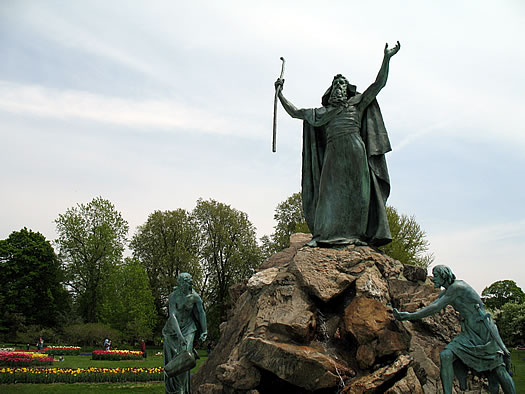
Moses fountain in Washington Park, Albany, NY.

Moses fountain in Washington Park, Albany, NY.

In our last Old Testament Study, we took a quick look at the closing of Exodus 17, and we left room for folks to catch up to where we are in the text. Today, we are going to take a look at Jethro’s Advice recorded in Exodus 18. We are going to see 2 major themes here, first we are going to take a look at the proper (Biblical) sharing of a testimony and worshiping God. Then we will look at Jethro’s advice to Moses and we will examine how churches today get this part wrong.

So let us dive right into the text beginning in the first verse of Exodus 18.

Exodus 18 (ESV) | Jethro’s Advice

Jethro, the priest of Midian, Moses’ father-in-law, heard of all that God had done for Moses and for Israel his people, how the Lord had brought Israel out of Egypt. Now Jethro, Moses’ father-in-law, had taken Zipporah, Moses’ wife, after he had sent her home, along with her two sons. The name of the one was Gershom (for he said, “I have been a sojourner in a foreign land”), and the name of the other, Eliezer (for he said, “The God of my father was my help, and delivered me from the sword of Pharaoh”). Jethro, Moses’ father-in-law, came with his sons and his wife to Moses in the wilderness where he was encamped at the mountain of God. And when he sent word to Moses, “I, your father-in-law Jethro, am coming to you with your wife and her two sons with her,” Moses went out to meet his father-in-law and bowed down and kissed him. And they asked each other of their welfare and went into the tent. Then Moses told his father-in-law all that the Lord had done to Pharaoh and to the Egyptians for Israel’s sake, all the hardship that had come upon them in the way, and how the Lord had delivered them. And Jethro rejoiced for all the good that the Lord had done to Israel, in that he had delivered them out of the hand of the Egyptians.

Testimony… we give testimony not of ourselves and how awesome we’ve become or how wonderful our life has become now that we made a decision or said a prayer. Our testimony is of what the Lord has done on our behalf. Notice the section that follows that Jethro doesn’t lavish praise upon Moses; rather, he offers praise and worship to the Lord God.

10 Jethro said, “Blessed be the Lord, who has delivered you out of the hand of the Egyptians and out of the hand of Pharaoh and has delivered the people from under the hand of the Egyptians. 11 Now I know that the Lord is greater than all gods, because in this affair they dealt arrogantly with the people.”12 And Jethro, Moses’ father-in-law, brought a burnt offering and sacrifices to God; and Aaron came with all the elders of Israel to eat bread with Moses’ father-in-law before God.

All praise and glory and honor be to God. They worshiped God (blessed His Name, confessed Him as God, offered burnt offering and sacrifices) and then they broke bread together. Now this act of worship takes a great deal of time, and led to the breaking of bread at the end of the day. The following day, we see Moses fulfilling his role as the Prophet of God to the Children of Israel, in the day-to-day affairs of leading such a large group through the wilderness. Until now, we’ve seen when the people murmur and complain to Moses, who then cries out to God and He acts, granting manna from heaven, quail from the wilderness, and water from a rock.

13 The next day Moses sat to judge the people, and the people stood around Moses from morning till evening. 14 When Moses’ father-in-law saw all that he was doing for the people, he said, “What is this that you are doing for the people? Why do you sit alone, and all the people stand around you from morning till evening?” 15 And Moses said to his father-in-law, “Because the people come to me to inquire of God; 16 when they have a dispute, they come to me and I decide between one person and another, and I make them know the statutes of God and his laws. 17 Moses’ father-in-law said to him, “What you are doing is not good. 18 You and the people with you will certainly wear yourselves out, for the thing is too heavy for you. You are not able to do it alone. 19 Now obey my voice; I will give you advice, and God be with you! You shall represent the people before God and bring their cases to God, 20 and you shall warn them about the statutes and the laws, and make them know the way in which they must walk and what they must do. 21 Moreover, look for able men from all the people, men who fear God, who are trustworthy and hate a bribe, and place such men over the people as chiefs of thousands, of hundreds, of fifties, and of tens. 22 And let them judge the people at all times. Every great matter they shall bring to you, but any small matter they shall decide themselves. So it will be easier for you, and they will bear the burden with you.23 If you do this, God will direct you, you will be able to endure, and all this people also will go to their place in peace.”

24 So Moses listened to the voice of his father-in-law and did all that he had said. 25 Moses chose able men out of all Israel and made them heads over the people, chiefs of thousands, of hundreds, of fifties, and of tens. 26 And they judged the people at all times. Any hard case they brought to Moses, but any small matter they decided themselves. 27 Then Moses let his father-in-law depart, and he went away to his own country.

Now, we have not yet been given the 10 Commandments. Moses was God’s servant and he heard God’s voice and God listened to Moses. Jethro knew that Moses alone could not be the only judge over all of the people. Moses needed to appoint men and delegate authority to them to sit as judges over tens, fifties, hundreds, and thousands. Delegated authority, not surrendered authority. Moses was still is held accountable to God for the people… he still represents the people before God. However, the smaller cases that have already been made clear can now be heard by able, God-fearing, trustworthy men who hate a bribe.

So how does the present-day church get this wrong? Modern-day pastors read themselves into the position of Moses when they should be reading themselves into the “able, God-fearing, trustworthy men who hate a bribe”. Jesus Christ is the head of His Church. Jesus Christ is our advocate with the Father in Heaven… the role of Moses is a shadow of Jesus Christ our Lord and Savior. Jesus, the Word made flesh, is the Head of His Church, not your senior pastor. Your elders/pastors are the ones to whom have been delegated authority in Christ Jesus to watch over, tend, teach, and feed His sheep. Some are placed over thousands, some hundreds, some fifties, and some tens. The children of Israel were divided up into tribes, clans, houses… but all were God’s Chosen People. The Church today is even more diverse and equally unified through the Gospel of Jesus Christ as written in His Word. Beware the false teacher, the false prophet, and the falsely anointed one (false christs). In closing, let us visit Paul’s exhortation to the elders of the church in Ephesus:

Acts 20:28-32 (ESV)

28 Pay careful attention to yourselves and to all the flock, in which the Holy Spirit has made you overseers, to care for the church of God, which he obtained with his own blood. 29 I know that after my departure fierce wolves will come in among you, not sparing the flock; 30 and from among your own selves will arise men speaking twisted things, to draw away the disciples after them. 31 Therefore be alert, remembering that for three years I did not cease night or day to admonish every one with tears. 32 And now I commend you to God and to the word of his grace, which is able to build you up and to give you the inheritance among all those who are sanctified.

In Christ Jesus,
Jorge

Gospel Wednesday | Matthew 3:13 – 17

bibleLast week, we picked up our Gospel Wednesday posts continuing in the Gospel According to Matthew, Chapter 3. After some feedback from my extended family and close friends, we’ve cut back on the amount of Scripture we aim to cover in a single post. While these posts are primarily the result of our family Bible studies, we’d love your feedback to see if we might better present our studies and make them available to you, the reader.

In our last post, we looked John the Baptist and how he fulfilled prophecy as the precursor to the arrival of the Messiah. Today, we will look at the Messiah entering the Account of Matthew continuing to fulfill all righteousness.

Matthew 3:13-17 (ESV) | The Baptism of Jesus

13 Then Jesus came from Galilee to the Jordan to John, to be baptized by him.14 John would have prevented him, saying, “I need to be baptized by you, and do you come to me?” 15 But Jesus answered him, “Let it be so now, for thus it is fitting for us to fulfill all righteousness.” Then he consented. 16 And when Jesus was baptized, immediately he went up from the water, and behold, the heavens were opened to him, and he saw the Spirit of God descending like a dove and coming to rest on him; 17 and behold, a voice from heaven said, “This is my beloved Son, with whom I am well pleased.”

This point has always perplexed me a bit. Why did Jesus need to be baptized? Much false christology has been birthed from bad rationalization of this portion of scripture. Firstly, let’s look at Jesus’s response, “Let it be so now, for thus it is fitting for us to fulfill all righteousness”. If we look for a ceremony of Baptism in the Old Testament that matches what John the Baptist was doing, we won’t find an exact copy. There are ceremonial cleansing laws for going outside the camp, bathing, and washing of garments worn at the time of having become unclean, but these on their own don’t fully define what John was doing. All of Jerusalem were coming out to John the Baptist confessing sins and being baptized for the forgiveness of sins, they weren’t going out there because they had touched a dead body or an unclean animal per se. The baptism for the forgiveness of sins what the ceremonial cleansing laws were pointing forward to, not the other way around. When John was baptizing by water, he also pointed forward to the one who would come after him to baptize by the Holy Spirit and with fire. Now that He has arrived on the scene, He is asking John to baptize Him for the sake of fulfilling all righteousness. At this command, John concedes. Jesus had no sins to confess or need for repentance, He was blameless.

One way to look at this comes from our having been blessed with the complete written Word of God so we can draw from Paul’s second letter to the church in Corinth:

2 Corinthians 5:16-21 (ESV) 16 From now on, therefore, we regard no one according to the flesh. Even though we once regarded Christ according to the flesh, we regard him thus no longer. 17 Therefore, if anyone is in Christ, he is a new creation. The old has passed away; behold, the new has come. 18 All this is from God, who through Christ reconciled us to himself and gave us the ministry of reconciliation; 19 that is, in Christ God was reconciling the world to himself, not counting their trespasses against them, and entrusting to us the message of reconciliation.20 Therefore, we are ambassadors for Christ, God making his appeal through us. We implore you on behalf of Christ, be reconciled to God. 21 For our sake he made him to be sin who knew no sin, so that in him we might become the righteousness of God.

Christ shed his blood on that cross as the ultimate payment for our sins, and now we join with Christ via Baptism. The Apostle Peter taught of water baptism in this way. Another way of looking at this which comes from a typological view of Scripture is to see that Jesus is Israel in the flesh. We know that Jesus is the very fulfillment of the Law and the Prophets. In Him, was the whole of the Scriptures fulfilled. We understand this from the clear teaching in the book of Hebrews. With this view in mind, let us turn to Ezekiel, chapter 36.

Ezekiel 36:22-32 (ESV) | I Will Put My Spirit Within You
22 “Therefore say to the house of Israel, Thus says the Lord God: It is not for your sake, O house of Israel, that I am about to act, but for the sake of my holy name, which you have profaned among the nations to which you came. 23 And I will vindicate the holiness of my great name, which has been profaned among the nations, and which you have profaned among them. And the nations will know that I am the Lord, declares the Lord God, when through you I vindicate my holiness before their eyes. 24 I will take you from the nations and gather you from all the countries and bring you into your own land. 25 I will sprinkle clean water on you, and you shall be clean from all your uncleannesses, and from all your idols I will cleanse you. 26 And I will give you a new heart, and a new spirit I will put within you. And I will remove the heart of stone from your flesh and give you a heart of flesh. 27 And I will put my Spirit within you, and cause you to walk in my statutes and be careful to obey my rules. 28 You shall dwell in the land that I gave to your fathers, and you shall be my people, and I will be your God. 29 And I will deliver you from all your uncleannesses. And I will summon the grain and make it abundant and lay no famine upon you. 30 I will make the fruit of the tree and the increase of the field abundant, that you may never again suffer the disgrace of famine among the nations. 31 Then you will remember your evil ways, and your deeds that were not good, and you will loathe yourselves for your iniquities and your abominations. 32 It is not for your sake that I will act, declares the Lord God; let that be known to you. Be ashamed and confounded for your ways, O house of Israel.

Now this prophecy pointed both to God’s bringing Israel out of the Exile into Babylon, but also points to the greater promise of the Messiah, a promise initially made in the Garden, when God said that the seed of woman would crush the head of the serpent. Jesus bore no uncleaness in His person, for He is the Word, God the Son; however, the Word became flesh to stand in our place. He fulfilled the Law and the Prophets on behalf of Israel, the Children of God. Wonderful stuff. Before we move on, I’d like to point out how Jesus brought up this baptism to the Pharisees when they questioned His authority.

Matthew 21:23-27 (ESV) | The Authority of Jesus Challenged
23 And when he entered the temple, the chief priests and the elders of the people came up to him as he was teaching, and said, “By what authority are you doing these things, and who gave you this authority?” 24 Jesus answered them, “I also will ask you one question, and if you tell me the answer, then I also will tell you by what authority I do these things. 25 The baptism of John, from where did it come? From heaven or from man?” And they discussed it among themselves, saying, “If we say, ‘From heaven,’ he will say to us, ‘Why then did you not believe him?’ 26 But if we say, ‘From man,’ we are afraid of the crowd, for they all hold that John was a prophet.” 27 So they answered Jesus, “We do not know.” And he said to them, “Neither will I tell you by what authority I do these things.

Jesus is clearly placing the Baptism of John as a Divinely inspired act. God is the author of the Baptism, not John. This is why I can say that the cleansing laws pointed forward to this Baptism and not the other way around.

As we continue in the Matthew 3 text, notice that the Spirit of God descends upon Jesus immediately following His baptism. This is why we went to the prophecy in Ezekiel, though we could find other references. God’s promise to send His spirit upon the righteous is being fulfilled here in Matthew 3. This promise is made available to all who believe in Him and are baptized in His name, just as Peter told his audience in Acts 2:36-41. Not only did the witnesses see the Heavens opened up to Jesus, and the Spirit of God descending upon Him, God the Father gave an audible testimony of Jesus as the Christ, “This is my beloved Son, with whom I am well pleased.

Next week, we will take a look at the battle fought out in the wilderness where the Holy Spirit of God led Jesus.

Colossians 3:16-17 (ESV) 16 Let the word of Christ dwell in you richly, teaching and admonishing one another in all wisdom, singing psalms and hymns and spiritual songs, with thankfulness in your hearts to God. 17 And whatever you do, in word or deed, do everything in the name of the Lord Jesus, giving thanks to God the Father through him.

In Christ Jesus,
Jorge