All Scripture is God-breathed…

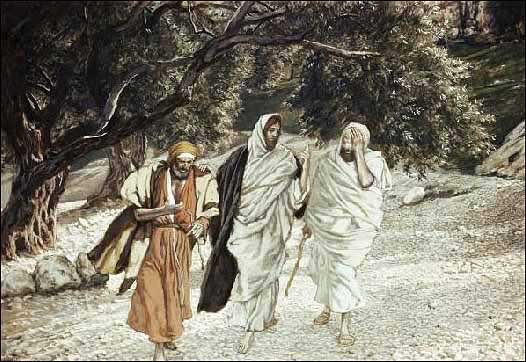
Road to Emmaus  by James J. Tissot

Road to Emmaus
by James J. Tissot

I had hoped to have written today’s post a bit sooner; nevertheless, I am grateful that God has granted me the grace and mercy to share another post on this fine Monday morning. As I have been spending a great deal of time in prayer regarding His plans for my life and my involvement within the local church (each year, twice a year, our local church engages in 21 days of prayer and fasting seeking God’s Will for our fellowship, our families, and our individual walks), this blog has come to mind repeatedly. I am reminded that I am not to take this blog lightly, that I cannot simply post what I like and rely on the first amendment to shield me from these writings. Rather, that as I commit myself to the study of God’s Word, and share here what I learn in the Scriptures, by the Grace of God by His Holy Spirit, that I do so prayerfully and humbly.

In the last post, we started to look at the subject of Biblical submission, that is, submitting to God and His Word in righteousness. Before continuing, I do think it important that we spend time again looking at the authority of the Scriptures. So, consider this a companion to the last post, because one cannot effectively discuss submission, without clearly and completely discussing authority.

Let us begin with the Apostle Paul’s instruction to Timothy, in which he declares:

2 Timothy 3:16 (NASB, emphasis mine) 16 All Scripture is [a]inspired by God and profitable for teaching, for reproof, for correction, for training in righteousness;
Footnote: [a] 2 Timothy 3:16 Lit God-breathed

I don’t normally include the footnotes in these posts; however, I couldn’t find a translation of the this passage that included the literal meaning of the Greek in the text. Every translation I searched included the literal meaning of the Greek as a footnote, and I believe it is important for us to recognize. Now, there is nothing wrong with the word “inspired” here, but I want to examine the literal “God-breathed” for a few moments.

Psalm 33:6 (NASB, emphasis mine) 6 By the word of the Lord the heavens were made, And by the breath of His mouth all their host.

Genesis 2:7 (NASB emphasis mine) 7 Then the Lord God formed man of dust from the ground, and breathed into his nostrils the breath of life; and man became a living being.

So, you see, the connection of all of Scripture to the Breath of God is an important one to maintain. As Paul wrote in Acts 17:28a (KJV), “For in him we live, and move, and have our being;” {oh yeah… I went old-school on that one 😉 }.

I mention this because in the past couple of decades we’ve seen a surge in the number of non-denominational Churches both here and abroad. There is a breaking away from the major hierarchies and set doctrines of these Churches that can be traced back to the reformation of the Roman Catholic Church. No doubt breaking away from false teaching, false doctrine, and corrupt leadership is necessary, but to do so without reconnecting to the authority of Scripture only leaves you floating aimlessly in a sea of organizations of men. Without a firm grasp on the authority of Scriptures, we cannot hope to remain submitted to God in keeping with His word, thus our attempts at reformation degrade into mere rebellion.  I’ve spoken to so many Christians who have left the church because they were hurt, mistreated, or lied to… only to reject all authority and to purpose within their hearts never to submit to “anyone but the Holy Spirit”. But to do so without acknowledging fully the authority of Scriptures is both reckless and rebellious and is a popular snare of the devil in our present culture and age.  It is to this generation that I hope to reach and reaffirm the authority of whole of Scriptures and the Gospel of Jesus Christ. It is why I’m focusing primarily in the New Testament affirmations of the Divine authority of scriptures. Let us continue on then…

I’d like to take a moment to look at one of the coolest accounts of Jesus after His resurrection found in Luke 24. I urge you strongly, to read the whole chapter… and then re-read it. It happens that as the women returned from finding the tomb of Jesus empty, and having been spoken to by Angels of the Lord, and shared their testimony with the disciples, that most did not believe. They were in mourning. Imagine for a moment, that only 3 days ago you saw your mentor, beloved teacher, Savior tortured and killed… you would undoubtedly have clouded judgement as well, would you not? But Peter took off running to see for himself. I love Peter… but that’s not where we are going right now, just setting up the backdrop for begins in verse 13:

Luke 24:13-17 (NASB, emphasis mine) 13 And behold, two of them were going that very day to a village named Emmaus, which was about seven miles from Jerusalem. 14 And they were talking with each other about all these things which had taken place. 15 While they were talking and discussing, Jesus Himself approached and began traveling with them. 16 But their eyes were prevented from recognizing Him. 17 And He said to them, “What are these words that you are exchanging with one another as you are walking?” And they stood still, looking sad.

The “them” in v13 refers to those disciples who heard the testimony of the women who had seen the empty tomb. But why did Jesus not just appear in full glory like, “here I am, BAM”? let’s read on, because the answer to this question is absolutely beautiful…

Luke 24:18-27 (NASB, emphasis mine) 18 One of them, named Cleopas, answered and said to Him, “Are You the only one visiting Jerusalem and unaware of the things which have happened here in these days?” 19 And He said to them, “What things?” And they said to Him, “The things about Jesus the Nazarene, who was a prophet mighty in deed and word in the sight of God and all the people, 20 and how the chief priests and our rulers delivered Him to the sentence of death, and crucified Him. 21 But we were hoping that it was He who was going to redeem Israel. Indeed, besides all this, it is the third day since these things happened. 22 But also some women among us amazed us. When they were at the tomb early in the morning, 23 and did not find His body, they came, saying that they had also seen a vision of angels who said that He was alive. 24 Some of those who were with us went to the tomb and found it just exactly as the women also had said; but Him they did not see.” 25 And He said to them, “O foolish men and slow of heart to believe in all that the prophets have spoken! 26 Was it not necessary for the Christ to suffer these things and to enter into His glory?” 27 Then beginning with Moses and with all the prophets, He explained to them the things concerning Himself in all the Scriptures.

Wow. You see… Jesus wanted His disciples to understand who He was and what had just happened in context of the Scriptures. He later reveals Himself to His disciples… but first, He chose to explain to them what they needed to know about Him… beginning with Moses and with all the prophets… Praise the Lord! While Jesus, being the Son of God, and already the first-born from the grave (resurrected) already bears all Authority in Heaven and Earth, He still chose to demonstrate His authority to His disciples by walking them through the scriptures. If Jesus chose to reveal Himself to His disciples in this manner, then we, too should likewise turn to the whole of Scripture to understand, proclaim, and reveal Jesus, the King of kings, and Lord of lords.

One more example before we close today. Let us return to the Apostle Paul for an example of how we are to share the Gospel as stewards of His word. Lets look at his letter to the Thessalonians. In the opening chapters of this letter, Paul is giving thanks for the faithfulness of the believers. One of the things for which Paul expresses thankfulness is particularly striking:

1 Thessalonians 2:13 (NASB) 13 For this reason we also constantly thank God that when you received the word of God which you heard from us, you accepted it not as the word of men, but for what it really is, the word of God, which also performs its work in you who believe.

So we have here that the Apostle is thankful that the believers accepted their words as the Word of God. But how is it, then, that such Authority could have been given to Paul by these believers? That they would not only accept their words as being of God, but that they “became imitators of the churches of God in Christ Jesus that are in Judea, for you also endured the same sufferings at the hands of your own countrymen…(v14)”. Thankfully, we have the account in Acts to bring us up-to-speed on what took place.

Acts 17:1-4(NASB) Paul at Thessalonica
17 Now when they had traveled through Amphipolis and Apollonia, they came to Thessalonica, where there was a synagogue of the Jews. 2 And according to Paul’s custom, he went to them, and for three Sabbaths reasoned with them from the Scriptures, 3 explaining and giving evidence that the Christ had to suffer and rise again from the dead, and saying, “This Jesus whom I am proclaiming to you is the Christ.” 4 And some of them were persuaded and joined Paul and Silas, along with a large number of the God-fearing Greeks and a number of the leading women.

This Jesus…is the Christ.” Paul reasoned with them from the Scriptures. That is where he derived his authority to preach, proclaiming the Jesus who had stopped him on the road to Damascus was in-fact the Christ. The authority isn’t in the vision, it’s in the Scriptures. Paul’s eyes needed to be opened, just as the eyes of the disciples that were walking on the road to Emmaus needed their eyes to be open.

It is my sincere prayer, that these posts spark a desire in your heart to read these scriptures for yourselves, and to get the full context of each passage. As I read/hear these passages I get a sense of what the disciples shared with one another after Jesus revealed Himself to them.

Luke 24:31-32 (NASB) 31 Then their eyes were opened and they recognized Him; and He vanished from their sight. 32 They said to one another, “Were not our hearts burning within us while He was speaking to us on the road, while He was explaining the Scriptures to us?”

May the Holy Spirit do likewise in your hearts as you search the Scriptures, and submit to the authority of God and His Word.

In Him,
FS

The Righteousness of Biblical Submission

Christ in Gethsemane by Heinrich Hofmann

Christ in Gethsemane by Heinrich Hofmann

We live in a society that absolutely rejects the notion of submission. For most Americans, submission is a sign of weakness, inferiority, and failure. What’s worse, there is a disturbing upward trend in deviant fetishism that seeks to add a very sick and twisted meaning to submission, due in large part to a recent publication of filth I don’t care to mention. To put it bluntly, submission is a dirty word in our society. There is a very good reason the enemy works so diligently to pervert, distort, and redefine “submission” and what it means to submit. As we will see in the Scriptures, the reason is that submission to God and the authority of His Word is our only hope for salvation. While that may seem like a “given”, I urge you to bear with me and see if we might dig a bit deeper into what it means to submit to God and His Word.

In the first chapter of the Gospel of John, we have the following introduction of Jesus Christ:

John 1:1-5 (NASB) The Deity of Jesus Christ
1 In the beginning was the Word, and the Word was with God, and the Word was God. 2 He was in the beginning with God. 3 All things came into being through Him, and apart from Him nothing came into being that has come into being. 4 In Him was life, and the life was the Light of men. 5 The Light shines in the darkness, and the darkness did not comprehend it.

John 1:14-18 (NASB) The Word Made Flesh
14 And the Word became flesh, and dwelt among us, and we saw His glory, glory as of the only begotten from the Father, full of grace and truth. 15 John *testified about Him and cried out, saying, “This was He of whom I said, ‘He who comes after me has a higher rank than I, for He existed before me.’” 16 For of His fullness we have all received, and grace upon grace. 17 For the Law was given through Moses; grace and truth were realized through Jesus Christ. 18 No one has seen God at any time; the only begotten God who is in the bosom of the Father, He has explained Him.

I like to start in the book of John, because I find that his intro does a wonderful job of introducing the Christ in such a manner that unifies the whole Bible. Right off the bat it is clear that in order to fully understand what it means to know Jesus involves studying all of God’s Word from Genesis through Revelation. If you’ll remember the wording of the prophecy in Isaiah 9:6 regarding the Messiah, “For a child will be born to us, a son will be given to us”, you see here that John was pointing out that while His flesh was born that day, Jesus was given to us… ,”And the Word became flesh”.

Now, as Christians, we are to take Jesus as our example. What did Jesus have to say about the Law and the Prophets?

Matthew 5:17-19 (NASB)
17 “Do not think that I came to abolish the Law or the Prophets; I did not come to abolish but to fulfill. 18 For truly I say to you, until heaven and earth pass away, not the smallest letter or stroke shall pass from the Law until all is accomplished. 19 Whoever then annuls one of the least of these commandments, and teaches others to do the same, shall be called least in the kingdom of heaven; but whoever keeps and teaches them, he shall be called great in the kingdom of heaven.

Jesus had every right, being God, to simply speak truth from His own authority. Why did He choose to return to scriptures time and time again? A common quick-answer given today is simply that He did so to demonstrate to us how we might live our lives. While there is truth in that, I believe that answer to be incomplete, and it leaves too much room for the enemy to inject into our minds doubts and false doctrines regarding the person of Jesus and the role of  biblical submission to Divine Authority. Jesus wasn’t just demonstrating submission to the scriptures and to God the Father, He submitted to the Father’s Will.  When He fasted for 40 days (Matt 4), He submitted to the Spirit, was led into the wilderness to be tempted, and He was hungry. Not an act just for demonstration’s sake, it was real. He resisted the temptation of the devil by referring to the Scriptures. That alone would make the point I’m trying to make, but look at His response to the second temptation.

Matthew 4:7 Jesus said to him, “On the other hand, it is written, ‘You shall not put the Lord your God to the test.’”

Jesus isn’t directing the quote at Satan, He presents the quote as a standard by which He must resist the temptation to put the Lord God to the test. Jesus is saying that He will not do what Satan suggested He do, because Scriptures clearly stay that we are not to test the Lord our God. Submission. Likewise in the response to the third and final temptation, Jesus isn’t commanding Satan ‘You shall worship the Lord your God, and serve Him only.’ He is saying that He is to worship the Lord God and serve Him only; therefore, He will resist the final temptation. Submission. Satan had to flee… and after he had run away, the angels came to minister to Jesus. I think that it is from this example that James writes

James 4:7-10 (NASB)
7 Submit therefore to God. Resist the devil and he will flee from you. 8 Draw near to God and He will draw near to you. Cleanse your hands, you sinners; and purify your hearts, you double-minded. 9 Be miserable and mourn and weep; let your laughter be turned into mourning and your joy to gloom. 10 Humble yourselves in the presence of the Lord, and He will exalt you.

I look forward to returning to James 4 at a later date, but for now, I just wanted to point out that the Apostles understood submission because they saw it in the life of Jesus. In your own private reading time, examine for yourselves all of the times Jesus deferred to His Father in Heaven. In the book of John, He made it very clear to the Pharisees that He was the Son of God, and that He was sent by Him, and that His authority over sin, sickness, even the Sabbath was from God; however, He also deferred to God’s Will and Authority. Let’s go to another truly desperate and painful times when Jesus submitted to God the Father

Mark 14:36 (NASB) (Luke 22:39-46; Matthew 26:36-46; Mark 14:32-42)
36 And He was saying, “Abba! Father! All things are possible for You; remove this cup from Me; yet not what I will, but what You will.”

Luke 23:34 (NASB) (On the Cross)
34 But Jesus was saying, “Father, forgive them; for they do not know what they are doing.” And they cast lots, dividing up His garments among themselves.

Luke 23:46 (NASB) 46 And Jesus, crying out with a loud voice, said, “Father, into Your hands I commit My spirit.” Having said this, He breathed His last.

Amen. Yes, Jesus demonstrated complete and total submission to God the Father… by being fully and completely submitted to God the Father. It is this point, this point exactly, that lead me to share this message today. If Jesus, being the Son of God, the Word of God, equal to God was righteous in His submission to God and the Word of God… where is it that we get this false notion that submission denotes inferiority? We submit to God not only because He is superior to us (because we are, in-fact, inferior to God) but because it is Right that we do so. If submission were based solely on inferiority of being then Jesus could not have submitted to God the Father, for He is in no way an inferior being. He submitted to the Authority of God the Father, because that is the design of God’s creation.

Pray about this, and settle it in your spirits. Biblical submission is righteousness in the sight of God. Submit therefore to God. There is much more to discuss concerning the righteousness of biblical submission. Know that the basis for subsequent discussion has been presented here, in that we must first submit to God, His Word, His Son, His Spirit, and His Will. We will take a prayerful look at what the scriptures have to say about submission, particularly in how we are to live our lives as Christians in society, family, and within the Church.

Until next time, May the Lord bless and keep you in His Will,

In Him,
FS

Related articles

CTT | And that not of yourselves…

sweeperOn my way in to work this morning, I heard the following scripture verse that is often quoted regarding salvation:

Ephesians 2:8-9 (NASB)
8 For by grace you have been saved through faith; and that not of yourselves, it is the gift of God; 9 not as a result of works, so that no one may boast.

What a wonderful message of the Grace of God. For it is by Grace that we have been saved, through faith. Paul takes that thought one step further and even highlights that we cannot boast on the faith that we blood of Jesus, for even that faith is a gift of God. Paul also mentions this in Romans 12 when in a similar message he is cautioning believers not to think too highly of themselves:

Romans 12:3 (NASB)
3 For through the grace given to me I say to everyone among you not to think more highly of himself than he ought to think; but to think so as to have sound judgment, as God has allotted to each a measure of faith.

While there is undoubtedly a sermon in the works here, I’d like to take a moment to point out that in stopping the related scripture verses short, I’ve actually omitted a greater message on Christian living. While I can appreciate a desire to keep the message of Salvation in its simplest form for those who are new to the Gospel, the concern I have is that we might not ever return to these scriptures and complete the thought. What is at risk here is a doctrine that stops at Salvation and fails to carry the new believer through to maturity in Christ. So, let’s go back to the passage in Ephesians and see if we can’t better complete the thought:

Ephesians 2:4-10 (NASB)
4 But God, being rich in mercy, because of His great love with which He loved us, 5 even when we were dead in our transgressions, made us alive together with Christ (by grace you have been saved), 6 and raised us up with Him, and seated us with Him in the heavenly places in Christ Jesus, 7 so that in the ages to come He might show the surpassing riches of His grace in kindness toward us in Christ Jesus. 8 For by grace you have been saved through faith; and that not of yourselves, it is the gift of God; 9 not as a result of works, so that no one may boast. 10 For we are His workmanship, created in Christ Jesus for good works, which God prepared beforehand so that we would walk in them.

In recent church history, there has been an overwhelming push to emphasize Salvation by faith (sound doctrine), and a distancing itself from the salvation by works (not  sound doctrine) as is generally the approach by most of the world’s religions. However, what sometimes happens is people who seek to counter balance an unbalanced theology, themselves become unbalanced whenever they lose sight of the whole of scriptures. In evangelical circles, we’ve gone so far in attacking the “salvation by works” that we’ve discredited any place for good works, or their necessity in God’s plan and design for the Body of Christ. We are His workmanship, created in Christ Jesus for good works, which God prepared before hand so that we would walk in them. While good works are in no way an avenue for Salvation, it is very much a part of the purpose for which we have been Saved, Redeemed, made alive in Christ. So, when we complete this thought in Ephesians, let’s also complete the thought in Romans:

Romans 12:3-8 (NASB)
3 For through the grace given to me I say to everyone among you not to think more highly of himself than he ought to think; but to think so as to have sound judgment, as God has allotted to each a measure of faith. 4 For just as we have many members in one body and all the members do not have the same function, 5 so we, who are many, are one body in Christ, and individually members one of another. 6 Since we have gifts that differ according to the grace given to us, each of us is to exercise them accordingly: if prophecy, according to the proportion of his faith; 7 if service, in his serving; or he who teaches, in his teaching; 8 or he who exhorts, in his exhortation; he who gives, with liberality; he who leads, with diligence; he who shows mercy, with cheerfulness.

I love that we find a continuation in parity between the passages. Notice, that the acknowledgement of the Grace of God extended to us is the pretense, or starting point for how we are to live our lives in Christ. That from the point of Grace, in which we have our Salvation and Redemption we are to move forward in exercising the gifts given to us by God. We are expected to do good works, provided we remain firmly grounded in the knowledge that apart from Jesus we can do nothing (John 15:5). If we look back at the underlined portion in Ephesians 2:5, we see that what follows is drawn in contrast to our previous state of being dead in sins. If you read from the beginning of the chapter, you see that while we were dead in sins, we were guilty of all sorts of works of evil. In fact the whole of Ephesians 2 is addressing the contrast between the works of sin we were guilty of prior to our redemption and salvation through Christ, and that we are now made alive in Christ and we are to continue growing and being built into the Temple of the Spirit of God (Eph 2:19-22).

The importance of completing the thought from salvation through maturity in Christ cannot be overstated. For if we neglect the place of good works within God’s plan for the Redeemed, then we are completely ill-equipped to understand how James would be so bold as to assert the following:

James 2:14-20 (NASB)
14 What use is it, my brethren, if someone says he has faith but he has no works? Can that faith save him? 15 If a brother or sister is without clothing and in need of daily food, 16 and one of you says to them, “Go in peace, be warmed and be filled,” and yet you do not give them what is necessary for their body, what use is that? 17 Even so faith, if it has no works, is dead, being by itself.
18 But someone may well say, “You have faith and I have works; show me your faith without the works, and I will show you my faith by my works.” 19 You believe that God is one. You do well; the demons also believe, and shudder. 20 But are you willing to recognize, you foolish fellow, that faith without works is useless?

Yikes, some strong words from the Apostle James. But he is speaking against the very over-reaction to “salvation by works” that we find ourselves discussing today. Only the early church wasn’t fighting/bucking against the Catholic Church of Rome; rather, they were tempted to abandon the Law and the Prophets. Paul had to address lawlessness in many of his letters, and he also had to deal with legalism. We serve such a Gracious God who has preserved for us His Word so that we will never be left without direction or purpose.

So, is it wrong to limit a quote of Ephesians 2 to verses 8 and 9? Not if the purpose is to highlight an unbalanced approach to works, or boasting. Personally, I’d prefer to include verse 10 to encourage balance in each message, so that if/when I am later quoted, the quote might better serve the one who would hear/read the quote. But most importantly, if you’ve never been introduced to verse 10, it is my hope that today, you will have a better appreciation for how we are to live out our lives as Christians. We are called to do good works, works that were prepared for us by God, who Himself also gave us the very means to perform those works, so that we cannot boast in ourselves, only in the Grace of God. In closing, I confess that I tend to be accused (jokingly) of being rather long-winded… and for the most part that holds true. But I love the Word of God, and I endeavor to be a faithful steward of the Gospel of Jesus Christ. I’m okay with being accused of “sharing too much” of the Word of God, especially when I consider the alternative…

May the Lord Bless and keep you in His Will.

In Him,
FS

Reaching forward to what lies ahead in 2014…

Happy New Year 2014In my family, New Years is the big holiday for the family to gather together and thank God for the year that has drawn to a close, and pray for His blessing on the year to come.  I am still on vacation, so this post will be rather short today; however, I did want to share what has been on my mind for 2014. A close brother in Christ shared the Sunday morning message at our church and he highlighted the following passage in Philippians.

Philippians 3:13-16 (NASB)
13 Brethren, I do not regard myself as having laid hold of it yet; but one thing I do: forgetting what lies behind and reaching forward to what lies ahead, 14 I press on toward the goal for the prize of the upward call of God in Christ Jesus. 15 Let us therefore, as many as are perfect, have this attitude; and if in anything you have a different attitude, God will reveal that also to you; 16 however, let us keep living by that same standard to which we have attained.

My wife and I have spent a great deal of time in December, discussing all of the ways that God has matured us and blessed us. We do tend to focus a bit too much on the various “growth opportunities” (trials) we faced in 2013.

I am not writing to tell you what God has in store for you in 2014… not specifically anyway. Rather, I know that to move on with the proper attitude, Paul begins his advice with the phrase, “forgetting what lies behind”. One thing I noticed here is that Paul didn’t specify “just the bad things that lie behind”. He said to forget what lies behind. That’s important, because too often we become so focused on the good things God did in the past that we fail to recognize any of God’s blessings that don’t look exactly like the blessings of the past. In doing so, we limit God and hurt ourselves and those around us by not being in a position/mindset to fully recognize and acknowledge the blessings of God. But holding on to the trials too tightly can be even worse. Not only can that rob us of future blessings, and blind us of future trials, but holding on too tightly to the trials themselves can rob us of the very lesson God had intended for us to learn from it. Additionally, we can leave room for the enemy to plant seeds of bitterness when hold on too tightly to the trials of the past.

I am writing this to encourage you (and me) to seek the Will of God for 2014. Our church begins each New Year with prayer and fasting. What is God calling you to do in 2014? What is the prize for upon which you need to set your gaze? I recommend, keeping a prayer journal, and writing down what you feel the Holy Spirit speaking to you. Once you’ve written down what you feel is God’s call for you this year, search out the Scriptures for what you’ve written down. Once you’ve found the scriptural basis for what you’ve written down, you can be confident that you heard from God and rest in the fact that He has called you to do good works. If you cannot find scriptural basis, maybe ask a brother or sister in Christ to pray with you and search the scriptures with you.  It could also be that you’ve injected your own desires or what you think God would want you to do. We’ve all done this at one time or another and to varying degrees. Here again, is why we need to be surrounded by Godly council and brotherly love.

I’m looking forward to 2014. I pray that this blog will be an encouragement to your lives in the upcoming year, and that you might share with us the great things He has done in your lives. May the Lord Bless you and keep you this year.

In Him,
FS

The Sovereignty of the One True God

Image: Sovereignty of God

Image is from pastorjessen.wordpress.com, related article below

I hope you enjoyed reading the past few blogs exploring the greater context of what we celebrate at Christmas. I certainly got a lot out of it myself. Today as I continued reading in Isaiah, I was reminded of just how awesome a God we serve. His Sovereignty is unquestionable. I think sometimes we get so caught up in the idea that He is our God, that we forget that He is the Only True God (John 17:3). That means that He reigns supremely over all of creation, because He IS God. Do you ever find yourself caught up in an us-versus-them mentality with respect to non-Christians? Or when defending your faith, do you ever catch yourself referring to their religion as “their gods”? While the concept is true for them in their unbelief, the ultimate Truth is that Our God, is their God, even when though they don’t know who He is. We serve an awesome, and truly Sovereign God.

Don’t just take my word for it, let’s look to the Word of God. Remember in our discussion of the Exile of Israel into Babylon? Isaiah prophesied of the end of the 2 kingdoms, of the scattering of Israel and the captivity of Judah. He prophesied of the hardship that would befall the remnant in Judah. In Chapter 9 we saw that he prophesied of the Birth of the Messiah. Do you remember what marked the end of the Exile in Babylon? Cyrus the king of Persia. He followed Zoroastrianism, and thus believed in many gods. We discussed the historical record of how in his belief of the great spectrum of gods, the God of Israel was one of the good Gods that needed to have His Temple restored. What I didn’t realize was that the Bible has a great deal to say about this king. God spoke again to the prophet Isaiah, a message to this king, in Chapter 45.

Isaiah 45 (NASB)
God Uses Cyrus

1 Thus says the Lord to Cyrus His anointed, Whom I have taken by the right hand, To subdue nations before him And to loose the loins of kings; To open doors before him so that gates will not be shut:
2 “I will go before you and make the rough places smooth; I will shatter the doors of bronze and cut through their iron bars.
3 “I will give you the treasures of darkness And hidden wealth of secret places, So that you may know that it is I, The Lord, the God of Israel, who calls you by your name.
4 “For the sake of Jacob My servant, And Israel My chosen one, I have also called you by your name; I have given you a title of honor Though you have not known Me.
5 “I am the Lord, and there is no other; Besides Me there is no God. I will gird you, though you have not known Me;
6 That men may know from the rising to the setting of the sun That there is no one besides Me. I am the Lord, and there is no other,
7 The One forming light and creating darkness, Causing well-being and creating calamity; I am the Lord who does all these.
8 “Drip down, O heavens, from above, And let the clouds pour down righteousness; Let the earth open up and salvation bear fruit, And righteousness spring up with it. I, the Lord, have created it.
9 “Woe to the one who quarrels with his Maker— An earthenware vessel among the vessels of earth! Will the clay say to the potter, ‘What are you doing?’ Or the thing you are making say, ‘He has no hands’?
10 “Woe to him who says to a father, ‘What are you begetting?’ Or to a woman, ‘To what are you giving birth?’”
11 Thus says the Lord, the Holy One of Israel, and his Maker:

“Ask Me about the things to come concerning My sons, And you shall commit to Me the work of My hands.
12 “It is I who made the earth, and created man upon it. I stretched out the heavens with My hands And I ordained all their host.
13 “I have aroused him in righteousness And I will make all his ways smooth; He will build My city and will let My exiles go free, Without any payment or reward,” says the Lord of hosts.
14 Thus says the Lord, “The products of Egypt and the merchandise of Cush And the Sabeans, men of stature, Will come over to you and will be yours; They will walk behind you, they will come over in chains And will bow down to you; They will make supplication to you: ‘Surely, God is with you, and there is none else, No other God.’”
15 Truly, You are a God who hides Himself, O God of Israel, Savior!
16 They will be put to shame and even humiliated, all of them; The manufacturers of idols will go away together in humiliation.
17 Israel has been saved by the Lord With an everlasting salvation; You will not be put to shame or humiliated to all eternity.
18 For thus says the Lord, who created the heavens (He is the God who formed the earth and made it, He established it and did not create it a waste place, but formed it to be inhabited),

“I am the Lord, and there is none else.

19 “I have not spoken in secret, in some dark land; I did not say to the offspring of Jacob,‘Seek Me in a waste place’; I, the Lord, speak righteousness, Declaring things that are upright.
20 “Gather yourselves and come; Draw near together, you fugitives of the nations; They have no knowledge, Who carry about their wooden idol And pray to a god who cannot save.
21 “Declare and set forth your case; Indeed, let them consult together. Who has announced this from of old? Who has long since declared it? Is it not I, the Lord? And there is no other God besides Me, A righteous God and a Savior; There is none except Me.
22 “Turn to Me and be saved, all the ends of the earth; For I am God, and there is no other.
23 “I have sworn by Myself, The word has gone forth from My mouth in righteousness And will not turn back, That to Me every knee will bow, every tongue will swear allegiance.
24 “They will say of Me, ‘Only in the Lord are righteousness and strength.’ Men will come to Him, And all who were angry at Him will be put to shame.
25 “In the Lord all the offspring of Israel Will be justified and will glory.”

Remember, God is speaking to (and of) a foreigner. And God has clearly stated that His Hand was upon Cyrus. We serve a truly awesome God… whose Sovereignty is absolute. Your belief in Him empowers you, not Him. Likewise, the unbelief in men hurts men, not God. We also have an often quoted verse in Romans:

Romans 5:6-11(NASB)
6 For while we were still helpless, at the right time Christ died for the ungodly. 7 For one will hardly die for a righteous man; though perhaps for the good man someone would dare even to die. 8 But God demonstrates His own love toward us, in that while we were yet sinners, Christ died for us. 9 Much more then, having now been justified by His blood, we shall be saved from the wrath of God through Him. 10 For if while we were enemies we were reconciled to God through the death of His Son, much more, having been reconciled, we shall be saved by His life. 11 And not only this, but we also exult in God through our Lord Jesus Christ, through whom we have now received the reconciliation.

Paul is not talking to Jews in this letter… he’s talking to Gentiles (Romans). This is extremely important because before Christ foreigners did not have access to God except through His Chosen people. Paul spends a great deal of time explaining throughout the Epistles just how awesome we have it as adopted sons and daughters of God. By the Blood of Jesus we have been made heirs and joint-heirs with Christ. Jesus did that, for us… all of us, even those of us who refuse to accept Him as Lord and Savior. There is only One God… and He Reigns Supreme over all of His creation.

So don’t lose sight of that wonderful truth. God is in control. He is sovereign over all things. That doesn’t mean we won’t struggle, or experience pain, or have our faith tested… it means that in all of it, God is in control. We modern-day Christians would do well to study the Old Testament and the History of the descendents of Abraham. Because, thanks to Jesus, their history is now our history. For some of you that fact is a great comfort, for others a bit of a warning… for most of us, it serves as both.

One of the men in our church recently asked me for some advice for some direction for growing in his walk. He is a new Christian, so my recommendation was to start reading Romans, with a pen and paper handy. Write down questions, concerns, and struggles with what he reads and be sure to share them with me as continues to read and absorb. I think we will be visiting Romans a great deal in the next month here at FS, and we will be looking at the roots laid in the Old Testament as well.

In Him,
FS