Biblical Submission | Relationships

marriageSo, it’s February, and Valentine’s Day is around the corner.  My wife and I don’t really make much of a big deal of this holiday… it’s more commercial than Biblical; however, given how many online blogs and sermons seem to be taking advantage of the holiday to teach self-help advice on Love and Marriages, I figured I’d weigh in.  I’d like to take a look at what the Bible has to say about the Marriage relationship as well as some things that are not found in the Bible. There are many places where we can start this discussion of Marriage, but I think the best place to begin, is in the baseline for relationships. This will be a 2 part series.

It does us no good to discuss Marriage Relationships without first establishing the baseline for relationships. So, for starters, let’s look at what Jesus had to say about how we are to treat each other. I’d like to begin our reading in Matthew 22. To catch us up a bit on the context here, this is after the Triumphal entrance of Jesus into Jerusalem. We see Jesus cleanse the temple of merchants and money changers, and when the children praise Him as being the son of David, the scribes challenge Jesus for not rebuking the children (because what they were doing was giving Jesus the praise due to the Messiah). They question the authority of Jesus to be speaking in the temple, and He moves on to teaching in parables to very openly declare who He is and of the Kingdom of Heaven. The first parable we find in Matthew 22 actually uses a wedding feast to represent Kingdom of Heaven. I’m starting here because it sets up the later portion we will be examining closely.

Matthew 22 (ESV) 1 And again Jesus spoke to them in parables, saying, 2 “The kingdom of heaven may be compared to a king who gave a wedding feast for his son, 3 and sent his servants to call those who were invited to the wedding feast, but they would not come. 4 Again he sent other servants, saying, ‘Tell those who are invited, “See, I have prepared my dinner, my oxen and my fat calves have been slaughtered, and everything is ready. Come to the wedding feast.”’ 5 But they paid no attention and went off, one to his farm, another to his business, 6 while the rest seized his servants, treated them shamefully, and killed them. 7 The king was angry, and he sent his troops and destroyed those murderers and burned their city. 8 Then he said to his servants, ‘The wedding feast is ready, but those invited were not worthy. 9 Go therefore to the main roads and invite to the wedding feast as many as you find.’ 10 And those servants went out into the roads and gathered all whom they found, both bad and good. So the wedding hall was filled with guests. 11 “But when the king came in to look at the guests, he saw there a man who had no wedding garment. 12 And he said to him, ‘Friend, how did you get in here without a wedding garment?’ And he was speechless. 13 Then the king said to the attendants, ‘Bind him hand and foot and cast him into the outer darkness. In that place there will be weeping and gnashing of teeth.’ 14 For many are called, but few are chosen.” 15 Then the Pharisees went and plotted how to entangle him in his words.

So, while the setting of the parable is a wedding feast, this is a picture of the Kingdom of heaven. Those invited who ignored the call represent the Jews in Israel who rejected the Messiah. So then the servants are sent out to the rest who were not originally invited, for the feast was already made ready. This tells of the Gospel going out to the Gentiles. Finally, those who come to the wedding feast, must come dressed for the wedding. Unless they are made righteous by the sacrifice of Jesus Christ, they cannot partake in the wedding feast (See Zechariah 3). Now, the next encounter is an absolutely beautiful lesson on submission to the governments of men, and to God regarding paying taxes. Awesome. But let’s move on to the next parable starting in verse 23.

Matthew 22:23-33 (ESV) 23 The same day Sadducees came to him, who say that there is no resurrection, and they asked him a question, 24 saying, “Teacher, Moses said, ‘If a man dies having no children, his brother must marry the widow and raise up offspring for his brother.’ 25 Now there were seven brothers among us. The first married and died, and having no offspring left his wife to his brother. 26 So too the second and third, down to the seventh. 27 After them all, the woman died. 28 In the resurrection, therefore, of the seven, whose wife will she be? For they all had her.” 29 But Jesus answered them, “You are wrong, because you know neither the Scriptures nor the power of God. 30 For in the resurrection they neither marry nor are given in marriage, but are like angels in heaven. 31 And as for the resurrection of the dead, have you not read what was said to you by God: 32 ‘I am the God of Abraham, and the God of Isaac, and the God of Jacob’? He is not God of the dead, but of the living.” 33 And when the crowd heard it, they were astonished at his teaching.

I promise, we are starting at the foundation of relationships first, though we are getting hints at some of what the Bible teaches regarding marriage. Notice here, that marriage is clearly something for us while we are on this Earth… not for the Kingdom of Heaven. Moving on…

Matthew 22:34-40 (ESV) 34 But when the Pharisees heard that he had silenced the Sadducees, they gathered together. 35 And one of them, a lawyer, asked him a question to test him. 36 “Teacher, which is the great commandment in the Law?” 37 And he said to him, “You shall love the Lord your God with all your heart and with all your soul and with all your mind. 38 This is the great and first commandment. 39 And a second is like it: You shall love your neighbor as yourself. 40 On these two commandments depend all the Law and the Prophets.

Okay stop! This is where we want to begin building the foundation for understanding what the Bible teaches about relationships, and upon that foundation we will look further into what the Bible teaches about the Marriage Relationship. Unquestionably, the single, most important relationship setup in the Bible, is that we are to love the Lord Our God with all of our heart, all of our soul, and all of our mind. This is the single greatest commandment, but notice that Jesus was quick to include a second, that we shall love our neighbor as ourselves. Is there a third? No. Jesus stops the list at 2 commandments, and clearly states that upon these 2 commandments rests all the Law and the Prophets. That’s it. Loving our neighbor as ourselves covers every imaginable relationship among mankind… including but not limited to marriage. It has to, because there are no other commandments in the short list, and the first is completely exclusive to God. Okay, but… how do we define who is “my neighbor”? Do we look to the Greek? the Hebrew? the Talmud? Well… let’s first look to how Jesus responded when the same question was asked of Him. Let’s look in Luke 10. Since this is a question asked of Jesus directly, we’ll just jump straight to verse

Luke 10:25-37 (ESV)25 And behold, a lawyer stood up to put him to the test, saying, “Teacher, what shall I do to inherit eternal life?” 26 He said to him, “What is written in the Law? How do you read it?” 27 And he answered, “You shall love the Lord your God with all your heart and with all your soul and with all your strength and with all your mind, and your neighbor as yourself.” 28 And he said to him, “You have answered correctly; do this, and you will live.” 29 But he, desiring to justify himself, said to Jesus, “And who is my neighbor?” 30 Jesus replied, “A man was going down from Jerusalem to Jericho, and he fell among robbers, who stripped him and beat him and departed, leaving him half dead. 31 Now by chance a priest was going down that road, and when he saw him he passed by on the other side. 32 So likewise a Levite, when he came to the place and saw him, passed by on the other side. 33 But a Samaritan, as he journeyed, came to where he was, and when he saw him, he had compassion. 34 He went to him and bound up his wounds, pouring on oil and wine. Then he set him on his own animal and brought him to an inn and took care of him. 35 And the next day he took out two denarii and gave them to the innkeeper, saying, ‘Take care of him, and whatever more you spend, I will repay you when I come back.’ 36 Which of these three, do you think, proved to be a neighbor to the man who fell among the robbers?” 37 He said, “The one who showed him mercy.” And Jesus said to him, “You go, and do likewise.”

So then, who is our neighbor? Mankind. The interesting thing about this answer, is that it was phrased in such a way where the Jewish lawyer is being told to emulate a Samaritan to show mercy on his neighbor, and to love similarly. That’s huge. So, that’s how Jesus defined being a neighbor. I want to also take a look at how the Bible defines love, since loving God and our neighbors is the crux of the Law and the Prophets. For this, lets look at what the Apostle Paul wrote to the Corinthians.

1 Corinthians 13 (ESV) 1 If I speak in the tongues of men and of angels, but have not love, I am a noisy gong or a clanging cymbal. 2 And if I have prophetic powers, and understand all mysteries and all knowledge, and if I have all faith, so as to remove mountains, but have not love, I am nothing. 3 If I give away all I have, and if I deliver up my body to be burned, but have not love, I gain nothing.

4 Love is patient and kind; love does not envy or boast; it is not arrogant 5 or rude. It does not insist on its own way; it is not irritable or resentful; 6 it does not rejoice at wrongdoing, but rejoices with the truth. 7 Love bears all things, believes all things, hopes all things, endures all things.

8 Love never ends. As for prophecies, they will pass away; as for tongues, they will cease; as for knowledge, it will pass away. 9 For we know in part and we prophesy in part, 10 but when the perfect comes, the partial will pass away. 11 When I was a child, I spoke like a child, I thought like a child, I reasoned like a child. When I became a man, I gave up childish ways. 12 For now we see in a mirror dimly, but then face to face. Now I know in part; then I shall know fully, even as I have been fully known. 13 So now faith, hope, and love abide, these three; but the greatest of these is love.

This passage is almost always read in the context of marriage, at weddings, anniversaries, etc. But that is not the context of this passage, and I think limiting it to such occasions does the hearer an injustice. This is not some high-standard to aim for in our romantic/marriage relationships, this is a standard of living, of loving God and our neighbors as ourselves. This portion comes almost as an aside, or a reality-check, in a discourse on operating in the Gifts of the Spirit. The Church at Corinth had apparently gotten carried away to the point of losing sight of the very purpose of the Holy Spirit and His gifts to the Church. That is how we get to verses 1-3, where Paul is saying that you might be fully operating in tongues, prophetic power, knowledge and faith, and still miss the mark. Remember that Jesus didn’t base the Law and the Prophets on the manifestations of the Holy Spirit, He based them on 2 commandments of love. And that is reaffirmed by Paul in verse 13. This isn’t simply how we are to love our spouse, this is how we are to love.

In closing, we will look at the first part of Ephesians 5 which will bring this post to a close, and pave the way for the next post as move into some of the specific things the Bible has to say about the Marriage Relationship. It  is paramount, that we do not lose sight of the baseline for Christian behavior, and love for our neighbor. Because there is absolutely no room for abuse or mistreatment of any, not even strangers or so-called enemies. Nothing we discuss within the Marriage relationship justifies mistreatment, because mistreatment of our enemies isn’t even permitted.

Ephesians 5:1-21 (ESV) 1 Therefore be imitators of God, as beloved children. 2 And walk in love, as Christ loved us and gave himself up for us, a fragrant offering and sacrifice to God. 3 But sexual immorality and all impurity or covetousness must not even be named among you, as is proper among saints. 4 Let there be no filthiness nor foolish talk nor crude joking, which are out of place, but instead let there be thanksgiving. 5 For you may be sure of this, that everyone who is sexually immoral or impure, or who is covetous (that is, an idolater), has no inheritance in the kingdom of Christ and God. 6 Let no one deceive you with empty words, for because of these things the wrath of God comes upon the sons of disobedience. 7 Therefore do not become partners with them; 8 for at one time you were darkness, but now you are light in the Lord. Walk as children of light 9 (for the fruit of light is found in all that is good and right and true), 10 and try to discern what is pleasing to the Lord. 11 Take no part in the unfruitful works of darkness, but instead expose them. 12 For it is shameful even to speak of the things that they do in secret. 13 But when anything is exposed by the light, it becomes visible, 14 for anything that becomes visible is light. Therefore it says,

“Awake, O sleeper, and arise from the dead, and Christ will shine on you.”

15 Look carefully then how you walk, not as unwise but as wise, 16 making the best use of the time, because the days are evil. 17 Therefore do not be foolish, but understand what the will of the Lord is. 18 And do not get drunk with wine, for that is debauchery, but be filled with the Spirit, 19 addressing one another in psalms and hymns and spiritual songs, singing and making melody to the Lord with your heart, 20 giving thanks always and for everything to God the Father in the name of our Lord Jesus Christ, 21 submitting to one another out of reverence for Christ.

So then, there we have our foundation for Christian relationships. We are to love our neighbor (friends and foreigners alike) as ourselves at the 1 Cor 13 level. Within the body of Christ, we are to walk in love, submitting to one another out of reverence for Christ. Baseline approach to relationships. Not just marriage, not even dating or courtship… baseline. And anything short of this is sin.  Thank God for His ever abounding Grace, for without the Gospel of Jesus Christ we are surely dead in our trespasses and sins. Apart from Him, we don’t have a chance at keeping the Law and the Prophets even if they are condensed to 2 commandments!

May the Lord bless and keep you,
In Him,
Jorge

Discipleship: Calling, Apprenticeship, & Ministry IV

Apprentice

Repro. of painting by Emile Adan, copyrighted by Braun & Co., N.Y.

Okay, so where has this week gone? I didn’t want the week to go without taking a look at a key figure in the Bible, his calling, apprenticeship, and ministry.  Today I want to return to the Old Testament, because I’d like to start looking at David. However, in order to get there, I felt it necessary to start with Samuel the Prophet of God.

Samuel

We’ve seen how God called, trained and sent out Gideon in the time of the Judges of Israel. In moving toward the time of the kings of Israel I’m excited about getting to the Throne of David, on whose throne Jesus is promised to reign forever (Gospel!). But I don’t want to skip straight there, because a key figure throughout this time period is Samuel. Now Samuel was called by God before birth, and his calling from God comes as an answer to prayer. So today’s story will be the first we look at that might be misconstrued a bit by some as prescription for obtaining the call of God on your life. Let us start by reading the setup directly from the Bible.

1 Samuel 1 (ESV)
1 There was a certain man of Ramathaim-zophim of the hill country of Ephraim whose name was Elkanah the son of Jeroham, son of Elihu, son of Tohu, son of Zuph, an Ephrathite. 2 He had two wives. The name of the one was Hannah, and the name of the other, Peninnah. And Peninnah had children, but Hannah had no children.

3 Now this man used to go up year by year from his city to worship and to sacrifice to the Lord of hosts at Shiloh, where the two sons of Eli, Hophni and Phinehas, were priests of the Lord. 4 On the day when Elkanah sacrificed, he would give portions to Peninnah his wife and to all her sons and daughters. 5 But to Hannah he gave a double portion, because he loved her, though the Lord had closed her womb. 6 And her rival used to provoke her grievously to irritate her, because the Lord had closed her womb. 7 So it went on year by year. As often as she went up to the house of the Lord, she used to provoke her. Therefore Hannah wept and would not eat. 8 And Elkanah, her husband, said to her, “Hannah, why do you weep? And why do you not eat? And why is your heart sad? Am I not more to you than ten sons?”

9 After they had eaten and drunk in Shiloh, Hannah rose. Now Eli the priest was sitting on the seat beside the doorpost of the temple of the Lord. 10 She was deeply distressed and prayed to the Lord and wept bitterly. 11 And she vowed a vow and said, “O Lord of hosts, if you will indeed look on the affliction of your servant and remember me and not forget your servant, but will give to your servant a son, then I will give him to the Lord all the days of his life, and no razor shall touch his head.

12 As she continued praying before the Lord, Eli observed her mouth. 13 Hannah was speaking in her heart; only her lips moved, and her voice was not heard. Therefore Eli took her to be a drunken woman. 14 And Eli said to her, “How long will you go on being drunk? Put your wine away from you.” 15 But Hannah answered, “No, my lord, I am a woman troubled in spirit. I have drunk neither wine nor strong drink, but I have been pouring out my soul before the Lord. 16 Do not regard your servant as a worthless woman, for all along I have been speaking out of my great anxiety and vexation.” 17 Then Eli answered, “Go in peace, and the God of Israel grant your petition that you have made to him.” 18 And she said, “Let your servant find favor in your eyes.” Then the woman went her way and ate, and her face was no longer sad.

19 They rose early in the morning and worshiped before the Lord; then they went back to their house at Ramah. And Elkanah knew Hannah his wife, and the Lord remembered her. 20 And in due time Hannah conceived and bore a son, and she called his name Samuel, for she said, “I have asked for him from the Lord.

Praise the Lord, for He is worthy to be praised. We serve a God who hears the prayers of our hearts, sees our distress, and answers our prayers. Now, I would like to caution you, to be very cautious in your vows. Making a vow to God is no small thing, and should not be engaged flippantly. While I do intend to present this story as an example of the Greatness, Love, Mercy, and Kindness of the Living God we serve, I’m not saying we should copy all of her steps; rather, that we pay attention to God’s response. She takes a dangerous road here in vowing a vow to God, but she remains faithful to her vow, so it works out here. Why the cautionary statement? Lets look at the strong warning in Ecclesiastes:

Ecclesiastes 5:1-7 (ESV) 1 Guard your steps when you go to the house of God. To draw near to listen is better than to offer the sacrifice of fools, for they do not know that they are doing evil. 2 Be not rash with your mouth, nor let your heart be hasty to utter a word before God, for God is in heaven and you are on earth. Therefore let your words be few. 3 For a dream comes with much business, and a fool’s voice with many words. 4 When you vow a vow to God, do not delay paying it, for he has no pleasure in fools. Pay what you vow. 5 It is better that you should not vow than that you should vow and not pay. 6 Let not your mouth lead you into sin, and do not say before the messenger that it was a mistake. Why should God be angry at your voice and destroy the work of your hands? 7 For when dreams increase and words grow many, there is vanity; but God is the one you must fear.

Aside from the vow, let’s look at what the Scriptures tell us about Hannah. She has endured a great amount of ridicule from the Peninnah, the other wife of Elkanah, their husband. Because she had no children, and was barren (the Lord closed up her womb). Her husband, is aware of her sadness and predicament, and it manifests itself in their worship (observing of the sacrifices/offerings). He tries to encourage her by saying, “Am I not more to you than ten sons?” Well, Elkanah cannot do anything more for her, and cannot provide children. So she takes her supplication to the Lord God. She prayed and wept bitterly. As she termed it, she poured out her soul to the Lord, that He would grant her a son. In asking the Lord for a son, she commits the gift of God (a son) back to God for the rest of his life. The comments she makes to Eli about not having had any wine or strong drink, and to the Lord God about no razor touching his head leads me to think she was committing him to a life-long Nazarite Vow similar to that of the calling of Samson (Judges 13). I don’t think Hannah is expecting to give birth to the next judge over Israel, she is dedicating a gift of thanksgiving to God in keeping with what is already in Scripture. She is asking that God would show mercy on her, and bless her with a son, and in return (thanksgiving) she will give back to the Lord what He has given her. What starts this blessing? What reaches the Lord’s heart? Her faith. She walks away from the Temple that day, assured that the Lord had heard her prayer, and that He will provide, “Then the woman went her way and ate, and her face was no longer sad“.

Hebrews 11:1-2 (ESV) 1 Now faith is the assurance of things hoped for, the conviction of things not seen. 2 For by it the people of old received their commendation.

If we are to emulate the people of old who received their commendation… we need to look to their faith, and the object of their faith, the Lord God of Israel. God gives her a son, and she is quick to complete her vow (please… don’t start making vows, especially vows you are not able to keep. Do not give the devil an opportunity to enslave you by the words of your own mouths). Make your requests known to God, and pray as Jesus taught us to pray (Matt 6; Luke 11)… and put your faith in Him. Will all of your prayers come true? No. God’s Sovereignty remains fully intact. We do not dictate to God anything. We make our requests known to Him through prayer, and we have the right by grace through faith in Jesus Christ. But God’s Will supersedes ours. Not every woman who prayed for a son received one. The Old Testament has a purpose, and that purpose is in the Promise of the Messiah. Let us continue with Samuel.

1 Samuel 1:21-28 (ESV) 21 The man Elkanah and all his house went up to offer to the Lord the yearly sacrifice and to pay his vow. 22 But Hannah did not go up, for she said to her husband, “As soon as the child is weaned, I will bring him, so that he may appear in the presence of the Lord and dwell there forever.” 23 Elkanah her husband said to her, “Do what seems best to you; wait until you have weaned him; only, may the Lord establish his word.” So the woman remained and nursed her son until she weaned him. 24 And when she had weaned him, she took him up with her, along with a three-year-old bull, an ephah of flour, and a skin of wine, and she brought him to the house of the Lord at Shiloh. And the child was young. 25 Then they slaughtered the bull, and they brought the child to Eli. 26 And she said, “Oh, my lord! As you live, my lord, I am the woman who was standing here in your presence, praying to the Lord. 27 For this child I prayed, and the Lord has granted me my petition that I made to him. 28 Therefore I have lent him to the Lord. As long as he lives, he is lent to the Lord.” And he worshiped the Lord there.

Good, she was faithful to her vow to God, and now Eli (who has 2 sons already serving as priests) has an apprentice. She has been dedicated to the House of the Lord, but is this his calling? Before we get to that, let us look at Hannah’s prayer of Thanksgiving and Prayer… because it’s awesome…

1 Samuel 2 (ESV) | Hannah’s Prayer

1 And Hannah prayed and said,
“My heart exults in the Lord;
my horn is exalted in the Lord.
My mouth derides my enemies,
because I rejoice in your salvation.
2 “There is none holy like the Lord:
for there is none besides you;
there is no rock like our God.
3 Talk no more so very proudly,
let not arrogance come from your mouth;
for the Lord is a God of knowledge,
and by him actions are weighed.
4 The bows of the mighty are broken,
but the feeble bind on strength.
5 Those who were full have hired themselves out for bread,
but those who were hungry have ceased to hunger.
The barren has borne seven,
but she who has many children is forlorn.
6 The Lord kills and brings to life;
he brings down to Sheol and raises up.
7 The Lord makes poor and makes rich;
he brings low and he exalts.
8 He raises up the poor from the dust;
he lifts the needy from the ash heap
to make them sit with princes
and inherit a seat of honor.
For the pillars of the earth are the Lord’s,
and on them he has set the world.
9 “He will guard the feet of his faithful ones,
but the wicked shall be cut off in darkness,
for not by might shall a man prevail.
10 The adversaries of the Lord shall be broken to pieces;
against them he will thunder in heaven.
The Lord will judge the ends of the earth;
he will give strength to his king
and exalt the horn of his anointed.”

11 Then Elkanah went home to Ramah. And the boy was ministering to the Lord in the presence of Eli the priest.

Here we have an apprenticeship beginning with only a partial calling. Hannah’s vow to the Lord committed Samuel to the service of the Lord as a Nazarite. God would soon Call on Samuel. Notice here that Eli isn’t exactly the most qualified (by human standards) to be Samuel’s mentor as evidenced by the next verse, “12 Now the sons of Eli were worthless men. They did not know the Lord.” Not good. Nevertheless, we see in v26, Now the boy Samuel continued to grow both in stature and in favor with the Lord and also with man.

Now, 1 Samuel 3 starts off with an interesting statement, “1 Now the boy Samuel was ministering to the Lord in the presence of Eli. And the word of the Lord was rare in those days; there was no frequent vision.” The Lord was about to change all of that, and He was about to make His Will known to Israel. Now, let’s look at what the Word of the Lord is to Samuel, when He finally Calls Samuel

1 Samuel 3:10-18 (ESV) 10 And the Lord came and stood, calling as at other times, “Samuel! Samuel!” And Samuel said, “Speak, for your servant hears.” 11 Then the Lord said to Samuel, “Behold, I am about to do a thing in Israel at which the two ears of everyone who hears it will tingle. 12 On that day I will fulfill against Eli all that I have spoken concerning his house, from beginning to end. 13 And I declare to him that I am about to punish his house forever, for the iniquity that he knew, because his sons were blaspheming God, and he did not restrain them. 14 Therefore I swear to the house of Eli that the iniquity of Eli’s house shall not be atoned for by sacrifice or offering forever.” 15 Samuel lay until morning; then he opened the doors of the house of the Lord. And Samuel was afraid to tell the vision to Eli. 16 But Eli called Samuel and said, “Samuel, my son.” And he said, “Here I am.” 17 And Eli said, “What was it that he told you? Do not hide it from me. May God do so to you and more also if you hide anything from me of all that he told you.” 18 So Samuel told him everything and hid nothing from him. And he said, “It is the Lord. Let him do what seems good to him.”

Woah… that’s rough. So here, we have the Word of the Lord coming to Samuel, at the end of his apprenticeship and his first task is to speak God’s judgement on the house of Eli. In obeying the Word of the Lord, the calling on Samuel’s life propels him into ministry as the Prophet of the Lord.

1 Samuel 3:19-20 (ESV) 19 And Samuel grew, and the Lord was with him and let none of his words fall to the ground. 20 And all Israel from Dan to Beersheba knew that Samuel was established as a prophet of the Lord.

Amen. We haven’t seen the last of Samuel. As I said at the beginning, we will see God use Samuel in mighty ways. But as we move through the first kings of Israel, I hope you remember that Samuel was a gift given to a woman, who placed her faith in God, and out of her blessing (from God) she returned to Him what she had promised. And she praised God and gave thanks to God. There is nothing here for Hannah, nor for Samuel to boast in, except the Grace and Mercy of a God who hears our prayers and commends faith (Hebrews 11) in His Word and in His Promise.

I pray you have a wonderful weekend, and may the Lord bless and keep you always,
In Him,
Jorge

A Look at 3 Creeds

THE_COUNCIL_OF_NICEA_Fresco_in_the_Sistine_Salon_Vatican

The council of Nicea
Fresco in the Sistine Salon Vatican

Today, I’m going to share a little bit more about myself than usual. I’ve had to delay some of the bible studies I’m working on for a few days, and was really in more of a reading and research mode. Today I spent my lunch break reading over the Apostle’s Creed, the Nicene Creed, and the Athanasian Creeds. I served in the US Army (both Active Duty and Reserve) for 12 years. My first exposure to creeds of any kind was in the Basic Training. I don’t like creeds, as a general rule. Rote memorization and ceremonial recitation of creeds seemed motivational at best, hypocritical at worst, and superfluous at very stages in between. When I entered the Army, we had the Soldier’s Creed, and then I got promoted and learned the NCO Creed. My job fell under Military Intelligence so I can honestly say that the MI Creed is the most ridiculous and horribly written piece of garbage I’ve ever had to memorize/recite. It is as though someone collected some 12 or 13 “cool” phrases on separate strips of paper, threw them into the air, and then picked up each one at random and kluged together a creed out of it. Clearly, I have an anti-creed bias. That is not to say that having a creed is bad, nor am I saying that liturgy is bad. There are good creeds, and the 3 we are looking at today are good creeds. I didn’t grow up in Liturgical Churches, I grew up in non-liturgical churches, mostly Pentecostal in their doctrine and worship. In some ways, I consider myself a recovering Pentecostal (not as an attack on the Pentecostal faith; rather, that I held on to some Pentecostalisms without questioning their Biblical foundations), and am now seeking to understand the scriptures based on what is found in scripture, rather than what any denomination says. In my study of the scriptures, I’ve found a great deal of insight and guidance from Lutheran and Presbyterian theologians, pastors, and writings (among other Christian denominations). I am not planning on joining either denomination, but a major part of my recovery process is to acknowledge that the work of “rightly handling the Word of God” has been done, and can be done by students of the scriptures regardless of their denominational affiliation. In fact, I’ve since adopted the Lutheran distinction between “Law” and “Gospel”. And that the teaching of Law is to expose sin, but it must be immediately followed by Gospel. But I digress… today, let’s talk a little bit about the creeds. For those of you who are Lutherans, I’d like you to know that the copies of the creeds I will be discussing were taken from the Lutheran Church – Missouri Synod (for the specific document click here). By the way, I really liked their website.

One thing I’d like to point out now before we read the creeds, is please note that there is a difference in “catholic” and “Catholic” church. The lower-case “catholic” means “universal” meaning the universal Church as in the whole doctrine of Jesus Christ, not to be confused with the “Catholic” church which falls under the Pope in Rome.

The Apostle’s Creed

I believe in God, the Father Almighty, maker of heaven and earth. And in Jesus Christ, His only Son, our Lord, who was conceived by the Holy Spirit, born of the virgin Mary, suffered under Pontius Pilate, was crucified, died and was buried. He descended into hell. The third day He rose again from the dead. He ascended into heaven and sits at the right hand of God the Father Almighty. From thence He will come to judge the living and the dead. I believe in the Holy Spirit, the holy catholic Church, the communion of saints, the forgiveness of sins, the resurrection of the body, and the life everlasting. Amen.

The Nicene Creed

I believe in one God, the Father Almighty, maker of heaven and earth and of all things visible and invisible. And in one Lord Jesus Christ, the only‐begotten Son of God, begotten of His Father before all worlds, God of God, Light of Light, very God of very God, begotten, not made, being of one substance with the Father, by whom all things were made; who for us men and for our salvation came down from heaven and was incarnate by the Holy Spirit of the virgin Mary and was made man; and was crucified also for us under Pontius Pilate. He suffered and was buried. And the third day He rose again according to the Scriptures and ascended into heaven and sits at the right hand of the Father. And He will come again with glory to judge both the living and the dead, whose kingdom will have no end. And I believe in the Holy Spirit, the Lord and giver of life, who proceeds from the Father and the Son, who with the Father and the Son together is worshiped and glorified, who spoke by the prophets. And I believe in one holy Christian and apostolic Church I acknowledge one Baptism for the remission of sins, and I look for the resurrection of the dead and the life of the world to come. Amen.

The Athanasian Creed

Whoever desires to be saved must, above all, hold the catholic faith. Whoever does not keep it whole and undefiled will without doubt perish eternally.

And the catholic faith is this, that we worship one God in Trinity and Trinity in Unity, neither confusing the persons nor dividing the substance. For the Father is one person, the Son is another, and the Holy Spirit is another. But the Godhead of the Father and of the Son and of the Holy Spirit is one: the glory equal, the majesty coeternal. Such as the Father is, such is the Son, and such is the Holy Spirit: the Father uncreated, the Son uncreated, the Holy Spirit uncreated; the Father infinite, the Son infinite, the Holy Spirit infinite; the Father eternal, the Son eternal, the Holy Spirit eternal. And yet there are not three Eternals, but one Eternal, just as there are not three Uncreated or three Infinites, but one Uncreated and one Infinite. In the same way, the Father is almighty, the Son almighty, the Holy Spirit almighty; and yet there are not three Almighties, but one Almighty. So the Father is God, the Son is God, the Holy Spirit is God; and yet there are not three Gods, but one God. So the Father is Lord, the Son is Lord, the Holy Spirit is Lord; and yet there are not three Lords, but one Lord. Just as we are compelled by the Christian truth to acknowledge each distinct person as God and Lord, so also are we prohibited by the catholic religion to say that there are three Gods or Lords.

The Father is not made nor created nor begotten by anyone. The Son is neither made nor created, but begotten of the Father alone. The Holy Spirit is of the Father and of the Son, neither made nor created nor begotten, but proceeding. Thus, there is one Father, not three Fathers; one Son, not three Sons; one Holy Spirit, not three Holy Spirits. And in this Trinity none is before or after another; none is greater or less than another; but the whole three persons are coeternal with each other and coequal, so that in all things, as has been stated above, the Trinity in Unity and Unity in Trinity is to be worshiped. Therefore, whoever desires to be saved must think thus about the Trinity.

But it is also necessary for everlasting salvation that one faithfully believe the incarnation of our Lord Jesus Christ. Therefore, it is the right faith that we believe and confess that our Lord Jesus Christ, the Son of God, is at the same time both God and man. He is God, begotten from the substance of the Father before all ages; and He is man, born from the substance of His mother in this age: perfect God and perfect man, composed of a rational soul and human flesh; equal to the Father with respect to His divinity, less than the Father with respect to His humanity. Although He is God and man, He is not two, but one Christ: one, however, not by the conversion of the divinity into flesh, but by the assumption of the humanity into God; one altogether, not by confusion of substance, but by unity of person. For as the rational soul and flesh is one man, so God and man is one Christ, who suffered for our salvation, descended into hell, rose again the third day from the dead, ascended into heaven, and is seated at the right hand of the Father, God Almighty, from whence He will come to judge the living and the dead. At His coming all people will rise again with their bodies and give an account concerning their own deeds. And those who have done good will enter into eternal life, and those who have done evil into eternal fire.

This is the catholic faith; whoever does not believe it faithfully and firmly cannot be saved.

Great work, research, study, debate, and prayer went into the forming of these creeds. These creeds explain the essential points of the Gospel in condensed form, so that a Christian can rightly say how they know they have been redeemed, and that they are in right-standing with God. They are beautiful and powerful. Some Liturgical churches recite these creeds as part of their worship, to serve as teaching, confession, acknowledgment, reverence and honor for the Word of God. These are good creeds. But they are not in themselves, the Word of God, but a confessional summary of the Word of God. A great tool for being able to quickly summarize the key points of faith, but not an end unto themselves.

Christians should push beyond the creeds to be able to cite and explain directly from Scriptures, their faith in God, His Son Jesus, and the Holy Spirit. Ultimately, I’d like to see the Church return not just to great teachers of the past (Spurgeon, C.S. Lewis, Luther, Calvin, ect…) but all the way back to the Bible. Where we look to the Law and the Prophets to explain the Greatness of God, the Trinity, His Promises, and His ultimate Promise of the Messiah, and to expose our sin, and then the New Testament Gospel for the Revelation of the Promised One, the Messiah, the One who fulfilled the Law and the Prophets, and that we are made righteous by Grace through Faith in the Gift of God, and the new promise that He will return for His People. Amen.

Until then, those who use the creeds, awesome! If you don’t use the creeds, be sure you’ve replaced them with sound, Biblical Doctrine. I’m not against modern worship (I’m a big fan of awesome music) but the content of the worship needs to be biblical Truth, Confessions, and Praise of the One True God… not merely entertainment and emotional warm-up/pep-rally.

May the Lord bless and keep you,
In Him,
Jorge

Discernment is an Imperative

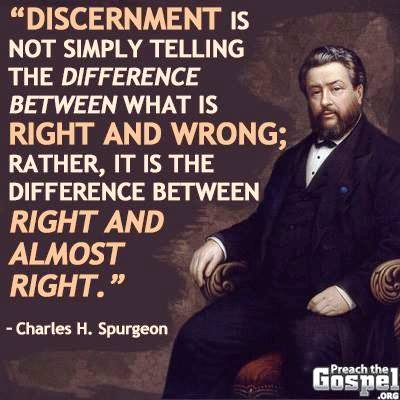
I’m not a big fan of the majority of internet memes (or info-graphics) that get shared all over the blog-o-sphere and Facebook. Occasionally, one gets shared that I think… “awesome”… and they stick with me for a while. I have a confession to make: I have only recently become familiar with Charles H. Spurgeon and some of the other influential church leaders in the past. Okay, moving along, this one meme in particular was a quote from Charles H. Spurgeon regarding Discernment. It is easy to practice Biblical discernment when you disagree with what is being said, or dislike the person saying it. Especially if what you are countering is clearly wrong according to scriptures. But it is an altogether different experience to discern between “right” and “almost right”… especially if you are trying to establish the “rightness” of a statement you already agree with, or one being made by a person you look up to (or, dare I say it, idolize) or someone a dear friend looks up to.

discernmentIs Discernment Really an Imperative?

Yes. Let’s look at what the Word of God says:

Matthew 7:15-23 (ESV) 15 “Beware of false prophets, who come to you in sheep’s clothing but inwardly are ravenous wolves. 16 You will recognize them by their fruits. Are grapes gathered from thornbushes, or figs from thistles? 17 So, every healthy tree bears good fruit, but the diseased tree bears bad fruit. 18 A healthy tree cannot bear bad fruit, nor can a diseased tree bear good fruit. 19 Every tree that does not bear good fruit is cut down and thrown into the fire. 20 Thus you will recognize them by their fruits. 21 “Not everyone who says to me, ‘Lord, Lord,’ will enter the kingdom of heaven, but the one who does the will of my Father who is in heaven. 22 On that day many will say to me, ‘Lord, Lord, did we not prophesy in your name, and cast out demons in your name, and do many mighty works in your name?’ 23 And then will I declare to them, ‘I never knew you; depart from me, you workers of lawlessness.’

1 John 4:1 (ESV) 4 Beloved, do not believe every spirit, but test the spirits to see whether they are from God, for many false prophets have gone out into the world.

Galatians 1:6-7 (ESV) 6 I am astonished that you are so quickly deserting Him who called you in the grace of Christ and are turning to a different gospel— 7 not that there is another one, but there are some who trouble you and want to distort the gospel of Christ.

There may be more references worth including here, but here I’ve listed the Authoritative warning by Jesus, and the reminder from 2 witnesses John and Paul. As I’ve said before, the entire book of Galatians focuses on this point… on the point of discerning between Gospel (“right”) and  Law (which cannot be considered wrong, but if you’ll read Galatians, you’ll see that it’s an “almost right”).  Before you start explaining away these passages as being about paganism, Satanism, or Mormonism… stop. Jesus said they’d be in sheep’s clothing… meaning they’d look like you and me. In 1 John, he goes to explain that some of these men had gone out from them… from the church in Jerusalem… and they were false. And Paul, in his letter to the Galatians, is talking about men from Jerusalem who were of the circumcision party of believers. We aren’t talking only about the obviously wrong teaching, or the in-your-face blasphemies… we are talking about a distortion of the Gospel of Christ.

Well, You are Entitled to your Opinion…

Yes, you are. But that has absolutely nothing to do with Biblical Discernment. In fact, if your opposition to (or defense of) a message, a prophecy, a sermon, or a theology begins and ends with “I feel like” or “what this passage means to me” you are engaging in opinion-sharing. While everyone has an opinion, it doesn’t mean there are no right, almost right, and wrong opinions. Furthermore, Biblical Discernment is not about opinion, it’s about understanding what the Word of God says, according to the Word of God. I submit to you that very little… if anything… is open to personal opinion when it comes to the God-breathed Scriptures. Don’t let anyone discourage you from comparing what is being said in the Name of God to what we find written in the Word of God. And if there is still a hesitation in your mind… well, let’s see what Paul thought.

Galatians 1:8-12 (ESV) 8 But even if we or an angel from heaven should preach to you a gospel contrary to the one we preached to you, let him be accursed. 9 As we have said before, so now I say again: If anyone is preaching to you a gospel contrary to the one you received, let him be accursed. 10 For am I now seeking the approval of man, or of God? Or am I trying to please man? If I were still trying to please man, I would not be a servant of Christ. 11 For I would have you know, brothers, that the gospel that was preached by me is not man’s gospel. 12 For I did not receive it from any man, nor was I taught it, but I received it through a revelation of Jesus Christ.

Galatians 5:7-12 (ESV) 7 You were running well. Who hindered you from obeying the truth? 8 This persuasion is not from him who calls you. 9 A little leaven leavens the whole lump. 10 I have confidence in the Lord that you will take no other view, and the one who is troubling you will bear the penalty, whoever he is. 11 But if I, brothers, still preach circumcision, why am I still being persecuted? In that case the offense of the cross has been removed. 12 I wish those who unsettle you would emasculate themselves!

And we also have this warning from Peter:

2 Peter 2:1-3 (ESV) 2 But false prophets also arose among the people, just as there will be false teachers among you, who will secretly bring in destructive heresies, even denying the Master who bought them, bringing upon themselves swift destruction. 2 And many will follow their sensuality, and because of them the way of truth will be blasphemed. 3 And in their greed they will exploit you with false words. Their condemnation from long ago is not idle, and their destruction is not asleep.

So, this is what is at stake. Any deviation from the Gospel of Christ is to be rebuked. But this isn’t just about calling out falsehood! Discernment is also about establishing what is true in light of the Word of God. Going back to 1 John 4:1, we weren’t told to test to see if they were false, but to test to see if the spirit is of God. When you grade a test, you don’t compare it to what is wrong, you compare it to what is Right, what is Truth!

Acts 17:10-12 (ESV) 10 The brothers immediately sent Paul and Silas away by night to Berea, and when they arrived they went into the Jewish synagogue. 11 Now these Jews were more noble than those in Thessalonica; they received the word with all eagerness, examining the Scriptures daily to see if these things were so. 12 Many of them therefore believed, with not a few Greek women of high standing as well as men.

These were Jews, described as being more noble than those in Thessalonica (because those in Thessalonica were jealous of the following that Paul and Silas gained, and stirred up the crowds to persecute Paul and Silas) and they examined the Scriptures daily. Paul and Silas were bringing them the Gospel of Jesus Christ, and these men were weighing what they were hearing by what they already knew was the Word of God! And it proved to be Right, and True according to God’s Word (the Law and the Prophets, our Old Testament) and so they were already obeying 1 John 4:1 before it was even written! And because God’s Word is True, they believed the Gospel as preached by Paul and Silas in the Grace given them by Our Lord and Savior Jesus Christ.

I don’t want to grieve the Holy Spirit…

Nor do I. Take great care in how you characterize the message and the messenger as you go about searching the Scriptures as the men in Berea did. But the solution to this concern is not to shy away from obeying what is clearly a Biblical Imperative. Based on Jesus teaching in Matthew 22:37-40, “And [Jesus] said to him, “You shall love the Lord your God with all your heart and with all your soul and with all your mind.  This is the great and first commandment.  And a second is like it: You shall love your neighbor as yourself.  On these two commandments depend all the Law and the Prophets.” Let us look to 1 Corinthians 13 to see how Love is defined in Scripture:

1 Corinthians 13:1-6 (ESV)1 If I speak in the tongues of men and of angels, but have not love, I am a noisy gong or a clanging cymbal. 2 And if I have prophetic powers, and understand all mysteries and all knowledge, and if I have all faith, so as to remove mountains, but have not love, I am nothing. 3 If I give away all I have, and if I deliver up my body to be burned, but have not love, I gain nothing. 4 Love is patient and kind; love does not envy or boast; it is not arrogant 5 or rude. It does not insist on its own way; it is not irritable or resentful; 6 it does not rejoice at wrongdoing, but rejoices with the truth.

When you choose to speak up (which you should) do so in Love. I also strongly recommend that you do so in private, first. Why? Matthew 18:15 “If your brother sins against you, go and tell him his fault, between you and him alone. If he listens to you, you have gained your brother…” so yes… do so in private, and in Love. Will it be welcomed? No. Will you always gain your brother? No. Will you always be right? only so far as you rightly use the Word of God, and don’t fall to your own sin of misinterpretation of the Word of God.

Again, it is not easy confronting false teaching that comes from a friend, or even a mentor. However, if you are not engaging in the opinions of men, and you’ve searched out the Scriptures, and proceed in love, it is a good thing to do. There is no prescription or mandate, to tolerate false-teaching. In fact, we are told not to fear the false teachers, nor to listen to them.

Titus 1:5-11 (ESV) 5 This is why I left you in Crete, so that you might put what remained into order, and appoint elders in every town as I directed you— 6 if anyone is above reproach, the husband of one wife, and his children are believers and not open to the charge of debauchery or insubordination. 7 For an overseer, as God’s steward, must be above reproach. He must not be arrogant or quick-tempered or a drunkard or violent or greedy for gain, 8 but hospitable, a lover of good, self-controlled, upright, holy, and disciplined. 9 He must hold firm to the trustworthy word as taught, so that he may be able to give instruction in sound doctrine and also to rebuke those who contradict it. 10 For there are many who are insubordinate, empty talkers and deceivers, especially those of the circumcision party. 11 They must be silenced, since they are upsetting whole families by teaching for shameful gain what they ought not to teach.

listentomenPaul is not instructing Titus to do something Paul had not already done. In fact, Titus was there when it happened. Let’s return to Galatians:

Galatians 2:1-11 (ESV) 1 Then after fourteen years I went up again to Jerusalem with Barnabas, taking Titus along with me. 2 I went up because of a revelation and set before them (though privately before those who seemed influential) the gospel that I proclaim among the Gentiles, in order to make sure I was not running or had not run in vain. 3 But even Titus, who was with me, was not forced to be circumcised, though he was a Greek. 4 Yet because of false brothers secretly brought in—who slipped in to spy out our freedom that we have in Christ Jesus, so that they might bring us into slavery— 5 to them we did not yield in submission even for a moment, so that the truth of the gospel might be preserved for you. 6 And from those who seemed to be influential (what they were makes no difference to me; God shows no partiality)—those, I say, who seemed influential added nothing to me. 7 On the contrary, when they saw that I had been entrusted with the gospel to the uncircumcised, just as Peter had been entrusted with the gospel to the circumcised 8 (for he who worked through Peter for his apostolic ministry to the circumcised worked also through me for mine to the Gentiles), 9 and when James and Cephas and John, who seemed to be pillars, perceived the grace that was given to me, they gave the right hand of fellowship to Barnabas and me, that we should go to the Gentiles and they to the circumcised. 10 Only, they asked us to remember the poor, the very thing I was eager to do. 11 But when Cephas came to Antioch, I opposed him to his face, because he stood condemned.

Titus witnessed was taught the value of conferring with Elders, submitting to Biblical Discernment (or Paul wanted to know that he had not run in vain) and in the necessity of rebuking hypocrisy and false doctrine (though it was the behavior of Cephas that was silently bearing testimony to the false teaching of the Judaizers). Cephas, was one who seemed to be influential, to be a pillar. The final thought for this post is this, that we dare not take the word of a leader over the Word of God.

I pray this has been of some encouragement to you. God’s Word isn’t open to individual interpretations and opinions… because it is Truth, Objective and Absolute Truth. We do not define Scripture by our emotion or by our opinions, but by the Word of God. The Elders of your assembly bear a great deal of responsibility. You, too, having all of the Word of God made readily available to you in this present age, learn to love God’s Word and search it out. No issue is too small, nor trial too great for answers to be found in the written Word of God.

May the Lord Bless and Keep you,
In Him,
Jorge

CTT | “Give your life to God”

CTTYou probably hear it all of the time, “give your life to God…” (or “give your life to Jesus” or “so-and-so gave his/her life to God”) and you will be saved, or your life will be made better, or you will become pleasing to God. Now… there is a way of understanding what is being said by this phrase that can be true. However, there is a fundamental problem with this statement that need to at least be discussed; therefore, it is the topic of today’s Complete the Thought (CTT).

The fundamental problem with this phraseology, is in the emphasis on the person being saved, rather than He who actually saved. It is dangerous to allow the focus of our redemption to move off of the Grace of God for the slightest of moments. Let’s look at how Jesus characterized His charge from the Father in the book of John:

John 10:14-18 (ESV) 14 I am the good shepherd. I know my own and my own know me, 15 just as the Father knows me and I know the Father; and I lay down my life for the sheep. 16 And I have other sheep that are not of this fold. I must bring them also, and they will listen to my voice. So there will be one flock, one shepherd. 17 For this reason the Father loves me, because I lay down my life that I may take it up again. 18 No one takes it from me, but I lay it down of my own accord. I have authority to lay it down, and I have authority to take it up again. This charge I have received from my Father.”

Jesus is, He knows, He calls, He brings, He laid down His life, and He took it up again, for the authority was His.  The Gospel Jesus Christ, must remain wholly and completely focused on Jesus Christ. So, when we regard the Gospel of Jesus, the Message of Salvation, we dare not use man-centered language “he gave himself to God”, or “he gave his life to Jesus”. Let’s see how Paul talked phrased salvation in his letter to the Ephesians:

Ephesians 2:1-10 (ESV) 1 And you were dead in the trespasses and sins 2 in which you once walked, following the course of this world, following the prince of the power of the air, the spirit that is now at work in the sons of disobedience— 3 among whom we all once lived in the passions of our flesh, carrying out the desires of the body and the mind, and were by nature children of wrath, like the rest of mankind. 4 But God, being rich in mercy, because of the great love with which he loved us, 5 even when we were dead in our trespasses, made us alive together with Christ—by grace you have been saved— 6 and raised us up with him and seated us with him in the heavenly places in Christ Jesus, 7 so that in the coming ages he might show the immeasurable riches of his grace in kindness toward us in Christ Jesus. 8 For by grace you have been saved through faith. And this is not your own doing; it is the gift of God, 9 not a result of works, so that no one may boast. 10 For we are his workmanship, created in Christ Jesus for good works, which God prepared beforehand, that we should walk in them.

So, how can someone who is dead in the trespasses and sins have any means of “giving his life” to God? What can that person do? Nothing. Anything that person might have done prior to being made alive in Christ is not only worthless… but disgusting by comparison to the gift of God’s Grace. Am I splitting hairs on this? Possibly, but I believe I am right in doing so.

Galatians 5:9-11 (ESV) 1 For freedom Christ has set us free; stand firm therefore, and do not submit again to a yoke of slavery. 2 Look: I, Paul, say to you that if you accept circumcision, Christ will be of no advantage to you. 3 I testify again to every man who accepts circumcision* that he is obligated to keep the whole law. 4 You are severed from Christ, you who would be justified by the law; you have fallen away from grace. 5 For through the Spirit, by faith, we ourselves eagerly wait for the hope of righteousness. 6 For in Christ Jesus neither circumcision nor uncircumcision counts for anything, but only faith working through love. 7 You were running well. Who hindered you from obeying the truth? 8 This persuasion is not from him who calls you. 9 A little leaven leavens the whole lump. 10 I have confidence in the Lord that you will take no other view, and the one who is troubling you will bear the penalty, whoever he is. 11 But if I, brothers, still preach circumcision*, why am I still being persecuted? In that case the offense of the cross has been removed.

* Paul isn’t just talking about the surgical procedure of circumcision here, but he is talking about the Law.

A little leaven leavens the whole lump of dough, and that is why I believe it right that we choose our words carefully, even at the risk of being accused of “splitting hairs”. The entire book of Galatians is a rebuke to them about allowing those who slipped in to start preaching to that they had to follow the Law of Moses in order to be true followers. The seal of those under that Law, those under the old covenant, was physical circumcision of all men under the covenant. They were preaching justification by works of the Law to those who were already saved by grace, through faith, in the Gospel of Jesus Christ. The entire letter to the Galatians bears this out in plain language. Paul is not talking to the lost, so any attempt to minimize what is being said here as simply “yeah, we’ve said all along that you are only saved by grace”. The Galatians were running well. They had received the Gospel of Jesus Christ. They were saved. Yet they had allowed the preaching of a different gospel, one of men, one that placed the hearers and doers of this gospel back under the yoke of slavery to the Law. But why were they teaching these things? Was it for the good of the Gentile believers? Let’s see how Paul closes this thought in Galatians:

Galatians 6:12-15 (ESV) 12 It is those who want to make a good showing in the flesh who would force you to be circumcised, and only in order that they may not be persecuted for the cross of Christ. 13 For even those who are circumcised do not themselves keep the law, but they desire to have you circumcised that they may boast in your flesh. 14 But far be it from me to boast except in the cross of our Lord Jesus Christ, by which the world has been crucified to me, and I to the world. 15 For neither circumcision counts for anything, nor uncircumcision, but a new creation.

There it is. Those who would preach a works-based gospel, can in-turn boast of their accomplishments, and in yours, because they taught you how to measure your life by your actions, actions whose teaching they can take credit. That is why Paul draws the distinction he does… Paul boasts only in the cross of our Lord Jesus Christ. No one can take credit for that, except Jesus. Eph 2:8-9, ” For by grace you have been saved through faith. And this is not your own doing; it is the gift of God, 9 not a result of works, so that no one may boast.”

So, what are we to give to God? Well, first of all, since we were dead before Christ, then it is not we who now live but Jesus who lives in us; therefore, “our lives” isn’t the best answer. It works, if everyone is speaking the same jargon (American football fans know the difference between ‘a safety’ regarding the defensive back, and ‘a safety’ regarding the loss of 2 points based on the context, but a non-fan hasn’t a clue, and can even be mislead if they assume the wrong meaning). I did a quick search of the the Pauline epistles “give God” in the ESV bible (I love the online bible tools!).  Overwhelming focus of who gives what to whom is that God has given us everything. We are told to give God “Thanks” for His gift. Not repayment… but thanks. So even to those of us who have heard and accepted the Gospel of Jesus Christ, live out our lives in humble thanksgiving to God in all circumstances. We don’t presume to repay anything… for such is beyond our reach. We must give thanks to God for His Gift of Salvation. Our charge is not to preach the old covenant, because righteousness was not possible through works of the Law, but the new covenant established by the One who was solely able to fulfill the Law and the Prophets, the One promised to Abraham, to Eve, to all of mankind, the One who was with God in the Beginning, the One through whom all that is made was made, and who laid down His life for His sheep and raised it once more, the Firstborn from the dead whose flesh will never see corruption, to whom all Authority in Heaven and Earth was given and now sits at the Right Hand of the Father, who sent the Holy Spirit to all who believe and are baptized in the Name of the Father, of the Son, and of the Holy Spirit as a comforter, a helper, to give power to those who believe to testify and act as a witness of the Gospel of Grace, the Gospel of Jesus Christ!

Will you slip from time to time and say someone, “gave their life to Christ”… just be quick to refocus the statement. Let us not be so quick to defend the clever verbiage of men over the God-Breathed passages of Scripture. Now, I prefer the phrases: “accepted Jesus Christ as Savior” or “received Jesus Christ” or even “baptized in Jesus Christ”. We accept/receive gifts, and we are told to baptize those who believe the Gospel of Jesus Christ in the Name of the Father, of the Son, and of the Holy Spirit. We could even go so far as to skip those attempts at pinpointing a moment in time and refer to them as simply Spirit-filled believers in the Gospel, because the Gift of the Holy spirit is for those who hear the Gospel, Believe and are baptized (Acts 2). So, there are is no shortage of Gospel-inspired terminology that accurately reflects the whole truth of the Gospel.

May the Lord bless and keep you,
In Him,
FS