Memorial Day 2014

Memorial Day 2014

While it is good to spend this day off with your friends and family, please take a moment to remember those who have fallen in service of this great nation. Those who have died protecting the freedoms you enjoy. Ultimately, give thanks to God for allowing us to live in a nation of freedom. May the Lord continue to bless the families of our service members.

Prayer | To whom and for whom (part 1)

Growing up in the church, I’ve been lead in a great many corporate prayers and have attended numerous prayer meetings. I’ve experienced a wide range of prayer styles and methodologies. I have an affinity for language and communication. I’m one who enjoys the music, but not apart from its lyric. The words being used matter a great deal to me. Whenever I hear someone lead a congregation or gathering in prayer, I’m not listening for impressive or colorful language, my first concern is the message of the prayer so that I know if it is something I can indeed say “Amen” to. Have you ever been part of a corporate prayer that left you wondering if it was a prayer or a lecture? Or worse, if it left you wondering exactly who was supposedly in charge of Creation? I’ve heard some prayers that went so outside of Biblical foundation that I caught myself repenting for my involvment, asking for forgiveness and protection in the middle of the prayer.

We’ve discussed prayer here before. The standard for any “How-To” for prayer is Matthew 6 and Luke 11. When God the Son is asked, “Lord, teach us to pray…” we would be foolish to presume that any other standard exists for prayer. Clearly the safest prayer is to repeat what we call the Lord’s Prayer and place all of our trust, hope, and faith in God the Father, God the Son, and God the Holy Spirit. While this instruction is the preeminent instruction/standard for prayer, it is not the only instruction we find in Scriptures. We will look at some of the other prayers in Scripture, but I first want to make one thing absolutely clear. The Written Word of God is the ONLY source of Truth. There nothing, NOTHING we can learn about prayer from any other source. Not from paganism, not from mysticism (eastern or western), not from new age, not from the occult. Nothing.

2 Timothy 3:10-17 (ESV) 10 You, however, have followed my teaching, my conduct, my aim in life, my faith, my patience, my love, my steadfastness, 11 my persecutions and sufferings that happened to me at Antioch, at Iconium, and at Lystra—which persecutions I endured; yet from them all the Lord rescued me. 12 Indeed, all who desire to live a godly life in Christ Jesus will be persecuted, 13 while evil people and impostors will go on from bad to worse, deceiving and being deceived. 14 But as for you, continue in what you have learned and have firmly believed, knowing from whom you learned it 15 and how from childhood you have been acquainted with the sacred writings, which are able to make you wise for salvation through faith in Christ Jesus. 16 All Scripture is breathed out by God and profitable for teaching, for reproof, for correction, and for training in righteousness, 17 that the man of God may be complete, equipped for every good work.

So, now that is out of the way, let us continue with looking at prayer in the Word of God.

For whom and to whom are your praying?

Throughout scripture, we have prayers written down and preserved for our benefit, for our training. As is the case in the aforementioned Luke 11, the Disciples asked Jesus to teach them to pray after He had finished praying. He taught them to pray to “Our Father in Heaven” to “give us this day our daily bread… forgive us our sins as we forgive those who sin against us…” Jesus often prayed in a quiet or secluded place. I believe that what His disciples were asking of Him was for how they were supposed to pray when they, too, were praying in secret. But let’s take a look at how He prayed before calling Lazarus to come out of the grave:

John 11:38-44 (ESV) 38 Then Jesus, deeply moved again, came to the tomb. It was a cave, and a stone lay against it. 39 Jesus said, “Take away the stone.” Martha, the sister of the dead man, said to him, “Lord, by this time there will be an odor, for he has been dead four days.” 40 Jesus said to her, “Did I not tell you that if you believed you would see the glory of God?” 41 So they took away the stone. And Jesus lifted up his eyes and said, “Father, I thank you that you have heard me. 42 I knew that you always hear me, but I said this on account of the people standing around, that they may believe that you sent me.” 43 When he had said these things, he cried out with a loud voice, “Lazarus, come out.” 44 The man who had died came out, his hands and feet bound with linen strips, and his face wrapped with a cloth. Jesus said to them, “Unbind him, and let him go.”

This audible prayer, was to God the Father, but it was for the people standing around, the witnesses, so that they may believe that God the Father had indeed sent His Son. This prayer, is also an example of “Holy is your Name“. In the very next chapter, we see a similar instance of prayer to God the Father for the benefit of the witnesses:

John 12:27-36 (ESV) 27 “Now is my soul troubled. And what shall I say? ‘Father, save me from this hour’? But for this purpose I have come to this hour. 28 Father, glorify your name.” Then a voice came from heaven: “I have glorified it, and I will glorify it again.” 29 The crowd that stood there and heard it said that it had thundered. Others said, “An angel has spoken to him.” 30 Jesus answered, “This voice has come for your sake, not mine. 31 Now is the judgment of this world; now will the ruler of this world be cast out. 32 And I, when I am lifted up from the earth, will draw all people to myself.” 33 He said this to show by what kind of death he was going to die. 34 So the crowd answered him, “We have heard from the Law that the Christ remains forever. How can you say that the Son of Man must be lifted up? Who is this Son of Man?” 35 So Jesus said to them, “The light is among you for a little while longer. Walk while you have the light, lest darkness overtake you. The one who walks in the darkness does not know where he is going. 36 While you have the light, believe in the light, that you may become sons of light.” When Jesus had said these things, he departed and hid himself from them.

In the previous example, we have the prayer of God the Son made audible for the benefit of the witnesses, and here we have the response of God the Father being made audible for the benefit of the witnesses not for God the Son. Again, all of this, points to “Holy is your Name“. It also points to “Your will be done on Earth as it is in Heaven“. Jesus knows what the Will of the Father is, and as the time draws near, His soul is troubled. It’s going to hurt. It’s going to be hell. But it is for this purpose that God the Son came to Earth, to do the Will of the Father.  We see it again in the Garden of Gethsemane.

Matthew 26:36-46 (ESV) 36 Then Jesus went with them to a place called Gethsemane, and he said to his disciples, “Sit here, while I go over there and pray.” 37 And taking with him Peter and the two sons of Zebedee, he began to be sorrowful and troubled. 38 Then he said to them, “My soul is very sorrowful, even to death; remain here, and watch with me.” 39 And going a little farther he fell on his face and prayed, saying, “My Father, if it be possible, let this cup pass from me; nevertheless, not as I will, but as you will.” 40 And he came to the disciples and found them sleeping. And he said to Peter, “So, could you not watch with me one hour? 41 Watch and pray that you may not enter into temptation. The spirit indeed is willing, but the flesh is weak.” 42 Again, for the second time, he went away and prayed, “My Father, if this cannot pass unless I drink it, your will be done.” 43 And again he came and found them sleeping, for their eyes were heavy. 44 So, leaving them again, he went away and prayed for the third time, saying the same words again. 45 Then he came to the disciples and said to them, “Sleep and take your rest later on. See, the hour is at hand, and the Son of Man is betrayed into the hands of sinners. 46 Rise, let us be going; see, my betrayer is at hand.”

Jesus wrestled with what He knew was coming. His flesh was not defiled, He was a pure and spotless Lamb of God, and still the flesh is tempted (Temptation isn’t sin, yielding to it would have been). Your will be done on Earth as it is in Heaven… I want to look at one more beautiful prayer uttered by God the Son.

John 17 (ESV) | The High Priestly Prayer

17 When Jesus had spoken these words, he lifted up his eyes to heaven, and said, “Father, the hour has come; glorify your Son that the Son may glorify you, 2 since you have given him authority over all flesh, to give eternal life to all whom you have given him. 3 And this is eternal life, that they know you the only true God, and Jesus Christ whom you have sent. 4 I glorified you on earth, having accomplished the work that you gave me to do. 5 And now, Father, glorify me in your own presence with the glory that I had with you before the world existed.

6 “I have manifested your name to the people whom you gave me out of the world. Yours they were, and you gave them to me, and they have kept your word. 7 Now they know that everything that you have given me is from you. 8 For I have given them the words that you gave me, and they have received them and have come to know in truth that I came from you; and they have believed that you sent me. 9 I am praying for them. I am not praying for the world but for those whom you have given me, for they are yours. 10 All mine are yours, and yours are mine, and I am glorified in them. 11 And I am no longer in the world, but they are in the world, and I am coming to you. Holy Father, keep them in your name, which you have given me, that they may be one, even as we are one. 12 While I was with them, I kept them in your name, which you have given me. I have guarded them, and not one of them has been lost except the son of destruction, that the Scripture might be fulfilled. 13 But now I am coming to you, and these things I speak in the world, that they may have my joy fulfilled in themselves. 14 I have given them your word, and the world has hated them because they are not of the world, just as I am not of the world. 15 I do not ask that you take them out of the world, but that you keep them from the evil one. 16 They are not of the world, just as I am not of the world. 17 Sanctify them in the truth; your word is truth. 18 As you sent me into the world, so I have sent them into the world. 19 And for their sake I consecrate myself, that they also may be sanctified in truth.

20 “I do not ask for these only, but also for those who will believe in me through their word, 21 that they may all be one, just as you, Father, are in me, and I in you, that they also may be in us, so that the world may believe that you have sent me. 22 The glory that you have given me I have given to them, that they may be one even as we are one, 23 I in them and you in me, that they may become perfectly one, so that the world may know that you sent me and loved them even as you loved me. 24 Father, I desire that they also, whom you have given me, may be with me where I am, to see my glory that you have given me because you loved me before the foundation of the world. 25 O righteous Father, even though the world does not know you, I know you, and these know that you have sent me. 26 I made known to them your name, and I will continue to make it known, that the love with which you have loved me may be in them, and I in them.”

Throughout this prayer, you can hear echos of, ” Our Father in Heaven, Holy is your Name. Your Kingdom come, your Will be done, on Earth as it is in Heaven. Give us this day our daily bread, and forgive us our debts as we forgive our debtors. And lead us not into temptation, but deliver us from evil” Whenever we pray, we must be certain that our right to approach the throne of God in prayer does not rest within ourselves; rather, in that we have believed in God the Son through the Gospel recorded in Scriptures. That we know that God the Son was sent by God the Father to save us by taking upon Himself the full punishment of sin. There for our “I” isn’t truly the same as Christ’s “I”, but He stands as our advocate, so that while we remain in Him, we have an audience with God.

So then we have our standard for the “to whom” and “for whom” prayers (for ourselves and for others). We will explore these concepts more, I’m sure, but I want to take a moment to caution what happens when we lose sight of to whom and for whom we are praying. In Matthew 6, Jesus pointed out 2 errors before giving instructions. First the error of the hypocrite (contextually the Pharisee, but we have many hypocrites by many names):

Matthew 6:5-6 (ESV) 5 “And when you pray, you must not be like the hypocrites. For they love to stand and pray in the synagogues and at the street corners, that they may be seen by others. Truly, I say to you, they have received their reward. 6 But when you pray, go into your room and shut the door and pray to your Father who is in secret. And your Father who sees in secret will reward you.

Matthew 6:7-8 (ESV) 7 “And when you pray, do not heap up empty phrases as the Gentiles do, for they think that they will be heard for their many words. 8 Do not be like them, for your Father knows what you need before you ask him.

The Gentiles covers all who are not Jews. Their phrases are empty because they do not know the One True God… their prayers are not heard because they do not know God. Why is Jesus warning the Jews not to pray like the Gentiles? Because they are and will continue to be guilty of being conformed to the world around them, a world that Hates God. If you look back at my introduction, I feel the same way… why am I warning against taking lessons on prayer from anything outside of scriptures if my target audience is Christians? Because we have fallen in the same trap. These are not the only pitfalls to prayer, as we will explore in the next post, but they are significant.

There is a lot of bad theology, false doctrine out there invading the church today. Labyrinth prayer, contemplative prayer, theophostic ministry, lectio divina,… some others less dangerous but no less out-of-focus. If you keep your focus on honoring God the Father, God the Son, and God the Holy Spirit in your prayers, to Glorify His name and to invite His Will to be done in your life regardless of the consequences, you will never need any so-called “new way to pray”. Make your requests to God, but do so without losing sight of to whom it is you are Praying. We will talk more about this final point in a later blog post.

In closing, I’d like to borrow from the Apostle Paul’s introduction to his letter to the Philippians:

Philippians 1:9-11 (ESV) 9 And it is my prayer that your love may abound more and more, with knowledge and all discernment, 10 so that you may approve what is excellent, and so be pure and blameless for the day of Christ, 11 filled with the fruit of righteousness that comes through Jesus Christ, to the glory and praise of God.

In Him,
Jorge

Abraham and Isaac | Pointing to the Cross

??????????Today, I wanted to share a wonderful look at Genesis 22, where God tests Abraham. Those of you who attend a foundational, bible-teaching, church should already have been presented with this view of the story. However, as society and the evangelical community drifts further and further away from bible teaching, I think we should take some time to check it out now.

Genesis 22 (ESV)

1 After these things God tested Abraham and said to him, “Abraham!” And he said, “Here I am.” 2 He said, “Take your son, your only son Isaac, whom you love, and go to the land of Moriah, and offer him there as a burnt offering on one of the mountains of which I shall tell you.”

His only son Isaac? Why is God ignoring the fact that Abram had already fathered Ishmael by Hagar? Abram was 86 years old when Ishmael was born. God changed Abram’s name to Abraham, and Sarai’s name to Sarah 13 years later. God’s covenant with Abraham (circumcision) was established when he was 99 years old. At the time of their circumcision, Ishmael is referred to as Abraham’s son. So is this a contradiction? Absolutely not. Let’s look at what God said of Ishmael specifically regarding God’s covenant with Abraham for all of mankind, His Promise of the Messiah.

Genesis 17:15-21 (ESV) 15 And God said to Abraham, “As for Sarai your wife, you shall not call her name Sarai, but Sarah shall be her name. 16 I will bless her, and moreover, I will give you a son by her. I will bless her, and she shall become nations; kings of peoples shall come from her.” 17 Then Abraham fell on his face and laughed and said to himself, “Shall a child be born to a man who is a hundred years old? Shall Sarah, who is ninety years old, bear a child?” 18 And Abraham said to God, “Oh that Ishmael might live before you!” 19 God said, “No, but Sarah your wife shall bear you a son, and you shall call his name Isaac. I will establish my covenant with him as an everlasting covenant for his offspring after him. 20 As for Ishmael, I have heard you; behold, I have blessed him and will make him fruitful and multiply him greatly. He shall father twelve princes, and I will make him into a great nation. 21 But I will establish my covenant with Isaac, whom Sarah shall bear to you at this time next year.”

God was very clear about Isaac being the son of Promise, the son with whom God will keep His covenant with Abraham. Yes, He heard Abraham’s request for Ishmael to be blessed, and Ishmael was blessed (while still being a wild donkey of a man…). But Sarah was upset when she witnessed Ishmael laughing at Isaac, and implored Abraham to send Hagar and Ishmael away.

Genesis 21:10-13 (ESV) 10 So she said to Abraham, “Cast out this slave woman with her son, for the son of this slave woman shall not be heir with my son Isaac.” 11 And the thing was very displeasing to Abraham on account of his son. 12 But God said to Abraham, “Be not displeased because of the boy and because of your slave woman. Whatever Sarah says to you, do as she tells you, for through Isaac shall your offspring be named. 13 And I will make a nation of the son of the slave woman also, because he is your offspring.”

God does make a nation of Ishmael. However, God’s promise to Abraham, for his namesake, for the lineage of the Messiah, is through Isaac, not Ishmael. Therefore, with respect to God’s promise to Abraham, God’s covenant with Abraham, there is only one son, Isaac. There is no “back-up”… plan B was rejected before plan A was even implemented. No turning back. Therefore, when God told Abraham to sacrifice “his only son”, He wasn’t miss counting offspring, He was letting Abraham know that He was fully aware that Isaac was the sole bearer of Abraham’s namesake, the only son by which God declared His promise to Abraham. This is significant, because what follows next points directly at the cross.

John 3:16-18 (ESV) 16 “For God so loved the world, that he gave his only Son, that whoever believes in him should not perish but have eternal life. 17 For God did not send his Son into the world to condemn the world, but in order that the world might be saved through him. 18 Whoever believes in him is not condemned, but whoever does not believe is condemned already, because he has not believed in the name of the only Son of God.

Praise the Lord. Next, let’s take a look at where God send Abraham for the sacrifice, to the land of Moriah, to a mountain He will show Abraham. Now, this is long before the captivity in Egypt, the Exodus, and the Law of Moses. Before Israel is lead into the Promised Land. Before King David and King Solomon. But notice the location of where King Solomon built the Temple of the Lord:

2 Chronicles 3:1 (ESV) 1 Then Solomon began to build the house of the Lord in Jerusalem on Mount Moriah, where the Lord had appeared to David his father, at the place that David had appointed, on the threshing floor of Ornan the Jebusite.

How cool is that? Even more interesting, is that if you’ll remember your history, when the Second Temple was built (after the Babylonian exile), the Temple remained in the same place, and maintained its same dimensions, but Herod wanted to make it more grand in nature, so he widened the temple mount… essentially creating a plateau of the hills around Mount Moriah, so that the Temple Mount was extended around the Temple. Jesus was crucified outside the city, on a hill of Moriah… where Abraham was lead to sacrifice “his only son” as a burnt offering to the Lord God. Let us continue on with the story.

Genesis 22:33 So Abraham rose early in the morning, saddled his donkey, and took two of his young men with him, and his son Isaac. And he cut the wood for the burnt offering and arose and went to the place of which God had told him. 4 On the third day Abraham lifted up his eyes and saw the place from afar. 5 Then Abraham said to his young men, “Stay here with the donkey; I and the boy will go over there and worship and come again to you.” 6 And Abraham took the wood of the burnt offering and laid it on Isaac his son. And he took in his hand the fire and the knife. So they went both of them together. 7 And Isaac said to his father Abraham, “My father!” And he said, “Here I am, my son.” He said, “Behold, the fire and the wood, but where is the lamb for a burnt offering?” 8 Abraham said, “God will provide for himself the lamb for a burnt offering, my son.” So they went both of them together.

Isaac carried the wood for the burnt offering, the sacrifice. We read in  John 19:16b-17 (ESV) “So he delivered him over to them to be crucified. So they took Jesus, 17 and he went out, bearing his own cross, to the place called The Place of a Skull, which in Aramaic is called Golgotha.” Praise the Lord.

Genesis 22:9 When they came to the place of which God had told him, Abraham built the altar there and laid the wood in order and bound Isaac his son and laid him on the altar, on top of the wood. 10 Then Abraham reached out his hand and took the knife to slaughter his son. 11 But the angel of the Lord called to him from heaven and said, “Abraham, Abraham!” And he said, “Here I am.” 12 He said, “Do not lay your hand on the boy or do anything to him, for now I know that you fear God, seeing you have not withheld your son, your only son, from me.” 13 And Abraham lifted up his eyes and looked, and behold, behind him was a ram, caught in a thicket by his horns. And Abraham went and took the ram and offered it up as a burnt offering instead of his son. 14 So Abraham called the name of that place, “The Lord will provide”; as it is said to this day, “On the mount of the Lord it shall be provided.”

Now here, we have the provision of God. God provides the sacrifice. Yes, Jesus was born of a virgin, and was fully man, the offspring of Abraham provided by God. God intervened so that mankind might by saved, spared from the judgement. Have you ever wondered about the crown of thorns they placed on Jesus head? Notice the ram provided by God as a substitutionary sacrifice on man’s behalf, is caught in a thicket by his horns.

15 And the angel of the Lord called to Abraham a second time from heaven 16 and said, “By myself I have sworn, declares the Lord, because you have done this and have not withheld your son, your only son, 17 I will surely bless you, and I will surely multiply your offspring as the stars of heaven and as the sand that is on the seashore. And your offspring shall possess the gate of his enemies, 18 and in your offspring shall all the nations of the earth be blessed, because you have obeyed my voice.”

We see here that God is again letting Abraham know that the Messiah is coming from his offspring because he obeyed the voice of the Lord God. Praise be to our Lord and Savior. In closing, I’d like to borrow from the Apostle Paul’s closing of his letter to the Romans:

Romans 16:25-27 (ESV) 16 Now to him who is able to strengthen you according to my gospel and the preaching of Jesus Christ, according to the revelation of the mystery that was kept secret for long ages 26 but has now been disclosed and through the prophetic writings has been made known to all nations, according to the command of the eternal God, to bring about the obedience of faith— 27 to the only wise God be glory forevermore through Jesus Christ! Amen.

May the Lord bless you and keep you,
In Him,

Jorge

CTT | David and Goliath

CTTToday’s CTT is going to be a little bit different. Undoubtedly you’ve heard the story of David defeating Goliath in your Sunday school class growing up, or perhaps in an adult Church service, or maybe on ESPN. Okay, well, if you caught it on ESPN, you probably only know it as a colloquialism for “an underdog’s victory”. If you grew up in an emergent/emerging/seeker-sensitive church, you probably heard sermons that tell the story of David defeating Goliath and then asking you, “what’s your Goliath?”. If you grew up in an NAR church, you’ve undoubtedly been taught that this was reflective of the “5 fold ministry”, possibly even emphasizing the office of the Apostle. We aren’t going to discuss any of that here today. The Bible isn’t about us, it is about God the Father, God the Son, and God the Holy Spirit.
The primary text for this CTT will be 1 Samuel 17 (ESV). Please, do take the time to read this passage in its entirety and double-check my work. In yesterday’s post, we looked at what the people of Israel were looking for in the Messiah, the Christ. We looked at how many of the prophesies regarding the Christ come as a promise to king David, that there will always be a man sitting on the throne of David. Now, we are first introduced to David, the youngest son of Jesse, the Ephrathite from Bethlehem, in 1 Samuel 16. The Lord God sent Samuel to anoint David as King of Israel, and the Spirit of the Lord departed from Saul and rushed upon David from that day forward. God chose David, and led Samuel to him. Notice the testimony of David that is given to Saul before any recorded acts of valor:

1 Samuel 16:14-23 (ESV) 14 Now the Spirit of the Lord departed from Saul, and a harmful spirit from the Lord tormented him. 15 And Saul’s servants said to him, “Behold now, a harmful spirit from God is tormenting you. 16 Let our lord now command your servants who are before you to seek out a man who is skillful in playing the lyre, and when the harmful spirit from God is upon you, he will play it, and you will be well.” 17 So Saul said to his servants, “Provide for me a man who can play well and bring him to me.” 18 One of the young men answered, “Behold, I have seen a son of Jesse the Bethlehemite, who is skillful in playing, a man of valor, a man of war, prudent in speech, and a man of good presence, and the Lord is with him.” 19 Therefore Saul sent messengers to Jesse and said, “Send me David your son, who is with the sheep.” 20 And Jesse took a donkey laden with bread and a skin of wine and a young goat and sent them by David his son to Saul. 21 And David came to Saul and entered his service. And Saul loved him greatly, and he became his armor-bearer. 22 And Saul sent to Jesse, saying, “Let David remain in my service, for he has found favor in my sight.” 23 And whenever the harmful spirit from God was upon Saul, David took the lyre and played it with his hand. So Saul was refreshed and was well, and the harmful spirit departed from him.

Quite the testimony. I think it is important to highlight who David was before the Goliath encounter. God had already chosen him, anointed him, and He was with him. He was already a skillful musician, a man of valor and a man of war, prudent in speech and of good presence. Too often, these qualities are overlooked in favor of eisegeting an “underdog story” about how we all are called to “defeat our own giants”. That, would be a very incomplete thought, indeed. Let’s move on to the next chapter.

1 Samuel 17 (ESV)  1 Now the Philistines gathered their armies for battle. And they were gathered at Socoh, which belongs to Judah, and encamped between Socoh and Azekah, in Ephes-dammim. 2 And Saul and the men of Israel were gathered, and encamped in the Valley of Elah, and drew up in line of battle against the Philistines. 3 And the Philistines stood on the mountain on the one side, and Israel stood on the mountain on the other side, with a valley between them. 4 And there came out from the camp of the Philistines a champion named Goliath of Gath, whose height was six cubits and a span. 5 He had a helmet of bronze on his head, and he was armed with a coat of mail, and the weight of the coat was five thousand shekels of bronze. 6 And he had bronze armor on his legs, and a javelin of bronze slung between his shoulders. 7 The shaft of his spear was like a weaver’s beam, and his spear’s head weighed six hundred shekels of iron. And his shield-bearer went before him. 8 He stood and shouted to the ranks of Israel, “Why have you come out to draw up for battle? Am I not a Philistine, and are you not servants of Saul? Choose a man for yourselves, and let him come down to me. 9 If he is able to fight with me and kill me, then we will be your servants. But if I prevail against him and kill him, then you shall be our servants and serve us.” 10 And the Philistine said, “I defy the ranks of Israel this day. Give me a man, that we may fight together.” 11 When Saul and all Israel heard these words of the Philistine, they were dismayed and greatly afraid.

16 For forty days the Philistine came forward and took his stand, morning and evening.

19 Now Saul and they and all the men of Israel were in the Valley of Elah, fighting with the Philistines. 20 And David rose early in the morning and left the sheep with a keeper and took the provisions and went, as Jesse had commanded him. And he came to the encampment as the host was going out to the battle line, shouting the war cry. 21 And Israel and the Philistines drew up for battle, army against army. 22 And David left the things in charge of the keeper of the baggage and ran to the ranks and went and greeted his brothers. 23 As he talked with them, behold, the champion, the Philistine of Gath, Goliath by name, came up out of the ranks of the Philistines and spoke the same words as before. And David heard him.

24 All the men of Israel, when they saw the man, fled from him and were much afraid. 25 And the men of Israel said, “Have you seen this man who has come up? Surely he has come up to defy Israel. And the king will enrich the man who kills him with great riches and will give him his daughter and make his father’s house free in Israel.” 26 And David said to the men who stood by him, “What shall be done for the man who kills this Philistine and takes away the reproach from Israel? For who is this uncircumcised Philistine, that he should defy the armies of the living God?” 27 And the people answered him in the same way, “So shall it be done to the man who kills him.”

Okay. Now keeping a finger here (or opening up a new tab in your browser), let’s look at some other verses.

Luke 2:1-6 (ESV) 1 In those days a decree went out from Caesar Augustus that all the world should be registered. 2 This was the first registration when Quirinius was governor of Syria. 3 And all went to be registered, each to his own town. 4 And Joseph also went up from Galilee, from the town of Nazareth, to Judea, to the city of David, which is called Bethlehem, because he was of the house and lineage of David, 5 to be registered with Mary, his betrothed, who was with child. 6 And while they were there, the time came for her to give birth.

52 And Jesus increased in wisdom and in stature and in favor with God and man.

Matthew 3:13-17 (ESV) 13 Then Jesus came from Galilee to the Jordan to John, to be baptized by him. 14 John would have prevented him, saying, “I need to be baptized by you, and do you come to me?” 15 But Jesus answered him, “Let it be so now, for thus it is fitting for us to fulfill all righteousness.” Then he consented. 16 And when Jesus was baptized, immediately he went up from the water, and behold, the heavens were opened to him, and he saw the Spirit of God descending like a dove and coming to rest on him; 17 and behold, a voice from heaven said, “This is my beloved Son, with whom I am well pleased.”

Luke 4 (ESV) 1 And Jesus, full of the Holy Spirit, returned from the Jordan and was led by the Spirit in the wilderness 2 for forty days, being tempted by the devil…13 And when the devil had ended every temptation, he departed from him until an opportune time.

John 13:21-27 (ESV) 21 After saying these things, Jesus was troubled in his spirit, and testified, “Truly, truly, I say to you, one of you will betray me.” 22 The disciples looked at one another, uncertain of whom he spoke. 23 One of his disciples, whom Jesus loved, was reclining at table at Jesus’ side, 24 so Simon Peter motioned to him to ask Jesus of whom he was speaking. 25 So that disciple, leaning back against Jesus, said to him, “Lord, who is it?” 26 Jesus answered, “It is he to whom I will give this morsel of bread when I have dipped it.” So when he had dipped the morsel, he gave it to Judas, the son of Simon Iscariot. 27 Then after he had taken the morsel, Satan entered into him. Jesus said to him, “What you are going to do, do quickly.”

So, here we have the setup. As Goliath challenged Israel to send a man to fight him to decide the fate of all of Israel, so too we have God’s Anointed, the Christ, the Messiah about to take on once and for all the battle for all of mankind. The last time Satan went toe-to-toe with mankind, he secured victory in leading Adam to rebel against God by sin. However, his victory came with a promise made to the serpent regarding eve, “I will put enmity between you and the woman, and between your offspring and her offspring; he shall bruise your head, and you shall bruise his heel.” (Genesis 3:15 ESV). Adam failed, but a rematch was scheduled, and now the battle lines have been redrawn. The Apostle Paul articulates it well in Romans:

Romans 5:18-19 (ESV) 18 Therefore, as one trespass led to condemnation for all men, so one act of righteousness leads to justification and life for all men. 19 For as by the one man’s disobedience the many were made sinners, so by the one man’s obedience the many will be made righteous.

Now, lets return to 1 Samuel 17

1 Samuel 17:28-30 (ESV) 28 Now Eliab his eldest brother heard when he spoke to the men. And Eliab’s anger was kindled against David, and he said, “Why have you come down? And with whom have you left those few sheep in the wilderness? I know your presumption and the evil of your heart, for you have come down to see the battle.” 29 And David said, “What have I done now? Was it not but a word?” 30 And he turned away from him toward another, and spoke in the same way, and the people answered him again as before.

Even the rejection/rebuke by his brothers points to Jesus.

John 7:2-7 (ESV) 2 Now the Jews’ Feast of Booths was at hand. 3 So his brothers said to him, “Leave here and go to Judea, that your disciples also may see the works you are doing. 4 For no one works in secret if he seeks to be known openly. If you do these things, show yourself to the world.” 5 For not even his brothers believed in him. 6 Jesus said to them, “My time has not yet come, but your time is always here. 7 The world cannot hate you, but it hates me because I testify about it that its works are evil.

See also Luke 4:16-30 (ESV)

Now, lets finish up the story in 1 Samuel:

1 Samuel 17:37-51 (ESV)

37 And David said, “The Lord who delivered me from the paw of the lion and from the paw of the bear will deliver me from the hand of this Philistine.” And Saul said to David, “Go, and the Lord be with you!”

38 Then Saul clothed David with his armor. He put a helmet of bronze on his head and clothed him with a coat of mail, 39 and David strapped his sword over his armor. And he tried in vain to go, for he had not tested them. Then David said to Saul, “I cannot go with these, for I have not tested them.” So David put them off. 40 Then he took his staff in his hand and chose five smooth stones from the brook and put them in his shepherd’s pouch. His sling was in his hand, and he approached the Philistine.

41 And the Philistine moved forward and came near to David, with his shield-bearer in front of him. 42 And when the Philistine looked and saw David, he disdained him, for he was but a youth, ruddy and handsome in appearance. 43 And the Philistine said to David, “Am I a dog, that you come to me with sticks?” And the Philistine cursed David by his gods. 44 The Philistine said to David, “Come to me, and I will give your flesh to the birds of the air and to the beasts of the field.” 45 Then David said to the Philistine, “You come to me with a sword and with a spear and with a javelin, but I come to you in the name of the Lord of hosts, the God of the armies of Israel, whom you have defied. 46 This day the Lord will deliver you into my hand, and I will strike you down and cut off your head. And I will give the dead bodies of the host of the Philistines this day to the birds of the air and to the wild beasts of the earth, that all the earth may know that there is a God in Israel, 47 and that all this assembly may know that the Lord saves not with sword and spear. For the battle is the Lord’s, and he will give you into our hand.”

48 When the Philistine arose and came and drew near to meet David, David ran quickly toward the battle line to meet the Philistine. 49 And David put his hand in his bag and took out a stone and slung it and struck the Philistine on his forehead. The stone sank into his forehead, and he fell on his face to the ground.

50 So David prevailed over the Philistine with a sling and with a stone, and struck the Philistine and killed him. There was no sword in the hand of David. 51 Then David ran and stood over the Philistine and took his sword and drew it out of its sheath and killed him and cut off his head with it. When the Philistines saw that their champion was dead, they fled.

The significance of the 5 smooth stones that points to Jesus? Chris Rosebrough talked about it this way, “Jesus was pierced 5 times, once in each hand and each foot, and a final piercing in his side.”  I would also like to add that Goliath fell dead from a single stone. I believe this points to the fact that Christ’s death was once and for all as Paul described in Hebrews 10.

Hebrews 10 (ESV) 1 For since the law has but a shadow of the good things to come instead of the true form of these realities, it can never, by the same sacrifices that are continually offered every year, make perfect those who draw near. 2 Otherwise, would they not have ceased to be offered, since the worshipers, having once been cleansed, would no longer have any consciousness of sins? 3 But in these sacrifices there is a reminder of sins every year. 4 For it is impossible for the blood of bulls and goats to take away sins.

5 Consequently, when Christ came into the world, he said,

“Sacrifices and offerings you have not desired,
but a body have you prepared for me;
6 in burnt offerings and sin offerings
you have taken no pleasure.
7 Then I said, ‘Behold, I have come to do your will, O God,
as it is written of me in the scroll of the book.’”

8 When he said above, “You have neither desired nor taken pleasure in sacrifices and offerings and burnt offerings and sin offerings” (these are offered according to the law), 9 then he added, “Behold, I have come to do your will.” He does away with the first in order to establish the second. 10 And by that will we have been sanctified through the offering of the body of Jesus Christ once for all.

11 And every priest stands daily at his service, offering repeatedly the same sacrifices, which can never take away sins. 12 But when Christ had offered for all time a single sacrifice for sins, he sat down at the right hand of God, 13 waiting from that time until his enemies should be made a footstool for his feet. 14 For by a single offering he has perfected for all time those who are being sanctified.

15 And the Holy Spirit also bears witness to us; for after saying,

16 “This is the covenant that I will make with them
after those days, declares the Lord:
I will put my laws on their hearts,
and write them on their minds,”

17 then he adds,

“I will remember their sins and their lawless deeds no more.”

18 Where there is forgiveness of these, there is no longer any offering for sin.

May the Name of our Lord and Savior, Jesus Christ, be forever praised! The primary lesson of the story of David and Goliath, is its foreshadowing of Christ’s victory of sin and death at the cross. Can other parallels be drawn from this narrative? Perhaps, however I would caution you against reading yourselves into this text. We aren’t all “called to slay Goliaths”, for the battle is clearly, and unequivocally the Lord’s. This narrative, as well as the whole of Scriptures, is focused on the Gospel of Jesus Christ, and the love of our Living God.

May the Lord bless you and keep you,
In Him,
Jorge

A very interesting archeological examination of the possible battlefield can be found here: http://www.netours.com/content/view/241/69/

Confessions of the Christ | What Israel was waiting for

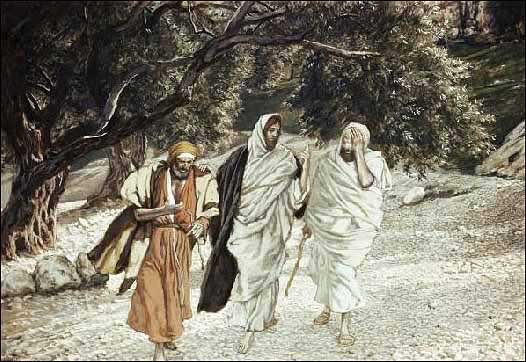
Road to Emmaus  by James J. Tissot

Road to Emmaus
by James J. Tissot

I shared a couple of weeks ago that I was working on this topic. I realized that I had gotten sucked into the trap of researching nuggets when in-fact the entirety of the Bible points to Jesus as the Messiah, the Christ, the Anointed One. So, this won’t be a singular post type of topic; rather, this is the central issue, the basis of our entire faith. I think the distraction was amplified by a desire to really make an impactful post in time for Easter, but thankfully, everything went wrong on many fronts. Thankfully? Yes. Sometimes things have to go wrong, for us to realize we’ve become too wrapped up in our own devices/plans/schemes/agendas. So, let’s get back to the basics of sharing Bible Studies as often as I can find the time, without worrying so much about “making something” of this blog. Forgive me for losing sight so quickly.

Confessions of the Christ

Our first stop will be the Gospel written by John. Please take a moment now to read John Chapter 1 in its entirety. Remember when we talked about the Sin of the Pharisee, we noted that John the Baptist knew what the Pharisees were getting at when they asked him who he was.

John 1:19-20 (ESV) 19 And this is the testimony of John, when the Jews sent priests and Levites from Jerusalem to ask him, “Who are you?” 20 He confessed, and did not deny, but confessed, “I am not the Christ.”

So without hesitation, he makes it clear to them that he is not the Christ. Now, when Jesus does step forward, John introduces Jesus to the people in a way that doesn’t fit with what they were looking for in the Christ:

John 1:29 (ESV) The next day he saw Jesus coming toward him, and said, “Behold, the Lamb of God, who takes away the sin of the world!…

At this time, sacrifices are a regular occurrence at the Temple. How did they miss this introduction as what is clearly a declaration of Jesus being the atoning sacrifice? They didn’t catch it, because they weren’t looking for it. Let us see what they were looking for:

John 1:30-34 (ESV) 30 This is he of whom I said, ‘After me comes a man who ranks before me, because he was before me.’ 31 I myself did not know him, but for this purpose I came baptizing with water, that he might be revealed to Israel.” 32 And John bore witness: “I saw the Spirit descend from heaven like a dove, and it remained on him. 33 I myself did not know him, but he who sent me to baptize with water said to me, ‘He on whom you see the Spirit descend and remain, this is he who baptizes with the Holy Spirit.’ 34 And I have seen and have borne witness that this is the Son of God.

Okay, so here we have a flat-out declaration of Jesus not only being named “The Christ” but now He is plainly declared to be the Son of God. Now, let’s look at the reactions of the early disciples to Him.

John 1:35-51 (ESV) 35 The next day again John was standing with two of his disciples, 36 and he looked at Jesus as he walked by and said, “Behold, the Lamb of God!” 37 The two disciples heard him say this, and they followed Jesus. 38 Jesus turned and saw them following and said to them, “What are you seeking?” And they said to him, “Rabbi” (which means Teacher), “where are you staying?” 39 He said to them, “Come and you will see.” So they came and saw where he was staying, and they stayed with him that day, for it was about the tenth hour. 40 One of the two who heard John speak and followed Jesus was Andrew, Simon Peter’s brother. 41 He first found his own brother Simon and said to him, “We have found the Messiah” (which means Christ). 42 He brought him to Jesus. Jesus looked at him and said, “You are Simon the son of John. You shall be called Cephas” (which means Peter).43 The next day Jesus decided to go to Galilee. He found Philip and said to him, “Follow me.” 44 Now Philip was from Bethsaida, the city of Andrew and Peter. 45 Philip found Nathanael and said to him, “We have found him of whom Moses in the Law and also the prophets wrote, Jesus of Nazareth, the son of Joseph.” 46 Nathanael said to him, “Can anything good come out of Nazareth?” Philip said to him, “Come and see.” 47 Jesus saw Nathanael coming toward him and said of him, “Behold, an Israelite indeed, in whom there is no deceit!” 48 Nathanael said to him, “How do you know me?” Jesus answered him, “Before Philip called you, when you were under the fig tree, I saw you.” 49 Nathanael answered him, “Rabbi, you are the Son of God! You are the King of Israel!” 50 Jesus answered him, “Because I said to you, ‘I saw you under the fig tree,’ do you believe? You will see greater things than these.” 51 And he said to him, “Truly, truly, I say to you, you will see heaven opened, and the angels of God ascending and descending on the Son of Man.”

Now, when these two disciples of John the Baptist hear Jesus identified as the “Lamb of God”, they understand that He is the One for whom John the Baptist was preparing them. So they follow Jesus. Here, we have the author explaining that the Hebrew word for “Messiah” is synonymous with the Greek word “Christ”. Neither word is actually translated into English, we’ve simply changed the way they are pronounced. They both translate to “Anointed”, and in the specific case of Jesus, “the Anointed One”. For those who might be new to the faith, or for those who simply have never asked, “Christ” isn’t part of Jesus name, it is a title. We notice also that Nathanael’s response to the news of Jesus was regarding Nazareth. Nazareth is never mentioned in the Law or the Prophets.  They were expecting the Messiah to come from the Bethlehem, the City of David (where Jesus was born). The Jewsish leaders of the day were looking for a descendant of David. Present-day Judaism still holds to these prophesies as indicators of the “end of days”, having missed their fulfillment in Jesus:

Jeremiah 23:5-6 (ESV)  5 “Behold, the days are coming, declares the Lord, when I will raise up for David a righteous Branch, and he shall reign as king and deal wisely, and shall execute justice and righteousness in the land. 6 In his days Judah will be saved, and Israel will dwell securely. And this is the name by which he will be called: ‘The Lord is our righteousness.’

Jeremiah 33:14-16 (ESV) 14 “Behold, the days are coming, declares the Lord, when I will fulfill the promise I made to the house of Israel and the house of Judah. 15 In those days and at that time I will cause a righteous Branch to spring up for David, and he shall execute justice and righteousness in the land. 16 In those days Judah will be saved, and Jerusalem will dwell securely. And this is the name by which it will be called: ‘The Lord is our righteousness.’ 17 “For thus says the Lord: David shall never lack a man to sit on the throne of the house of Israel, 18 and the Levitical priests shall never lack a man in my presence to offer burnt offerings, to burn grain offerings, and to make sacrifices forever.”

The prophet Isaiah also prophesied regarding Him in a similar phrasing (naturally, since these are the Words of God, not of men):

Isaiah 11:1-5 (ESV) 1 There shall come forth a shoot from the stump of Jesse, and a branch from his roots shall bear fruit.
2 And the Spirit of the Lord shall rest upon him,
the Spirit of wisdom and understanding,
the Spirit of counsel and might,
the Spirit of knowledge and the fear of the Lord.
3 And his delight shall be in the fear of the Lord.
He shall not judge by what his eyes see,
or decide disputes by what his ears hear,
4 but with righteousness he shall judge the poor,
and decide with equity for the meek of the earth;
and he shall strike the earth with the rod of his mouth,
and with the breath of his lips he shall kill the wicked.
5 Righteousness shall be the belt of his waist,
and faithfulness the belt of his loins.

So we see clearly between the confessions of John the Baptist, and the Prophecies of Jeremiah and Isaiah, that Jesus came as the atoning sacrifice, the Lamb of God, the Messiah, the Christ, the Branch of David, who will be called “the Lord is our Righteousness”… this is the Gospel of Jesus, the Christ, the Son of God. God’s Word is so awesome.

It was not only the Pharisees and the disciples of John the Baptist who were looking for the Christ. As we see in John 4, even the lowly Samaritans where aware of the prophesied Messaiah:

John 4:16-26 (ESV) 16 Jesus said to her, “Go, call your husband, and come here.” 17 The woman answered him, “I have no husband.” Jesus said to her, “You are right in saying, ‘I have no husband’; 18 for you have had five husbands, and the one you now have is not your husband. What you have said is true.” 19 The woman said to him, “Sir, I perceive that you are a prophet. 20 Our fathers worshiped on this mountain, but you say that in Jerusalem is the place where people ought to worship.” 21 Jesus said to her, “Woman, believe me, the hour is coming when neither on this mountain nor in Jerusalem will you worship the Father. 22 You worship what you do not know; we worship what we know, for salvation is from the Jews. 23 But the hour is coming, and is now here, when the true worshipers will worship the Father in spirit and truth, for the Father is seeking such people to worship him. 24 God is spirit, and those who worship him must worship in spirit and truth.” 25 The woman said to him, “I know that Messiah is coming (he who is called Christ). When he comes, he will tell us all things.” 26 Jesus said to her, “I who speak to you am he.”

So awesome. Jesus tells her at the Samaritans (corporate “you”) worship what they do not know. To demonstrate what she does know, she shows us that they, too, were waiting for the Messiah to tell them all things. Samaritans were outsiders. They were of mixed blood and mixed faith, but they looked for the Messiah to come. Praise the Lord God for His faithfulness.

Now then, that we have seen some of what it was the Jews and even the Samaritans were looking for, lets look at Peter’s confession of Jesus.

Matthew 16:13-20 (ESV) 13 Now when Jesus came into the district of Caesarea Philippi, he asked his disciples, “Who do people say that the Son of Man is?” 14 And they said, “Some say John the Baptist, others say Elijah, and others Jeremiah or one of the prophets.” 15 He said to them, “But who do you say that I am?” 16 Simon Peter replied, “You are the Christ, the Son of the living God.” 17 And Jesus answered him, “Blessed are you, Simon Bar-Jonah! For flesh and blood has not revealed this to you, but my Father who is in heaven. 18 And I tell you, you are Peter, and on this rock I will build my church, and the gates of hell shall not prevail against it. 19 I will give you the keys of the kingdom of heaven, and whatever you bind on earth shall be bound in heaven, and whatever you loose on earth shall be loosed in heaven.” 20 Then he strictly charged the disciples to tell no one that he was the Christ.

This confession is huge. One into which Peter would yet need to grow, but he does by the Grace of God. Notice, that this confession/revelation is not by flesh and blood, but given as a gift from God the Father who is in heaven. This statement bears a strong resemblance to what Paul wrote in Ephesians 2:8 (ESV) “For by grace you have been saved through faith. And this is not your own doing; it is the gift of God…”

Peter was not alone in having to grow into the understanding of just what it meant to confess Jesus as the Christ, Son of the Living God. Martha had a very hard time of it, too when her brother, Lazarus, died.

John 11:17-27 (ESV) 17 Now when Jesus came, he found that Lazarus had already been in the tomb four days. 18 Bethany was near Jerusalem, about two miles off, 19 and many of the Jews had come to Martha and Mary to console them concerning their brother. 20 So when Martha heard that Jesus was coming, she went and met him, but Mary remained seated in the house. 21 Martha said to Jesus, “Lord, if you had been here, my brother would not have died. 22 But even now I know that whatever you ask from God, God will give you.” 23 Jesus said to her, “Your brother will rise again.” 24 Martha said to him, “I know that he will rise again in the resurrection on the last day.” 25 Jesus said to her, “I am the resurrection and the life. Whoever believes in me, though he die, yet shall he live, 26 and everyone who lives and believes in me shall never die. Do you believe this?” 27 She said to him, “Yes, Lord; I believe that you are the Christ, the Son of God, who is coming into the world.”

It is on this note, that I’d like to pause for a moment. We all, must come to faith in Jesus as the Christ, Son of the Living God. The Lamb of God who laid down His life as the perfect atonement for the sin of mankind, for our sins included. This faith comes as a Gift from God, that we might die to sin ourselves, so that in Him we might have everlasting life.

Ephesians 4:1-16 (ESV) 1 I therefore, a prisoner for the Lord, urge you to walk in a manner worthy of the calling to which you have been called, 2 with all humility and gentleness, with patience, bearing with one another in love, 3 eager to maintain the unity of the Spirit in the bond of peace. 4 There is one body and one Spirit—just as you were called to the one hope that belongs to your call— 5 one Lord, one faith, one baptism, 6 one God and Father of all, who is over all and through all and in all. 7 But grace was given to each one of us according to the measure of Christ’s gift. 8 Therefore it says,

“When he ascended on high he led a host of captives,and he gave gifts to men.”[Ps 68:18]

9 (In saying, “He ascended,” what does it mean but that he had also descended into the lower regions, the earth? 10 He who descended is the one who also ascended far above all the heavens, that he might fill all things.) 11 And he gave the apostles, the prophets, the evangelists, the shepherds and teachers, 12 to equip the saints for the work of ministry, for building up the body of Christ, 13 until we all attain to the unity of the faith and of the knowledge of the Son of God, to mature manhood, to the measure of the stature of the fullness of Christ, 14 so that we may no longer be children, tossed to and fro by the waves and carried about by every wind of doctrine, by human cunning, by craftiness in deceitful schemes. 15 Rather, speaking the truth in love, we are to grow up in every way into him who is the head, into Christ, 16 from whom the whole body, joined and held together by every joint with which it is equipped, when each part is working properly, makes the body grow so that it builds itself up in love.

In Jesus, the Christ, the Son of the Living God, through the working of God the Holy Spirit, we are being woven together, fitted together, into one body. I thank God for each of you who do the hard work of discernment in all things, and in sharing the Gospel of Jesus Christ, the Lamb of God, who has is called “the Lord is our righteousness”. We who are in Christ long for the day of His return, to reign forever as King of kings and Lord of lords. Until that day, let do the work the Lord predestined for us to do in Him, so that when the Master returns, He will find His servants hard at work. Study the Scriptures, Preach the Word, and Love your neighbors as yourselves. Amen.

In Him,
Jorge